
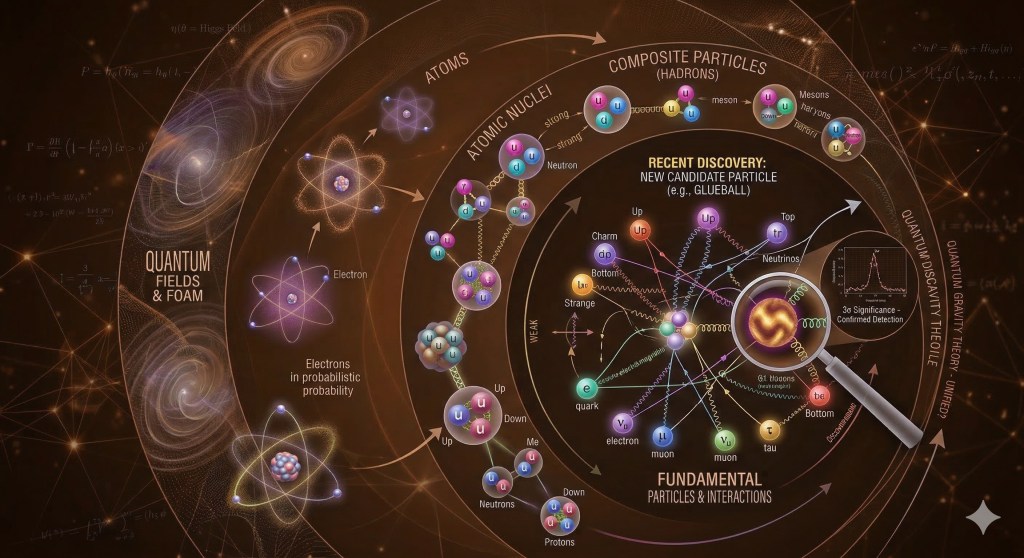
Presented by Claude for Zia H Shah MD
Abstract
Quantum mechanics is the most precisely confirmed theory in the history of science, and its technological progeny — transistors, lasers, MRI, GPS, electron microscopes, and the emerging error-corrected quantum computers of the mid-2020s — place the reality of quantum phenomena beyond dispute. Yet the very strangeness that makes quantum theory fertile also makes it an object of chronic abuse: “quantum” has become, in much popular and some theological writing, a synonym for “mysterious,” licensing inferences that the physics does not support. This essay proposes and defends a seven-part demarcation criterion for separating reasonable from unreasonable appeals to quantum mechanics in explaining macro-level reality, and then applies it domain by domain: photosynthesis and quantum biology, consciousness, free will, divine providence, and the afterlife. The central physical fact organizing the analysis is decoherence: the extraordinarily rapid destruction of macroscopic superpositions by environmental entanglement, which explains why the everyday world is overwhelmingly classical and which sets a high bar for any claim that quantum coherence “does work” at the scale of neurons, choices, or persons. A second organizing fact is interpretive underdetermination: because the leading interpretations of quantum mechanics are (mostly) empirically equivalent, any theological or philosophical thesis that presupposes one interpretation is hostage to a contested and possibly undecidable question. Applying these constraints, the essay grades the domains honestly. The radical-pair mechanism of avian magnetoreception and hydrogen tunneling in enzymes are genuinely quantum and empirically supported; the once-celebrated case of “coherent” photosynthetic energy transfer has been substantially revised and now stands as a cautionary tale of over-interpretation. Quantum theories of consciousness (Orch-OR, the Posner-molecule proposal) are speculative and face severe decoherence and empirical objections, and — crucially — even if true would not dissolve the hard problem. Libertarian free will is not established by quantum indeterminism, which faces the luck objection and the amplification problem; the strongest reconstruction of a libertarian position (Kane’s event-causal model, List’s emergentist “agential indeterminism”) does not actually require reading indeterminism off the wavefunction. Quantum Divine Action (Russell’s NIODA) is coherent but faces decisive technical and theological objections and is not needed by the classical theism of primary and secondary causation, nor — I argue — by the occasionalism of al-Ghazālī and the kalām tradition, which is a stronger thesis that quantum grounding would paradoxically weaken. Claims that quantum physics secures personal immortality (Tipler, Lanza, Hameroff) are near-universally rejected and commit a category error. Throughout, science–Qurʾān convergences are treated strictly as resonances and anticipations of temper, never as concordist proofs, following the methodological cautions of Nidhal Guessoum against iʿjāz ʿilmī literature and distancing the argument from the concordism of Bucaille, Naik, and Mirza Tahir Ahmad. The thesis is deflationary but not dismissive: quantum mechanics genuinely chastens naive determinism and naive realism, opening conceptual space for theology and metaphysics, but it establishes no theological conclusion. Its lesson for the believer is an epistemic humility that cuts equally against dogmatic materialism and dogmatic theological rationalism.
TL;DR
- The demarcation is set by decoherence and interpretive underdetermination. Quantum coherence is destroyed at the neural scale in roughly 10⁻¹³–10⁻²⁰ seconds against cognition’s 10⁻³ seconds, so the macro world of brains, choices, and persons is overwhelmingly classical; and because the interpretations of quantum mechanics are largely empirically equivalent, any doctrine that leans on one interpretation being true is built on ground a future physics could remove. A reasonable appeal to the quantum makes a differential prediction, survives decoherence, is interpretation-robust, and lets “quantum” do genuine mechanistic (not merely rhetorical) work.
- Graded honestly by domain: avian magnetoreception (radical pairs) and enzyme hydrogen-tunneling are well-supported; “coherent photosynthesis” was overstated and substantially revised (the long-lived oscillations are vibronic, ~tens of femtoseconds); quantum consciousness (Orch-OR, Posner molecules) and quantum-grounded libertarian free will are speculative-to-unwarranted; Quantum Divine Action is coherent but weak and unnecessary; and quantum “proofs” of the afterlife are category errors.
- The theological payoff is deflationary but constructive. Quantum mechanics is not a proof of God, the soul, free will, or the afterlife — it opens conceptual space rather than furnishing conclusions. The strongest forms of the questioner’s own frameworks (the occasionalist “Inshallah universe,” and libertarian agency) are in fact stronger without the quantum gap: the Qurʾānic God is the God of the whole (sunnat Allāh), not of the gaps, and human responsibility (kasb) and resurrection (the first-creation analogy) were secured centuries before Heisenberg.
Key Findings
- The technological base is undeniable and precisely quantified. QED predicts the electron g-factor to 13 significant digits; bound-state QED was tested to 0.56 parts-per-trillion in neon isotopes (2022) and in hydrogen-like tin (AlphaTrap, 2023). A 1987 Fermilab analysis estimated that roughly 23% of U.S. gross national product traced to technologies invented from atomic-scale physics; the widely repeated “30–35% of GDP” figure originated as a remark by former Lockheed Martin CEO Norman Augustine at Fermilab and should be cited with that provenance rather than as a hard datum. Google’s “Willow” (Nature 638:920–926, published online 9 December 2024) reported logical-error suppression by Λ = 2.14 ± 0.02 per two-unit increase in code distance, culminating in a 101-qubit distance-7 code at 0.143% ± 0.003% error per cycle, “beyond breakeven” by a factor of 2.4 ± 0.3.
- Decoherence is the crux. Tegmark’s estimate (Phys. Rev. E 61:4194, 2000) of neural decoherence at 10⁻¹³–10⁻²⁰ s makes the brain, for cognitive purposes, a classical machine. This is the sharpest blade of the demarcation.
- Interpretive underdetermination forbids theological over-leverage. Bell/Kochen–Specker/PBR revise classical metaphysics profoundly but select no unique interpretation; the no-signaling theorem specifically forbids the “everything is connected” misuse of entanglement.
- Quantum biology is genuinely quantum in its robust cases and cautionary in its famous one. Radical-pair magnetoreception (Xu et al., Nature 594:535–540, 2021) and enzyme H-tunneling (soybean lipoxygenase KIE = 81, Knapp–Rickert–Klinman, JACS 124:3865, 2002) pass the criterion; “coherent photosynthesis” failed it upon revision (Cao et al., Science Advances 6:eaaz4888, 2020).
- “Quantum” neither solves the hard problem nor secures free will. Swapping a deterministic for an indeterministic mystery leaves qualia unexplained; randomness is not authorship (the luck objection). The strongest defensible libertarianism (List’s emergentism) decouples freedom from the contested physics entirely.
- Neither Quantum Divine Action nor the occasionalist “Inshallah universe” needs the quantum gap — and grounding them there weakens rather than strengthens them.
- Quantum afterlife claims (Tipler, Lanza, Hameroff) are refuted or category-erroneous; the Qurʾānic doctrine rests on omnipotence and the first-creation analogy, needing no physics.
Details
I. The Undeniable Base: Why Quantum Mechanics Commands Assent
Any honest inquiry must begin by conceding the questioner’s premise in full. Quantum mechanics is not a speculative philosophy; it is the operating system of modern physical technology and the most stringently tested framework science possesses.
The empirical case rests first on precision. Quantum electrodynamics (QED) predicts the anomalous magnetic moment of the electron — the deviation of its g-factor from the Dirac value of 2 — and the most precise direct measurements of the electron g-factor reach 13 significant digits, in agreement with theory. Bound-state QED tests have advanced further: in 2022 a Max-Planck team measured the isotopic shift of the bound-electron g-factor in neon isotopes (²⁰Ne⁹⁺ and ²²Ne⁹⁺) to 0.56 parts-per-trillion, and in 2023 the AlphaTrap experiment tested QED in the extreme field of hydrogen-like tin. No theory in history has been confirmed to comparable precision.
The case rests second on technology. Quantum band theory underlies the transistor and the entire semiconductor industry; quantum tunneling is exploited directly in the scanning tunneling microscope, in flash memory, and in tunnel diodes; stimulated emission gives us the laser; nuclear magnetic resonance gives us MRI; the de Broglie wavelength of accelerated electrons makes electron microscopy possible; the quantized energy levels of atoms give us atomic clocks, without whose relativistic-and-quantum corrections the Global Positioning System would drift into uselessness within hours; superconductivity, LEDs, and photovoltaics are all irreducibly quantum. On the economic scale of this dependence, a 1987 Fermilab analysis estimated that roughly 23% of U.S. gross national product could be traced to technologies invented from atomic-scale physics (semiconductors, lasers, MRI, LEDs). The more dramatic and widely quoted “30–35% of GDP” figure appears to have originated as a remark by former Lockheed Martin CEO Norman Augustine in a speech at Fermilab; it is best cited with that provenance rather than as an audited statistic. Either way, the qualitative point is unassailable: a very large share of the modern economy is built on devices whose design requires quantum mechanics.
The case rests third, and most recently, on the maturing of quantum computation. In December 2024 Google’s Quantum AI reported its 105-qubit “Willow” processor (Google Quantum AI, “Quantum error correction below the surface code threshold,” Nature 638:920–926, published online 9 December 2024), demonstrating for the first time that a surface-code logical qubit could cross “below threshold”: “The logical error rate of our larger quantum memory is suppressed by a factor of Λ = 2.14 ± 0.02 when increasing the code distance by 2, culminating in a 101-qubit distance-7 code with 0.143% ± 0.003% error per cycle.” The paper further reported a “beyond breakeven” result in which the encoded qubit exceeded the lifetime of its best physical qubit by a factor of 2.4 ± 0.3, together with real-time decoding — an exponential error suppression that had been a goal since Peter Shor introduced quantum error correction in 1995. IBM and other groups have published multi-year roadmaps toward fault-tolerant machines. Whatever one’s philosophy, the engineering verdict is unambiguous.
This is the sense in which the questioner is exactly right: “when some reality is produced there is no denying it.” The rest of this essay is an argument about the limits of that undeniability — about how far the writ of the quantum runs into the macroscopic, the biological, the mental, and the theological.
II. Why the Macro World Is (Mostly) Classical: Decoherence
The single most important physical fact for demarcation is that quantum superpositions of macroscopically distinct states are destroyed almost instantaneously by interaction with the environment. This is decoherence, pioneered by H. Dieter Zeh (1970), developed by Erich Joos and Zeh (1985), and given its mature “einselection”/”pointer state” and “quantum Darwinism” formulations by Wojciech Zurek (whose 2003 Reviews of Modern Physics survey, “Decoherence, einselection, and the quantum origin of the classical,” is the standard reference).
The mechanism: a system in a superposition becomes entangled with its environment (photons, air molecules, phonons, water dipoles), which acts as a continuous “measurement.” Interference between the superposed branches becomes locally inaccessible essentially immediately, “selecting” a preferred basis of robust “pointer states” — typically the quasi-classical states of position — and explaining why cats, chairs, and neurons are found in definite configurations. Decoherence does not by itself solve the measurement problem (it does not explain why one outcome rather than another occurs), but it explains the appearance of classical definiteness, and it does so quantitatively.
The quantitative bite is decisive for the mind. Max Tegmark’s paper “Importance of quantum decoherence in brain processes” (Physical Review E 61:4194–4206, 2000; DOI 10.1103/PhysRevE.61.4194) estimated decoherence timescales for candidate neural quantum degrees of freedom — ion superpositions in neural firing and “kink-like” excitations in microtubules — at roughly 10⁻¹³ to 10⁻²⁰ seconds, against the 10⁻³ to 10⁻¹-second timescales of actual neural dynamics. If correct, this places a gulf of ten to seventeen orders of magnitude between the lifetime of any brain superposition and the timescale on which cognition operates: the brain, for cognitive purposes, is a classical machine.
Fairness requires reporting the rebuttal. Scott Hagan, Stuart Hameroff, and Jack Tuszyński, “Quantum computation in brain microtubules: Decoherence and biological feasibility” (Phys. Rev. E 65:061901, 2002), argued that Tegmark had modeled a straw-man geometry and that, with shielding, counterion screening, and coherence-pumping, microtubule decoherence times might reach 10⁻⁵–10⁻⁴ s — still far short of the 10⁻³ s needed, though closer. More recent experimental work keeps the question alive: the Wiest laboratory reported (2024) that microtubule-stabilizing drugs delay the onset of general anesthesia in rats, interpreted as weak evidence for a microtubule role in consciousness; and several groups (e.g., Babcock et al., 2024) report anomalous room-temperature effects in microtubules. These results are intriguing but do not demonstrate functionally relevant coherence, and the mainstream assessment remains that decoherence makes large-scale neural quantum computation implausible. The lesson for demarcation: any claim that quantum coherence does macro-level work must survive a decoherence estimate at the relevant scale and temperature. This is the first and sharpest blade of our criterion.
III. The Interpretive Underdetermination
The second organizing fact is that quantum mechanics, as an uninterpreted formalism, is spectacularly successful, but what it says about reality remains contested among mutually incompatible interpretations that are — to an excellent approximation — empirically equivalent.
The menu is well known. The Copenhagen family (Bohr, Heisenberg) treats the wavefunction as a tool for predicting outcomes and takes collapse as primitive or as a feature of the classical/quantum cut. The von Neumann–Wigner variant flirts with the idea that consciousness causes collapse — a view Wigner later abandoned and which almost no physicist now holds. Everett/Many-Worlds denies collapse: the universal wavefunction always evolves unitarily, and all outcomes are realized in branching worlds. The de Broglie–Bohm pilot-wave theory is deterministic, restoring definite particle trajectories, at the cost of explicit nonlocality. The GRW/CSL family (Ghirardi–Rimini–Weber; Continuous Spontaneous Localization) modifies the Schrödinger equation itself so that collapse is a real, stochastic, mass-dependent physical process — and one now heavily constrained: experiments from gravitational-wave detectors (LISA Pathfinder) to underground germanium detectors have excluded large swaths of the CSL parameter space, though not all of it. QBism (Fuchs, Mermin) reads the state as an agent’s subjective beliefs; relational QM (Rovelli) relativizes states to systems; superdeterminism (a small minority: ‘t Hooft, Hossenfelder) denies measurement independence.
Three technical results discipline the space, and it is essential to state precisely what they do and do not establish. Bell’s theorem (1964), tested in loophole-free experiments in 2015 and honored by the 2022 Nobel Prize to Alain Aspect, John Clauser, and Anton Zeilinger, shows that no theory that is both local and grounded in predetermined local “hidden variables” (local realism) can reproduce quantum correlations. It does not show that “everything is connected” in any usable sense: the no-signaling theorem proves that entanglement cannot transmit information faster than light. The Kochen–Specker theorem establishes contextuality. The PBR theorem (Pusey, Barrett, Rudolph, 2012) argues that the quantum state is ontic rather than merely epistemic. Leggett–Garg inequalities test “macrorealism” across time. Together these refute naive local realism and naive value-definiteness — a genuine and profound revision of classical metaphysics — but they do not select a unique interpretation, and they do not license mystical holism.
The corollary is the second blade of our criterion: a claim is epistemically risky in proportion to its dependence on a contested interpretation being true. A thesis that God acts through quantum indeterminacy presupposes ontic indeterminism (roughly Copenhagen or GRW) and simply fails if Bohm or Everett is correct. To build a doctrine on interpretation is to build on ground that a future physics — or a future philosophical consensus — might remove.
IV. Domain by Domain
IV.1 Photosynthesis and Quantum Biology: the Strongest Case, with a Twist
Photosynthesis. The excitement began with Gregory Engel et al. (2007, Nature), reporting long-lived oscillatory signals (“quantum beats”) in two-dimensional electronic spectra of the Fenna–Matthews–Olson (FMO) complex, and a 2010 follow-up (Panitchayangkoon et al., PNAS 107:12766) reporting such signals persisting for hundreds of femtoseconds at physiological temperature. This was widely popularized as evidence that photosynthesis achieves near-perfect efficiency by exploiting long-lived electronic quantum coherence.
The field has since substantially revised that interpretation. A large multi-group review — Cao, Cogdell, Coker, Duan, Hauer and fourteen further authors, “Quantum biology revisited,” Science Advances 6:eaaz4888 (2020) — concluded, from eighteen leading researchers across sixteen institutions, that “interexciton coherences are too short lived to have any functional significance in photosynthetic energy transfer” and that “the observed long-lived coherences originate from impulsively excited vibrations.” The emerging consensus (building on Duan et al., PNAS 2017; Thyrhaug et al.; and Tomáš Mančal’s 2020 review, “A decade with quantum coherence”) is that purely electronic coherence at physiological temperature lives only on the order of tens of femtoseconds, not the picoseconds required to steer energy transfer, and that the long-lived oscillations are largely vibrational or vibronic in origin. What survives as genuine: vibronic coupling can tune energy transfer, and environment-assisted quantum transport (ENAQT) — the counterintuitive result that moderate environmental noise helps excitonic transport — is real and theoretically robust. But the headline claim of functional long-lived electronic coherence has not held up. Photosynthesis is thus the field’s great cautionary tale: a genuinely quantum system whose popular framing outran the evidence, exactly as our criterion warns.
Avian magnetoreception (the radical-pair mechanism). This is the strongest live candidate for functionally relevant quantum spin dynamics in biology. The hypothesis, developed by Klaus Schulten and matured by Peter Hore and Henrik Mouritsen (Annual Review of Biophysics 45:299, 2016), holds that blue light triggers electron transfer in retinal cryptochrome, creating a spin-correlated radical pair whose singlet–triplet interconversion is sensitive to the geomagnetic field. The decisive advance was Jingjing Xu et al., “Magnetic sensitivity of cryptochrome 4 from a migratory songbird,” Nature 594:535–540 (2021), which showed in vitro that “the photochemistry of cryptochrome 4 (CRY4) from the night-migratory European robin (Erithacus rubecula) is magnetically sensitive in vitro, and more so than CRY4 from two non-migratory bird species, chicken (Gallus gallus) and pigeon (Columba livia),” with site-specific mutations revealing “four successive flavin–tryptophan radical pairs.” Work in 2023–2024 extended the picture (radical-pair effects in Drosophila; treatments invoking the quantum Zeno effect). This case scores well: it makes differential predictions (isotope effects, radiofrequency disruption, species comparisons), the relevant spin coherences survive on biologically plausible timescales (microseconds), and “quantum” does genuine explanatory work. Confidence: high, though the in-vivo signaling chain is not yet closed.
Enzyme catalysis and hydrogen tunneling. It is well established — through large and temperature-dependent kinetic isotope effects — that hydrogen/proton tunneling is real and functionally significant in many enzyme-catalyzed C–H and H-transfer reactions, and that protein “promoting” motions modulate the donor–acceptor distance to enable it. The foundational demonstration was Cha, Murray, and Klinman, “Hydrogen tunneling in enzyme reactions,” Science 243:1325 (1989); the framework matured in Klinman and Kohen, Annual Review of Biochemistry 82:471 (2013), and in Nigel Scrutton’s work (Hay and Scrutton, “Good vibrations in enzyme-catalysed reactions,” Nature Chemistry 4:161, 2012). Soybean lipoxygenase-1 shows an exceptionally large kinetic isotope effect: KIE = 81 near room temperature with a very weak temperature dependence (Knapp, Rickert & Klinman, J. Am. Chem. Soc. 124:3865, 2002), which the authors call “consistent with H· transfer that occurs entirely by a tunneling event.” Confidence: tunneling is established; sustained quantum coherence beyond incoherent, environmentally coupled tunneling is not.
DNA proton tunneling and mutation. Per-Olov Löwdin proposed in 1963 (“Proton tunneling in DNA and its biological implications,” Reviews of Modern Physics 35:724) that proton transfer within hydrogen-bonded base pairs could produce rare tautomers and hence spontaneous point mutations. The idea has been revived computationally by the Surrey group: Slocombe, Sacchi, and Al-Khalili, “An open quantum systems approach to proton tunnelling in DNA,” Communications Physics 5:109 (2022; DOI 10.1038/s42005-022-00881-8), report that tunneling makes the tautomeric occupation probability of the guanine–cytosine pair about 1.73 × 10⁻⁴, several orders of magnitude larger than classical estimates, “suggesting that such proton transfer may well play a far more important role in DNA mutation than has hitherto been suggested” (with a follow-up in Communications Chemistry 5:144, 2022). This is a computational prediction; the authors note that experimental tautomerization rates for G–C are not yet available. Confidence: respectable and suggestive, but unconfirmed experimentally.
Olfaction (the vibrational theory). Luca Turin’s proposal that smell receptors detect molecular vibrations by inelastic electron tunneling (Chemical Senses 21:773, 1996) is a clear example of a quantum-biological claim that the receptor-level evidence weighs against. Eric Block and colleagues, “Implausibility of the vibrational theory of olfaction,” PNAS 112:E2766 (2015; DOI 10.1073/pnas.1503054112), tested cloned human and mouse olfactory receptors against normal and deuterated musk isotopomers and found no difference in receptor response, attributing earlier positive human results to impurities or perireceptor effects. Turin et al. replied; Block et al. rebutted. The shape/docking model remains dominant. Confidence: largely discredited at the receptor level.
Jim Al-Khalili and Johnjoe McFadden’s Life on the Edge (2014) is the best popular synthesis of the field, but its optimistic framing (like the early photosynthesis coverage) sometimes ran ahead of what has survived scrutiny. Overall grade for quantum biology: a real and exciting field with one or two robust cases, several respectable-but-open ones, and at least one cautionary retraction — precisely the differentiated verdict our criterion is designed to yield.
IV.2 Consciousness
Orchestrated Objective Reduction (Orch-OR). Roger Penrose (The Emperor’s New Mind, 1989; Shadows of the Mind, 1994) and Stuart Hameroff propose that consciousness arises from quantum computations in neuronal microtubules, terminated by an “objective reduction” — a gravitationally induced, non-computable collapse occurring when a superposition’s mass-energy reaches a threshold related to gravitational self-energy by E ≈ ħ/t. Penrose’s motivation is partly Gödelian: he argues from the incompleteness theorems that human mathematical insight cannot be captured by any algorithm.
The critiques are serious and, in my assessment, collectively decisive against the theory as it stands. The Gödelian argument has been widely rejected — Hilary Putnam, Solomon Feferman, David Chalmers, and the detailed critique by LaForte, Hayes, and Ford (1998) all argue that Penrose conflates the consistency we cannot prove of ourselves with the soundness he assumes. Tegmark’s decoherence estimate (Section II) attacks the substrate directly. Reimers et al. (2009) argued the specific “Fröhlich condensate” coherence Hameroff invoked is physically implausible. Moreover, the objective-collapse physics on which OR depends is now experimentally constrained: a 2022 Gran Sasso experiment (Donadi, Curceanu, et al.) searching for the spontaneous radiation predicted by the simplest Diósi–Penrose gravitational-collapse model found none, rendering that simplest version “highly implausible” (more complex variants Penrose is developing survive). Orch-OR is a bold, admirably precise, but poorly supported theory.
Other quantum-mind proposals. Henry Stapp invokes the quantum Zeno effect and von Neumann–Wigner collapse; the Beck–Eccles proposal locates quantum effects in synaptic exocytosis. Matthew Fisher’s proposal (2015) is the most concrete and testable: phosphorus-31 nuclear spins in “Posner molecules” (Ca₉(PO₄)₆) could serve as long-lived neural qubits because nuclear spins decohere slowly. This is a genuinely serious hypothesis — but tests since 2018 (e.g., by the Hore group on Posner spin dynamics) have questioned key requirements such as long-lived entanglement, and several results are negative. It remains open but unconfirmed.
The mainstream alternatives. Against all of these stand well-developed neuroscientific theories that invoke no quantum resources: the Global Neuronal Workspace (Baars, Dehaene, Changeux); Integrated Information Theory (Tononi); Higher-Order Theories; and predictive processing (Friston, Andy Clark, Anil Seth). The COGITATE adversarial collaboration, pitting Global Workspace against IIT, published in Nature in 2025, returned equivocal results — corroborating IIT’s claim that posterior cortex suffices for conscious content while failing to confirm global broadcasting as necessary. Meanwhile, Fleming et al., “The Integrated Information Theory of Consciousness as Pseudoscience” (PsyArXiv, posted 15 September 2023), signed by 124 researchers (signatories including Daniel Dennett, Patricia Churchland, Joseph LeDoux, and Bernard Baars), provoked a fierce controversy; Chalmers likened the letter to “dropping a nuclear bomb over a regional dispute,” and Anil Seth argued the “pseudoscience” label was itself a category error. The relevance is twofold: mainstream consciousness science is contested and immature, so the failure of quantum theories does not settle the matter; and none of the leading theories needs quantum mechanics.
Why quantum does not dissolve the hard problem. Even granting that consciousness correlated with quantum collapse or coherence, we would have explained no phenomenal fact: we would have swapped a deterministic mystery (why does this neural process feel like something?) for an indeterministic one (why does this quantum process feel like something?). Two mysteries do not make a solution. This is why the most serious non-reductive alternatives — Thomas Nagel’s Mind and Cosmos (2012), and the revival of neutral monism and panpsychism (Galen Strawson, Philip Goff, the Russellian monist tradition) — do not invoke quantum mechanics at all; they locate the problem in the categorical nature of the physical, not its dynamics. The mystery of consciousness is not a quantum mystery, and dressing it in quantum language tends to obscure rather than illuminate it. Grade: quantum consciousness is speculative, with the strongest single proposal (Fisher’s) still unconfirmed and the most famous (Orch-OR) facing decisive objections.
IV.3 Free Will
The questioner is a committed libertarian, drafting a defense against Robert Sapolsky’s Determined (2023) and Daniel Dennett. The most useful thing this essay can do is build the strongest libertarian position — which means first stating the hardest objection without flinching.
The luck/dilemma objection. The classical dilemma (a form of Hume’s fork, sharpened by van Inwagen’s Consequence Argument and rollback argument, and by Alfred Mele’s luck objection): if my choice is determined, it is not free in the libertarian sense; but if it is undetermined — a fortiori if it turns on a quantum random event — then it is not mine in the relevant sense; it is chance or luck. Randomness is not freedom; a decision made by a synaptic dice-roll is no more authored by me than one dictated by prior causes. This is the crux, and it is why appealing to quantum indeterminacy does not by itself secure free will. Van Inwagen, himself a libertarian, calls free will a “mystery” precisely because of it.
The historical appeals. The questioner’s existing work on Eddington is well placed. Following the 1927 recognition that quantum mechanics is indeterministic, Eddington (The Nature of the Physical World, 1928) and Arthur Compton (1931 Terry Lectures) both suggested that quantum indeterminacy had reopened the physical possibility of free will that Laplacean determinism had seemed to foreclose. This is a genuine and important shift, but it establishes only the possibility of undetermined events, not that such events constitute freedom.
The amplification problem. Even granting ontic indeterminism, the libertarian must show that microscopic indeterminacy is amplified to the level of neurons and behavior rather than washed out by decoherence and averaging. Mark Balaguer, Free Will as an Open Scientific Problem (2009), frames this precisely: whether the relevant neural events are quantum-indeterministic in the right way is an open empirical question.
The strongest reconstructions. Three moves rescue a defensible libertarianism. First, Robert Kane’s event-causal libertarianism (The Significance of Free Will, 1996) locates indeterminism in “self-forming actions” during torn decisions, where competing motivational networks are “stirred toward chaos,” amplifying quantum indeterminacy to the neural level; because the agent wills both options and is satisfied by whichever “wins,” Kane argues the outcome is not mere luck but genuine self-formation. Critics (Mele, Vargas, and Dennett’s needle-quivering objection) press that the specific outcome remains arbitrary and the empirical commitments (neural indeterminacy plus chaotic amplification) are demanding and unverified. Second, agent-causal libertarianism (Chisholm, Timothy O’Connor, Randolph Clarke) posits an irreducible causal power of the agent-as-substance. Third — the resource the questioner most needs — Christian List’s Why Free Will Is Real (2019) argues that free will is a higher-level phenomenon: because agential states are multiply realizable over physical states, there can be genuine agential indeterminism (open alternative possibilities at the psychological level) even if the underlying physics is deterministic. List’s “compatibilist libertarianism” secures alternative possibilities without reading indeterminism off the wavefunction, immunizing the view against both determinism and the physical-level luck objection. (Critics such as Caruso press whether the luck problem reappears at the higher level; the debate is live.)
The neuroscience is not the threat it seemed. Benjamin Libet (1983) and Soon et al. (2008) were long read as showing the brain “decides” before we are conscious of deciding. But Aaron Schurger, Jacobo Sitt, and Stanislas Dehaene, “An accumulator model for spontaneous neural activity prior to self-initiated movement,” PNAS 109 (2012), reinterpreted the “readiness potential” as a leaky stochastic accumulator crossing a threshold driven by ongoing neural noise — not the trace of a prior unconscious decision. Follow-up work (2016–2024) has largely deflated the Libet-style anti-free-will argument. This does not prove free will, but removes what was taken to be its strongest empirical refutation.
Sapolsky and Dennett. Sapolsky’s Determined argues “turtles all the way down.” The leading critical reviews — John Martin Fischer in Notre Dame Philosophical Reviews, Kevin Mitchell, and Kieran Setiya in The Atlantic — converge on the charge that Sapolsky treats a philosophical question as purely scientific, uses “free will” vaguely (ignoring the alternative-possibilities vs. actual-sequence distinction), and does not engage the compatibilist literature that dominates the field. Dennett’s compatibilism (Elbow Room, 1984; Freedom Evolves, 2003; the Dennett–Caruso exchange Just Deserts, 2021) argues that the freedom “worth wanting” is a real, evolved capacity for rational self-control. The sociological datum: in the 2020 PhilPapers survey (Bourget & Chalmers, N = 1758), compatibilism drew 59.16%, libertarianism 18.83%, and no free will 11.21%. The libertarian is a respectable minority, not a fringe.
The Islamic backdrop. The tradition worked through this problem centuries before Hume and without quantum mechanics. The early Qadariyya affirmed human power over acts; the Jabriyya affirmed compulsion; the Muʿtazila held that humans create (khalq) their acts, protecting divine justice. Al-Ashʿarī forged kasb (acquisition, iktisāb): God creates the act, but the human “acquires” it and thereby bears responsibility — often read as compatibilist-adjacent. Al-Māturīdī granted a real (if created) capacity of choice. Ibn Rushd, in al-Kashf ʿan manāhij al-adilla, sought a middle way. The Qurʾān holds divine decree (qadar: Q 54:49, 25:2, 87:2–3) and human responsibility (Q 18:29, “whoever wills, let him believe, and whoever wills, let him disbelieve”; 76:3, 76:29–30; 41:40; 13:11, “God does not change a people’s condition until they change what is in themselves”; 91:7–10; 2:286; 6:104; 39:41; 10:99) in productive tension. The tradition reached a compatibilist-adjacent settlement (kasb) without quantum indeterminism — strongly suggesting that grounding human responsibility in quantum gaps is neither necessary nor traditionally warranted. The questioner’s libertarianism is best defended not by quantum indeterminacy (which faces the luck objection) but by a List-style emergentist argument coupled to the Qurʾānic anthropology of taklīf — a position that neither over-leverages nor depends on contested physics.
IV.4 Divine Action and Providence
The Divine Action Project (DAP). Between 1988 and 2003 the Vatican Observatory and the Center for Theology and the Natural Sciences produced five major volumes (edited by Robert John Russell, Nancey Murphy, Arthur Peacocke, William Stoeger) on “non-interventionist” divine action. The animating problem: how can God act specifically without violating the laws of nature?
Quantum Divine Action (QDA / NIODA). Russell’s Non-Interventionist Objective Divine Action holds that God acts by determining the outcomes of otherwise objectively-indeterminate quantum events. Because (on an indeterminist reading) the laws only fix probabilities, God’s determining a particular outcome “violates” no law — God acts “with the grain of nature.” Thomas Tracy and Nancey Murphy developed related versions; George Ellis linked it to top-down causation; Peacocke and Polkinghorne preferred “whole–part” and top-down approaches, with Polkinghorne favoring chaos theory and “active information” over quantum indeterminacy.
The critiques, which are formidable. Nicholas Saunders, Divine Action and Modern Science (Cambridge, 2002) and “Does God Cheat at Dice?” (Zygon 35, 2000), concluded that existing QDA theories face severe technical problems. Three objections are telling. (1) The amplification/scale problem: single quantum events are minuscule; Saunders notes that steering a single asteroid would require God to begin manipulating events long before the relevant era — cumbersome for an omnipotent agent who designed the laws. (2) The interpretation-dependence problem: QDA presupposes ontic indeterminism and collapses under Bohmian or Everettian readings (our second blade). (3) The Born-rule problem: even indeterministic QM specifies objective probabilities, so a God who systematically biased outcomes would in principle leave a statistical fingerprint. Recent scholarship (Qureshi-Hurst and Bennett, Zygon 56:75, 2021) adds that NIODA’s implications for theodicy — God’s implication in harmful mutations — remain unresolved. William Wildman’s 2004 DAP assessment was candid about these difficulties, and the “God of the gaps” worry looms.
The classical alternative: primary and secondary causation. Against QDA stands the Thomistic framework, revived by William Carroll and Ignacio Silva. On Aquinas’s view, God is the primary cause who acts through the full integrity of created secondary causes; divine concurrence and double agency mean the same event is wholly caused by God (as primary cause) and wholly by the creature (as secondary cause), at different levels. God does not need a quantum “gap,” because God is not one cause among others competing for causal room but the transcendent ground of the entire causal order. The Thomist regards QDA as a category mistake — treating God as a secondary cause looking for a vacancy.
Al-Ghazālī, occasionalism, and the “Inshallah universe.” Al-Ghazālī’s famous 17th Discussion of the Tahāfut al-Falāsifa denies that the connection between “cause” and “effect” is necessary: when fire touches cotton, it is God who creates the burning, following a habit (ʿāda). The Ashʿarite metaphysics is an atomism (al-jawhar al-fard, the indivisible atom; aʿrāḍ, accidents) with continuous re-creation of the world at each instant. Ibn Rushd replied in the Tahāfut al-Tahāfut that to deny causal natures is to deny knowledge (“using causality to deny causality”). Modern scholarship complicates the picture: Frank Griffel (Al-Ghazālī’s Philosophical Theology, 2009) and Michael Marmura disagree over how thoroughgoing al-Ghazālī’s occasionalism was, with Griffel, Perler, and Rudolph arguing he left room for a divinely created disposition in things rather than pure occasionalism. Malebranche developed a parallel occasionalism; Hume secularized the critique of necessary connection.
Now the pointed argument, offered respectfully. Occasionalism does not need quantum indeterminacy — and grounding it there may quietly betray it. Occasionalism is a stronger thesis than QDA: created things have no genuine causal power anywhere, so God is the immediate cause of every event, classical and quantum alike. QDA is the weaker claim that God acts specifically in the indeterministic gaps while classical regions run under their own created causal power. To locate divine action specifically in quantum indeterminacy is therefore to concede that the classical regions are causally autonomous — exactly what the occasionalist denies. The “Inshallah universe,” rigorously construed, already has its answer: every event, the fall of every leaf (cf. Q 6:59), is directly sustained by God as sunnat Allāh — the regular “custom of God” we misread as autonomous natural law. On this view quantum indeterminacy is neither necessary nor privileged. The strongest form of the questioner’s own framework thus dispenses with the quantum gap altogether, and is the better for it: it is interpretation-robust (surviving Bohm and Everett equally), it is not a god-of-the-gaps (no future physics can close a gap it never relied on), and it is faithful to the Qurʾānic language of continuous divine sustaining (Q 35:41, God holds the heavens and earth “lest they cease”; 2:255, the Throne Verse; 55:29, “every day He is upon some task”; 13:8; 3:189–191). This is close to Basil Altaie, whose Daqīq al-Kalām project and God, Nature and the Cause (2016) and Islam and Natural Philosophy (2023) relate kalām’s continuous re-creation and indeterminacy principles to modern physics — and who treats kalām’s re-creation as the deeper principle, with quantum indeterminacy as its resonance rather than its foundation. Grade: QDA is coherent but weak and unnecessary; the occasionalist “Inshallah universe” is stronger precisely when it does not lean on the quantum gap.
IV.5 The Afterlife
Tipler’s Omega Point. Frank Tipler’s The Physics of Immortality (1994) argued that a closed, recollapsing universe would, near its final singularity, permit infinite information processing to resurrect everyone. The theory is near-universally rejected, and its central physical premise is empirically refuted: it requires a closed, recollapsing universe, whereas the 1998 discovery of accelerating expansion (dark energy) indicates an open cosmos. The scaffolding collapsed with the premise.
Lanza’s biocentrism and “quantum immortality.” Robert Lanza’s Biocentrism (2009) claims consciousness constructs reality and that death is an illusion because consciousness persists across many-worlds branches. This trades on the “quantum suicide/immortality” thought experiment — which physicists overwhelmingly regard as a reductio of a literal many-worlds reading, not a result establishing survival. Biocentrism is rooted in “quantum mysticism” and offers no testable predictions.
Hameroff’s “soul as quantum information.” The circulated claim that at death the quantum information in microtubules “returns to the universe at large” as a soul inherits all of Orch-OR’s decoherence problems and adds a category error.
The black-hole information paradox misuse. Some argue from unitarity and the “no-hiding” theorem — quantum information is never destroyed — to the survival of the “information” constituting a person. This is a category error: conservation of quantum information (if it holds; the paradox is unresolved) concerns the global recoverability-in-principle of quantum states, not their remaining organized as a person, any more than the conservation of a burned book’s atoms means the book still exists. Personal identity is a matter of organization, continuity, and (on most religious views) divine re-creation, not the bare conservation of degrees of freedom.
The legitimate work. There is serious, non-quantum work on resurrection: Peter van Inwagen, Trenton Merricks, Kevin Corcoran, Lynne Rudder Baker’s constitution view, and Hud Hudson, alongside the Christian-materialism-versus-dualism debate. The Islamic tradition is rich: al-Ghazālī insisted on bodily resurrection in the 20th Discussion of the Tahāfut; Ibn Sīnā argued for the survival of the rational soul; the mutakallimūn discussed the ʿajb al-dhanab and the intermediate state of barzakh. And the Qurʾān’s argument for resurrection is from divine power and the analogy of the first creation, not from physics: “Does man think We cannot assemble his bones? Indeed, We are able to proportion his very fingertips” (Q 75:3–4); “He who gave them life the first time will give them life again” (Q 36:78–79); and Q 17:49–51; 56:60–62; 50:15; 22:5; 46:33; 86:5–8; 23:12–16; 79:10–11; 32:10–11. The doctrine rests on omnipotence and the first-creation analogy, and needs no quantum mechanics; to ground an eternal doctrine in contingent, revisable physics is to make the eternal hostage to the temporary — and, as Tipler’s refutation shows, the hostage can be lost. Grade: quantum afterlife claims are unwarranted and often category-erroneous.
V. Beyond the Categories: What Quantum Mechanics Does and Does Not Give Metaphysics and Theology
What it genuinely contributes. First, it refutes Laplacean determinism as a necessary reading of physics (though not as an impossible one, given Bohm/Everett). Second, it refutes naive local realism (Bell) and naive value-definiteness (Kochen–Specker), forcing a revision of classical substance metaphysics and of naive scientific realism. Third, it motivates ontic structural realism (Ladyman and Ross, Every Thing Must Go, 2007) and quantum holism / non-separability (Teller, Healey). Fourth, it revives a broadly Aristotelian category: Heisenberg (Physics and Philosophy) connected the quantum state to Aristotle’s dunamis (potentia), and contemporary work by Ruth Kastner (the transactional/possibilist interpretation), Robert Koons, and Stanley Grove reads quantum indeterminacy through hylomorphic potency/actuality. Fifth, quantum-gravity cosmology (Hartle–Hawking’s no-boundary proposal, Vilenkin’s tunneling-from-nothing) bears on the fine-tuning argument and its multiverse response — with its Bayesian critiques and the “Boltzmann brain” problem, and Quentin Smith’s deployment of quantum indeterminism against the cosmological argument’s causal principle, drawing Craig-style responses (relevant to the questioner’s separate Q 52:35–36 project).
The epistemological humility argument. There is a genuine, even edifying lesson: if the deep structure of the physical world is this counterintuitive — non-separable, contextual, indeterministic-or-branching — then a priori confidence that reality must conform to common sense is misplaced. This cuts both ways, and that symmetry is the heart of a pluralist, non-polemical stance: it chastens the dogmatic materialist who insists reality must be local, deterministic, and picturable; and it chastens the dogmatic theological rationalist who insists the divine order must be transparent to human logic. Bernard d’Espagnat’s “veiled reality,” the Pauli–Jung conjecture, John Archibald Wheeler’s “it from bit” and “participatory universe,” and Anton Zeilinger’s information-theoretic reading all express this humility in different registers.
What it cannot do. But here the demarcation must be firm, and it is the essay’s governing thesis: quantum mechanics is not a proof of God, not a proof of the soul, not a proof of free will, and not a proof of the afterlife. It opens conceptual space — removing the Laplacean bulldozer that seemed to flatten all such possibilities — but establishes no positive theological conclusion. The underdetermination argument (Section III) guarantees this: any theology a given interpretation supports, a rival interpretation undercuts. Niels Bohr himself resisted mystical extrapolations of complementarity; Sean Carroll and Sabine Hossenfelder are today’s most vigorous critics of quantum-consciousness and quantum-mysticism claims, and on the specific point that “quantum” cannot bear theological weight they are largely right. Erwin Schrödinger’s Vedantic leanings (What Is Life?, Mind and Matter), Eddington’s idealist “mind-stuff” (The Nature of the Physical World), and James Jeans’s aphorism that “the universe begins to look more like a great thought than like a great machine” are suggestive — but they are the personal metaphysics of physicists, not deliverances of the physics, and should be presented as such.
VI. The Demarcation Criterion, Stated
An appeal to quantum mechanics in explaining macro-level reality is reasonable to the degree that it passes these seven tests, and slides toward “quantum woo” to the degree it fails.
- Differential prediction. Does the proposal predict something different from the non-quantum alternative? (Radical-pair magnetoreception: yes. “Quantum healing”: no.)
- Decoherence survival. Does the proposed coherence survive a decoherence estimate at the relevant scale and temperature? (Nuclear spins in Posner molecules: arguably. Electronic superpositions in warm neurons: no.)
- Interpretation-robustness. Does the claim hold across interpretations, or require a contested one? (Occasionalist sustaining: robust. QDA: fragile.)
- Explanatory work. Is “quantum” doing genuine mechanistic work, or is it a synonym for “mysterious”? (Enzyme tunneling: work. “Quantum consciousness” as a mood: none.)
- No equivocation (amphiboly). Does the argument trade on the everyday connotations of technical terms — “observer,” “measurement,” “information,” “non-locality,” “entanglement,” “uncertainty” — rather than their precise meanings? (The “observer effect” misread as requiring a conscious mind, when a photon or Geiger counter “observes”; “non-locality” misread as “everything is connected,” when no-signaling forbids transmission; “uncertainty” misread as epistemic ignorance, when it is an ontic feature of conjugate observables; “superposition” misused as a metaphor for human indecision.)
- No scale error. Does the argument illicitly extrapolate from Hilbert-space structure to lived macroscopic experience?
- No god-of-the-gaps. Would the theological claim collapse if physics later closed the gap? If so, the theology was mislocated.
Applied to the notorious cases: Deepak Chopra’s “quantum healing,” the What the Bleep Do We Know!? phenomenon, and the “consciousness creates reality” reading of the observer effect fail tests 1, 4, and 5 outright. The Fritjof Capra (The Tao of Physics, 1975) and Gary Zukav (The Dancing Wu Li Masters, 1979) tradition — criticized incisively by Victor Stenger — is more sophisticated but fails test 5 (equivocation on holism/non-locality) and test 6 (scale error), even where its irenic spirit is admirable. These must be distinguished carefully from serious work (radical pairs, enzyme tunneling, Fisher’s testable proposal, Russell’s internally coherent if ultimately weak QDA), which passes several tests and fails honestly on others.
Summary Table: Grading the Applications
| Application | Grade | Governing reason |
|---|---|---|
| Semiconductors, lasers, MRI, GPS, QED precision, error-corrected qubits | Established | The technological base; not in question |
| Radical-pair avian magnetoreception (cryptochrome) | Well-supported | Differential predictions; coherence survives; quantum does the work |
| Enzyme H-tunneling (Klinman, Scrutton) | Well-supported (tunneling); coherence beyond that unproven | KIE = 81 in soybean lipoxygenase; no established sustained coherence |
| DNA proton tunneling → mutation (Löwdin; Slocombe et al.) | Speculative but respectable | Strong computation; awaits experiment |
| “Coherent” photosynthetic energy transfer (long-lived electronic) | Substantially revised / overstated | Coherences are vibronic and ~tens of fs; Cao et al. 2020 |
| Vibrational theory of olfaction (Turin) | Largely discredited | Block et al. 2015 receptor tests negative |
| Orch-OR consciousness (Penrose–Hameroff) | Speculative; facing decisive objections | Decoherence; Gödel-argument rebuttals; Gran Sasso null |
| Posner-molecule quantum cognition (Fisher) | Speculative but testable; several tests negative | Concrete, but key requirements unconfirmed |
| Quantum → libertarian free will (direct) | Unwarranted as stated | Luck objection; amplification problem |
| Emergentist agential free will (List) / Kane reconstruction | Defensible; does not require reading indeterminism off QM | Decouples freedom from contested physics |
| Quantum Divine Action / NIODA (Russell) | Coherent but weak and unnecessary | Amplification, interpretation-dependence, Born-rule, gaps |
| Occasionalist “Inshallah universe” (al-Ghazālī / Altaie) | Stronger without the quantum gap | Interpretation-robust; not god-of-the-gaps; Qurʾānic sustaining |
| Quantum afterlife (Tipler, Lanza, Hameroff) | Unwarranted / category error | Refuted premises; information ≠ personal identity |
| QM as epistemic humility / anti-Laplacean space | Reasonable and valuable | Genuinely chastens naive determinism and naive realism |
| QM as proof of God / soul / free will | Unwarranted | Underdetermination forbids it |
VII. The Islamic Intellectual Tradition as a Resource (and a Discipline)
The classical Islamic intellectual tradition is not a naive precursor waiting to be validated by physics, but a disciplining resource that, at several points, already contains the more robust position. The kalām atomists — Abū al-Hudhayl, al-Bāqillānī, al-Juwaynī — developed a physics of discrete atoms and discontinuous time (the “atom of time”), and it is tempting, but must be resisted as concordism, to read this as an “anticipation” of quantized spacetime in loop quantum gravity. The correct register is resonance: a structural rhyme that testifies to the seriousness of kalām natural philosophy, not a proof. Fakhr al-Dīn al-Rāzī entertained multiple worlds; Ibn Sīnā’s necessary/contingent distinction remains a live metaphysical resource; Muhammad Iqbal’s The Reconstruction of Religious Thought in Islam (1930) engaged Einstein, the new physics, Zeno’s paradoxes, and the nature of time and the ego (khudī) in ways strikingly relevant here — especially his treatment of the self as a genuine, undetermined center of agency, an Islamic resource for the free-will project that owes nothing to quantum indeterminacy. Seyyed Hossein Nasr’s scientia sacra and Osman Bakar critique the reduction of nature to the merely quantitative; Nidhal Guessoum’s Islam’s Quantum Question (2011) is the indispensable contemporary treatment and — importantly for the questioner’s stated method — is largely a refutation of iʿjāz ʿilmī (“scientific miracle”) literature, targeting Zaghloul El-Naggar and Harun Yahya, and by extension the concordism of Bucaille and Naik; Ziauddin Sardar critiques the very idea of an “Islamic science”; Mehdi Golshani and Muzaffar Iqbal work the same terrain; and Basil Altaie’s Daqīq al-Kalām framework offers the most developed contemporary bridge between kalām’s re-creation metaphysics and quantum cosmology — a bridge strongest when it treats quantum theory as resonance rather than foundation. Named philosopher-scientists the questioner engages — John Polkinghorne, Paul Davies, Nagel, Chalmers, Penrose, Wigner — recur throughout; to them this essay has added the disciplining voices of Bohr (against mystical extrapolation), d’Espagnat, Pauli, Zeilinger, Wheeler, Dyson, Schrödinger, Eddington, Jeans, and, on the skeptical side, Carroll and Hossenfelder.
Recommendations
Staged, concrete next steps for the essay and its programme:
- Adopt the seven-test demarcation criterion (Section VI) as the essay’s spine, and print the grading table. It is the deliverable most useful to readers and the surest guard against the concordism the questioner explicitly disavows. Benchmark that would change this: if a future experiment demonstrated functionally relevant, decoherence-surviving coherence at the neural scale (e.g., a positive, replicated Posner-molecule entanglement result in vivo), test 2 would need re-weighting for consciousness.
- Re-frame the “Inshallah universe” so that it does NOT depend on the quantum gap. This is the single most important philosophical recommendation. Ground divine action in sunnat Allāh and continuous re-creation (Altaie’s kalām re-creation as the deeper principle), presenting quantum indeterminacy only as a resonance. This makes the position interpretation-robust and immune to the god-of-the-gaps objection. Benchmark: if one committed to NIODA specifically, one must then answer Saunders’s amplification, Born-rule, and interpretation-dependence objections head-on — a heavier burden.
- Defend libertarian free will via List’s emergentism + Iqbal’s khudī + the Qurʾānic taklīf, not via quantum indeterminacy directly. Concede the luck objection openly, then show it is best answered at the agential level. Use the Schurger 2012 reinterpretation to neutralize the Libet argument, and the Fischer/Setiya/Mitchell reviews to answer Sapolsky. Benchmark: if List’s higher-level indeterminism is shown to reduce to physical indeterminism (a live critique), fall back to Kane’s event-causal model and defend the amplification premise empirically.
- Treat quantum biology as the essay’s showcase of intellectual honesty: lead with the revision of the photosynthesis story, not its 2007 hype, and grade magnetoreception and enzyme tunneling as the robust cases. This models the very demarcation the essay preaches.
- On the afterlife and consciousness, argue the deflationary thesis positively: the doctrines stand better on classical theological grounds (omnipotence, first-creation analogy, bodily resurrection in al-Ghazālī) than on quantum speculation, which makes the eternal hostage to revisable physics.
- Retain the required template — the Abstract (above) and Thematic Epilogue (below) — and keep the register pluralist and interfaith-friendly by presenting the Christian DAP and the Islamic kalām traditions as parallel responses to a shared problem.
Caveats
- Provenance of the “GDP” figure. The oft-quoted “30–35% of GDP depends on quantum technology” is not an audited statistic; it traces to a remark attributed to Norman Augustine and to a 1987 Fermilab estimate of ~23% of GNP. Cite it as an order-of-magnitude claim with named provenance, not as hard data.
- Live and evolving science. The consciousness field is in flux: the COGITATE (2025) results were equivocal, and the IIT “pseudoscience” controversy is unresolved — so the failure of quantum theories of consciousness does not vindicate any particular alternative. Microtubule and Posner-molecule research is ongoing; some 2024 results are suggestive but none demonstrates functional coherence. CSL/objective-collapse parameter space is being progressively but not completely excluded.
- Forward-looking technology claims. Quantum-computing roadmaps (IBM’s toward fault tolerance) are projections, not accomplished facts; only the Willow below-threshold demonstration is a completed, peer-reviewed 2024 result.
- Interpretive humility. Because interpretations are largely empirically equivalent, several claims in this essay (e.g., that indeterminism is “real”) are themselves interpretation-relative; they are stated conditionally by design.
- Computational vs. experimental. The DNA proton-tunneling result (Slocombe et al.) is a modeling prediction whose biological significance is explicitly presented by its authors as suggestive pending experiment.
- Contested Ghazālian scholarship. Whether al-Ghazālī was a thoroughgoing occasionalist is genuinely disputed (Griffel/Marmura); the essay’s argument about occasionalism and the quantum gap holds on either reading but should acknowledge the disagreement.
- Some primary sources reached via secondary channels. A few citations (e.g., the Gran Sasso Diósi–Penrose null result, Reimers et al. on the Fröhlich condensate, the 2015 Block–Turin PNAS exchange) were confirmed through review and secondary literature rather than the original articles directly; the DOIs and journal details given are reliable but should be verified against the primary text before formal publication.
Thematic Epilogue: The Two Temptations and the Middle Path
The questioner’s instinct is exactly right on both ends. Quantum mechanics has “produced reality” — undeniably, in the transistor beneath these words and the atomic clock overhead — and it has dissolved the Laplacean certainty that once seemed to leave no room for God, freedom, or the soul. That is the first truth, and it must not be surrendered out of a fastidious fear of “quantum woo.”
But there is a second truth, and it disciplines the first. The macroscopic world is classical not by accident but by the deep physics of decoherence; the quantum realm’s strangeness is screened from the world of choices and persons by ten to twenty orders of magnitude of environmental entanglement. And where the quantum does surface in biology — in the compass of a migrating robin, in the tunneling proton of an enzyme — it does so as mechanism, not as metaphor, and it is identified by differential prediction, not by the frisson of the word “quantum.”
Between the two temptations — the reductionist’s, to say that because the brain is physical the mind and its freedom are illusions; and the mystic’s, to say that because the quantum is strange it must be the hiding-place of consciousness, freedom, God, and the soul — lies a middle path more demanding than either. It asks the believer to hold that the deepest religious realities do not need a quantum gap to be true. The Qurʾān’s God is not the God of the gaps but the God of the whole: the One who is “with you wherever you are” (Q 57:4), whose custom (sunnat Allāh) is the regularity we call natural law, and whose sustaining hand upholds the heavens “lest they cease” (Q 35:41) — in the deterministic orbit no less than the indeterminate decay. The resurrection is promised on the strength of the One who “proportions the very fingertips” (Q 75:4), not on the strength of a closed universe or a conserved bitstream. And human responsibility — the taklīf on which the whole moral drama of revelation depends — was secured by al-Ashʿarī’s kasb and Ibn Rushd’s middle way centuries before Heisenberg, and is best secured today not by a random synaptic dice-throw (which would make us lucky, not free) but by the genuine, emergent, undetermined agency of the self that Iqbal called khudī and List calls agential indeterminism.
The strangeness of the quantum world is a gift to theology precisely and only in this: it demolishes the pretension that reality must be transparent to common sense, and thereby humbles the dogmatist of every stripe — the materialist who was too sure the world was a machine, and the rationalist who was too sure the divine was a syllogism. It opens the space. It does not furnish the room. To mistake the opening of space for the furnishing of it — to read a proof of God, or the soul, or freedom, or heaven, off the wavefunction — is to make the eternal hostage to the contingent, and to trade the God of the whole for the God of the gaps. The wiser course, and the one this essay commends, is to receive the quantum world with the same two words the tradition has always offered before a reality larger than our categories: Allāhu aʿlam — God knows best.
Read in PDF file:



Leave a Reply