
Presented by Zia H Shah MD
Audio teaser: The Divine Physics of Coast Redwoods
Abstract
This comprehensive report examines the physiological and engineering marvels of the Coast Redwood (Sequoia sempervirens), specifically focusing on the biological mechanisms that allow these titans to transport water to heights exceeding 380 feet (115 meters). Standing as the tallest biological entities on Earth, redwoods like Hyperion utilize a sophisticated passive hydraulic system governed by the Cohesion-Tension Theory, a process that defies gravity without metabolic energy expenditure. This report contrasts these natural systems with the immense complexity, energy requirements, and maintenance intensity of human-made vertical hydraulic systems designed for similar heights. Furthermore, it integrates these scientific findings into a theological exegesis of Quranic verses 26:7-9 from Surah Ash-Shu’ara. Utilizing the natural theology framework presented by Zia H. Shah MD, the analysis argues that the “noble kinds” of the botanical kingdom serve as evidentiary signs (ayat) of a Creator who is both Al-Aziz (The Almighty) and Al-Rahim (The Most Merciful). By synthesizing botanical physics, mechanical engineering, and Islamic metaphysics, the report demonstrates how the vertical ascent of water in redwoods acts as a living eulogy for a Divine Designer, bridging the gap between observable natural phenomena and spiritual realization.
The Botanical Giants of the Pacific Coast
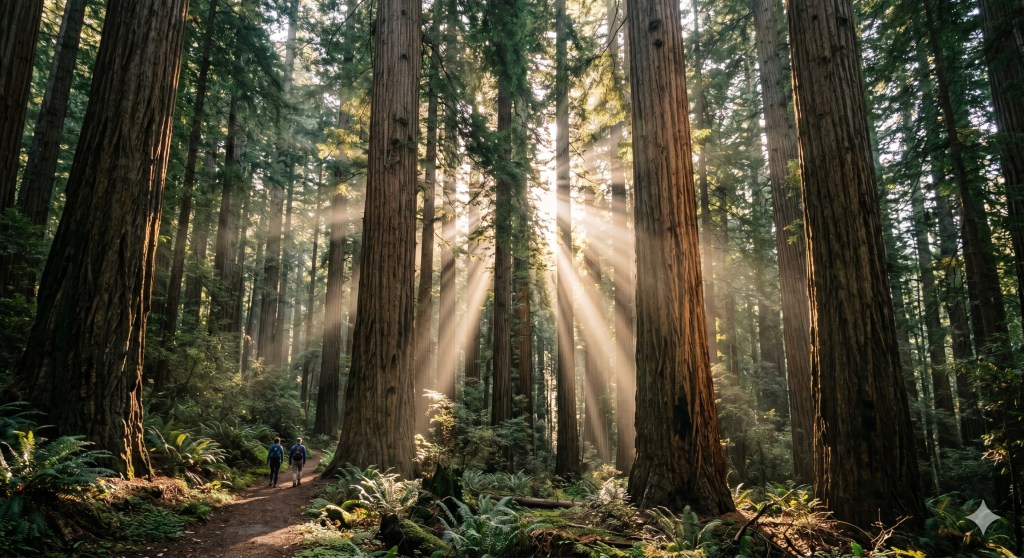
The Coast Redwood (Sequoia sempervirens) represents the apex of terrestrial plant growth. Found in a narrow, fog-shrouded strip along the Pacific coast from Southern Oregon to Central California, these trees are not merely plants but ancient ecological monuments. Among them, the specimen known as Hyperion holds the current world record for height, standing at 380.8 feet (116.07 meters). To put this in perspective, this height surpasses the Statue of Liberty and rivals many modern skyscrapers. Other notable giants include Raven’s Tower, a Sitka spruce, and the massive Giant Sequoias (Sequoiadendron giganteum), which, while shorter, possess greater total volume.
The survival of such massive organisms hinges on their ability to solve a fundamental physical problem: the transport of water and dissolved minerals from deep underground to leaves located hundreds of feet above the soil. A single mature redwood can move several tons of water—hundreds of gallons—each day. This feat is achieved through a “breathtaking symphony of physics and biology” that operates without a heart, a pump, or any mechanical engine.
Comparative Metrics of the Tallest Tree Species
| Species Common Name | Scientific Name | Maximum Recorded Height (ft) | Primary Water Source | |
| Coast Redwood | Sequoia sempervirens | 380.8 (Hyperion) | Groundwater + Fog | |
| Sitka Spruce | Picea sitchensis | 317.0 (Raven’s Tower) | Rainfall + Groundwater | |
| Giant Sequoia | Sequoiadendron giganteum | 311.0 | Groundwater + Snowmelt | |
| Douglas Fir | Pseudotsuga menziesii | 300.0+ | Rainfall + Groundwater |
The physiological constraints on these trees are immense. As height increases, so does the gravitational pull on the water column and the hydraulic resistance within the transport tissue. The limit of tree height—theoretically estimated at approximately 426 feet (130 meters)—is determined by the point at which water tension becomes so great that it induces widespread cavitation, or air blockages, which the tree cannot survive.
The Physics of Ascent: Cohesion-Tension Theory
The mechanism by which water ascends to the top of a 380-foot redwood is governed by the Cohesion-Tension Theory. This theory posits that water is not “pushed” from the bottom by the roots but is “pulled” from the top by the leaves. This process leverages the unique molecular properties of water, turning trillions of individual molecules into a continuous, rope-like column that spans the entire height of the tree.
The Driving Force: Transpirational Pull
The “engine” for this transport system is located in the leaves. On the surface of redwood needles are microscopic pores called stomata. These pores open to allow the intake of carbon dioxide ($CO_2$) for photosynthesis. However, as $CO_2$ enters, water vapor inevitably escapes—a process called transpiration.
As water molecules evaporate from the surfaces of cells inside the leaf, they are drawn out of the cell wall’s tiny pores. This creates highly curved air-water interfaces known as menisci. Due to the surface tension of water, these curved interfaces generate a massive negative pressure, or tension, within the leaf’s xylem. This tension creates a water potential gradient that is significantly lower than that of the roots, pulling water upward through the tree.
The Water Rope: Cohesion and Adhesion
Water is capable of sustaining this intense tension because of two fundamental properties related to its molecular polarity:
- Cohesion: Water molecules “stick” to each other with incredible strength due to hydrogen bonding. This turns the water column into a continuous “rope”.
- Adhesion: Water molecules also “stick” to the cellulose walls of the xylem conduits, helping to support the weight of the water column against gravity and preventing it from slipping back down.
The strength of these hydrogen bonds allows water in the xylem to withstand tensions as high as -2.0 to -3.0 megapascals (MPa) in tall trees. For context, to lift water 115 meters against gravity, the tree must overcome a gravitational potential of roughly 1.1 MPa, in addition to the friction of the narrow tubes.
Xylem Architecture and Safety
The transport happens through the xylem, which in redwoods consists primarily of tracheids—elongated, spindle-shaped cells that are dead at maturity, leaving behind hollow, straw-like conduits. These tracheids are interconnected by bordered pits, which are specialized valves containing a porous membrane.
The greatest risk to this system is cavitation—the formation of an air bubble (embolism) that breaks the continuous water rope. When tension becomes too high, air can be sucked in through the pits. Redwoods manage this through:
- Redundancy: Having thousands of tracheids in parallel so that if one fails, others can bypass the blockage.
- Compartmentalization: The surface tension of the water within the pits prevents an air bubble from spreading from one failed tracheid to its neighbors.
- Vertical Scaling: As height increases, the tracheids in redwoods become narrower and more resistant to cavitation, though this increases hydraulic resistance and eventually caps the tree’s maximum height.
Thermodynamics of Water Potential
The movement of water is described by the water potential equation:
$$\Psi_w = \Psi_s + \Psi_p + \Psi_g + \Psi_m$$
Where:
- $\Psi_w$ is the total water potential.
- $\Psi_s$ is the solute potential (osmotic effects).
- $\Psi_p$ is the pressure potential (tension or turgor).
- $\Psi_g$ is the gravitational potential ($0.01 \text{ MPa per meter of height}$).
- $\Psi_m$ is the matric potential (adhesion to cell walls).
In a 380-foot (115m) redwood, $\Psi_g$ is approximately $1.15 \text{ MPa}$. To ensure upward flow, the leaf water potential ($\Psi_{leaf}$) must be significantly more negative than the root water potential ($\Psi_{root}$) to account for both gravity and the frictional resistance of the narrow tracheid “straws”.
The Human Hydraulic Challenge: 115-Meter Vertical Lift
To appreciate the “miracle” of the redwood’s passive ascent, one must contrast it with the energy and complexity required for a human-made hydraulic system to achieve a similar 115-meter (380-foot) lift. While the redwood uses free solar energy and simple physics, human engineering requires massive mechanical input and constant maintenance.
Pressure Requirements and Energy Consumption
In engineering, lifting water 115 meters requires a minimum static pressure of 165 pounds per square inch (psi) just to hold the column in place. To actually move the water at a functional flow rate, the starting pressure must be significantly higher—often 200 to 250 psi—to overcome the “friction head” generated by the pipe walls.
| Feature | Human Pumping System (115m Lift) | Coast Redwood (115m Lift) | |
| Primary Force | Positive Pressure (Push) | Negative Pressure (Pull) | |
| Energy Input | Electricity/Fuel (High cost) | Solar/Transpirational (Zero cost) | |
| Pressure Method | Multistage Centrifugal Impellers | Molecular Hydrogen Bonding | |
| Complexity | VFDs, Sensors, PLC Controllers | Hormonal and Stomatal Regulation | |
| Maintenance | Seals, Bearings, Lubrication, Overhauls | Self-Repairing / Compartmentalization |
A human-made system for this height typically uses a vertical multistage centrifugal pump. These systems are notoriously complex, requiring:
- Variable Frequency Drives (VFDs): To match the pump speed to varying loads and maximize efficiency, which is often as low as 40-70% in real-world applications.
- Material Science: Impellers and casings must be made of high-grade, corrosion-resistant materials to withstand the stresses and vibrations of high-pressure operation.
- Acoustic and Structural Stress: High-pressure pumps generate significant noise and vibration, requiring robust foundations and vibration isolators.
Maintenance Intensity
Human pumps are subject to “wear and tear” that a tree avoids. Maintenance for a 115-meter pump system includes:
- Daily Checks: Monitoring for oil/water leaks and abnormal noises or vibrations.
- Weekly Tasks: Checking bolt tightness and lubrication quality.
- Monthly/Annual Servicing: Replacing mechanical seals, bearings, and cleaning impellers of deposits. If an “air lock” (the equivalent of a tree’s embolism) occurs in a human system, the pump may lose its prime and fail completely, potentially leading to motor burnout if not immediately addressed.
Quranic Exegesis: The Signs in the Soil
The Quran frequently directs humanity to observe the natural world as a primary source of knowledge and faith. In Surah Ash-Shu’ara (The Poets), revealed during the middle Makkan period, the Prophet Muhammad (pbuh) was facing rejection and demands for “compelling signs” or supernatural miracles from the sky.
The Text and Translation (Quran 26:7-9)
In response to the skeptics, the Quran shifts the focus from the heavens to the earth:
Arabic Text:
أَوَلَمْ يَرَوْا إِلَى الْأَرْضِ كَمْ أَنبَتْنَا فِيهَا مِن كُلِّ زَوْجٍ كَرِيمٍ (٧)
إِنَّ فِي ذَٰلِكَ لَآيَةً ۖ وَمَا كَانَ أَكْثَرُهُم مُّؤْمِنِينَ (٨)
وَإِنَّ رَبَّكَ لَهُوَ الْعَزِيزُ الرَّحِيمُ (٩)
English Translation (MAS Abdel Haleem): 26:7 Do they not see the earth, and what noble kinds of thing We grow in it? 26:8 Surely in this is a sign. Yet most of them would not believe. 26:9 And your Lord is certainly the Almighty, Most Merciful.
Contextual Significance: Nature as a Clear Book
The preceding verses (26:4) mention that if God willed, He could send a sign from the heavens that would leave people’s “necks bent in utter submission”. However, the Quranic philosophy, as elaborated by Zia H. Shah MD, emphasizes that faith should be an act of free choice based on reflection, not a result of coercion.
Verse 26:7 invites an empirical turn, asking humanity to “observe the earth”. This shift from the spectacular (signs from the sky) to the observable (botanical diversity) is a hallmark of Quranic epistemology. The redwood’s 380-foot vertical ascent is a perfect manifestation of this “sign.” It is a feat that occurs silently and constantly, yet it requires a level of engineering that rivals our most complex machinery.
The “Noble Kinds” (Zawjin Kareem)
The term zawjin kareem is translated as “noble kind” or “fine types”.
- Biological Nuance: Zia H. Shah MD points out that the word zawj (pair/kind) resonates with the sexual reproduction of plants, where “pairs” are essential for the production of seeds and the continuation of the species.
- Taxonomic Diversity: With over 390,900 vascular plant species known to science, the “noble kinds” produced from the earth represent an almost infinite variety of forms and survival strategies.
- The Redwood as “Kareem”: The Coast Redwood is “noble” not just for its height, but for its longevity (up to 2,000 years) and its generous role in its ecosystem, providing habitat and moisture for countless other species.
The redwood is a “sign” (verse 26:8) because its hydraulic success is built into the very laws of the universe—the polar properties of water and the strength of cellulose. It suggests that the world was designed with the intention that life could reach such staggering scales.
Zia H. Shah MD: God the Creator of the Quran and Islam
Zia H. Shah MD, through his work on “The Quran Love,” provides a robust framework of natural theology that bridges 21st-century science with Islamic thought. His insights embellish the commentary on these verses by highlighting the intentionality behind the complexity of nature.
Natural Theology for the Modern Age
Shah argues that nature is a “living scripture” that runs parallel to the written Quran. Drawing on William Paley’s 1802 “Watchmaker” analogy—where the complexity of a watch implies a watchmaker—Shah updates this logic for modern biology.
- Guided Evolution: Shah proposes that evolution is the method by which the Creator unfolds life’s tapestry. The redwood’s transport system is not a lucky accident but a result of natural laws that were “divinely guided” to produce such magnificent complexity.
- Quantum Providence: Shah suggests that the Divine may guide processes like genetic mutations or cellular development at the quantum level, where uncertainty allows for “Providence” to shape outcomes without overriding the scientific laws of nature.
The Attribute of Al-Aziz (The Almighty)
The conclusion of the botanical sign in verse 26:9 names God as Al-Aziz.
- Defying Resistance: Al-Aziz denotes power and invincibility. In the redwood, this is seen in the tree’s ability to defy the relentless pull of gravity—the most pervasive force in the cosmos.
- Structural Might: To support a 380-foot column of water, the tree must possess a structural strength that remains functional for centuries. This “might” is not loud or violent like a human engine; it is the quiet, irresistible power of physical laws working as intended.
The Attribute of Al-Rahim (The Most Merciful)
Verse 26:9 also names God as Al-Rahim.
- Sustenance through Fog: The mercy of Al-Rahim is evident in the specific adaptations that allow redwoods to survive dry summers. Redwoods thrive in coastal fog, and research shows they can absorb fog water directly through their leaves—foliar water uptake—providing a “merciful” bypass for their hydraulic system when the soil is dry.
- Regulatory Mercy: The tree’s ability to communicate between roots and leaves via hormones (Abscisic Acid) to close stomata and prevent dehydration is a system designed for the “mercy” of preservation.
Synthesis: The Living Eulogy of the Universe
Zia H. Shah MD notes that the universe and all its contents engage in tasbīḥ (glorification) of Allah. For the Coast Redwood, its tasbīḥ is the silent, constant lifting of water to the heavens.
The Sign of the Water Cycle
The redwood is a key player in the water cycle, a process the Quran describes as a scientific marvel and spiritual signifier.
- Evapotranspiration: By lifting tons of water from the soil and releasing it as vapor, redwoods contribute to the moisture in the atmosphere, fueling further rainfall and fog.
- The Balance: The Quran (24:43) describes God driving and gathering clouds. The redwoods participate in this cycle, acting as massive “biological pumps” that maintain the ecological health of the Pacific coast.
The Problem of Human Heedlessness
Despite the “noble kinds” being everywhere, verse 26:8 notes that “most of them would not believe”. Shah relates this to the “problem of human heedlessness”—the tendency to take the profound for granted. We walk through forests without realizing we are in the presence of a 380-foot vertical hydraulic miracle that makes our best engineering look primitive and inefficient.
Conclusion: The Redwood as a Multi-Scalar Sign
The study of Sequoia sempervirens provides a unique intersection between physics, engineering, and theology.
- Passive Perfection: The tree utilizes the molecular properties of water—cohesion and adhesion—to achieve a vertical lift that human systems can only replicate with high-energy mechanical force.
- Complexity without Effort: The redwood represents a “noble kind” that is self-sustaining, self-repairing, and integrated into its environment, reflecting a Creator who is Al-Aziz (mighty in design) and Al-Rahim (merciful in sustenance).
- Intellectual Foundation: As Zia H. Shah MD emphasizes, the diversity of the plant kingdom and the specific mechanics of water transport are “signs” intended for the “attentive mind”.
The redwood is not a random result of blind chance; it is a calculated manifestation of the laws of the universe, designed to reach the heavens and sustain life. It stands as one of the “thousands of examples” that the Quran invites us to ponder as proof of a Living, Creating God.
Thematic Epilogue: The Wisdom of the Ascent
The Coast Redwood does not struggle to reach its height; it grows in accordance with its nature (fitra), utilizing the sun and the properties of water to touch the clouds. In doing so, it serves as a metaphor for the human spiritual journey. Just as the redwood requires the “mercy” of the fog and the “might” of its xylem to survive, the human soul requires the “signs” of the Quran and the natural world to transcend its earthly limitations.
The miracle of the redwood is not just that it is tall, but that it reaches such heights through a process of “utter submission” to the physical laws of its Creator. It does not need a “spectacular sign from the heaven” to prove its purpose; its very existence—the way it sips the earth and breathes the sky—is the sign. For those who reflect, the 380-foot climb of a water molecule is a silent, towering sermon, echoing the conclusion of the Poets: “And your Lord is certainly the Almighty, Most Merciful.”





Leave a comment