

Author: Dr. Zia H. Shah, MD — Chief Editor, The Muslim Times — for thequran.love, with help of Claude
Abstract
This study offers a comprehensive, verse-by-verse and cumulative scholarly commentary on the final movement of Sūrat al-Raḥmān (Q 55:46–78), the passage of the “two pairs of gardens” reserved for the God-fearing, punctuated by the surah’s signature refrain fa-bi-ayyi ālāʾi rabbikumā tukadhdhibān (“Then which of the favors of your Lord will you both deny?”). For each verse-cluster the Arabic text, transliteration, and six named English renderings are provided — Sahih International, Yusuf Ali, Pickthall, Muhammad Asad, Maududi, and Maulana Muhammad Ali of Lahore. The classical exegesis of al-Ṭabarī, al-Zamakhsharī, Fakhr al-Dīn al-Rāzī, al-Qurṭubī, and Ibn Kathīr is marshaled throughout. Special emphasis falls on Q 55:52, fīhimā min kulli fākihatin zawjān (“In both of them are of every fruit, two kinds / in pairs”), where the classical reading of zawjān anchors a theological thesis developed here: that Paradise is genuinely physical, yet need not occupy the familiar three spatial and one temporal dimensions of our present life. This thesis is supported by (a) the Qurʾānic teaching of Q 32:17 that “no soul knows what comfort of the eyes has been kept hidden” and its associated hadith qudsi; (b) the analogy of the fetus who cannot comprehend the world into which it will be born; and (c) modern physics’ serious entertainment of extra spatial dimensions (Kaluza–Klein theory, string/M-theory, braneworld cosmology). Three governing frameworks from the author’s corpus on thequran.love are integrated: the Quranic paradise and the extra dimensions of the universe, paradise as “not far,” and paradise as vast as the expanding universe. The essay maintains an explicit scholarly distinction between mainstream Sunni tafsīr and the Lahore Ahmadiyya reading of Maulana Muhammad Ali, and closes with a thematic epilogue on the physicality of Paradise, its extra-dimensional character, the limits of human comprehension, and the primacy of the Qurʾān.
I. Introduction: Sūrat al-Raḥmān and Its Architecture
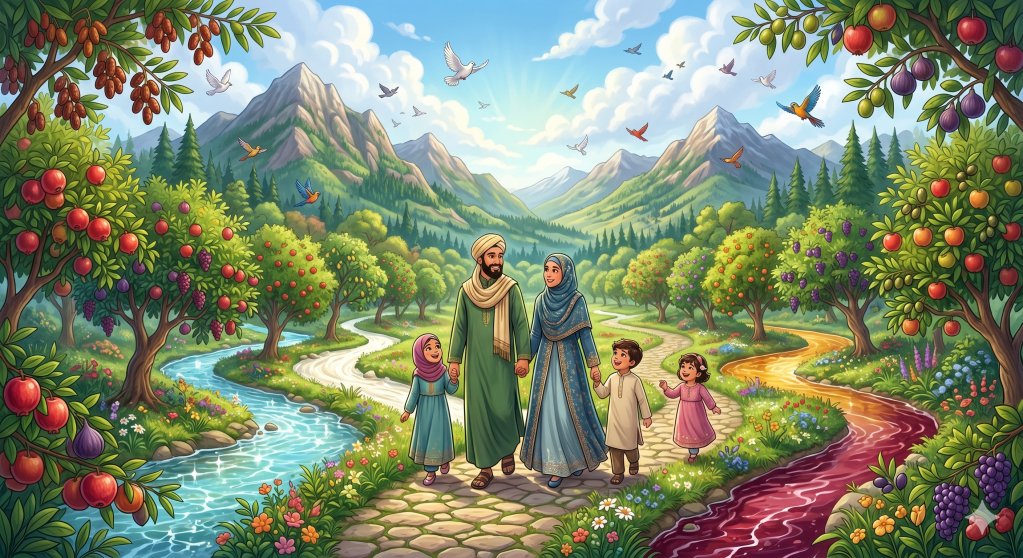
Sūrat al-Raḥmān is the 55th chapter of the Qurʾān, comprising 78 verses. It takes its name from its opening word — al-Raḥmān, “The Most Gracious / The Most Merciful / The Beneficent” — one of the most exalted Divine Names, here standing alone as a complete first verse. The chapter belongs, in the reckoning of Maulana Muhammad Ali and the majority of classical authorities (Ibn ʿAbbās, ʿIkrimah, al-Qurṭubī), to the early Makkan period, though a minority held parts of it to be Madinan.
The surah is among the most musically structured chapters of the Qurʾān, composed in sajʿ (rhymed, accent-based prose). Its defining feature is the refrain فَبِأَيِّ آلَاءِ رَبِّكُمَا تُكَذِّبَانِ — fa-bi-ayyi ālāʾi rabbikumā tukadhdhibān, “Then which of the favors of your Lord will you both deny?” — repeated thirty-one times across the 78 verses. The dual forms rabbikumā (“Lord of you two”) and tukadhdhibān (“you two deny”) address, on the consensus of the classical commentators (Ibn Kathīr, al-Ṭabarī), the two morally accountable species — al-thaqalān, the “two weighty ones”: humankind (al-ins) and the jinn (al-jinn). The word ālāʾ (“favors, bounties, signs of power”) is the pivot of the entire surah; it occurs 34 times in the Qurʾān, 31 of them in this chapter.
Classical commentators (al-Rāzī in particular) discern a three-fold structure: (1) the cosmos as the theatre of Mercy (vv. 1–30); (2) the Reckoning and the two destinations (vv. 31–45); and (3) the Two Pairs of Gardens (vv. 46–78), the subject of this commentary. Maulana Muhammad Ali titles these three sections, in his English translation and commentary, “Divine Beneficence,” “Judgment of the Guilty,” and “Reward of the Righteous.” There is a celebrated, if variously graded, report that the Prophet recited the surah to the jinn, who at each refrain answered: “No, O our Lord, we deny none of Your favors — to You belongs all praise,” and the saying, “Everything has a bride, and the bride of the Qurʾān is Sūrat al-Raḥmān.”
Editorial and methodological note. The classical mufassirūn read the dual address as humans and jinn, and that classical understanding is faithfully presented here. The author has elsewhere noted that there is also a modern reading of the word jinn in this surah; the present commentary, however, follows the classical understanding while reserving the Lahore Ahmadiyya hermeneutic for the explicitly marked sections.
II. The Passage: Text, Transliteration, and Six Translations
Cluster 1 — The Two Gardens for the God-fearing (Q 55:46–47)
Arabic: وَلِمَنْ خَافَ مَقَامَ رَبِّهِ جَنَّتَانِ فَبِأَيِّ آلَاءِ رَبِّكُمَا تُكَذِّبَانِ
Transliteration: Wa liman khāfa maqāma rabbihī jannatān (46) Fa-bi-ayyi ālāʾi rabbikumā tukadhdhibān (47)
- Sahih International: “But for he who has feared the position of his Lord are two gardens — Then which of the favors of your Lord would you deny?” Quranic Arabic Corpus
- Yusuf Ali: “But for such as fear the time when they will stand before (the Judgment Seat of) their Lord, there will be two Gardens — Then which of the favours of your Lord will ye deny?”
- Pickthall: “But for him who feareth the standing before his Lord there are two gardens. Which is it, of the favours of your Lord, that ye deny?” My Islam
- Muhammad Asad: “But for him who stands in fear of his Sustainer’s Presence [in the life to come] there are two gardens — Which, then, of your Sustainer’s powers can you disavow?”
- Maududi: “For any who fears to stand before his Lord are two Gardens. Which of your Lord’s favours will you twain — you men and jinn — then deny?” My Islam
- Maulana Muhammad Ali (Lahore): “And for him who fears to stand before his Lord are two Gardens. Which then of the bounties of your Lord will you deny?” alahmadiyya
Cluster 2 — Branches, Springs, Fruits in Pairs (Q 55:48–53)
Arabic: ذَوَاتَا أَفْنَانٍ … فِيهِمَا عَيْنَانِ تَجْرِيَانِ … فِيهِمَا مِن كُلِّ فَاكِهَةٍ زَوْجَانِ
Transliteration: Dhawātā afnān (48) … Fīhimā ʿaynāni tajriyān (50) … Fīhimā min kulli fākihatin zawjān (52) [each followed by the refrain]
- Sahih International: “Having [spreading] branches … In both of them are two springs, flowing … In both of them are of every fruit, two kinds.”
- Yusuf Ali: “Containing all kinds (of trees and delights) … In them (each) will be two Springs flowing (free) … In them will be Fruits of every kind, two and two.”
- Pickthall: “Of spreading branches … Wherein are two fountains flowing … Wherein is every kind of fruit in pairs.”
- Muhammad Asad: “[two gardens] of many wondrous hues … in [each of] these two [gardens] two springs will flow … In [each of] these two [gardens] will two kinds of every fruit be [found].”
- Maududi: “Full of large branches … In each of the two Gardens are two flowing springs … In both these is a pair of every fruit.”
- Maulana Muhammad Ali (Lahore): “Full of varieties … In both of them are two fountains flowing … In both of them are pairs of every fruit.” alahmadiyya
Cluster 3 — Reclining, the Maidens of Modest Gaze (Q 55:54–61)
Arabic: مُتَّكِئِينَ عَلَىٰ فُرُشٍ بَطَائِنُهَا مِنْ إِسْتَبْرَقٍ ۖ وَجَنَى الْجَنَّتَيْنِ دَانٍ … فِيهِنَّ قَاصِرَاتُ الطَّرْفِ لَمْ يَطْمِثْهُنَّ إِنسٌ قَبْلَهُمْ وَلَا جَانٌّ … كَأَنَّهُنَّ الْيَاقُوتُ وَالْمَرْجَانُ … هَلْ جَزَاءُ الْإِحْسَانِ إِلَّا الْإِحْسَانُ
Transliteration: Muttakiʾīna ʿalā furushin baṭāʾinuhā min istabraq, wa janā l-jannatayni dān (54) … Fīhinna qāṣirātu ṭ-ṭarf lam yaṭmithhunna insun qablahum wa lā jānn (56) … Ka-annahunna l-yāqūtu wa l-marjān (58) … Hal jazāʾu l-iḥsāni illā l-iḥsān (60)
- Sahih International: “[They are] reclining on beds whose linings are of silk brocade, and the fruit of the two gardens is hanging low … In them are women limiting [their] glances, untouched before them by man or jinni … As if they were rubies and coral … Is the reward for good [anything] but good?”
- Yusuf Ali: “They will recline on Carpets, whose inner linings will be of rich brocade: the Fruit of the Gardens will be near (and easy of reach) … In them will be (Maidens), chaste, restraining their glances, whom no man or Jinn before them has touched … Like unto rubies and coral … Is there any Reward for Good — other than Good?”
- Pickthall: “Reclining upon couches lined with silk brocade, the fruit of both gardens near to hand … Therein are those of modest gaze, whom neither man nor jinni will have touched before them … (In beauty) like the jacynth and the coral-stone … Is the reward of goodness aught save goodness?”
- Muhammad Asad: “[In such a paradise the blest will dwell,] reclining upon carpets lined with rich brocade; and the fruit of both gardens will be within easy reach … In these [gardens] will be mates of modest gaze, whom neither man nor invisible being will have touched ere then … [as] resplendent as rubies and [as pure as] coral … Could the reward of good be aught but good?”
- Maududi: “They shall recline on couches lined with rich brocade, and within reach shall hang the fruits of the two Gardens … In the midst of these shall be maidens of modest gaze, whom no man or jinn has ever touched before … Lovely as rubies and pearls … Can the reward of goodness be any other than goodness?”
- Maulana Muhammad Ali (Lahore): “Reclining on beds, whose inner coverings are of silk brocade. And the fruits of the two Gardens are within reach … Therein are those restraining their glances, whom no man nor jinn has touched before them … As though they were rubies and pearls … Is the reward of goodness aught but goodness?” alahmadiyya
Cluster 4 — The Second Pair of Gardens (Q 55:62–69)
Arabic: وَمِن دُونِهِمَا جَنَّتَانِ … مُدْهَامَّتَانِ … فِيهِمَا عَيْنَانِ نَضَّاخَتَانِ … فِيهِمَا فَاكِهَةٌ وَنَخْلٌ وَرُمَّانٌ
Transliteration: Wa min dūnihimā jannatān (62) … Mudhāmmatān (64) … Fīhimā ʿaynāni naḍḍākhatān (66) … Fīhimā fākihatun wa nakhlun wa rummān (68)
- Sahih International: “And below them both [in excellence] are two [other] gardens … Dark green [in color] … In both of them are two springs, spouting … In both of them are fruit and palm trees and pomegranates.”
- Yusuf Ali: “And besides these two, there are two other Gardens … Dark-green in colour (from plentiful watering) … In them (each) will be two Springs pouring forth water in continuous abundance … In them will be Fruits, and dates and pomegranates.”
- Pickthall: “And beside them are two other gardens … Dark green with foliage … Wherein are two abundant springs … Wherein is fruit, the date-palm and pomegranate.”
- Muhammad Asad: “And besides those two there will be yet two [other] gardens … two [gardens] of the deepest green … in [each of] which two springs will gush forth … In both of them will be fruit, and date-palms and pomegranates.”
- Maududi: “And besides these two there shall be two other Gardens … Two Gardens, dark green and deep … In both of them will be two gushing springs … In both of them will be fruits and dates and pomegranates.”
- Maulana Muhammad Ali (Lahore): “And besides those two are two (other) Gardens … Both of deepest green … In both of them are two springs gushing forth … In both of them are fruits and palms and pomegranates.” alahmadiyya
Cluster 5 — The Goodly Ones, the Ḥūr, the Furnishings, the Closing Benediction (Q 55:70–78)
Arabic: فِيهِنَّ خَيْرَاتٌ حِسَانٌ … حُورٌ مَّقْصُورَاتٌ فِي الْخِيَامِ … لَمْ يَطْمِثْهُنَّ إِنسٌ قَبْلَهُمْ وَلَا جَانٌّ … مُتَّكِئِينَ عَلَىٰ رَفْرَفٍ خُضْرٍ وَعَبْقَرِيٍّ حِسَانٍ … تَبَارَكَ اسْمُ رَبِّكَ ذِي الْجَلَالِ وَالْإِكْرَامِ
Transliteration: Fīhinna khayrātun ḥisān (70) … Ḥūrun maqṣūrātun fī l-khiyām (72) … Lam yaṭmithhunna insun qablahum wa lā jānn (74) … Muttakiʾīna ʿalā rafrafin khuḍrin wa ʿabqariyyin ḥisān (76) … Tabāraka smu rabbika dhī l-jalāli wa l-ikrām (78)
- Sahih International: “In them are good and beautiful women … Fair ones reserved in pavilions … Untouched before them by man or jinni … Reclining on green cushions and beautiful fine carpets … Blessed is the name of your Lord, Owner of Majesty and Honor.”
- Yusuf Ali: “In them will be fair (Companions), good, beautiful … Companions restrained (as to their glances), in (goodly) pavilions … Whom no man or Jinn before them has touched … Reclining on green Cushions and rich Carpets of beauty … Blessed be the name of thy Lord, full of Majesty, Bounty and Honour.”
- Pickthall: “Wherein (are found) the good and beautiful … Fair ones, close-guarded in pavilions … Whom neither man nor jinni will have touched before them … Reclining on green cushions and fair carpets … Blessed be the name of thy Lord, Mighty and Glorious!”
- Muhammad Asad: “In these [gardens] will be [all] things most excellent and beautiful … [There the blest will live with their] companions pure and modest, in pavilions [splendid] … whom neither man nor invisible being will have touched ere then … [In such a paradise will they dwell,] reclining upon meadows green and carpets rich in beauty … Hallowed be thy Sustainer’s name, full of majesty and glory!”
- Maududi: “In which there will be maidens, good and comely … There shall be maidens sheltered in tents … Whom no man or jinn ever touched before … They shall be reclining on green cushions and splendid carpets … Blessed be the name of your Lord, the Lord of Majesty and Glory.”
- Maulana Muhammad Ali (Lahore): “Therein are goodly beautiful ones … Pure ones confined to pavilions … Whom no man nor jinn has touched before them … Reclining on green cushions and beautiful carpets … Blessed be the name of thy Lord, the Lord of Glory and Honour!” alahmadiyya
III. Classical Tafsīr of the Two Pairs of Gardens
The fear that earns the gardens (v. 46)
The passage opens with the condition: wa liman khāfa maqāma rabbihī — “for him who fears the standing/station of his Lord.” Per the Maarif al-Qurʾān synthesis and most exegetes, this names the believer who is mindful, in public and in private, of one day standing before God to account for his deeds. Al-Qurṭubī preserves a second reading — that maqām rabbihī signifies the High Station of the Lord Himself, who watches over the servant’s words and deeds, overt and covert; this nearness of divine surveillance is itself what keeps the servant from sin. Ibn Kathīr stresses that the verse is general, applying to humans and jinn alike, which proves that believing, God-fearing jinn too will enter Paradise — fitting the surah’s dual address.
Why two gardens — and then two more
The consensus running through al-Ṭabarī, al-Qurṭubī, and Ibn Kathīr is that the first pair of gardens (v. 46) belongs to the foremost, those brought near (al-muqarrabūn), and the second pair (v. 62, wa min dūnihimā — “and besides/below these two”) to the People of the Right Hand (aṣḥāb al-yamīn), of lesser spiritual rank. Al-Ṭabarī records, traced to the Prophet via Abū Mūsā: “Two gardens of gold for those brought near, and two gardens of silver for the People of the Right Hand.” Al-Bukhārī records the parallel: “There are two gardens of silver, their vessels and all they contain, and two gardens of gold, their vessels and all they contain; and nothing stands between the people and beholding their Lord but the cloak of pride upon His Face in the Garden of Eden.”
Ibn Kathīr marshals textual proofs that the first pair is superior: the first gardens are described with afnān (spreading branches, or varied delights), the second only as mudhāmmatān (dark green from abundant irrigation); the first have springs tajriyān (“flowing”), the second springs naḍḍākhatān (“gushing”) — and, as ʿAlī b. Abī Ṭalḥah reports from Ibn ʿAbbās, “flowing is stronger than gushing.” Al-Qurṭubī adds the same observation: the first gardens have two flowing springs, the second merely gushing ones.
Fakhr al-Dīn al-Rāzī, in Mafātīḥ al-ghayb (al-Tafsīr al-kabīr), gives the most philosophical treatment. He notes that the believers, unlike the criminals who are made to “circulate” between two torments (fire and scalding water), are made kings (mulūk) who are served (yuṭāfu ʿalayhim) out of honor. Most strikingly for the present thesis, al-Rāzī raises the question of the nature of the two gardens: because Paradise “encompasses what gives delight to the soul (al-rūḥ) and to the body (al-jism), it is as if it were two gardens” — and he explicitly entertains the alternatives that both gardens are corporeal (jismiyya) or that one is spiritual and one corporeal. This classical openness to a Paradise of body-and-soul together is the seed of the dimensional argument developed below. Al-Rāzī also explains the inversion of earthly experience: in this world fruit hangs high and the reclining person is far from it; in Paradise the believer reclines and “the fruit descends to him,” all within reach “at one time and in one place.”
The maidens and the ḥūr (vv. 56, 70, 72)
The first gardens contain qāṣirātu ṭ-ṭarf — those “restraining their glances” — “whom neither man nor jinn has touched before.” The verb yaṭmith, as Maarif notes, here denotes the consummation of marriage with a virgin. The second gardens contain khayrātun ḥisān (the “good and beautiful”) — al-Ṭabarī and Maarif gloss khayrāt as good of character, ḥisān as beautiful of feature — and ḥūrun maqṣūrātun fī l-khiyām, “pure/fair ones reserved in pavilions.” Ibn Kathīr cites al-Bukhārī’s hadith of the pearl pavilion sixty miles wide in each corner of which are companions. Al-Zamakhsharī glosses the ḥūr as maidens of intense black-and-white eyes, secluded in pavilions of studded gems annexed to the palaces.
Q 55:52 and the meaning of zawjān — the interpretive crux
The verse fīhimā min kulli fākihatin zawjān — “In both of them are of every fruit, two kinds / in pairs” — is the theological hinge of this commentary, and the classical readings of zawjān are remarkably consistent:
- Al-Ṭabarī (Jāmiʿ al-bayān) gives the spare gloss: of every type of fruit there are “two sorts” (ḍarbān). Quran
- Al-Zamakhsharī (al-Kashshāf) reads zawjān as “two sorts (ṣinfān): a familiar/known kind (maʿrūf) and a strange/novel kind (gharīb); or one fresh/moist (raṭb) and one dry (yābis).” IslamWeb
- Al-Rāzī (Mafātīḥ al-ghayb) observes the grammatical difficulty that zawj here means “variety” (nawʿ), yet Paradise’s varieties are many; he resolves it either by taking the dual to mean the plural (preserving the rhyme and the surah’s pervasive pairing) or by reading the two kinds as “eaten fresh versus eaten dry” — fresh dates and dried dates, grapes and raisins. Islamic Book
- Al-Qurṭubī (al-Jāmiʿ li-aḥkām al-Qurʾān) gives “two sorts, both sweet and delightful,” cites the famous Ibn ʿAbbās tradition, and notes the contrast establishing the first gardens’ superiority. Quran
- Maarif al-Qurʾān, following Mazharī, summarizes: zawjān means every fruit will be of two types — perhaps one of dried fruits and one of fresh, or one of ordinary taste and one of extraordinary flavor. Islamicstudies.info
The decisive classical statement is that of Ibn ʿAbbās, preserved by Ibn Kathīr at Q 55:48: “There is no fruit in this world, sweet or bitter, but it is also in Paradise — even the colocynth (ḥanẓal), except that there it is sweet.” And at Q 2:25, the parallel “fruits in resemblance” verse: “Nothing in Paradise resembles anything in this world except in name” (laysa fī l-dunyā mimmā fī l-ākhira illā l-asmāʾ). The servants of Paradise bring fruit; the people say, “This is the same as what you brought before”; and the reply comes: “Eat — the color is the same, but the taste is different.” Abū al-ʿĀliya glosses the Qurʾānic word mutashābihan (“in resemblance”): “They look like each other, but the taste is different.” Quran.comQuran.com
This is the theological key. The fruits of Paradise come in pairs and kinds; they bear the names of earthly fruits; they are recognizably fruit — and yet they are not the fruits of this world. The continuity is real (Paradise is physical, with genuine fruit, springs, and substance), but the mode of that physicality is transformed beyond earthly recognition. Paradise is, in the precise sense the classical sources license, physical without being of the physical order familiar to us.
The closing benediction (v. 78)
The surah seals with tabāraka smu rabbika dhī l-jalāli wa l-ikrām — “Blessed be the name of thy Lord, the Lord of Majesty and Honour.” Maarif observes that the whole surah calls attention to God’s bounties, and that even His Name is glorious: all bounties subsist by virtue of Him.
IV. “No Soul Knows What Has Been Hidden”: Q 32:17
The pivot from describing Paradise to confessing the limits of describing it is Q 32:17 (Sūrat al-Sajdah):
Arabic: فَلَا تَعْلَمُ نَفْسٌ مَّا أُخْفِيَ لَهُم مِّن قُرَّةِ أَعْيُنٍ جَزَاءً بِمَا كَانُوا يَعْمَلُونَ
Transliteration: Fa-lā taʿlamu nafsun mā ukhfiya lahum min qurrati aʿyunin jazāʾan bimā kānū yaʿmalūn
- Sahih International: “And no soul knows what has been hidden for them of comfort for eyes as reward for what they used to do.”
- Yusuf Ali: “Now no person knows what delights of the eye are kept hidden (in reserve) for them — as a reward for their (good) deeds.” My Islam
- Pickthall: “No soul knoweth what is kept hid for them of joy, as a reward for what they used to do.” My Islam
- Muhammad Asad: “And [as for all such believers,] no human being can imagine what blissful delights, as yet hidden, await them [in the life to come] as a reward for all that they did.”
- Maududi: “No one knows what delights of the eyes are kept hidden for them as a reward for their deeds.” My Islam
- Maulana Muhammad Ali (Lahore): “So no soul knows what refreshment of the eyes is hidden for them: a reward for what they did.”
The classical commentaries are united and emphatic. Ibn Kathīr glosses: “No one knows the vastness of what Allah has concealed for them of everlasting joy in Paradise and delights such as no one has ever seen.” The verse is the Qurʾānic anchor of the celebrated hadith qudsi, narrated by Abū Hurayra and recorded by al-Bukhārī (no. 3244; also no. 7498) and Muslim (no. 2824), graded muttafaqun ʿalayhi (agreed upon). In the wording of Ṣaḥīḥ al-Bukhārī, the Prophet said: “Allah said, ‘I have prepared for My righteous slaves (such excellent things) as no eye has ever seen, nor an ear has ever heard, nor a human heart can ever think of,’” upon which Abū Hurayra adds: “Recite, if you wish: ‘No soul knows what has been hidden for them of comfort’” (Q 32:17). Maududi notes that the same tradition comes through Abū Saʿīd al-Khudrī, al-Mughīra b. Shuʿba, and Sahl b. Saʿd, and is recorded by Muslim, Aḥmad, Ibn Jarīr al-Ṭabarī, and al-Tirmidhī (who graded it ḥasan ṣaḥīḥ).
The juxtaposition is exact and deliberate: Sūrat al-Raḥmān lavishes the most concrete imagery — branches, springs, paired fruits, brocade, rubies, pavilions — while Q 32:17 and its hadith insist that the reality exceeds every eye, ear, and human imagination. The imagery is true; it is also, by divine declaration, radically inadequate. The Qurʾān gives us, in Ibn ʿAbbās’s phrase, the names — and withholds the reality.
V. The Fetus in the Womb: An Analogy for the Limits of Comprehension
Consider the fetus in the womb. It is alive, growing, equipped with eyes that cannot yet see distance, lungs that have never drawn breath, ears filling with muffled sound. It inhabits a warm, fluid, bounded world — and that world is, to it, the whole of reality. The fetus cannot conceive of the world into which it will be born: cannot imagine sky, sunlight, color, the open air, the faces of those who await it, the vast landscapes and oceans of the earth. Its present faculties are wholly insufficient to the world to come, not because that world is unreal, but because the fetus has not yet developed the organs and categories with which to grasp it. And yet that world is intensely physical — more physical, more spacious, more luminous than the womb — and it is continuous with the fetus’s present life: the same person will inhabit both.
This is the precise structure of Q 32:17. We are, in relation to Paradise, as the fetus is in relation to the world. “No soul knows what comfort of the eyes has been kept hidden.” Our incomprehension is not evidence that Paradise is a vague metaphor or a disembodied abstraction; it is exactly what we should expect if Paradise is a higher and more real physical order for which our present faculties are as unready as the fetus’s eyes are for sunlight. The hadith qudsi — “what no eye has seen, no ear has heard, and what no human heart can ever think of” — is the report of a reality that exceeds our present sensorium the way Spaceland exceeds the comprehension of a creature confined to a line. The continuity is the point: just as the born child is the grown fetus, so the dweller of Paradise is the matured believer; and just as the fruits of Paradise bear the names of earthly fruits, the world to come bears recognizable continuity with this one — while utterly transcending it.
VI. The Physicality of Paradise and the Extra Dimensions of the Universe
The classical materials assembled above license a thesis that the present author has developed across a series of essays on thequran.love: Paradise is physical, yet it need not occupy the familiar three spatial dimensions and one temporal dimension of our present life. It may be physical in dimensions beyond our reach.
The dimensional analogy
In the essay “The Quranic Paradise and the Extra Dimensions of Our Universe” (February 24, 2025), the author opens with the parable of Finn, a fish confined first to a one-dimensional “Lineland,” then carried successively into two-dimensional “Flatland” and three-dimensional “Spaceland,” each time encountering a fuller reality his prior faculties could not have imagined — and, on returning, finding his tales met with disbelief. The author writes: “There may be extra dimensions in our three-dimension universe as we know it, just like Finn we are not able to easily appreciate these additional dimensions.”
The scientific basis is real. Contemporary physics seriously entertains additional spatial dimensions:
- Kaluza–Klein theory (Theodor Kaluza, 1921; Oskar Klein, 1926) sought to unify gravity and electromagnetism by positing a fifth dimension. Klein, in “Quantum Theory and Five-Dimensional Theory of Relativity,” Zeitschrift für Physik 37(12):895–906 (1926), proposed that the fifth dimension is compactified into a tiny circle (radius on the order of 10⁻³⁰ cm), curled so small as to be undetectable in ordinary experience.
- Superstring theory is mathematically consistent only in ten dimensions (nine spatial, one temporal); M-theory extends this to eleven dimensions. The extra dimensions are generally taken to be compactified at scales far smaller than an atomic nucleus.
- Braneworld cosmology — in the model of Nima Arkani-Hamed, Savas Dimopoulos, and Gia Dvali, “The hierarchy problem and new dimensions at a millimeter,” Physics Letters B 429:263–272 (1998) — holds that our familiar four-dimensional universe is a “brane” embedded in a higher-dimensional “bulk.” On this model, the strong, weak, and electromagnetic forces are confined to our brane, while gravity propagates into extra dimensions “as large as ∼1 mm,” which would lower the fundamental scale toward ∼1 TeV and so explain why gravity appears so weak relative to the other forces (the “hierarchy problem”). Such large extra dimensions could, in principle, be probed at high-energy colliders (through missing-energy signatures of gravitons escaping into the bulk, Kaluza–Klein “towers,” or even microscopic black holes) and via sub-millimeter tests of Newton’s inverse-square law. arxiv
The author is scrupulous to mark the epistemic status of these ideas: as of this writing no conclusive experimental evidence confirms extra dimensions; they remain hypotheses under investigation, used here as conceptual analogy, not as proof of doctrine. The value of the analogy is that it shows how a domain can be unimaginably vast and yet “not far” — real, physical, and “all around,” yet inaccessible to perception at our scale.
Hidden is not absent; vast can be near
In “Paradise Not Far: Scientific, Philosophical, and Theological Reflections on Qurʾān 50:30–35” (March 3, 2026), the author reads the announcement that “Paradise will be brought near to the righteous, not far” (wa-uzlifati l-jannatu… ghayra baʿīd) through three lenses — theological, philosophical, and scientific. He notes that the verb uzlifat (from the root z-l-f) carries the sense of nearness in rank as well as in space; that the same chapter teaches “We are closer to him than his jugular vein” (50:16), which the commentators read as nearness of knowledge rather than physical adjacency; and that al-Qurṭubī preserves a reading in which Paradise is brought near “to their hearts” already in this life. The CERN public-education analogy of the tightrope and the ant — additional directions of motion that are real yet inaccessible at a given scale — is invoked to illustrate that “hiddenness is not the same as absence” and that “vastness and nearness can coexist if ‘distance’ is measured in a different metric.” The disciplined conclusion: the Qurʾān joins “immensity and immediacy” — Paradise is unimaginably vast yet structurally near within God’s ordering.
As vast as the expanding universe
In “Paradise as Vast as the Expanding Universe: Scientific, Philosophical, and Theological Insights on Quran 3:133 & 57:21” (September 8, 2025), the author connects the Qurʾānic description of Paradise as “a Garden as wide as the heavens and the earth” (Q 3:133; Q 57:21) to modern cosmology’s revised inventory of the cosmos. The mid-1990s working estimate, derived from the Hubble Deep Field, was on the order of 120 billion galaxies (AAS Nova, Dec. 20, 2016). That figure was overturned by Christopher J. Conselice et al., “The Evolution of Galaxy Number Density at z < 8 and Its Implications,” The Astrophysical Journal 830:83 (Oct. 13, 2016), which concluded that there are “at least 2 × 10¹² (two trillion) galaxies in the currently visible universe, the vast majority of which cannot be observed” — about ten times more than previously thought. More recent observational work suggests that even this is too conservative: as the astrophysicist Ethan Siegel summarizes (Big Think, “Starts With A Bang,” informed by exchanges with Eric Bell and Chris Conselice at the 240th meeting of the American Astronomical Society), “there are between 6 and 20 trillion galaxies out there,” as the James Webb Space Telescope detects objects too faint or too redshifted for Hubble to see.
The author pairs this with Q 51:47 — “And the heaven We built with might, and indeed We are expanding it” (wa innā la-mūsiʿūn) — read as a 7th-century allusion to cosmic expansion confirmed only in the 20th. Classical exegesis is woven in: al-Baghawī notes that only the width of Paradise is mentioned “as an exaggeration to signify vastness, because the length of anything is usually greater than its width,” and al-Zuhrī that as for its length, “only God knows”; the companion Anas b. Mālik, asked where Paradise is, replied, “Above the seven heavens, beneath the Throne”; and Ibn Kathīr conceives Paradise as “a dome under the Throne.” When Heraclius’s emissary objected, “You call to a garden whose breadth is the heavens and earth — so where is the fire?” the Prophet answered: “Glory be to God! Where is the night when the day comes?” — a discipline of the imagination teaching that created realities can be ordered in ways that exceed ordinary spatial intuition.
Bringing the three frameworks to bear on Q 55:52
Read together, these frameworks illuminate fīhimā min kulli fākihatin zawjān. The fruits of Paradise are in pairs and kinds — they are genuine fruit, physical and substantial, as the classical mufassirūn insist (Ibn ʿAbbās: even the colocynth is there, but sweet). Yet they bear earthly reality “only in name”; they are recognizably fruit and yet not the fruits of this world. The dimensional thesis names how both can be true at once: Paradise is physical, but its physics is not ours. As the fruit comes in pairs on earth and also in pairs in the Garden, so the created order itself may come in “pairs” of dimensions — the familiar and the hidden — the Garden being as real as our world while inaccessible to faculties tuned only to three spatial dimensions and one of time.
Two further frameworks from the author’s corpus stand in the background. First, al-Ghazālī’s occasionalism — the “Inshallah universe” — in which, as the Ashʿarī tradition holds and as al-Ghazālī argued in Tahāfut al-falāsifa (The Incoherence of the Philosophers), no created thing possesses intrinsic causal power; God is the sole true cause, and what we call “laws of nature” are descriptions of His habitual action (ʿāda / sunna), which He maintains by choice and can suspend by will. On this view there is no metaphysical obstacle to a created order operating by different regularities in a different dimensional frame: the same God who sustains our physics sustains the physics of the Garden. Second, the cosmological reflections above ground the Qurʾān’s claim that Paradise is “as wide as the heavens and the earth” in a universe whose scale and expansion modern science has only recently begun to grasp.
VII. Scholarly Caveats: Mainstream Sunni Tafsīr and the Lahore Ahmadiyya Reading
Intellectual honesty requires marking clearly where the mainstream Sunni exegetical tradition and the Lahore Ahmadiyya reading of Maulana Muhammad Ali converge and where they diverge.
On the gardens. Mainstream tafsīr (al-Ṭabarī, al-Qurṭubī, Ibn Kathīr) reads the two pairs of gardens primarily as distinct eschatological abodes — gold for the foremost, silver for the People of the Right Hand. Maulana Muhammad Ali offers a markedly different gloss: the two Gardens of v. 46 are, on his reading, “a Garden in this life and a Garden in the Hereafter” — the Garden of this life being “the spiritual bliss which the righteous find here in the doing of good, of which gardens and rivers and fruits are symbols,” with a possible further reference to the worldly conquests promised to the Muslims. For the second pair (v. 62), he aligns them with the two classes of Sūrat al-Wāqiʿa (the foremost and those on the right hand, Q 56:8–10), or alternatively reads the first pair as the Gardens of the Hereafter and the second as the Gardens of this world. This is a more thoroughgoingly symbolic and “two-worlds” reading than the mainstream. alahmadiyya
On the ḥūr / houris. Here the divergence is sharpest. Mainstream tafsīr (Ibn Kathīr, al-Zamakhsharī) and the bulk of the tradition understand the ḥūr and the qāṣirāt al-ṭarf as actual female companions of Paradise, of surpassing beauty, reserved in pavilions. The Lahore Ahmadiyya reading, following Maulana Muhammad Ali, renders ḥūr not as “beautiful damsels” but as “pure ones” — noting that the Arabic ḥūr is the common plural of both the masculine aḥwar and the feminine ḥawrāʾ, applies to both sexes, and need not be limited to women at all. On this view the ḥūr are “a heavenly blessing which the righteous women shall have along with the righteous men,” and the descriptions of Paradise’s delights are “physical manifestations of spiritual blessings which the doers of good enjoy in this life as well as in the next.” Maulana Muhammad Ali’s footnote to v. 58 (“as though they were rubies and pearls”) cross-refers to the spiritual blessings of Q 52:20, adding that “so far as it relates to this life, the chaste and modest wives of the faithful are meant.” AhmadiyyaAhmadiyya
On the physical versus the metaphorical. The most important caveat concerns method, and it cuts in an instructive direction. The mainstream classical commentators read the garden imagery largely literally (real fruits, real springs, real pavilions), while the Lahore Ahmadiyya tradition reads it largely metaphorically (symbols of spiritual states realized partly here and fully hereafter). The present author’s dimensional thesis occupies a deliberately distinct position, which he has articulated explicitly: “Often the conservative or the traditional commentators read the Quran literally and I want to suggest a metaphorical reading. Here, the converse is true, and the conservatives have gone metaphorical, and I want to read the Quran literally, in its first and apparent meaning, in light of the suggestions of modern physics including the string theory, which proposes ten or eleven possible dimensions.” On this reading Paradise is neither a merely spiritual metaphor nor a duplicate of our familiar three-dimensional world, but a genuinely physical reality in dimensions beyond our present reach — and the author notes that this “also opens up the possibility that both [Paradise and Hell] may be in virtual reality,” and that the Prophet’s Miʿrāj “may then be both physical and spiritual if it implied travel into different dimensions.”
Readers should weigh these positions on their merits. The classical readings carry the authority of the great mufassirūn and the weight of consensus; the Lahore Ahmadiyya reading carries the rigor of lexical analysis and a consistent spiritualizing hermeneutic; the dimensional reading is offered as a modern, science-engaged proposal that takes the physicality of Paradise seriously while explaining our incomprehension of it. All three are united by Q 32:17’s insistence that the reality exceeds our knowing.
VIII. Thematic Epilogue
Sūrat al-Raḥmān is a hymn of bounty, and its final movement — the two pairs of gardens — is the crescendo of that hymn: branches and springs, paired fruits and pomegranates, brocade and rubies and pavilions, sealed by the benediction of the Name “full of Majesty and Honour.” Thirty-one times the refrain falls like a heartbeat: fa-bi-ayyi ālāʾi rabbikumā tukadhdhibān — “Then which of the favors of your Lord will you both deny?” The question is addressed to humans and jinn together, and it is unanswerable except as the believing jinn answered it: “Not one of Your favors do we deny; to You is all praise.” Quran Gallery App
At the center of the passage stands a small phrase of enormous weight: fīhimā min kulli fākihatin zawjān — “In both of them are of every fruit, two kinds.” The fruits come in pairs. They are real fruits, in a real Garden, with real springs and real substance — Paradise is physical, as the classical commentators insist and as Ibn ʿAbbās affirms when he says that even the bitter colocynth is there, made sweet. And yet, as the same Ibn ʿAbbās declares, “Nothing in Paradise resembles anything in this world except in name.” The fruit is recognizable and unrecognizable at once; continuous with our world and utterly beyond it. Q 32:17 names the reason: “No soul knows what comfort of the eyes has been kept hidden” — what no eye has seen, no ear has heard, and what no human heart can ever think of.
We are, before this reality, as the fetus in the womb is before the world: alive, growing, real, continuous with the life to come — and yet without the organs to imagine it. Modern physics, in its talk of compactified Kaluza–Klein dimensions, of a ten- or eleven-dimensional cosmos, of our world as a brane within a higher-dimensional bulk, hands us — not a proof, but an analogy — for how a thing can be physical, vast, “all around,” and still hidden and “not far.” Paradise need not be a metaphor to be beyond us; it need only be physical in dimensions we cannot yet enter, sustained by the same God who, in al-Ghazālī’s vision, sustains every atom of this world at every instant by His will, and who has made the heavens and “is expanding” them, and who has prepared a Garden “as wide as the heavens and the earth.”
The final word, fittingly, is the surah’s own and the author’s: that all of this — the cosmos and its hidden dimensions, the expanding heavens, the paired fruits of a Garden no eye has seen — points back to the one Name with which the surah opens and the one Book that discloses it. When we read the works of God (the universe) in the light of the Word of God (the Qurʾān), and the Word in the light of the works, “new dimensions open up, literally and figuratively.” The Qurʾān remains primary: it gives us the names, trains the imagination, and entrusts the reality to the mercy of al-Raḥmān — “Blessed be the name of thy Lord, the Lord of Majesty and Honour.”



Leave a Reply