
Presented by Claude
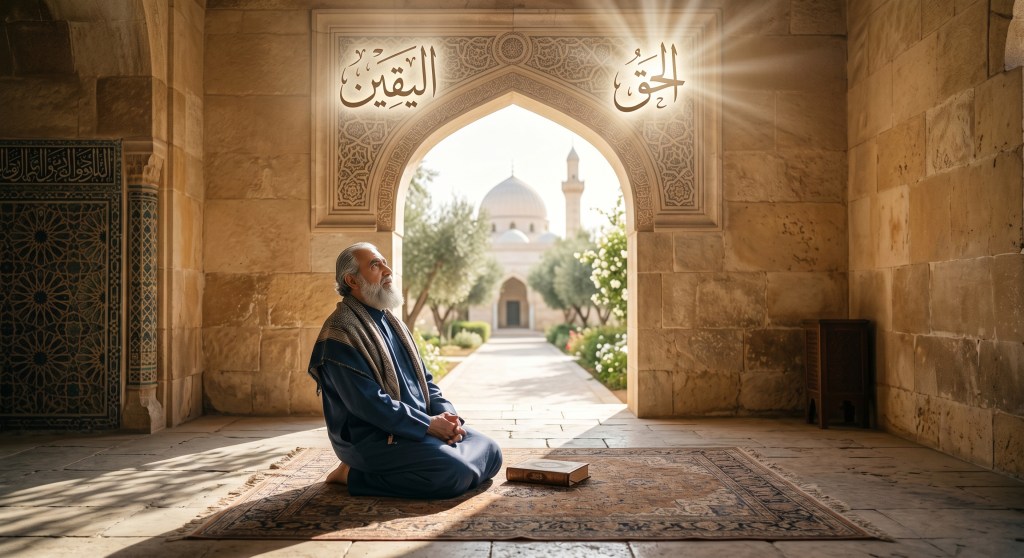
- Qur’an 56:95 (إِنَّ هَٰذَا لَهُوَ حَقُّ الْيَقِينِ, “Indeed, this is the absolute truth of certainty”) is the culminating affirmation of Sūrat al-Wāqiʿah’s deathbed/eschatology passage; it stacks four emphatic devices (inna + lām al-tawkīd + the separating pronoun huwa + the genitive construct ḥaqq al-yaqīn) to assert the highest possible grade of truth — about both the afterlife it has just described and, by extension, the Qur’an itself.
- “Ḥaqq al-yaqīn” is the third and highest of the three Qur’anic grades of certainty — ʿilm al-yaqīn (102:5), ʿayn al-yaqīn (102:7), and ḥaqq al-yaqīn (56:95, 69:51) — classically illustrated by the fire/honey analogy: hearing of fire, seeing fire, and being consumed by/tasting it.
- The root Ḥ-Q-Q (“truth/reality/right/the established”) underlies Allah’s name Al-Ḥaqq (The Real/Absolute Truth), invoked across nine verses, and its opposite al-bāṭil (the perishing-false) is dramatized in the parable of 13:17 (foam/dross vanishes, water/pure metal endures) — tying together truth, divine reality, the Qur’an, and the certainty of the Hereafter.
Key Findings
1. The verse and its emphatic architecture. The Arabic is إِنَّ هَٰذَا لَهُوَ حَقُّ الْيَقِينِ (Inna hādhā la-huwa ḥaqqu al-yaqīn), commonly rendered “Indeed, this is the absolute truth” / “the truth of certainty.” It is verse 95 of Sūrat al-Wāqiʿah (chapter 56), the 56th surah, 96 verses, in Juz 27; per Qur’anic commentators it was revealed in Mecca specifically around 7 years before the Hijrah (622), and the traditional Egyptian chronology counts it the 41st chapter by order of revelation (after Sūrat al-Ṭūr). The verse is immediately followed by 56:96, “Fa-sabbiḥ bismi rabbika al-ʿaẓīm” (“So glorify the name of your Lord, the Most Great”). Islamicstudies.info
2. Grammar (iʿrāb) and rhetoric (balāghah). Per the Quranic Arabic Corpus morphology: inna is an accusative particle of emphasis (ḥarf naṣb); hādhā is a masculine singular demonstrative serving as the noun of inna (ism inna); la- in la-huwa is the emphatic lām (lām al-tawkīd / lām al-ibtidāʾ shifted onto the predicate); huwa is a detached personal pronoun functioning as the pronoun of separation (ḍamīr al-faṣl); ḥaqqu is a nominative noun (the predicate, khabar inna) in a construct (iḍāfah); and al-yaqīn is its genitive second term (muḍāf ilayh). The cumulative effect — four distinct devices of ta’kīd in one short clause — is among the densest concentrations of emphasis in the Qur’an. The ḍamīr al-faṣl additionally conveys restriction/exclusivity (qaṣr): “this is precisely and exclusively the truth of certainty.” The iḍāfah “ḥaqq al-yaqīn” does not merely say “this is certain” but “this is the very realized truth OF certainty itself,” i.e., certainty at its terminal, absolute grade. quran
3. What does “hādhā” (this) refer to? Classical mufassirūn predominantly take “this” to point to the immediately preceding content — the death-scene (vv. 83–87) and the threefold fate of the dying (vv. 88–94). Ibn Kathīr glosses: “this news is the truth; there is no doubt about it, nor escape from it for anyone.” Mufti Shafiʿ’s Maʿāriful Qurʾān ties “hādhā” to “the preceding verses,” stating the reward and punishment mentioned “are a dead certainty that has no room for any doubt or suspicion.” A complementary, broader reading — supported by the surah’s mid-section (vv. 75–82), which is an extended oath defending the Qur’an (“innahu la-Qurʾānun karīm”) — extends “this” to the surah’s whole message and hence to the Qur’anic revelation itself. The two readings are not mutually exclusive: the proximate referent is the eschatological report; the message of which is Qur’anic truth. Quran.comIslamicstudies.info
4. The three grades of certainty. Classical and Sufi epistemology distinguishes:
- ʿilm al-yaqīn (“knowledge of certainty”), Qur’an 102:5 (كَلَّا لَوْ تَعْلَمُونَ عِلْمَ الْيَقِينِ, “No! If you only knew with knowledge of certainty…”); Surah Quran
- ʿayn al-yaqīn (“eye/vision of certainty”), Qur’an 102:7 (ثُمَّ لَتَرَوُنَّهَا عَيْنَ الْيَقِينِ, “Then you will surely see it with the eye of certainty”); Wikipedia
- ḥaqq al-yaqīn (“truth/reality of certainty”), Qur’an 56:95 and 69:51.
The standard analogy: ʿilm al-yaqīn is like being told reliably that there is a fire (or hearing a description of honey); ʿayn al-yaqīn is seeing the fire’s flames (or seeing the honey); ḥaqq al-yaqīn is being consumed by the fire (or tasting the honey). Ibn al-Qayyim, in Madārij al-Sālikīn, gives the honey version and stresses that certainty is “solely a gift from God … earned from the perspective of its means, but a pure gift from the perspective of its essence.” Importantly, the three terms are a synthesis assembled from two different surahs (102 supplies the first two; 56 and 69 supply the third); the Qur’an never lists them together as a single ladder. Almirajsuficentreyaqeeninstitute
5. Scholarly nuance/dispute. Several positions exist beyond the popular “spiritual ladder”:
- Affirmation, not human ascent (Naseer Ahmed, New Age Islam): in 56:95 and 69:51 “it is Allah who is affirming” the objective truth of the Hellfire-account and of the Qur’an respectively; regarding the Unseen (al-ghayb), humans can only have īmān, not yaqīn itself. He notes ʿilm and ʿayn al-yaqīn appear only once each (Surah 102), while ḥaqq al-yaqīn appears in 56:95 and 69:51. New Age Islam + 2
- Not strictly Sufi (Aftab Ahmad, New Age Islam): the three grades apply to all fields of knowledge, including empirical/scientific inquiry, not only mysticism. newageislam
- Attainable only with/after death or by an elite — connecting to Ibn Kathīr’s reading elsewhere (15:99; 74:47) that “al-yaqīn” means death; and the Shīʿa ʿirfānī framing (e.g., via wikishia and Ayatollah Khalil Mansouri) that ḥaqq al-yaqīn is a rare station of “union with the reality” reserved for those brought very near to God. Quran.com
6. 56:95 vs. 69:51. Both verses end with the identical phrase ḥaqq al-yaqīn, but with different referents. In 69:51 (وَإِنَّهُ لَحَقُّ الْيَقِينِ) the attached pronoun -hu (“it”) refers to the Qur’an. Sūrat al-Ḥāqqah is the 69th surah of 52 verses, Meccan; verses 40–51 defend the Qur’an as the speech of an honored Messenger, not poetry or soothsaying, and (per Understand Qur’an Academy) the surah closes “saying the Quran is the Truth and is absolute and pure: and for those who deny it, it will be a source of deep regret.” Ibn Kathīr glosses 69:51 as “the right and truthful news in which there is no doubt, suspicion or confusion.” In 56:95 the demonstrative hādhā points to the eschatological account. Together, the Qur’an declares that both the message (resurrection/judgment) and the medium (the Qur’an) occupy the highest grade of truth. My Islam + 3
Details
The immediate context: Sūrat al-Wāqiʿah 83–96
The surah’s central theme is the absolute certainty of the Resurrection and the sorting of humanity into three classes (v. 7, “azwājan thalāthah”): As-Sābiqūn / al-Muqarrabūn (the foremost, brought near), Aṣḥāb al-Yamīn / al-Maymanah (the People of the Right), and Aṣḥāb al-Shimāl / al-Mashʾamah (the People of the Left, the denying-astray). After arguments from creation, agriculture, water, and fire (vv. 57–74) and an oath defending the Qur’an (vv. 75–82), the surah returns to the three classes via the deathbed scene: The Last Dialogue
- vv. 83–85: “Then why, when the soul reaches the throat — while you are watching — and We are nearer to him than you, though you see not…”
- vv. 86–87: “…then why, if you are not to be recompensed, do you not bring it [the soul] back, if you are truthful?”
- vv. 88–89: if the dying person is of the Muqarrabūn — then rest (rawḥ), fragrance (rayḥān), and a Garden of Bliss. NobleQuran
- vv. 90–91: if of the People of the Right — “Peace to you” from the People of the Right. Islamic StudiesNobleQuran
- vv. 92–94: if of the deniers, the astray — a welcome of scalding water (ḥamīm) and burning in Hellfire (taṣliyatu jaḥīm). Quran.com +2
- v. 95: “Inna hādhā la-huwa ḥaqq al-yaqīn” — sealing the entire account as the truth of certainty.
- v. 96: “Fa-sabbiḥ bismi rabbika al-ʿaẓīm.”
Thus v. 95 functions as the doctrinal climax: the destinies just described are not speculation but the highest-grade truth, and the only fitting response (v. 96) is glorification of the Lord.
The root Ḥ-Q-Q and the haqq/bāṭil contrast
The triliteral root ḥā-qāf-qāf (ح ق ق) occurs 287 times in the Qur’an, in seven derived forms (Quranic Arabic Corpus; corroborated by Understand Qur’an Academy’s “And the Answer is… Al-Haqq!”, which lists forms including ḥaqqa, “proved true”; aḥaqqu, “more right”; al-ḥaqq, “the truth”; and al-ḥāqqatu, “the inevitable reality”). Its semantic range (per Lisān al-ʿArab, al-Iṣfahānī’s Mufradāt, and Lane’s Lexicon via Tāj al-ʿArūs) includes: truth, reality, fact, that which is established/confirmed, right, due, obligation, the necessary/unavoidable, the genuine/authentic, and that which is in accord with wisdom and justice. Notably, the same root yields both “truth” and “right/due” (ḥuqūq), linking ethics and metaphysics: a right is an “established truth.” Derived ḥaqīqah denotes the essence or inner reality of a thing. Understand Al Quran Academy
Its antithesis is al-bāṭil (root b-ṭ-l: nullity, vanity, worthlessness, the void, the transient). The Qur’an repeatedly stages their confrontation: 17:81, “Wa qul jāʾa al-ḥaqqu wa zahaqa al-bāṭilu inna al-bāṭila kāna zahūqā” (“Truth has come and falsehood has vanished; indeed, falsehood is ever bound to vanish”); and 21:18, “We hurl truth against falsehood and it crushes it, and behold, it [falsehood] vanishes.” Understand Al Quran Academy + 2
Al-Ḥaqq as a Name of Allah
Al-Ḥaqq (“The Truth / The Real / The Ultimate Reality”) is among the Most Beautiful Names (al-Asmāʾ al-Ḥusnā). Shaykh ʿAbd al-Raḥmān al-Saʿdī (Taysīr al-Karīm al-Raḥmān) states that Allah calls Himself al-Ḥaqq “on nine occasions in the Qur’an. Al-Haqq is true in and of Himself and in His attributes; His existence is undeniable and nothing else can exist except through Him”: His word, His messengers, His books, His promise, the meeting with Him, and worship of Him alone are all truth. This is enshrined in the Prophet’s tahajjud supplication, recorded verbatim in Ṣaḥīḥ al-Bukhārī (narrated by Ibn ʿAbbās): “أَنْتَ الْحَقُّ وَوَعْدُكَ الْحَقُّ وَلِقَاؤُكَ حَقٌّ وَقَوْلُكَ حَقٌّ وَالْجَنَّةُ حَقٌّ وَالنَّارُ حَقٌّ وَالنَّبِيُّونَ حَقٌّ وَمُحَمَّدٌ ﷺ حَقٌّ وَالسَّاعَةُ حَقٌّ” (“You are the Truth, Your promise is true, the meeting with You is true, Your word is true, Paradise is true, Hell is true, the Prophets are true, Muhammad ﷺ is true, and the Hour is true”). Sufi metaphysics (al-Junayd, Ibn ʿArabī) uses al-Ḥaqq to signify Being (wujūd) itself, contrasted with khalq (creation) and ʿadam (nonexistence); Ibn ʿArabī distinguishes al-Ḥaqq from all else by “essential necessity” (wujūb dhātī), the necessity of existence peculiar to God alone. Tumblr + 2
Note on the count: academic sources (e.g., Burrell in the Encyclopaedia of the Qurʾān) count ḥaqq as a “formal divine name” fewer times (five), because counters differ on whether to include cases where al-Ḥaqq is an adjective modifying another name (e.g., al-Maliku al-Ḥaqq, “the True King”) or a predicate (huwa al-Ḥaqq). The “nine” figure is the one cited in devotional literature and attributed to al-Saʿdī, and it corresponds to the verse set below.
The verses where Allah is referred to as Al-Ḥaqq — exact text and translation
Based on classical lists (corroborated by al-Saʿdī’s nine and standard tafsir), the canonical verses naming Allah al-Ḥaqq are 6:62, 10:32, 18:44, 20:114, 22:6, 22:62, 23:116, 24:25, and 31:30.
- 22:62 (Al-Ḥajj): ذَٰلِكَ بِأَنَّ اللَّهَ هُوَ الْحَقُّ وَأَنَّ مَا يَدْعُونَ مِن دُونِهِ هُوَ الْبَاطِلُ وَأَنَّ اللَّهَ هُوَ الْعَلِيُّ الْكَبِيرُ — “That is because Allah — He is the Truth (huwa al-Ḥaqq), and that which they call upon besides Him is falsehood, and because Allah is the Most High, the Grand.” (User-requested; confirmed.) Ayah Surah QuranAllah-names
- 24:25 (An-Nūr): يَوْمَئِذٍ يُوَفِّيهِمُ اللَّهُ دِينَهُمُ الْحَقَّ وَيَعْلَمُونَ أَنَّ اللَّهَ هُوَ الْحَقُّ الْمُبِينُ — “That Day, Allah will pay them in full their just due, and they will know that Allah — He is the Manifest Truth (huwa al-Ḥaqq al-Mubīn).” (User-requested; confirmed.) Quran + 2
- 31:30 (Luqmān): ذَٰلِكَ بِأَنَّ اللَّهَ هُوَ الْحَقُّ وَأَنَّ مَا يَدْعُونَ مِن دُونِهِ الْبَاطِلُ وَأَنَّ اللَّهَ هُوَ الْعَلِيُّ الْكَبِيرُ — “That is because Allah — He is the Truth, and that which they call upon besides Him is falsehood, and because Allah is the Most High, the Grand.” (User-requested; confirmed. Note: 31:30 reads “al-bāṭil” without the pronoun huwa, whereas 22:62 reads “huwa al-bāṭil.”) Surah QuranSurah Quran
- 10:32 (Yūnus): فَذَٰلِكُمُ اللَّهُ رَبُّكُمُ الْحَقُّ ۖ فَمَاذَا بَعْدَ الْحَقِّ إِلَّا الضَّلَالُ ۖ فَأَنَّىٰ تُصْرَفُونَ — “For that is Allah, your Lord, the Truth (rabbukumu al-Ḥaqq). And what can be beyond truth except error? So how are you averted?” (User-requested; confirmed.) Quranic Arabic Corpus
- 20:114 (Ṭā Hā): فَتَعَالَى اللَّهُ الْمَلِكُ الْحَقُّ — “So high above all is Allah, the Sovereign, the Truth (al-Maliku al-Ḥaqq).” (User-requested; confirmed.) My Islam
- 23:116 (Al-Muʾminūn): فَتَعَالَى اللَّهُ الْمَلِكُ الْحَقُّ ۖ لَا إِلَٰهَ إِلَّا هُوَ — “So exalted is Allah, the Sovereign, the Truth (al-Maliku al-Ḥaqq); there is no deity except Him.” (User-requested; confirmed.) My IslamKnowingallah
- 6:62 (Al-Anʿām): ثُمَّ رُدُّوا إِلَى اللَّهِ مَوْلَاهُمُ الْحَقِّ ۚ أَلَا لَهُ الْحُكْمُ وَهُوَ أَسْرَعُ الْحَاسِبِينَ — “Then they are returned to Allah, their true Master (mawlāhumu al-Ḥaqq). Is not His the judgment? And He is the swiftest of those who take account.” (Substituted into the canonical nine — see Caveats.) Quran Omyislam
- 22:6 (Al-Ḥajj): ذَٰلِكَ بِأَنَّ اللَّهَ هُوَ الْحَقُّ وَأَنَّهُ يُحْيِي الْمَوْتَىٰ وَأَنَّهُ عَلَىٰ كُلِّ شَيْءٍ قَدِيرٌ — “That is because Allah — He is the Truth, and because He gives life to the dead, and because He is competent over all things.” (Substituted.) Ahmed HulusiSurah Quran +2
- 18:44 (Al-Kahf): هُنَالِكَ الْوَلَايَةُ لِلَّهِ الْحَقِّ ۚ هُوَ خَيْرٌ ثَوَابًا وَخَيْرٌ عُقْبًا — “There the [protective] authority belongs to Allah, the Truth (lillāhi al-Ḥaqq). He is best in reward and best in outcome.” (Substituted.) Quran O
These nine fall into three grammatical types: (a) standalone predicate huwa al-Ḥaqq (22:6, 22:62, 24:25 [+mubīn], 31:30); (b) adjective of another divine name — al-Maliku al-Ḥaqq (20:114, 23:116), mawlāhumu al-Ḥaqq (6:62); and (c) rabbukumu al-Ḥaqq / lillāhi al-Ḥaqq (10:32, 18:44).
Quran 13:17 (Ar-Raʿd) — the parable of truth and falsehood
Exact text: أَنزَلَ مِنَ السَّمَاءِ مَاءً فَسَالَتْ أَوْدِيَةٌ بِقَدَرِهَا فَاحْتَمَلَ السَّيْلُ زَبَدًا رَّابِيًا ۚ وَمِمَّا يُوقِدُونَ عَلَيْهِ فِي النَّارِ ابْتِغَاءَ حِلْيَةٍ أَوْ مَتَاعٍ زَبَدٌ مِّثْلُهُ ۚ كَذَٰلِكَ يَضْرِبُ اللَّهُ الْحَقَّ وَالْبَاطِلَ ۚ فَأَمَّا الزَّبَدُ فَيَذْهَبُ جُفَاءً ۖ وَأَمَّا مَا يَنفَعُ النَّاسَ فَيَمْكُثُ فِي الْأَرْضِ ۚ كَذَٰلِكَ يَضْرِبُ اللَّهُ الْأَمْثَالَ.
Translation (Sahih International): “He sends down from the sky, rain, and valleys flow according to their capacity, and the torrent carries a rising foam. And from that [ore] which they heat in the fire, desiring adornments and utensils, is a foam like it. Thus Allah presents [the example of] truth and falsehood. As for the foam, it vanishes, [being] cast off; but as for that which benefits the people, it remains on the earth. Thus does Allah present examples.” My IslamQur’an Wiki
The key clause, كَذَٰلِكَ يَضْرِبُ اللَّهُ الْحَقَّ وَالْبَاطِلَ (“Thus does Allah present/strike [the example of] truth and falsehood”), governs two paired similitudes. Ibn Kathīr: “This honorable Ayah contains two parables which affirm that truth remains and increases, while falsehood diminishes and perishes.” On the foam (zabad): “when they both exist, falsehood does not remain, just as foam does not remain with the water or the gold and silver ores … it all goes away and never returns. However, water, gold and silver remain and are used to man’s benefit.” Remarkably, Ibn Kathīr extends the parable to the epistemic register: the enduring matter is “in reference to certainty. And just as when jewelry is heated in fire and is rid of its impurity … similarly Allah accepts certainty and discards doubt.” Tafsīr al-Jalālayn glosses the foam/dross as “useless refuse,” while the beneficial matter “abides on the earth.” Maududi’s symbolic key: the water is the divinely-sent knowledge/guidance; the valleys/riverbeds are hearts receiving “each according to its measure”; the scum is the conspicuous-but-transient falsehood that is purged. My Islam + 3
Synthesis: ḥaqq al-yaqīn, Al-Ḥaqq, and the permanence of truth
A coherent thread links the themes. (1) The Qur’an asserts that the eschatological reality (56:95) and the Qur’an conveying it (69:51) are ḥaqq al-yaqīn — truth at its most absolute. (2) That truth is grounded in Allah Himself, who IS al-Ḥaqq (The Real); His promise, His books, the meeting with Him, and the Hereafter are all ḥaqq. (3) Because truth is anchored in the necessarily-existent Real, it is permanent, whereas al-bāṭil — like foam and dross (13:17) — is by nature evanescent (17:81; 21:18). Ibn Kathīr’s reading of 13:17 as fire purifying metal of dross “just as Allah accepts certainty and discards doubt” directly bridges the parable to the certainty-theme of 56:95: divine truth purifies the heart of shakk (doubt), leaving only enduring yaqīn. Thus ḥaqq al-yaqīn (the certainty), Al-Ḥaqq (the divine name), and the permanence of truth (13:17) form one doctrine: ultimate reality, the Qur’an, the Afterlife, and Allah Himself are all “the truth that remains.”


Leave a Reply