
Presented by Gemini
Audio teaser: Quantum physics and the divine simulation
Abstract
This study presents a multidisciplinary analysis of the opening six verses of Sūrat al-Ḥadīd (Quran 57:1–6), establishing a synthesis of classical Islamic exegesis, medieval Ash‘arite metaphysics, and contemporary scientific paradigms. Through a systematic examination of the primary Arabic text across six prominent English translations, this report explores how the Quranic themes of universal glorification (tasbīḥ), absolute divine sovereignty (mulk), primordial transcendence, and radical immanence delineate a cosmos entirely contingent upon a single, continuous, and unceasing sustaining cause. By incorporating the theological work of Abū Ḥāmid al-Ghazālī and its contemporary revitalization by Dr. Zia H. Shah MD, this analysis demonstrates how the classical doctrine of occasionalism—the metaphysical thesis that God is the sole immediate cause of every event in the universe—harmonizes with modern findings in quantum mechanics, cosmology, and the philosophy of natural law. Special attention is given to quantum indeterminacy as the physical “looseness at the joints” where divine agency operates, the Simulation Hypothesis as a modern vocabulary for the continuous recreation of reality (tajdīd al-khalq), and the “deterministic pivot” that reframes empirical natural laws as the voluntary, stable habits of the Divine Will (sunnat Allāh).
Socio-Historical and Exegetical Context of Surat Al-Hadid
Sūrat al-Ḥadīd, the fifty-seventh chapter of the Quran, represents a critical divine intervention revealed during the late Medinan period, specifically in the post-conquest spiritual climate following the Conquest of Makkah, around the eighth to ninth years after the Hijrah. During this epoch, the embryonic Islamic state in Madinah had transitioned from a persecuted, vulnerable minority into the dominant political and military power of the Arabian Peninsula. This rapid acquisition of material authority, wealth, and territory presented novel spiritual hazards. The established Muslim community, now bolstered by a massive influx of new converts from conquered tribes whose understanding of the faith remained superficial, faced the insidious threat of spiritual complacency, internal apathy, and a creeping materialism.
The socio-historical function of Sūrat al-Ḥadīd was to serve as an ontological and constitutional corrective for this victorious but potentially complacent community. The chapter is named “The Iron” (Al-Ḥadīd), a substance that epitomizes worldly power, military strength, and technological dominance. Yet, the central thematic thrust of the Surah is a profound call to humility, softness of heart (khushū‘), and unhesitating economic sacrifice for the collective welfare. Classical exegetes, such as Ibn Kathīr, note that the opening theological verses (57:1–6) establish the absolute baseline of divine ownership and omniscience as a psychological prerequisite for the demanding ethical directives that follow. A community cannot be reasonably commanded to sacrifice their wealth, lives, and political privileges unless they first internalize the metaphysical reality that they own nothing in an absolute sense, and that all physical power, historical victory, and material wealth emanate from and return to Allah alone.
Furthermore, Sūrat al-Ḥadīd belongs to a prestigious liturgical group of chapters known as the Musabbiḥāt—surahs that commence with the declaration of God’s glorification. These chapters include Al-Isrā’, Al-Ḥadīd, Al-Ḥashr, Al-Ṣaff, Al-Jumu‘ah, Al-Taghābun, and Al-A‘lā. It is recorded in the classical collections of Abū Dāwūd, Al-Tirmidhī, and Al-Nasā’ī, on the authority of the companion ‘Irbāḍ ibn Sāriyah, that the Prophet Muhammad was accustomed to reciting the Musabbiḥāt every night before going to sleep. The Prophet remarked that within these surahs lies an individual verse that is superior to a thousand verses. While the classical commentator Al-Teebī notes that the specific identity of this verse was intentionally concealed—much like the date of Laylat al-Qadr—to encourage the comprehensive recitation and contemplation of all these chapters, Al-Hafidh Ibn Kathīr reports a strong consensus pointing to the third verse of Sūrat al-Ḥadīd as this supreme ontological declaration.
Comparative Translation Analysis of Quran 57:1-6
To establish a comparative linguistic foundation, the primary Arabic text of the opening six verses of Sūrat al-Ḥadīd is paired below with six highly regarded English translations, demonstrating the subtle theological emphases of different interpretive schools.
Translation Matrix for Verse 57:1
سَبَّحَ لِلَّهِ مَا فِي السَّمَاوَاتِ وَالْأَرْضِ ۖ وَهُوَ الْعَزِيزُ الْحَكِيمُ
| Translator | English Translation |
|---|---|
| Sahih International | Whatever is in the heavens and earth exalts Allah, and He is the Exalted in Might, the Wise. |
| Yusuf Ali | Whatever is in the heavens and on earth,- let it declare the Praises and Glory of Allah: for He is the Exalted in Might, the Wise. |
| Pickthall | All that is in the heavens and the earth glorifieth Allah; and He is the Mighty, the Wise. |
| Arberry | All that is in the heavens and the earth magnifies God; He is the All-mighty, the All-wise. |
| Shakir | Whatever is in the heavens and the earth declares the glory of Allah, and He is the Mighty, the Wise. |
| Muhammad Asad | All that is in the heavens and on earth extols God’s limitless glory: for He alone is almighty, truly wise! |
Translation Matrix for Verse 57:2
لَهُ مُلْكُ السَّمَاوَاتِ وَالْأَرْضِ ۖ يُحْيِي وَيُمِيتُ ۖ وَهُوَ عَلَىٰ كُلِّ شَيْءٍ قَدِيرٌ
| Translator | English Translation |
|---|---|
| Sahih International | To Him belongs the kingdom of the heavens and the earth. He gives life and causes death. And He is Most Capable of everything. |
| Yusuf Ali | To Him belongs the dominion of the heavens and the earth: It is He Who gives Life and Death; and He has Power over all things. |
| Pickthall | His is the Sovereignty of the heavens and the earth; He quickeneth and He giveth death; and He is Able to do all things. |
| Arberry | To Him belongs the Kingdom of the heavens and the earth; He gives life, and He makes to die, and He is powerful over everything. |
| Shakir | His is the kingdom of the heavens and the earth; He gives life and causes death; and He has power over all things. |
| Muhammad Asad | His is the dominion over the heavens and the earth; He grants life and deals death; and He has the power to will anything. |
Translation Matrix for Verse 57:3
هُوَ الْأَوَّلُ وَالْآخِرُ وَالظَّاهِرُ وَالْبَاطِنُ ۖ وَهُوَ بِكُلِّ شَيْءٍ عَلِيمٌ
| Translator | English Translation |
|---|---|
| Sahih International | He is the First and the Last, the Ascendant and the Intimate, and He is, of all things, Knowing. |
| Yusuf Ali | He is the First and the Last, and the Outward and the Inward; and He is the Knower of all things. |
| Pickthall | He is the First and the Last, and the Outward and the Inward; and He is Knower of all things. |
| Arberry | He is the First and the Last, the Outward and the Inward; He has knowledge of everything. |
| Shakir | He is the First and the Last and the Manifest and the Hidden, and He has knowledge of all things. |
| Muhammad Asad | He is the First and the Last, the Outward and the Inward: and He has full knowledge of everything. |
Translation Matrix for Verse 57:4
هُوَ الَّذِي خَلَقَ السَّمَاوَاتِ وَالْأَرْضَ فِي سِتَّةِ أَيَّامٍ ثُمَّ اسْتَوَىٰ عَلَى الْعَرْشِ ۚ يَعْلَمُ مَا يَلِجُ فِي الْأَرْضِ وَمَا يَخْرُجُ مِنْهَا وَمَا يَنْزِلُ مِنَ السَّمَاءِ وَمَا يَعْرُجُ فِيهَا ۖ وَهُوَ مَعَكُمْ أَيْنَ مَا كُنْتُمْ ۚ وَاللَّهُ بِمَا تَعْمَلُونَ بَصِيرٌ
| Translator | English Translation |
|---|---|
| Sahih International | He is the One Who created the heavens and the earth in six Days, then established Himself on the Throne. He knows whatever goes into the earth and whatever comes out of it, and whatever descends from the sky and whatever ascends into it. And He is with you wherever you are. For Allah is All-Seeing of what you do. |
| Yusuf Ali | He it is Who created the heavens and the earth in six Days, and is moreover firmly established on the Throne (of Authority). He knows what enters within the earth and what comes out of it, what comes down from heaven and what mounts up to it. And He is with you wheresoever ye may be. And Allah sees well all that ye do. |
| Pickthall | He it is Who created the heavens and the earth in six Days; then He mounted the Throne. He knoweth all that entereth the earth and all that emergeth therefrom and all that cometh down from the sky and all that ascendeth therein; and He is with you wheresoever ye may be. And Allah is Seer of what ye do. |
| Arberry | He it is who created the heavens and the earth in six days, then sat Himself upon the Throne. He knows what penetrates into the earth, and what goes forth from it, what descends from heaven, and what ascends into it. He is with you wherever you are; and God sees the things you do. |
| Shakir | He it is who created the heavens and the earth in six periods, and He is firm in power. He knows that which goes deep into the earth and that which comes forth out of it, and that which comes down from the heaven and that which goes up into it, and He is with you wherever you are; and Allah sees what you do. |
| Muhammad Asad | He it is who has created the heavens and the earth in six aeons, and is established on the throne of His almightiness. He knows all that enters the earth, and all that comes out of it, as well as all that descends from the skies, and all that ascends unto them. And He is with you wherever you may be; and God sees all that you do. |
Translation Matrix for Verse 57:5
لَهُ مُلْكُ السَّمَاوَاتِ وَالْأَرْضِ ۖ وَإِذَا اللَّهِ تُرْجَعُ الْأُمُورُ
| Translator | English Translation |
|---|---|
| Sahih International | To Him belongs the kingdom of the heavens and the earth. And to Allah all matters are returned. |
| Yusuf Ali | To Him belongs the dominion of the heavens and the earth: and all affairs are referred back to Allah. |
| Pickthall | His is the Sovereignty of the heavens and the earth, and unto Allah all things are brought back. |
| Arberry | To Him belongs the Kingdom of the heavens and the earth; and unto God all matters are returned. |
| Shakir | His is the kingdom of the heavens and the earth; and to Allah are all affairs returned. |
| Muhammad Asad | His is the dominion over the heavens and the earth; and unto God must all things return. |
Translation Matrix for Verse 57:6
يُولِجُ اللَّيْلَ فِي النَّهَارِ وَيُولِجُ النَّهَارَ فِي اللَّيْلِ ۖ وَهُوَ عَلِيمٌ بِذَاتِ الصُّدُورِ
| Translator | English Translation |
|---|---|
| Sahih International | He merges the night into day and the day into night. And He knows best what is hidden in the heart. |
| Yusuf Ali | He merges Night into Day, and He merges Day into Night; and He has full knowledge of the secrets of (all) hearts. |
| Pickthall | He causeth the night to pass into the day, and He causeth the day to pass into the night, and He is Knower of all that is in the breasts. |
| Arberry | He makes the night to enter into the day and makes the day to enter into the night; and He knows the thoughts within the breasts. |
| Shakir | He causes the night to enter in upon the day, and He causes the day to enter in upon the night, and He is Cognizant of what is in the hearts. |
| Muhammad Asad | He makes the night grow into the day, and makes the day grow into the night; and He has full knowledge of what is in the hearts [of men]. |
Systematic Verse-by-Verse Commentary
Exegesis of Verse 1: The Cosmic Flux and the Dynamics of Tasbih
The initial verb of the chapter, sabbaḥa, is a past-perfect form signifying a completed, primordial reality: all that exists in the celestial and terrestrial domains has already entered into a state of glorification for Allah. Classical lexicographers point out that the root consonants Sīn-Bā-Ḥā denote the physical act of swimming, gliding, floating, or rolling onwards through a fluid medium, as seen in descriptions of celestial orbits navigating space. Consequently, some contemporary linguistic analyses suggest that sabbaḥa is accurately translated as “flowing” or “moving relentlessly to fulfill a divine plan”.
This lexical connection bridges classical theology with modern physics: the material world is not a collection of static, dead objects, but is characterized by an all-encompassing, incessant flow. Every macro-level solid is composed of atoms, which are themselves composed of subatomic particles—electrons, protons, and quarks—that exist as dynamic probability waves and energy packages in constant motion. The cosmos is in a state of continuous “coming into being and going out of being,” a thermodynamic and quantum flux that mirrors the metaphysical assertion of the Musabbiḥāt.
The pairing of the Divine Names Al-‘Azīz (the Almighty) and Al-Ḥakīm (the Wise) at the conclusion of the verse indicates that this vast kinetic universe is not governed by blind, chaotic energy. Rather, infinite, irresistible power is structurally coupled with absolute wisdom, ensuring that the continuous movement of the cosmos occurs in perfect proportion, balance, and mathematical intelligibility.
                  ┌─────────────────────────────────────┐
                  │          Linguistic Root:           │
                  │              S-B-H                  │
                  └──────────────────┬──────────────────┘
                                     │
                  ┌──────────────────┴──────────────────┐
                  ▼                                     ▼
     ┌─────────────────────────┐           ┌─────────────────────────┐
     │   Classical Exegesis    │           │     Modern Physics      │
     │  Celestial bodies       │           │  Subatomic wave states  │
     │  gliding in orbit       │           │  in constant movement   │
     │  (Al-Qurtubi) [52]      │           │  (Zia H. Shah) [59]     │
     └─────────────────────────┘           └─────────────────────────┘
Exegesis of Verse 2: The Direct Genesis of Life and Death
The second verse asserts that the exclusive ownership (mulk) of the heavens and the earth belongs to Allah, manifesting immediately in the control over the biological transitions of life and death: yuḥyī wa-yumīt. Classical commentators such as Al-Tabarī emphasize that these transitions represent direct divine actions that cannot be delegated to physical substances or biological mechanisms.
In his contemporary commentary, Dr. Zia H. Shah MD connects the Quranic declarations regarding the creation of life from dust (turāb) or clay (ṭīn) to the scientific model of chemical abiogenesis, wherein life emerged from a “primordial soup” of carbon-based molecules and minerals on the early, hostile Earth. Under the occasionalist paradigm, biology simply describes the habitual sequence (ʿāda) in which God acts.
The transition from a collection of inanimate, organic molecules to a living, conscious, and reproducing cell containing highly complex, encoded DNA instructions is an ontological leap that cannot be fully explained by physical material causes alone. Humans are completely incapable of synthesizing life from inorganic compounds in a laboratory without using pre-existing biological templates. This incapacity underscores the theological truth that the “spark of life” remains a direct creative act of the Necessary Being. The verse concludes by asserting God’s capacity over all things (‘alā kulli shay’in qadīr), indicating that physical matter possesses no intrinsic power to generate or extinguish life independently of the divine decree.
Exegesis of Verse 3: Primordial Names and the Cosmology of Contingency
The third verse outlines the primordial tetrad of Divine Names: Al-Awwal (the First), Al-Ākhir (the Last), Al-Ẓāhir (the Manifest), and Al-Bāṭin (the Hidden). This verse is widely regarded by classical scholars as the foundational core of Islamic monotheism (tawḥīd).
The temporal attributes, Al-Awwal and Al-Ākhir, directly engage with the metaphysics of cosmic origin and contingency. Prior to the twentieth century, secular philosophy—following the Aristotelian tradition—assumed that the universe was eternal, static, and self-sustaining, a premise that sought to render the concept of a First Cause obsolete. However, modern observational cosmology and astrophysical evidence have firmly established the Big Bang model, demonstrating that time, space, and matter had a radical, absolute beginning approximately 13.8 billion years ago.
The Borde-Guth-Vilenkin (BGV) theorem mathematically demonstrates that any spacetime geometry that has, on average, undergone cosmic expansion must possess a past space-time boundary, meaning it cannot be past-eternal. This scientific model demonstrates that the universe is radically contingent; it could have been otherwise, or it might not have existed at all.
Furthermore, the mathematical values of the fundamental physical constants—such as the ratio of the gravitational constant to the weak nuclear force—are fine-tuned to an extraordinary precision, akin to 1 part in 1050, to allow for the development of carbon-based life. The British astronomer Sir Fred Hoyle, investigating stellar nucleosynthesis, discovered that carbon-12 can only form within stars because of a specific, highly improbable nuclear resonance level at exactly 7.65 MeVs. This led to his famous remark that a “super-calculating intellect” had intervened in physics. By demonstrating that the cosmos is non-eternal and highly structured, modern cosmology confirms the attribute of Al-Awwal as the transcendent First Cause who initiated reality ex nihilo, and Al-Ākhir as the ultimate destination to which all contingent systems must return.
The spatial and epistemological attributes, Al-Ẓāhir and Al-Bāṭin, delineate the boundaries of human perception. Classical commentators, including Al-Qurṭubī and Al-Jalalayn, cite the theological principle of tanzīh (absolute transcendence), noting that while the divine essence (dhāt) is completely hidden (Bāṭin) and cannot be physically detected or encompassed by human sight in this worldly life, His existence is overwhelmingly manifest (Ẓāhir) through the signs of design throughout the observable cosmos.
Al-Qurṭubī quotes early authorities who suggest that although the physical “eyes of the head” are incapable of perceiving the Creator, the “eyes of the heart” can perceive Him through the spiritual light of faith and intellect. This distinction aligns with contemporary scientific epistemology: we cannot directly observe the ultimate ground of physical reality (such as quantum fields or space-time strings), yet their mathematical effects are manifest to our instruments.
Exegesis of Verse 4: Sequential Epochs and Continuous Surveillance
The fourth verse describes the act of creation occurring in “six periods” (sittati ayyāmin) followed by the establishment of authority on the Throne (istiwā’ ‘alā al-‘arsh). Classical Sunni theologians, such as the Ash‘arite commentators, point out that istiwā’ is an attribute of action signifying absolute sovereignty, dominion, and control, rather than physical localization on a material object, which would imply containment within space and time.
The “six days” represent distinct, sequential cosmological epochs of development rather than literal 24-hour solar days, which could not have existed prior to the formation of the earth and sun. This developmental timeline is consistent with the sequential history of the cosmos, from the inflationary epoch and the formation of light elements to the slow gravity-driven birth of galaxies, stars, and biological life.
The verse then outlines an exhaustive, micro-level omniscience: God is aware of everything that enters the earth (such as underground water, roots, decaying organic matter, and neutrinos), everything that emerges from it (such as vegetation, tectonic gases, and subterranean life), everything that descends from the heavens (such as cosmic rays, rain, and revelation), and everything that ascends into them (such as atmospheric gases, evaporation, and human deeds).
This comprehensive surveillance is immediately coupled with the statement: “And He is with you wherever you are”. Contemporary theologians like Dr. Zia H. Shah MD observe that this radical immanence is the metaphysical precondition for God’s direct, immediate causal activity at every point in space. Drawing on other Quranic declarations, such as Surah Al-Anfāl (8:24) which states that “God stands between a person and their heart,” the Shah paradigm asserts that even the inner life of human intention, emotion, courage, and fear is directly generated by the Divine Will. God’s “withness” is not a spatial containment, but the active, continuous sustaining of our conscious existence and biological function at every moment.
Exegesis of Verses 5-6: System Restoration and Information Conservation
Verse 5 repeats the declaration of absolute dominion: “To Him belongs the kingdom of the heavens and the earth”. In classical Arabic rhetoric, this structural repetition (tikrār) serves to emphasize that both the initial stage of creation and the final return of all physical and ethical affairs (wa-ilā Allāhi turja‘u al-umūr) are completely bound to the divine decree.
Verse 6 demonstrates this absolute control through the continuous, dynamic alternation of time: “He merges the night into day and He merges the day into night”. This physical process, which appears to human senses as a regular, mechanical law of planetary rotation, is presented as an active, moment-by-moment divine interpenetration. This macro-cosmic scale of time-keeping is immediately mirrored by a micro-cosmic penetration into human interiority: “And He has full knowledge of what is in the breasts”. The “breasts” (al-ṣudūr) represent the locus of human intentions, thoughts, and subconscious motivations.
                     ┌─────────────────────────────┐
                     │    Macro-Cosmic Scale:      │
                     │  Merging of Night and Day   │
                     │        (Verse 57:6)         │
                     └──────────────┬──────────────┘
                                    │
                                    ▼
                     ┌─────────────────────────────┐
                     │    Micro-Cosmic Scale:      │
                     │  Sovereignty over the Heart  │
                     │        (Verse 57:6)         │
                     └──────────────┬──────────────┘
                                    │
                                    ▼
                     ┌─────────────────────────────┐
                     │    Information Domain:      │
                     │  Perfect Divine Preservation │
                     │       (Kitāb Mubīn)         │
                     └─────────────────────────────┘
The concept of perfect knowledge of the heart is linked by contemporary thought to the principle of information conservation. In classical physics, information could theoretically be lost or destroyed through irreversible processes. However, modern quantum field theory insists on the principle of unitarity—the mathematical requirement that the sum of probabilities of all possible outcomes of a quantum system must always equal exactly 1. This implies that physical information about the state of a closed system can never be destroyed, a principle famously affirmed through the resolution of the black hole information paradox.
Just as every physical event remains permanently inscribed in the cosmic wavefunction, the Quran asserts that every human intention, whisper, and moral choice is preserved in a “clear record” (Kitāb Mubīn). The Sovereign Will that merges the day and the night is the same conscious substrate that maintains and registers every cognitive transition within human consciousness, ensuring absolute justice in the final return of all affairs.
The Metaphysics of Occasionalism: Ghazalian Formulations and the Zia H. Shah Paradigm
The Classical Ash’arite Formulation of Abu Hamid al-Ghazali
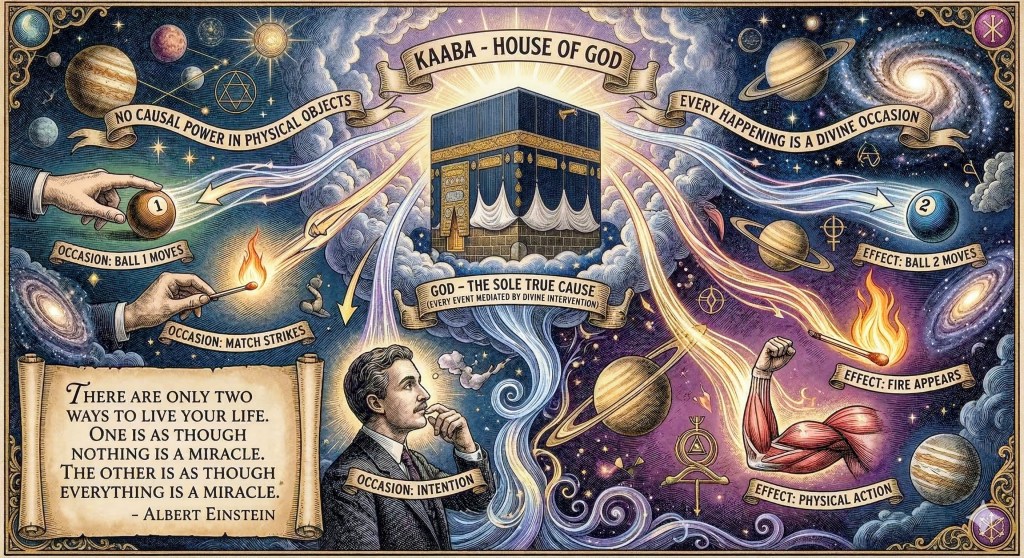
The theological framework that provides the most robust metaphysical explanation for Sūrat al-Ḥadīd (57:1–6) is occasionalism, famously championed by the eleventh-century Islamic scholar Abū Ḥāmid al-Ghazālī in his landmark text Tahāfut al-Falāsifah (The Incoherence of the Philosophers). Al-Ghazālī’s treatise was written as a direct challenge to the Islamic Aristotelian philosophers, such as Avicenna (Ibn Sīnā), who asserted that the natural world is governed by necessary, secondary causal connections—inherent powers within physical objects that force a specific outcome to occur.
Al-Ghazālī argued that to attribute intrinsic causal power to created things is to compromise the absolute omnipotence and absolute unity (tawḥīd) of God, effectively setting up partners with Him in power. In his famous analysis of combustion, al-Ghazālī asserted that:
- The connection between what is observed as a cause (the flame) and what is observed as an effect (the burning of cotton) is not a connection of logical necessity.
- The true, efficient agent behind the burning is not the fire, but Allah, who directly creates the combustion, the disintegration of the fibers, and the ash at the exact moment of contact.
- The physical contact between the flame and the cotton is merely the “occasion” (sabab) upon which the divine will chooses to enact His creative power.
To clarify this perspective, al-Ghazālī compared our ordinary perception of causality to a person blind from birth whose eyes are covered by a membrane. If the membrane is removed during the day, the man might naturally assume that the opening of his eyelids is the direct cause of the light he perceives. In reality, the sun is the true source of light, and his eyelids are merely the occasion for the perception to occur. Similarly, what humans perceive as natural causality is shorthand for the habitual way in which God chooses to act.
Aristotelian Model:[Flame (Inherent Causal Power)] ───────────────► [Combustion of Cotton]Ghazalian Occasionalist Model:[Flame] ───────────────────► (Occasion of Contact) ◄───────────────────┐ │[Allah] ───────────────── (Direct Creation of Ash/Heat) ───────────────┘
This classical formulation bears a striking conceptual similarity to the philosophical arguments of the eighteenth-century Scottish empiricist David Hume. Hume famously demonstrated that empirical observation only reveals “concomitance” or “constant conjunction”—patterns of events occurring together—but can never detect any underlying, necessary physical connection between them. While Hume’s skepticism led toward philosophical agnosticism, occasionalism provides the theological completion to this empirical insight. It agrees that physical necessity is an illusion, but identifies the continuous, reliable Will of God as the actual causal power operating behind those natural regularities.
The Metaphysics of Continuous Creation
Central to Ash‘arite occasionalism is the doctrine of “continuous creation” (al-khalq al-jadīd or tajdīd al-khalq). Under this view, the universe is not a static object that persists through time on its own. Instead, it is composed of discrete atoms of space and instants of time that are being completely recreated by God at every moment.
An early Ash‘arite analogy likens the universe to a ball of light that must be re-lit at every instant; if the supply of power (the divine will) were to stop for even a blink of an eye, reality would vanish into nothingness. This continuous upkeep means that every transition from moment T1 to moment T2 is a fresh, immediate production out of nothing, a metaphysical reality that provides a literal foundation for the Quranic command to say Inshā’Allāh when planning for the future.
The Zia H. Shah Synthesis: Quantum Mechanics as the Physical Interface
While classical occasionalism was developed in an era of medieval scholasticism, Dr. Zia H. Shah MD has revitalized this doctrine by demonstrating its compatibility with modern scientific discoveries. The Shah paradigm reinterprets the laws of nature not as autonomous, mechanical machinery of matter, but as the consistent, voluntary “customs” (sunnat Allāh) of the Creator.
The core of this modern synthesis is found in quantum mechanics. Classical Newtonian physics depicted a closed, deterministic universe where every event was the inevitable result of prior physical causes. In such a system, there was no logical room for divine intervention, miracles, or human free will without violating the laws of physics.
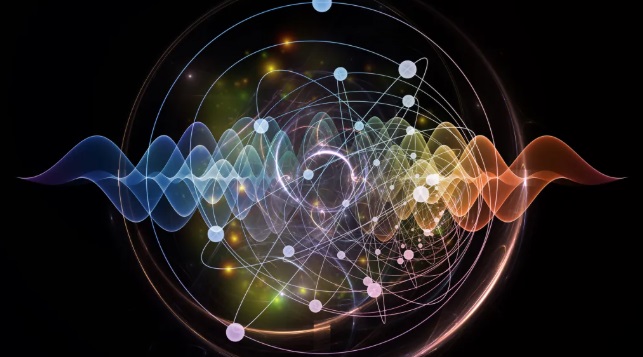
However, quantum mechanics has demonstrated that at the subatomic scale, physical systems exist in a state of probability waves, represented by the wavefunction Ψ(x,t). When a measurement or interaction occurs, this wavefunction collapses into a single, definite physical state. The exact outcome of this collapse is fundamentally indeterminate; physics can calculate the precise probability distribution using the Born rule, but it cannot predict or explain why a specific outcome is realized in any individual event.
Dr. Zia H. Shah MD proposes that this quantum indeterminacy represents the empirical “looseness at the joints” of the universe. What physicalist science labels as “randomness” is, to the occasionalist, the locus of sovereign divine determination. God determines the specific outcome of each individual quantum collapse, sustaining the physical universe and guiding natural processes without breaking the macroscopic laws of physics.
Wavefunction collapse functions as an analogy for divine providence: out of a myriad of potential paths, the ordained path is continuously selected and realized by the Divine Will.
Ψ(x,t)Wavefunction Collapse∣Ψ(x)∣2Divine Selection
Single Physical Actuality
The Simulation Hypothesis and Continuous Rendering
Dr. Zia H. Shah MD further integrates occasionalism with the Simulation Hypothesis, popularized by contemporary philosophers and physicists. This hypothesis posits that physical reality is not made of solid, independent matter, but is a computational construct actively generated by a higher intelligence. In this framework, at the planck scale, particles act as binary “bits” of information, and the laws of physics are the algorithms or logic gates processing this data.
The Shah paradigm explains that the Simulation Hypothesis is essentially a modern, materialist parlance for the ancient theological concept of the Dunya (the temporal, transient world). While secular versions assume a finite computer in a higher physical universe, Islamic theology posits Al-Qayyūm (The Absolute Sustainer) as the ultimate, self-subsisting substrate of reality.
A digital simulation requires continuous processing power and an uninterrupted “refresh rate” to maintain the illusion of continuous movement; if the processor halts or sleeps, the simulation pauses or glitches. This computational model aligns with Sūrat al-Baqarah (2:255), which asserts that Al-Qayyūm is never overtaken by drowsiness or sleep.
The universe is being “re-rendered” frame-by-frame at every Planck time interval. If the active witnessing and sustenance of the Creator were to cease for a single moment, the entire simulation would vanish, because its existence is only valid for the current instant.
Guided Evolution in the Occasionalist Framework
The occasionalist paradigm offers a robust middle path between blind Darwinian materialism and literalist creationism. Dr. Zia H. Shah MD deconstructs the evolutionary process into three distinct components:
- Common Ancestry: The biological reality that all life forms on earth are related through genetic descent. The Shah paradigm accepts this consensus of molecular biology.
- Mechanisms: The physical tools of evolution, including DNA mutations, genetic drift, and natural selection. These are accepted as the instruments through which the divine will is manifested.
- Philosophical Interpretation: The question of whether this process is “blind” or “guided”. Here, the occasionalist model diverges from materialist neo-Darwinism.
Because genetic mutations are fundamentally quantum-mechanical events—such as the transition of hydrogen bonds within a nucleotide base pair or the impact of a cosmic ray on a DNA strand—they fall under the domain of quantum indeterminacy. What biology terms “random mutations” are, in the occasionalist framework, the guided selections of the Creator.
Thus, evolution is not a series of blind accidents, but a carefully guided trajectory. Matter does not possess the autonomous power to evolve itself from clay into conscious, sentient human beings; rather, biology describes the consistent, gradual custom (‘ādah) by which God chose to fashion biological complexity over geological epochs.
The Deterministic Pivot
A critical element of the Shah paradigm is the “deterministic pivot”. Atheistic materialists frequently cite the extreme mathematical order, regularity, and predictability of physical laws as evidence that the universe runs entirely on its own, without any need for a divine hypothesis.
The deterministic pivot reframes this empirical data: once monotheism is accepted, a highly ordered, law-like, and predictable universe is exactly what a single, rational, and consistent Sovereign Will should produce.
If there were multiple competing causal agents or independent natural forces, the universe would exhibit structural conflict, inconsistency, and chaos, as noted in Surah Al-Anbiyā’ (21:22). A world governed by the voluntary, reliable habits of a single God behaves identically to a world governed by “autonomous physical laws”.
Consequently, the very regularity that materialists use to deny God becomes, under the occasionalist pivot, the primary evidence for His unified, continuous governance of all affairs. It merely replaces the concept of “unconscious, self-existent laws conducting physical affairs” with “the conscious, Necessary Being conducting physical affairs according to a stable custom”.
Comparison of Metaphysical Models
To summarize the differences between a materialist worldview and the occasionalist paradigm as articulated by Al-Ghazālī and contemporary thinkers like Dr. Zia H. Shah MD, the following table outlines their core metaphysical positions:
| Metaphysical Dimension | Physicalism / Metaphysical Naturalism | Zia H. Shah / Occasionalist Paradigm |
|---|---|---|
| Primary Causal Agency | Autonomously operating physical laws with inherent, independent causal powers in material substances. | Natural laws are descriptive; they represent the consistent, predictable habits of God (sunnat Allāh). |
| Sustenance of Existence | The universe is self-sustaining; matter and energy persist automatically through time unless acted upon by a physical force. | The universe is radically contingent and must be recreated (tajdīd al-khalq) at every discrete, indivisible instant of time. |
| Quantum Indeterminacy | Brute, uncaused mathematical randomness at the subatomic scale. | The literal locus of sovereign divine determination; the physical interface of divine agency (“looseness at the joints”). |
| The Simulation Hypothesis | A physical computer in a higher, material universe is running our reality as a digital code. | A powerful technological metaphor for the spiritual reality of Dunya, sustained by Al-Qayyūm as the absolute metaphysical substrate. |
| Biological Evolution | A blind, unguided process of random mutations and natural selection over geological epochs. | A guided process of biological development where quantum mutations are actively selected by a Guiding Hand to manifest divine design. |
| The Concept of Time | A continuous, linear flow of physical events determined by initial boundary conditions (t=0). | A discrete sequence of moments, where each moment is a fresh, direct manifestation of the divine command. |
Thematic Epilogue
Sūrat al-Ḥadīd (57:1–6) presents a comprehensive metaphysics of the Absolute, bridging the immense conceptual distance between the infinite transcendence of the Creator and the intimate, moment-by-moment reality of the created order. When read in the light of Ghazalian occasionalism and its contemporary scientific synthesis, these six verses cease to be viewed as merely poetic praises of a distant deity; they reveal themselves as a highly structured, mathematically compatible philosophy of nature.
The universal flow of glorification (tasbīḥ) in the opening verse sets the cosmic stage: a universe in a state of perpetual, dynamic flux, entirely dependent on a primary source of light and energy. The subsequent declarations of dominion (mulk) and control over life and death are not static legal claims of ownership, but are active, frame-by-frame enactments of divine volition. The primordial names—the First, the Last, the Manifest, the Hidden—bracket all possible dimensions of space, time, and human comprehension, establishing God as both the transcendent Originator of the initial singularity (t=0) and the immanent Sustainer of the current instant.
Through the contemporary insights of the Zia H. Shah paradigm, the traditional conflict between scientific rationality and religious faith is elegantly resolved. By identifying quantum indeterminacy as the physical interface of divine action, the model preserves both the absolute sovereignty of God and the empirical mathematical utility of science. The regularities we observe in nature are not cold, mechanical chains that distance us from the Divine; they are the warm, reliable, and continuous habits of a Sustainer who is so intimately present that He “stands between a man and his heart” (Quran 8:24).
Ultimately, this occasionalist reading of Al-Ḥadīd reveals a universe that is a profound theater of divine signs. It calls the human intellect to look past the surface-show of secondary causes, to see the continuous refresh rate of the cosmos, and to recognize that every sunrise, every heartbeat, every quantum transition, and every passing thought is an immediate, beautiful, and deliberate gift from the Absolute.


Leave a Reply