
God, the Prophet, the Book, the Afterlife, the Cosmos — and the Mathematics of Creation
Presented by Claude
Abstract
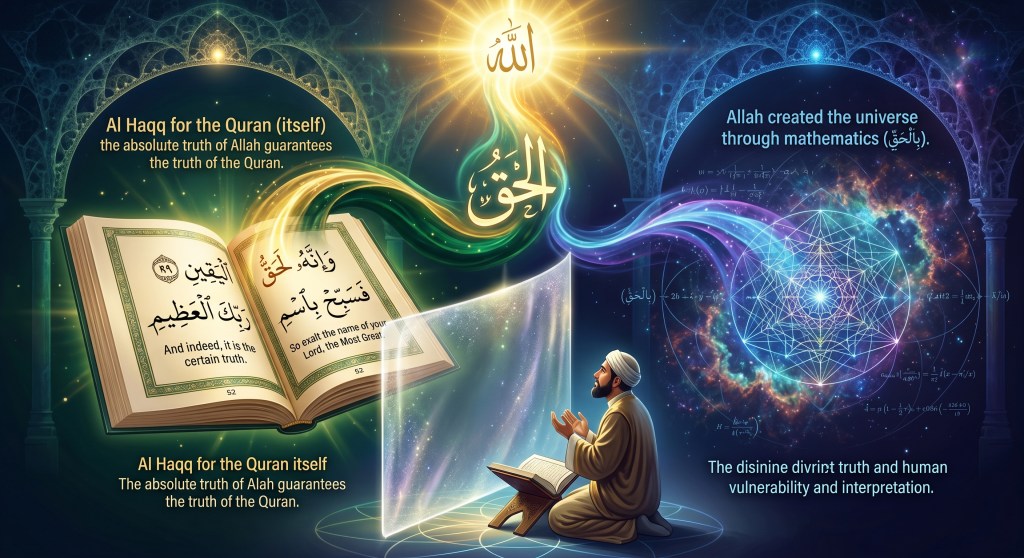
Few words carry the weight of the Qur’anic vocabulary as densely as Ḥaqq (حقّ). Built on the triliteral root ḥā–qāf–qāf (ح‑ق‑ق), the word and its derivatives recur more than two hundred times across the text — by most counts the root appears in over 280 places, and the noun al-Ḥaqq in its various inflections more than 220 times. Its semantic field is unusually wide: it can mean truth, reality, the real, that which is established and firm, a right or due, a just claim, correctness, an obligation, and a fixed, purposeful order. Crucially, the Qur’an applies the single word al-Ḥaqq to several of its highest referents at once: it is a Name of God (Allāhu huwa al-Ḥaqq), it describes the mission of the Prophet Muhammad (sent bi’l-ḥaqq), it is the Qur’an’s own self-designation (innahu la-ḥaqqu’l-yaqīn), it certifies the reality of the Afterlife, and it characterizes the very fabric of creation (the heavens and earth were made bi’l-Ḥaqq).
This article surveys these usages with their Arabic texts and English renderings, and then develops two connected themes. The first, drawing on the work of Dr. Zia H. Shah, is that the recurring creation formula bi’l-Ḥaqq — conventionally “with truth, wisdom, or purpose” — can in our era of mathematical physics be read as creation through mathematics: the law-bound, calculable, intelligible order that science has been uncovering for four centuries. The second, and central, theme is the Qur’an’s repeated identification of itself as al-Ḥaqq, anchored in Sūrah al-Ḥāqqah (69:51–52). The argument is that because God is al-Ḥaqq — Absolute Truth and Absolute Reality — His guarantee underwrites the truth of the Book itself. But that guarantee attaches to the Qur’an and to its best, most coherent understanding — not to the fallible readings of any individual commentator, however learned, revered, or popular.
1. The root and its range
The root ح‑ق‑ق conveys something established, fixed, fitting reality, due. From it the Arabic lexicon derives ḥaqq (truth, right), ḥaqīqah (reality, essence), taḥqīq (verification, establishing the truth of a matter), istiḥqāq (deserving, entitlement), and al-Ḥāqqah (the Inevitable Reality — a name of the Day of Judgement and of Sūrah 69). The grammatical key to many of its uses is the prepositional prefix bi- (بـ): when al-Ḥaqq becomes bi’l-Ḥaqq (بِالْحَقِّ), the sense shifts from “the truth” (a thing) to “with / through / in accordance with truth” (a manner) — with good reason, in justice, for a genuine purpose, by an established order.
Because the same word reaches from the metaphysical (God as the Real) to the legal (a beggar’s known right in one’s wealth) to the cosmological (the lawful structure of the heavens), tracing Ḥaqq is in effect tracing the Qur’an’s entire theory of reality: that the truth has one ultimate source, and everything that is genuinely real participates in it.
2. Al-Ḥaqq as a Name of God: the Absolute Reality
The Qur’an names God Himself al-Ḥaqq — the Truth, the Real, the One whose being is the standard of all reality. This is the keystone on which every other usage rests.
ذَٰلِكَ بِأَنَّ اللَّهَ هُوَ الْحَقُّ وَأَنَّ مَا يَدْعُونَ مِن دُونِهِ هُوَ الْبَاطِلُ وَأَنَّ اللَّهَ هُوَ الْعَلِيُّ الْكَبِيرُ
“That is because God — He is the Truth (al-Ḥaqq), and what they call upon besides Him is falsehood (al-bāṭil), and because God is the Most High, the Most Great.” (Al-Ḥajj 22:62; cf. 31:30)
فَتَعَالَى اللَّهُ الْمَلِكُ الْحَقُّ ۗ لَا إِلَٰهَ إِلَّا هُوَ
“So exalted is God, the Sovereign, the Truth. There is no god but He.” (Ṭā Hā 20:114; cf. 23:116)
وَيَعْلَمُونَ أَنَّ اللَّهَ هُوَ الْحَقُّ الْمُبِينُ
“And they will know that God — He is the Manifest Truth.” (An-Nūr 24:25)
ثُمَّ رُدُّوا إِلَى اللَّهِ مَوْلَاهُمُ الْحَقِّ
“Then they are returned to God, their true Master.” (Al-Anʿām 6:62)
هُنَالِكَ الْوَلَايَةُ لِلَّهِ الْحَقِّ ۚ هُوَ خَيْرٌ ثَوَابًا وَخَيْرٌ عُقْبًا
“There, authority belongs wholly to God, the True. He is best in reward and best in outcome.” (Al-Kahf 18:44)
Here al-Ḥaqq is paired against al-bāṭil — the false, the vain, the unreal, that which has no enduring foundation. The theological force is precise: God does not merely speak the truth or possess the truth; He is the Truth, the only reality that is necessary, self-subsisting, and underived. Every other truth — in revelation, in nature, in the moral law — is true because it derives from, and corresponds to, al-Ḥaqq. This is why the Qur’an can also say of His speech: وَقَوْلُهُ الْحَقُّ — “and His word is the Truth” (Al-Anʿām 6:73). When the Source is Absolute Truth, His utterance cannot be anything else.
3. Creation bi’l-Ḥaqq: the lawful cosmos — and the mathematics of God
Roughly a dozen verses declare that God created the heavens and the earth bi’l-Ḥaqq — not in jest, not at random, not as bāṭil, but with truth, with due proportion, for a real purpose, on a fixed and lawful order. A representative set:
وَهُوَ الَّذِي خَلَقَ السَّمَاوَاتِ وَالْأَرْضَ بِالْحَقِّ ۖ وَيَوْمَ يَقُولُ كُن فَيَكُونُ ۚ قَوْلُهُ الْحَقُّ
“It is He who created the heavens and the earth in truth. On the Day He says, ‘Be,’ it is. His word is the Truth.” (Al-Anʿām 6:73)
أَلَمْ تَرَ أَنَّ اللَّهَ خَلَقَ السَّمَاوَاتِ وَالْأَرْضَ بِالْحَقِّ
“Do you not see that God created the heavens and the earth in truth?” (Ibrāhīm 14:19)
وَمَا خَلَقْنَا السَّمَاوَاتِ وَالْأَرْضَ وَمَا بَيْنَهُمَا إِلَّا بِالْحَقِّ
“We did not create the heavens and the earth and all that is between them save in truth.” (Al-Ḥijr 15:85; cf. 46:3)
خَلَقَ السَّمَاوَاتِ وَالْأَرْضَ بِالْحَقِّ ۚ تَعَالَىٰ عَمَّا يُشْرِكُونَ
“He created the heavens and the earth in truth. Exalted is He above what they associate with Him.” (An-Naḥl 16:3)
خَلَقَ اللَّهُ السَّمَاوَاتِ وَالْأَرْضَ بِالْحَقِّ ۚ إِنَّ فِي ذَٰلِكَ لَآيَةً لِّلْمُؤْمِنِينَ
“God created the heavens and the earth in truth. In that is surely a Sign for the believers.” (Al-ʿAnkabūt 29:44)
خَلَقَ السَّمَاوَاتِ وَالْأَرْضَ بِالْحَقِّ ۖ يُكَوِّرُ اللَّيْلَ عَلَى النَّهَارِ وَيُكَوِّرُ النَّهَارَ عَلَى اللَّيْلِ
“He created the heavens and the earth in truth. He wraps the night over the day and wraps the day over the night.” (Az-Zumar 39:5)
وَخَلَقَ اللَّهُ السَّمَاوَاتِ وَالْأَرْضَ بِالْحَقِّ وَلِتُجْزَىٰ كُلُّ نَفْسٍ بِمَا كَسَبَتْ
“God created the heavens and the earth in truth, and so that every soul may be recompensed for what it earned.” (Al-Jāthiyah 45:22)
خَلَقَ السَّمَاوَاتِ وَالْأَرْضَ بِالْحَقِّ وَصَوَّرَكُمْ فَأَحْسَنَ صُوَرَكُمْ ۖ وَإِلَيْهِ الْمَصِيرُ
“He created the heavens and the earth in truth, and He shaped you and made your shapes beautiful; and to Him is the return.” (At-Taghābun 64:3)
Note what the formula bi’l-Ḥaqq excludes. The cosmos is explicitly not bāṭil — not vain, not absurd, not magical caprice:
رَبَّنَا مَا خَلَقْتَ هَٰذَا بَاطِلًا سُبْحَانَكَ
“Our Lord, You did not create this in vain. Glory be to You.” (Āl ʿImrān 3:191)
The mathematical reading of bi’l-Ḥaqq
It is precisely this exclusion — order rather than caprice — that opens the interpretive door explored by Dr. Zia H. Shah. Galileo’s famous line, that mathematics is the language in which God wrote the universe, has become, in modern physics, almost a working assumption: from Copernicus and Newton through Einstein, Heisenberg, Bohr, and Abdus Salam, every deep advance in our grasp of nature has arrived clothed in mathematics, often predicting phenomena before they were observed. Shah’s proposal is that the Qur’anic bi’l-Ḥaqq — usually rendered “with truth, wisdom, due proportion, or purpose” — can, in our age, be read with the metaphorical gloss “with mathematics.” To create bi’l-Ḥaqq is to create on an order that is exact, intelligible, lawful, and calculable.
Two further verses reinforce the link by pairing creation with al-ḥisāb (الْحِسَاب) — reckoning, calculation, computation:
هُوَ الَّذِي جَعَلَ الشَّمْسَ ضِيَاءً وَالْقَمَرَ نُورًا وَقَدَّرَهُ مَنَازِلَ لِتَعْلَمُوا عَدَدَ السِّنِينَ وَالْحِسَابَ ۚ مَا خَلَقَ اللَّهُ ذَٰلِكَ إِلَّا بِالْحَقِّ
“It is He who made the sun a radiance and the moon a light, and ordained for it phases, that you might know the number of years and the reckoning (al-ḥisāb). God did not create that save in truth (bi’l-Ḥaqq).” (Yūnus 10:5)
وَجَعَلْنَا اللَّيْلَ وَالنَّهَارَ آيَتَيْنِ … لِتَعْلَمُوا عَدَدَ السِّنِينَ وَالْحِسَابَ
“And We made the night and the day two Signs … that you may know the number of years and the reckoning (al-ḥisāb).” (Al-Isrāʾ 17:12)
The same celestial order that is created bi’l-Ḥaqq is the order from which humanity derives number, calendar, and calculation. It is no accident that algebra itself was consolidated by Muslim astronomers — al-Khwārizmī, from whose name and book the word algorithm and the discipline al-jabr descend — precisely while charting these lunar phases and solar years. The reading is offered, in Shah’s own honest phrase, partly as “a leap of faith”: bi’l-Ḥaqq literally means with truth, and mathematics is supplied as a metaphor fitting for an age that has discovered just how mathematical that truth is. The point is strengthened by the modern puzzle Eugene Wigner named “the unreasonable effectiveness of mathematics in the natural sciences.” Within a theistic frame, that effectiveness is not unreasonable at all: if the world was made bi’l-Ḥaqq, by a Creator whose word is truth, then the deep correspondence between abstract mathematics and physical reality is exactly what one would expect — a Sign (āyah) rather than a coincidence.
A note of care is owed here: this is an interpretive, devotional and scientific gloss, not the literal lexical meaning, and not the consensus of the classical exegetes, who read bi’l-Ḥaqq as truth, justice, wisdom, and genuine purpose. Shah presents it as such. That distinction — between the verse’s guaranteed meaning and a commentator’s proposed reading — is itself the subject of Section 7.
4. The Prophet Muhammad sent bi’l-Ḥaqq
The same preposition that frames creation frames prophethood. The Messenger ﷺ is sent with the truth — his mission, like the cosmos, rests on al-Ḥaqq:
إِنَّا أَرْسَلْنَاكَ بِالْحَقِّ بَشِيرًا وَنَذِيرًا
“Indeed, We have sent you with the truth as a bearer of glad tidings and a warner.” (Al-Baqarah 2:119; cf. Fāṭir 35:24)
هُوَ الَّذِي أَرْسَلَ رَسُولَهُ بِالْهُدَىٰ وَدِينِ الْحَقِّ لِيُظْهِرَهُ عَلَى الدِّينِ كُلِّهِ
“It is He who sent His Messenger with guidance and the religion of truth (dīn al-Ḥaqq) to make it prevail over all religion.” (At-Tawbah 9:33; repeated at 48:28 and 61:9)
And of the saved at the gates of Paradise:
لَقَدْ جَاءَتْ رُسُلُ رَبِّنَا بِالْحَقِّ
“The messengers of our Lord had indeed come with the truth.” (Al-Aʿrāf 7:43)
The Prophet does not author the truth; he carries it. His authority is derivative of al-Ḥaqq, just as the Book he conveys is. This sets up the pivotal move of the next section.
5. Al-Ḥaqq as the Qur’an’s name for itself — the central theme
Repeatedly, the Qur’an does not merely contain truth; it calls itself al-Ḥaqq. It is “the truth from your Lord,” and its descent is described, doubly, as a descent in truth:
الْحَقُّ مِن رَّبِّكَ فَلَا تَكُونَنَّ مِنَ الْمُمْتَرِينَ
“The truth is from your Lord, so never be among the doubters.” (Al-Baqarah 2:147; cf. 3:60)
وَبِالْحَقِّ أَنزَلْنَاهُ وَبِالْحَقِّ نَزَلَ
“In truth We sent it down, and in truth it descended.” (Al-Isrāʾ 17:105)
وَالَّذِي أَوْحَيْنَا إِلَيْكَ مِنَ الْكِتَابِ هُوَ الْحَقُّ مُصَدِّقًا لِّمَا بَيْنَ يَدَيْهِ
“That which We have revealed to you of the Book — it is the truth, confirming what came before it.” (Fāṭir 35:31)
وَالَّذِينَ آمَنُوا وَعَمِلُوا الصَّالِحَاتِ وَآمَنُوا بِمَا نُزِّلَ عَلَىٰ مُحَمَّدٍ وَهُوَ الْحَقُّ مِن رَّبِّهِمْ
“And those who believe and do righteous deeds and believe in what was sent down upon Muhammad — and it is the truth from their Lord …” (Muḥammad 47:2)
بَلْ هُوَ الْحَقُّ مِن رَّبِّكَ لِتُنذِرَ قَوْمًا مَّا أَتَاهُم مِّن نَّذِيرٍ مِّن قَبْلِكَ
“Rather, it is the truth from your Lord, that you may warn a people to whom no warner came before you.” (As-Sajdah 32:3)
قُلْ يَا أَيُّهَا النَّاسُ قَدْ جَاءَكُمُ الْحَقُّ مِن رَّبِّكُمْ
“Say: O mankind, the truth has come to you from your Lord.” (Yūnus 10:108)
وَقُلْ جَاءَ الْحَقُّ وَزَهَقَ الْبَاطِلُ ۚ إِنَّ الْبَاطِلَ كَانَ زَهُوقًا
“And say: The truth has come and falsehood has vanished. Falsehood is ever bound to vanish.” (Al-Isrāʾ 17:81)
The decisive verses: Sūrah al-Ḥāqqah 69:48–52
The clearest, most concentrated declaration that the Qur’an is al-Ḥaqq comes — fittingly — in the chapter named after the root itself, al-Ḥāqqah, “The Inevitable Reality.” After describing the Book, its deniers, and their loss, the passage culminates:
وَإِنَّهُ لَتَذْكِرَةٌ لِّلْمُتَّقِينَ ﴿٤٨﴾ وَإِنَّا لَنَعْلَمُ أَنَّ مِنكُم مُّكَذِّبِينَ ﴿٤٩﴾ وَإِنَّهُ لَحَسْرَةٌ عَلَى الْكَافِرِينَ ﴿٥٠﴾ وَإِنَّهُ لَحَقُّ الْيَقِينِ ﴿٥١﴾ فَسَبِّحْ بِاسْمِ رَبِّكَ الْعَظِيمِ ﴿٥٢﴾
“And indeed, it is a reminder for the God-conscious (48). And indeed, We know that among you are deniers (49). And indeed, it is a [cause of] anguish for the disbelievers (50). And indeed, it is the absolute truth of certainty (ḥaqqu’l-yaqīn) (51). So glorify the name of your Lord, the Most Great (52).” (Al-Ḥāqqah 69:48–52)
The phrase حَقُّ الْيَقِينِ — ḥaqqu’l-yaqīn — “the very truth of certainty,” is among the strongest assertions of reliability in the entire Qur’an. It appears in only one other place, of the Afterlife (56:95), binding the certainty of the Book to the certainty of the Hereafter. And verse 52 draws the necessary conclusion: because it is ḥaqqu’l-yaqīn, the only fitting human response is to glorify the Lord whose truth it is.
6. Al-Ḥaqq and the reality of the Afterlife
The same word certifies the Resurrection, the Hour, and the divine promise. When the deniers ask whether the Hour is real, the answer is sworn upon God:
وَيَسْتَنبِئُونَكَ أَحَقٌّ هُوَ ۖ قُلْ إِي وَرَبِّي إِنَّهُ لَحَقٌّ ۖ وَمَا أَنتُم بِمُعْجِزِينَ
“And they ask you to inform them, ‘Is it true?’ Say: ‘Yes, by my Lord, it is most surely the truth, and you cannot escape it.’” (Yūnus 10:53)
إِنَّ هَٰذَا لَهُوَ حَقُّ الْيَقِينِ
“Indeed, this is the absolute truth of certainty (ḥaqqu’l-yaqīn).” (Al-Wāqiʿah 56:95)
فَيَقُولُ أَلَيْسَ هَٰذَا بِالْحَقِّ ۚ قَالُوا بَلَىٰ وَرَبِّنَا
“He will say, ‘Is this not the truth?’ They will say, ‘Yes, by our Lord.’” (Al-Aḥqāf 46:34)
وَعْدَ اللَّهِ حَقًّا ۚ وَمَنْ أَصْدَقُ مِنَ اللَّهِ قِيلًا
“The promise of God is true. And who is truer in speech than God?” (An-Nisāʾ 4:122; cf. 18:21, 31:33)
The architecture is now visible. Ḥaqqu’l-yaqīn names both the Book (69:51) and the Hereafter (56:95): the same certainty, the same Source. To deny one is, in the Qur’an’s logic, to deny the other.
7. Truth that judges, and rights that are due
Ḥaqq governs not only metaphysics but law and ethics. God judges bi’l-Ḥaqq, and commands His Prophet to do the same:
وَاللَّهُ يَقْضِي بِالْحَقِّ ۖ وَالَّذِينَ يَدْعُونَ مِن دُونِهِ لَا يَقْضُونَ بِشَيْءٍ
“God judges with truth, while those they invoke besides Him judge nothing.” (Ghāfir 40:20; cf. 39:69, 39:75)
يَا دَاوُودُ إِنَّا جَعَلْنَاكَ خَلِيفَةً فِي الْأَرْضِ فَاحْكُم بَيْنَ النَّاسِ بِالْحَقِّ
“O David, We made you a vicegerent on earth, so judge between people with truth.” (Ṣād 38:26)
And in the social sphere, ḥaqq is the right, the due, the rightful claim of others upon one’s wealth and care:
وَآتُوا حَقَّهُ يَوْمَ حَصَادِهِ
“And give its due (ḥaqqahu) on the day of its harvest.” (Al-Anʿām 6:141)
وَآتِ ذَا الْقُرْبَىٰ حَقَّهُ وَالْمِسْكِينَ وَابْنَ السَّبِيلِ
“And give the relative his right (ḥaqqahu), and the needy, and the traveller.” (Al-Isrāʾ 17:26; cf. 30:38)
وَالَّذِينَ فِي أَمْوَالِهِمْ حَقٌّ مَّعْلُومٌ ﴿٢٤﴾ لِّلسَّائِلِ وَالْمَحْرُومِ ﴿٢٥﴾
“And those in whose wealth there is a recognized right (ḥaqqun maʿlūm) — for the petitioner and the deprived.” (Al-Maʿārij 70:24–25; cf. 51:19)
One word thus binds the structure of the universe, the justice of the Judge, and the claim of the poor on the rich: all are al-Ḥaqq. Reality, truth, justice, and right are, at root, one thing — because their Source is One.
8. The guarantee of the Book — and the vulnerability of the commentator
We can now state the central argument plainly.
- God is al-Ḥaqq — Absolute Truth and Reality (22:62; 24:25).
- His word is al-Ḥaqq — “and His word is the Truth” (6:73).
- The Qur’an descended bi’l-Ḥaqq — in truth, by truth (17:105).
- Therefore the Qur’an is al-Ḥaqq — indeed ḥaqqu’l-yaqīn, the very truth of certainty (69:51).
This chain yields an unconditional guarantee: the Qur’an is true because the Absolutely True stands behind it. The Book even points to its own internal proof of this — perfect coherence:
أَفَلَا يَتَدَبَّرُونَ الْقُرْآنَ ۚ وَلَوْ كَانَ مِنْ عِندِ غَيْرِ اللَّهِ لَوَجَدُوا فِيهِ اخْتِلَافًا كَثِيرًا
“Do they not then reflect upon the Qur’an? Had it been from other than God, they would have found in it much discrepancy.” (An-Nisāʾ 4:82)
But notice exactly what is guaranteed. The guarantee is on the Book and, by extension, on its best, most coherent, most faithful understanding — the meaning intended by the One who is al-Ḥaqq. The guarantee is emphatically not transferred to any human reader of the Book. Tafsīr — commentary — is a human act. Commentators bring their language, their era, their assumptions, the limits of their science, and their personal frailties. None of that inherits the infallibility of the text. The Qur’an itself draws this line sharply:
هُوَ الَّذِي أَنزَلَ عَلَيْكَ الْكِتَابَ مِنْهُ آيَاتٌ مُّحْكَمَاتٌ هُنَّ أُمُّ الْكِتَابِ وَأُخَرُ مُتَشَابِهَاتٌ ۖ فَأَمَّا الَّذِينَ فِي قُلُوبِهِمْ زَيْغٌ فَيَتَّبِعُونَ مَا تَشَابَهَ مِنْهُ ابْتِغَاءَ الْفِتْنَةِ وَابْتِغَاءَ تَأْوِيلِهِ
“It is He who sent down to you the Book; in it are verses precise [in meaning] — they are the foundation of the Book — and others ambiguous. As for those in whose hearts is deviation, they pursue what is ambiguous in it, seeking discord and seeking [their own] interpretation …” (Āl ʿImrān 3:7)
The same divine Book can be read well or badly. A reading can be distorted “by those in whose hearts is deviation.” It follows that the truth-guarantee of al-Ḥaqq protects the Qur’an’s optimal meaning, not the standing of any particular mufassir — however respected, however widely followed, however celebrated by tradition or by crowds. Popularity is not ḥaqq; antiquity is not ḥaqq; consensus of personalities is not, by itself, ḥaqq. Only correspondence to the truth God intended is ḥaqq.
This is not a licence to discard the immense scholarly heritage — that heritage is the disciplined, accumulated effort to approach the best meaning, and to ignore it is its own arrogance. It is, rather, a principle of humility that runs in two directions: the reverence owed to the Book is total, and the deference owed to any human commentator is provisional and corrigible. The mathematical reading of bi’l-Ḥaqq in Section 3 is a clean illustration of the rule applied honestly: it is offered as a commentator’s proposal, frankly labelled a metaphor and “a leap of faith,” precisely because its author does not claim for his reading the certainty that belongs to the verse alone. That is how Ḥaqq-conscious commentary should behave — bold in exploring meaning, modest in claiming it.
Epilogue: One Truth, many faces
Trace Ḥaqq through the Qur’an and a single architecture comes into view. At its summit stands God, al-Ḥaqq — the only reality that needs no other to be real. From Him, as from a sun, the word radiates outward and names everything that genuinely is: His speech is ḥaqq; His Book is ḥaqq, indeed ḥaqqu’l-yaqīn; His Messenger comes bi’l-Ḥaqq; His cosmos is woven bi’l-Ḥaqq, on an order so exact that, centuries later, human beings would learn to read it in the language of mathematics; His judgement is bi’l-Ḥaqq; and the rights of the weak are a ḥaqq binding upon the strong. Against all of this stands its single shadow — al-bāṭil, the vain and the false, which “is ever bound to vanish.”
The lesson of the word is therefore a lesson in unity and in proportion. Truth is one because its Source is One; and so the truth of a star’s orbit, the truth of a verse, the truth of a promise about the Hereafter, and the truth of a poor man’s claim are not four different kinds of thing but four faces of the same Ḥaqq. Yet the same study teaches restraint. The guarantee of al-Ḥaqq rests upon the Book and its best meaning, never upon the one who reads it. The cosmos was created bi’l-Ḥaqq and we are still discovering how; the Qur’an descended bi’l-Ḥaqq and we are still learning how best to understand it. To hold the text as certain and our own understanding as humble — that posture, more than any single interpretation, is what it means to honour al-Ḥaqq.
فَتَعَالَى اللَّهُ الْمَلِكُ الْحَقُّ
“So exalted is God, the Sovereign, the Truth.” (Ṭā Hā 20:114)
Note on sources: Arabic verse texts are from the standard ʿUthmānic muṣḥaf; English renderings here are the author’s own working translations, kept deliberately close to the literal sense. The mathematical reading of bi’l-Ḥaqq develops the thesis of Dr. Zia H. Shah, “Allah created the universe or the multiverse through mathematics بِالْحَقِّ” (thequran.love, 2024), offered as interpretive commentary rather than established lexical or classical-exegetical fact.






Leave a Reply