
Presented by Claude
- Quran 45:27–32 is the climactic “reckoning” passage of Surah al-Jathiyah: God’s sovereignty (v.27), every nation kneeling and summoned to its book of deeds (v.28), the divine record that “speaks against you in truth” because “We were transcribing what you used to do” (v.29), the bifurcation into mercy (v.30) and the indictment of arrogance (v.31), and the closing rebuke of those who treated the Hour as mere conjecture/zann (v.32). The double mention of the “book” in vv.28–29 is explained classically by the philology of istinsākh (copying from a master register) and by istiʾnāf bayānī (v.29 explains how the book can testify truthfully).
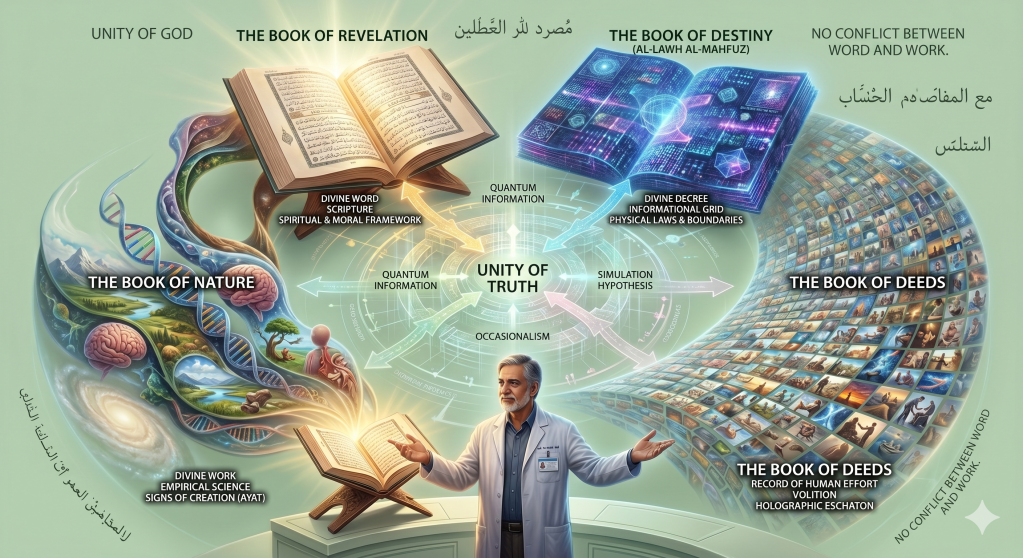
- Dr. Zia H. Shah’s “Four Books of God” thesis maps four Quranic “inscribed realities” — Revelation, Nature, Destiny (al-Lawh al-Mahfuz), and Deeds (Kitab al-Aʿmal) — onto four modern frameworks (REM-sleep neurobiology; al-Ghazali’s occasionalism; the simulation hypothesis; quantum information theory). Verse 45:29’s nastansikhu anchors his “Book of Deeds,” which he reads through information conservation and the “Holographic Eschaton.”
- The strongest, most defensible synthesis is the structural resonance between the inerrant Quranic record (“not a letter added or deleted,” per Ibn Kathir) and the physics of information conservation (quantum unitarity, the no-hiding theorem, block-universe eternalism). The weaker, contested claims are the concordist/apologetic identifications (Bucailleism) and the Lahore-Ahmadiyya this-worldly reading of v.28 — both flagged below as requiring provenance caveats.
Key Findings
- The six verses form a tight forensic sequence: sovereignty → kneeling → the speaking record → verdict (mercy / condemnation) → the epistemic root of denial (zann). The thequran.love commentary frames al-Jathiyah as “a single extended argument moving in three movements: from the Book of the Cosmos, to the Book of the Soul, to the Book of the Record,” with vv.27–32 as the third movement.
- The pivotal philological datum is nastansikhu (Form X of n-s-kh): it denotes copying from a pre-existing original. The Ibn ʿAbbas dictum — “does istinsākh occur except from an original (aṣl)?” — is the engine of the classical “two-record” theology, in which guardian-angels’ real-time record is collated against a master register descended from al-Lawh al-Mahfuz, matching perfectly.
- Classical exegetes uniformly read “the book speaks” (yanṭiqu) as figurative — istiʿāra (the book “makes clear/testifies”) or majāz ʿaqlī (the reckoning-angels actually pronounce its contents), cross-referenced to 23:62 (“with Us is a Book that speaks the truth”) and 18:49.
- Verse 32’s zann (conjecture) vs. ḥaqq (certain truth) opens a genuine epistemological theme — the three grades of certainty (ʿilm/ʿayn/ḥaqq al-yaqīn) — that Shah and others connect to the limits of naturalistic claims about the afterlife.
- Shah’s “Four Books” is a modern fourfold extension of the classical “two books” (Revelation + Nature) metaphor, adding Destiny and Deeds; verse 45:29 is one of his named anchors for the Book of Deeds, which he reads through quantum information theory and the conservation of information.
Details
1. The Six Verses: Arabic, Transliteration, and Six Translations
45:27
Arabic: وَلِلَّهِ مُلْكُ ٱلسَّمَٰوَٰتِ وَٱلْأَرْضِ ۚ وَيَوْمَ تَقُومُ ٱلسَّاعَةُ يَوْمَئِذٍ يَخْسَرُ ٱلْمُبْطِلُونَ Transliteration: Wa lillāhi mulku s-samāwāti wa’l-arḍ; wa yawma taqūmu s-sāʿatu yawmaʾidhin yakhsaru’l-mubṭilūn.
- Sahih International: “And to Allah belongs the dominion of the heavens and the earth. And the Day the Hour appears – that Day the falsifiers will lose.”
- Yusuf Ali: “To Allah belongs the dominion of the heavens and the earth, and the Day that the Hour of Judgment is established,- that Day will the dealers in Falsehood perish!”
- Pickthall: “And unto Allah belongeth the Sovereignty of the heavens and the earth; and on the day when the Hour riseth, on that day those who follow falsehood will be lost.”
- Asad: “For, God’s is the dominion over the heavens and the earth; and on the Day when the Last Hour dawns – on that Day will be lost all who [in their lifetime] tried to reduce to nothing [whatever they could not understand].”
- Maududi: “Allah’s is the kingdom of the heavens and the earth, and on the Day when the Hour (of Resurrection) shall come to pass, the followers of falsehood shall be in utter loss.” Islamic Studies
- Maulana Muhammad Ali (Lahore): “And Allah’s is the kingdom of the heavens and the earth. And on the day when the Hour comes to pass, on that day will the followers of falsehood perish.” Ahmadiyya
45:28
Arabic: وَتَرَىٰ كُلَّ أُمَّةٍ جَاثِيَةً ۚ كُلُّ أُمَّةٍ تُدْعَىٰٓ إِلَىٰ كِتَٰبِهَا ٱلْيَوْمَ تُجْزَوْنَ مَا كُنتُمْ تَعْمَلُونَ Transliteration: Wa tarā kulla ummatin jāthiyah; kullu ummatin tudʿā ilā kitābihā; al-yawma tujzawna mā kuntum taʿmalūn.
- Sahih International: “And you will see every nation kneeling [from fear]. Every nation will be called to its record [and told], ‘Today you will be recompensed for what you used to do.’” Quran O
- Yusuf Ali: “And thou wilt see every sect bowing the knee: every sect will be called to its Record: ‘This Day shall ye be recompensed for all that ye did!’”
- Pickthall: “And thou wilt see each nation crouching, each nation summoned to its record. (And it will be said unto them): This day ye are requited what ye used to do.” Islam Awakened
- Asad: “And [on that Day] thou wilt see all people kneeling down [in humility]: all people will be called upon to [face] their record: ‘Today you shall be requited for all that you ever did!’” Islam Awakened
- Maududi: “On that Day you shall see every people fallen on their knees. Every people will be summoned to come forth and see its Record and will be told: ‘Today you shall be requited for your deeds.’” Islamic Studies
- Maulana Muhammad Ali (Lahore): “And you will see every nation kneeling down. Every nation will be called to its record. This day you are recompensed for what you did.” Ahmadiyya
45:29
Arabic: هَٰذَا كِتَٰبُنَا يَنطِقُ عَلَيْكُم بِٱلْحَقِّ ۚ إِنَّا كُنَّا نَسْتَنسِخُ مَا كُنتُمْ تَعْمَلُونَ Transliteration: Hādhā kitābunā yanṭiqu ʿalaykum bi’l-ḥaqq; innā kunnā nastansikhu mā kuntum taʿmalūn.
- Sahih International: “This, Our record, speaks about you in truth. Indeed, We were having transcribed whatever you used to do.” My Islam
- Yusuf Ali: “This Our Record speaks about you with truth: For We were wont to put on Record all that ye did.” My Islam
- Pickthall: “This Our Book pronounceth against you with truth. Lo! We have caused (all) that ye did to be recorded.” My Islam
- Asad: “This Our record speaks of you in all truth: for, verily, We have caused to be recorded all that you ever did!” Islam Awakened
- Maududi: “This is Our Record which bears witness against you with truth; We used to record all what you did.” My IslamIslamic Studies
- Maulana Muhammad Ali (Lahore): “This is Our record that speaks against you with truth. Surely We wrote what you did.” alahmadiyyaIslamAwakened
45:30
Arabic: فَأَمَّا ٱلَّذِينَ ءَامَنُوا۟ وَعَمِلُوا۟ ٱلصَّٰلِحَٰتِ فَيُدْخِلُهُمْ رَبُّهُمْ فِى رَحْمَتِهِۦ ۚ ذَٰلِكَ هُوَ ٱلْفَوْزُ ٱلْمُبِينُ Transliteration: Fa-ammā’lladhīna āmanū wa ʿamilū’ṣ-ṣāliḥāti fa-yudkhiluhum rabbuhum fī raḥmatih; dhālika huwa’l-fawzu’l-mubīn.
- Sahih International: “So as for those who believed and did righteous deeds, their Lord will admit them into His mercy. That is what is the clear attainment.”
- Yusuf Ali: “Then, as to those who believed and did righteous deeds, their Lord will admit them to His Mercy: that will be the achievement for all to see.”
- Pickthall: “Then, as for those who believed and did good works, their Lord will bring them in unto His mercy. That is the evident triumph.”
- Asad: “Now as for those who have attained to faith and done righteous deeds, their Sustainer will admit them to His grace: that will be [their] manifest triumph!” Islam Awakened
- Maududi: “As for those who believe and act righteously, their Lord shall admit them to His Mercy. That indeed is the manifest triumph.”
- Maulana Muhammad Ali (Lahore): “Then as to those who believed and did good, their Lord will admit them to His mercy. That is the manifest achievement.”
45:31
Arabic: وَأَمَّا ٱلَّذِينَ كَفَرُوٓا۟ أَفَلَمْ تَكُنْ ءَايَٰتِى تُتْلَىٰ عَلَيْكُمْ فَٱسْتَكْبَرْتُمْ وَكُنتُمْ قَوْمًا مُّجْرِمِينَ Transliteration: Wa ammā’lladhīna kafarū a-fa-lam takun āyātī tutlā ʿalaykum fa’stakbartum wa kuntum qawman mujrimīn.
- Sahih International: “But as for those who disbelieved, [it will be said], ‘Were not My verses recited to you, but you were arrogant and became a people of criminals?’”
- Yusuf Ali: “But as to those who rejected Allah, (to them will be said): ‘Were not Our Signs rehearsed to you? But ye were arrogant, and were a people given to sin!’”
- Pickthall: “And as for those who disbelieved (it will be said unto them): Were not Our revelations recited unto you? But ye were scornful and became a guilty folk.”
- Asad: “But as for those who were bent on denying the truth, [they will be told:] ‘Were not My messages conveyed to you? And withal, you gloried in your arrogance, and so you became people lost in sin.’”
- Maududi: “But those who disbelieved, they will be told: ‘Were My Signs not rehearsed to you? But you waxed proud and became a guilty people.’”
- Maulana Muhammad Ali (Lahore): “And as to those who disbelieved — were not My messages recited to you? But you were proud and you were a guilty people.” alahmadiyya
45:32
Arabic: وَإِذَا قِيلَ إِنَّ وَعْدَ ٱللَّهِ حَقٌّ وَٱلسَّاعَةُ لَا رَيْبَ فِيهَا قُلْتُم مَّا نَدْرِى مَا ٱلسَّاعَةُ إِن نَّظُنُّ إِلَّا ظَنًّا وَمَا نَحْنُ بِمُسْتَيْقِنِينَ Transliteration: Wa idhā qīla inna waʿda’llāhi ḥaqqun wa’s-sāʿatu lā rayba fīhā qultum mā nadrī ma’s-sāʿatu in naẓunnu illā ẓannan wa mā naḥnu bi-mustayqinīn.
- Sahih International: “And when it was said, ‘Indeed, the promise of Allah is truth and the Hour [is coming] – no doubt about it,’ you said, ‘We know not what is the Hour. We assume only assumption, and we are not convinced.’”
- Yusuf Ali: “And when it was said that the promise of Allah was true, and that the Hour- there was no doubt about its (coming), ye used to say, ‘We know not what is the hour: we only think it is an idea, and we have no firm assurance.’”
- Pickthall: “And when it was said: Lo! Allah’s promise is the truth, and there is no doubt of the Hour’s coming, ye said: We know not what the Hour is. We deem it naught but a conjecture, and we are by no means convinced.” My Islam
- Asad: “for when it was said, ‘Behold, God’s promise always comes true, and there can be no doubt about [the coming of] the Last Hour’ – you would answer, ‘We do not know what that Last Hour may be: we think it is no more than an empty guess, and [so] we are by no means convinced!’”
- Maududi: “And when it was said to them: ‘Surely Allah’s promise is true, and there is no doubt regarding the Hour of Resurrection,’ you were wont to say: ‘We do not know what the Hour (of Resurrection) is. We are simply making conjectures and are not at all certain.’” My Islam
- Maulana Muhammad Ali (Lahore): “And when it was said, Surely the promise of Allah is true and the Hour — there is no doubt about it, you said: We do not know what the Hour is. We think (it) only a conjecture and we are not at all sure.” alahmadiyya
Translation sources: quran.com, legacy.quran.com, islamawakened.com (Asad and 70+ parallels), islamicstudies.info (Maududi/Tafhim), alahmadiyya.org and en.wikisource.org (Maulana Muhammad Ali, 2010 edition).
2. Surah al-Jathiyah: Context and Structure
Al-Jathiyah (“The Kneeling”) is Chapter 45, a Meccan surah of 37 verses, the sixth of the seven Ḥā-Mīm chapters (Ghāfir, Fuṣṣilat, al-Shūrā, al-Zukhruf, al-Dukhān, al-Jāthiyah, al-Aḥqāf). It takes its name from verse 28’s image of every nation jāthiyah (crouching on its knees). Its alternate name is al-Dahr (“Time”), from verse 24. Per the Egyptian chronology it follows al-Dukhan (65th in revelation order); the Nöldeke chronology places it 72nd, after Fussilat (Wikipedia, “Al-Jathiya”). It was revealed around the 4th–7th year of prophethood.
Major themes: signs of God in nature (vv.3–6, 12–13), accountability and the Day of Judgment, the refutation of materialism (Dahr, v.24: “nothing but time destroys us”), and the supreme sin of making one’s own desire (hawā) a god (v.23). Verse 22 is the surah’s pivot — “God created the heavens and the earth bi’l-ḥaqq … to repay each soul according to its deeds” — which al-Razi reads as the metaphysical answer to verse 21: if creation has purpose, justice must be real; if justice must be real, there must be a Day. Verses 27–32 are the surah’s climax: the public reckoning.
3. Classical Tafsir on 45:27–32
Verse 27 — al-mubṭilūn. The verse asserts God’s absolute sovereignty (mulk) in this world and the next. Maududi: since God controls the entire universe, He is doubtlessly capable of resurrecting the dead. Al-mubṭilūn = “the followers/dealers of falsehood,” those who built their lives on what was not real (Asad renders it expansively as those “who tried to reduce to nothing whatever they could not understand”).
Verse 28 — jāthiyah and “every nation called to its book.” Ibn Kathir: “And you will see each nation humbled to their knees (Jathiyah), kneeling, fearful of the tremendous calamity.” He preserves the tradition that when Hellfire is brought forth and exhales but once, every soul — even the prophets Ibrahim and ʿIsa — will crouch in awe, each crying “Nafsī, nafsī” (myself, myself). On kullu ummatin tudʿā ilā kitābihā, Ibn Kathir glosses kitāb as “Record of deeds,” citing 39:69 (“And the Book will be presented…”).
Al-Qurtubi gives several senses for kitābihā in v.28: its reckoning (ḥisāb); the book in which its good and evil deeds were transcribed (yastansikhu lahā — attributed to Muqatil/Mujahid); what the angels wrote against it; the revealed scripture sent to it; or al-Lawh al-Mahfuz. He notes Yaʿqub al-Hadrami’s variant accusative reading of kulla ummatin in v.28 as a badal (grammatical substitution).
Maududi (note 41): “People will be filled with such awe and dread in the Grand Assembly … that they will give up their boasting and arrogance. They will surrender themselves, meekly and humbly, before God.”
Maulana Muhammad Ali (Lahore Ahmadiyya) offers a distinctive, this-worldly reading: “That every nation shall have a book or a record of its deeds shows that nations are also judged according to their deeds. But nations are judged in this life, therefore the day on which every nation is called to its record is the day of its doom. The words — you will see every nation kneeling down — hint at a great spiritual awakening being brought about in the world.” This minority/sectarian reading diverges from mainstream Sunni eschatological tafsir and must be flagged as such.
Verse 29 — “This Our book speaks against you in truth; We were transcribing.” This is the philological and theological heart of the passage.
On “yanṭiqu” (the book “speaks”): All classical authorities treat this as figurative.
- Al-Qurtubi: “yanṭiqu ʿalaykum bi’l-ḥaqq = it testifies (yashhad). It is a metaphor (istiʿāra): one says ‘the book spoke of such-and-such’ meaning it made it clear (bayyana). And it is said: they read it, and the book reminds them of what they did, so it is as though it speaks against them” — citing 18:49 and 23:62 (“wa ladaynā kitābun yanṭiqu bi’l-ḥaqq” — “with Us is a Book that speaks the truth”).
- Ibn ʿAshur (al-Tahrir wa’l-Tanwir): “Ascribing speech to the Book is a majāz ʿaqlī (rational metaphor): it is really the reckoning-angels who pronounce what is in the Book; or ‘speech’ is borrowed for ‘indication,’ as in the expression naṭaqat al-ḥāl (‘the situation spoke’).”
- Al-Baghawi: “it testifies against you with a thorough clarification, so it is as if it speaks (ka-annahu yanṭiq).”
- Ibn Kathir: on yanṭiqu, “it brings forth all your deeds with no addition or subtraction,” citing 18:49. surahquran
On “nastansikhu” (n-s-kh, transcribe) and the “two-record” interpretation: The decisive point, repeated across the tradition, is that istinsākh (Form X) implies copying from a pre-existing master — the Ibn ʿAbbas dictum “does istinsākh occur except from an original (aṣl)?” (وهل يكون الاستنساخ إلا من أصل), quoted by al-Tabari, al-Qurtubi, and al-Baghawi.
- Al-Tabari: plain gloss — “We had Our recording-angels write down your deeds, so they fix them in the books and write them”; but transmits the Ibn ʿAbbas material identifying the Book with Umm al-Kitab, plus the “al-Nun wa’l-qalam” report in which guardian-angels “copy each day from the keepers (khuzzan).”
- Al-Qurtubi (fullest two-record model): “God appointed purified angels who copy out from Umm al-Kitab, in Ramadan, everything that will be of the deeds of mankind; then they collate (yuʿāriḍūn) against God’s guardian-angels over the servants every Thursday, and find what the guardians brought matching exactly what is in their book copied from that [master] Book, with no addition or subtraction.” He also cites al-Hasan al-Basri (the guardians raise the scrolls to the keepers) and the view that neutral/permissible acts (mubāḥāt) are not transferred to the “second copy” (al-nuskha al-thāniya).
- Ibn Kathir (explicit Lawh al-Mahfuz collation): “The angels record the deeds of the servants and then ascend to heaven … There they meet the angels entrusted with the Records sent down from al-Lawh al-Mahfuz on each Night of al-Qadr, containing what Allah has written will occur from the servants long before He created them. They will compare their records and find that not a single letter was added or deleted.“
- Al-Zamakhshari (al-Kashshaf): resolves the double attribution of the Book (to the nations in v.28, to God in v.29) by mulābasa (association): “associated with them because their deeds are fixed in it; with God because He is its Owner and commanded His angels to write.” Reads nastansikhu as “We have the angels write down your deeds for us (nastaktibuhum aʿmālakum),” without stressing the master-copy idea. Islamic Book
- Al-Baghawi: offers the cleanest “book copied from a book” (kitāb min kitāb) formula; lists al-Daḥḥak (“we affirm”), al-Suddi (“we write”), al-Hasan (“we preserve”).
- Al-Wahidi / al-Shawkani: report that “the majority of exegetes (akthar al-mufassirin) hold that this istinsākh is from al-Lawh al-Mahfuz … because istinsākh occurs only from an original.”
- Al-Razi (Mafatih al-Ghayb) — CAVEAT: a clean verbatim block on 45:29 could not be confirmed (digitized copies are OCR-corrupted). His “two-record/collation” framing is inferred from an adjacent passage in the same tafsir on the purpose of the pre-written register — that the master Book exists “so that the angels charged with al-Lawh al-Mahfuz collate against it what occurs in the scroll of this world and find it matching.” Verify against a print edition (Dar Ihya al-Turath, vol. 27) before quoting.
Why the record is referenced twice (vv.28–29): Ibn ʿAshur explains v.29’s “innā kunnā nastansikhu…” as an istiʾnāf bayānī (explanatory resumption) answering the implicit question raised by v.28: how can the Book testify today about deeds done long ago? Answer: because God had the deeds copied into the scrolls at the very time of action. The two mentions are not two competing books: v.28’s kitāb = each nation’s scroll of deeds (or its scripture/reckoning), and v.29’s “Our kitāb” shifts attribution to God and supplies the explanatory clause grounding how the Book bears truthful witness.
Verse 30 — believers admitted to mercy (raḥmah). Paradise is named raḥmah; entry is by God’s mercy, not by earning. This is al-fawz al-mubīn, the manifest triumph.
Verse 31 — the disbelievers: arrogance (istikbār) and crime (ijrām). The indictment is istakbartum (arrogance), echoing verse 8. Not ignorance — they heard the verses recited.
Verse 32 — zann (conjecture) versus ḥaqq (certain truth). The disbelievers say of the Hour: “in naẓunnu illā ẓannan wa mā naḥnu bi-mustayqinīn” — “we think it only conjecture and we are not convinced.” Maududi (note 44) distinguishes this group from the absolute deniers of v.24: here are those who regard the Hereafter as merely possible on the basis of conjecture, but the moral consequence is identical. His note on v.24 (note 34) makes the epistemological point: the deniers “have no means of knowledge by which they might know with certainty … The maximum they could say scientifically is: ‘We do not know whether there is any life after death or not’; but they cannot say: ‘We know that there is no other life.’” Confident naturalism, on this reading, claims more than its evidence warrants.
4. Key Philology
- KITAB (k-t-b): book, record, writ, prescription. Across these verses it ranges over the scroll of an individual nation’s deeds (v.28), the divinely-owned master register (v.29), and intertextually al-Lawh al-Mahfuz (85:22), Umm al-Kitab (43:4), and the kitāb mubīn (6:59).
- NASTANSIKHU (n-s-kh, Form X istafʿala): “to seek/cause a copy to be made,” to transcribe from an original. The Quranic Arabic Corpus lists the same root for nansakh (“We abrogate,” 2:106), fa-yansakhu (“Allah abolishes,” 22:52), and nuskhatihā (“their inscription,” 7:154); 45:29 is the sole Form X occurrence and uniquely denotes transcription/copying.
- bi’l-ḤAQQ (ḥ-q-q): “with/in truth.” Per Lisan al-ʿArab and al-Isfahani, the root means “what is necessitated by wisdom, justice, right, truth, or reality; established, confirmed, necessary.” Al-Haqq is one of God’s 99 names (Ultimate Reality). The phrase recurs: scripture “sent down bi’l-ḥaqq” (2:176, 2:213), creation “bi’l-ḥaqq” (45:22, 29:44), the speaking book pronouncing “bi’l-ḥaqq” (45:29; cf. 23:62). It carries a dual load: truth (accuracy of the record) and rightness/justice (validity of the verdict).
- JATHIYAH (j-th-w): from juthuww, a posture in which only knees and toes touch the ground, the body pressed forward in dread (Ibn Kathir: kneeling in fear).
- ZANN (ẓ-n-n): conjecture, supposition short of certainty — contrasted in the Quran with ʿilm (knowledge) and yaqīn (certainty); cf. 53:28 (“they follow nothing but conjecture; and conjecture avails nothing against the truth/al-ḥaqq“) and 10:36.
- The three grades of certainty: ʿilm al-yaqīn (knowledge of certainty, 102:5), ʿayn al-yaqīn (sight of certainty, 102:7), ḥaqq al-yaqīn (truth of certainty, 56:95). Classical Sufi metaphor: hearing of a fire (ʿilm), seeing its flames (ʿayn), being consumed by it (ḥaqq). Verse 32’s mustayqinīn (from y-q-n) places the deniers below even the first grade.
5. Dr. Zia H. Shah’s “Four Books of God” Thesis
Primary source: “The four books of God: a Quranic cosmology in the age of quantum physics,” thequran.love, April 20, 2026 (bylined “Presented by Claude”; the site, The Glorious Quran and Science, is edited by Zia H. Shah MD, a sleep-disorders physician in Upstate New York, Chief Editor of the Muslim Times, author of 400+ articles). It is an avowedly apologetic, Neo-Bucailleist corpus.
The Four Books and their modern frameworks:
- Revelation (al-Qurʾān / al-Waḥy) — anchors 53:3-4 and the dream-hadith (“a true dream is one of the forty-six parts of prophethood”). Framework: neurobiology of REM sleep, hypnagogic/hypnopompic states, Hobson’s “virtual-reality generator” theory.
- Nature (Qurʾān-e takwīnī) — anchors 6:59, 3:190, 41:53, 30:22. Framework: al-Ghazali’s occasionalism (laws as God’s “habit,” ʿāda / sunnat Allah), quantum indeterminacy.
- Destiny / Qadar (al-Lawh al-Mahfuz) — anchors 54:49, 57:22, 3:145, 17:13, 85:21-22. Framework: the simulation hypothesis (Bostrom, Chalmers); pre-computed state.
- Deeds (Kitab al-Aʿmal) — anchors 50:17-18, 82:10-12, 18:49, 45:29, 54:52-53, 100:10. Framework: quantum information theory, Wheeler’s “it from bit,” the holographic principle, the no-cloning theorem.
Core claim: a scripture composed in seventh-century Arabia “names four distinct orders of inscription — revelation, nature, destiny, and deeds — and four independent strands of twenty-first-century intellectual life have, without coordination, converged on the view that reality is informationally grounded.” The Quranic cosmos is “a cosmos of records all the way down.” Shah states candidly that modern physics makes Quranic metaphysics “far more conceivable” rather than demonstrable.
On 45:29 specifically: Shah quotes the verse — “This, Our record, speaks about you in truth. Indeed, We were having transcribed whatever you used to do” — and notes that “the verb nastansikhu (to transcribe, to copy out) suggests a recording mechanism whose operation is faintly analogous to modern information technology”; the chapter name al-Jathiyah “depicts the moment when every community is summoned to its kitāb, and the verb nastansikhu suggests a transcribing mechanism that modern readers can, without strain, model on digital recording.” thequran
On bi’l-Haqq and mathematics (related article, “Creation of the Universe ‘Bil-Ḥaqq’,” June 25, 2025): the Quran repeatedly says God created the universe bil-ḥaqq — “with truth, purpose, and accuracy” — implying the world “is neither a random accident nor a futile plaything, but operates by fixed laws and serves meaningful ends.” He links ḥisāb (“calculation/reckoning”) to mathematics, “subtly linking creation in truth with the mathematical regularities of nature.” Thequran + 2
On the “Holographic Eschaton” (January 25, 2026), Shah’s three-step argument that resurrection is “the retrieval of quantum information and the reversal of entropy”:
- The universe is created bil-ḥaqq (“in truth/with purpose”), demanding moral symmetry between the righteous and the evildoer (the argument of 45:21-22).
- Because quantum unitarity and the holographic principle together guarantee that information is never destroyed, the total record of a human life is physically conserved.
- Therefore resurrection is “ontologically necessary,” and the Book of Deeds (45:29 etc.) “is not a metaphor but a physically instantiable record that can, in principle, be re-presented to its subject.” (This is Shah’s theological argument, not established physics — see caveats.)
On al-Ghazali’s occasionalism (Shah’s largest category, 30+ articles): God is the direct cause of every event; secondary causes are mere “occasions.” Lineage from al-Ashʿari (873–935) through al-Ghazali (c. 1055–1111; Tahafut al-Falasifa, the fire-and-cotton example of the Seventeenth Discussion) to Malebranche. Shah calls occasionalism “the metaphysics of Inshallah” and notes al-Ghazali’s analysis of causation as constant conjunction anticipated Hume by six centuries. Proof-text: 8:17 (“You did not throw when you threw, but Allah threw”). thequran
6. Scientific and Philosophical Material for the “Book of Deeds”
The informational turn in physics. John Archibald Wheeler’s “It from Bit,” from “Information, Physics, Quantum: The Search for Links” (Proc. 3rd Int. Symp. Foundations of Quantum Mechanics, Tokyo, 1989, pp. 354–368): “It from bit symbolizes the idea that every item of the physical world has at bottom … an immaterial source and explanation; that what we call reality arises in the last analysis from the posing of yes-no questions and the registering of equipment-evoked responses … that all things physical are information-theoretic in origin and this is a participatory universe.” Wheeler’s three career phases: “Everything Is Particles,” “Everything Is Fields,” “Everything Is Information.” Seth Lloyd, Programming the Universe (Knopf, 2006): “All interactions between particles in the universe … convey not only energy but also information — in other words, particles not only collide, they compute“; the universe computes “its own dynamical evolution … As the computation proceeds, reality unfolds.” Frank Wilczek: “the deepest reality is simultaneously information and physics.” thequran
The holographic principle. Bekenstein’s black-hole entropy (scales with surface area, not volume); ‘t Hooft (1993) and Susskind (1995, “The World as a Hologram”); Maldacena’s 1997 AdS/CFT correspondence. Jacob D. Bekenstein, “Information in the Holographic Universe,” Scientific American 289(2), Aug. 2003, pp. 58–65, opens: “Ask anybody what the physical world is made of, and you are likely to be told ‘matter and energy.’ Yet if we have learned anything from engineering, biology and physics, information is just as crucial an ingredient.” Shah reads the event horizon as “a cosmic archive at the boundary of the unseen.”
Conservation of information / unitarity. Quantum unitarity guarantees that “quantum states are preserved and no information is lost” — Susskind calls it “the minus first law.” The no-cloning theorem (Wootters and Zurek, 1982) and the no-hiding theorem — Samuel L. Braunstein and Arun K. Pati, “Quantum Information Cannot Be Completely Hidden in Correlations,” Phys. Rev. Lett. 98, 080502 (23 Feb 2007), experimentally tested by Samal, Pati & Kumar, “Experimental Test of the Quantum No-Hiding Theorem,” Phys. Rev. Lett. 106, 080401 (22 Feb 2011) on a three-nucleus (H, F, C) NMR processor, demonstrating the conservation of quantum information for the first time — together imply no information in the universe is ever truly lost. The black-hole information paradox was conceded by Hawking on 21 July 2004 at the 17th International Conference on General Relativity and Gravitation in Dublin, when he handed John Preskill the 8th edition of Total Baseball: The Ultimate Baseball Encyclopedia — “from which information can be retrieved at will” (APS News). This physics of indelible information is the structural analogue Shah maps onto the inerrant divine record (cf. Ibn Kathir’s “not a single letter was added or deleted”). Springer + 2
Block universe / eternalism. Minkowski’s spacetime (1908) supports the view that past, present, and future “coexist with equal status” (Royal Society Phil. Trans. A, 2018). The Putnam–Rietdijk argument from relativity of simultaneity defends eternalism; approaches to quantum gravity “all seem to require the eternalist picture.” The block universe entails the past is permanent and “written” — every event “inalterably and forever in the block” — a physical correlate of the indelible record of deeds. (Hrvoje Nikolić has argued a block-time model resolves the black-hole information paradox.) Royal Society Open Science + 2
Epistemology of zann vs. ḥaqq. Verse 32 maps onto the philosophy of certainty (the ʿilm/ʿayn/ḥaqq al-yaqīn triad). Shah’s article “Conjecture, Knowledge, and Truth in the Quran” (October 8, 2025) examines 53:28, 10:36, and 2:78 on the contrast between baseless assumption (zann) and authentic knowledge (ʿilm), pointing to al-haqq as the Quran’s core message.




Leave a comment