
By Dr. Zia H. Shah, MD — Chief Editor, The Muslim Times; thequran.love
Abstract
This essay offers an integrated psychological and theological commentary on two Qur’anic passages: the closing verses of Surat al-Fajr (89:27–30), which address al-nafs al-muṭmaʾinnah — the soul at peace — and the closing verse of Surat al-Tīn (95:8), a-laysa Allāhu bi-aḥkam al-ḥākimīn, “Is not God the best of judges?” Working within the fixed template I have used across my Qur’anic commentaries on thequran.love, I present the Arabic text with transliteration and six named English translations, engage the classical mufassirūn (al-Ṭabarī, Ibn Kathīr, al-Qurṭubī, Fakhr al-Dīn al-Rāzī, and al-Zamakhsharī), and trace the Sufi doctrine of the stations of the self (maqāmāt al-nafs). I then map the Qur’anic anthropology of the soul’s three states — al-nafs al-ammāra bi’l-sūʾ (12:53), al-nafs al-lawwāma (75:2), and al-nafs al-muṭmaʾinnah (89:27) — onto modern psychological frameworks: Freudian structural theory, attachment theory and Kirkpatrick’s attachment-to-God model, Pargament’s psychology of religious coping, Acceptance and Commitment Therapy, and Seligman’s positive psychology of flourishing. The semantic field of the root ṭ-m-ʾ-n (tranquility, settledness, reassurance) is examined in relation to sakīna, and the reciprocal pleasure (riḍā) of the soul and God in 89:28 is read alongside 13:28 — “in the remembrance of God do hearts find rest.” A concluding section argues that 95:8 supplies the juridical-eschatological frame within which the soul’s tranquility becomes intelligible: the soul can be at peace precisely because the One to whom it returns is the most just of judges. A thematic epilogue and explicit scholarly caveats — distinguishing mainstream Sunni tafsīr from the Lahore Ahmadiyya reading and flagging apologetic overreach — close the essay.
I. The Two Passages: Arabic, Transliteration, and Six Translations
Qur’an 89:27–30 (Surat al-Fajr)
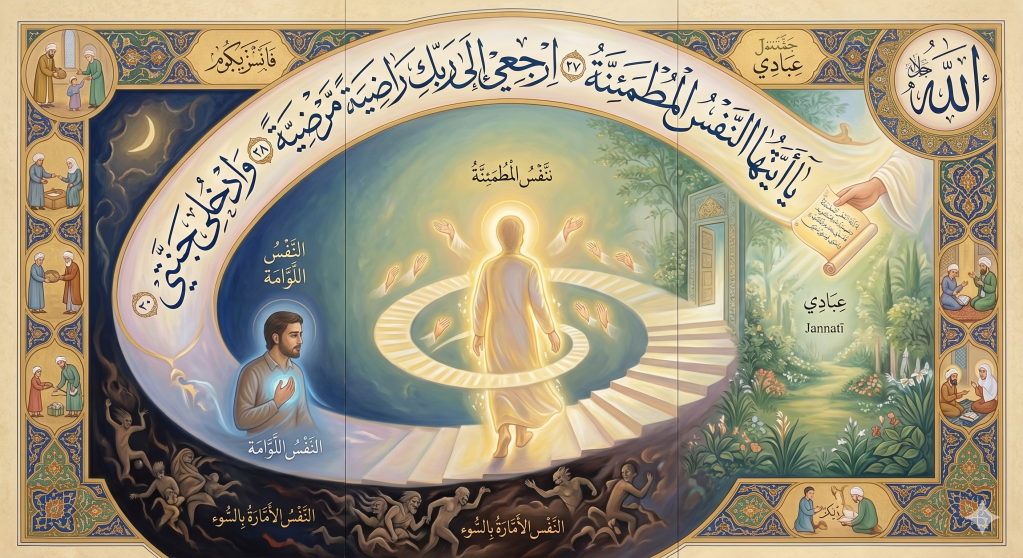
يَا أَيَّتُهَا النَّفْسُ الْمُطْمَئِنَّةُ ارْجِعِي إِلَىٰ رَبِّكِ رَاضِيَةً مَّرْضِيَّةً فَادْخُلِي فِي عِبَادِي وَادْخُلِي جَنَّتِي
Transliteration: Yā ayyatuhā al-nafsu al-muṭmaʾinnah. Irjiʿī ilā rabbiki rāḍiyatan marḍiyyah. Fa-dkhulī fī ʿibādī. Wa-dkhulī jannatī.
Six translations:
- Sahih International: “[To the righteous it will be said], ‘O reassured soul, return to your Lord, well-pleased and pleasing [to Him], and enter among My [righteous] servants, and enter My Paradise.’”
- Yusuf Ali: “(To the righteous soul will be said:) ‘O (thou) soul, in (complete) rest and satisfaction! Come back thou to thy Lord,— well pleased (thyself), and well-pleasing unto Him! Enter thou, then, among My devotees! Yea, enter thou My Heaven!’”
- Pickthall: “But ah! thou soul at peace! Return unto thy Lord, content in His good pleasure! Enter thou among My bondmen! Enter thou My Garden!”
- Muhammad Asad: “[But unto the righteous God will say,] ‘O thou human being that hast attained to inner peace! Return thou unto thy Sustainer, well-pleased [and] pleasing [Him]: enter, then, together with My [other true] servants — yea, enter thou My paradise!’” Alim
- Maududi: “(On the other hand it will be said): ‘O serene soul! Return to your Lord well-pleased (with your blissful destination), well-pleasing (to your Lord). So enter among My (righteous) servants and enter My Paradise.’” My Islam
- Maulana Muhammad Ali (Lahore): “O soul that art at rest, return to thy Lord, well-pleased (with Him), well-pleasing (Him). So enter among My servants, and enter My Garden!” alahmadiyya
Qur’an 95:8 (Surat al-Tīn)
أَلَيْسَ اللَّـهُ بِأَحْكَمِ الْحَاكِمِينَ
Transliteration: A-laysa Allāhu bi-aḥkam al-ḥākimīn?
Six translations:
- Sahih International: “Is not Allah the most just of judges?”
- Yusuf Ali: “Is not Allah the wisest of Judges?” alim
- Pickthall: “Is not Allah the most conclusive of all judges?” alim
- Muhammad Asad: “Is not God the most just of judges?” alim
- Maududi: “Is not Allah the Greatest of all sovereigns?” (rendered also “the Greatest Ruler of all the rulers”).
- Maulana Muhammad Ali (Lahore): “Is not Allah the Best of the Judges?”
The spread of renderings for 95:8 is itself instructive. The triliteral root ḥ-k-m generates ḥukm (judgment, governance, wisdom), ḥākim (judge, ruler), and ḥakīm (wise). Hence the verse simultaneously affirms God as supreme judge, supreme ruler/sovereign, and supremely wise — a semantic density that no single English word captures, as Dr. Munir Munshey’s gloss explicitly notes (“‘Hukm’ carries all three meanings”). IslamAwakened
II. The Semantic Field: iṭmiʾnān, sakīna, and the Settled Heart
The adjective muṭmaʾinnah derives from the root ṭ-m-ʾ-n, whose verbal form iṭmaʾanna conveys becoming calm, settled, reassured, secure, and at rest; the noun ṭumaʾnīna denotes inner peace and reassurance. In its concrete sense the root describes the subsidence of agitation — the stilling of what was disturbed. Applied to the soul, it names not a transient mood but a settled disposition: the self that has ceased to be tossed about by appetite, fear, and doubt.
This vocabulary belongs to a wider Qur’anic lexicon of tranquility. Most important is 13:28: alladhīna āmanū wa-taṭmaʾinnu qulūbuhum bi-dhikri Allāh; a-lā bi-dhikri Allāhi taṭmaʾinnu al-qulūb — “Those who believe and whose hearts find rest (taṭmaʾinnu) in the remembrance of God; surely in the remembrance of God do hearts find rest.” The same root that names the soul at peace in 89:27 names the resting of the heart in 13:28; the two verses interpret one another. As I have argued in my commentary on 13:28–29 (Peace of Mind through Prayer and Remembrance), the dhikr that produces this rest is not parrot-like repetition but a meaningful dwelling on the divine attributes that, understood and practiced, accelerates the journey to serenity.
Closely related but distinct is sakīna (root s-k-n: to dwell, settle, be still), the divine tranquility “sent down” into the hearts of the believers (e.g., 48:4). The Arabic sakīna is cognate with the Hebrew shekhinah (“dwelling,” the indwelling Presence) and the Aramaic shkhintā. The contemplative tradition draws a fine distinction between the two: sakīna (serenity) is the gradual coming-to-rest of the heart as it receives gifts from the Unseen, while iṭmiʾnān (peacefulness) is “a spiritual state beyond serenity,” defined as “full satisfaction and the state of being at complete rest without any serious lapse” (Fethullah Gülen, Sakina–Itmi’nan, Fountain Magazine). On this reading sakīna is the threshold and iṭmiʾnān the established station — a continuity that matters for the developmental psychology proposed below.
III. The Eschatological Setting of 89:27–30
The closing verses of al-Fajr arrive after a sweeping movement: oaths by the dawn and the ten nights (89:1–5); the destruction of ʿĀd, Thamūd, and Pharaoh, who “exceeded the limits” (89:6–14); the diagnosis of the unstable human psyche that reads affluence as honor and hardship as humiliation (89:15–16); the indictment of those who neither honor the orphan nor urge feeding the poor (89:17–20); and the convulsions of the Day of Judgment (89:21–26). Against this backdrop of cosmic accountability, the soul at peace is summoned home.
The classical authorities preserve a near-consensus that 89:27–30 is an address — by the angels or by God Himself — delivered either at the moment of death, when the soul leaves the body, or on the Day of Resurrection. As Seyyed Hossein Nasr and colleagues note in The Study Quran, these verses “play an important role in Muslim piety, as they are often recited in eulogies for the dead and are seen by Sufis and others as a reference to the true nature of the soul when it is purified of all defilements.” Crucially, as I emphasized in my 2017 commentary Surah Al Fajr – The Dawn: Happiness and Peace in God: although traditional commentaries locate the address at death, the soul-at-peace “is a state of mind achieved through a lifetime of righteous living and devotion to God.” The deathbed greeting ratifies a serenity already cultivated in life. thequranthequran
The pivotal phrase is rāḍiyatan marḍiyyah (89:28) — the soul returns “well-pleased and well-pleasing.” This is a reciprocity of riḍā: the soul is content with God (with His reward, His decree, His destiny), and God is content with the soul. The Shīʿī exegete al-Ṭabrisī (in Majmaʿ al-bayān) glosses the pair precisely so: the owner of the soul at peace “is pleased with God’s reward, and God is also pleased with his actions.” ʿAllāma Ṭabāṭabāʾī adds that confidence in God causes the soul to be pleased with decree and destiny, so that “no bad event makes the person upset and he is not infected with sin.” The mutuality of pleasure is echoed across the Qur’an — 5:119, 9:100, 58:22, and 98:8: raḍiya Allāhu ʿanhum wa-raḍū ʿanhu, “God being pleased with them and they with Him.” WikishiaWikishia
IV. The Classical Mufassirūn on al-nafs al-muṭmaʾinnah
Al-Ṭabarī (d. 310/923), the dean of exegetes, anchors the verse in the lexical sense of the root: the nafs muṭmaʾinnah is the soul made tranquil and assured through faith, certain of God’s promise — calm because it trusts. His Jāmiʿ al-bayān, together with al-Baghawī’s Maʿālim al-tanzīl, is cited for the foundational schema that the Qur’an addresses three (and only three) named states of the nafs: al-ammāra bi’l-sūʾ, al-lawwāma, and al-muṭmaʾinnah. Islamiqate
Al-Zamakhsharī (d. 538/1144), in al-Kashshāf, reads the tranquil soul as the one secured by certainty (yaqīn) — the believing soul that has put down the disturbances of doubt. His reading is condensed in the gloss preserved by later tradition (and reflected in Jalālayn): “‘O soul at peace!’ — [the one] secure, namely, the believing one.” Alro7
Fakhr al-Dīn al-Rāzī (d. 606/1209), in Mafātīḥ al-ghayb, develops the intellectual-mystical dimension most fully. The soul at peace is the soul that has attained certainty; this, he notes, is the very thing Abraham requested in 2:260, li-yaṭmaʾinna qalbī — “so that my heart may be at peace.” Al-Rāzī links the degree of remembrance (dhikr) to the strength of certainty and both to the degree of peace, and he reads “return to your Lord” as implying that the soul was with its Lord before creation and is now recalled to its origin. (On the metaphysics of the soul, al-Rāzī — with al-Ghazālī and the mystics — held the rūḥ to be non-corporeal pure essence, advancing twelve arguments to that effect, against the majority who held it a subtle physical entity.) Thequran
Al-Qurṭubī (d. 671/1272), in al-Jāmiʿ li-aḥkām al-Qurʾān, gathers the range of meanings: the soul at peace possesses certainty (yaqīn) and true knowledge or gnosis (maʿrifa); it is the soul at rest in the remembrance of God (13:28); and contentment (riḍā) is, in a phrase he transmits from al-Qushayrī’s Risāla, “the greatest gate of God and the paradise of this world.” Al-Qurṭubī also preserves the variant reading of Ubayy ibn Kaʿb, who read the verse as al-nafs al-āmina — “the soul secure, at peace” — i.e., the soul not fazed by fear or sorrow, unlike the unstable self of 89:15–16. thequran
Ibn Kathīr (d. 774/1373), in his Tafsīr, gives the most widely transmitted plain-sense reading: the nafs muṭmaʾinnah is the believing soul tranquil through the remembrance and obedience of God, called back at death to its Lord. On 95:8 he is equally direct: God is “the best of judges, Who does not oppress or do any injustice to anyone… from His justice is that He will establish the Judgement, and He will give retribution to the person who was wronged.” For Ibn Kathīr the tranquil soul and the just Judge are two faces of one assurance. Quran O
The Indo-Pakistani Maʿārif al-Qurʾān tradition consolidates these strands: muṭmaʾinnah “literally means ‘calm’… the soul that is peaceful and tranquil as a result of remembrance and obedience of Allah,” purified through spiritual discipline until “Sharīʿa becomes his nature”; and “return to your Lord” indicates that the soul’s first abode was with its Lord. Quran.com + 4
On 95:8, the classical reading is unanimous in substance. Maududi’s Tafhīm al-Qurʾān paraphrases the rhetorical force: “When you want and expect even the petty judges of the world to do justice… what is your opinion about God? Is He not the greatest of all judges?… Do you expect that He will treat the good and the evil alike?” The verse carries a liturgical response in the Sunna: on the authority of Abū Hurayra, the Prophet taught that one who recites it should answer, balā wa-anā ʿalā dhālika min al-shāhidīn — “Yes, and I am among those who bear witness to that” — though IslamQA notes that the chain of this particular report is weak (ḍaʿīf). My Islam
V. The Sufi Stations of the Self (Maqāmāt al-nafs)
The Qur’anic triad furnished Sufism with the skeleton of a developmental psychology. The lowest is al-nafs al-ammāra bi’l-sūʾ (12:53), “the soul that incites to evil,” at the mercy of appetite and anger — the starting point of the journey of purification (tazkiyat al-nafs). Through ascetic discipline (riyāḍa) and spiritual struggle (mujāhada) it becomes al-nafs al-lawwāma (75:2), “the self-reproaching soul,” the awakened conscience that sins yet blames itself and strives to amend. With perseverance it may reach al-nafs al-muṭmaʾinnah (89:27), “the soul at peace,” which has so internalized the sacred law that obedience becomes its nature and it develops a settled aversion to whatever contradicts it. Sakeena AcademyQuran.com
Many Sufi orders elaborate the triad into seven stations, harvesting later terms directly from the same passages: (1) ammāra (12:53); (2) lawwāma (75:2); (3) mulhima, the inspired self; (4) muṭmaʾinnah (89:27); (5) rāḍiya, the soul content with God (from rāḍiya, 89:28); (6) marḍiyya, the soul with which God is pleased (from marḍiyya, 89:28); and (7) kāmila (or ṣāfiya), the perfected self. It is striking that three of the seven names are mined from al-Fajr’s four verses alone — the passage is, in effect, the charter of the entire ladder. Al-Qushayrī’s Risāla, al-Ghazālī’s analysis in the Iḥyāʾ (the nafs as a besieged city whose intellect-king must subdue the enemy of appetite and anger), Ibn al-Qayyim’s works on tazkiya, and Rūmī’s Mathnawī all map this ascent. For Rūmī the soul’s task is a voluntary journey (sulūk) from nafs to spirit, purifying the ego under a guide until it reaches “the grade of contentment (riḍā)” — the worldly material being transitory, only the return to the Divine yields lasting happiness. As Elif Shafak renders Rūmī’s scheme, the depraved ego that blames others gives way to the accusing self that blames itself, then to the inspired self that learns true surrender, and onward toward the purified self, insān-i kāmil. Sufi Philosophy + 3
VI. Psychological Frameworks: Mapping the Three Souls
The central ambition of this commentary — consistent with my long-running project of reading the Qur’an alongside modern science and psychology — is to show that the Qur’anic anthropology of the nafs anticipates, and in places surpasses, the leading modern models of the self.
1. Freudian structural theory
In my 2017 commentary on al-Fajr I proposed a direct mapping of the Freudian tripartite psyche onto the Qur’anic souls. The id — the reservoir of primitive drives ruled by the pleasure principle — corresponds to al-nafs al-ammāra bi’l-sūʾ (12:53), the self that “commands to evil.” The superego — the internalized moral censor that produces guilt — corresponds to al-nafs al-lawwāma (75:2), the self-reproaching conscience. The ego, mediating between drive and conscience under the reality principle through its defense mechanisms (repression, reaction formation, denial, displacement, rationalization), is the arena of struggle in which the lawwāma does its work. But here the parallel reaches its limit and the Qur’an extends beyond Freud. Freud’s structural model has no category above conflict management; al-nafs al-muṭmaʾinnah names a fourth condition Freud never theorized — a settled integration in which the war between drive and conscience is not merely managed but transcended through devotion to the Transcendent. As Abraham Maslow conceded of Freud in Toward a Psychology of Being (1968), “It is as if Freud supplied us the sick half of psychology and we must now fill it out with the healthy half.” The soul at peace is the healthy half made complete by the spiritual dimension Freud’s naturalism omitted. thequran
2. Maslow, self-actualization, and self-transcendence
In my articles Self Actualization a Step Towards Soul-At-Peace and From Self-Actualization to Self-Transcendence, I argued that Maslow’s hierarchy of needs — physiological, safety, love, esteem, self-actualization — correctly describes the ascent of the personal psyche but stops short. Self-actualization is “conceptualized without any reference to our Creator, on whom we are so utterly dependent.” The soul at peace is “a state of self-transcendence beyond self-actualization” — what Viktor Frankl intuited in Man’s Search for Meaning: “Self-actualization is not man’s ultimate destination. It is not even his primary intention. Self-actualization, if made an end in itself, contradicts the self-transcendent quality of human existence.” Fulfillment, for Frankl, “ensues” only as a byproduct of meaning beyond the self. The Qur’an names that meaning: return to, and contentment in, the Lord (cf. 59:9, 64:16). thequran
3. Attachment theory and attachment to God
John Bowlby’s attachment theory and Mary Ainsworth’s empirical work identify the secure base as the antidote to fear: a child confident that an attachment figure is available is, in Bowlby’s words, “much less prone to either intense or chronic fear” than one without such confidence. Lee Kirkpatrick extended this to the psychology of religion, arguing that the believer’s relationship with God meets the defining criteria of an attachment bond — proximity-seeking (notably through prayer), a safe haven in distress, and a secure base from which to engage life (Kirkpatrick, An Attachment-Theory Approach to the Psychology of Religion). Securely attached individuals tend to image God as a reliable secure base, and Keefer and Brown (2019) found that secure attachment to God enhances psychological well-being. The nafs muṭmaʾinnah is, in these terms, the phenomenology of secure attachment to God: the soul that, knowing its Sustainer is available and reliable, is freed from the chronic anxiety that destabilizes the self of 89:15–16. The command irjiʿī ilā rabbiki — “return to your Lord” — is the language of proximity-seeking consummated.
4. Pargament’s psychology of religious coping
Kenneth Pargament’s research (Pargament, Smith, Koenig & Perez, 1998; and the Brief RCOPE, Pargament, Feuille & Burdzy, 2011, which defines religious coping as “efforts to understand and deal with life stressors in ways related to the sacred”) distinguishes positive religious coping (benevolent reappraisal, collaborative coping, seeking spiritual support, active religious surrender) from negative religious coping (spiritual discontent, “punishing God” reappraisal), the former associated with better well-being and the latter with poorer adjustment. Of particular relevance is the construct of active religious surrender, defined by Wong-McDonald and Gorsuch (2000, “Surrender to God: An Additional Coping Style?”, Journal of Psychology and Theology) thus: “Surrender is not a passive waiting for God to take care of everything; rather, it entails an active choice to relinquish one’s will to God’s rule” — a construct later folded into Pargament’s RCOPE. Together with collaborative coping (partnering with God in problem-solving), both are consistently linked to well-being. The reciprocal riḍā of 89:28 is the spiritual maturation of exactly this surrender: the soul pleased with God’s decree (rāḍiya) is the soul that has moved from anxious bargaining to trusting collaboration and, finally, to serene acceptance. ResearchGate
5. Acceptance and Commitment Therapy (ACT)
Steven C. Hayes’s ACT centers on psychological flexibility — contacting the present moment as a conscious being and persisting in values-based action even amid discomfort — cultivated through six processes (the “Hexaflex”): acceptance, cognitive defusion, present-moment contact, self-as-context, values, and committed action. ACT does not seek to eliminate painful thoughts but to change one’s relationship to them. The soul at peace is not the soul that never feels grief or fear; as contemporary commentators note, “a person may be in difficulty and still have a muṭmaʾinnah soul if their heart stays tied to Allah.” This is psychological flexibility sub specie aeternitatis: acceptance of decree (riḍā bi’l-qaḍāʾ), defusion from the ego’s commanding chatter (the ammāra), and committed action in the service of the highest value (the pleasure of God). Anxietyinstitute + 2
6. Seligman’s positive psychology and flourishing
Martin Seligman’s PERMA model (introduced in Flourish, 2011) defines well-being through five elements — Positive emotion, Engagement, Relationships, Meaning, and Accomplishment — that together constitute flourishing, integrating the hedonic with the eudaimonic (“living in accordance with one’s own daimon“). The soul at peace satisfies and exceeds the PERMA criteria: positive emotion (riḍā, contentment), engagement and meaning (a life ordered to the Transcendent), relationship (the secure bond with God and the moral community of 89:17–20), and accomplishment (the completed tazkiya). Where secular eudaimonia terminates in the flourishing self, the Qur’anic model terminates in the flourishing self received by God — “enter among My servants, enter My Garden.” Wikipedia
VII. The Moral Foundation: Compassion Before Contentment
A consistent thesis across my Nafs-e-Mutmainnah writings is that the road to serenity runs through ethics. Al-Fajr itself makes the point structurally: before the soul at peace is greeted (89:27–30), the surah indicts those who fail the orphan and the poor (89:17–20). As I argued in Moral and Compassionate Life As Foundation for Spirituality or Nafs Al-Mutmainnah, “Leading a moral and a compassionate life is the most important pre-requisite” of soul-at-peace. The Qur’an binds the God-conscious and the compassionate together — “Indeed, Allah is with those who are God conscious and are compassionate towards fellow humans” (16:128). There is, in my reading, a sequence: by being just toward our fellow humans we develop the lawwāma (superego) and discipline the ammāra (id); the spiritual dimension then completes what the moral dimension begins. Thequranthequran
The second pillar I have emphasized is the meaningful contemplation of the divine attributes. In Nafs Al-Mutmainnah Through Dwelling Meaningfully On Attributes of Allah, I take 13:28 as the program and argue that “merely remembering Allah… as a parrot is likely to do little”; peace begins when the attributes are truly understood and practiced. I dwell on Al-Kāfī (The Sufficient — “Is not Allah sufficient for His servant?”, 39:36), Al-Ḥasīb (The Reckoner), Ar-Razzāq (The Provider), Al-Ḥakīm (The Wise), Al-Ghafūr (The Forgiving), and above all Ar-Raḥīm (The Merciful) — “the most important attribute for our purposes to achieve soul-at-peace.” An understanding of the attributes that gives hope and answers the problem of suffering is what “will put your heart and mind at ease and in spiritual ecstasy with your God.” Thequran
VIII. The Best of Judges: 95:8 as the Frame of the Soul’s Peace
Surat al-Tīn swears by the fig and the olive, Mount Sinai, and “this secure land” (Mecca) — symbols, in Asad’s reading, of the ethical unity of the prophetic line from Moses through Jesus to Muhammad — declares that humanity was created “in the best of moulds” (aḥsan taqwīm) yet reduced to “the lowest of the low” save the believers who do righteous deeds, and then asks: a-laysa Allāhu bi-aḥkam al-ḥākimīn? The rhetorical question is not a request for information but an appeal to the moral intuition of the listener. Alim
The function of 95:8 is juridical and consoling at once. Maududi captures its logic: if we expect even “the petty judges of the world” to reward the good and punish the wicked, how could the Greatest Judge let the doer of good and the doer of evil “both end in the dust”? Ibn Kathīr’s gloss completes the thought: God is the best of judges precisely because “He will give retribution to the person who was wronged in this life against whoever wronged him.” Divine justice is the guarantor that the moral order is not a fiction. My IslamQuran O
Herein lies the deep thematic bond between the two passages of this essay. The soul can be muṭmaʾinnah — settled, reassured, unafraid of death and the Reckoning — only because the One to whom it returns is aḥkam al-ḥākimīn. Tranquility that ignored the Judgment would be denial; the Qur’an’s tranquility presupposes the Judgment and is grounded in confidence about its outcome. The unstable man of 89:15–16, who misreads every fortune and misfortune as a verdict on his worth, is anxious because he has the wrong theory of judgment. The soul at peace has the right one: it trusts the Best of Judges, and so it is rāḍiya — content — before the verdict is even read. Psychologically, 95:8 supplies the cognitive appraisal (in Pargament’s terms, the benevolent reappraisal of ultimate reality) that makes secure attachment to God rational and riḍā possible.
IX. Thematic Epilogue
The two verses placed at the head of this essay form a single arc. Surat al-Tīn ends with a question; Surat al-Fajr ends with an answer. “Is not God the best of judges?” — and the soul at peace replies, with its whole settled being, balā, “Yes.” Between the question and the answer lies the entire moral and contemplative labor of a human life: the taming of the soul that incites to evil, the awakening of the soul that reproaches itself, and the ripening of the soul that has found its rest. The modern psychologies of well-being — Maslow’s self-actualization, Frankl’s self-transcendence, Bowlby and Kirkpatrick’s secure base, Pargament’s surrender, Hayes’s acceptance, Seligman’s flourishing — each illuminate one facet of that ripening, and the Qur’an gathers them into a single vocation: to return to one’s Lord, well-pleased and well-pleasing. The dawn by which al-Fajr swears is, in the end, the dawn of the soul itself — the fajr of a self that, having passed through the long night of struggle, is greeted at last with the most gracious of all summonses: “Enter My Garden.”






Leave a Reply