
Audio teaser:
Abstract
This comprehensive research report offers a detailed, scholarly analysis of the Bohra community, specifically focusing on the Tayyibi Musta’li branch of Ismaili Shia Islam. Tracing their lineage from the Fatimid Caliphate of North Africa and Egypt, through the mountain fortresses of Yemen, to the commercial centers of Gujarat, India, the report explores the historical schisms, migrations, and cultural adaptations that have shaped this affluent global merchant community. The analysis examines Bohra theology, highlighting the dualism of the exoteric (zahir) and esoteric (batin), Tayyibi cosmology, the Seven Pillars of Islam, and the foundational covenant of the misaaq. It evaluates the highly centralized leadership model of the Da’i al-Mutlaq, mapping the clerical hierarchy, the administrative power of excommunication, and the resultant constitutional battles within the Indian legal system.
The report also establishes a comparative framework, mapping the commonalities and divergences between the Bohras, Twelver Shias, mainstream Sunnis, and the Ahmadiyya Muslim Community. It details the sociological parallels of minority boundary-maintenance—such as uniform attire, sacred languages, and strict social control—shared between the Bohras and Ahmadis, contrasting them with popular Sunni devotional structures like Barelvi Sufism. Finally, drawing on contemporary pan-Islamic philosophical discourses, this analysis outlines a theological and philosophical roadmap for de-escalating the historic sectarian divide, advocating for a shift from leader-centric polemics to a scripture-centric, Tawhid-focused framework to foster genuine solidarity across the global Muslim Ummah.
Historical Evolution and Doctrinal Lineage
The historical trajectory of the Bohra community is a complex narrative of imperial rule, doctrinal schisms, transcontinental migrations, and localized cultural adaptation. To understand the modern Bohra identity, one must trace their lineage back to the early sectarian divisions of Shia Islam, the golden age of the Fatimid Empire, and the subsequent establishment of a decentralized, esoteric mission in South Asia.
The Fatimid Foundation and the Musta’li-Nizar Schism
The religious and literary heritage of the Bohras is linked to the Fatimid Caliph-Imams, who ruled over North Africa, Egypt, the Hejaz, and the Levant from the tenth to the twelfth centuries CE. The Fatimids, claiming direct descent from the Prophet Muhammad through his daughter Fatima and her husband Ali ibn Abi Talib, presided over an empire renowned for its patronage of the arts, scientific discovery, and philosophical inquiry.
The primary division that set the ancestors of the Bohras on their distinct historical path occurred in 1094 CE (486/487 AH) following the death of the eighteenth Fatimid Caliph-Imam, Al-Mustansir Billah. A succession dispute erupted between Al-Mustansir’s sons: the eldest son, Nizar, and the younger, Al-Musta’li. The Ismaili communities in Egypt, Yemen, and Western India supported Al-Musta’li as the rightful successor, establishing the Musta’li branch of Ismailism. Conversely, the Ismailis of Persia and Syria championed the cause of Nizar, giving rise to the Nizari branch, whose modern descendants are led by the Aga Khan.
A secondary, highly consequential schism occurred in 1130 CE (524 AH) after the death of the Musta’li Caliph-Imam, Al-Amir bi-Ahkam Allah. The mainstream Musta’li community in Egypt and Yemen recognized Al-Amir’s infant son, At-Tayyib Abu’l-Qasim, as the twenty-first Imam, hence their designation as Tayyibis. However, the political elite in Cairo established a regency under Al-Hafiz, leading to the split between the Hafizi and Tayyibi Musta’li branches. While the Hafizi regime eventually collapsed with the demise of the Fatimid Caliphate in 1171 CE, the Tayyibi branch survived independently, preserved by a dedicated underground network of missionaries in Yemen and India.
The Seclusion of the Imam and the Yemenite Da’wah
According to Tayyibi Ismaili doctrine, the twenty-first Imam, At-Tayyib, went into physical concealment (satr) in 1134 CE (528 AH) to escape political persecution. Before his seclusion, the administration of the faith was entrusted to a supreme, unrestricted missionary known as the Da’i al-Mutlaq. This office was formally established under the guidance and patronage of Queen Arwa al-Sulayhi, the ruler of Yemen, who served as the hujjah (proof) of the concealed Imam.
The first Da’i al-Mutlaq, Zoeb bin Moosa, was appointed in Yemen, initiating an unbroken chain of succession based on the principle of nass—the exclusive, divinely inspired spiritual designation of a successor. Operating from secluded mountain fortresses in Yemen, such as Haraz and Hutayb, the Tayyibi Du’at preserved the extensive Fatimid library, maintained theological correspondence with India, and managed the affairs of the faithful in secret.
The South Asian Mission and the Wulaat ul-Hind
The roots of the Tayyibi Ismaili mission in India predate the Tayyibi-Hafizi split. During the reign of the Fatimid Caliph-Imam Al-Mustansir Billah in the late eleventh century, high-ranking missionaries (du’aat) were dispatched from Yemen to Western India under the guidance of the manifest Imam. Mawla’i Abdullah and Mawla’i Ahmad came to Khambhat (Cambay) in the present-day state of Gujarat, while Mawla’i Nur al-Din traveled further south to Dongam in the Deccan region, close to modern-day Aurangabad. They initiated conversions of local populations, primarily from Hindu mercantile and agricultural castes.
These Indian converts came to be known as “Bohras,” a term derived from the Gujarati words vohrvu or vyavahar, meaning “to trade” or “honest dealings,” reflecting their professional background. The Indian community, governed by a succession of designated local deputies known as the Wulaat ul-Hind, maintained close spiritual and financial contact with the Tayyibi Du’at in Yemen.
In the early fifteenth century, the eminent wali Mawla’i Adam bin Sulayman led a large contingent of Bohras from Patan to settle in the newly built city of Ahmedabad, the capital of the Muzaffarid Sultans of Gujarat. During the stewardship of his son, Mawla’i Hasan, the Bohras faced intense persecution under the zealous Sunni Sultans of Gujarat. Acting at the instigation of a disenfranchised Bohra scholar named Ja’far bin Muhammad Khwaja, and later under the Sunni cleric Ja’far Shirazi, the state used systematic coercion to force the Bohras to convert to Sunni Islam. This campaign resulted in the conversion of more than a million Bohras, who formed the Ja’fari Sunni Vohra community. Only a minority—ranging between 20% and 40% of the community—remained Tayyibi Shias, maintaining their secret allegiance to the Yemenite Da’wah.
The Transfer of the Headquarters and Subsequent Schisms
Yusuf bin Sulayman Najmuddin of Sidhpur, Gujarat, traveled to Yemen to seek religious knowledge, studying under Hasan bin Nuh al-Bharuchi. He rose through the spiritual hierarchy and was eventually appointed the twenty-fourth Da’i al-Mutlaq in 1539 CE, becoming the first Indian to lead the global Tayyibi Da’wah. Following Yusuf’s death in 1567 CE (974 AH), his successor, Jalal bin Hasan, permanently transferred the central headquarters of the Da’wah from Yemen to Gujarat. The headquarters operated from various locations in India, adjusting to shifting political climates:
- Ahmedabad (1567–1655 CE): Eight Du’at presided here during the expansion of the community under Mughal rule.
- Jamnagar (1655–1737 CE): Five Du’at governed from this Kathiawar state.
- Ujjain (1737–1779 CE): Two Du’at administered the community from Madhya Pradesh.
- Burhanpur (1779–1813 CE): One Da’i sat in this major commercial hub.
- Surat (1813–present/historical seat): A major administrative center, home to the premier seminary Aljamea-tus-Saifiyah.
- Mumbai (Modern administrative seat): Currently hosting the official residence of the Da’i al-Mutlaq.
Upon the death of the twenty-sixth Da’i al-Mutlaq, Dawoodji Burhanuddin bin Ajabshah, in Ahmedabad in 1591 CE (997 AH), a succession dispute split the Tayyibi community. Sulayman bin Hassan, the grandson of the twenty-fourth Da’i and the wali in Yemen, claimed the succession, supported by the Yemeni Bohras. However, the Indian Bohras denied his claim of nass, declaring his supporting documentation to be forged, and recognized Dawood bin Qutubshah as the twenty-seventh Da’i. This led to a permanent division:
- Dawoodi Bohras: The majority group, who followed Dawood bin Qutubshah and maintained their headquarters in India.
- Sulaymani Bohras: The minority group, who followed Sulayman bin Hassan, centered primarily in Yemen (the Haraz region and Najran) with a small presence in India.
A further internal division occurred among the Dawoodi Bohras in Ahmedabad in 1621 CE (1030 AH) following the death of the twenty-eighth Da’i, Sheikh Adam Safiuddin. A small faction recognized his grandson, Ali bin Ibrahim, as the rightful successor, separating from the majority to form the Alavi Bohras.
In the early nineteenth century, the community was impacted by severe drought in the Kathiawar region. The forty-third Da’i, Abdeali Saifuddin, invited 12,000 of his starving followers to Surat, providing them with food, lodging, and mandatory vocational training. He returned their accumulated earnings to them when they were ready to leave, initiating a highly successful wave of migration that established the Bohra trading presence in East Africa.
Demographics and Geographical Diaspora
The contemporary Bohra community is a unique demographic and sociological phenomenon, characterized by high levels of education, substantial economic prosperity, and a tightly preserved cultural identity that blends Fatimid-Yemenite religious practices with Gujarati customs.
Global Population Distribution
The global population of Dawoodi Bohras is estimated to be approximately one million members, with the vast majority residing in India, alongside established congregations globally. Sizable migrations throughout the nineteenth and twentieth centuries led to the establishment of communities in East Africa, Southeast Asia, the Persian Gulf, and the West.
| Region / Country | Principal Urban Centers | Demographic and Economic Character |
| India (Approx. 800,000 in South Asia) | Mumbai, Surat, Ahmedabad, Ujjain, Jamnagar, Indore, Dohad, Nagpur, Udaipur, Rajkot, Pune, Kolkata, Chennai | The historic heartland; highly concentrated in business districts; possesses major shrines and community infrastructure. |
| Pakistan (Part of South Asian total) | Karachi | Sizable established trading class; concentrated in highly organized residential enclaves. |
| Yemen (Approx. 13,000) | Haraz region | Indigenous Arab Tayyibi communities identifying with the term Bohra; maintaining historical mountain settlements. |
| East Africa | Kenya (Mombasa, Nairobi), Tanzania, Uganda | Descendants of the early nineteenth-century mercantile migration fleeing Kathiawar droughts. |
| Indian Ocean & Southeast Asia | Maldives, Sri Lanka, Singapore, Hong Kong | Highly successful mercantile class integrated into major international trading hubs. |
| Persian Gulf | United Arab Emirates, Kuwait | Modern professional and trading diaspora; experiencing rapid growth since the mid-twentieth century. |
| Western Diaspora (Approx. 200,000 global total outside South Asia/Yemen) | United States (20,000 across 31 centers), Canada, United Kingdom, Australia | Rapidly growing professional and educational hubs; characterized by high-income families and modern community centers. |
The history of the Western diaspora is illustrated by the United States, where the first Dawoodi Bohra arrived in the 1920s. Over the subsequent century, this presence grew to nearly 20,000 members, who are highly integrated as corporate professionals, physicians, and entrepreneurs.
Socioeconomic Profile and Educational Infrastructure
The Bohras are recognized as one of the most prosperous, highly educated, and philanthropic communities in South Asia and the wider Muslim world. True to their name, they are traditionally entrepreneurs, traders, industrialists, and increasingly, highly skilled professionals such as physicians, corporate attorneys, and financial consultants.
Under the direct guidance of the modern Du’at, the community has prioritized education, achieving a near 100% literacy rate worldwide. The cornerstone of their intellectual and religious infrastructure is Aljamea-tus-Saifiyah (The Arabic Academy), a premier theological university with four campuses: Surat (founded in 1813 CE), Karachi, Mumbai, and Nairobi. This institution trains the community’s clergy, scholars, and administrators in Fatimid literature, classical Arabic, and modern sciences, ensuring a highly standardized transmission of religious knowledge.
Cultural Markers: Language, Attire, and Enclaving
The Bohras maintain a highly distinct cultural boundary that visibly distinguishes them from both mainstream Muslim populations and non-Muslim societies:
- Lisan al-Dawat: This is the official and sacred language of the Bohras. It is a Neo-Indo-Aryan dialect based on Gujarati, but written in the Arabic Naskh script and heavily saturated with Arabic, Persian, and Urdu theological and literary vocabulary. This linguistic hybridization serves as a powerful instrument of cultural preservation, rendering their internal discourses largely inaccessible to outsiders.
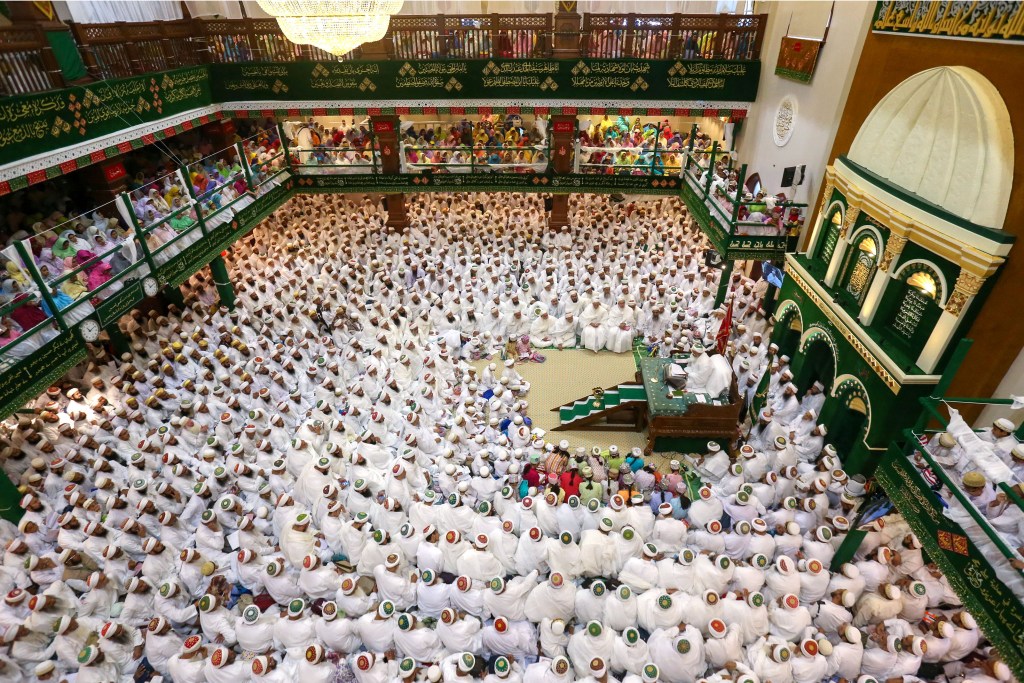
- Libas al-Anwar: The community follows a mandatory, uniform dress code introduced in the late twentieth century to foster egalitarianism and visual cohesion. The men wear an all-white three-piece outfit (comprising a kurta, pyjama, and an overcoat called a saya) accompanied by a distinct white crocheted cap (topi) heavily embroidered with gold thread. The women wear a highly distinct two-piece dress known as the rida, which consists of a cape covering the head and upper body, and a long skirt. Unlike the standard black abaya or burqa found in other Muslim communities, the rida is colorful, featuring intricate floral patterns, lace, and embroidery, and it purposefully does not cover the woman’s face.
- Masjid Centrality and Enclaving: The masjid (mosque) serves as the “beating heart” of the Bohra community, acting as a spiritual, social, and administrative center. To maintain their distinct identity and protect their sacred spaces, the clergy enforces a strict entry policy. In many urban centers, access to Bohra mosques and community dining halls is restricted to individuals who possess an official, electronic community-issued identity card. This intense enclaving preserves their internal solidarity but has historically drawn criticism for separating them from the broader Muslim population.
Theology, Core Beliefs, and Esoteric Cosmology
Bohra theology is a highly systematic, esoteric formulation that blends Quranic revelation, neo-Platonic emanationist metaphysics, and strict ritual adherence.
The Esoteric Metaphysics: Zahir, Batin, and the Ten Intellects
Like all Ismaili traditions, Bohra theology operates on a fundamental distinction between the exoteric, outer dimension of faith (zahir) and the esoteric, inner truth (batin). The zahir consists of the literal text of the Quran, the visible actions of the Sharia (Islamic law), and physical ritual worship. The batin, by contrast, represents the immutable, universal spiritual truths (haqa’iq) underlying the physical rituals. This esoteric knowledge is not accessible through literal reading or rational speculation alone; it requires ta’wil (allegorical, spiritual interpretation) which can only be dispensed by the divinely designated guide of the era—the Imam, or in his concealment, his absolute deputy, the Da’i al-Mutlaq.
The real foundation of Tayyibi esoteric doctrine was elaborated by the second Da’i al-Mutlaq, Ibrahim al-Hamidi (1151–1162 CE), in his seminal work, Kitab Kanz al-Walad (Book of the Child’s Treasure). This cosmological system describes a hierarchy of Ten Intellects. According to this metaphysics, when the Second Intellect attained its rightful position by its superior effort, the Third Intellect failed to recognize its precedence. As punishment for its haughty insubordination, the Third Intellect fell from the third rank, slipping behind the remaining seven Intellects. After undergoing profound repentance, it stabilized as the Tenth Intellect, also known as the Demiurge or Ruler of the Physical World.
The human soul is directly linked to this cosmic drama. The soul of every believer is joined upon initiation to the esoteric truth by a “point of light”. This point of light represents the believer’s spiritual soul, which grows gradually as they advance in esoteric knowledge. After physical death, this light rises from the material world to join the soul of the holder of the spiritual rank (hadd) immediately above the believer in the dawah hierarchy.
Furthermore, Tayyibi cosmology distinguishes between the “first Adam,” who rose to the horizon of the Tenth Intellect and took his place, and the “partial Adam,” who opened the present age of concealment (satr), wherein the spiritual truth is hidden under the exterior of prophetic messages and religious laws.
The Seven Pillars of Islam and the Misaaq
While mainstream Sunni Islam observes five pillars of practice, the Bohras—following classical Fatimid-Ismaili jurisprudence formulated by Qadi al-Nu’man—adhere strictly to Seven Pillars of Islam :
- Walayah (Guardianship and Devotion): This is the first, most critical pillar. It denotes supreme love, absolute devotion, and unswerving obedience to God, His Prophets, the Imams, and the Da’i al-Mutlaq. In Bohra doctrine, without walayah, all other religious deeds, prayers, and fasts are spiritually null and void, and will not be accepted by God.
- Taharah (Purity): Translating as ritual and physical cleanliness, this pillar governs bodily purity, ablutions, and the cultivation of a clean soul. The Bohras maintain highly rigorous standards of physical hygiene, observing strict guidelines for ritual baths and purification.
- Salah (Prayer): The Bohras perform five daily prayers, though they routinely combine them into three prayer times (Fajr, Zuhr-Asr, and Maghrib-Isha), matching classical Shia practice. They pray with hands folded down at their sides, following the Shia tradition, and recite specific supplications emphasizing the spiritual authority of the Prophet’s household (Ahl al-Bayt).
- Zakat (Purifying Alms): The Bohras pay an annual tithe of 2.5% of their total accumulated wealth and income, which is collected centrally by the office of the Da’i al-Mutlaq. In addition to the standard zakat, members pay various designated communal taxes (huquq) to fund the community’s global administrative, welfare, and missionary projects.
- Sawm (Fasting): The community observes strict fasting during the month of Ramadan. Uniquely, the Bohras do not rely on physical moon-sightings to determine the start of lunar months; instead, they utilize a highly precise, pre-calculated Fatimid astronomical calendar. This often leads to their fasting and Eid celebrations occurring one or two days ahead of the mainstream Sunni or Twelver Shia populations.
- Hajj (Pilgrimage): The Bohras perform the literal pilgrimage to the Kaaba in Mecca, following the traditional rites. Esoterically, however, they also view the hajj as a metaphor for seeking spiritual audience with the living Imam of the era (or his representative, the Da’i).
- Jihad (Spiritual and Physical Struggle): While historically associated with defending the Fatimid state, modern Bohra theology interprets jihad almost exclusively in its esoteric sense: a continuous, lifelong spiritual struggle against one’s base desires and ego to attain moral righteousness.
Every Bohra initiate must formally swear the Misaaq, an ancient Fatimid oath of initiation and allegiance. This ceremony is performed upon reaching physical and spiritual maturity (puberty). A critical theological detail of the misaaq is that the oath of allegiance is taken directly in the name of Allah and for the Imam uz Zaman (the living Imam of the Time), rather than for the Da’i al-Mutlaq himself, although the Da’i acts as the physical proxy officiating the covenant.
The oath binds the initiate to perform good deeds, avoid sins, observe the seven pillars, and obey the spiritual regulations of the dawah.
Codified Daily Practices and Rituals
Bohra daily life is characterized by highly structured, codified rules governing hygiene, domestic life, and mourning, drawn from their classical traditions:
- Hygiene and Body Rites: The community practices ten specific hygiene rules divided between the head and the body. The five rites for the head include trimming the moustache, wearing a full beard (for men), trimming the hair of the head, brushing the teeth, and flossing the teeth. The five rites for the body comprise circumcision, trimming the nails, cleansing the body with water, shaving underarm and pubic hair, and performing the ceremonial bath (ghusl) after sexual intercourse or ritual impurity.
- Domestic and Mourning Regulations: The rules governing social conduct are highly specific, especially regarding mourning and widowhood. A widow in mourning is required to observe a strict period of seclusion at home, devoting her time to reciting and understanding the Quran, offering prayers for her deceased husband, and caring for her home. She is permitted to leave her home only under circumstances of absolute necessity. In such cases, she must return before nightfall and is forbidden from spending the night elsewhere. She must keep away from men other than her immediate blood relatives and is restricted from wearing colorful attire. Instead, she must clothe herself in simple white garments—symbolizing the white shroud of the deceased and the garments worn during Hajj—or simple black clothing, if she prefers.
Leadership Models, Governance, and Legal Battles
The modern Bohra community is structured as a centralized, bureaucratic hierarchy that exercises spiritual and temporal authority over its members. This governance model has enabled the community to survive centuries of external pressure but has also sparked internal reformist movements and complex legal challenges.
The Office of the Da’i al-Mutlaq and Clerical Hierarchy
At the apex of the Bohra administrative and spiritual pyramid stands the Da’i al-Mutlaq (Absolute, Unrestricted Summoner). In the theological absence of the concealed twenty-first Imam, At-Tayyib, and his biological descendants, the Da’i is invested with unrestricted authority (itlaaq) to govern the religious, social, and secular affairs of the community. The Da’i is believed to be guided by divine inspiration (ta’yeed) directly from the hidden Imam, rendering his spiritual decrees final and his authority absolute.
Unlike the hereditary Ismaili Imam, who must be a direct biological descendant of the previous Imam, the Da’i al-Mutlaq can designate any pious believer as his successor through nass. In practice, however, for the past two centuries, the office has been controlled and passed hereditarily within a single powerful family clan (Khandan). The current leader is the fifty-third Da’i al-Mutlaq, His Holiness Syedna Mufaddal Saifuddin, who assumed office in January 2014 following the death of his father and predecessor, the fifty-second Da’i, Syedna Mohammed Burhanuddin.
Under the Da’i al-Mutlaq, the da’wah is managed by a centralized hierarchy :
- Mazoon al-Da’wat: The second-highest spiritual rank. The Mazoon sits to the right of the Da’i during major congregations, acts as his primary assistant, and serves as his legatee in the Da’i’s absence. The successor-designate (mansoos) of the Da’i is frequently, though not always, appointed to this rank.
- Mukasir al-Da’wat: The third-in-command in the spiritual hierarchy, who assists the Mazoon in carrying out the administrative and theological activities of the central office.
- Amil (Local Clergy): In every city or town with a Bohra population, the Da’i appoints a local representative known as the Amil. The Amil oversees the local masjid, manages the community chest, conducts weddings, funerals, and daily prayers, and serves as the direct administrative link between the local congregation (jamat) and the central office in Mumbai.
Social Control, Excommunication, and Constitutional Jurisprudence
The leadership’s control over the personal and secular lives of the faithful is reinforced by the power of excommunication (historically known as Bara’at). If a member publicly challenges the authority of the Da’i, questions clerical financial management, or aligns with reformist groups, the Da’i holds the unilateral authority to excommunicate them.
Excommunication results in a complete social boycott. The excommunicated individual is denied access to all Bohra mosques, community halls, and sacred burial grounds. Furthermore, other members of the community—including the individual’s immediate family—are ordered to sever all social, commercial, and personal ties with them under threat of being excommunicated themselves. This severe practice has sparked a century of legal battles in the Indian constitutional system:
┌─────────────────────────────────────────────────────────────────────────┐│ CHRONOLOGY OF BOHRA LEGAL BATTLES │├───────┬─────────────────────────────────────────────────────────────────┤│ 1949 │ Bombay Prevention of Excommunication Act outlaws the practice. ││ │ │├───────┼─────────────────────────────────────────────────────────────────┤│ 1962 │ Supreme Court (Taher Saifuddin v. Bombay) invalidates the Act, ││ │ protecting the Da'i's power under Article 26. │├───────┼─────────────────────────────────────────────────────────────────┤│ 1986 │ Central Board of Dawoodi Bohra Community files a writ petition ││ │ requesting a judicial review of the 1962 decision. │├───────┼─────────────────────────────────────────────────────────────────┤│ 2016 │ Maharashtra Social Boycott Act is passed, defining 16 types of ││ │ social ostracization as criminal offenses. │├───────┼─────────────────────────────────────────────────────────────────┤│ 2023 │ Supreme Court unanimously refers the excommunication issue to ││ │ the 9-Judge Sabarimala Review Bench. │└───────┴─────────────────────────────────────────────────────────────────┘
The legal history began in earnest on November 1st, 1949, when the government of Bombay passed the Bombay Prevention of Excommunication Act, which sought to protect the civil and human rights of citizens by rendering excommunication illegal. The fifty-first Da’i al-Mutlaq, Sardar Syedna Taher Saifuddin, challenged the constitutional validity of this Act in 1962. Writing for a Constitution Bench of the Supreme Court of India, Chief Justice B.P. Sinha held that the Da’i’s position was an essential part of the religious community’s identity. The court ruled that the power to excommunicate was protected under Article 26(b) of the Constitution (freedom to manage religious affairs) as an essential practice to enforce internal discipline and preserve the denomination, rather than to punish.
This ruling was challenged in 1986 when the Central Board of the Dawoodi Bohra Community, a representative body of reformist Dawoodi Bohras, filed a writ petition asking the Supreme Court to reconsider the 1962 ruling and reinstate protections against excommunication. While this petition was pending, the Maharashtra Legislative Assembly passed the Maharashtra Protection of People from Social Boycott (Prevention, Prohibition and Redressal) Act of 2016, which repealed the 1949 Act but defined 16 types of social ostracization as highly illegal, inhuman, and punishable by up to three years in prison. These prohibited actions explicitly included expelling a member from their community or denying them access to community facilities, mosques, halls, or burial grounds.
The legal battle culminated on February 10th, 2023, when a five-judge bench of the Supreme Court, led by Justice A.S. Oka, delivered a unanimous decision to refer the entire issue of the constitutional validity of excommunication to the larger nine-judge bench associated with the Sabarimala review case. The court determined that it must re-evaluate whether the power of a religious leader to excommunicate violates fundamental constitutional rights to dignity, life, and personal freedom under the guise of managing religious affairs.
The Reformist Challenge
These legal actions have been propelled by the Progressive Bohras, a reformist movement historically led by the scholar and activist Asghar Ali Engineer. The reformists do not challenge the core spiritual tenets of Ismaili-Tayyibi theology or the spiritual legitimacy of the office of the Da’i al-Mutlaq. Instead, they protest the abuse of temporal power, demanding transparency in the collection and distribution of communal funds (zakat and huquq), democratic accountability within the local jamats, and an end to the social control that requires clerical permission for mundane civil activities such as starting businesses, marrying, or establishing charities.
Comparative Matrix: Bohras, Shia, Sunni, and Ahmadiyya Communities
To position the Bohra community within the wider landscape of Islamic theology and sociology, it is essential to compare their practices and structures with three major reference points: mainstream Sunnism, Twelver Shi’ism, and the Ahmadiyya Muslim Community.
Shared Foundations and Commonalities
Despite acute theological and political divisions, all four groups share deep, immutable foundational realities that bind them to the global Ummah:
- The Identical Quranic Text: All four traditions share a foundational veneration for the Arabic Quran, recognizing it as the final, unadulterated literal word of God (Kalam Allah). There is no “Shia Quran,” “Bohra Quran,” or “Ahmadi Quran”; the exact same 114-chapter Uthmanic codex is utilized in Tehran, Mecca, Mumbai, and London. Authoritative scholars across all these traditions reject any notions of textual alteration or corruption.
- Prophet Muhammad as the Prime Messenger: All four groups venerate the Prophet Muhammad as the final law-bearing messenger who received the Quran and served as the primary exemplar of the faith.
- The Core Articles of Faith: Belief in one God (Tawhid), His angels, His scriptures, His prophets, the afterlife, and the Day of Judgment represents a shared dogmatic baseline across all four denominations.
- Universal Observance of Key Rituals: Although methods of execution and theological explanations vary, all four groups practice the five core Islamic actions in some form: reciting the Shahadah, performing daily prayers, fasting during Ramadan, giving charity, and performing the pilgrimage to Mecca.
A Comparative Matrix of Doctrinal and Structural Variables
The following table provides a comparative breakdown of the theological, legal, and operational variables across the four major communities:
| Dimension / Variable | Sunni Islam | Twelver Shia Islam | Bohra Ismaili Islam | Ahmadiyya Community |
| Locus of Spiritual Authority | Decentralized; based on consensus (ijma) of the scholarly class (ulema). | A line of twelve historical Imams; currently guided by high-ranking living jurists (Maraji). | A concealed living Imam, represented on earth by the absolute, infallible Da’i al-Mutlaq. | An elected, non-political Caliph (Khalifatul Masih) who succeeds the Promised Messiah. |
| Leadership Succession Model | Historically dynastic caliphates; currently decentralized with no single head. | Meritocratic within the seminary (Hawza) hierarchy; based on juristic emulation. | Dynastic/Hereditary within the elite family clan (Khandan) via spiritual designation (nass). | Democratic election by a consultative council (Shura) under believed divine guidance. |
| Scriptural Interpretation | Prioritizes the apparent, literal meaning (zahir) and the Prophet’s Sunnah. | Interprets the text through the lens of the infallible Imams and historical Ahl al-Bayt. | Prioritizes the hidden, esoteric meaning (batin) via allegorical interpretation (ta’wil). | Emphasizes rational, contextual, and scientific explanations aligned with the Promised Messiah. |
| Core Jurisprudential Framework | Four traditional schools (Hanafi, Maliki, Shafi’i, Hanbali). | The Jafari school, named after the sixth Imam, Ja’far al-Sadiq. | Fatimid-Ismaili jurisprudence, heavily based on the codex of Qadi al-Nu’man. | Generally follows the Hanafi school, subject to the revelations of Mirza Ghulam Ahmad. |
| Number and Structure of Pillars | Five Pillars of Islam. | Five Pillars of Practice + Ten Branches of Religion (Furu’ al-Din). | Seven Pillars of Islam (elevating Walayah and Taharah). | Five Pillars of Islam. |
| Operational and Sociological Focus | Global, highly diverse, majoritarian, often decentralized. | State-supported institutions (Iran/Iraq) and decentralized local clerical networks. | Highly centralized, affluent, insular global mercantile network. | Tightly disciplined, highly centralized, global missionary organization. |
Specific Commonalities and Contrasts with Shia Communities
As a branch of Ismaili Shi’ism, the Bohra community shares profound theological, emotional, and ritual bonds with other Shia traditions, particularly the Twelver Shia (Ithna’ashariyya):
- Ahl al-Bayt Centrality: Both Bohras and Twelvers place the family of the Prophet Muhammad at the absolute center of their theology, viewing devotion (walayah) and love for them as a prerequisite for salvation. They both believe that the Prophet designated Ali ibn Abi Talib as his successor at Ghadir Khumm.
- The Liturgy of Karbala and Muharram: Both communities participate in intense, communal mourning during the first ten days of Muharram to commemorate the martyrdom of Imam Husayn at the Battle of Karbala. Both practice chest-beating (matam), deliver emotional sermons recounting the suffering of the Prophet’s family, and invest this historical suffering with redemptive theological value.
- Ziyarat (Pilgrimage to Shrines): Like Twelver Shias, the Bohras place immense importance on ziyarat—pilgrimages to the shrines of the Imams and saints in Iraq (Najaf, Karbala), Egypt (Cairo), Syria, and India, viewing these visits as sources of spiritual blessing (barakah).
- The Divergence of the Imamate: The fundamental point of departure lies in the line of succession. While the Twelvers believe the line of visible Imams ended with the twelfth Imam (Muhammad al-Mahdi) in 874 CE, who went into major occultation and will return as the Mahdi , the Bohras trace the visible line of Imams through the seventh (Isma’il ibn Ja’far) to the twenty-first (At-Tayyib), who went into concealment in the twelfth century, leaving his authority to the Da’i al-Mutlaq.
Specific Commonalities and Contrasts with Sunni Communities
The relationship between the Bohras and the mainstream Sunni majority is marked by a dual reality: a high degree of ritual similarity in daily life, contrasted with a deep theological divide regarding religious authority.
- Daily Practice and Sharia Alignment: Sociologically, the Bohras are much closer to mainstream Sunni practice than other Ismaili groups like the Nizaris. While the Nizari Ismailis have metaphoricalized physical rituals (such as not requiring the standard five daily prayers or physical fasting during Ramadan, viewing them as spiritualized concepts) , the Bohras adhere strictly to the literal, physical enforcement of the Sharia. They pray the traditional salah, fast physically from sunrise to sunset during Ramadan, pay zakat, and perform the literal hajj to Mecca alongside Sunnis.
- The Rejection of Intermediaries: The core Sunni critique of Bohra theology focuses on the concept of religious authority. Sunni theology emphasizes direct, unmediated access to God, rejecting any formal priestly hierarchy, infallible human guides, or centralized institutions that claim a monopoly on truth or salvation. Sunnis argue that the absolute authority invested in the Da’i al-Mutlaq has no scriptural basis in the Quran or the authentic prophetic Sunnah, and that the practice of requiring a spiritual leader’s permission for secular or personal affairs compromises individual moral agency and personal accountability before God.
Specific Commonalities and Contrasts with the Ahmadiyya Muslim Community
One of the most striking sociological and structural parallels in the modern Islamic world exists between the Dawoodi Bohras and the Ahmadiyya Muslim Community. Although these two groups emerge from completely different theological lineages—the Bohras being an ancient esoteric Shia Ismaili sect, and the Ahmadis emerging as a late nineteenth-century Sunni-revivalist, messianic movement—they have developed nearly identical administrative, cultural, and behavioral survival mechanisms :
- Absolute, Centralized Global Leadership: Both communities are structured around a single global spiritual head. The Bohras look to the Da’i al-Mutlaq as the representative of the concealed Imam , while the Ahmadis look to the Khalifatul Masih (Successor of the Messiah) as the spiritual and organizational head of their global community. In both cases, the leader’s authority is absolute, commanding total obedience (ta’at) and devotion from the followers.
- Hereditary and Familial Elements: In both groups, leadership has historically exhibited a strong dynastic character. Although the Ahmadi Caliph is elected by a consultative council (Shura), the position has consistently remained within the direct lineage or immediate family clan (Khandan) of the founder, Mirza Ghulam Ahmad. Similarly, the modern Du’at of the Bohra community are drawn from the family of Syedna Taher Saifuddin, creating an aristocratic family structure at the helm of the community.
- Linguistic and Cultural Preservation: Both communities have elevated a specific language as a vital vehicle for cultural and religious preservation. For the Bohras, Lisan al-Dawat (a hybridized Gujarati written in Arabic script) serves to maintain their internal cultural discourse. For the Ahmadis, who originated in Punjab, Urdu was the language of their founder’s revelations and writings, making the study and preservation of Urdu an indispensable part of Ahmadi identity globally, even among non-Pakistani converts.
- Mandatory, Uniform Attire: Both groups utilize distinct visual markers to foster high internal cohesion and boundary-maintenance. Bohra men are instantly recognizable by their gold-embroidered white topis and white saya, and women by their colorful ridas. Ahmadi men wear the distinct black Jinnah cap or a specific style of turban, while Ahmadi women wear a standardized style of long coats and distinct headscarves.
- Strict Social Discipline and Excommunication: To prevent dissolution into the majoritarian Sunni environments, both communities enforce rigorous internal social discipline. Both utilize the tool of excommunication or social boycott to expel rebellious or non-compliant members. Once excommunicated, individuals in both communities face profound social isolation, as their families and friends are forbidden from associating with them.
- Theological Divergence: While their sociological structures are nearly identical, their core theological claims are diametrically opposed. Ahmadis believe that their founder, Mirza Ghulam Ahmad, was a subordinate, non-law-bearing prophet who fulfilled the prophecies of the second coming of Jesus and the arrival of the Mahdi. This claim is rejected as heretical by mainstream Sunnis, Shias, and Bohras alike, who maintain that the Prophet Muhammad was the absolute and final prophet of God, and that no form of prophethood can exist after him. The Bohras, by contrast, base their authority strictly on the Shia concept of the Imamate and the administrative office of the Da’i, making no claims to prophethood for their leaders.
Popular Sunni Counterparts to Centralized Authority
While mainstream Sunni polemics strongly criticize the rigid hierarchy of Shia and Ahmadi structures, Sunnism itself contains popular devotional movements that exhibit highly structured, personal spiritual authority. This is prominent in South Asia within the Barelvi movement, which represents traditional Sufi-Sunni practices. Barelvi Sunnis uphold the authority of Sufi pirs (saintly guides) and clerics.
Many followers enter into a formal covenant of spiritual allegiance (bay’ah) with a pir, forming tight-knit disciple circles. This movement sustains itself through an informal yet powerful network of khanqahs (Sufi lodges) and the annual celebration of saints’ death anniversaries (urs), which reinforce absolute loyalty to the saint’s lineage. This demonstrates that the human psychological need for a tangible spiritual guide is a cross-confessional reality, finding expression within Sunni Sufism just as it does within Ismaili walayah or Ahmadi Khilafat.
De-escalating the Sectarian Divide: A Theological and Philosophical Framework for Ummah Unity
The contemporary global Muslim community, exceeding 2.18 billion adherents in 2026, faces internal fragmentation. This disunity is driven by geopolitical conflicts, historical grievances, and the deliberate mobilization of sectarian identity markers for political gain. To counter this division, modern Islamic thinkers emphasize the necessity of reconstructing a pan-Islamic consciousness based on foundational scriptural models.
The “One Body” Prophetic Metaphor and Ayat al-Ukhuwwah
The primary theological and psychological framework for pan-Islamic solidarity is the famous prophetic tradition narrated in both Sahih al-Bukhari and Sahih Muslim:
“The parable of the believers in their mutual love, mercy, and compassion is that of one body. When one limb of it aches, the whole body responds with sleeplessness and fever.”
This biological metaphor establishes that the global Ummah is not a loose confederation of independent nation-states or competing theological sects, but a single, interconnected living organism. The suffering of a Muslim—completely transcending national passports, linguistic differences, and confessional labels—must resonate as a physical pain across the entire body of the faithful. This “Ummah-consciousness” demands a profound shift in perspective: moving away from the polemical question of “Who is right?” to the ethical question of “Who is hurting—and what does my faith require of me?”
This prophetic vision is anchored directly in the Quran, specifically in Surah Al-Hujurat (49:10), known as the Ayat al-Ukhuwwah (Verse of Brotherhood):
“The believers are but brothers, so make peace between your brothers.”
The classical exegete Ibn Kathir explains that this verse means “all of them are brothers in Islam,” supporting this interpretation with the “one body” hadith. Linguistically, the verse utilizes the restrictive Arabic particle innama (إِنَّمَا), which carries the force of absolute exclusivity. This grammatical structure establishes that the only relationship that properly describes the bond between believers is brotherhood—it is not merely an aspiration, but an ontological reality.
The structural context of this verse is significant. It is immediately preceded by Verse 9, which instructs the community to step in and make peace between warring factions of believers, using force if necessary to suppress oppressors, before establishing a just and even-handed reconciliation. The Quran thus mandates proactive conflict resolution to protect the organic unity of the Ummah.
Shifting from Leader-Centric to Scripture-Centric Guidance
A core philosophical insight for de-escalating the sectarian divide is the necessity of shifting the focal point of Islamic guidance from a leader-centric model to a scripture-centric model.
Historically, sectarian divisions have crystallized around the question of human leadership and succession: Sunnis focusing on the political caliphs and community consensus, Twelvers on the twelve infallible Imams, Bohras on the hidden Imam and the absolute Da’i al-Mutlaq, and Ahmadis on their Messiah and Caliph. These competing, exclusive claims to an infallible human authority in each era have raised deep theological questions and triggered endless polemical disputes.
From a philosophical standpoint, the finality of the message of Islam—reflected in the divine declaration in Surah Al-Ma’idah (5:3) that the religion has been perfected—implies a fundamental shift from prophet-centric and leader-centric guidance to scripture-centric guidance. The ultimate guarantor of Islam’s integrity across the centuries is the preserved text of the Holy Quran itself, not an unbroken chain of divinely protected or infallible individuals.
The Quran explicitly encourages all believers to read, understand, and ponder its verses directly (“Will they not then reflect on the Quran?”). By prioritizing the universally preserved text of the Quran and the absolute monotheism of Tawhid as the ultimate gravitational centers, the Ummah can transcend historical debates about the rights of specific lineages or leaders.
Historical Lessons from Saladin and the Danger of Division
The catastrophic consequences of sectarian division are illustrated by the history of the Crusades. When the First Crusade struck the Middle East at the close of the eleventh century, the Muslim world was deeply fragmented. The region was splintered among rival rulers: the Sunni Seljuk Turks held parts of Syria and Anatolia under the nominal Abbasid caliph in Baghdad, while the Shia Fatimid Caliphate in Egypt claimed its own independent authority.
This deep confessional divide, institutionalized by two competing caliphates in Baghdad and Cairo, prevented any coordinated defense. Furthermore, smaller factions, regional warlords, and dissident sects like the newly emergent Nizari Isma’ili “Assassins” further fractured the region, turning Muslim leaders into “small-minded territorial princes” who were often more concerned with local rivalries than the common defense. As a direct result of this internal paralysis, Jerusalem fell to the Crusaders in 1099 CE.
For nearly ninety years after the fall of Jerusalem, Muslim efforts to reclaim the Holy City were hampered by these rival dynasties and sectarian rifts. It was only under Salah al-Din Yusuf ibn Ayyub (Saladin) that a united counter-crusade became possible. Saladin recognized that political and military success was impossible without spiritual and organizational unity.
He systematically overcame internal divisions, notably by ending the Fatimid Shia caliphate in Egypt in 1171 CE and bringing the various Syrian and Egyptian factions under a single, unified administration. This unity of purpose culminated in the decisive victory at the Battle of Hattin and the recapture of Jerusalem in 1187 CE.
Overcoming the Modern “Sectarianization” through Tawhid
In the modern era, the physical crusaders of the past have been replaced by the ideological challenges of atheism, materialism, and irreligion, which threaten the spiritual survival of all Muslim communities regardless of their sectarian affiliation. Just as the external threat of the Crusades eventually forced a historical unification under Saladin, the modern intellectual challenge of skepticism must serve as a catalyst to awaken a contemporary sense of solidarity.
Muslim scholars must present a compelling scientific, philosophical, and theological defense of belief in the One Creator (Tawhid). By addressing the intellectual doubts of the younger generation, scholars can rally diverse Muslim communities around their shared faith. This focus shifts attention away from historical disputes, demonstrating that all Muslims find their ultimate kinship through God’s Oneness, as expressed in Surah Al-Baqarah (2:112):
“In fact, any who direct themselves wholly to God and do good will have their reward with their Lord: no fear for them, nor will they grieve.”
This scriptural focus directly counters the process of sectarianization—the modern political weaponization of historical religious differences by geopolitical actors seeking strategic influence. By recognizing that division is condemned in the Quran—such as the warning in Surah Al-An’am (6:159) not to be divided into sects , and the warning in Surah al-Mu’minun (23:52-53) against breaking up into factions over minor, subsidiary questions —the global Ummah can actively resist external “divide and conquer” strategies, building a permanent, structural unity that persists through both peace and crisis.
Epilogue
The story of the Bohra community—from its roots in the golden age of the Fatimid Caliphate to its modern existence as an educated, prosperous, and highly organized global diaspora—is a powerful testament to the resilience of esoteric Shia traditions. Through the meticulous preservation of their spiritual literature, the cultivation of a unique cultural-linguistic identity, and a highly disciplined administrative structure, they have survived centuries of severe political persecution, economic displacement, and social upheaval.
Yet, the very mechanisms that have successfully ensured their survival as a distinct minority—strict enclaving, mandatory visual indicators, absolute obedience to the Da’i al-Mutlaq, and the enforcement of social conformity through the threat of excommunication—highlight the perpetual tension between communal preservation and individual liberty. As the community navigates the legal challenges currently unfolding within the Indian constitutional framework and responds to the calls for modernization from its own reformist wing, its leadership faces the delicate task of balancing traditional hierarchical authority with the universal human values of personal agency and social integration.
For the wider global Ummah, the Bohra community serves as a reminder of the rich, pluralistic tapestry of the Islamic heritage. The path to genuine pan-Islamic unity does not lie in a forced, artificial eradication of historical legal schools, theological nuances, or cultural identities. Rather, it demands the realization of a mature, mature brotherhood that is large enough to hold real variety while standing firmly upon their common foundation.
By de-emphasizing the leader-centric polemics of the past and returning to the scripture-centric, universally preserved text of the Holy Quran and the absolute monotheism of Tawhid, Muslims of all confessions can find their ultimate kinship. In an increasingly complex global landscape, the “One Body” of the Ummah must learn to cherish the unique contributions of each of its limbs, recognizing that their diversity is a source of civilizational strength, while their unified commitment to justice, compassion, and the worship of the One Creator remains the ultimate key to their collective revival.






Leave a Reply