
An independent scholarly essay by Dr. Zia H. Shah, MD — for thequran.love by Claude
Abstract
This essay offers an interdisciplinary, publication-quality survey of the Bohra Muslims, a Musta’li-Tayyibi Isma’ili Shia community whose largest branch, the Dawoodi Bohras, numbers roughly one million adherents worldwide. Drawing on the scholarship of Farhad Daftary and the Institute of Ismaili Studies, the jurisprudence of al-Qadi al-Nu’man, the anthropology of Jonah Blank, and contemporary reportage, the study traces the Bohras’ descent from the Fatimid Caliphate; the Musta’li–Nizari schism of 1094; the Tayyibi–Hafizi rupture following the death of the imam al-Amir (1130) and the concealment (satr) of the infant imam al-Tayyib; the resulting doctrine of the hidden imam and the institution of the Da’i al-Mutlaq; the transfer of the da’wa from Yemen to Gujarat; and the Dawoodi–Sulaymani split of 1591. It examines Tayyibi theology — the seven pillars (da’a’im), the zahir/batin duality, ta’wil, and the Neoplatonic cosmology of the Ten Intellects — and the community’s highly centralized clerical-administrative leadership. Comparative reference points situate the Bohras among Twelver Shia, Sunni, and Ahmadiyya Muslims. A thematic epilogue argues, in an irenic Quran-centric voice, that Muslims should prioritize the Quran over restrictions on who may interpret Islam, and should extend solidarity to the whole Ummah rather than confine it to sectarian enclaves.
Introduction
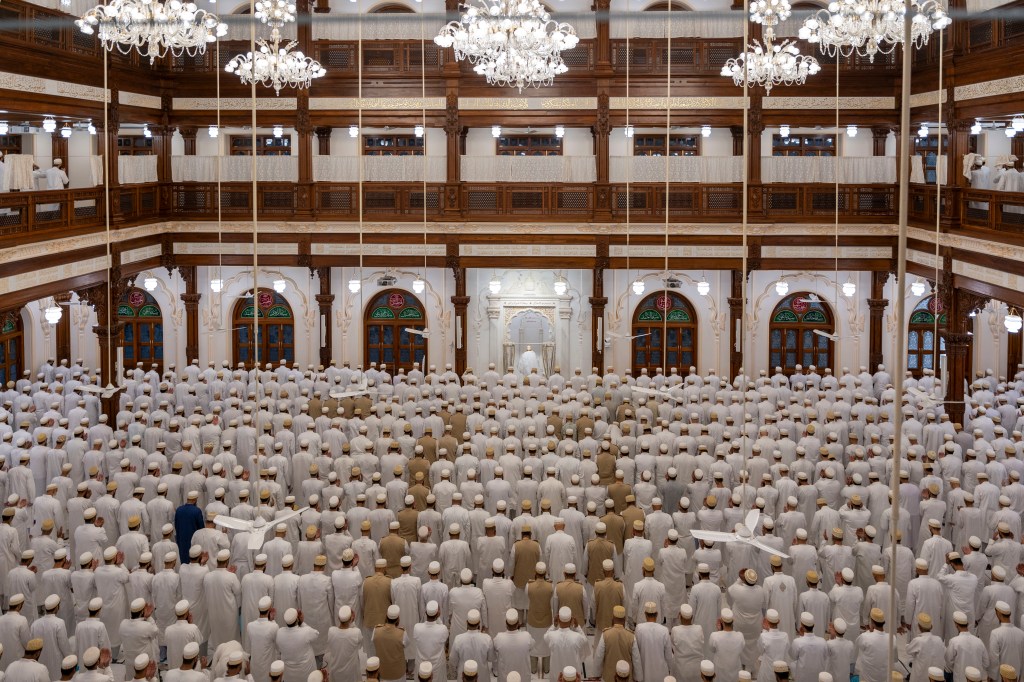
The Bohras are among the most distinctive, cohesive, and least understood Muslim communities in the world. Concentrated historically in Gujarat in western India but now settled in over forty countries across the globe — a figure stated by the official Dawoodi Bohra community site, which notes that “aggregating to around 1 million members, the Dawoodi Bohras have settled in over 40 countries across the globe” — they combine scrupulous religious orthopraxy with conspicuous commercial success and a remarkable embrace of modern technology, a combination that the anthropologist Jonah Blank memorably captured in the title of his ethnography, Mullahs on the Mainframe (2001). They are a branch of the Musta’li-Tayyibi line of Isma’ili Shia Islam, and their religious life is organized around one of the most centralized clerical institutions in the Muslim world: the office of the Da’i al-Mutlaq, the “absolute” or “unrestricted summoner,” who governs the community as the representative of an imam believed to be alive but concealed. Dawoodi Bohra Muslim Community
This essay treats the Bohras as its principal subject, with the Dawoodi Bohras — by far the largest branch — at its center. Comparisons with Sunni Islam, Twelver (Ithna Ashari) Shiism, and the Ahmadiyya Muslim Community are offered briefly, as reference points that illuminate what is shared and what is distinctive. The aim is descriptive and irenic, not polemical, and the closing epilogue makes a normative argument for the primacy of the Quran and the unity of the Ummah.
I. History
Origins within Isma’ili Shiism and the Fatimid background
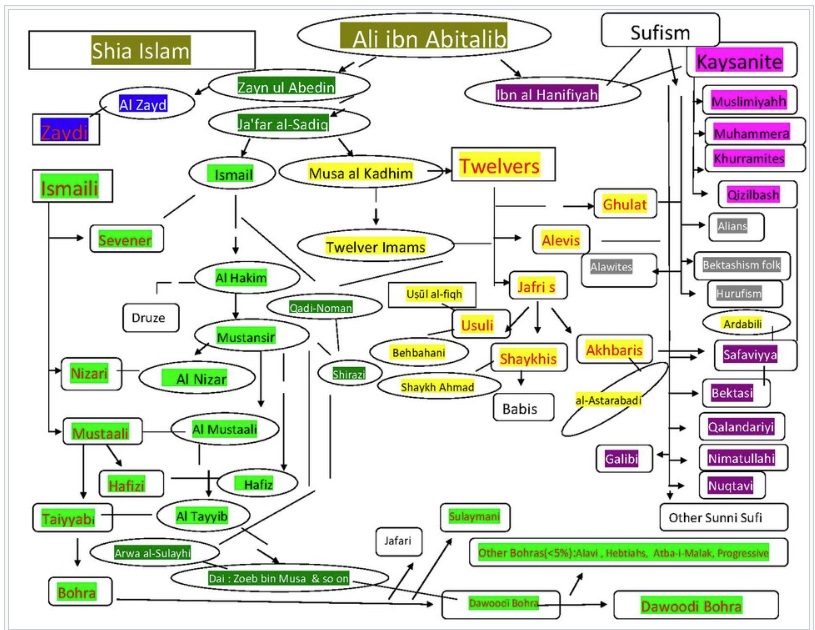
All Shia Muslims hold that leadership of the community after the Prophet Muhammad belonged to his cousin and son-in-law, Ali ibn Abi Talib, and to designated descendants from his line through the Prophet’s daughter Fatima. The Isma’ilis are that branch of Shiism which, after the death of the sixth imam, Ja’far al-Sadiq (d. 765), recognized his son Isma’il (and Isma’il’s son Muhammad) in the line of imams, diverging from the Twelvers who followed Ja’far’s other son, Musa al-Kazim.
The Isma’ili da’wa (mission) culminated politically in the establishment of the Fatimid Caliphate, which ruled from 909 over an empire that at its height stretched across North Africa, Egypt, the Hejaz, and the Levant. The Fatimids founded Cairo and al-Azhar — one of the oldest universities in the world — and presided over a celebrated age of arts and learning. It was during the long reign of the Fatimid imam-caliph al-Mustansir bi’llah (1036–1094) that Isma’ili missionaries reached Gujarat and began making converts among local trading communities; the Bohras trace their spiritual ancestry to these conversions.
The Musta’li–Nizari schism of 1094
The death of al-Mustansir in December 1094 precipitated the great schism of Isma’ili history. Al-Mustansir had earlier designated his elder son Nizar as heir, but the powerful vizier al-Afdal Shahanshah engineered the accession of a younger son, Abu’l-Qasim Ahmad, who took the regnal title al-Musta’li. Nizar fled to Alexandria, rebelled, was defeated, and was executed (c. 1095). The Isma’ili world split permanently: the official da’wa in Egypt, Syria, and Yemen recognized al-Musta’li, while the communities of Persia and Iraq — led by Hasan-i Sabbah of Alamut — upheld Nizar. The Bohras descend from the Musta’li line; the Nizari line continues today under the Aga Khans. The Institute of Ismaili Studies, in a lecture by Professor Paul Walker, has emphasized how contested and fragmentary the historical record of this succession is — a useful caution against treating any single confessional account as settled fact.
The Tayyibi–Hafizi split and the concealment of al-Tayyib (1130)
A second rupture followed the assassination of the Musta’li imam-caliph al-Amir bi-Ahkam Allah in 1130. According to Tayyibi tradition, al-Amir had an infant son, al-Tayyib Abu’l-Qasim, born shortly before his death and designated as the twenty-first imam. When power in Cairo passed to al-Amir’s cousin al-Hafiz, the Isma’ili world divided again: the Hafizi branch (which recognized the later Fatimid caliphs as imams and became extinct after the dynasty’s fall in 1171) and the Tayyibi branch, which held that al-Tayyib had entered a state of concealment (satr), traditionally dated to 528 AH / 1134 CE. The Tayyibis are the only surviving Musta’li community, and all Bohras are Tayyibis.
Crucially, the Tayyibi doctrine holds that the imam did not die but remains alive and hidden, his line continuing through hidden successors, and that he will one day reappear. In his absence, religious authority was vested in a new office.
The institution of the Da’i al-Mutlaq
In Yemen, the Sulayhid queen al-Sayyida Arwa bint Ahmad (al-Hurra al-Malika), who had earlier served as the imam’s hujja (“proof”), is credited with establishing the office of the Da’i al-Mutlaq — the “absolute missionary” — to lead the community on the hidden imam’s behalf. The first Da’i, Zoeb (Dhu’ayb) bin Musa, was appointed circa 1138. According to Tayyibi doctrine, in the imam’s absence the Da’i al-Mutlaq holds the same authority as the imam himself. The early intellectual architect of the tradition was the second Da’i, Ibrahim al-Hamidi (d. 1162), author of Kanz al-walad.
For roughly four centuries the Tayyibi da’wa was headquartered in Yemen, surviving persecution by the Zaydi rulers. The nineteenth Da’i, Idris Imad al-Din (1428–1468), was both a powerful leader and a major historian, author of the seven-volume Uyun al-akhbar.
The transfer of the da’wa to India and the Dawoodi–Sulaymani split of 1591
The community had grown steadily in Gujarat — at Cambay (Khambhat), Patan, Sidhpur, and Ahmedabad — and the twenty-fourth Da’i, Yusuf Najmuddin, was himself an Indian from Sidhpur. Owing to persecution in Yemen, the headquarters of the da’wa shifted permanently to India in the sixteenth century, where it has remained for roughly 450 years.
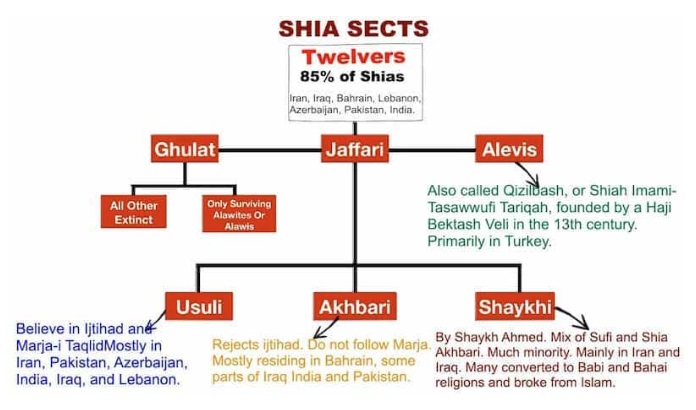
The defining schism of the Indian period came after the death of the twenty-sixth Da’i. The majority in India recognized Dawud bin Qutubshah as the twenty-seventh Da’i, while a faction in Yemen (and a minority in India) followed Sulayman bin Hasan. The dispute was even brought before the Mughal emperor Akbar around 1597, whose tribunal favored Dawud. The followers of Dawud became the Dawoodi Bohras (the great majority, centered in India); those of Sulayman became the Sulaymani Bohras (centered in Yemen and later Najran). This split is conventionally dated to 1591/1592.
The origin of the term “Bohra” and the community’s mercantile character
The name “Bohra” (also Bohara, Vohra) derives from the Gujarati word vohorvu or vyavahar, meaning “to trade.” The name reflects the community’s overwhelmingly mercantile character: most early Indian converts to Tayyibi Isma’ilism were traders. The label has occasionally been claimed by non-Isma’ili trading communities as well, but it applies most properly to the Tayyibi Isma’ilis. Beyond their distinct theology, the Bohras developed a distinctive language, Lisan al-Dawat (“the tongue of the da’wa”), a form of Gujarati infused with Arabic, Persian, and Urdu vocabulary and written in Arabic script.
Later splits and movements
Several further divisions occurred. In the fifteenth century, a community at Patan converted to Hanafi Sunni Islam under Sayyid Jafar Shirazi, becoming the Jafari (or Sunni) Bohras. In 1621, a small faction in Ahmedabad recognized a different line of da’is and became the Alavi Bohras, who later established themselves at Vadodara.
In the twentieth and twenty-first centuries, a reformist / Progressive Dawoodi Bohra movement emerged, with roots in early-twentieth-century disputes over secular education and a major resurgence beginning around 1970–1977. Centered in Udaipur, it challenged the clergy’s absolute control, demanded financial transparency and democratic communal governance, and opposed practices such as baraat (social boycott/excommunication) and compulsory raza (permission). Its most prominent leader was the scholar-activist Asghar Ali Engineer (1939–2013). The Nathwani Commission — chaired by the retired judge N. P. Nathwani (alongside the jurist V. M. Tarkunde) and convened by Citizens for Democracy — reported in 1979 that there was “large-scale infringement of civil liberties and human rights of reformist Bohras at the hands of the priestly class.” Dawoodi Bohras
The most recent rupture is the succession dispute of 2014. On the death of the fifty-second Da’i, Syedna Mohammed Burhanuddin, in January 2014, his son Mufaddal Saifuddin assumed office as the fifty-third Da’i. His half-uncle Khuzaima Qutbuddin — who had served as mazoon (second-in-command) for some five decades — claimed that he himself had secretly received nass (designation) and was the rightful successor. He filed suit in the Bombay High Court in 2014; after his death in 2016, his son Taher Fakhruddin continued both the claim to the office and the litigation.
II. Demographics
The Dawoodi Bohras are most commonly estimated at around one million members worldwide, though figures vary by source: the advocacy group WeSpeakOut estimates “about 1.5 million total worldwide,” while Voice of America cites “an estimated 1 to 2 million followers around the globe.” All such figures are estimates, as the community does not publish audited census data. The majority live in India — especially Gujarat, Mumbai, and Surat — with significant populations in Pakistan (notably Karachi), and communities in Yemen, East Africa (Kenya, Tanzania, and historically Zanzibar), and a growing diaspora in the United Kingdom, the United States, Canada, the Gulf states, Southeast Asia, and Australia. WespeakoutVoice of America
The smaller branches are correspondingly modest. The Sulaymanis are concentrated in Yemen and in Najran (now Saudi Arabia), with population estimates that vary considerably between sources, plus a few thousand in India (Vadodara, Hyderabad, Mumbai, Surat) and small numbers elsewhere; they are led by a Da’i drawn in recent centuries mostly from the Makrami family. The Alavi Bohras are a small community of a few thousand based in Vadodara, led by their own line of da’is.
Socioeconomically, the Bohras are distinguished by their mercantile and entrepreneurial orientation, high levels of literacy and education, and exceptionally tight-knit communal organization. Blank’s Mullahs on the Mainframe documents a community that sends sons and daughters alike to universities in Britain and the United States, exhibits relatively high gender parity in education, and became an early adopter of internet technology — all while maintaining conservative norms of prayer, dress, dietary practice, and avoidance of interest-based finance.
III. Theology and Beliefs
The imamate and the seven pillars
Bohra theology is grounded in the Isma’ili doctrine of the imamate: that the earth is never without a living imam from the progeny of Ali and Fatima through al-Husayn, who is the authoritative interpreter of revelation. Tayyibi jurisprudence follows the Fatimid legal code articulated by the great jurist al-Qadi al-Nu’man (d. 974) in his Da’a’im al-Islam (“The Pillars of Islam”), commissioned by the imam-caliph al-Mu’izz.
Where Sunni Islam speaks of five pillars, the Da’a’im enumerates seven: walaya (loving devotion to God, the prophets, the imams, and their representatives — held to be the highest pillar), tahara (purity), salat (prayer), zakat (purifying alms), sawm (fasting), hajj (pilgrimage), and jihad (struggle). The elevation of walaya above all other pillars is the doctrinal cornerstone of Isma’ili religiosity, since it is through allegiance to the imam (and, in his absence, the Da’i) that the believer is held to gain access to the true, inner meaning of the faith.
Zahir, batin, and ta’wil
A defining feature of Isma’ili thought is the distinction between the zahir (the exoteric, outward form of scripture and law) and the batin (the esoteric, inner meaning). The discipline of recovering inner meaning is ta’wil (esoteric interpretation), to which al-Qadi al-Nu’man devoted a companion work, Asas al-Ta’wil. In Tayyibi doctrine, authoritative ta’wil belongs to the imam, and during his concealment to the Da’i al-Mutlaq. This is the theological root of the community’s strong norm against unauthorized individual interpretation of doctrine.
Cosmology: the Ten Intellects and the haqa’iq
Tayyibi theology preserves an elaborate Neoplatonic-influenced cosmology, the system of haqa’iq (“realities”). Building on the work of the Fatimid philosopher Hamid al-Din al-Kirmani (d. after 1020), whose Rahat al-aql replaced the earlier Neoplatonic dyad of Intellect and Soul with a series of ten separate Intellects (partly adapted from al-Farabi’s Aristotelian cosmos), the Yemeni Tayyibi da’is — especially Ibrahim al-Hamidi — developed a gnostic cosmic drama in which the Tenth Intellect plays a central salvific role, and the souls of initiates ascend through cycles toward a final resurrection. This represents what scholars call the fourth and final stage in the development of medieval Isma’ili cosmology. It is a sophisticated metaphysics, though one largely reserved for advanced initiates rather than the lay believer.
The concealed imam and the Da’i al-Mutlaq
The theological linchpin of Bohra faith is the conviction that the twenty-first imam, al-Tayyib, and his hidden descendants remain alive on earth, and that the Da’i al-Mutlaq guides the faithful and preserves the faith until the imam’s reappearance. Tayyibi scholars note that this concealment differs from the Twelver Shia occultation: where the Twelvers await the return of a single hidden imam (the Mahdi), the Tayyibi tradition posits a continuous, hidden line of imams whose authority is exercised through the Da’i.
Distinctive practices
Several practices mark Bohra religious life:
- The misaq (mithaq): the oath of allegiance, a covenant between the believer and God mediated through the Da’i’s representative, by which the initiate (typically at puberty) pledges to uphold the shari’a and accept the spiritual guidance of the imam and the Da’i. It is renewed annually on the 18th of Dhu al-Hijja, the date Shia Muslims commemorate as Ghadir Khumm, when the Prophet is held to have designated Ali. Reformist critics have argued that, in its modern form, the oath demands obedience to the Da’i in secular as well as religious matters — a contention central to a series of twentieth-century court cases.
- The Fatimid calendar: the Bohras follow a tabular lunar calendar fixed by astronomical calculation rather than moon-sighting, so that their fasts and festivals are set in advance and often differ by a day or two from other Muslims.
- Distinctive dress: men wear a white three-piece saya kurta with a gold-worked cap (topi); women wear the colorful, distinctive rida. The ensemble is termed libas al-anwar.
- Mourning of Karbala: like other Shia, the Bohras commemorate the martyrdom of Imam al-Husayn during the first ten days of Muharram with majalis (mourning assemblies).
- Ziyarat: pilgrimage to the shrines of the imams and revered da’is is central to devotional life, supported by rest-houses and charitable foundations.
- Taqiyya: the precautionary concealment of belief under threat, a practice shared across Shia traditions, which has historically shaped the community’s guardedness toward outsiders.
- Communal dining from a shared platter (thaal) expresses the community’s strong ethic of solidarity.
IV. Leadership Models
The Da’i al-Mutlaq and the da’wa hierarchy
The Bohra polity is among the most centralized in the Muslim world. At its apex stands the Da’i al-Mutlaq — addressed by Dawoodis as Syedna or Aqa Maula — who exercises supreme religious and administrative authority. Beneath him the classical Fatimid da’wa hierarchy continues: the Mazoon (licentiate, second-in-command), the Mukasir (third rank), and below them a network of aamils (local clergy who administer individual jamaats) and shaikhs. The seminary al-Jamea al-Saifiyah in Surat trains the clerical cadre.
Succession to the office is determined not by heredity in the strict sense but by nass — the formal designation of a successor by the incumbent Da’i. In practice, since the office moved to India, the Da’is have very often been drawn from a single family, and the last several successions have passed from father to son. Unlike the imam — whom the tradition regards as infallible (ma’sum) — the Da’i’s status with respect to infallibility has itself been a point of internal contention, with reformists insisting that the early tradition reserved infallibility to the imam alone.
The administrative apparatus, sometimes called the Kothar (or Dawat-e-Hadiyah), oversees finances, religious certification, and communal welfare. The community’s cohesion is reinforced through mechanisms of compliance: the misaq, the requirement of raza (permission) for various undertakings, religious “certificates of orthopraxy,” and, at the extreme, baraat — excommunication and social boycott of dissenters.
Modernity and centralized authority
Blank’s central insight is that this premodern clerical structure has not impeded modernization but has actively directed it: the twentieth-century da’is, especially the fifty-first (Taher Saifuddin) and fifty-second (Mohammed Burhanuddin), used their centralized authority to raise educational standards, strengthen orthopraxy, and embrace technology, producing a community that is at once thoroughly traditional and thoroughly modern.
Contemporary controversies
Three areas of controversy deserve mention, treated here with care and balance.
First, the reform movement and the practice of baraat. Reformists have long argued that excommunication and social boycott — which can sever a dissenter from family, mosque, burial rights, and commerce — violate individual conscience and civil liberty, and have noted that there is no Quranic basis for such a boycott. The establishment maintains that communal discipline is integral to the faith and that membership is voluntary. Both positions are sincerely held; an objective account must record the genuine human cost documented by the Nathwani Commission’s 1979 report alongside the community’s account of voluntary cohesion.
Second, female genital cutting (khafd/khatna). The Dawoodi Bohras are notable as a community in which a form of female genital cutting — classified by the World Health Organization as Type I FGM — has been practiced. Survivor-led research suggests the practice has been widespread: WeSpeakOut’s 2018 study (Anantnarayan et al., 94 participants) found that 75% of daughters had been cut, while Sahiyo’s global survey of more than 384 Bohra women found that 80% had undergone khatna — though notably 81% wanted the practice to stop. The issue has become highly contested. In November 2015, the Supreme Court of New South Wales convicted three people — the girls’ mother, the retired nurse Kubra Magennis, and the senior clergyman Shabbir Vaziri (as an accessory who facilitated a cover-up) — of performing khatna on two sisters who had been cut between 2010 and 2012 at the ages of six and seven; this was the first FGM prosecution in Australia, where the practice has been illegal since 1997. (Those convictions were subsequently overturned on appeal in August 2018, before a later appellate ruling reaffirmed that FGM in its various forms is unlawful.) Bohra trusts in several Western countries instructed members to obey local law, while the community leadership has continued to characterize the practice as a religious matter in jurisdictions where it is not banned — a stance activists have strongly criticized. This essay records the practice and the controversy without endorsing it; the weight of medical and human-rights opinion regards it as harmful.
Third, the 2014 succession dispute and litigation. The challenge by Khuzaima Qutbuddin and his son Taher Fakhruddin produced one of the most closely watched religious-succession cases in recent Indian legal history (Suit No. 337 of 2014, Taher Fakhruddin v. Mufaddal Saifuddin). The suit was filed on March 28, 2014; hearings concluded on April 5, 2023. After a trial spanning nearly a decade, Justice Gautam Patel of the Bombay High Court delivered judgment on April 23, 2024, dismissing the suit and effectively upholding Mufaddal Saifuddin as the rightful fifty-third Da’i. The court was at pains to stress that it decided the matter on evidence rather than faith, framing the case around the legal requirements of a valid nass. According to the official Dawat-e-Hadiyah statement, the judgment held that Taher Fakhruddin “was unable to prove his claim of the conferral of nass,” while finding that “the 52nd Dai had conferred nass upon Syedna Saifuddin on four separate occasions”; the defense further argued, on textual grounds, that a nass is not irrevocable and that only the last valid designation governs. The judgment is under appeal before a Division Bench. The case has had a disturbing afterlife: per India TV News (June 9, 2026), Justice Patel’s daughter Aditi received an anonymous letter on June 5 claiming a “contract” had been issued against the family, following months of threatening letters in India and the United Kingdom and a physical attack on her in London — threats that both Bohra factions, as well as the Bombay Bar Association, have publicly condemned.
V. Comparative Reference Points
These brief comparisons are intended only to locate the Bohras within the wider Muslim landscape; the Bohras remain the principal subject.
Shared ground with other Shia (especially Twelver / Ithna Ashari)
The Bohras share with all Shia the love of the Ahl al-Bayt, the conviction that Ali was the Prophet’s legatee (wasi) and rightful successor, and the doctrine of the imamate as divinely guided authority. They share the mourning of al-Husayn at Karbala during Muharram; the practice of taqiyya; the institution of ziyarat to shrines; and the very concept of a concealed imam. The principal differences are that the Twelvers follow a different line of imams (through Musa al-Kazim) and await a single returning Mahdi, whereas the Tayyibi Bohras follow the Isma’ili line (through Isma’il), posit a continuous hidden imamate, and vest authority in the Da’i al-Mutlaq. Scholars often note that, in outward ritual, the Musta’li Tayyibis are among the most “traditional” of Isma’ilis, observing prayer and fasting in forms close to those of other Shia.
Shared ground with Sunni Muslims
With Sunnis — and indeed with all Muslims — the Bohras share the shahada, the five daily prayers, fasting in Ramadan, the Hajj to Mecca, the giving of zakat, the Quran as the literal word of God, the uncompromising monotheism of tawhid, and the belief in Muhammad as the seal of the prophets (khatam al-nabiyyin). The Bohras’ seven pillars include the Sunni five within them; the additions of walaya and tahara reflect the Shia emphasis on devotion to the imam and on ritual purity, not a rejection of the shared practices. It is worth underscoring, against polemical claims, that the Bohras revere exactly the same Arabic Quran as all other Muslims.
Comparison with the Ahmadiyya Muslim Community
The comparison with the Ahmadiyya is instructive because both are minority communities organized around a strong, living central leadership and marked by exceptional communal cohesion, organizational discipline, and an ethic of obedience to a central spiritual authority — and both face questions about their orthodoxy from segments of the Sunni mainstream.
The decisive difference lies in the source of authority. In the mainstream Ahmadiyya Muslim Community, authority is vested in a living, visible Khalifa (Khalifatul Masih), whose office is held to derive from the claims of the Promised Messiah, Mirza Ghulam Ahmad (1835–1908), and whose worldwide organization (Nizam-e-Jama’at) emphasizes obedience to Khilafat. By contrast, the Bohra Da’i al-Mutlaq derives his authority from a concealed, hidden imam whom he represents. Thus one community is led in the name of a present and visible successor, the other in the name of an absent and hidden imam.
A further distinction concerns the Lahore Ahmadiyya Movement (Ahmadiyya Anjuman Isha’at-e-Islam Lahore) — the tradition with which the present author is affiliated. The Lahore Ahmadis, who separated from the Qadian-based majority in 1914, regard Mirza Ghulam Ahmad as a mujaddid (reformer/renewer of the fourteenth Islamic century) and the metaphorical Promised Messiah — emphatically not a prophet — and uphold the absolute finality of the prophethood of Muhammad. They also reject the institution of a hereditary-style caliphate in favor of a more decentralized, consultative model: leadership by an Anjuman (council) headed by an Amir. The Lahore movement therefore stands at the opposite pole from the Bohras on the question of centralized living authority: where the Bohra Da’i wields near-absolute personal authority as the deputy of a hidden imam, the Lahori model deliberately diffuses authority through a council and treats its founder as a reformer subordinate to the Quran and the finality of Muhammad’s prophethood.
VI. The Quran-Centric Perspective: Integrating the Corpus of thequran.love
The thematic concerns of this essay resonate with a body of work published on thequran.love and in the affiliated Muslim Times. That corpus advances several arguments directly relevant to the Bohra case.
First, it insists on the primacy of the Quran as the shared foundation of all Muslims. As one essay observes, the various sects “revere the Qur’an as God’s word — in fact, all sects share exactly the same Arabic Qur’an text,” unlike the multiple textual versions found in some other scriptural traditions. What divides Muslims, that work argues, is not the text but “how the Qur’an is understood and who holds authority to interpret it” — precisely the question that the Isma’ili doctrines of ta’wil and the authoritative imam-Da’i place at the center of religious life.
Second, the corpus diagnoses sectarianism as a besetting ailment of the modern Ummah. An essay titled “Beyond Sects: A Call for Ummah Unity” likens Muslim sects to political parties, and observes pointedly that “smaller communities like Isma’ilis, Bohras, Memons and the Ahmadiyya can become even more insular.” The remedy it proposes is not the erasure of difference but the cultivation of “compassion for the entire Ummah.”
Third, the corpus repeatedly invokes the Quranic and Prophetic images of unity: the command to “hold firmly to the rope of Allah all together and do not become divided” (Q 3:103), and the Prophet’s teaching that the believers are “like one body.” It treats the Ka’ba and the shared Quran as the great symbols of an underlying Muslim unity that “colonial borders and sectarian labels have not erased.”
These themes frame the present study. A community as cohesive, learned, and accomplished as the Bohras is a treasure of the Muslim world; the question this essay raises — gently — is whether the inward-looking mechanisms of authority and boundary-maintenance that have preserved that cohesion are always compatible with the wider Quranic vision of one Ummah.
VII. Scholarly Caveat
Several methodological cautions are in order, in fairness both to the Bohra community and to the reader.
First, the distinction between confessional and academic accounts must be kept in view. Much of the most detailed information about Bohra history and doctrine comes either from the community’s own institutions — which present the tradition in a devotional and favorable light — or from reformist and dissident sources, which are critical. Independent academic scholarship (Farhad Daftary and the Institute of Ismaili Studies; the jurisprudential studies of Ismail Poonawala; the anthropology of Jonah Blank; the contributions of Tahera and Saifiyah Qutbuddin to Daftary’s A Modern History of the Ismailis) provides the most balanced foundation, but even here scholars have noted that some surveys lean toward the establishment and others toward the dissidents. Readers should weigh the provenance of each claim.
Second, many historical attributions are contested. The dating of al-Tayyib’s birth and concealment, the authenticity of the nass in various successions, and the precise circumstances of the 1094 and 1130 schisms rest on fragmentary and partisan sources, as the Institute of Ismaili Studies itself acknowledges. Such matters are articles of faith within the tradition and objects of cautious reconstruction outside it; this essay has tried to mark that line.
Third, population figures are estimates. The roughly one-million figure for Dawoodi Bohras, and all figures for the smaller branches, are approximations; the community does not release audited data, and the practice of taqiyya and the closed character of communal records make precise enumeration difficult.
Fourth, on contested contemporary practices — particularly female genital cutting and baraat — this essay has reported the existence of the practices, the community’s stated rationale, and the substantial criticism from survivors, activists, courts, and reformists, without resorting to polemic. Respect for the Bohras as a community is fully compatible with honest acknowledgment of these controversies.
Epilogue: The Quran First, and the Whole Ummah
If there is a single lesson to be drawn from the long and dignified history of the Bohras — and from the parallel histories of the Twelvers, the Ahmadiyya, and indeed every Muslim community — it is how readily the love of God can be narrowed into the love of a faction. Each of these communities began as an attempt to be faithful; each, over time, built walls. The Bohra misaq and baraat, the mutual excommunications of rival Ahmadi and Sunni and Shia camps, the very multiplication of da’is and khalifas and imams claiming exclusive authority — all are, at bottom, answers to a single question: who has the right to teach and interpret Islam?
The Quran’s own answer is strikingly democratic in its starting point. The Book is addressed to all who would read it: “We have indeed made the Qur’an easy to remember” (Q 54:17). It declares that “this community of yours is one community” (ummatun wahida, Q 23:52), and it commands believers, in words that should be inscribed over every mosque and every seminary, “Hold fast, all together, to the rope of Allah, and do not be divided” (Q 3:103). It reminds us that human difference is not a scandal to be abolished but a sign to be understood: “O mankind, We created you from a male and a female, and made you into nations and tribes that you may know one another” (Q 49:13). And it warns, soberly, against precisely the path that sectarian history has so often taken: “Be not like those who became divided and differed after clear proofs had come to them” (Q 3:105).
The argument of this epilogue is therefore twofold. First, that for Muslims the Quran should take priority over any human apparatus that restricts who may approach it. The scholar, the jurist, the imam, the da’i, the khalifa — each may serve the Book, but none may stand between the believer and the Book in a way that the Book itself does not sanction. The genius of Islam was to abolish a priestly caste; where any community reconstructs one, it should at least be asked, in candor and friendship, whether the reconstruction serves the Quran or supplants it.
Second, that solidarity should be directed toward the larger Ummah, not confined to the smaller community. There is far more that unites the Bohra and the Sunni, the Twelver and the Ahmadi, than divides them: one God, one Prophet, one Book, one Ka’ba toward which they all turn. The Prophet’s image of the believers as a single body — when one limb suffers, the whole body responds with fever and sleeplessness — was not a description of a sect but of the Ummah entire. To love one’s own community is natural and good; to love it instead of the Ummah is to mistake the limb for the body.
The Bohras have given the Muslim world a model of cohesion, learning, charity, and resilience under persecution that the rest of us would do well to admire and emulate. The hope expressed here — offered in the irenic spirit of one who believes the Quran was sent as “a mercy to all peoples” (Q 21:107) — is not that any community should dissolve its heritage, but that every community, the author’s own included, should hold its distinctive identity loosely enough to embrace the brother and sister who pronounce the same shahada and turn to the same Ka’ba. “The believers are but a single brotherhood” (Q 49:10). May we live to see that brotherhood realized.
This essay was prepared as an independent scholarly article for thequran.love. It draws on academic scholarship (notably Farhad Daftary and the Institute of Ismaili Studies, Ismail Poonawala, and Jonah Blank), primary jurisprudence (al-Qadi al-Nu’man’s Da’a’im al-Islam*), reputable journalism, and the published corpus of the author. Where historical attributions are contested or figures are estimates, this has been noted in the text.*






Leave a comment