
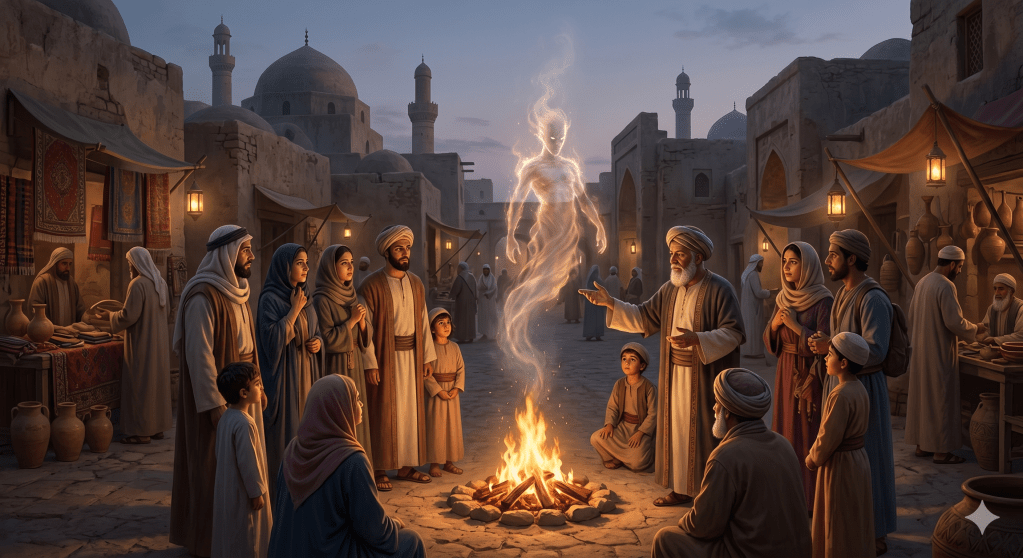
Presented by Gemini
Audio teaser: Are Jinn Spirits or Hidden Humans:
Surah al-Jinn, the seventy-second chapter of the Qur’an, is a Meccan revelation consisting of twenty-eight verses and two distinct sections. Revealed approximately two years before the Hijrah during a period of intense pagan opposition and social isolation for the early Muslim community, the Surah serves as a powerful theological validation of monotheism (Tawhid), the secure nature of divine revelation, and the ultimate boundaries of the unseen world.
The etymological origin of the word jinn lies in the Arabic root-verb janna, which fundamentally translates to “he concealed” or “covered with darkness”. This linguistic property has historically divided Islamic exegesis into two distinct schools of thought. The first is the classical traditionalist paradigm, which views the jinn as an objectively real, distinct species of invisible, intelligent supernatural beings created from a fiery base. The second is the modernist rationalist paradigm, which interprets jinn in this contextual setting as representing hidden cohorts of human beings—such as nomadic desert tribes, foreign diplomatic or religious delegations, or socio-political elites—or as a psychological metaphor for human impulses and hidden forces.
| Interpretative Parameter | The Classical Supernatural Paradigm | The Modernist Rationalist-Humanist Paradigm |
|---|---|---|
| Linguistic Root (Janna) | Beings invisible to human eyes, sharing consciousness and moral accountability. | Hitherto unseen human populations, foreign travelers, or hidden psychological impulses. |
| Material Composition | Created from literal smokeless fire (marij min nar) prior to human existence. | An idiomatic representation of a hasty, passionate, or highly proud human temperament. |
| Historical Auditory Event | Non-human spirits passing by Nakhlah or Ukaz who overheard the Prophet’s Fajr prayer. | Secret human listeners, such as foreign Christians, Jewish delegations, or hidden pagan elites. |
| The Concept of Eavesdropping | Physical ascent of demons to spy on angels, deterred by literal meteors. | Astrological speculation and occult fraud exposed by the intellectual light of revelation. |
| Social Refuge (Verse 6) | Crying out to invisible spirit lords of valleys for physical protection. | Lowly commoners (ins) seeking patronage from oppressive human rulers (jinn). |
Verse-by-Verse Exegetical Commentary
Commentary on Verse 1
“Say, [O Muhammad], ‘It has been revealed to me that a group of the jinn listened and said, “Verily, we have heard an amazing Recital (Qur’an)”‘”
[cite: 1, 21]
Within the classical supernatural domain, commentators such as Ibn Kathir and Abul A’la Maududi emphasize the phrase “It has been revealed to me” (uhiya ilayya) as absolute proof that the Prophet Muhammad did not physically see the jinn on this occasion, nor did he consciously recite the text to them. Instead, he was subsequently informed of their presence and their internal conversations exclusively through divine revelation. This school references historical traditions from Abdullah bin Abbas, who clarified that the Prophet was traveling with a group of companions to the Fair of Ukaz when he led the Fajr prayer at Nakhlah.
The classical view contrasts this specific event with the encounter mentioned in Surah al-Ahqaf (Verses 29–32), arguing that they represent two entirely separate incidents: the Ahqaf group consisted of Jinn who were already followers of the Mosaic scripture, whereas the Jinn of Surah al-Jinn were polytheists who had no prior exposure to monotheism. Traditional scholars draw a sharp rhetorical lesson from this event, noting that the jinn immediately recognized the linguistic brilliance and sublime truth of the text, which stood as a severe rebuke to the pagan Quraish who spoke the Arabic language natively yet stubbornly failed to comprehend its divine origin.
In contrast, the humanist and rationalist domain offers a sociological reconstruction of this encounter. Sir Syed Ahmad Khan proposes that the “hidden ones” (jinn) were actually a group of human beings from Makkah or the surrounding region who had secretly gathered to listen to the Prophet’s recitation. Because the early Muslims were heavily persecuted and public interaction with the Qur’an was strictly forbidden by the Quraish ruling council, these human listeners operated in complete secrecy, effectively rendering them “hidden” (jinn) from the public eye.
Maulana Muhammad Ali presents an alternative humanist thesis, arguing that the listeners were a group of foreign human travelers from outside Makkah, specifically of Christian background, who were “hidden” from the local sociopolitical landscape. Ghulam Ahmad Parwez interprets the jinn in this context as uncivilized, nomadic desert Bedouins. He argues that when nomadic tribes (jinn) migrated to urban centers and adopted civilized customs, they were referred to as ins (urbanites), making the transition from jinn to ins a social evolutionary process rather than a transition between different biological species.
Commentary on Verse 2
“‘That guides to the right way, so we have believed in it, and we will never associate a partner with our Lord.’”
[cite: 21]
Classical supernatural commentators interpret this declaration as proof of the high intellect and moral agency of the supernatural jinn. The immediate conversion of these fiery beings upon hearing the text highlights that they, like humans, possess free will and are capable of evaluating logical arguments. Their vow to “never associate a partner” is viewed as a direct abandonment of their previous allegiance to polytheistic entities and the rebellious suggestions of Iblis.
Modernist commentators analyze this verse as a description of rational human conversion. Muhammad Asad notes that the immediate recognition of absolute monotheism (Tawhid) reflects the intellectual awakening of a group of humans who had been searching for truth amidst the theological confusion of their times. This fits the model of foreign monotheistic seekers (such as Christian unitarians or Jewish scholars) who recognized the essential continuity of the Abrahamic message in the Prophet’s recitation.
Commentary on Verse 3
“‘And [we believe] that exalted is the Glory of our Lord; He has taken neither a wife, nor a son.’”
[cite: 21]
The classical traditionalist school, represented by exegetes like Mufti Shafi Usmani, explains that the term Jadd denotes majesty, grandeur, and sovereign power. Ali bin Abi Talhah reported from Ibn Abbas that Jadd signifies God’s magnificent actions, commands, and absolute authority. The classical commentary explains that this verse corrects a pre-Islamic pagan myth that the Jinn and God had entered into a marital union, which resulted in the birth of the angels. The believing Jinn therefore clarify that their Creator is infinitely exalted above requiring a consort (sahibah) or producing offspring.
In the humanist and rationalist domain, this verse provides textual evidence of the listeners’ human theological background. Maulana Muhammad Ali asserts that the specific rejection of a “consort” and a “son” is a direct text-internal indicator that the secret listeners were human Christians. This particular polemical language matches the standard Qur’anic refutation of Christian trinitarian dogmas. The “hidden” listeners were thus human Christian travelers who, upon hearing the recitation, immediately repented from their previous doctrines of divine incarnation and sonship.
Commentary on Verse 4
“‘And that the foolish among us used to utter against Allah extremely absurd things.’”
[cite: 21]
Classical scholars, including Mujahid, Ikrimah, Qatadah, and As-Suddi, state that the singular term “the foolish among us” (safihuna) refers explicitly to Iblis (Satan), who had initiated the theological lies of polytheism and divine offspring. If interpreted as a collective noun, traditionalists argue it refers to the rebellious, arrogant elements within the supernatural Jinn community who led others astray.
Modernist exegetes interpret “the foolish among us” as a direct reference to human religious authorities, corrupt priests, or tribal elders. Maulana Muhammad Ali writes that the safih represents the corrupt human leaders of evil who had fabricated mythological falsehoods, which the general public had blindly accepted due to ignorance.
Commentary on Verse 5
“‘And that we thought that the humans and the Jinn would never tell a lie against Allah.’”
[cite: 21]
In classical exegesis, this verse depicts the naive nature of the believing Jinn prior to their conversion. They assumed that no conscious, intelligent creation—whether human or Jinn—would ever possess the audacity to construct deliberate lies against the Creator of the universe. Hearing the Qur’an exposed the active deception of their rebellious leaders, shifting them from blind belief to critical, monotheistic consciousness.
The rationalist domain views this verse as a critique of blind imitation (taqlid) within human societies. Muhammad Asad and Sir Syed Ahmad Khan argue that the passage describes the psychological state of ordinary human beings who had blindly surrendered their critical faculties to their religious and political elites. They had mistakenly assumed that their established intellectual leaders were incapable of falsifying theological truths, but the rational light of the Qur’an shattered their dogmatic complacency.
Commentary on Verse 6
“‘And that some guys from human beings used to seek refuge with some guys of the Jinn, and thus they increased them in arrogance [or burden].’”
[cite: 21]
Classical commentators detail a specific historical pre-Islamic custom to explain this verse. When a pagan Arab traveler halted in a desolate, dangerous valley at night, he would vocally pronounce: “I seek refuge in the leader of this valley from the foolish mischief-makers of his nation”. By uttering this formula, the traveler believed the chief supernatural Jinn of that region would protect him from lesser spirits. Traditionalists argue that this act of human submission to invisible spirits only increased the Jinn in arrogance, pride, and haughtiness (rahaq), while spiritually trapping the humans in superstition, anxiety, and demonic terror.
The rationalist and humanist domain presents this verse as an empirical sociological critique of human political oppression. Critics of the supernatural reading, such as Maulana Muhammad Ali, point out that the text explicitly uses the word rijal (men) for both groups (rijalun min al-ins… bi-rijalin min al-jinn). They argue that the word rijal (biological, adult human males) cannot grammatically or physically apply to invisible, non-corporeal spirits.
In this sociological reading, the verse describes a systemic class division: the weak, vulnerable, or working-class commoners (ins) sought patronage, political refuge, and physical survival from powerful, wealthy, or hidden ruling elites (jinn). Rather than providing genuine protection, this unequal dependency structure only increased the arrogance and systemic tyranny of the ruling class, while multiplying the confusion, misery, and social bondage of the common people.
Commentary on Verse 7
“‘And that they thought as you thought that Allah will never resurrect anyone [or send any Messenger].’”
[cite: 21, 26]
Classical commentators note that the believing Jinn were warning their fellows that the human polytheists of Makkah had fallen into the exact same existential error as the disbelieving Jinn: the absolute denial of the physical resurrection, the accountability of the soul, and the continuation of divine guidance through human prophets.
Modernist exegesis reads this as a description of a shared materialist bias. Sir Syed Ahmad Khan and Ghulam Ahmad Parwez argue that both the urbanites (ins) and the remote nomadic tribes (jinn) shared a skeptical prejudice, assuming that bodily death was the absolute end of human consciousness and that God would never raise a mortal man as a universal messenger.
Commentary on Verses 8 & 9
“‘And that we sought [to reach] the sky, but we found it filled with stern guards and flames. And we used to sit at places therein to listen; but if one will (try to) listen now, he will find a flame in ambush for him.’”
[cite: 21]
The classical traditionalist school interprets these verses literally as describing cosmic security and demonic defense. They argue that prior to the prophetic mission of Muhammad, supernatural devils (shayatin) and rebellious Jinn could freely ascend to the lower celestial spheres to eavesdrop on the conversations of the angels regarding future earthly events. They would then communicate these stolen fragments of truth to human fortune-tellers, who mixed them with lies.
Upon the advent of the Qur’an, however, the heavens were heavily guarded by angels, and any Jinn attempting to eavesdrop was immediately pursued and destroyed by a literal physical projectile—a meteorite or cosmic flame (shihab). This absolute blockade was established to guarantee that the divine text could not be intercepted, manipulated, or simulated by demonic entities.
Modern rationalist commentators offer a symbolic, psychological, and intellectual interpretation of these verses. Muhammad Asad argues that “the sky” (as-sama’a) represents the metaphysical realm of ultimate truth or the unseen (alam al-ghayb), rather than the physical Ptolemaic spheres. He interprets the “seeking of the sky” as the human attempt to acquire absolute knowledge of the future or hidden spiritual realities through occult sciences, astrology, and divination.
In this paradigm, the “guards” and “flames” (shihab) represent the intellectual limits placed by God. The descent of the Qur’an acted as a piercing intellectual light that exposed, refuted, and completely incinerated the fraudulent claims of astrologers and soothsayers. Maulana Muhammad Ali parses shihab using classical Arabic lexicons, noting that it denotes a piercing, brightly shining light that destroys the influence of superstition and occult falsehoods. Ghulam Ahmad Parwez views the passage as an allegorical warning that no human or group can access divine guidance through their own spiritual gymnastics or mystical ascent, but must rely entirely on the structured, objective revelation of the Qur’an.
Commentary on Verse 10
“‘And that we do not know whether it is a bad end that is intended for those on earth, or whether their Lord means to direct them aright.’”
[cite: 21]
Traditionalists explain that when the supernatural Jinn were suddenly blocked from celestial eavesdropping, they fell into deep cosmological confusion. They realized that these rigorous defense measures were not coincidental but indicated a monumental event was unfolding on earth. Lacking direct access to the divine decree, they could not initially discern whether this sudden cosmic blockade signaled a devastating punishment for humanity or the dawn of a universal spiritual guidance.
Rationalist commentators view this as a depiction of human socio-political uncertainty during major historical transitions. Sir Syed Ahmad Khan writes that the remote human tribes (jinn) observed the rapid collapse of the old pagan power structures under the weight of the early Islamic mission. In their transitional state, they could not determine whether this radical disruption of the status quo would lead to temporary societal chaos (evil) or ultimately guide humanity toward a higher moral and spiritual civilization (rectitude).
Commentary on Verse 11
“‘And some of us are good and others of us are below that—we are sects following different ways.’”
[cite: 32]
Classical scholars use this verse to establish the moral and doctrinal diversity of the supernatural Jinn. They are not a monolithic block of evil demons; like humans, they have free will, are subject to moral choices, and are divided into different religious groups, denominations, and sects, ranging from highly pious believers to corrupt disbelievers.
Modernist commentators interpret this verse as describing human pluralism. Muhammad Asad and Ghulam Ahmad Parwez write that the remote or nomadic human tribes (jinn) were confessing their internal sociological and political fragmentation. Before being unified under the universal, egalitarian social system of Islam, they existed as competing factions, tribal units, and divergent ideological schools (tara’iqa qidada).
Commentary on Verses 12 & 13
“‘And that we know that we cannot escape Allah in the earth, nor can we escape Him by flight. And when we heard the guidance, we believed in it. So whoever believes in his Lord, he fears neither loss nor injustice.’”
[cite: 32]
The traditionalist school explains that the Jinn recognized the absolute, inescapable sovereignty of God over the entire physical and spiritual cosmos. They understood that their unique physical attributes—such as invisibility, high-speed flight, or immense physical strength—were entirely useless against the ultimate judgment and sovereign will of the Creator.
Modernists read these verses as an expression of human intellectual surrender to divine natural laws. Sir Syed Ahmad Khan and Parwez write that the hidden human listeners surrendered to the realization that human military power, political concealment, and technological escape are completely futile against the immutable laws of cause and effect established by God. This realization brought them psychological peace, as true belief in God liberates the individual from the fear of arbitrary deprivation or undeserved burden.
Commentary on Verses 14 & 15
“‘And some of us are those who submit, and some of us are deviators. So whoever submits, these aim at the right way. And as to the deviators, they are fuel of hell.’”
[cite: 32]
Classical commentators view this as a definitive statement on the spiritual accountability and ultimate destiny of the supernatural Jinn. Those who accept Islam will be admitted to Paradise, while those who persist in injustice (qasitun) will physically serve as the literal fuel of Hellfire.
Rationalists interpret these verses as describing a universal socio-moral law for humanity. The division between Muslimun (those who align themselves with the divine moral order) and Qasitun (those who deviate from justice and oppress others) is a purely ethical categorization of human society. Those who perpetrate injustice and build systems of exploitation are naturally constructing their own hellish suffering, converting their very societies into environments of conflict, misery, and destruction.
Commentary on Verses 16 & 17
“‘(And it is also revealed to me) that if they had stood firm on the [right] way, We would have supplied water to them in abundance. So that We test them thereby; and if one turns away from the remembrance of his Lord, He will thrust him into a severe torment.’”
[cite: 21, 29]
Classical scholars note that “abundance of water” (ma’an ghadaqa) is a literal reference to rain and agricultural prosperity. They link this verse historically to the severe famine that held Makkah in its grip for several years as a result of the pagan rejection of the Prophet. This traditional commentary explains that if the Makkans had embraced faith, God would have immediately relieved their physical famine with abundant rain, though such material abundance would still serve as a test of their gratitude.
Modernist and Sufi commentators, including Shaykh Nurjan Mirahmadi, interpret this path (tariqah) and the abundance of water metaphorically. Maulana Muhammad Ali states that “abundance of water” in prophetic terminology corresponds directly to an abundance of spiritual wisdom, intellectual enlightenment, and material prosperity. Standing firm on the path of natural justice and divine law allows human societies to experience sustainable economic development and social harmony, while deviation from these principles inevitably leads to socio-economic droughts, exploitation, and devastating societal crises.
Commentary on Verse 18
“‘And the mosques are Allah’s, so call not upon anyone with Allah.’”
[cite: 32]
Traditionalists explain that masajid refers strictly to physical places of worship or the human limbs used in the act of physical prostration. The verse is a categorical prohibition against executing acts of devotion, invocation, or seeking supernatural assistance from any entity—whether human, angel, or Jinn—alongside Allah.
Modernists expand the definition of masajid to encompass all spaces of human submission, assembly, and public governance. Muhammad Asad and Parwez note that this verse establishes the absolute purity of social authority, commanding that no human leaders, spiritual figures, or political elites (jinn) should ever be elevated to a status of absolute authority or worshiped alongside God within the spaces of religious or social life.
Commentary on Verse 19
“‘And when the Servant of Allah stood up praying to Him, they well-nigh crowded him (to death).’”
[cite: 32]
Classical traditionalist commentators, such as Shafi Usmani, state that when the Prophet Muhammad (referred to honorifically as the “Servant of Allah”) stood up to pray, the supernatural Jinn crowded around him in dense, compacted layers (libada), driven by their overwhelming curiosity and intense fascination with the celestial beauty of the Qur’anic recitation.
Rationalist commentators interpret this as a vivid description of human opposition. Sir Syed Ahmad Khan and Muhammad Asad explain that the “compacted mass” refers to the hostile Makkans who swarmed around the Prophet in crowds, attempting to physically overwhelm, silence, or mock him when he publicly initiated his prayers and called upon the One True God. Maulana Muhammad Ali similarly notes that it represents the overwhelming social pressure and physical crowding of both overawed seekers and hostile adversaries around the singular prophetic figure.
Commentary on Verses 20 – 25
“Say: ‘I only call upon my Lord, and associate naught with Him.’ Say: ‘I control not evil nor good for you.’ Say: ‘None can protect me against Allah, nor can I find any refuge besides Him. (Mine is naught) but to deliver (the command) of Allah and His messages…’”
[cite: 32]
Traditionalists argue that these verses establish the absolute limits of prophetic power, clarifying that even the final messenger possesses no autonomous supernatural ability to independently grant benefit or avert harm. This serves to demystify the Prophet’s role, asserting that all supernatural control belongs exclusively to God.
Modernists view these verses as a manifesto of rational human leadership. Sir Syed Ahmad Khan points out that this section reinforces the naturalistic framework of Islam: the Prophet is a mortal human messenger whose sole duty is the clear, logical communication of the divine message (balagh). He does not operate outside the established laws of nature, nor does he possess mystical, arbitrary control over human destiny, health, or wealth.
Commentary on Verses 26 – 28
“The Knower of the unseen, so He makes His secrets known to none, except a messenger whom He chooses. For surely He makes a guard to go before him and after him, that He may know that they have truly delivered the messages of their Lord; and He encompasses what is with them, and He keeps account of all things.”
[cite: 32]
Classical commentators explain that the ultimate knowledge of the unseen (al-ghaib) belongs exclusively to Allah. While devils and Jinn have absolutely no access to the future, Allah temporarily lifts the veil of the unseen exclusively for His chosen human messengers through secure prophetic revelation. To ensure this revelation is not intercepted by supernatural forces, Allah dispatches powerful angelic guards (rasada) to securely escort the message from the heavens to the Prophet.
Rationalist exegesis interprets this celestial security detail metaphorically. Muhammad Asad explains that “the unseen” represents the metaphysical realities that lie entirely beyond human empirical perception. When God elects a messenger to convey these truths, He protects the integrity of the revelation through infallible psychological and situational safeguards (rasada), ensuring that the message is preserved from human distortion, interpolation, or the subjective biases of the historical environment. The “guards” represent the objective historical preservation of the text, guaranteeing that the pristine word of God is delivered to humanity with absolute mathematical and linguistic fidelity.
Comparative Synthesis of Interpretative Frameworks
The profound exegetical divide over the nature of the jinn in Surah 72 reflects a broader epistemological evolution within Islamic thought, illustrating how different theological methodologies handle supernatural narratives and historical events.
The classical traditionalist paradigm relies heavily on transmitted reports (riwayah), literal readings of the text, and classical Arabic linguistic conventions to preserve a cosmology filled with both visible and invisible creations of God. In this view, admitting non-human spiritual agents into the text’s literal meaning is essential to safeguarding the supernatural dimension of revelation and the comprehensive, inter-dimensional scope of the Prophet’s mission to all creation.
Conversely, the modernist rationalist paradigm operates on a naturalistic hermeneutic, prioritizing empirical reason (aql) and sociological context. Scholars within this domain argue that translating jinn as “hidden human groups” or “nomadic tribes” is not an arbitrary linguistic stretch, but a valid application of the etymological root janna (to conceal), perfectly grounded in the linguistic and historical context of pre-Islamic Arabia. By stripping the text of what they view as mythological embellishments, modernists and reformists extract immediate, practical lessons for human society: the rejection of spiritual superstition, the dismantling of oppressive class hierarchies, and the pursuit of a highly rational, egalitarian path under the absolute sovereignty of God.




Leave a comment