

Written and collected by Zia H Shah MD, Chief Editor of the Muslim Times
Introduction
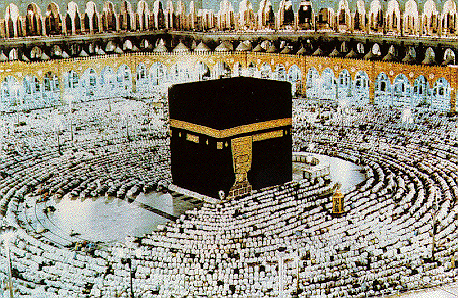
The Ḥajj – the pilgrimage to the Kaʿba in Mecca – holds profound importance in Twelver Shiʿa Islam, as it does in all Islamic traditions. In Twelver Shiʿism (Imamiyya), Ḥajj is among the essential religious obligations, a duty owed to God by every capable believer, rooted in the Qur’anic command: “Pilgrimage to the House is a duty imposed on mankind by God, for anyone who can afford a way to do so” en.wikihaj.com. Shiʿa theology regards Ḥajj not only as one of Islam’s “pillars” of practice but also imbues it with unique spiritual and eschatological dimensions. Twelver scholars and Imams have emphasized that neglecting this duty (without legitimate excuse) is a grave sin that can jeopardize one’s faith al-islam.org. At the same time, a properly performed Ḥajj is seen as a source of spiritual purification, renewal of one’s covenant with God, and reinforcement of core Shiʿa principles such as wilāyah (loyalty to the divinely appointed Imams). This article explores the theological and spiritual significance of Ḥajj in Twelver Shiʿism, compares Shiʿa and Sunni interpretations of its rituals, and examines how Ḥajj intersects with Shiʿa concepts like imamate and loyalty to the Prophet’s family (Ahl al-Bayt). Citations from the Qur’an, hadith (both Shiʿa and Sunni sources), and the works of classical and contemporary Shiʿa scholars (e.g. Shaykh al-Mufīd, Shaykh al-Ṭūsī, Imām Khomeini, Ayatollah Sistani) will elucidate these points.
The Spiritual Significance of Ḥajj in Twelver Shiʿa Doctrine
In Twelver Shiʿa theology, the Ḥajj pilgrimage is laden with spiritual symbolism and is viewed as a journey of purification and absolute devotion. Like other Muslims, Shiʿa believe that a valid and sincere Ḥajj cleanses the pilgrim of sins – “he will return after Hajj free from all sins as if born anew” according to a well-known hadith sunnah.com. Imam Jaʿfar al-Ṣādiq is reported to have said that as long as a pilgrim gazes upon the Kaʿba with reverence, “he will receive rewards and his sins are forgiven” duas.orgduas.org. The Imams taught that Allah bestows special mercies during Ḥajj: “God has provided 120 types of blessings around the Kaʿba – 60 for those circumambulating (performing ṭawāf), 40 for those praying, and 20 for those merely looking [at the Kaʿba]” duas.orgduas.org. The central rites of Ḥajj are thus seen as channels of divine grace: standing on the plain of ʿArafāt (wuqūf) leads to the acceptance of prayers and repentance, with Shiʿa narrations stating that certain sins are forgiven only at ʿArafāt duas.orgduas.org. It is related that Imam Muḥammad al-Bāqir said “None of the righteous or wicked stand at ʿArafāt without God hearing their prayers; the righteous have both worldly and spiritual prayers answered, while even the wicked are granted their worldly requests” duas.orgduas.org. This highlights the immense mercy available on Ḥajj, underscoring its role in spiritual renewal and purification.
Shiʿa doctrine also stresses conviction in God’s forgiveness during Ḥajj. In one account, Imam al-Ṣādiq rebuked a man who performed all the rituals yet doubted whether God forgave him – the Imam said this lack of faith in divine mercy was “the greatest sin” duas.orgduas.org. A successful Ḥajj, therefore, requires not only completing the outward rites but also sincere tawba (repentance) and trust in God’s compassion, leaving the pilgrim “as pure as the day of birth” in spiritual terms sunnah.com.
Beyond personal purification, Twelver Shiʿism ascribes eschatological significance to Ḥajj. Shiʿa traditions often compare the Hajj pilgrimage to the Day of Judgment: pilgrims dressed in white iḥrām garments resemble shrouds, standing together on ʿArafāt prefigures humanity standing together before God, and the intense spirituality and reckoning of Hajj foreshadow the ultimate reckoning. Notably, Shiʿa eschatology holds that the Mahdī (the twelfth Imam in occultation) will one day appear in Mecca to restore justice; believers will pledge allegiance to him at the Kaʿba itself al-islam.org. Imam al-Bāqir prophesied: “When the Qāʾim (Mahdī) appears in Mecca, [devotees] will pay allegiance to him” al-islam.org. Thus the Kaʿba and the Hajj gathering are central even in end-times narratives – the final Imam’s rise will be announced in the context of the pilgrimage, signaling the fulfillment of God’s plan. This eschatological link adds another layer of reverence for Ḥajj among Shiʿa: every pilgrimage is a reminder of the awaited Imam and the hope for ultimate divine justice.
In summary, Twelver Shiʿa theology regards Ḥajj as a foundational act of worship that operates on multiple levels. It is a mandatory religious duty whose neglect is deemed a major sin – Imam al-Ṣādiq warned that if a person has no hindrance (financial, health, or political) yet dies without performing Hajj, “Allah shall raise him on Judgment Day with the Christians or Jews” al-islam.org. Conversely, an accepted Hajj earns Paradise by Prophetic promiseduas.org. It purifies the soul, as echoed in a famous saying of the Prophet and accepted by Shiʿa: “Whoever performs Hajj purely for Allah and avoids obscenity and wrongdoing shall return as innocent as a newborn” sunnah.com. The pilgrimage is also a transformative spiritual journey: the rites of ihrām, ṭawāf, saʿī, ʿArafāt, and the stoning at Minā are interpreted allegorically by Shiʿa mystics and Imams – for example, Imam al-Ṣādiq taught that running between Ṣafā and Marwa symbolizes humbling oneself and “undervaluing the power of tyrants” duas.orgduas.org (since Hājara’s frantic search for water is seen as an act of hope defying despair, a stance the believer takes against oppressors). Kissing the Black Stone (al-Ḥajar al-Aswad), according to Imam al-Bāqir, “represents kissing the Hand of God on earth – the Black Stone is like God’s hand extended to His servants, containing the oaths of the people” duas.org. Shiʿa pilgrims, when touching the Stone, traditionally say: “O Lord, I have fulfilled my trust and upheld my covenant”, alluding to a primordial covenant with God duas.org. Such narrations show the deep spiritual and symbolic meaning that Twelver Shiʿism attaches to each Hajj ritual, far beyond the external acts. The pilgrimage is a reenactment of sacred history (the trials of Abraham, Hagar, and Ismaʿil) and a rehearsal for the hereafter, instilling taqwā (God-consciousness) as the Qur’an notes: “Whoever venerates the symbols of Allah – indeed it is from the piety of the hearts” (Qur’an 22:32).
Qur’anic Foundations for the Shiʿa Perspective on Ḥajj
The Qur’an provides the primary basis for Hajj’s significance in Shiʿa Islam, and Twelver exegesis on Hajj verses aligns closely with general Islamic understanding while sometimes drawing connections to Shiʿa-specific beliefs. The obligation of Hajj is grounded in Qur’an Āl ʿImrān 3:97, which Shiʿa scholars frequently cite: “In it [the Kaʿba] are clear signs – the station of Abraham – and whoever enters it is secure. Pilgrimage to the House is a duty men owe to God, upon those who can find a way to do so. And whoever disbelieves (i.e. refuses) – then indeed Allah has no need of [such] worlds” en.wikihaj.com. This verse is interpreted in Shiʿa doctrine to mean that istıṭāʿah (ability) – financial, physical, and security – makes Hajj immediately obligatory; delaying it without cause is a serious offense al-islam.org. The phrase “whoever disbelieves” in 3:97 is understood by Shiʿa commentators as referring to one who denies or willfully neglects Hajj despite being able, equating such negligence with ingratitude or disbelief. Thus, the Qur’anic mandate is taken literally: Hajj must be performed at least once as a debt to God by all who are capable.
Another key verse often noted by Shiʿa sources is Qur’an al-Ḥajj 22:27, in which Allah orders Prophet Ibrāhīm: “Proclaim the Hajj to mankind; they will come to you on foot and on every lean camel from every distant path.” Shiʿa tafsīr emphasizes that this verse shows Hajj was meant for all humanity, not just local Arabs – a point underscored by the global diversity of those who answer the call. Shiʿa tradition holds that by God’s miracle, the call “Come to Hajj!” reached every soul, including those not yet born, and that people’s response in the spiritual realm determined who will go in reality duas.org. This ties into the Shiʿa idea of a primordial covenant (often related to Qur’an 7:172) and gives Hajj a cosmic scope in Shiʿa spirituality: the invitation to Hajj is eternal and universal.
Shiʿa exegesis also looks to Qur’an al-Baqara 2:158: “Surely Ṣafā and Marwa are among the symbols of Allah. So whoever makes Hajj of the House or ʿumra, there is no blame on him to walk between them…” as affirming the legitimacy of saʿī (running between the hills) – something even pre-Islamic Arabs did – now validated as a shaʿīra (divine symbol). Shiʿa sources concur with Sunni ones that this verse came to correct a misconception some early Muslims had that performing saʿī might be idolatrous; the Qur’an makes it an integral rite. Similarly, Qur’an 2:196, 2:197 and others give rules (avoid obscenity and dispute during Hajj, etc.) which Shiʿa jurists incorporate into their law and spiritual counsel. Twelver jurists often quote al-Baqara 2:197: “And take provisions, but indeed the best provision is God-consciousness (taqwā)” to remind pilgrims that while planning materially for the journey is allowed, the true preparation is ethical and spiritual.
Importantly, Shiʿa also see Qur’anic allusions to the themes of wilāyah (authority of the Imams) and barāʾah (disassociation from polytheists and injustices) within the context of Hajj. One example is Qur’an al-Tawba 9:3: “An announcement from Allah and His Messenger to the people on the day of the greater pilgrimage (yawm al-ḥajj al-akbar) that Allah and His Messenger dissociate from the polytheists…”. Twelver scholars note that the Prophet (ṣ) chose Imam ʿAlī to publicly proclaim this verse during the Hajj of year 9 AH, underscoring ʿAlī’s unique status al-islam.org. The phrase “day of the greater Hajj” is interpreted as the day of ʿĪd al-Aḍḥā in Hajj, and the command to disavow idolaters is seen as establishing the principle that true monotheism includes rejecting ṭāghūt (false gods or tyrants). Shiʿa teachings connect this Qur’anic directive to their practice of tabarrī (dissociating from the enemies of Ahl al-Bayt). In Shiʿa understanding, just as the Prophet and ʿAlī announced barāʾah from the mushrikīn at Hajj, so too must believers in every age dissociate from injustice and impiety while upholding allegiance to God and His friends. This lends a distinctive tone to Shiʿa spirituality during Hajj: alongside prayers for mercy, there is a tradition of condemning oppression (historically, some Shiʿa even quietly invoke curses on figures like Yazīd or those who wronged the Prophet’s family, seeing it as part of maintaining loyalty to truth). The Qur’anic foundations for Hajj, therefore, are read by Shiʿa not only as prescriptions of ritual, but as affirmations of the moral and authority structure of Islam that Twelver Shiʿism cherishes (obedience to God, His Messenger, and the Imams, and rejection of their opponents).
Hajj Rituals: Similarities and Differences between Twelver Shiʿa and Sunni Practices
In terms of practical rites, Twelver Shiʿa perform the Hajj rituals almost identically to their Sunni brethren, completing the same manāsik (acts): entering iḥrām at the mīqāt, circling the Kaʿba (ṭawāf), praying behind Maqām Ibrāhīm, running between Ṣafā and Marwa (saʿī), standing at ʿArafāt, gathering in Muzdalifa (Mashʿar), the stoning of the Jamarāt in Mina, offering the sacrifice (qurbānī), and shaving or clipping hair (ḥalq/taqsīr). Both Shiʿa and Sunni pilgrims chant the same talbiya (“Labbayka Allāhumma labbayk…”), and both honor the sanctity of the haram (sacred precinct) and the inviolability of life and property during Hajj. In essence, the core pillars of Hajj (arkān al-ḥajj) – iḥrām, wuqūf at ʿArafāt, ṭawāf of the Kaʿba, saʿī, and the stoning/sacrifice – are unanimously observed in Shiʿa practice. A casual onlooker in Mecca would notice little difference in how Shiʿa pilgrims carry out the rites, aside from minor variations in supplications or jurisprudential detail. Indeed, many hadith about Hajj virtues are shared between Sunni and Shiʿa. For example, both traditions transmit that “Al-Ḥajj ʿArafah” (the standing at ʿArafāt is the heart of Hajj) and that an accepted Hajj (al-ḥajj al-mabrūr) has no reward less than Paradise duas.org.
However, Twelver fiqh does include certain distinct rulings and emphases in the performance of Hajj. Key differences in ritual law or interpretation include:
- Types of Hajj (Tamattuʿ vs Ifrād/Qirān): All schools recognize the three forms of Hajj: Hajj al-Tamattuʿ, Hajj al-Qirān, and Hajj al-Ifrād. Twelver Shiʿa strongly emphasize Hajj al-Tamattuʿ (the “interrupted” Hajj, involving an ʿumra followed by Hajj in the same trip) for non-residents of Mecca. In fact, according to Imāmī jurisprudence, Hajj al-tamattuʿ is obligatory for any pilgrim living more than ~48 miles (16 farsakhs) from Mecca; one may not choose ifrād or qirān in such cases except in emergency majalla.org. Sunni law, by contrast, generally allows a choice between tamattuʿ, qirān, or ifrād for distant pilgrims (though tamattuʿ is highly encouraged in many Sunni views). This difference stems from Shiʿa adherence to the practice that the Prophet (ṣ) and Imam ʿAlī insisted upon during the Farewell Pilgrimage – combining ʿUmra and Hajj – whereas some early Sunni authorities (e.g. the second caliph ʿUmar) had discouraged tamattuʿ in certain periods. Thus, a Twelver pilgrim from, say, Iran or Iraq will always perform ʿUmrat al-tamattuʿ before Hajj, as part of the required rites majalla.orgmajalla.org.
- Additional Ṭawāf (Ṭawāf al-Nisāʾ): One of the most notable ritual differences is the Twelver inclusion of Ṭawāf al-Nisāʾ (“circling of the women”). In Shiʿa fiqh, after completing the regular ṭawāf of Hajj (known as ṭawāf al-ziyārah or ṭawāf al-ḥajj) and its two rakaʿāt prayer, and after performing the saʿī between Ṣafā-Marwa, pilgrims must perform an extra circumambulation called ṭawāf al-nisāʾ (followed by a two-rakaʿāt prayer) en.wikishia.net. This ritual has a specific purpose: until it is done, the pilgrim remains under a restriction – all sexual relations remain forbidden even after exiting iḥrām en.wikishia.net. By doing ṭawāf al-nisāʾ, this last prohibition (pertaining to intimacy with one’s spouse) is lifted. Sunni jurisprudence has no equivalent ritual. In fact, Sunni authorities do not recognize ṭawāf al-nisāʾ at all en.wikishia.net. For Sunnis, once the main ṭawāf al-ifaḍa (and saʿī and halq) are done, the pilgrim is completely out of iḥrām. Shiʿa traditions, however, consider ṭawāf al-nisāʾ obligatory (wājib) for all – men, women, even children – when performing Hajj or ʿUmra (with the exception of ʿUmrat al-tamattuʿ, where it is performed during the subsequent Hajj) en.wikishia.net. Failing to do it does not invalidate the Hajj itself, but leaves the person in a state where marriage/intimacy is not lawful until rectified en.wikishia.net. Shiʿa sources recount that this practice was instituted by the Prophet and taught by the Imams; it is a point where legal narratives diverged. In practical terms, Shiʿa pilgrims after finishing all other rites will re-enter the Grand Mosque to perform this final ṭawāf, whereas Sunni pilgrims at that time might be preparing to depart. (Sunni fiqh does mandate a farewell ṭawāf – ṭawāf al-wadāʿ – for those departing Mecca, but its purpose is different: it’s a recommended goodbye act, not related to marital permissibility). The Shiʿa ṭawāf al-nisāʾ underscores how seriously Twelvers view the sanctity of the ihrām bond – a symbolic “farewell to worldly desires” until every rite is completed en.wikishia.net.
- Women’s Mahram Requirement: A subtle difference in jurisprudence concerns whether a woman must be accompanied by a maḥram (male guardian) to perform Hajj. In classical Sunni law (per Hadith and juristic consensus), a woman is generally not permitted to travel for Hajj (or any long journey) without a maḥram, for reasons of safety and propriety. Twelver Shiʿa law, on the other hand, does not impose an absolute maḥram requirement if the woman is otherwise safe emadionline.com. Shiʿa jurists state that if a woman has the means and physical ability and the route is secure, she may perform Hajj even if no maḥram accompanies her emadionline.com. This difference is based on Shiʿa hadith interpretations that stress capability (istıṭāʿah) in terms of safety and finances, without an added gender condition. In modern times, this has meant that Shiʿa women (especially from Iran, Iraq, Lebanon, etc.) do often travel in organized groups without a specific male relative, whereas Sunni practices (though evolving) traditionally required either a maḥram or (as in some countries today) an age threshold or group travel for women. Both traditions, of course, emphasize modesty and security; the divergence is juridical and stems from differing hadith criteria on women’s travel.
- Prayer and Combining Rituals: During Hajj, certain prayer schedules and combined prayers are common to all (e.g. praying ẓuhr and ʿaṣr together at ʿArafāt, and maghrib and ʿishāʾ together at Muzdalifa, following the Prophetic practice). Shiʿa pilgrims follow the practice of the Prophet exactly as reported by Imam ʿAlī and the Ahl al-Bayt. Hence, there is virtually no difference at ʿArafāt or Muzdalifa – both Sunni and Shiʿa combine those prayers. A minor difference can be how prayers are led: Shiʿa jurisprudence allows one to follow a Sunni imam in Hajj for the sake of unity, although many Shiʿa will perform their own prayers separately (sometimes out of concern for differences in wūḍūʾ or qirāʾat). This is more a matter of practical arrangement than theology. Both communities hold that “al-ḥajj ʿarafah” – if one misses the ʿArafāt standing, the Hajj is null, reflecting a shared understanding from Prophetic hadith.
- Sequence and Timing: There are slight differences in how strictly the sequence of certain rites is enforced. For instance, on Eid day (10th Dhuʾl-Ḥijja), Sunnis ideally perform the stoning, then sacrifice, then halq, then ṭawāf ifaḍa, but allow some leeway in order. Shiʿa law similarly prefers an order but is generally flexible if needed. Both have provisions if one item is delayed. Another example is the stoning of Jamarāt in the following days: Shiʿa jurists permit stoning in the night if one cannot during the day (a concession especially used when crowds are dangerous), and Sunni jurists likewise have allowances. These are procedural nuances where fatāwā may vary, but not fundamental differences in meaning.
- Ziyārat (Visitation of Holy Sites): While not part of the Hajj rite per se, Twelver Shiʿa place great emphasis on visiting the Prophet Muhammad’s tomb in Medina and the graves of the Shiʿa Imams (such as the four Imams buried in al-Baqīʿ cemetery) after completing the Hajj. All Muslims venerate the Prophet’s grave; the difference is one of degree and doctrine. Shiʿa consider such ziyārah highly recommended (mustahabb) and even a completion of the spiritual journey. A saying from Imam al-Bāqir instructs pilgrims: “Begin your Hajj from Mecca and finish it with us (the Ahl al-Bayt)” duas.org. This is taken to mean that after performing the rites of God’s House, one should come to the Imams (by visiting their resting places) as an acknowledgment of their authority and to seek closeness to Allah through love of the Prophet’s family. In practice, Shiʿa groups traveling for Hajj will often include an extension to Medina (to visit the Prophet, Fāṭima al-Zahrā’s presumed grave, and Imams al-Ḥasan, al-Sajjād, al-Bāqir, and al-Ṣādiq at Jannat al-Baqīʿ). Many also try to visit Karbalā (the shrine of Imam Ḥusayn) either before or after Hajj if possible. While Sunni pilgrims also visit Medina, the Shiʿa theological emphasis on the wilāyah of those buried in Baqīʿ and Karbalā makes that visitation spiritually obligatory in their view (though not part of Hajj’s fiqh). This difference in emphasis stems from Shiʿa devotion to the Imams and the belief that “he who visits the Imams after Hajj has his Hajj sealed with acceptance” (as implied by some narrations).
In summary, the similarities in Hajj far outweigh the differences – Shiʿa and Sunni alike fulfill the Quranic call and Prophetic Sunnah of pilgrimage. The differences that do exist are primarily in jurisprudential details (like the additional ṭawāf al-nisāʾ in Shiʿi law or the conditions for women’s travel) and certain spiritual interpretations (e.g. Shiʿa integrating ziyārat of Imams or connecting rituals to historical imamate events). Both traditions revere the Kaʿba as the House of God built by Abraham and see Hajj as a time of Muslim unity, donning the same garments and performing the same rites. It is often noted that Hajj is a powerful display of Islamic unity – and indeed, Shiʿa and Sunnis pray side by side in Mecca and share in the universal chant of “Labbayk Allāhumma labbayk”. At the level of theology, however, Twelver Shiʿism adds additional layers of meaning to the Hajj, tying it to the Imams and to the narrative of guidance versus deviation in early Islam. These aspects are explored in the next sections, especially concerning scriptural interpretations and the concept of wilāyah.
Hadith Perspectives: Shiʿa and Sunni Traditions on Hajj
Both Shiʿa and Sunni Islam possess rich hadith corpora extolling the merits of Hajj and detailing its rites. Many sayings of the Prophet Muḥammad (ṣ) about Hajj are accepted by both communities. For instance, the famous Prophetic hadith “Whoever performs Ḥajj and does not commit obscenity or wrongdoing, returns as sinless as the day his mother bore him” is found in Sunni sources (Sahih al-Bukhārī, Muslim) sunnah.com and similarly appears in Shiʿa hadith works with only minor variations in chain. Likewise, the Prophet’s teaching that “al-ḥajj al-mabrūr has no reward except Paradise” and that “Hajj wipes out whatever came before it” are echoed in both Sahih al-Bukhari and in Shiʿa compilations like Man Lā Yaḥḍuruhu al-Faqīh by Shaykh al-Ṣadūq duas.org. Both traditions narrate that the Prophet called the Kaʿba “the House of God” and emphasized the safety and brotherhood of all in its vicinity. There is broad agreement that Archangel Gabriel taught Prophet Ibrāhīm the manāsik, and that every step in Hajj has deep wisdom.
Where hadith diverge is often in interpretative or doctrinal additions that reflect Shiʿa emphasis on the Imams’ guidance. Twelver Shiʿa rely not only on the Prophet’s sayings but also heavily on hadith from the Twelve Imams, especially Imams al-Bāqir and al-Ṣādiq, who elaborated on Hajj in the 8th century. Classical Shiʿa hadith collections such as Al-Kāfī (by al-Kulaynī), Tahdhīb al-Aḥkām and al-Istibṣār (by Shaykh al-Ṭūsī), and Man Lā Yaḥḍuruhu al-Faqīh (by al-Ṣadūq) contain entire chapters on Hajj rituals, merits, and spiritual meanings. These often include dialogues where disciples asked an Imam about points of Hajj law or symbolism. For example, Al-Kāfī records that when asked “Why is the Black Stone important?”, Imam al-Ṣādiq explained that it is “God’s covenant with His servants – it will testify for those who fulfilled their pledge” duas.org. In Al-Kāfī there is also a famous narration from Imam al-Bāqir describing Islam’s foundation: “Islam is built upon five things: prayer (ṣalāt), almsgiving (zakāt), fasting (ṣawm), Hajj, and wilāyah (allegiance to the Ahl al-Bayt). And nothing was stressed as much as the wilāyah on the Day of Ghadīr.” al-islam.org. This Shiʿa hadith is significant because it deliberately includes wilāyah among the “five pillars”, whereas the well-known Sunni hadith (narrated from Ibn ʿUmar) lists the shahāda (testimony of faith) instead. In Sunni collections like Sahih Muslim, the Prophet’s saying is: “Islam is built on five: the testimony that none is worthy of worship but Allah and Muḥammad is His Messenger, establishing prayer, paying zakāt, Hajj to the House, and fasting Ramadan.” sunnah.com. The Shiʿa version essentially replaces the first pillar (shahāda) with wilāyah (since acceptance of the Imams, in Shiʿa theology, is the continuation of true monotheism and prophethood) – testimony of faith is assumed as a given, while loyalty to the Imams is elevated as a defining pillar. This contrast in hadith highlights how Twelver Shiʿism intertwines the concept of Imamate with the standard pillars like Hajj. Sunnis and Shiʿa both agree Hajj is obligatory, but Shiʿa hadith often add that Hajj, without recognizing the Imam of one’s time, loses its true value (a point discussed in the next section).
To illustrate, a hadith attributed to Imam al-Ṣādiq in Shiʿa sources declares: “If a man were to stay up [in worship] all night, fast all day, give all his wealth in charity, and perform Hajj every year of his life, yet not recognize the authority (imām) of God’s chosen one, he would have no right to reward from God and would not be among the faithful.” 14sayings.blogspot.com. This stark statement is unique to Shiʿa tradition – it doesn’t appear in Sunni hadith – and it underscores the Shiʿa belief that acts of worship (even as grand as lifelong pilgrimages) require correct faith in God’s authorized leaders to be accepted. By contrast, Sunni hadith literature would stress proper intention (ikhlāṣ) and adherence to the Sunnah for deeds to be accepted, without the concept of an Imam’s recognition. For Sunnis, as long as one believes in Allah and His Messenger genuinely, the Hajj is valid and rewarded. The Shiʿa hadith does not contradict the need for sincerity; rather, it adds Iman bil-Imam as a criterion for completeness of faith.
Comparative examples from hadith can be seen in the area of Fiqh as well: Both traditions recount how the Prophet performed the Farewell Hajj, but Shiʿa hadith from Imam ʿAlī or Imam al-Bāqir highlight details that justify Shiʿa rulings (such as combining ʿumra with Hajj, or the necessity of ṭawāf al-nisāʾ, which Sunni hadith collections do not mention). Shiʿa hadith also preserve sayings of the Imams extolling those who perform Hajj and then come to visit them. One hadith states: “Perform Hajj and ʿumra repeatedly, for they are two markets of the Hereafter… The frequent pilgrim is a guest of God: if he lives, he lives forgiven, and if he dies [on the journey], he enters Paradise.” Another from Imam ʿAlī ibn Musa al-Riḍā (the 8th Imam) explains one rationale for Hajj: “People were commanded to perform Hajj so that they come to the presence of the Imam (leader) and learn from him” (this reflects the era when the Imams themselves often taught pilgrims in Mecca or Medina). In Sunni hadith, Hajj’s rationale is usually given as “to remember Allah and celebrate His name in the appointed days” (echoing Qur’an 22:28), which Shiʿa also accept. But Shiʿa hadith add the dimension of connecting the pilgrims with the Prophet’s heirs.
Sunni hadith collections like Sahih al-Bukhari and Muslim devote chapters to the excellence of Hajj, containing narrations such as: “O people, Allah has enjoined Hajj upon you, so perform Hajj,” and the companions asking if every year or just once. Shiʿa hadith books similarly cite when this command came, often attributing the clarification (“just once, and more if you can voluntarily”) to the Imams reaffirming the Prophet’s words. Both sects transmit that “failing to perform Hajj despite capability” is a grievous error – for instance, a Sunni report (in Tirmidhī) says one who has means and doesn’t Hajj may die a Jew or Christian; we saw the Shiʿa version in al-Kāfī with the Imam’s wording that he’d be raised with disbelievers.
Incorporating Sunni hadith for comparison, we observe that Sunni Islam emphasizes the universal aspects of Hajj: it’s one of the five pillars, meant to inculcate piety and unity. Shiʿa hadith literature includes all those universal aspects and then layers on the narrative of the Imams. For example, Sunni perspective (from hadith): Hajj is jihad (struggle) for those unable to fight (as the Prophet told a female companion that her jihad is a flawless Hajj). Shiʿa perspective: Imams agree Hajj is a form of jihad of the self; additionally, Shiʿa sources relate that Imam Ḥusayn ibn ʿAlī said greeting and shaking hands with a ḥājjī (returning pilgrim) before he sins again is like touching a sanctified person – a somewhat lighter narration encouraging honoring pilgrims.
In summary, Sunni hadith provide the foundational narratives of Hajj’s duties and merits, and Shiʿa hadith both preserve those and expand with Imams’ interpretations. The result is a shared core of understanding – Hajj is critically important, immensely rewardable, and an act of obedience – with a Shiʿa-specific emphasis that proper Hajj also involves recognition of and allegiance to the Prophet’s household. This brings us to how Twelver scholars, classical and modern, have articulated the significance of Hajj and its connection to key Shiʿa tenets.
Perspectives of Shiʿa Scholars: Classical to Contemporary
Throughout history, major Twelver Shiʿa scholars have reiterated the importance of Hajj in both legal and spiritual terms. Classical scholars like Shaykh al-Mufīd (d. 1022 CE) and Shaykh al-Ṭūsī (d. 1067 CE) – who helped define Shiʿa doctrine in the Buyid era – devoted extensive attention to Hajj in their works. Shaykh al-Mufīd, in his Kitāb al-Irshād and other treatises, affirmed Hajj as an obligation instituted by the Prophet and binding on all Imāmī Shiʿa. He emphasized that neglecting Hajj (when capable) is a major sin that can even put one’s status as a Muslim at risk, echoing the Imams’ teachings that indifference to Hajj is tantamount to impiety. In his legal manual al-Muqniʿa, Shaykh al-Mufīd carefully outlines the conditions of istıṭāʿah (financial/physical ability) and stresses that Hajj must be performed immediately in the first year one is able – delaying it without excuse is ḥarām (forbidden)al-islam.org. This view is rooted in Shiʿa hadith (as we saw, Imams called it a “deadly sin” to postpone when one has the means al-islam.org). Thus, classical authorities ingrained a sense of urgency and seriousness about Hajj in the Shiʿa legal conscience.
Shaykh al-Ṭūsī, known as “Shaykh al-Ṭāʾifa” (leader of the sect) for his monumental contributions, compiled two of the Four Books of Shiʿa hadith, both of which have extensive chapters on Hajj. In Tahdhīb al-Aḥkām, al-Ṭūsī preserves numerous narrations of the Imams dealing with fine points of Hajj law – everything from how to perform the talbiya to the rulings on animal sacrifice. He often compares these narrations with the opinions of other jurists, defending the distinct Shiʿa practices such as tawāfu’n-nisāʾ and the obligation of tamattuʿ for distant pilgrims majalla.org. Al-Ṭūsī’s other works, like al-Nihāya and al-Istibṣār, also reinforce that Hajj is one of the furūʿ al-dīn (branches of religion) that every Shiʿa must uphold. Notably, al-Ṭūsī and earlier scholars like al-Ṣadūq fought against any notion (held by some extremist sects) that Hajj could be abandoned or was superseded by spiritual pilgrimage. In the 10th century, the Qarmaṭī movement (an Ismaʿili offshoot) had sacked Mecca and tried to discourage Hajj, claiming the true Kaʿba was the human heart or other esoteric interpretations. Twelver scholars like Mufīd and Ṭūsī staunchly rejected this, reaffirming the physical Hajj as non-negotiable in Islam – an ijmāʿ (consensus) of all Muslims. They cited the Qur’anic mandate and the Imams’ own practice (most of the Twelve Imams performed Hajj many times) as evidence that no pious believer could forsake the annual gathering in Mecca.
Shaykh al-Mufīd also addressed the spiritual side of Hajj in theological discussions. In his Awāʾil al-Maqālāt, while enumerating differences with other sects, he made it clear that Twelver Shiʿism does not defer Hajj until the Mahdi’s return (a mistaken view some might have attributed to Shiʿa due to their emphasis on the Imam). He wrote that even in the Imam’s occultation, the Shiʿa are fully obligated to perform Hajj and all Islamic duties – the Imam’s physical absence does not nullify the pillar of pilgrimage, a stance that guided Shiʿa praxis through the centuries.
Moving to the modern era, leading Shiʿa scholars and marājiʿ (authorities) continue to emphasize Hajj’s importance and have written on its deeper meaning. Ayatollah Ruhollah Khomeini (d. 1989), the founder of Iran’s Islamic Republic and a prominent marjaʿ, delivered messages to Hajj pilgrims each year highlighting both the spiritual and socio-political dimensions of Hajj. In Khomeini’s view, Hajj represents the unity of the ummah and the renunciation of tyranny. He echoed classical teachings that Hajj purifies one’s soul and is a chance to repent, but he also stressed that Hajj is meant to gather Muslims of all lands to foster Islamic brotherhood and resist oppressors. Khomeini often cited the Qur’anic baraāʾah declaration (Qur’an 9:3) and reminded pilgrims of the Prophet’s example of denouncing idolatry during Hajj al-islam.org. He revived the practice of holding a “Disavowal of the Polytheists” ceremony during Hajj, whereby Iranian (and some other Shiʿa) pilgrims would collectively proclaim slogans against global arrogance – effectively linking the Qur’anic call to disavow the mushrikīn to modern powers seen as oppressors. Theologically, Khomeini described Hajj as “the summation of the Islamic faith, a scene where Tawḥīd (Divine Unity) is exhibited and where Muslims affirm walāyah to Allah and disconnect from taghut (tyranny).” In his book “Ādāb al-Ṣalāt” (which touches on Hajj briefly), he interprets the state of iḥrām as entering a sanctified state akin to death (removing stitched clothes, etc.), and the Kaʿba as a focal point of love of God. Khomeini’s contributions, therefore, were to reinforce traditional spirituality while also urging pilgrims not to forget the obligation of amr bil-maʿrūf wa nahy ʿan al-munkar (enjoining good and forbidding evil) on a global scale during Hajj – a perspective shaped by Shiʿa revolutionary thought.
Ayatollah Ali al-Sistani, the leading Shiʿa marjaʿ of Iraq (b. 1930), likewise underscores in his rulings that Hajj is fard ʿayn (an individual obligation) once in a lifetime when capable. Sistani’s Risālah ʿAmaliyyah (practical law manual) devotes a large section to Hajj, closely following the templates set by classical jurists. He details the rites and conditions and often provides guidance for modern scenarios (such as visa issues, travel by airplane, etc., under the rubric of istıṭāʿah). Theologically, Sistani has commented that Hajj is an “arena of divine forgiveness” and that pilgrims should come out of it as better human beings, committed to truth and justice. While not as publicly political as Khomeini, Sistani too has spoken of the unity experienced in Hajj – that Shiʿa and Sunni stand together at ʿArafāt – as a reminder that Muslims should resolve disputes and focus on common values. In his public statements, Ayatollah Sistani has condemned any sectarian behavior during Hajj, urging Shiʿa pilgrims to avoid arguments and instead exemplify piety and respect. This reflects the Shiʿa scholarly approach to Hajj as a time to display the ideals of Islam (mercy, brotherhood, equality before God). Sistani also emphasizes the educational aspect of Hajj; he encourages pilgrims to learn the correct way of Prophet Ibrahim and Prophet Muhammad in rituals, which resonates with a saying of Imam al-Bāqir: “Surely, Allah only intended the Hajj so that people would come to us and learn our teachings.”
Another modern scholar, Allama Muhammad Husayn Ṭabaṭabaʾī (d. 1981), in his famous Tafsīr al-Mīzān, gives mystical commentary on Hajj verses, beloved by Shiʿa seminarians. He notes that circling the Kaʿba symbolizes the angels circling the Divine Throne, and that a pilgrim’s journey from home to the holy land symbolizes the soul’s journey to God. Classical mystics like Muḥyiddīn Ibn ʿArabī (though Sunni, admired by some Shiʿa) and Shiʿa sages like Mullā Ṣadrā wrote about Hajj as the soul’s “arc of ascent”. Ayatollah Khomeini, who was also a gnostic, likely drew on such ideas. In summary, modern Shiʿa scholars uphold the fiqh of Hajj with precision and simultaneously explore its inner dimensions: a training in obedience and an affirmation of the Imam’s guidance.
Ḥajj, Wilāyah, and Loyalty to Ahl al-Bayt in Twelver Shiʿism
One of the defining features of Twelver Shiʿa thought is the doctrine of wilāyah – the divinely sanctioned authority and guardianship of the Twelve Imams (the Ahl al-Bayt of the Prophet). Twelver theology holds that acknowledging the wilāyah of the Imams is indispensable for the completeness of one’s faith. This principle deeply influences how Shiʿa view all acts of worship, including Hajj. In Twelver belief, Hajj reinforces and is reinforced by wilāyah in multiple ways:
- Wilāyah as a Pillar alongside Hajj: As mentioned earlier, a hadith from Imam al-Bāqir explicitly lists Hajj and Wilāyah together among the five foundations of Islam al-islam.org. The Imam said Islam is built on prayer, fasting, zakat, Hajj and wilāyah, “and nothing was called out (to the people) as much as the wilāyah on the Day of Ghadīr.” al-islam.org. This indicates that, for Shiʿa, allegiance to the Imam is of comparable importance to performing the ritual pillars. The Day of Ghadīr – when Prophet Muḥammad (ṣ) returning from his Farewell Hajj, famously declared, “Whomsoever I am his mawla (guardian), ʿAlī is also his mawla” – is seen as the culmination of that Hajj. Shiʿa scholars often point out that the Prophet chose the context of Hajj, with tens of thousands of believers present, to announce Imam ʿAlī’s leadership, thereby intertwining the completion of the religion (cf. Qur’an 5:3, revealed at Ghadīr per Shiʿa exegesis) with the pilgrimage. In Shiʿa understanding, Hajj was the backdrop for the proclamation of wilāyah. The Qur’anic verse revealed at that moment (“Today I have perfected your religion for you…”) is interpreted as signifying that Islam’s rites (like Hajj) achieved full meaning only when the Prophet’s successor was announced. Hence, every Hajj season, Shiʿa remember Ghadīr (which falls about 70 days after Hajj, in Dhū’l-Ḥijjah 18) as an echo of that inaugural event of wilāyah.
- Acceptance of Deeds Requires the Imam: Twelver doctrine holds that deeds are accepted by God only if performed with correct faith, which includes faith in the Imams. We saw a strong hadith to this effect: even lifelong worship and annual Hajj avail nothing if someone “does not recognize the guardianship of the Imam” of their time 14sayings.blogspot.com. Another narration similarly states: “No servant (of God) truly believes until he knows his Imam. One who dies without knowing the Imam of his age dies the death of ignorance (jāhiliyya).” Shiʿa interpret this to mean that acts like Hajj, to be spiritually fruitful, should be accompanied by adherence to the true spiritual guide. Practically, this doesn’t mean a non-Shiʿa’s Hajj is invalid as a ritual, but in Shiʿa theology its full reward may be lacking. Conversely, performing Hajj while affirming the Imam’s wilāyah is considered an act of great merit. There is a Shiʿa report that Imam al-Ṣādiq, upon completing his own Hajj, would perform a ziyārat (visitation) duʿā addressing Imam ʿAlī (who is buried in Iraq) from afar, effectively “sending salutations” to ʿAlī as part of concluding the Hajj rites. This illustrates how intertwined the concepts are.
- Hajj as an Expression of Tawallī and Tabarrī: Twelver Shiʿism adds Tawallī (loving and following the Prophet’s family) and Tabarrī (disassociating from their enemies) as duties of the faithful. The Hajj, in Shiʿa practice, becomes an occasion to exercise these principles. The very gathering in Mina where pilgrims throw stones at the Jamarāt (symbolizing rejection of Satan) is sometimes invoked by Shiʿa preachers as symbolic of “stoning the devils” of every age – including those who oppressed the Prophet’s family. While this is not an official part of the ritual, the spirit of barāʾah (dissociation from evil) is heightened in Shiʿa consciousness during Hajj. In modern times, Shiʿa groups (particularly Iranian pilgrims since 1979) have held rallies in Mecca to denounce imperialism or Zionism, framing it as a form of barāʾah mandated by Qur’an 9:3 during the Hajj surahquran.com. This practice originates from Imam Khomeini’s teachings and is grounded in the idea that loyalty to Allah’s friends implies enmity to Allah’s enemies. Historically, the “enemies” for Shiʿa were figures like the Umayyad caliphs who persecuted the Ahl al-Bayt. It is recorded that some Shiʿa pilgrims in medieval times would quietly curse the killers of Imam Ḥusayn during Hajj as a form of tabarrī, though the sanctity of the place usually kept such sentiments private.
- Imam as Spiritual Guide of Hajj: Shiʿa belief holds that in every age there is an Imam who is the “ḥujjah” (proof of God) on earth. Even if hidden (as the Mahdi is), he is spiritually overseeing. Many Twelvers believe that Imam Mahdi attends the Hajj invisibly or incognito every year. There is a popular Shiʿa anecdote that the 12th Imam is present at ʿArafāt and perhaps meeting pious individuals unknown to them. This echoes a saying from Imam al-Ṣādiq: “People lose their Imam, but the Imam does not lose them – he attends their Hajj and other gatherings.” Such beliefs reinforce the mystical presence of wilāyah during the pilgrimage. Furthermore, Shiʿa hadith encourage believers to perform Hajj on behalf of the Prophet and Imams (after fulfilling their own obligation). Traditions say the reward of such a niyāba (proxy Hajj) is immense. For example, Imam al-Riḍā said doing Hajj on behalf of Imam Ḥusayn is like visiting his grave (which has enormous merit in Shiʿa lore). Ayatollah Sistani’s rulings note that one may perform nīyabat al-hajj for the Prophet or Imams as a recommended act al-islam.org. This practice of dedicating the Hajj’s spiritual reward to the Ahl al-Bayt again ties the act of worship to love of the Imams.
- Visiting the Imams after Hajj – Completion of Wilāyah: It was mentioned how Imam al-Bāqir told one companion to “finish the Hajj with us” duas.org. Shiʿa exegesis often connects this with the concept that the Ziyārat of the Imam is an extension of the Hajj. In fact, some narrations even state that visiting the shrine of Imam Ḥusayn in Karbalāʾ is equal to many supererogatory Hajj. One hadith boldly claims: “One who visits al-Ḥusayn (as) on Arbaʿīn, Allah will record for him the reward of 1000 ḥajjs and 1000 ʿumras.” While such narrations are viewed with suspicion by non-Shiʿa (and even some Shiʿa see them as hyperbolic or weak in chain), they reflect the value Shiʿa place on wilāyah-oriented devotion. The idea is not to undermine Hajj – rather to assert that mawaddah (love of Ahl al-Bayt) yields rewards akin to obligatory worship. Twelver scholars clarify that these ziyārah deeds never replace Hajj, but once Hajj is done, they are a way to multiply one’s closeness to God. Many pilgrims from Iran/Iraq will actually combine Hajj with a visit to Medina (for the Imams in Baqīʿ) and then travel to Iraq for Karbalāʾ or Najaf. This combined journey is colloquially called “Ḥajj wa Ziyārah”. It is seen as fulfilling both the right of God (Hajj) and the right of the Imams (visitation), thereby achieving tawallī (loyalty) in full.
Finally, Shiʿa see the rites of Hajj themselves as subtly affirming the memory of the Ahl al-Bayt. When Shiʿa pilgrims perform the Saʿī between Ṣafā and Marwa, they recall Hagar’s devotion and God’s providence – but they might also recall that Imam al-Ḥasan and Imam al-Ḥusayn as children ran between the hills when visiting Mecca with their grandfather. When they sacrifice at Minā, they think of Ismāʿīl’s story – and also remember Imam Ḥusayn’s great sacrifice (since Ashūrāʾ, the 10th of Muḥarram, is sometimes analogized as Abraham’s sacrifice magnified). In the talbiya itself – “Labbayk, Allāhumma labbayk, lā sharīka laka labbayk” – the Shiʿa heart adds “…labbaik” (I am here, O Lord). Some Shiʿa historical reports say that the “lā sharīk laka” (no partner have You) was extended by the Imams to implicitly curse those who set up unjust leaders as partners in God’s authority. (There is a report that Imam Zayn al-ʿĀbidīn, in a duʿā at the Kaʿba, said: “Labbayk… You have no partner… and added under his breath, “except those whose wilāyah You have made obligatory”, which mainstream Shiʿa interpret as not contradicting tawḥīd but asserting the Imams’ Divinely-appointed role).
In essence, for Twelver Shiʿa, the Ḥajj is not only a journey to the House of God but also a renewal of one’s pledge to God’s appointed guardians. It is meant to cement the bond of walāyah (allegiance). At the end of the Hajj, during the Eid al-Adha and the days of Tashrīq, Shiʿa often incorporate prayers for the welfare of the Imam of the Time (the Mahdi). A popular Shiʿa supplication Duʿāʾ al-Nudba (supplication of lament) is recommended on Eid days; it calls out for the absent Imam and mourns the injustices done to Ahl al-Bayt. Reciting such a duʿāʾ in Mina or Mecca (even if privately) ties the pilgrimage to the yearning for the Imam’s appearance. Twelvers firmly believe that when the Mahdi reappears, he will perform Hajj (or at least ʿumra) and stand between the Rukn and Maqām (corner of the Kaʿba and Abraham’s station) where people will finally see him and pledge allegiance al-islam.org. Thus the circle of wilāyah and Hajj will close in the eschaton: the Hajj will literally bring people to their Imam.
Conclusion
In Twelver Shiʿa Islam, the Ḥajj pilgrimage is a multi-layered act of worship, rich in theological, spiritual, and symbolic significance. It fulfills the universal Islamic duty, established by the Qur’an and the Prophet, of making pilgrimage to the sacred House of God in Mecca – a duty that Shiʿa Muslims have cherished and observed with devotion throughout history. At the same time, Shiʿa doctrine infuses Hajj with distinct nuances: it is a journey of the soul toward purification (tazkiyah) and an opportunity to reaffirm one’s commitment to wilāyat Ahl al-Bayt – the leadership of the Prophet’s progeny. The Shiʿa Imams taught that Hajj, in its inner reality, trains the believer in obedience to God and love of the Truth, and they warned that the rites should never become empty rituals. A true Hajj transforms the pilgrim’s life, renewing his or her pledge to lead a righteous life under God’s guidance. As Imam al-Ṣādiq beautifully put it, the worst sin a pilgrim could commit is to come away from Hajj doubting God’s mercy or not changing his behavior, whereas the greatest achievement is to return home with sins forgiven and heart illumined duas.orgduas.org.
The comparison of Twelver Shiʿa and Sunni perspectives on Hajj shows a broad common ground in practice – both perform the same fundamental rituals ordained by the Prophet – alongside specific differences in interpretation and jurisprudence. Shiʿa jurists mandate acts like ṭawāf al-nisāʾ that highlight purity of life after pilgrimage, and allow more flexibility for women to undertake Hajj, reflecting the inclusive spirit they see in Islam. Theologically, Shiʿa extend the meaning of Hajj to include loyalty to the Imam: a dimension less accentuated in Sunni discourse. The Qur’anic verses underlying Hajj are equally honored in Shiʿism, with added commentary linking them to the Imam’s role (such as 3:97’s obligation being tied to acceptance of all pillars including wilāyah al-islam.org, or 9:3’s announcement at Hajj being tied to Imam ʿAlī’s authority).
From the teachings of classical scholars like al-Mufīd and al-Ṭūsī to modern leaders like Khomeini and Sistani, Twelver authorities have consistently upheld Hajj as a pillar of the faith that must be neither neglected nor stripped of its deeper meaning. They guide the community in the correct performance of rites while encouraging a profound understanding: that every circuit around the Kaʿba is like orbiting the center of all holiness, every stone thrown at Mina is a rejection of devilish influences in one’s life, and every prayer on the plain of ʿArafāt is a rehearsal for standing before the Almighty on Judgment Day.
For Shiʿa, the presence of the Imam is felt throughout this journey – historically, Imams themselves were leaders of piety at Hajj (Imam Zayn al-ʿĀbidīn’s moving duʿās at ʿArafāt are recorded; Imam al-Bāqir was known to teach masses of Hujjāj 14sayings.blogspot.com). Today, Shiʿa pilgrims carry that legacy forward. In their hearts they carry Karbalāʾ even as they face the Kaʿba, knowing that love of Ḥusayn and performance of Hajj are both expressions of loving God. The wilāyah of the Imams gives them a lens to see Hajj as not only a personal duty but part of the continuous thread of divine guidance – from Ibrāhīm to Muḥammad to the Mahdī.
In conclusion, the Twelver Shiʿa view of Hajj is holistic: it is law and mysticism, remembrance of the past and hope for the future, individual purification and collective solidarity. It is an obligation to be taken with utmost seriousness (one who can afford Hajj yet delays it, said Imam al-Ṣādiq, may die spiritually blind al-islam.org), and simultaneously a gift from God wherein the pilgrim is His guest and beloved. A successful Hajj, in Shiʿa thought, should leave the believer forgiven, humbled, and more loyal than ever to the cause of God embodied by the Prophet and his Ahl al-Bayt. Such a pilgrim returns home not only garbed in the physical iḥrām cloth, but clothed in taqwā and firm in the allegiance (bayʿah) that Hajj implicitly renews – the allegiance to Allah’s unity and to His chosen guides, the Imams. In the words of a Shiʿa narration: “Complete your Hajj by visiting us (the Imams). By this, your Hajj will be accepted (mabrūr) and your souls purified.” duas.org While Sunni tradition would not include the latter clause, for the Shiʿa devotee this encapsulates the unique theological vision: Hajj and wilāyah go hand in hand, each illuminating the other, leading the Shiʿa faithful toward salvation and closeness to the Divine.
Sources:
- The Holy Qur’an: Āl ʿImrān 3:96-97; al-Baqarah 2:158, 196-198; al-Ḥajj 22:27-32; al-Tawbah 9:3 en.wikihaj.com surahquran.com.
- Al-Kulaynī, Al-Kāfī, vol. 2, p. 21 (Hadith of Imam al-Bāqir on five pillars) al-islam.org.
- Al-Ṣadūq, Man Lā Yaḥḍuruhu al-Faqīh, and al-Ṭūsī, Tahdhīb al-Aḥkām – chapters on Hajj (various hadith: importance of Hajj, conditions, tawāf al-nisāʾ, etc.) al-islam.org en.wikishia.net.
- Shaykh al-Mufīd, Kitāb al-Irshād and al-Muqniʿa (on the obligation and timing of Hajj) al-islam.org.
- Shaykh al-Ṭūsī, al-Istibṣār and al-Nihāya (Hajj laws; requirement of Hajj al-tamattuʿ for distant pilgrims) majalla.org.
- Ḥadīth collections (Sunni): Sahih al-Bukhārī 1521sunnah.com; Sahih Muslim (Ibn ʿUmar narration on five pillars) sunnah.com; Sunan al-Tirmidhī (on neglecting Hajj = dying as Jew/Christian) al-islam.org.
- Imam al-Sajjād (Zayn al-ʿĀbidīn), Ṣaḥīfa Sajjādiyya – includes supplications for Hajj.
- Ayatollah Khomeini’s Messages to Hajj Pilgrims (1980-1988) – published in collections of his speeches, emphasizing unity and barāʾah.
- Ayatollah al-Sistani’s Islamic Laws (Risālah), Hajj section (English edition) – rulings on Hajj and notes on recommended acts emadionline.com al-islam.org.
- Sayyid Abdul Ḥusayn Dastghaib Shirazi, Greater Sins, vol. 3 – discussion on the sin of ignoring Hajj al-islam.org.
- Al-Islam.org (Shiʿa scholarly site): Articles on Hajj, e.g. “The Spiritual Significance of Hajj” and “Hajj in the words of Ahlul Bayt”duas.orgduas.org.
- Wikishia entries: Hajj, Tawaf al-Nisaʾ en.wikishia.net, Imamate, etc., for concise summaries of Shiʿa views.
- Duas.org (Shiʿa hadith repository): “Importance of Hajj and Umrah in Hadith” – a compilation of Imams’ sayings on Hajj duas.orgduas.org.
- M. Ayoub, “Redemptive Suffering in Islam” – discusses Hajj and Karbala link in Shiʿism.
- L. Clarke, “Shiite Devotional Literatures” – provides context on Ziyārat practices post-Hajj.
These sources collectively testify to how Twelver Shiʿism venerates the Hajj as both an act of worship and an affirmation of the Shiʿa identity of devotion to the Prophet’s family. Through Hajj, the Twelver faithful seek closeness to Allah, forgiveness of sins, unity with the global Muslim ummah, and a renewal of the pledge to uphold the truth of wilāyah until the awaited Imam al-Mahdī makes his appearance in Mecca to unite humanity under God’s banner. al-islam.org
 The Glorious Quran and Science
Leave a comment