
Presented by Gemini for Zia H Shah MD
Audio teaser: Cosmic Awe and Quranic Perspectives:
The human experience of the cosmos is universally defined by an overwhelming sense of awe. When contemplating the vastness of the universe, the precision of its physical laws, and the intricate, delicate balance that sustains conscious life, observers across the entire spectrum of belief frequently report a profound, almost transcendent emotional response. Yet, a persistent paradox exists at the intersection of cosmology, philosophy, and theology: the phenomenon wherein brilliant scientific minds experience this deep, reverent wonder—often described in overtly religious, mystical, or spiritual terms—but actively resist the final cognitive and spiritual step of attributing this majestic order to a purposeful, personal Creator.
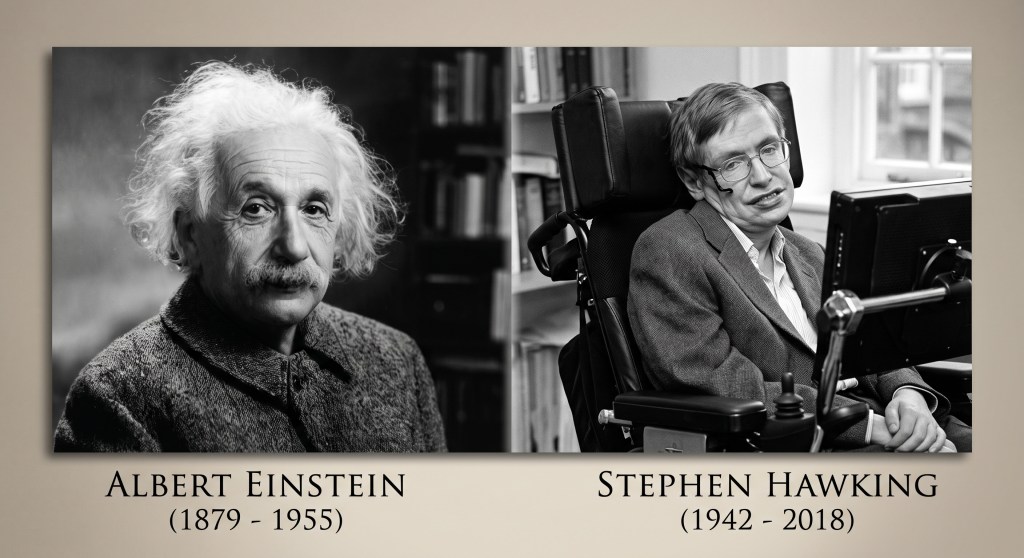
The inquiry into what keeps human beings in a state of agnosticism or atheism, despite their profound appreciation of cosmic beauty, requires a highly multidisciplinary analysis spanning epistemology, cognitive psychology, the philosophy of science, and theology. Prominent theoretical physicists such as Albert Einstein and Stephen Hawking stand as historical archetypes of this cognitive and spiritual paradox. Both expressed a staggering reverence for the universe’s elegant structure and both spent their lives attempting to decode its fundamental laws, yet both stopped short of theism. Instead, they retreated into philosophical frameworks that insulated them from a personal God—Einstein into Spinozan pantheism and strict determinism, and Hawking into absolute materialism and multiverse theories.
To properly understand this cognitive plateau, it is necessary to contrast their secular philosophical frameworks with the Quranic paradigm of Ulu al-Albab (the People of Understanding). This conceptual model, derived directly from the Quran, explicitly bridges the gap between empirical observation of the natural world and teleological realization, diagnosing the exact point where secular awe becomes paralyzed and outlining the intellectual and spiritual mechanisms required to complete the journey from observation to submission.
The Quranic Framework of Cosmic Reflection: Surah Ale ‘Imran 3:189-191
To establish the theological baseline against which secular cosmic awe must be measured, one must first examine the specific Quranic verses that explicitly connect the observation of natural phenomena with the realization of divine purpose and ultimate accountability. In Surah Ali ‘Imran (Chapter 3), verses 189 through 191, the text outlines the sequential cognitive and spiritual journey of the Ulu al-Albab. This passage serves as the definitive scriptural thesis on how wonder should function within the human intellect—not as an emotional terminus or a mere aesthetic appreciation, but as a deliberate catalyst for profound existential clarity and moral awakening.
The Arabic text of these verses, alongside five distinct and authoritative English translations, illustrates the nuanced progression from acknowledging sovereign power to engaging in deep scientific reflection and, ultimately, recognizing cosmic purpose and personal accountability.
| Source | Verse 189 | Verse 190 | Verse 191 |
| Arabic Text[cite: 1, 2, 3] | وَلِلَّهِ مُلْكُ السَّمَاوَاتِ وَالْأَرْضِ ۗ وَاللَّهُ عَلَىٰ كُلِّ شَيْءٍ قَدِيرٌ | إِنَّ فِي خَلْقِ السَّمَاوَاتِ وَالْأَرْضِ وَاخْتِلَافِ اللَّيْلِ وَالنَّهَارِ لَآيَاتٍ لِّأُولِي الْأَلْبَابِ | الَّذِينَ يَذْكُرُونَ اللَّهَ قِيَامًا وَقُعُودًا وَعَلَىٰ جُنُوبِهِمْ وَيَتَفَكَّرُونَ فِي خَلْقِ السَّمَاوَاتِ وَالْأَرْضِ رَبَّنَا مَا خَلَقْتَ هَٰذَا بَاطِلًا سُبْحَانَكَ فَقِنَا عَذَابَ النَّارِ |
| Sahih International[cite: 1, 4] | And to Allah belongs the dominion of the heavens and the earth, and Allah is over all things competent. | Indeed, in the creation of the heavens and the earth and the alternation of the night and the day are signs for those of understanding. | Who remember Allah while standing or sitting or [lying] on their sides and give thought to the creation of the heavens and the earth, [saying], “Our Lord, You did not create this aimlessly; exalted are You [above such a thing]; then protect us from the punishment of the Fire.” |
| Yusuf Ali[cite: 1, 5] | To Allah belongeth the dominion of the heavens and the earth; and Allah hath power over all things. | Behold! in the creation of the heavens and the earth, and the alternation of night and day,- there are indeed Signs for men of understanding,- | Men who celebrate the praises of Allah, standing, sitting, and lying down on their sides, and contemplate the (wonders of) creation in the heavens and the earth, (With the thought): “Our Lord! not for naught Hast Thou created (all) this! Glory to Thee! Give us salvation from the penalty of the Fire.” |
| Marmaduke Pickthall[cite: 1, 6] | Unto Allah belongeth the Sovereignty of the heavens and the earth. Allah is Able to do all things. | Lo! In the creation of the heavens and the earth and (in) the difference of night and day are tokens (of His Sovereignty) for men of understanding, | Such as remember Allah, standing, sitting, and reclining, and consider the creation of the heavens and the earth, (and say): Our Lord! Thou createdst not this in vain. Glory be to Thee! Preserve us from the doom of Fire. |
| Dr. Mustafa Khattab[cite: 1, 3] | To Allah belongs the kingdom of the heavens and the earth. And Allah is Most Capable of everything. | Indeed, in the creation of the heavens and the earth and the alternation of the day and night there are signs for people of reason. | ˹They are˺ those who remember Allah while standing, sitting, and lying on their sides, and reflect on the creation of the heavens and the earth ˹and pray˺, “Our Lord! You have not created ˹all of˺ this without purpose. Glory be to You! Protect us from the torment of the Fire.” |
| Abdel Haleem[cite: 1] | Control of the heavens and earth belongs to God; God has power over everything. | There are signs in the creation of the heavens and the earth, and in the alternation of night and day for people of understanding; | who remember God standing, sitting, and lying down, who reflect on the creation of the heavens and earth: “Our Lord! You have not created all this without purpose- You are far above that!- so protect us from the torment of the Fire.” |
The Epistemology of Ulu al-Albab
To grasp precisely why the secular scientific mind often halts before the realization expressed in verse 191, one must rigorously deconstruct the term Ulu al-Albab. Linguistically, the phrase is a construct combining ulu (possessors or owners of) with albab, which is the plural of the Arabic word lubb. In classical Arabic morphology, lubb translates to the “kernel,” “pith,” “core,” or “essence” of a subject or object, standing in direct contrast to qishr, which means the shell, husk, or superficial outer layer. In classical Islamic epistemology, the intellect (known as ‘aql) is only elevated to the exalted status of lubb when it has been systematically purified of cognitive biases, egoic interference, emotional prejudices, and the superficial allure of material phenomena. Not every possessor of basic rationality (‘aql) qualifies as one of the Ulu al-Albab; rather, they are the “People of the Essence,” those who pierce through the outer husk of observable data to reach the inner kernel of absolute truth.
The Quranic paradigm outlines a highly specific cognitive gradient. It mandates the engagement of deep, deliberate reflection (tafakkur) on the physical mechanics of the universe—such as the orbital mechanics, gravitational choreography, and chronobiology implied by the “alternation of the night and the day”. Historical exegesis (Tafsir) illustrates the practical application of this reflection. A famous narration from Ibn Abbas describes how the Prophet Muhammad would wake in the last third of the night, look up toward the sky, and recite these exact verses, demonstrating that the observation of the cosmos is an active, physical precursor to spiritual illumination.
However, this empirical observation must seamlessly transition into spiritual remembrance (tazakkur). For the Ulu al-Albab, the universe is not merely an object of detached, sterile study; it is a profound semiotic reality. Within this framework, physical laws serve as ayat (signs or tokens) pointing directly and unequivocally toward a transcendent Author.
The critical differentiator in verse 191 is the theological conclusion: “Our Lord, You did not create this aimlessly” (or batila, meaning in vain, falsely, or without profound purpose). This represents the zenith of the Data-Information-Knowledge-Wisdom (DIKW) pyramid. The secular scientist may possess unparalleled data and knowledge regarding the mathematical fine-tuning of the cosmos, but without recognizing the teleological purpose—the ultimate “Why” behind the structural “How”—they fail to achieve hikmah (wisdom). The Ulu al-Albab recognize that a universe characterized by such exact mathematical governance and life-permitting balance cannot be an accidental fluctuation of nothingness.
Furthermore, they immediately acknowledge the moral and existential implications of this reality, evidenced by the concluding plea: “Protect us from the torment of the Fire”. This signals a complete acceptance of existential accountability. It is precisely this accountability—the realization that a purposeful Creator entails a purposeful existence with moral consequences—that secular frameworks actively attempt to circumvent through various philosophical maneuvers.
Albert Einstein: The Paralysis of the Cosmic Religious Feeling
Albert Einstein’s relationship with the concept of God, religion, and the cosmos remains one of the most widely analyzed, frequently quoted, and often misunderstood facets of his intellectual legacy. Far from being a rigid, cynical atheist, Einstein harbored a profound, almost mystical reverence for the universe. Yet, he vehemently and consistently rejected the monotheistic concept of a personal God who intervenes in human history, judges human actions, or sustains an afterlife. To understand why Einstein remained perpetually suspended in a state of wonder without taking the final theological step toward theism, one must examine his adherence to Spinozan pantheism, his strict determinism, and his unique concept of the “cosmic religious feeling.”
The Rejection of the Personal God and the Embrace of Spinoza
Einstein frequently clarified his stance to both admirers and detractors, stating definitively, “I am not an atheist,” and describing himself instead as an agnostic or a “religious nonbeliever”. When pressed via telegram by the prominent American Rabbi Herbert S. Goldstein regarding his belief in God, Einstein provided his most defining and famous theological statement: “I believe in Spinoza’s God, who reveals Himself in the lawful harmony of the world, not in a God who concerns himself with the fate and the doings of mankind”.
Baruch Spinoza, a brilliant but highly controversial 17th-century Dutch philosopher, posited a radical pantheistic framework where “God” and “Nature” (Deus sive Natura) were effectively identical. In this philosophical view, God is not a transcendent, personal Creator who exists outside of space and time. Rather, God is the infinite, self-caused substance of the universe itself, encompassing all of reality. Einstein found profound intellectual and emotional comfort in this philosophy because it harmonized perfectly with his scientific pursuit of universal laws while simultaneously eliminating the chaotic variables of miracles, divine intervention, and human free will.
Einstein’s commitment to strict physical determinism was absolute. He famously rejected the probabilistic, seemingly random nature of quantum mechanics, asserting in letters to physicist Max Born that “God does not play dice with the universe” and expressing his belief in “complete law and order in a world which objectively exists”. Because he believed human behavior was completely determined by unbroken causal chains—agreeing with Schopenhauer that “Man can do what he wants, but he cannot will what he wills”—the concept of moral accountability inherent in a personal God was logically incompatible with his worldview. He stated unequivocally: “I cannot conceive of a God who rewards and punishes his creatures, or has a will of the kind that we experience in ourselves. Neither can I nor would I want to conceive of an individual that survives his physical death; let feeble souls, from fear or absurd egoism, cherish such thoughts”. Thus, Einstein’s epistemology effectively conflated the aesthetic beauty of physical laws with deity, removing the necessity of an independent Lawgiver.
The Cosmic Religious Feeling as a Psychological Endpoint
Einstein theorized that human religion evolved through three distinct historical stages. The first was the religion of fear, driven by primitive humanity’s terror of nature, hunger, sickness, and death. The second was the religion of morality, driven by the human desire for social cohesion, comfort, and divine guidance. Finally, the highest stage of spiritual evolution, which he argued was rarely found in a pure form, he termed the “cosmic religious feeling”. He argued that this feeling is exceedingly difficult to explain to those devoid of it because “there is no anthropomorphic conception of God corresponding to it”.
In this exalted emotional state, the individual feels the absolute futility of human desires and aims, and instead stands in rapturous amazement at the sublimity and marvelous order revealed in nature and the world of thought. Individual existence begins to feel like a prison, and the observer yearns to experience the totality of existence as a single significant unity. Einstein believed this emotion was the true, pure wellspring of both art and science, declaring: “The most beautiful emotion we can experience is the mysterious. It is the fundamental emotion that stands at the cradle of all true art and true science. He who does not know it and can no longer wonder, no longer feel amazement, is as good as dead, a snuffed-out candle”. He argued that pioneers like Kepler and Newton were sustained in their years of solitary labor not by a desire for practical results, but by a deep conviction in the rationality of the universe fueled exclusively by this cosmic religious feeling.
However, the psychological limitation of the cosmic religious feeling lies in its inherently terminal nature. For Einstein, awe was not a vehicle intended to transport the observer to a destination of moral surrender; the awe was the destination. He articulated this cognitive boundary clearly: “It is enough for me to contemplate the mystery of conscious life perpetuating itself through all eternity, to reflect upon the marvelous structure of the universe which we dimly perceive, and to try humbly to comprehend an infinitesimal part of the intelligence manifested in nature”.
Einstein’s famous analogy of the library perfectly encapsulates his cognitive boundary and his ultimate refusal to engage with teleology: “The human mind, no matter how highly trained, cannot grasp the universe. We are in the position of a little child, entering a huge library whose walls are covered to the ceiling with books in many different tongues. The child knows that someone must have written those books. It does not know who or how. It does not understand the languages in which they are written. The child notes a definite plan in the arrangement of the books, a mysterious order, which it does not comprehend, but only dimly suspects”.
Here, Einstein approaches the very precipice of the Ulu al-Albab paradigm. He acknowledges the “someone” who must have written the books, and he sees the intelligent, mysterious arrangement. Yet, he purposefully maintains the posture of the bewildered child. He refuses to ask what the Author demands of the reader, preferring the intellectual safety of romantic humility over the heavy burden of divine revelation and obedience.
Stephen Hawking: The Mechanics of a Self-Creating Cosmos
If Einstein represents the mystical edge of secular wonder, finding spiritual solace in the harmony of pantheism, Stephen Hawking represents the apex of absolute materialist determinism. Hawking, universally recognized as one of the most brilliant theoretical physicists in modern history, stared deeply into the abyss of space-time singularities, black holes, and the highly volatile origins of the cosmos. Despite severe physical limitations imposed by early-onset motor neurone disease, his mind mapped the extreme parameters of reality, allowing him to contemplate the universe in ways few humans ever have.
Like Einstein, Hawking recognized the immense emotional gravity of contemplating the universe. He frequently utilized language that evoked wonder, famously advising his children and his audiences: “Remember to look up at the stars and not down at your feet. Try to make sense of what you see and wonder about what makes the universe exist. Be curious. And however difficult life may seem, there is always something you can do and succeed at. It matters that you don’t just give up”.
Yet, Hawking aggressively severed the emotional experience of wonder from any theological implications. In his later intellectual life, particularly in his 2010 book The Grand Design (co-authored with Leonard Mlodinow), Hawking boldly and unapologetically declared the total irreconcilability of natural science with the God hypothesis.
The Illusion of Spontaneous Creation and the Death of Philosophy
Hawking’s central philosophical thesis was explicitly designed to deliver a fatal blow to the necessity of a Creator. He famously proclaimed: “Because there is a law such as gravity, the universe can and will create itself from nothing. Spontaneous creation is the reason there is something rather than nothing, why the universe exists, why we exist. It is not necessary to invoke God to light the blue touch paper and set the universe going”.
This statement represents a profound epistemological shift in the history of science. Hawking attempted to substitute the agency of a Creator entirely with the mechanism of physical laws. To avoid the fine-tuning argument—the undeniable observation that the universe’s fundamental constants and parameters are perfectly calibrated to permit the existence of life—Hawking leaned heavily into M-theory, quantum fluctuation, and the concept of the multiverse. According to quantum theory as interpreted by Hawking in The Grand Design, the cosmos does not possess just a single existence or history, but rather every possible history of the universe exists simultaneously. If an infinite number of universes exist, each appearing spontaneously out of nothing with wildly different laws of nature, then our finely tuned, life-permitting universe is merely a statistical inevitability—a roll of the cosmic dice—rather than a purposeful, intentional creation.
Furthermore, Hawking famously declared on the very first page of The Grand Design that “philosophy is dead,” claiming it had failed to keep up with modern developments in science, particularly theoretical physics, and that scientists had now become the sole bearers of the torch of discovery. Having summarily dismissed both theology and philosophy, Hawking confidently asserted the absolute primacy of atheistic materialism: “We are each free to believe what we want, and it’s my view that the simplest explanation is; there is no god. No one created our universe, and no one directs our fate. This leads me to a profound realization; There is probably no heaven, and no afterlife either”. In his view, humanity is merely an “advanced breed of monkeys on a minor planet of a very average star,” though our ability to understand the universe makes us somewhat special.
The Epistemological Fallacy of the Law as the Creator
While Hawking’s theoretical physics were undeniably groundbreaking, his philosophical conclusions have drawn intense scrutiny and devastating critique from philosophers of science, mathematicians, and theologians alike. The primary cognitive error in Hawking’s thesis lies in a fundamental category mistake regarding the nature and ontology of physical laws.
As Oxford mathematician and philosopher of science John Lennox astutely observes in his critique of The Grand Design, Hawking’s declaration that “because there is a law such as gravity, the universe can and will create itself from nothing” is replete with massive self-contradictions. First, if there is a law such as gravity, the state of origin is demonstrably not “nothing.” A law is a descriptive principle of something that already exists; it is not a creative agent. Second, the concept that the universe “creates itself” is logically incoherent; a thing cannot be the ontological source of its own existence, as it would have to exist before it existed in order to create itself. Finally, laws of nature, by definition, depend for their own existence on the prior existence of the nature they purport to describe.
Gravity is a mechanism, not an agent. To say gravity created the universe is akin to saying the rules of arithmetic created a financial spreadsheet, or that the laws of internal combustion created a motor vehicle, entirely omitting the necessity of an accountant or an engineer.
Hawking’s reliance on the multiverse also exposes a deep psychological preference within modern atheism. When faced with the overwhelming evidence of cosmic fine-tuning, the logical choices are either a transcendent Fine-Tuner or an infinite number of unobservable universes generated by unexplained, eternal “meta-laws”. The fact that minds like Hawking prefer the latter—investing absolute faith in unobservable, mathematically theoretical multiverses governed by transcendent meta-mechanisms rather than a transcendent Creator—reveals that the barrier to belief is not a lack of evidence, but an a priori philosophical commitment to materialism.
The Anatomy of Ulu al-Albab: A Multidimensional Cognitive Architecture
To fully comprehend the depth of the failure in the atheistic and pantheistic scientific paradigms, one must look beyond the single passage of Surah Ali ‘Imran 3:189-191 and examine the holistic cognitive architecture of the Ulu al-Albab as detailed throughout the Quran. The term is invoked sixteen times across ten different chapters, representing a highly sophisticated cognitive model that combines empirical observation, sociological awareness, economic pragmatism, and spiritual reflection.
An analysis of these verses reveals that the Ulu al-Albab do not merely stare at the stars; they apply this purified, core intellect to every facet of human existence, utilizing “System 2” deliberative thinking to override “System 1” instinctual reactions. The failure of the secular scientist is often a failure to apply the rigor of their scientific methodology to the philosophical and moral implications of their discoveries. The Ulu al-Albab framework demonstrates how true intellect must operate across multiple domains:
1. The Sociology of Law and Deterrence (Al-Baqarah 2:179)
The Quran states: “And there is for you in legal retribution [saving of] life, O you [people] of understanding, that you may become righteous”. On a superficial level (qishr), executing a murderer seems like a second death and a net loss of life. However, the Ulu al-Albab look to the kernel (lubb) of the societal outcome. They understand deterrence theory—that the certainty of retribution preserves the collective life of the social organism by checking violent impulses. They override the psychological bias of empathy for the guilty to preserve the security of the innocent.
2. The Economics of Faith and Logistics (Al-Baqarah 2:197)
Addressing pilgrims traveling without resources under the guise of trusting God, the Quran states: “And take provisions, but indeed, the best provision is fear of Allah. And fear Me, O you of understanding”. The Ulu al-Albab reject the false dichotomy between material logistics and spiritual reliance (tawakkul). They understand that supply chain management, risk allocation, and physical planning are required by God; a believer who fails to plan fails the test of intellect.
3. Cognitive Wealth and the Data-Wisdom Hierarchy (Al-Baqarah 2:269)
The Quran juxtaposes material wealth with cognitive wealth: “He gives wisdom to whom He wills, and whoever has been given wisdom has certainly been given much good. And none will remember except those of understanding”. While modern science excels at gathering data and information, the Ulu al-Albab strive for Hikmah (Wisdom)—the judicious application of knowledge for the greatest ethical good. They are the ethical guardians of intellect, preventing science from becoming a tool of destruction.
4. Epistemology and Intellectual Humility (Ali ‘Imran 3:7)
Regarding the verses of the Quran, some are precise (Muhkamat) and others are unspecific or allegorical (Mutashabihat). The Ulu al-Albab are characterized by profound intellectual humility. Just as a scientist accepts the limits of the observable universe, the person of understanding accepts the limits of human cognition regarding the divine. They do not obsess over ambiguous anomalies to cause discord (fitnah), avoiding the cognitive bias of manipulating ambiguous data to fit predetermined conclusions.
5. Statistical Fallacy and Ethical Consumption (Al-Ma’idah 5:100)
“Say, ‘Not equal are the evil and the good, although the abundance of evil might impress you.’ So fear Allah, O you of understanding”. The Ulu al-Albab deconstruct the primitive mental shortcut that “majority rules” or that quantity dictates quality. In sociology, they resist the bandwagon effect; in science, they know a large sample size of corrupted data yields false results; in economics, they recognize that a small, ethically sourced income (tayyib) is vastly superior to a massive fortune gained through exploitation (khabith).
6. Communication Theory and Deep Reading (Ibrahim 14:52 & Sad 38:29)
The Quran describes itself as a Balagh (notification). The Ulu al-Albab engage in Tadabbur (deep reading and hermeneutics), moving past superficial chanting to analyze deep meanings and ponder consequences. They successfully navigate the cognitive gradient from receiving data to internalizing spiritual reality, a step the secular scientist refuses to take.
Through these multidimensional applications, the Ulu al-Albab paradigm demands an “Unblinded Faith.” These individuals act as the “Scientists of the Core,” looking past the superficial shell of rain, historical cycles, and physical laws to understand the foundational truths of the universe.
Synthesizing the Divide: Why the Final Step Remains Untaken
To definitively answer the question of what keeps highly intelligent, awe-struck individuals in a state of agnosticism or atheism despite their profound appreciation of cosmic beauty, one must synthesize the case studies of Einstein and Hawking with the diagnostic framework of the Ulu al-Albab. The analysis reveals three primary psychological, epistemological, and philosophical barriers that form the chasm between secular wonder and theistic submission.
1. The Conflation of Mechanism with Agency
The most pervasive intellectual trap in modern science is the assumption that describing how a phenomenon operates automatically eliminates the necessity of explaining who designed the operation. As demonstrated by Hawking’s reliance on gravity and M-theory, the scientific method is extraordinarily adept at reverse-engineering the mechanics of the universe. However, atheistic thought erroneously assumes that the existence of an elegant mechanism (like gravitational wave models or biological evolution) negates the existence of an agent.
The Ulu al-Albab paradigm warns against this cognitive myopia. The verse “Indeed, in the creation of the heavens and the earth and the alternation of the night and the day are signs” points directly to the mechanisms of orbital mechanics. However, to the intellect purified of bias, these mechanisms are signs (ayat) pointing to a sovereign power, not independent, self-creating realities. The secular scientist examines a magnificent painting, analyzes the chemical composition of the pigments, calculates the precise geometry of the brushstrokes, and subsequently concludes that the painting created itself through the laws of chemistry and physics, confidently declaring the painter obsolete.
2. The Repulsion of Anthropomorphism and the Strawman of the “God of the Gaps”
Both Einstein and Hawking developed an intense, almost visceral distaste for classical religious dogmas, which they viewed as primitive, fear-based, and inherently anti-intellectual. Einstein specifically cited the idea of a God “whose purposes are modeled after our own — a God, in short, who is but a reflection of human frailty” as alien, naive, and childish. Hawking consistently attacked the “God of the Gaps” mentality—a lazy theological approach where God is merely inserted to explain phenomena that science has not yet figured out.
Their critiques of primitive, anthropomorphic religion were largely valid. However, they committed a massive logical fallacy by assuming that if primitive, human-centric conceptions of God were false, then all conceptions of a personal Creator must inherently be false. They constructed a straw man of deity—an old, bearded man in the sky interfering with physical equations—and easily knocked it down. They entirely failed to engage with the sophisticated, transcendent theology of the Quran, which explicitly states, “There is nothing like unto Him” (Q 42:11), presenting a Creator who is the omnipotent author of the laws of physics, not a being who merely operates within the shrinking gaps of scientific ignorance.
3. The Psychological Demand for Autonomy Over Accountability
The transition from agnosticism to theism carries immense psychological and moral weight. Pantheism, as Arthur Schopenhauer astutely argued, is essentially just a polite form of atheism. If God is simply the universe itself, then God has no conscious will, issues no moral commands, and demands no accountability. Einstein’s universe, governed entirely by strict causality and lacking free will, offers profound intellectual and psychological comfort. It allows the scientist to experience the transcendent ecstasy of religious awe without the corresponding burden of religious duty or ethical submission.
The Quran directly addresses this stark reality in its definition of the Ulu al-Albab. The culmination of their reflection is not merely a philosophical nod to an intelligent designer, but a desperate, humbling prayer: “Protect us from the torment of the Fire”. The true realization of God involves recognizing human vulnerability, absolute moral responsibility, and the terrifying reality of ultimate justice. For many intellectuals, the concept that they are merely an “advanced breed of monkeys” (as Hawking described) is ironically much more palatable than the realization that they are noble, morally accountable stewards of a deliberate creation. To remain an agnostic or a pantheist is to maintain ultimate autonomy over one’s life; to cross the threshold into theism is to submit.
When brilliant minds observe the staggering complexity of the cosmos, the resulting cognitive dissonance must be resolved. The “cosmic religious feeling” serves as a highly effective psychological safety valve. It allows scientists to process the overwhelming emotional impact of the universe’s beauty and fine-tuning by “making science sacred”. By elevating the universe itself to the status of an impersonal deity, the observer can engage in a form of secular worship—feeling a part of a unified, significant whole—while fiercely protecting their philosophical materialism.
Conclusion
The intersection of modern cosmological physics and the profound human capacity for wonder represents the absolute frontier of existential philosophy. As vividly demonstrated by the lives, theories, and legacies of Albert Einstein and Stephen Hawking, it is entirely possible to map the outer limits of the universe, uncover the intricate mathematics that bind the stars, and experience a rapturous “cosmic religious feeling,” yet remain completely alienated from the Author of those mechanics.
The prevailing persistence of agnosticism and atheism among those who deeply appreciate cosmic beauty stems from a complex matrix of psychological self-preservation, epistemological limitations, and a deep-seated resistance to moral accountability. By equating physical mechanism with creative agency, by reacting against primitive anthropomorphism with absolute materialism, and by utilizing pantheism as a comfortable intellectual hedge against the rigors of true theism, the secular scientific mind constructs an elegant but ultimately terminal worldview. They arrive at the threshold of the sublime, recognize the intricate arrangement of the grand library of the cosmos, but refuse to seek the Librarian.
In stark contrast, the Quranic paradigm of the Ulu al-Albab provides a holistic cognitive architecture that fully embraces empirical observation while demanding teleological resolution. Verses 3:189-191 of Surah Ali ‘Imran serve as a timeless testament to the true purpose of scientific and natural reflection. The rotation of the earth, the alternation of night and day, and the mathematical grace of the cosmos are not ends in themselves, nor are they the accidental byproducts of a multi-dimensional quantum fluctuation. They are profound, intentional signs designed to shatter the husk (qishr) of human arrogance, revealing the pure core (lubb) of the intellect. True, complete understanding is achieved only when the observer looks at the stars, processes the empirical data, feels the transcendent awe, and inevitably concludes: “Our Lord, You have not created this without purpose.”



Leave a Reply