
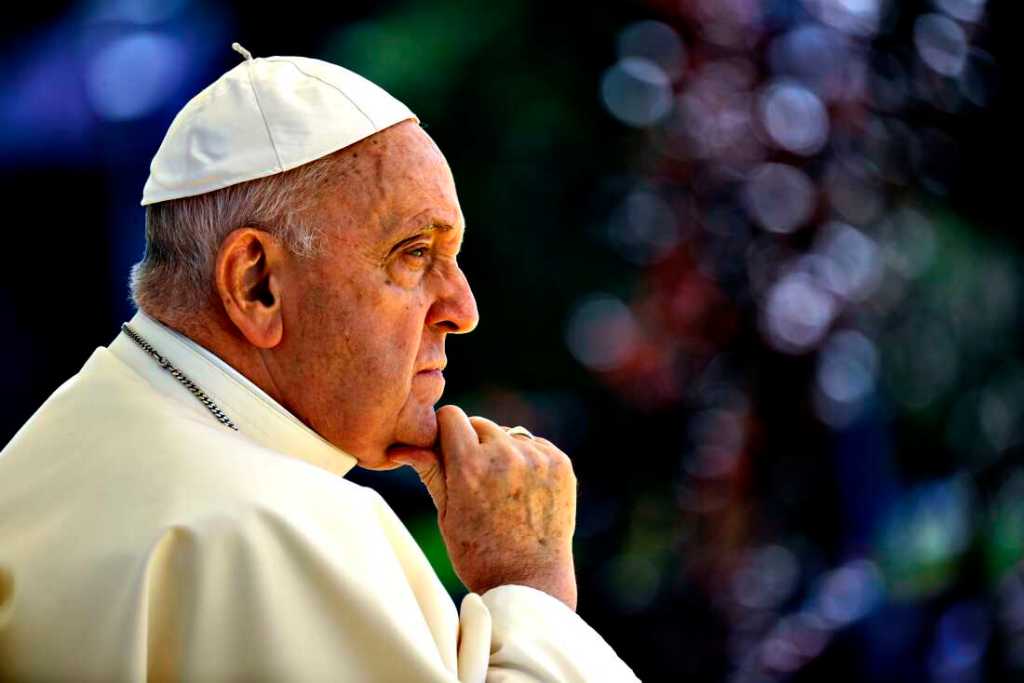
Presented by ChatGPT for Zia H Shah MD
Abstract
Religious communities face a permanent institutional dilemma. Strong central leadership can preserve unity, coordinate humanitarian activity, resolve disputes, and give a worldwide community a recognizable moral voice. Yet the same concentration of authority can magnify error, inhibit criticism, protect abusive officials, and encourage followers to confuse loyalty to God with unconditional submission to a human being. Distributed authority encourages interpretation, intellectual competition, local adaptation, and resistance to tyranny, but it can also produce fragmentation, doctrinal confusion, personality cults, weak accountability, and an inability to act collectively.
Roman Catholicism and Protestant Christianity illustrate these contrasting tendencies, but neither is internally uniform. Catholic papal infallibility is much narrower than the popular idea that the pope is generally incapable of error, while Protestantism includes episcopal, presbyterian, congregational, and highly charismatic systems. Similarly, the Sunni–Shiʿa divide cannot be reduced to “Muslim Protestantism” and “Muslim Catholicism.” Sunni Islam generally distributes interpretive authority among scholars, legal schools, institutions, and communities, but historically also recognized caliphs and powerful state-sponsored religious establishments. Twelver Shiʿism attributes infallibility to the Twelve Imams, but its contemporary marājiʿ are fallible and plural. Nizari Ismailism follows a living hereditary Imam; Tayyibi Bohra communities follow a highly authoritative Dāʿī al-Muṭlaq during the Imam’s concealment; Zaydi Shiʿism generally denies the infallibility of later imams; and the Ahmadiyya Muslim Community follows an elected, lifelong caliph who is officially considered humanly fallible but protected by a form of “minor infallibility” in matters affecting the community.
History suggests that neither centralization nor decentralization automatically produces science, rationality, morality, or pluralism. Institutions function as amplifiers: centralized systems can disseminate wisdom or error with extraordinary speed; decentralized systems can generate creativity or chaos. The most promising “happy medium” is therefore a form of constitutional, consultative, and federated religious leadership: revelation remains supreme; scholars interpret through reasoned argument; a coordinating leader symbolizes unity; representative councils share authority; dissent is protected; decisions are reviewable; and independent institutions guard against financial, sexual, political, and intellectual abuse. Such a model could preserve community without imposing uniformity and could advance the Quranic and universal ideal of humanity as one moral family.
The Fundamental Leadership Dilemma
Every enduring religion must answer at least five questions:
- Who has authority to interpret revelation?
- How is a leader chosen?
- What is the scope of that leader’s authority?
- Can the leader be wrong, and who may correct him?
- What happens when conscience, reason, evidence, and authority appear to conflict?
Religious traditions answer these questions differently because they fear different dangers.
Centralized traditions tend to fear fragmentation, innovation, false teaching, and communal disintegration. Decentralized traditions tend to fear tyranny, priestcraft, institutional corruption, and the subordination of scripture to human authority. Both fears are justified. Religious history contains schisms caused by uncontrolled interpretation and oppression caused by uncontrolled leadership.
The Catholic–Protestant and Shiʿa–Sunni comparisons are therefore illuminating, provided they are treated as analogies rather than identities.
A comparative overview
| Tradition | Primary leadership structure | Basis of legitimacy | Claimed protection from error | Principal strength | Principal danger |
|---|---|---|---|---|---|
| Roman Catholic | Pope, bishops, magisterium | Apostolic succession and Petrine primacy | Papal infallibility under narrowly defined conditions; infallibility of the Church’s definitive teaching | Worldwide unity and coordination | Overcentralization and magnification of error |
| Eastern Orthodox | Autocephalous churches and councils | Apostolic succession and conciliar reception | No individually infallible bishop; Church preserved through councils | Conciliarity and historical continuity | National fragmentation and institutional deadlock |
| Anglican/mainline Protestant | Bishops, synods, presbyteries, elected assemblies | Scripture, historic ministry, communal discernment | Generally no infallible individual | Balance of continuity and debate | Ambiguity and slow collective decision-making |
| Evangelical/congregational Protestant | Local church, pastor, elders, congregation | Scripture and local recognition | Formally none | Flexibility and lay participation | De facto personality cults and fragmentation |
| Sunni Islam | Distributed ʿulamāʾ, legal schools, institutions, states | Qur’an, Sunnah, scholarship, ijmāʿ and ijtihād | No infallible post-prophetic leader | Interpretive plurality and resistance to one-man rule | Conflicting authorities and weak coordination |
| Twelver Shiʿism | Infallible Twelve Imams; today plural marājiʿ; in Iran, Supreme Jurist | Divine designation of Imams; scholarly competence during occultation | Imams infallible; contemporary jurists generally not | Coherent sacred history and disciplined scholarship | Clerical hierarchy or politicized guardianship |
| Nizari Ismailism | Living hereditary Imam | Continuous divine designation through the Prophet’s family | Very strong authoritative teaching function; terminology varies | Unity, adaptability, coordinated development | Excessive dependence on one interpretive center |
| Tayyibi/Dawoodi Bohra | Dāʿī al-Muṭlaq representing the concealed Imam | Appointment within the sacred hierarchy | Very elevated practical authority | Strong organization and mutual support | Limited transparency and constrained dissent |
| Zaydi Shiʿism | Qualified descendant of Ḥasan or Ḥusayn who claims leadership | Learning, lineage, justice, and active leadership | Later imams generally not infallible | Greater corrigibility than other Shiʿa models | Lineage restriction and political militarization |
| Ahmadiyya Muslim Community | Elected, lifelong Khalīfat al-Masīḥ | Election understood as divinely guided | Human fallibility plus ʿiṣmat-i ṣughrā, “minor infallibility” | Exceptional global unity and coordination | Obedience may outgrow meaningful accountability |
Part I: Christian Models of Authority
1. The Roman Catholic model
The theological justification
Catholicism grounds the papacy principally in three New Testament passages:
- Matthew 16:18–19, where Jesus gives Peter the “keys of the kingdom”;
- Luke 22:32, where Jesus prays that Peter’s faith may not fail and commands him to strengthen his brethren;
- John 21:15–17, where Peter is instructed to feed Christ’s sheep.
Catholic theology joins these texts to apostolic succession. Christ entrusted authority to the apostles; the apostles appointed successors; bishops inherit their pastoral office; and the Bishop of Rome, as Peter’s successor, possesses a unique primacy within the episcopal college.
This produces a threefold Catholic authority structure:
- Scripture;
- apostolic tradition;
- the teaching office or Magisterium, exercised by the pope and bishops.
From the Catholic perspective, a self-interpreting Bible cannot resolve every controversy, because Christians who sincerely affirm scripture reach incompatible conclusions. A living teaching authority is therefore needed to preserve continuity and determine which interpretations remain within the apostolic faith.
What papal infallibility actually means
It is inaccurate to say that Catholics officially regard every papal statement as infallible. The First Vatican Council formally defined papal infallibility in 1870, not fifteen centuries earlier. The Second Vatican Council restated its restricted conditions: the pope exercises this charism when, acting as supreme shepherd and teacher of all Christians, he definitively proclaims a doctrine concerning faith or morals for the universal Church. He is not thereby declared sinless, scientifically omniscient, politically infallible, or incapable of poor judgment. The official formulation appears in Lumen Gentium, section 25.
Nevertheless, a difference can arise between formal doctrine and institutional culture. Even when a statement does not meet the technical conditions of an infallible definition, intense reverence for the papal office may create a practical or “semi-infallible” atmosphere. Followers, bishops, and institutions may hesitate to distinguish respectfully between:
- an irreformable dogmatic definition;
- an authoritative but potentially reformable teaching;
- a prudential judgment;
- a political observation;
- and a pope’s personal opinion.
This phenomenon of “creeping infallibility” can be more consequential than the narrow dogma itself.
The strengths of the Catholic model
Catholicism possesses extraordinary institutional continuity. A Catholic in the Philippines, Brazil, Nigeria, Poland, or the United States belongs to one visible communion with common sacraments, a recognized episcopal hierarchy, a body of canon law, and a universal leader.
The Church can consequently:
- coordinate education and health care across continents;
- articulate worldwide positions on poverty, war, migration, climate, and human dignity;
- negotiate with governments;
- discipline clergy across diocesan boundaries;
- convene ecumenical councils;
- mobilize relief rapidly;
- preserve a cumulative intellectual tradition.
Its political influence is not merely demographic. Vatican statistics place the global Catholic population at about 1.422 billion in 2024, and the Holy See currently maintains diplomatic relations with 184 states. This combination of numbers, hierarchy, and sovereign diplomacy gives the papacy a unique international voice. See the 2026 Pontifical Yearbook summary and the Holy See’s official diplomatic report.
The weaknesses
Centralization makes institutional error scalable. When a local pastor errs, the damage may remain local. When a supreme institution makes an error and attaches sacred authority to it, the error can be propagated across nations and centuries.
The papal and magisterial system has at different times contributed to:
- suppression of theological dissent;
- censorship through the Index of Forbidden Books;
- inquisitorial proceedings;
- coercive enforcement of religious conformity;
- delayed correction of inherited interpretations;
- excessive clerical control;
- concealment of institutional abuse;
- the marginalization of laity and women from decision-making.
The Galileo proceedings remain a genuine warning. Even if the affair involved scientific uncertainties, personalities, Reformation politics, and Galileo’s provocative style, a religious tribunal condemned a scientific conclusion that proved correct. Centralized authority converted an interpretive mistake into an institutional humiliation.
Did Catholicism prevent the Scientific Revolution?
The claim that the Catholic Church simply resisted independent thought for 1,500 years and prevented the Scientific Revolution is too broad. At times, ecclesiastical authorities undoubtedly punished independent inquiry, and the possibility of doctrinal prosecution created a chilling effect. That criticism should not be minimized.
Yet Catholic institutions also:
- preserved and transmitted classical learning;
- founded and chartered medieval universities;
- developed traditions of scholastic disputation;
- sponsored astronomy and calendar reform;
- educated Copernicus;
- supported Jesuit mathematicians and astronomers;
- produced scientists such as Roger Bacon, Albert the Great, Mendel, and Georges Lemaître.
The Scientific Revolution arose within a Christian Europe containing both Catholic and Protestant scholars. The Church could sponsor inquiry in one setting and suppress it in another. The most accurate conclusion is not that Catholicism either “created” or “prevented” modern science, but that its concentrated authority functioned as an amplifier. Enlightened patronage greatly assisted scholarship; defensive dogmatism greatly impeded it.
2. Protestant models
The theological justification
The Reformation challenged the idea that an ecclesiastical hierarchy possessed an indefectible monopoly over Christian truth. Its characteristic principles included:
- sola Scriptura: scripture is the final norm by which traditions and leaders are judged;
- the priesthood of all believers;
- direct responsibility of the believer before God;
- the right and duty to test teaching against revelation;
- justification by faith rather than dependence upon sacerdotal mediation.
Protestants often appeal to the Bereans, praised in Acts 17:11 for testing Paul’s preaching against scripture, and to Galatians 1:8, where even an angelic message must be rejected if it contradicts the gospel.
This model offers an essential safeguard: no bishop, council, pastor, theologian, or inherited custom stands above the Word of God.
Protestantism is not one leadership system
“Protestant” is an umbrella covering several forms of polity.
Episcopal Protestants
Anglicans and many Methodists retain bishops, dioceses, and synods. Anglicanism combines scripture with tradition and reason, while its national or regional provinces remain largely self-governing. The Archbishop of Canterbury is a focus of unity but not a pope with jurisdiction over every province. The Anglican Communion describes scripture as its ultimate standard while reading it through a Christ-centered tradition of communal interpretation. See its statement on scripture, tradition, and reason.
Presbyterian and Reformed traditions
Authority is exercised through elected elders arranged in graded assemblies—session, presbytery, synod, and general assembly. This model distrusts episcopal monarchy but does not leave each individual entirely alone.
Congregational traditions
Baptists, Congregationalists, and many independent churches locate final institutional authority in the local congregation. Members may call or dismiss pastors, approve budgets, and determine affiliation.
Pentecostal and charismatic networks
Many are formally congregational, but their practical authority may center upon a founder, prophet, televangelist, or senior pastor. A church that rejects a pope in doctrine can still create a functional pope without canon law, historical constraints, or a college of bishops.
Strengths
Protestant decentralization has encouraged:
- vernacular translation and literacy;
- lay Bible study;
- competition among interpretations;
- rapid institutional innovation;
- contextual adaptation;
- resistance to a universally coercive church;
- freedom to form new communities when existing authorities become corrupt;
- greater participation by local congregations.
Competition between churches sometimes created a form of intellectual diversification. No single institution could permanently prevent every scholar from publishing or every community from experimenting.
Weaknesses
The Reformation did not immediately create modern pluralism. Lutheran, Reformed, Anglican, and other Protestant states frequently imposed their own confessions, censored opponents, and persecuted dissenters. Calvin’s Geneva was not a contemporary liberal democracy. Protestants also resisted scientific conclusions when they believed them inconsistent with scripture; modern anti-evolution movements have often flourished in decentralized Protestant settings.
Decentralization creates its own pathologies:
- thousands of denominations;
- contradictory doctrines all claiming biblical authority;
- consumer-oriented religion;
- weak professional standards for clergy;
- financial opacity;
- celebrity pastors;
- manipulation through charismatic claims;
- congregations built around one personality;
- ease of schism over secondary issues.
Catholicism risks one pope ruling too much. Protestantism sometimes risks making every pastor—or every individual reader—his own pope.
3. Eastern Orthodoxy: an important third Christian model
Eastern Orthodoxy demonstrates that Christianity is not limited to papal centralization and Protestant fragmentation. It preserves bishops, apostolic succession, liturgy, and tradition while rejecting the infallibility of any single bishop. Authority is conciliar: the Church gathered in council, and the reception of the council by the whole Church, testifies to truth. The Orthodox Church in America summarizes the position plainly: no pope or other individual is infallible; the Church is guided when gathered in council. See its explanation of Orthodox conciliarity and infallibility.
Its strength is “unity without one supreme monarch.” Its difficulty is that autocephalous national churches may become entangled with ethnicity and state interests. Without an effective universal mechanism, disputes between patriarchates can remain unresolved. Conciliarity may protect against unilateral error, but it can also produce paralysis.
Part II: Leadership in Islamic History
1. The original succession question
The Prophet Muhammad, peace be upon him, united prophetic, spiritual, judicial, and political authority. After his death in 632 CE, Muslims agreed that prophethood had ended but disagreed about the legitimate continuation of leadership.
The question was not simply “Who should govern?” It was also:
- Did the Prophet designate a successor?
- Should leadership be chosen through consultation?
- Must it remain within the Prophet’s family?
- Is the successor merely a political administrator, or also a divinely protected interpreter?
- Does religious authority belong to one person or to the community’s learned scholars?
The Sunni and Shiʿa traditions developed as different answers to this cluster of questions.
Part III: The Sunni Model—Distributed but Not Leaderless
Sunni Muslims constitute approximately 87–90 percent of Muslims worldwide; Shiʿa communities account for roughly 10–13 percent, although precise figures vary by country and definition. Pew’s widely cited demographic study provides these approximate proportions. Pew Research Center
The Sunni justification
Sunnis generally hold that the Prophet did not establish an infallible hereditary imamate. Abū Bakr’s selection after consultation at Saqīfah and the varied means by which the first four caliphs assumed office are taken to show that political succession belongs to communal judgment rather than an immutable bloodline.
Sunni political and religious thought draws upon:
- shūrā, consultation: Qur’an 42:38 and 3:159;
- obedience to legitimate authority: Qur’an 4:59;
- ijmāʿ, scholarly or communal consensus;
- ijtihād, disciplined reasoning;
- the Qur’an and Sunnah as the final norms;
- the fallibility of every person after the prophets.
In principle, the caliph preserved public order and defended the community, while the ʿulamāʾ interpreted law and theology. These spheres frequently overlapped, but they were not identical.
The Abbasid miḥnah of the ninth century illustrates the significance of this distinction. Caliphs attempted to impose a theological position concerning the createdness of the Qur’an, but scholars such as Aḥmad ibn Ḥanbal resisted. The eventual failure of the miḥnah helped establish that the ruler could not simply dictate doctrine to the scholarly community.
The Sunni scholarly ecosystem
Sunni religious authority came to be distributed across:
- the four major legal schools;
- scholars linked through ijāzah and teaching lineages;
- judges and muftis;
- mosques and madrasas;
- Sufi orders;
- universities such as al-Azhar;
- royal and republican state institutions;
- modern movements, publishers, broadcasters, and online preachers.
Sunni authority is therefore dispersed, but it is not supposed to be untrained individualism. Classical scholars became authoritative through years of study and recognition by other scholars, not merely through popularity. The historical role of this credentialed scholarly culture is described in the Maydan’s account of traditional ʿulamāʾ and religious authority.
Strengths
The Sunni model:
- prevents one post-prophetic leader from monopolizing revelation;
- permits multiple legal conclusions;
- contains internal mechanisms for minority opinions;
- makes it difficult for one mistaken decree to bind all Muslims;
- protects scholarship from complete political absorption;
- allows local cultural adaptation;
- recognizes that sincere jurists may disagree.
At its best, the madhhab tradition represents disciplined pluralism: one revealed source, several responsible interpretations.
Weaknesses
The absence of a universally recognized coordinating authority produces:
- conflicting fatwas;
- competition among states for religious legitimacy;
- poorly trained preachers claiming expertise;
- uncertainty among lay Muslims;
- politicized scholars dependent on governments;
- sectarian media;
- difficulty producing a unified response to global crises;
- movements that reject centuries of scholarship while claiming direct access to scripture.
Decentralization can restrain a tyrant, but it can also enable extremists to shop for opinions or establish a self-authorized “caliphate.” Sunni religious authority has been aptly described as real but fragmented—pluralistic and enriching, yet often confusing. See the Carnegie Endowment’s historical analysis, “Leading From Everywhere”.
Part IV: Shiʿa Models—Several Distinct Forms of Imamate
It is inaccurate to say without qualification that all Shiʿa communities follow the same Catholic-like model. Their leadership doctrines vary considerably.
1. Twelver Shiʿism
Justification of the Imamate
Twelver Shiʿism teaches that God did not leave the interpretation and leadership of Islam entirely to political negotiation. ʿAlī and eleven of his descendants were divinely designated Imams.
The principal proofs include Shiʿa interpretations of:
- Qur’an 4:59 concerning obedience to “those vested with authority”;
- Qur’an 5:55 concerning wilāyah;
- Qur’an 33:33 concerning the purification of the Prophet’s household;
- the event of Ghadīr Khumm;
- the Hadith of the Two Weighty Things, the Qur’an and the Prophet’s family.
From this perspective, revelation requires an authoritative interpreter protected against serious religious error. Otherwise, the community could receive a perfect book but be abandoned to contradictory human readings.
The occultation and the rise of the jurists
Twelvers believe the Twelfth Imam entered occultation. Consequently, the living leadership model is not equivalent to a reigning infallible pope. Authority is exercised by learned jurists, especially the marājiʿ al-taqlīd, whom believers may select as sources of legal emulation. There can be several marājiʿ simultaneously. Their authority rests on learning and recognition, not hereditary succession, and they are not generally considered infallible.
Iran’s doctrine of wilāyat al-faqīh adds a more centralized political model: a qualified jurist exercises guardianship during the Imam’s absence. Even among Twelver scholars, however, the scope of this doctrine remains disputed. Some accept extensive political guardianship; others defend more limited clerical authority or political quietism. It should not be treated as the position of every Twelver Shiʿa.
Strengths and weaknesses
Twelver Shiʿism combines a powerful sacred center—the infallible Imams—with contemporary scholarly plurality. Its seminaries support rigorous legal training, and the memory of Karbala creates a compelling moral language of resistance to injustice.
Its danger arises when the spiritual authority of the infallible Imams is transferred psychologically to contemporary, fallible clerics. A jurist may be treated socially as though criticism of him were criticism of the Imam. Where clerical and state power merge, political opposition may be sacralized as religious disobedience.
2. Nizari Ismailism
Nizari Ismailis follow a living hereditary Imam descended, in their understanding, from ʿAlī and Fāṭimah. Since February 2025, Prince Rahim al-Hussaini Aga Khan V has served as the fiftieth hereditary Imam. His succession is described by the official Ismaili community.
The Imam possesses a uniquely authoritative role in interpreting the faith for the conditions of the age. The Nizari model is therefore the closest Islamic parallel to a strongly centralized Catholic system, although important differences remain:
- the Imam is hereditary rather than elected by cardinals;
- his authority is grounded in continuing lineage and designation;
- he is not merely the head of a clerical hierarchy;
- the community’s institutions integrate spiritual guidance, education, development, and social welfare.
Strengths
This model produces:
- exceptional communal cohesion;
- adaptability through contemporary interpretation;
- long-range institutional planning;
- coordinated education and development;
- a unified global identity;
- reduced conflict among competing clerics.
The Aga Khan Development Network demonstrates what centralized vision can accomplish in health, education, architecture, culture, and poverty reduction.
Weaknesses
The theological centrality of one living interpreter can restrict the visible space for independent religious disagreement. Even benevolent and intellectually sophisticated leadership requires structures that distinguish:
- spiritual devotion;
- administrative governance;
- financial oversight;
- historical scholarship;
- individual conscience.
A community may be well led for generations, but durable governance must be designed for the possibility of mistaken judgment, disputed succession, or less capable leadership.
3. Tayyibi Ismailis and the Dawoodi Bohra model
Tayyibi Ismailis believe that the Imam is concealed and represented by the Dāʿī al-Muṭlaq, the “absolute missionary.” Dawoodi Bohras presently recognize Syedna Mufaddal Saifuddin as the fifty-third Dāʿī al-Muṭlaq. The community’s official account describes the office and succession. The Dawoodi Bohras
The model creates disciplined communal life, strong welfare networks, educational institutions, business solidarity, and distinctive religious identity. Its centralization can be especially effective for a geographically dispersed minority.
The corresponding risks include:
- limited transparency;
- concentration of spiritual and administrative power;
- the social costs of disagreement;
- disputes over succession;
- financial dependence;
- difficulty appealing decisions to an independent institution.
The question is not whether a revered Dāʿī may be righteous. It is whether any human institution should depend primarily on the righteousness of its present officeholder rather than on permanent safeguards.
4. Zaydi Shiʿism: a major exception
Zaydism demonstrates why “all Shiʿa leaders are infallible” is incorrect. The dominant Zaydi position does not require the Imam after the earliest members of the Prophet’s family to be infallible. A qualified descendant of Ḥasan or Ḥusayn who possesses learning, courage, and justice and actively claims leadership may become Imam. Leiden University’s overview notes that non-infallibility is the dominant Zaydi view. Leiden Arabic Humanities
Zaydism is therefore closer to certain Sunni theories of active, qualified leadership, though it retains an Alid lineage requirement.
Its strength is that the Imam can be judged by knowledge and conduct. Its dangers are the restriction of eligibility by descent and the historical association of legitimate leadership with armed uprising, which can turn theological legitimacy into continuing political conflict.
Part V: The Ahmadiyya Muslim Community—An Elective but Highly Centralized Sunni-Origin Model
The Ahmadiyya Muslim Community arose in nineteenth-century British India around Mirza Ghulam Ahmad of Qadian, whom Ahmadis recognize as the Promised Messiah and Mahdi. After his death in 1908, the mainstream community established the office of Khalīfat al-Masīḥ, Caliph of the Messiah.
Although Ahmadis emerged from a Sunni milieu and retain many Sunni forms, their current leadership structure is much closer institutionally to a centralized church than to ordinary Sunni decentralization.
Election and legitimacy
The caliph is formally elected by an Electoral College after the death of his predecessor. The office is not doctrinally hereditary. Once elected, however, the caliph serves for life, and the community believes that God guides the electors toward His chosen person.
Official Ahmadiyya sources state that every member is expected to obey the elected caliph, while the caliph should consult the community but is not required to accept the advice given. Official explanation of the election
The theological justification draws heavily upon:
- Qur’an 24:55, interpreted as a divine promise of caliphate after prophethood;
- the Hadith concerning caliphate “on the pattern of prophethood”;
- the need for a living center of unity;
- the belief that God establishes and protects the institution.
Is the Ahmadi caliph infallible?
The official answer is nuanced but highly consequential. The caliph may make personal or minor errors, yet God is believed not to permit an error that produces harmful consequences for the community. This is called ʿiṣmat-i ṣughrā, “minor infallibility,” in contrast to the greater protection associated with prophets.
An official Ahmadiyya explanation says that the caliph is the final authority in matters of faith and religious understanding, is answerable to God rather than to community members, and is divinely protected from consequential error affecting the Jamaat. “Is a Khalifa infallible?”
Thus the Ahmadi caliph is not infallible in the full Twelver or Nizari sense, but the practical doctrine approaches semi-infallibility. The distinction may be formulated as follows:
- The caliph can make a mistake.
- Yet no significant mistake will be allowed to harm the Jamaat.
- Members must therefore obey with confidence that the eventual result will be good.
Strengths
The model has produced remarkable cohesion for a relatively small and frequently persecuted community:
- one recognized worldwide leader;
- coordinated missionary work;
- an international broadcasting network;
- disciplined financial giving;
- rapid humanitarian mobilization;
- consistent messaging;
- durable identity across national boundaries;
- a strong public emphasis on peace and the motto “Love for All, Hatred for None.”
A centrally led persecuted minority may survive pressures that would fragment a loosely organized movement.
Weaknesses
The combination of lifelong authority, total communal allegiance, divine selection, and protection from consequential error creates a serious accountability challenge. If a policy fails, followers may assume that the failure cannot count as evidence against the policy. If the leader is answerable only to God, there may be no institutional body able to require correction.
The risk is not necessarily overt dictatorship. It is epistemic closure: the system may define the leader as corrigible in theory while making correction difficult in practice.
The mainstream community’s elections are non-hereditary in doctrine, yet most caliphs after the first have belonged to the founder’s extended family. That does not invalidate their elections, but greater transparency and broader representation would strengthen confidence that the institution is genuinely elective rather than informally dynastic.
The Lahore Ahmadiyya movement, which separated in 1914, rejected the mainstream caliph’s extensive authority and adopted a more collegial administrative model. Its far smaller size suggests that strong leadership can preserve organizational cohesion—but size alone cannot settle the theological question of legitimacy.
Ahmadis, like every other religious minority, deserve complete freedom from persecution and full civil equality. Internal critique of governance must never be used to justify the discrimination Ahmadis suffer in Pakistan or elsewhere.
Part VI: Leadership, Rationality, and the History of Science
No simple equation can be sustained:Centralization=anti-science
orDecentralization=rationality.
Centralized Catholic institutions sometimes suppressed new ideas, but also founded universities and patronized science. Protestant pluralism sometimes liberated inquiry, but Protestant churches also imposed confessions and resisted evolution. Sunni decentralization supported a brilliant civilization of competing jurists, philosophers, physicians, mathematicians, and theologians, but modern fragmentation has also empowered anti-intellectual populism. Centralized Ismaili and Ahmadi institutions have often promoted education and engagement with science.
The better institutional principle is:
Centralization increases the reach of both wisdom and error; decentralization increases the variety of both insight and confusion.
A unified leader who accepts evidence can reform an entire community quickly. A unified leader who resists evidence can delay correction everywhere. A decentralized culture permits innovation somewhere, but it also permits misinformation everywhere.
The Scientific Revolution required more than a leadership model. It depended upon universities, printing, mathematical methods, instruments, patronage, commercial networks, political competition, access to Greek and Islamic learning, and a growing willingness to distinguish theological meaning from empirical description.
Likewise, the rise and relative decline of scientific leadership in Muslim civilizations cannot be explained solely by Sunni decentralization or Shiʿa hierarchy. Political instability, invasions, patronage structures, economic change, colonialism, educational institutions, and attitudes toward philosophy and independent reasoning all played roles.
Part VII: Is There a Happy Medium?
A promising synthesis may be called constitutional conciliar leadership: enough unity to act together, enough distributed authority to correct the center.
Its essential principles
1. Revelation above every leader
No pope, imam, caliph, patriarch, jurist, pastor, dāʿī, or council should be treated as the source of revelation. Leadership must remain stewardship rather than ownership of faith.
For Muslims, the Qur’an must function as the enduring “rope of Allah” holding the community together. A leader may help believers grasp the rope; he should never replace it.
2. A coordinating leader without unlimited authority
A worldwide community benefits from a visible spokesperson who can:
- represent it internationally;
- call assemblies;
- coordinate relief;
- speak against war and persecution;
- encourage common educational standards;
- mediate internal disputes.
But this office should be constitutionally limited. Symbolic primacy need not become interpretive monopoly.
3. Representative councils
Major decisions should involve councils containing:
- trained theologians and jurists;
- scientists and physicians;
- historians and philosophers;
- local clergy;
- women;
- younger members;
- representatives from different nations and cultures;
- independent ethical and legal experts.
Consultation should be more than ceremonial. If the leader rejects a strong council majority, reasons should ordinarily be recorded and review permitted.
4. Subsidiarity
Decisions should be made at the lowest competent level. A universal center should handle genuinely universal matters; national institutions should address national matters; local communities should retain meaningful autonomy.
This preserves unity without bureaucratic suffocation.
5. Corrigibility
Every non-prophetic leader should be explicitly correctable. A doctrine of providential guidance should mean that God may guide the community through criticism, evidence, consultation, or the correction of the leader—not that loyalty requires pretending mistakes never occurred.
6. Independent accountability
Religious communities require institutions independent of the leader’s personal office:
- financial auditors;
- safeguarding boards;
- ombudsmen;
- appellate tribunals;
- transparent disciplinary procedures;
- conflict-of-interest rules;
- published succession procedures.
A leader who is truly righteous should welcome safeguards that protect both the community and his office from suspicion.
7. Protected scholarly disagreement
Qualified dissent should not be treated as betrayal. Communities can distinguish between:
- malicious agitation;
- ordinary disagreement;
- conscientious objection;
- academic investigation;
- doctrinal rebellion.
Without this distinction, the vocabulary of unity becomes an instrument of control.
8. No civil coercion
Religious authority should persuade through argument, example, and service. Excommunication or loss of membership must not become loss of citizenship, employment, personal safety, family, or civil rights.
Part VIII: Specific Suggestions for Reform
For the Roman Catholic Church
- Preserve the pope as a global symbol of unity, but prevent “creeping infallibility” beyond the strict doctrinal definition.
- Expand synodal governance and give bishops, theologians, women, and laity a meaningful deliberative role.
- Require independent investigation of abuse rather than internal clerical handling.
- Distinguish dogma, theological opinion, and prudential policy much more clearly.
- Protect Catholic scholars who responsibly explore unsettled scientific and historical questions.
- Treat the Galileo episode as a permanent institutional lesson: scriptural interpretation should not prematurely foreclose empirical inquiry.
- Strengthen subsidiarity so that universal unity does not become Roman micromanagement.
For Eastern Orthodox churches
- Establish a permanent pan-Orthodox consultative structure capable of mediating disputes.
- Resist the identification of church boundaries with nationalism.
- Broaden participation by laity and women.
- Make the process by which councils are received and recognized more transparent.
- Develop stronger universal mechanisms for safeguarding and financial accountability.
For mainline Protestants and Anglicans
- Preserve synodality but clarify which doctrines are central and which allow regional diversity.
- Develop stronger mechanisms for resolving disagreements before they become schisms.
- Keep scripture primary while using tradition and reason to prevent historical amnesia.
- Make ecumenical cooperation more binding in humanitarian and peace-building work.
For evangelical, congregational, and Pentecostal churches
- Ensure that independent pastors are accountable to boards not appointed entirely by themselves.
- Publish finances and prohibit family-controlled succession without genuine election.
- Require theological and safeguarding credentials.
- Distinguish spiritual gifts from unreviewable authority.
- Build federations that preserve local vitality while preventing “celebrity pastor” absolutism.
- Teach that sola Scriptura does not mean solo Scriptura: individual interpretation needs history, language, scholarship, and community.
For Sunni Muslims
- Create a non-coercive international council of scholars rather than attempting to invent an infallible Sunni pope.
- Include all major legal schools and multiple intellectual orientations.
- Restore ijtihād as disciplined reasoning, not untrained private opinion.
- Protect scholarly institutions from state control.
- Establish transparent credentials for public religious teachers.
- Include women scholars, scientists, economists, physicians, and ethicists in deliberation.
- Distinguish fatwa from state law and religious advice from coercive command.
- Recover the classical etiquette of disagreement: a jurist may defend his conclusion without declaring every opponent deviant.
For Twelver Shiʿa communities
- State more forcefully that the infallibility of the Twelve Imams does not transfer automatically to contemporary jurists.
- Preserve the plurality of the marjaʿiyyah.
- Define constitutional limits on wilāyat al-faqīh where it is politically implemented.
- Protect scholars who adopt quietist or minority interpretations.
- Separate religious criticism from treason.
- Strengthen lay and female participation in religious administration.
For Nizari Ismailis
- Preserve the living Imam’s unifying and adaptive role while increasing transparency in administrative governance.
- Distinguish the Imam’s spiritual authority from the reviewable decisions of appointed officials.
- Protect independent historical and theological scholarship.
- Maintain autonomous auditing and grievance procedures.
- Encourage members to understand allegiance as morally intelligent commitment rather than suspension of conscience.
For Dawoodi Bohras and related Tayyibi communities
- Establish independent mechanisms for appealing administrative or financial decisions.
- Publish clearer accounts of institutional assets and obligations.
- Protect members from social or economic retaliation for conscientious disagreement.
- Broaden consultative participation beyond officials appointed by the central hierarchy.
- Clarify succession processes and reduce the possibility that sacred claims must be adjudicated through secular inheritance litigation.
For Zaydi communities
- Preserve the principle that leaders are fallible and accountable.
- Reconsider lineage as a necessary qualification for political leadership.
- Replace armed self-assertion as a criterion of legitimacy with constitutional consultation and public consent.
- Separate religious identity from militia or state coercion.
- Protect Sunni and other Shiʿa minorities wherever Zaydis exercise power.
For the Ahmadiyya Muslim Community
- Interpret ʿiṣmat-i ṣughrā as God’s protection through correction, consultation, and institutional learning—not as a reason that consequential error can never be acknowledged.
- Give the elected Shūrā a stronger and more transparent advisory function.
- Broaden the Electoral College across geography, gender, profession, age, and non-familial leadership.
- Clarify why a formally non-hereditary office has repeatedly passed within the founder’s extended family.
- Establish an independent ombudsman and appellate process not ultimately controlled by the same chain of command.
- Publish principled distinctions between binding religious teaching, administrative policy, personal advice, and spiritual exhortation.
- Protect respectful internal academic inquiry.
- Teach that unity of purpose does not require uniformity of thought.
- Continue and deepen the community’s admirable emphasis on peace, education, interfaith dialogue, and “Love for All, Hatred for None.”
For Sufi orders
- Preserve spiritual mentorship while rejecting uncritical obedience to the pīr or shaykh.
- Require financial transparency and safeguarding.
- Make clear that spiritual inspiration does not override the Qur’an, reason, law, or consent.
- Prevent hereditary succession from being treated automatically as evidence of sanctity.
For Salafi movements
- Acknowledge that rejecting formal schools does not eliminate interpretation; it often transfers authority to contemporary teachers.
- Recover the humility of the early scholars regarding disagreement.
- Distinguish theological conviction from the right to coerce.
- Build stable scholarly and ethical accountability instead of relying on media prominence.
Part IX: Which Model Best Promotes Pluralism and Universal Brotherhood?
No leadership structure guarantees pluralism. A centralized leader may teach compassion and rapidly transform millions of attitudes; another may enforce exclusion. A decentralized community may permit diversity; it may also permit hundreds of intolerant factions.
Pluralism depends upon at least four elements:
- a theology that recognizes the dignity of people beyond one’s own group;
- freedom of conscience;
- institutions that restrain coercion;
- habits of dialogue and shared service.
Centralized traditions possess a special advantage when their leaders embrace pluralism. Vatican II’s declarations on religious liberty and relations with non-Christian religions changed Catholic teaching and practice across the world far more rapidly than thousands of independent congregations could have coordinated. Likewise, an Ismaili Imam or Ahmadi caliph can make interfaith service a worldwide communal priority.
Distributed traditions possess a different advantage: if one scholar or denomination becomes intolerant, others can resist. No single Sunni mufti or Protestant pastor can permanently define every believer’s relationship with humanity.
The strongest model for universal brotherhood is therefore neither absolute monarchy nor complete atomization. It is a federated pluralism characterized by:
- a shared moral covenant;
- multiple legitimate schools;
- a coordinating but limited leadership;
- protected freedom of conscience;
- reciprocal recognition;
- common humanitarian work;
- refusal to use the state against theological minorities.
For Muslims, this model can draw upon the Qur’an’s universal vision:
يَا أَيُّهَا النَّاسُ إِنَّا خَلَقْنَاكُم مِّن ذَكَرٍ وَأُنثَىٰ وَجَعَلْنَاكُمْ شُعُوبًا وَقَبَائِلَ لِتَعَارَفُوا
“People, We created you all from a single man and a single woman, and made you into peoples and tribes so that you should come to know one another.” (49:13)
The verse does not say that difference exists so that communities may dominate one another. Difference is ordered toward taʿāruf—mutual knowledge.
Universal brotherhood also requires separating two propositions that religious communities too often confuse:
- “I believe my tradition is true.”
- “Therefore, people who disagree with me deserve fewer rights.”
The first is a normal religious conviction. The second is an ethical and political error. A believer can hold profound theological commitments while defending the complete dignity and freedom of Catholics, Protestants, Orthodox Christians, Sunnis, Shiʿas, Ahmadis, Jews, Hindus, Buddhists, agnostics, and atheists.
Thematic Epilogue: The Rope, the Guide, and the Community
Religious leadership exists because human beings need teachers, institutions, memory, coordination, and moral example. Yet the need for a guide can become the temptation to surrender conscience. The desire for freedom can likewise become the temptation to reject learning, discipline, and community.
Catholicism demonstrates the power of visible unity. Its worldwide hierarchy can preserve tradition, mobilize service, and speak to nations with a voice few religious institutions can match. Its history also warns that when institutional authority becomes defensive, error may be protected precisely because admission appears to threaten the institution.
Protestantism demonstrates the liberating power of returning to scripture and challenging inherited authority. Its diversity has encouraged translation, lay participation, and intellectual competition. Its history also warns that abolishing a pope does not abolish dogmatism. Authority may simply reappear in the local pastor, charismatic founder, national church, or isolated interpreter.
Sunni Islam demonstrates how scripture, scholarship, consensus, and competing schools can create a civilization of disciplined plurality without an infallible post-prophetic individual. Its modern condition also reveals how plurality without coordination can dissolve into confusion, state manipulation, sectarianism, and self-appointed authority.
Shiʿa traditions preserve the compelling intuition that divine guidance should not be severed from moral and spiritual exemplarity. Their devotion to the Prophet’s family has sustained communities through persecution and created profound traditions of sacrifice, justice, and remembrance. Yet reverence for the infallible Imam must not quietly render every contemporary representative immune from scrutiny.
The Ahmadiyya experience demonstrates that a small, persecuted community can achieve remarkable global coherence through elective caliphate. It also makes the central question especially clear: can a leader be declared fallible while the institutional consequences of his significant fallibility remain nearly impossible to recognize? The lasting strength of Ahmadi Khilafat will depend not only on obedience, but on its ability to make consultation, correction, transparency, and intellectual freedom visible parts of divine guidance.
The happy medium is not leaderlessness. Nor is it a sacred autocrat. It is leadership that teaches without replacing revelation, unites without erasing diversity, consults without pretending consultation, and accepts correction without fearing collapse.
In the Islamic vocabulary, the leader should help the community hold fast to the rope of Allah; he must never become the rope himself. In Christian language, the shepherd serves the flock but does not own it. In universal moral language, authority is legitimate when it enlarges truth, conscience, compassion, and justice.
The best religious leader is therefore not one whose followers are forbidden to imagine him mistaken. It is one whose character, reasoning, humility, and institutions make correction possible—and whose leadership enables human beings to recognize, beneath their many creeds and communities, one shared family under the sovereignty of the One God.




Leave a Reply