
Story by Tristan Greene
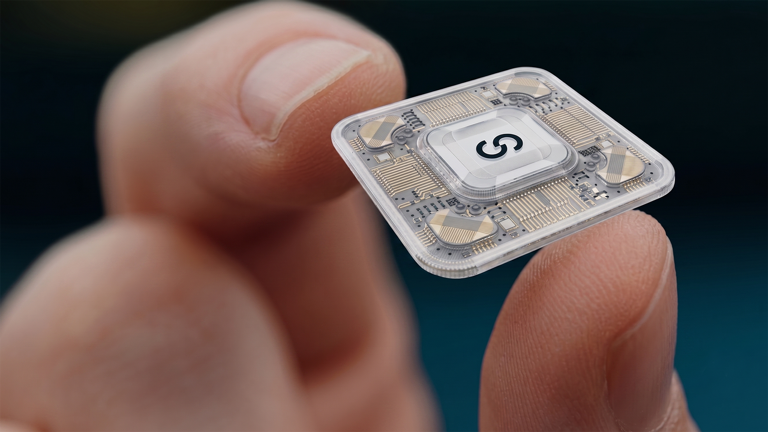
The new diamond-based quantum processor is the first of its kind to exceed a size of 10 qubits.© Saxon Q
A German startup has debuted the world’s first diamond-based quantum computing system to exceed 10 qubits.
The machine, built by engineers at Saxon Q, is a nitrogen-vacancy (NV) quantum computer, meaning it uses defects in synthetic diamonds as quantum bits (qubits) to perform quantum operations. Qubits can be manipulated to represent the 0s and 1s of data, as well as quantum states that are superpositions of both the 0s and the 1s.
The hardware is currently available in rack-mounted systems featuring up to 128 qubits, with 512-qubit configurations available for delivery next year. According to the company’s road map, the goal is to scale to 10,000 qubits and beyond after 2030.
Although the technology existed before this debut, scientists have found it difficult to build systems beyond 10 qubits due to the difficulty of creating nitrogen vacancy qubits.
Although Live Science saw a technical white paper outlining how the technology works, there didn’t appear to be any published research demonstrating a functional quantum computer based on the NV architecture operating with more than 10 qubits before this launch. It’s still unclear exactly how well the firm’s quantum computers stack up against other platforms.
Quantum mechanics and flawed diamonds
In the 1970s, scientists discovered that certain diamonds shone with a brilliant red light when illuminated in a specific way. Subsequent research determined that the optical shift was caused by annealing radiation damage that attracted isolated substitutional nitrogen atoms. In other words, nature occasionally produces a diamond that has a nitrogen atom where a carbon atom should be.



 The Glorious Quran and Science
Leave a comment