

Presented by ChatGPT for Zia H Shah MD
Abstract
Sūrat al-Raʿd presents the Qur’anic argument for God not as a single syllogism but as a sustained movement through revelation, cosmology, geology, hydrology, botany, embryology, meteorology, psychology, ethics, history, prophecy, and final accountability. The heavens without visible supports, the ordered courses of sun and moon, neighboring soils producing different fruits, the hidden processes of the womb, lightning suspended between fear and hope, thunder glorifying God, shadows prostrating, rivers carrying away foam, tranquil hearts, changing societies, and the rise and fall of nations all become interconnected signs. Their cumulative force points beyond isolated natural causes toward a single Creator, Sustainer, Knower, Moral Legislator, and ultimate end of existence.
Read through al-Ghazālī’s occasionalism, the surah depicts natural regularities not as independent powers but as the stable divine custom through which Allah continuously governs creation. Yet it does not teach fatalism: human beings change what is within themselves, turn toward God, honor or violate covenants, plot, choose, earn, and are held accountable. Divine sovereignty supplies the existence, powers, circumstances, and realization of every act; human freedom supplies its morally attributable intention and direction.
Verse 15 expands this cosmic submission to shadows. Literally, shadows lengthen, contract, and change direction under the governing relations of light, matter, planetary rotation, and time. Metaphysically, they can also symbolize the dependence of every projection, counterfactual, possibility, and true proposition upon the divine knowledge in which all actual and possible realities are comprehended. This modal interpretation is an illuminating philosophical extension, though not the verse’s exclusive lexical meaning.
Finally, verses 38–39 and 43 bring the surah into Dr. Zia H. Shah’s Four Books thesis: the Book of Revelation, the Book of Nature, the Book of Destiny, and the Book of Deeds. Sūrat al-Raʿd teaches humanity to read all four together. The thunder is therefore not an interruption of the surah’s argument. It is its audible emblem: nature itself has become testimony.
The Qur’an as an extended cosmological argument
A formal cosmological argument may be compressed into a few premises:
- Contingent realities do not contain the sufficient reason for their own existence.
- The universe and everything within it are contingent.
- Therefore, reality ultimately depends upon a non-contingent or Necessary Being.
Islamic philosophy developed two major forms of this reasoning. The kalām argument reasons from the temporal beginning of the universe, while Ibn Sīnā’s argument reasons from the present contingency of everything other than the Necessary Existent. The latter does not require the universe to have had a temporal beginning: even an everlasting universe would remain dependent at every moment. The history and distinctions between these arguments are summarized by the Stanford Encyclopedia of Philosophy.
Sūrat al-Raʿd is closer in spirit to this second, continuously sustaining argument. Its question is not only, “Who began the universe?” but also:
- Who holds its structure together?
- Who governs its processes?
- Why does it exhibit stable order?
- Why is it mathematically intelligible?
- Why does one water yield diverse fruits?
- How are hidden possibilities measured?
- Why does moral consciousness answer to obligation?
- Why do hearts seek an ultimate ground of peace?
- Why should history culminate in justice?
The surah thus moves from creation to conservation, from existence to intelligibility, from nature to conscience, and from conscience to accountability. Dr. Shah’s cosmological-argument collection similarly treats the case for God as cumulative: cosmological, teleological, moral, experiential, and revelatory arguments reinforce one another.
Cosmic glorification: from the Musabbihāt to al-Raʿd
The Qur’an repeatedly declares that creation performs tasbīḥ: it proclaims God’s perfection and absolves Him of every limitation. This includes:
- “The seven heavens, the earth, and all within them glorify Him” (17:44).
- “Whatever is in the heavens and earth glorifies Allah” (57:1; 59:1; 61:1; 62:1; 64:1).
- Birds in flight each know their prayer and glorification (24:41).
The so-called Musabbihāt employ both past and present forms of sabbaḥa/yusabbiḥu, suggesting praise that is established and continuously renewed. Sūrat al-Raʿd makes this cosmic liturgy concrete:
وَيُسَبِّحُ الرَّعْدُ بِحَمْدِهِ وَالْمَلَائِكَةُ مِنْ خِيفَتِهِ
“The thunder glorifies Him with His praise, as do the angels in awe of Him.” (13:13)
This glorification may be understood on several levels.
First, there is lisān al-ḥāl, the “language of condition.” A contingent thing declares through its very existence: “I did not create myself. I do not sustain myself. My properties are received.” In this sense a star, cell, river, or atom praises God by displaying dependence and order.
Second, the Qur’an may be affirming modes of creaturely awareness beyond human perception. Verse 17:44 explicitly says that humans do not comprehend creation’s glorification. We should therefore avoid reducing the verse either to ordinary human speech or to a merely decorative metaphor.
Third, scientific explanation can describe the physical process without exhausting its theological meaning. Thunder is the acoustic shockwave produced when lightning rapidly heats and expands the surrounding air—temperatures in the channel may approach 30,000°C, according to NOAA. That mechanism answers how thunder occurs. “Thunder glorifies God” answers what the phenomenon signifies within a theistic ontology: even violent atmospheric energy remains ordered, measurable, dependent, and unable to escape the laws under which it exists.
Dr. Shah’s essay on the cosmic liturgy of creation develops this idea: nature is neither divine, as in pantheism, nor metaphysically dead, as in reductive mechanism. It is a world of signs whose existence, regularity, beauty, and dependence testify to its Creator.
Verse-by-verse commentary
Verse 1 — Revelation enters the world of signs
Sense: Alif Lām Mīm Rā. These are the signs of the Book. What has been sent down to you from your Lord is the truth, though most people do not believe.
The unexplained letters appropriately begin a surah about the relation between knowledge and mystery. Human beings can hear and pronounce them, yet cannot confidently determine their intended meaning. Revelation begins by establishing epistemic humility.
The word āyāt means both scriptural verses and signs. This double meaning governs the whole surah. The written verse and the natural phenomenon are not competing sources of truth: both are signs inviting interpretation.
The verse calls revelation al-ḥaqq—the truth, the real, and that which is firmly established. The surah will later contrast truth with foam: truth endures and benefits, whereas falsehood may be conspicuous but lacks lasting substance. Revelation is therefore not detached from reality; it interprets reality.
Within the Four Books thesis, verse 1 introduces the Book of Revelation. Verses 2–17 immediately place it beside the Book of Nature.
Verse 2 — The heavens without visible pillars
Sense: Allah raised the heavens without visible supports, established sovereignty, subjected the sun and moon, appointed their courses, governs every affair, and explains His signs so that people may become certain of meeting Him.
The phrase “without pillars that you can see” should not be forced into a claim that the Qur’an explicitly predicted Newtonian gravity or Einsteinian spacetime. Classical readers understood it as an affirmation that the heavens stand by divine power without the architectural supports familiar to human construction.
Modern astronomy nevertheless greatly deepens the verse’s contemplative force. Celestial bodies are not suspended by solid columns. Their motions arise through gravitational relations, inertia, mass-energy, and the geometry of spacetime. Gravity holds structures together from planets and stars to galaxies, as NASA explains.
Yet naming gravity does not explain why a gravity-bearing universe exists, why its laws possess their particular mathematical form, or why those laws continue to hold. Scientific laws describe regularities and relationships; they do not act as conscious legislators. “He governs the affair”—yudabbiru al-amr—moves from physical description to metaphysical grounding.
The verse culminates not in astronomy for its own sake but in resurrection. The One who orders cosmic trajectories can order the second creation. Knowledge of nature is meant to enlarge moral horizons.
Verse 3 — The habitable earth, rivers, fruits, and alternating time
Sense: He spread out the earth, placed mountains and rivers within it, made fruits in pairs, and draws night over day. In these are signs for those who reflect.
“Spread out” describes the earth as human beings encounter it: an extended and habitable surface. It neither requires nor teaches a flat-earth cosmology. Phenomenological language remains valid on a spherical planet, just as we still speak of sunrise.
Mountains arise through tectonic, volcanic, and erosional processes. Rivers join precipitation, groundwater, glaciers, topography, erosion, nutrients, and ecosystems into planetary circulation. The hydrological cycle is driven principally by solar energy and gravity; precipitation, runoff, infiltration, groundwater, and evaporation form one interconnected system, as summarized by the USGS Water Science School.
The “pairs” of fruits may include contrasting kinds and reproductive complementarities. Flowering-plant reproduction commonly involves pollen, ovules, gametes, fertilization, seeds, and fruit, although botanical reproduction is far more diverse than a simplistic claim that every individual plant is either male or female. Modern biology therefore supports reflection on complementarity while warning against an overextended “scientific miracle” claim. A useful scientific overview appears in this review of flowering-plant fertilization.
Night covering day introduces temporal order. Earth’s rotation produces the locally experienced succession, but the deeper sign is the lawful coordination of planetary motion, light, metabolism, sleep, and biological rhythms.
Verse 4 — One water, neighboring soils, diverse fruits
Sense: Neighboring tracts of land contain vineyards, crops, and date palms—some sharing roots, others separate—all watered with one water, yet differing in produce. These are signs for people who use reason.
This is one of the Qur’an’s most striking invitations to comparative science. Similar inputs need not yield identical outcomes. Water is indispensable, but a plant’s phenotype arises through the interaction of genome, gene expression, soil chemistry, mineral availability, temperature, sunlight, microbial communities, pests, cultivation, and developmental history.
Neighboring fields may differ in drainage, salinity, pH, organic matter, root ecology, and microclimate. Even cultivars of the same species can convert similar water, carbon dioxide, and sunlight into fruits of different color, fragrance, texture, nutritional content, and taste.
Philosophically, the verse moves from regularity to differentiated order. Nature is neither pure sameness nor chaos. It is unity capable of diversity. Occasionalistically, water is an occasion, not an autonomous sufficient cause. The same water does not determine a single inevitable fruit; it participates in a larger, divinely sustained causal order.
The verse ends with yaʿqilūn—people who reason. Faith is not invited to replace causal inquiry. It is invited to interpret the intelligibility that inquiry discovers.
Verse 5 — First creation and second creation
Sense: More astonishing than creation itself is their objection: “When we are dust, will we be created anew?”
Human bodies already participate in immense material circulation. Their atoms have belonged to stars, soils, plants, animals, and earlier organisms. Resurrection is not the reassembly of independently self-identifying atoms, as though personal identity resided in a particular carbon molecule. It is the restoration of the person by the One whose knowledge grounds that identity.
The argument is analogical: first creation establishes divine power; second creation is therefore not intrinsically impossible. Science cannot experimentally demonstrate resurrection, but neither can it show that a transcendent Creator who produced consciousness and embodied personality once could not restore them.
The “shackles” are both eschatological and existential. A person may regard disbelief as liberation while becoming captive to an ontology in which death extinguishes every final demand for justice.
Verse 6 — Moral impatience and delayed judgment
Sense: They ask for punishment before asking for good, though examples of judgment have preceded them. Your Lord forgives despite wrongdoing, yet is severe in retribution.
The delay of consequences is not evidence that actions lack consequences. Biological, ecological, psychological, and political systems frequently contain latency: effects accumulate before becoming visible.
Theologically, divine patience is neither absence nor indifference. The interval between wrongdoing and judgment creates space for repentance. Mercy and justice are not opposites: mercy offers transformation; justice prevents evil from becoming metaphysically final.
Occasionalism must not turn every misfortune into a confident diagnosis of divine punishment. The verse speaks from revealed prophetic context. Ordinary humans do not possess exhaustive access to providential intention and should not label another person’s illness or disaster as punishment.
Verse 7 — The demand for spectacle
Sense: The disbelievers ask why a miraculous sign has not been sent, while the Prophet is a warner and every people has received guidance.
They have already been surrounded by signs in verses 2–4. Their demand reveals that evidence can be rejected not because it is absent but because it arrives in an unwanted form.
A miracle may startle, but it does not mechanically create moral receptivity. The Qur’an prefers a durable epistemology in which revelation, reason, conscience, nature, and history converge.
Prophetic guidance is personal and linguistic. Nature displays dependence; the messenger explains its moral meaning.
Verse 8 — The womb and the order of measure
Sense: Allah knows what every female bears, what wombs diminish, and what they increase; everything with Him has a measure.
Classical interpretations included fetal number, growth, miscarriage, gestational duration, and what wombs retain or lose. Modern obstetrics measures fetal size, placental function, amniotic fluid, growth trajectories, cervical change, and gestational age. Ultrasound has dramatically expanded human vision, but measurement remains partial, probabilistic, and subject to uncertainty.
The verse’s claim is not merely that pregnancy follows measurable processes. It contrasts acquired human information with divine knowledge encompassing every organism, event, disposition, possibility, and outcome.
The recurring word miqdār links science and theology. Science depends on quantities, proportions, thresholds, and lawful relations. Theologically, measure reflects qadar: creation is neither unbounded accident nor independent necessity.
Verse 9 — The seen and unseen
Sense: He knows the unseen and the witnessed; He is the Great, the Transcendent.
The observable is only part of reality. Contemporary science itself reasons about entities not directly accessible to unaided senses: fields, genes, microbes, neutrinos, dark matter, distant galaxies, and past evolutionary events. Their scientific legitimacy arises through effects, models, and converging evidence.
This does not prove the theological unseen. It does, however, dissolve the naïve principle that only what can be directly seen is real.
God’s knowledge is not improved by instruments. The distinction between unseen and seen belongs to creatures; to the divine knower, both are fully present.
Verse 10 — Secret speech and public action
Sense: It is alike to God whether one conceals speech or declares it, hides by night or moves openly by day.
The verse enters the domain of thoughts and intentions. Human observers infer intention imperfectly through words, behavior, physiology, and context. Even neuroscience detects correlates rather than directly experiencing another person’s first-person consciousness.
Divine knowledge includes both the outward act and its inward moral form. Two physically similar deeds may be ethically different because one is compassionate and the other manipulative.
For occasionalism, thoughts are not independent islands outside divine sustenance. Yet divine knowledge of a thought is not divine coercion of its moral intention. Knowing a free act perfectly does not logically convert it into an involuntary act.
Verse 11 — Providence, inward change, and human freedom
Sense: Each person has successive guardians by God’s command. Allah does not change the condition of a people until they change what is within themselves; when judgment comes, no independent protector can repel it.
This verse is the decisive Qur’anic safeguard against fatalism. Collective transformation begins with changes in belief, intention, character, knowledge, habits, relationships, and institutions. Providence does not cancel participation.
A full occasionalism must therefore distinguish several levels:
- Allah grants existence, capacity, opportunity, bodily power, and the world in which an act occurs.
- The human subject forms an intention and chooses a morally significant orientation.
- Allah permits and actualizes the embodied event.
- The person “acquires” or owns the act morally and is accountable for it.
Strict Ashʿarī kasb places strong emphasis on divine creation of acts. A libertarian-compatible account may give the created person a genuine but derivative power of self-determination. Either way, the creature is never independent of God; but dependence need not mean compulsion.
Dr. Shah’s occasionalist synthesis similarly insists that tawakkul is not passivity: humans act, struggle, choose, and bear responsibility without becoming ultimate or self-sufficient causes.
Verse 12 — Lightning between fear and hope
Sense: He shows lightning, inspiring fear and hope, and brings forth heavy clouds.
A single phenomenon carries opposite possibilities. Lightning may announce destructive fire, electrocution, flooding, and loss; the same storm may bring desperately needed rain.
Meteorologically, thunderstorms arise through moisture, atmospheric instability, and lift. Turbulent movement and collisions within clouds contribute to charge separation; electrical discharge produces lightning, while the rapidly expanding heated air produces thunder. NOAA’s account explains these mechanisms.
The phrase “fear and hope” is also a theology of creaturely finitude. Humans can forecast probabilities but cannot command the atmosphere. The verse trains emotional realism: neither complacency nor despair, but reverent preparedness and hope.
Verse 13 — Thunder as praise
Sense: Thunder glorifies God with praise, the angels do so in awe, and He sends thunderbolts while people continue disputing about Him.
Thunder’s praise is not contradicted when its acoustic mechanism is understood. Mechanism is the grammar of its praise. Its energy, speed, lawful propagation, and place in atmospheric circulation reveal a phenomenon utterly unlike a self-existent deity.
The verse also refuses to identify angels simply with electricity or atmospheric forces. Angels belong to the theological unseen. Natural processes may be among the means through which divine governance is manifested, but explaining lightning does not explain away angels.
The irony is deliberate: human beings use the orderliness of their nervous systems, language, and logic to dispute the source of order, while thunder—without philosophical vocabulary—fulfills its creaturely nature.
Verse 14 — The true prayer and the unreachable water
Sense: The true invocation belongs to God. Calling on powerless beings is like stretching one’s hands toward water and expecting it to reach the mouth by itself.
Water does not respond to an empty gesture. The image is causal and existential. Desire alone does not make an incapable object into an agent.
The argument against idolatry is therefore not merely numerical. It asks what the alleged object of worship can ultimately explain, originate, sustain, know, or answer. A contingent being cannot be the final ground of contingent reality.
The verse also teaches that prayer is not magic. The believer addresses a knowing and free God, not an impersonal mechanism that can be manipulated.
Verse 15 — Universal prostration and the shadows of possibility
وَلِلَّهِ يَسْجُدُ مَن فِي السَّمَاوَاتِ وَالْأَرْضِ طَوْعًا وَكَرْهًا وَظِلَالُهُم بِالْغُدُوِّ وَالْآصَالِ
“To Allah prostrate all who are in the heavens and earth, willingly or unwillingly, and so do their shadows in the mornings and evenings.”
This is the surah’s ontological center. Conscious creatures may submit willingly through worship or unwillingly through mortality, embodiment, and dependence. No creature can refuse gravity, aging, time, or the conditions of its own existence.
Shadows make this submission visible. Their direction and length vary with the position of the light source, the shape of the object, the surface receiving the projection, and the rotation of Earth. A shadow possesses no independent causal career. It is relational through and through.
Shadows, possibilities, and propositions
Your proposed extension can be developed as a powerful modal metaphor. One object can cast innumerable possible shadows as illumination, angle, time, and surrounding geometry vary. The realized shadow is one projection from a wider range of possible projections. In this sense:
- the object resembles an underlying reality;
- changing light and conditions resemble possible worlds or counterfactual circumstances;
- each shadow resembles a proposition or description true under particular conditions;
- no projection explains or actualizes itself.
Thus not only actual objects but their possible configurations remain dependent. Actuality, possibility, counterfactual truth, mathematical relation, and intelligible proposition cannot be metaphysically sovereign. They belong to an ordered space of intelligibility comprehended by divine knowledge.
This is a philosophical extension, not a claim that ẓilāl lexically means “all propositions.” The direct meaning concerns actual shadows. But verses 8–10 establish divine knowledge of hidden realities, and verse 39 places erasure, confirmation, and possibility beneath the Mother of the Book. Together they justify a wider meditation: every actual form and every genuinely possible form “bows” before the necessary logical and ontological order grounded in God.
Verse 16 — One Creator or competing creators?
Sense: Ask who is Lord of the heavens and earth. Can protectors who cannot benefit even themselves equal Allah? Are blindness and sight, darkness and light, equal? Have alleged partners created anything comparable? Allah is Creator of all things, the One, the Irresistible.
The cosmological argument becomes explicit. If supposed partners have created nothing, they do no explanatory work. Multiplying dependent beings does not produce an independent ground.
The verse also rejects metaphysical dualism. Darkness is not an eternal power rivaling light; evil is not a creator competing with God. Created opposition exists within a deeper unity of sovereignty.
“The One” points to explanatory unification. Science itself seeks increasingly comprehensive laws rather than unrelated domains governed by rival ultimate principles. Tawḥīd supplies a metaphysical analogue: one coherent creation reflects one sovereign source.
Verse 17 — Water, capacity, foam, and truth
Sense: Rain descends; valleys flow according to their capacities; torrents carry foam. Metals heated for ornaments and tools also produce dross. Foam disappears, while what benefits people remains.
The parable joins hydrology and metallurgy. Rainfall becomes channels, runoff, streams, and stored water according to topography and capacity. Ores subjected to heat separate useful material from impurities.
Truth is compared not with whatever is loudest but with what possesses depth, endurance, and benefit. Falsehood often occupies the surface because foam is visually conspicuous. Its prominence should not be confused with substance.
“Each valley according to its capacity” also describes human reception. Revelation is one, but minds receive it according to intellectual, moral, and spiritual capacity.
The verse does not reduce truth to usefulness. A proposition is not true merely because someone finds it useful. Rather, enduring benefit is one fruit of truth’s contact with reality. Dr. Shah’s dedicated commentary on 13:17 emphasizes this distinction between transient appearance and abiding substance.
Verse 18 — Response and reckoning
Sense: Those who answer their Lord receive what is best; those who refuse would surrender twice the earth’s wealth to escape the reckoning.
Cosmology becomes ethics. If the universe belongs to God, human life cannot be morally ownerless. The move from Creator to accountability is central to the surah.
Material wealth cannot purchase metaphysical exemption. What was treated as ultimate in worldly life is revealed as incapable of answering the ultimate question.
Verse 19 — Knowledge is moral sight
Sense: Is one who recognizes the revelation as truth like one who is blind? Only people of understanding take heed.
The Qur’an does not equate disagreement with biological disability. Blindness here is moral-epistemic: refusing to see what evidence and conscience make available.
Ulū al-albāb, people of the intellect’s innermost core, do more than accumulate facts. They integrate facts into wisdom. Scientific literacy without moral perception can enlarge power while leaving purpose unanswered.
Verse 20 — Covenant as moral structure
Sense: People of understanding fulfill God’s covenant and do not break their pledges.
A law-governed cosmos is answered by covenant-governed character. The stability observed in nature should be mirrored in human fidelity.
Promises create morally real relations that cannot be reduced to the movement of air during speech. A physical description of a promise does not capture its normative force. The reality of obligation therefore challenges an ontology that recognizes particles but not duties.
Verse 21 — Joining what ought to be joined
Sense: They maintain the bonds God commands, revere their Lord, and fear a difficult account.
The verse includes kinship but is not exhausted by it. Human flourishing depends upon connections: families, neighbors, contracts, institutions, ecological relationships, knowledge and compassion.
Sin frequently takes the form of fragmentation—separating power from responsibility, wealth from obligation, science from ethics, worship from justice, and individuals from the communities that sustain them.
Verse 22 — The moral phenotype of faith
Sense: They remain patient for God’s sake, establish prayer, spend secretly and openly, and repel evil with good.
These are observable expressions of an inward orientation:
- patience disciplines time;
- prayer disciplines attention;
- charity disciplines possession;
- repelling evil with good interrupts cycles of retaliation.
The verse demonstrates why occasionalism cannot excuse inactivity. Divine sovereignty becomes the ground for steadfast action. The believer acts intensely but does not idolize personal control over outcomes.
Verses 23–24 — Relational salvation and the greeting of peace
Sense: The righteous enter lasting gardens with righteous family members. Angels greet them from every gate: “Peace be upon you for your steadfastness.”
The afterlife preserves rather than abolishes morally purified relationship. Salvation is personal but not atomistic.
“Peace” is the culmination of a surah named after thunder. The path passes through uncertainty, struggle, moral discipline, and history, but its final word to the faithful is salām.
Patience here is not passive endurance of injustice. It is sustained fidelity to God, moral responsibility, prayer, generosity, and goodness under pressure.
Verse 25 — The anti-covenant
Sense: Those who break God’s covenant, sever what should be joined, and spread corruption inherit alienation and a miserable home.
The verse reverses verses 20–22. Covenant becomes betrayal, connection becomes severance, and cultivation becomes corruption.
Fasād fī al-arḍ includes moral and social destruction and can reasonably encompass environmental corruption when human conduct disrupts the conditions of life. A Qur’anic ecology follows naturally: a world that glorifies God should not be treated as meaningless waste.
Verse 26 — Provision and the smallness of worldly life
Sense: Allah expands provision for some and restricts it for others. People rejoice in worldly life, though it is only a brief enjoyment compared with the Hereafter.
The verse is not an endorsement of economic inequality or an instruction to leave poverty uncorrected. The same surah commands spending and maintaining human bonds.
Provision emerges through countless interacting conditions: health, geography, inheritance, education, institutions, opportunity, markets, effort, chance, injustice, generosity, and disaster. Theologically, none escapes divine knowledge; ethically, those possessing abundance remain accountable for how they acquired and used it.
Verse 27 — Turning and guidance
Sense: They demand a sign. Say that Allah leaves astray whom He wills and guides to Himself whoever turns toward Him.
The final clause prevents a fatalistic reading. Human turning and divine guidance are not rivals. The act of return is itself enabled by grace, yet it is genuinely the person’s return.
Misguidance may be understood as divine abandonment after persistent refusal, not arbitrary coercion of an innocent seeker. The Qur’an repeatedly interprets divine “sealing” or leaving astray within histories of chosen arrogance and rejection.
Verse 28 — Remembrance and tranquility
أَلَا بِذِكْرِ اللَّهِ تَطْمَئِنُّ الْقُلُوبُ
“Truly, in the remembrance of Allah hearts find tranquility.”
Ṭumaʾnīnah is not mere sedation. It is the settledness produced when the self is oriented toward its ultimate ground.
Prayer, recitation, gratitude, rhythmic breathing, communal worship, and trust may have measurable psychological and physiological correlates. But the verse makes a larger claim: the heart seeks not only lower arousal but meaning, forgiveness, belonging, hope, and metaphysical security.
Dhikr does not replace psychiatric or medical treatment. A faithful person may suffer anxiety, depression, trauma, or other illness requiring professional care. The verse describes the ultimate orientation of the heart, not a license to blame sufferers for inadequate faith.
Dr. Shah’s commentary on 13:28–29 draws together prayer, psychology, spiritual practice, and the Qur’anic understanding of the integrated self.
Verse 29 — Faith embodied in deeds
Sense: Those who believe and do righteous deeds have blessedness and an excellent homecoming.
The Qur’an joins belief and action. An inner state that produces no ethical transformation remains incomplete.
The word ṭūbā conveys goodness, flourishing, joy, and blessed destiny. Tranquility in verse 28 flowers into moral action in verse 29.
Verse 30 — Prophetic continuity and the Merciful
Sense: Muhammad is sent as earlier messengers were sent, to recite revelation to a community that rejects al-Raḥmān. He declares: “He is my Lord; there is no god but Him; in Him I trust, and to Him I return.”
The cosmological ground is not an impersonal first principle. It is al-Raḥmān, the Universally Merciful.
This matters philosophically. The surah does not end its reasoning with a deistic architect who initiates the universe and withdraws. God creates, sustains, knows, guides, forgives, judges, and invites trust.
Tawakkul is occasionalism lived existentially: employ every appropriate means, but do not mistake means for independent guarantors.
Verse 31 — Spectacular miracles and the sovereignty of the affair
Sense: Even if a recitation could move mountains, split the earth, or make the dead speak, the entire affair would still belong to Allah. Had He willed, He could have guided everyone. Calamity continues to approach persistent wrongdoing until His promise arrives.
The verse undermines the demand that revelation perform as spectacle. Coercive evidence might overwhelm resistance but would not necessarily produce freely chosen love, humility, or moral transformation.
“All command belongs to Allah” is occasionalist language of the highest intensity. Mountains, earth, death, guidance, history, and judgment do not operate outside divine sovereignty.
Yet “had God willed, He could have guided all” implies that the present world serves purposes other than compulsory uniformity. It is a realm of genuine response, moral formation, and accountability.
Verse 32 — Mockery does not escape providence
Sense: Messengers before Muhammad were mocked. The rejecters were given respite and then held accountable.
Divine delay is once again distinguished from divine absence. Human history often rewards arrogance temporarily. The Qur’an judges events over a longer horizon.
For the Prophet, the verse is consolation: his responsibility is fidelity, not control of reception.
Verse 33 — God stands over every soul and what it earns
Sense: Can the One who stands over every soul, knowing what it has earned, be compared with imaginary partners? The disbelievers are challenged to name those partners.
The expression qāʾim ʿalā kulli nafs suggests continuous sustaining, guarding, observing, and governing. It is not merely episodic intervention.
Yet the verse says bimā kasabat—in relation to what the soul has earned. Divine sustaining and human moral ownership appear in one sentence. This is perhaps the surah’s clearest concise synthesis of sovereignty and agency.
God sustains the thinker, the neural system, language, opportunity, and bodily act; the person remains answerable for the intention and chosen use of those gifts.
Verse 34 — Consequence in history and the Hereafter
Sense: There is suffering for them in this life, while the Hereafter is more severe, and no independent power can shield them from God.
Some moral consequences are intrinsic: deceit destroys trust, greed corrodes solidarity, violence reproduces fear, and arrogance resists correction. Other injustices remain unresolved in history, making final judgment necessary to the Qur’anic moral universe.
The Hereafter prevents the victims of history from becoming metaphysical footnotes.
Verse 35 — The garden of enduring provision
Sense: The promised Garden has rivers flowing beneath it, with lasting fruit and shade. This is the outcome of reverence; fire is the outcome of rejection.
Earthly gardens depend upon water, light, soil, photosynthesis, climate, pollinators, and time. They flourish and perish. Paradise is described through the most life-giving earthly images while transcending earthly decay.
Science cannot verify or falsify the Hereafter because it studies regularities within the presently observable creation. The theological argument is analogical: the Creator of the first biophilic order is capable of a second order not subject to the same corruption.
Verse 36 — Recognition, partial rejection, and the unity of worship
Sense: Some recipients of earlier scripture rejoice in the Qur’an, while factions reject part of it. The Prophet is commanded to worship Allah alone, associate nothing with Him, call to Him, and return to Him.
Revelation appears within history, where communities respond diversely. The verse recognizes continuity without pretending that all interpretations are identical.
Its criterion is tawḥīd. Scriptural knowledge should lead away from religious tribalism and toward worship of the one God.
Verse 37 — Arabic revelation and accountable knowledge
Sense: The Qur’an has been sent as an Arabic judgment. Following desires after knowledge has arrived would leave even the Messenger without protector.
Revelation necessarily enters a human language, with its grammar, rhetoric, semantic range, and historical audience. Its Arabic form is not an obstacle to universality; it is the concrete means by which universal guidance first becomes communicable.
The warning to the Prophet establishes a profound principle: status does not make interpretation or conduct infallible. Knowledge increases responsibility.
Verse 38 — Human messengers, miracles by permission, and a Book for every term
Sense: Earlier messengers had spouses and children. No messenger could bring a sign except by Allah’s permission. Every appointed term has its Book or decree.
Prophets are embodied human beings, not rival divine figures. Their family lives confirm rather than diminish their prophetic vocation.
“No messenger can bring a sign except by Allah’s permission” is explicitly occasionalist. Miraculous power is not stored within the prophet as an autonomous possession. The prophet asks; God decides.
The closing phrase—li-kulli ajalin kitāb—admits several related readings: every event has an appointed decree, every period has its prescribed record, and every religious age receives appropriate guidance. The common foundation is ordered divine wisdom.
Verse 39 — Erasure, confirmation, and the Mother of the Book
يَمْحُو اللَّهُ مَا يَشَاءُ وَيُثْبِتُ وَعِندَهُ أُمُّ الْكِتَابِ
“Allah effaces what He wills and confirms what He wills, and with Him is the Mother of the Book.”
Classical commentators applied erasure and confirmation to abrogation in revealed law, the unfolding decrees shown to angels, the alteration of circumstances, and the relation between conditional and final decree. The Mother of the Book was widely identified with the Preserved Tablet or archetypal divine record. Maʿārif al-Qur’an’s commentary distinguishes the mutable unfolding order from the immutable divine source.
The verse suggests a two-level ontology:
- The created and historical order in which events appear, change, emerge, and disappear.
- The comprehensive divine knowledge in which nothing is discovered, forgotten, or revised through ignorance.
Prayer can therefore be meaningful without surprising God. From the creature’s temporal perspective, possibilities remain open and outcomes change. From the divine perspective, the entire history of prayers, choices, responses, and outcomes is eternally known.
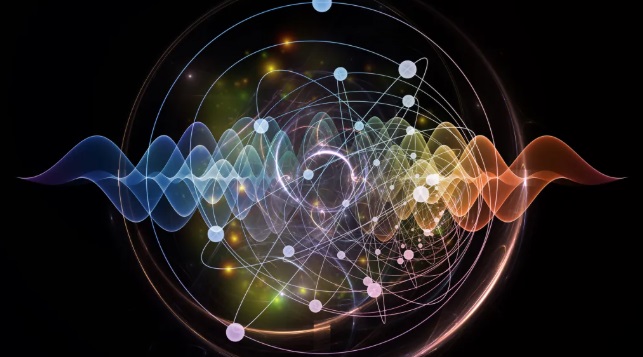
Modern information theory and quantum mechanics provide suggestive analogies, but not proofs. A wavefunction, information field, or holographic encoding is not the Preserved Tablet. Quantum indeterminacy does not scientifically establish divine selection. Indeed, Dr. Shah’s own occasionalist synthesis appropriately concedes that divine action is a metaphysical interpretation, not an experimentally isolable physical variable. The 2022 Nobel Prize confirmed experimental violations of Bell inequalities involving entangled photons; it did not award a proof of occasionalism or theology. The precise achievement is described by the Nobel Prize organization.
Theologically, however, modern physics has weakened the old picture of nature as a collection of completely separable objects carrying self-sufficient properties. It can make a relational and information-rich metaphysics more imaginable.
Verse 40 — The limits of prophetic responsibility
Sense: Whether the Prophet sees some promised consequences or dies before they occur, his duty is only to convey; the reckoning belongs to God.
This verse separates witness from control. Even a prophet cannot force history, manufacture faith, or determine the timetable of judgment.
For ordinary believers, it is a charter against coercion and messianic anxiety. Speak truth, embody mercy, work for justice, and leave ultimate judgment to God.
Verse 41 — The land diminished at its borders
Sense: Do they not see that God approaches the land, diminishing it from its edges? Allah judges, and no one reverses His judgment.
In context, the strongest interpretation concerns the contraction of hostile power and territory as the prophetic message spreads. Classical commentary also included the death of leading people or scholars and the gradual decline of established communities. Maududi reads it historically as the shrinking sphere of opposition to Islam (Tafhīm al-Qur’an).
Coasts erode, landscapes change, and political borders contract, but presenting the verse as a specific prediction of plate tectonics or a shrinking planet exceeds its context. Scientific compatibility should not be confused with demonstrated exegetical identity.
The broader lesson is historical contingency. Civilizations that appear immovable are being altered at their edges long before their center recognizes the change.
Verse 42 — Human plotting within the encompassing divine plan
Sense: Earlier peoples also plotted, but the whole governance of planning belongs to Allah. He knows what every soul earns, and the final outcome will become clear.
Human planning is real: people deliberate, deceive, resist, cooperate, and choose. Yet no plot creates its own world, controls every variable, or escapes unforeseen consequences.
Occasionalism here is not the denial of strategy but its relativization. Human beings plan within a reality they did not create, with minds and opportunities they do not independently sustain, amid other agents they cannot fully know.
Again the verse preserves accountability: God knows what every soul earns. Dependence does not erase moral authorship.
Verse 43 — God and the knowledge of the Book as witnesses
Sense: The disbelievers deny Muhammad’s messengership. He answers that Allah is sufficient as witness, together with whoever possesses knowledge of the Book.
Classical interpreters variously understood “whoever has knowledge of the Book” as learned recipients of earlier revelation, particular scriptural witnesses, or—according to the grammatical rendering reflected by Abdel Haleem—the knowledge of Scripture that ultimately belongs to God. The historical point is that Muhammad’s message stands within the Abrahamic continuum rather than appearing without precedent.
In the Four Books framework, this closing verse returns to revelation as interpreted knowledge. A book does not bear witness merely by being possessed; it must be read rightly. The surah has trained the reader to recognize that the “Book” includes not only lines of script but an entire divinely authored order of nature, destiny, conscience, deeds, and history.
Occasionalism across Sūrat al-Raʿd
Al-Ghazālī famously challenged the claim that the connection between a created cause and its effect is metaphysically necessary. We observe fire with burning, but sensory observation alone does not reveal a logical necessity making it impossible for God to prevent the burning. The classical debate is more nuanced than the slogan “al-Ghazālī denied causality”: contemporary scholarship recognizes debate over whether he accepted occasionalism alone or also allowed non-necessitating secondary causes. See the Stanford Encyclopedia’s discussions of occasionalism and al-Ghazālī.
Sūrat al-Raʿd repeatedly supplies an occasionalist grammar:
| Domain | Verses | Divine action |
|---|---|---|
| Cosmic order | 2–3 | Raises, subjects, governs, alternates |
| Biological diversity | 3–4 | Creates pairs and differentiates produce |
| Embryonic development | 8 | Knows and measures what wombs bear |
| Human interiority | 9–11 | Knows hidden speech and inward change |
| Meteorology | 12–13 | Shows lightning, forms clouds, sends thunderbolts |
| Prayer | 14 | Alone truly hears and answers |
| Universal dependence | 15–16 | All beings and shadows submit; He creates all |
| Hydrology and material transformation | 17 | Sends water and establishes capacities |
| Guidance | 27–30 | Guides those who turn and gives tranquility |
| Miracles and history | 31–32, 38–42 | Owns the affair, permits signs, effaces and confirms |
| Moral agency | 11, 22, 33, 42 | Sustains persons while holding them to what they earn |
| Judgment | 18, 34–35, 40–43 | Reckons and determines the final outcome |
The surah does not say that scientific causes are unreal in the practical sense. Rain nourishes soil; genes affect fruit; lightning heats air; human decisions reshape societies. It denies that these are self-existent, exhaustive, or sovereign causes.
Natural laws may therefore be understood as the dependable ʿādah or custom of God. Science studies that dependable order. Occasionalism asks what ontologically sustains it.
Occasionalism without a “God of the gaps”
A mature occasionalism does not place God only where scientific explanation is incomplete. God is not invoked because we do not understand thunder. He remains the ground of thunder when atmospheric physics is perfectly understood.
Nor should quantum mechanics be used as a blank check. Quantum phenomena may challenge classical mechanical intuitions, but randomness is not a scientific synonym for divine choice. Bell experiments rule out broad classes of local hidden-variable theories; they do not establish God as a laboratory variable.
Dr. Shah’s strongest formulation is therefore also the most defensible: materialism, determinism, secondary causation, and occasionalism can sometimes be competing metaphysical readings of the same empirical regularities. Science constrains theology by telling us what physical events occur; it does not by itself decide why there is a law-governed reality at all.
Divine sovereignty and libertarian human freedom
Sūrat al-Raʿd places two sets of statements side by side.
Divine sovereignty
- Allah governs every affair (13:2).
- Everything has its measure (13:8).
- Nothing hidden escapes Him (13:9–10).
- Lightning, clouds, thunder, and thunderbolts remain under His command (13:12–13).
- All creation prostrates (13:15).
- The entire affair belongs to Him (13:31).
- No sign occurs except by His permission (13:38).
- He erases and confirms (13:39).
- All ultimate planning belongs to Him (13:42).
Human agency and responsibility
- People must change what is within themselves (13:11).
- They answer or refuse their Lord (13:18).
- They keep or break covenants (13:20, 25).
- They connect or sever relationships (13:21, 25).
- They persevere, pray, give, and repel evil with good (13:22).
- They turn toward God and receive guidance (13:27).
- They believe and act righteously (13:29).
- Every soul earns and is judged for its earning (13:33, 42).
The most coherent synthesis is layered agency. God is the necessary and sustaining cause of the agent’s existence and powers. The human person is the responsible source of the act’s moral orientation. Divine concurrence makes action possible; human intention makes it attributable.
Libertarian freedom need not mean independence from God. It means that, among divinely sustained possibilities, the agent is not coerced into the morally decisive orientation. The freedom is created and dependent, but real.
This preserves both humility and responsibility:
- I cannot say, “I created myself and independently caused my success.”
- I also cannot say, “My wrongdoing was God’s fault and therefore not mine.”
Verse 11 makes inner transformation a condition of social transformation; verse 33 makes earning the basis of accountability. Any occasionalism that eliminates those truths has ceased to be an interpretation of this surah.
Verse 15 and the submission of all possibilities
The extension from shadows to possibilities can now be stated more formally.
Let an actual object O stand in relation to a light source L, receiving surface S, and time t. Its shadow is a projection:Shadow=f(O,L,S,t)
Changing any relevant condition changes the projection. The actual shadow is therefore surrounded conceptually by a field of counterfactual shadows:{f(O,Li,Sj,tk)}
The physical verse speaks about realized shadows. Philosophically, however, this structure becomes a model of modal dependence:
- A possibility cannot actualize itself.
- A true counterfactual cannot ground its own truth.
- A mathematical relation does not explain why a physical world instantiates it.
- A proposition describes or corresponds to reality but does not create that reality.
- Contradictions are not possibilities that even omnipotence must actualize; they are failures of coherent description.
- Every genuine possibility is therefore subordinate to the necessary structure of truth and to the divine knowledge encompassing all possible and actual worlds.
Verse 15 supplies the image; verses 8–10 supply exhaustive knowledge; verse 31 declares that the entire affair belongs to God; verse 39 supplies the archetypal Book in which confirmation and effacement are grounded.
Thus actual beings bow through existence, physical shadows bow through lawful projection, possibilities bow through dependence for actualization, and true propositions bow through their place in the intelligible order known by God.
This should not be confused with pantheism. Shadows, possibilities, and propositions are not parts of God. Their dependence precisely distinguishes them from the Necessary Being.
Sūrat al-Raʿd and the Four Books of God
Dr. Shah’s principal formulation identifies four divine books:
- The Book of Revelation — the Qur’an and divinely revealed scripture.
- The Book of Nature — the created cosmos as a readable order of signs.
- The Book of Destiny — divine measure, decree, and the Preserved Tablet.
- The Book of Deeds — the moral record of human intentions and actions.
This formulation is developed in “The Four Books of God: A Qur’anic Cosmology in the Age of Quantum Physics”.
Sūrat al-Raʿd contains all four:
| Book | Principal verses | Content |
|---|---|---|
| Revelation | 1, 7, 19, 30, 36–38, 43 | The Qur’an as truth, prophetic recitation, Arabic judgment, continuity with earlier scripture |
| Nature | 2–4, 8, 12–17 | Heavens, celestial courses, earth, mountains, rivers, plants, wombs, lightning, thunder, shadows, water and metals |
| Destiny | 8–11, 31, 38–42 | Measure, protection, permission, appointed terms, erasure and confirmation, divine judgment and planning |
| Deeds | 10–11, 18–25, 28–29, 33, 40, 42 | Intentions, inward change, covenant, patience, prayer, charity, corruption, earning, and reckoning |
The books are distinct but not separable.
- Revelation tells humanity how to interpret nature.
- Nature displays the power and wisdom of revelation’s Author.
- Destiny places both nature and history within divine measure.
- Deeds record how human freedom responded to the other three.
Verse 39 does not turn the Mother of the Book into a fifth coordinate alongside them. It is the archetypal divine source and comprehensive knowledge beneath every created and revealed inscription.
Verse 43 then closes with ʿilm al-kitāb, knowledge of the Book. The reader is no longer allowed to read scripture without nature, nature without moral responsibility, destiny without freedom, or deeds without final judgment.
The cumulative argument of the surah
Sūrat al-Raʿd offers at least seven mutually reinforcing arguments.
1. The argument from contingency
Heavens, earth, organisms, minds, societies, and histories do not contain the reason for their own existence. Their dependence points toward the Necessary and Self-Sustaining.
2. The argument from continuous governance
The question is not merely who began the universe. It is why there remains an ordered universe from moment to moment. “He governs the affair” is a doctrine of continuous creation and conservation.
3. The argument from intelligibility
Nature is expressible through measure, regularity, mathematical relation, and differentiated order. Human reason can partially read it. The fit between mind and cosmos invites explanation.
4. The argument from unity amid diversity
One water produces many fruits; one physical order supports stars, rivers, plants, wombs, minds, and moral communities. Diversity does not fragment the universe into competing ultimate sources.
5. The argument from consciousness and inward knowledge
Human beings do not merely move; they intend, conceal, remember, trust, fear, hope, and find tranquility. A complete worldview must account for first-person consciousness and moral experience, not merely external behavior.
6. The moral argument
Covenants are genuinely binding, corruption genuinely wrong, patience and generosity genuinely good, and persons genuinely accountable. If these are more than evolutionary conveniences or social preferences, moral reality calls for an adequate transcendent ground.
7. The argument from revelation and history
Prophetic messages recur across communities, calling humanity toward one God, moral reform, and accountability. Their historical continuity joins the cosmic and moral arguments to a communicative divine source.
None of these alone eliminates every conceivable objection. Together they make the Qur’anic worldview an inference to the best total explanation: one necessary, intelligent, powerful, knowing, purposeful, just, merciful, and continuously active Creator.
Thematic epilogue: When thunder becomes testimony
Sūrat al-Raʿd begins with a Book and immediately opens that Book onto the heavens. It looks upward to the unsupported cosmic order, downward to rivers and neighboring soils, inward to wombs and secret thoughts, outward to lightning and thunder, and forward to resurrection and judgment. Nothing remains religiously mute.
The sun and moon glorify through their courses. The earth glorifies through habitability. Mountains glorify through their histories of uplift and erosion. Rivers glorify through circulation. Plants glorify by turning one water into vineyards, grain, dates, color, fragrance, nourishment, and seed. The womb glorifies through measured development hidden from ordinary sight. Lightning glorifies through energy poised between danger and mercy. Thunder glorifies in the voice of atmospheric power. Shadows glorify by displaying their complete relational dependence. Human beings alone are invited to transform involuntary submission into willing worship.
The surah’s occasionalism is therefore not a denial of science. It is a refusal to confuse description with ultimate explanation. Gravity is real, but not self-subsisting. Water nourishes, but not independently. Brains participate in thought, but do not explain away consciousness. Human beings act, but do not create their own being, powers, opportunities, or final outcomes. Laws of nature are reliable enough for science because the divine custom is faithful; they are not rival gods possessing autonomous legislative authority.
Nor does divine sovereignty abolish liberty. The God who governs the storm declares that He does not change a people until they change what is within themselves. The God who stands over every soul judges it according to what it earns. The God who could have compelled universal guidance instead calls for a freely meaningful response. Human freedom is neither absolute independence nor illusion; it is a divinely sustained capacity for morally significant self-direction.
Verse 15 then opens the widest horizon. Bodies bow. Shadows bow. Actualities bow because they do not ground themselves. Possibilities bow because they cannot actualize themselves. Propositions bow because truth is not created by human speech. Mathematical relations bow because intelligibility is received rather than invented out of nothing. Every realm—physical, mental, moral, modal, and abstract—remains contingent before the One who is necessary.
The four Books now lie open together. Revelation names the Author. Nature displays His artistry and power. Destiny preserves measure and possibility beneath the flux of events. Deeds record the free moral response of each soul. The Mother of the Book unites them within a knowledge that neither forgets nor learns, neither guesses nor revises through error.
At the end, the disbelievers say, “You are not a messenger.” The answer is not mere assertion. God is witness; revelation is witness; earlier scripture is witness; nature is witness; conscience is witness; history is witness; and the moral fruits of faith are witnesses. The entire surah has summoned reality to the stand.
Thunder, then, is more than its title. It is the surah’s governing symbol. To the inattentive ear, it is noise. To science, it is a shockwave produced by electrical discharge and superheated air. To philosophy, it is a contingent event dependent upon an immense network of conditions. To theology, it is a creature fulfilling its nature under divine command. To the spiritually awakened heart, it is praise.
And after the thunder, the surah promises peace:
Peace be upon you because you remained steadfast. How excellent is the final home.



Leave a Reply