
Presented by Gemini
Abstract
Metaphysical naturalism (also called ontological or philosophical naturalism) is a worldview asserting that the universe consists entirely of natural elements, physical laws, and forces. It completely rejects supernatural phenomena, such as deities, ghosts, or miracles. Under this view, everything in reality can ultimately be explained by science.
This work presents a comprehensive critique of metaphysical naturalism’s systematic failure to account for human consciousness, operating at the intersection of contemporary philosophy, neuroscience, and Quranic teleology. Beginning with an analytical summary of Galen Strawson’s interview with Alex O’Connor, it highlights the “silence of physics” and the logical rejection of radical emergence. Expanding into a targeted philosophical essay, it demonstrates that subjective qualitative experience (qualia) shatters the reductive materialist paradigm. It argues unapologetically that consciousness is an undeniable signpost leading directly to a Prior, Supreme Mind—God—exposing secular alternatives like panpsychism as make-believe frameworks designed by some philosophers to deny this divine conclusion. This thesis is embellished through the lens of Quranic verses 2:28 and 17:85, which emphasize the divine origin and epistemic limits of the soul. Finally, it reviews the multidisciplinary synthesis of Zia H Shah MD, whose extensive writings utilize modern scientific discovery as an expansive commentary on the Quran, establishing consciousness as the ultimate frontier where empirical science surrenders to divine reality.
Video Summary: I’m a Materialist, but Consciousness is Foundational – Galen Strawson
In this interview hosted on the channel Alex O’Connor, philosopher Galen Strawson outlines his defense of “psychism” (panpsychism) from within a physicalist framework.
- The Definition of Physicalism and the “Silence of Physics”: Strawson defines himself as a physicalist because he believes physics ultimately describes everything in the universe [00:00]. However, he notes a profound everyday misunderstanding: people assume “physical” means intrinsically non-conscious [00:42]. Strawson introduces the concept of the “silence of physics,” asserting that while physics describes the structural relations and equations of matter, it remains completely quiet on the intrinsic, non-structural nature of the “stuff” itself [01:15].
- The Deductive Argument Against Radical Emergence: Strawson presents a structured five-step deductive argument: (1) Physicalism is true; (2) Consciousness is real and non-negotiable; (3) Therefore, consciousness must be wholly physical; (4) Radical or strong emergence does not exist; (5) Therefore, consciousness must exist at the foundational level of reality [02:39].
- The Critique of Emergence Examples: Strawson defines radical emergence as the magical appearance of a completely new property out of a base substance that contains absolutely nothing to explain it [04:01]. He rejects common scientific counterarguments—such as liquidity emerging from $H_2O$ molecules or heat from atomic vibrations—explaining that these phenomena smoothly reduce to structural physical laws [05:24]. Crucially, the “feeling” of heat or the “experience” of wetness are not properties of the matter itself; they are phenomena that already occur within a conscious observer [07:01].
- Energy as Consciousness: While evolution accounts for complex animal consciousness, it requires fundamental building blocks to work with [11:09]. Evoking Werner Heisenberg, Strawson suggests treating energy as a foundational substance rather than just a property [12:34]. Since it is theoretically extravagant to believe consciousness emerged from utterly non-conscious matter, the most parsimonious conclusion is that the intrinsic nature of this foundational energy field is consciousness-involving [15:41].
- Rejecting Illusionism and Atomistic Panpsychism: Strawson fiercely critiques “illusionism” (eliminative materialism), calling the denial of conscious experience the silliest idea ever proposed in philosophy, because an illusion is itself an experience [23:06]. He clarifies that his view, which he prefers to call “psychism” [28:42], does not mean everyday objects like tables are conscious [39:17]. He rejects the atomistic “marble” view of panpsychism, conceptualizing the universe instead as a single, real, highly complex concrete field [33:52].
- Consciousness vs. Intelligence in AI: Strawson draws a sharp line between intelligence and consciousness. He asserts that as Large Language Models (LLMs) become indistinguishable from humans in intelligence, there remains zero reason to assume they are conscious [52:21]. True consciousness is pure subjective experience (“what it’s likeness”), which can exist without intelligence (such as in a fetus) and vice versa. Artificial structural simulations fail because true biological structure goes “all the way down” to the wetware [55:18].
Essay: Metaphysical Naturalism Cannot Explain Our Consciousness
The Explanatory Failure of the Naturalist Paradigm
Metaphysical naturalism operates on a restrictive dogma: reality is ultimately composed of blind, mindless, quantitative, and non-conscious physical entities. Within this paradigm, human consciousness—the subjective inner world of thoughts, agonizing pains, and brilliant colors (qualia)—is treated as a late-stage byproduct of cosmic evolution, a fortunate accident emerging from neural architecture.
Yet, this paradigm suffers from absolute explanatory bankruptcy. The “Hard Problem of Consciousness” remains entirely unresolvable for the naturalist because there is a vast, unbridgeable chasm between quantitative descriptions and qualitative realities. You can map every neuron, measure every electrochemical spike, and write down every mathematical relation of the human brain, but nothing in those equations can logically deduce the subjective experience of seeing a sunset or feeling joy.
As the philosophical critique of “radical emergence” demonstrates, the notion that experiencing awareness can magically burst forth from entirely non-experienced matter is a logical impossibility. It demands that a collection of zeroes somehow sums up to a positive integer. If the fundamental architecture of the universe is utterly devoid of awareness, no amount of mechanical arrangement, complexity, or biological wiring can generate a single spark of subjective feeling. Metaphysical naturalism breaks down because it attempts to construct the undeniable reality of our minds out of a structural vacuum.
Panpsychism: A Secular Substitute and Failed Stratagem
Faced with the undeniable failure of radical emergence, a growing segment of secular philosophers has turned to panpsychism. Recognizing that consciousness cannot emerge from dead matter, they make a radical concession: consciousness must be foundational, baked into the very fabric of the universe, existing inside fields, energy, or fundamental particles.
While panpsychism correctly diagnoses the failure of naturalism, it reveals itself as a desperate, make-believe stratagem designed to avoid theism. It is an incomplete philosophy that stops short of its own logical conclusion. By scattering consciousness across aimless fields and unguided energy, panpsychists attempt to attribute divine characteristics—such as self-existence, eternal permanence, and foundational awareness—to the physical creation itself.
This is nothing more than a philosophical evasion of God. Awareness requires an objective locus of intent, design, and unity. To suggest that a shimmering, unguided physical field possesses inherent awareness without an ultimate Source is metaphysically absurd. Consciousness is not an aimless property smeared across cosmic dust; it is a unified, intentional reality that points directly to a Prior Mind. Panpsychism is a failed philosophy because it tries to enjoy the fruits of a conscious universe while stubbornly denying the conscious Creator who sustained it. Consciousness is a deliberate, targeted signpost designed to lead the human intellect out of the matrix of blind matter and directly to the presence of God.
The Quranic Illumination of the Mind
The failure of naturalism and the conceptual wandering of panpsychism find absolute clarity and resolution within the teleological framework of the Glorious Quran. The transition from inanimate matter to vibrant human awareness is highlighted in Surah Al-Baqarah (2:28):
“How can you disbelieve in Allah when you were lifeless and He brought you to life; then He will cause you to die, then He will bring you back to life, and then to Him you will be returned.”
This verse unmasks the core flaw of materialism. Left to itself, the physical world is “lifeless” (amwātan). The dust, the carbon, and the chemical elements possess no intrinsic power to wake up and contemplate their own existence. The spark of subjective awareness—the act of being “brought to life”—is a deliberate, transcendent intervention by Al-Hayy (The Living) and Al-Qayyum (The Self-Subsisting). Consciousness is a divine gift that breaks the chains of material determinism.
Furthermore, the Quran directly addresses the reductionist desire to completely demystify and capture the essence of awareness through material equations. In Surah Al-Isra (17:85), it states:
“And they ask you, [O Muhammad], about the soul. Say, ‘The soul is of the affair of my Lord. And mankind has not been given of knowledge except a little.’”
This profound verse establishes an epistemic boundary. While humanity is encouraged to investigate the neural correlates, biological frameworks, and structural mechanisms of the brain, the intrinsic nature of the soul and consciousness belongs to the Amr—the Divine Command. Consciousness is not a mechanical puzzle to be solved and replicated by human hands; it is a sovereign signifier of divine authorship, intentionally designed to remain beyond total material reduction.
Zia H Shah MD’s Synthesis on Consciousness and God
A significant, multidisciplinary contribution to this modern philosophical battleground is found in the extensive body of work by Zia H Shah MD, published on his blog, The Glorious Quran and Science (specifically curated under the category link: https://thequran.love/category/consciousness/). Dr. Shah establishes a sophisticated synthesis, operating on the premise that all valid scientific discovery serves as an expansive commentary on the Quran.
In key articles such as “The Ontological Incoherence of the Naturalist Paradigm: Consciousness as the Impossible Miracle” and “Consciousness Denial and the Incoherence of Metaphysical Naturalism,” Dr. Shah exposes the severe vulnerabilities of modern atheistic materialism. He argues that when secular naturalists realize consciousness cannot be reduced to simple physics, they frequently resort to “illusionism”—denying the reality of their own inner minds. Dr. Shah demonstrates that this denial is fundamentally incoherent; it undermines the very reliability of human reason and the scientific enterprise itself.
Dr. Shah bridges this philosophical analysis with cutting-edge science by referencing leading contemporary neuroscientists. In pieces like “Why AI Will Never Be Conscious – Anil Seth,” he examines the deep structural differences between computation and biological awareness. He emphasizes that while AI can process complex computational instructions, it completely lacks a metabolism, subjective feelings, and inner life. This scientific reality directly echoes his commentary on Quran 22:73 (“The Divine Parable of the Musca”), highlighting that human engineering cannot create true life or awareness from scratch.
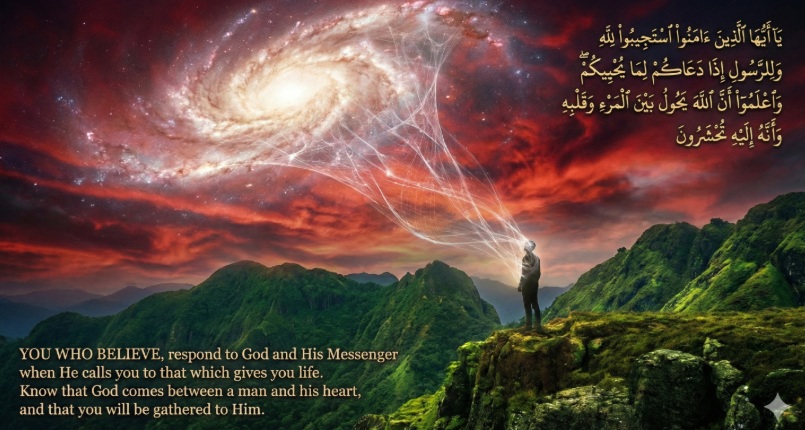
Ultimately, Dr. Shah’s writings frame human consciousness as an intentional, unassailable sign (Ayat) designed to guide humanity toward the Divine. In his commentaries on Quran 41:53 (“Human Consciousness as a Sign Leading to God”) and Quran 8:24 (“Consciousness at the Meeting Point of Finite and Infinite”), he articulates that our inner world of awareness is where the finite human experience directly interfaces with the infinite reality of the Creator. By showing that consciousness can never be fully demystified or reduced to blind matter, Dr. Shah builds an enduring multidisciplinary case that human awareness is a direct reflection of a Prior Divine Mind.
Thematic Epilogue
Consciousness is the foundational ground of all human experience, the quiet lens through which we perceive every color, feel every sorrow, and deduce every scientific law. To strip the universe of a Prior Mind and expect consciousness to emerge from blind, mechanical dust is the ultimate delusion of the modern secular paradigm. As we examine the limitations of physical equations and see through the artificial, make-believe safety nets of panpsychism, the unified human spirit is left facing a singular, magnificent truth. Human awareness is not a biological accident, nor is it scattered aimlessly across an indifferent cosmic field. It is a brilliant, sacred mirror carefully designed to reflect the knowledge, intent, and reality of the Creator. Across every culture, section of society, and theological tradition, this shared gift of awareness serves as a universal bridge—a reminder that we are united by a divine spark that calls us out of the darkness of dead matter and points us back toward the living source of all light.






Leave a Reply