
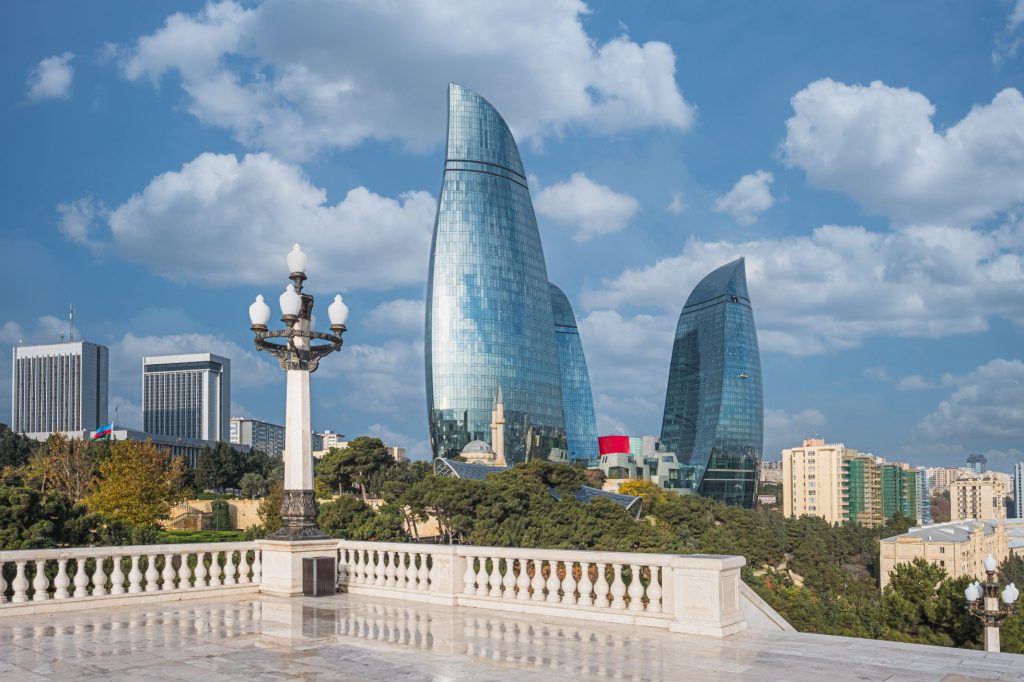
The Islamization of Azerbaijan: conquest, conversion, and the forging of a Muslim nation
Presented by Zia H Shah MD
Abstract
The arrival and entrenchment of Islam among the Azerbaijani population was not a single event but a layered, centuries-long process shaped by military conquest, dynastic ambition, Sufi mysticism, imperial rivalry, and the persistent undertow of pre-Islamic memory. Beginning with the Arab campaigns of the 640s into a land divided between Zoroastrian fire-worshippers and Caucasian Albanian Christians, Islamization proceeded unevenly — first among urban elites, then gradually through the countryside — reaching demographic majority only by the tenth century. The Turkic migrations of the eleventh century fused a new ethno-linguistic identity with Islamic civilization, while the Mongol cataclysm of the thirteenth century paradoxically deepened Islam’s roots through the conversions of Ghazan Khan of the Ilkhanate and Berke and Özbeg Khan of the Golden Horde. The Safavid revolution of 1501 imposed Twelver Shi’ism upon a largely Sunni population, creating the sectarian identity that defines Azerbaijani Islam today. Subsequent Ottoman-Safavid wars, Russian imperial conquest, and seven decades of Soviet atheist repression further transformed — but never extinguished — the Islamic identity of the Azerbaijani people. This essay traces that full arc, arguing that Azerbaijani Islam is best understood as a palimpsest: each era inscribed new meanings over older ones, producing a faith tradition uniquely marked by syncretism, secularism, and resilience.
The land of fire before the Prophet
Before the first Arab horsemen crossed the Zagros passes, the territory that would become Azerbaijan was among the most religiously diverse landscapes in western Asia. The very name of the land announced its oldest faith: Ādurbādagān, the Middle Persian “Land of the Fire Protectors,” derived from a tradition linking the region to the sacred fires of Zoroastrianism. Arabic geographers al-Baladhuri and Ibn Khordadbeh reported that Azerbaijan was Zoroaster’s birthplace, locating his origin near Urmia. Encyclopaedia Iranica The Sasanian Empire (224–651 CE) elevated Zoroastrianism to state ideology across the region, and the great shrine at Shiz — likely the site of modern Takht-e Soleyman — functioned as the spiritual heart of Azerbaijani fire worship. Wikipedia Natural gas seeps on the Absheron Peninsula sustained perpetual flames that attracted devotees for millennia, a phenomenon preserved in the Ateshgah temple near Baku and the eternally burning hillside of Yanar Dag. Baku Travel Packages
Yet Zoroastrianism did not reign unchallenged. North of the Aras River lay Caucasian Albania, a distinct polity whose king Urnayr adopted Christianity as the state religion around 313 CE, Wikipedia receiving baptism from Gregory the Illuminator. The Albanian Apostolic Church developed its own script around 420 CE, produced a network of at least twelve episcopal sees from Partav (Barda) to Kabalaka (Gabala), and maintained an autocephalous hierarchy until Arab and Armenian pressure extinguished its independence in 705. The church oscillated between Monophysite and Chalcedonian orientations depending on whether Armenian or Georgian influence held sway — a doctrinal flexibility that reflected the political precariousness of a small Christian kingdom wedged between empires.
Beyond these two organized traditions, a substrate of older beliefs persisted. Strabo recorded Albanian worship of the Sun, the Sky, and especially the Moon, Wikipedia accompanied by horse sacrifice. Turkic peoples filtering into the northern reaches — Huns, Khazars, Sabirs — brought Tengri worship and shamanistic practices. InAzerbaijan Jewish communities, some claiming 2,600 years of continuous habitation, had settled in mountainous areas around Quba and Derbent. Baku Travel Packages Mazdakism, the egalitarian Zoroastrian heresy, survived in peripheral districts and would later fuel the great Khurramite rebellion. This kaleidoscope of faiths meant that Islam, when it arrived, entered a landscape already accustomed to religious competition and coexistence — a pattern that would shape the character of Azerbaijani Islam for centuries to come.
Arab swords and Azerbaijani treaties: the first century of Islam
The decisive Battle of Nahavand in 642 CE — which the Arabs called the “Victory of Victories” — shattered organized Sasanian resistance and flung open the gates of the Iranian plateau. Caliph Umar immediately dispatched armies in three directions; the column sent northwest, under commanders including Hudhayfah ibn al-Yaman and Bukayr ibn Abdallah, entered Azerbaijan by 643. Wikipedia The pattern of conquest was remarkably consistent: a combination of military pressure and negotiated submission. Ardabil surrendered without resistance on terms of jizya payment. The local marzban Isfandyadh, after being defeated and captured, signed a treaty guaranteeing that Arabs would not interfere with religious beliefs or local customs in exchange for tax obligations and the quartering of soldiers. Wikipedia
This formula — military dominance coupled with contractual tolerance — defined early Islamic governance in Azerbaijan and explains why Islamization proceeded so slowly. Zoroastrians were classified as dhimmis, protected non-Muslims permitted to practice their faith upon payment of the poll tax. Wikipedia Christians enjoyed similar protections as People of the Book. The economic incentive to convert was real but not overwhelming; the social incentive was stronger for elites who wished to access the administrative apparatus of the caliphate.
The conquest of northern Azerbaijan (Caucasian Albania) was bloodier and more protracted. Between 646 and 705, Arab forces repeatedly seized and lost cities — Beylagan, Barda, Shamkir, Gabala, Shaki, Shirvan — as local populations revolted each time garrisons withdrew. The Albanian prince Javanshir, the era’s most skillful Caucasian statesman, accepted nominal caliphal vassalage while maneuvering between Arabs and Khazars to preserve internal autonomy. His assassination in 680–681 began Albania’s terminal decline; by 705, the kingdom had been fully absorbed into the caliphate, Multikulturalizm and the Albanian Church lost its autocephaly in the same year, subordinated permanently to the Armenian Apostolic Church.
The Arab-Khazar wars turned the eastern Caucasus into a grinding frontier for a century. Derbent — Bab al-Abwab, the “Gate of Gates” — became Islam’s northernmost bastion. In 713–714, the Umayyad general Maslamah ibn Abd al-Malik captured and fortified the city, building the Juma Mosque (734 CE, the oldest mosque in what is now Russia) atop a former Christian basilica. He settled several thousand Syrian and Iraqi Arab colonists along the frontier to secure it. At its height, Derbent’s garrison and civilian population reached approximately 50,000. Yet as late as the tenth century, the boundary of the Dar al-Islam extended barely three miles north of the city walls — a measure of how stubbornly the mountainous Caucasus resisted Islamic penetration.
Richard Bulliet’s landmark quantitative study of conversion rates, based on onomastic evidence from Iranian provinces including Azerbaijan, traces an S-shaped curve: roughly 10% Muslim by 750, rising to 40% by the mid-ninth century, 80% by 950, and approaching totality only by the late eleventh century. The pattern was elite-first: state officials converted to preserve privileges, merchants to access trade networks, and urban artisans to gain social mobility. Azerbaijan.az Rural populations, especially in mountainous areas where Christianity or paganism held sway, resisted longest. The most dramatic expression of this resistance was the Khurramite rebellion of Babak Khorramdin silkroadstudies (816–837), a neo-Mazdakite uprising rooted in pre-Islamic Iranian identity that held off Abbasid armies for twenty years, Islam Awareness +2 controlled much of Azerbaijan from a mountain fortress, and was suppressed only after a massive military campaign and Babak’s betrayal, capture, and public execution in Samarra in 838. The revolt demonstrated that even two centuries after the conquest, Islamization remained incomplete and contested.
Persian culture as Islam’s medium
If the Arab conquest provided the political framework for Islamization, it was Persian culture that gave Islam its deepest roots in Azerbaijan. From the tenth century onward, Azerbaijan was embedded in the Persianate cultural sphere — that vast zone stretching from Anatolia to Central Asia where Persian served as the language of literature, administration, scholarship, and courtly life. Even as Turkic-speaking populations became demographically dominant after the eleventh century, Persian remained the prestige language, and Islamic learning arrived wrapped in Persian literary forms.
The earliest major Persian poet from the region, Qatran Tabrizi (1009–1072), established what scholars call the Shirvan School of Persian poetry. But it was the next century that produced Azerbaijan’s supreme literary achievement: Nizami Ganjavi (c. 1141–1209), whom the Encyclopædia Britannica calls “the greatest romantic epic poet in Persian literature.” His Khamsa — five long narrative poems totaling 30,000 couplets World History Encyclopedia — wove Islamic ethics, Quranic themes, pre-Islamic Iranian mythology, and Greek philosophical traditions into works of staggering beauty and intellectual complexity. Alongside Nizami, Khaqani Shirvani (c. 1120–1199), whose mother was a Nestorian Christian Wikipedia convert, produced qasidas of extraordinary formal innovation. WikipediaGrokipedia These poets did not merely decorate Islam with literary beauty; they made Islam legible to Azerbaijani society by translating its spiritual and ethical content into the region’s dominant cultural idiom.
The role of Sufi orders was arguably even more consequential for popular Islamization than courtly literature. Sufism — with its emphasis on personal mystical experience, charismatic saints, and spiritual lineages — proved far more effective at converting nomadic and rural populations than the legalistic Islam of the urban ulema. Azerbaijan became one of medieval Islam’s most fertile Sufi landscapes. The Khalwatiyya order, tracing its practice to the Azerbaijani mystic Yahya Shirvani Wikipedia (who gathered ten thousand followers in Baku), Wikipedia became one of the Ottoman Empire’s most influential tariqas. Wikipedia The Safaviyya order, founded by Sheikh Safi al-Din in Ardabil The Persians in 1252–1334, began as an orthodox Sunni brotherhood before its extraordinary transformation into the militant Shi’i movement that would seize the Iranian throne. The Naqshbandiyya and Qadiriyya orders, meanwhile, drove Islamization in the northern Caucasus — Dagestan, Chechnya, and northern Azerbaijan — where Arab conquest had failed to penetrate deeply. Encyclopedia.com
When the Turks came: Seljuks, atabegs, and the fusion of sword and faith
The Seljuk Turkic migrations of the eleventh century transformed Azerbaijan’s demographic, linguistic, and religious character permanently. Oghuz Turkmen nomads had been filtering into Azerbaijan since at least 1029, but the Seljuk conquests of the 1040s–1050s turned a trickle into a flood. As the historian J.J. Saunders observed, “Many of them poured into Azerbaijan, a fertile province of orchards and pastures which in a few generations became mainly Turkish-speaking.” Facts and Details The Battle of Manzikert in 1071, where Sultan Alp Arslan destroyed the Byzantine army of Emperor Romanus IV, opened Anatolia to Turkic settlement and channeled further migration through Azerbaijan — the corridor between the Central Asian steppe and the Mediterranean world.
The Seljuks were devout Sunni Muslims who consciously positioned themselves as champions of orthodox Islam. ethzPerlego Their great vizier Nizam al-Mulk established a network of Nizamiyya madrasas that standardized religious education across the empire, and the theologian al-Ghazali, working under Seljuk patronage, achieved the epochal reconciliation of Sufism with Sunni orthodoxy. Perlego Yet among ordinary Turkic nomads, Islamization remained shallow. The chroniclers noted that these herders “continued to follow pagan and shamanistic practices and beliefs, mixing them with newer Islamic ideals. In place of the shamans… they followed Sufi saints who claimed to have spiritual powers.” TheCollector This syncretic frontier Islam — militant, mystical, organized around charismatic ghazi warrior-saints — became the primary vehicle through which Turkic tribal identity merged with Islamic civilization in the Caucasus.
The Eldiguzids (c. 1137–1225), a dynasty of Kipchak Turkic origin who served as atabegs (guardian-rulers) for Seljuk princes, Wikipedia exemplified this fusion. From their base in Azerbaijan and Arran, Detailed Pedia they patronized Persian literature while serving as “champions of Islam against the Bagratids of Georgia.” Wikipedia Nizami Ganjavi dedicated works to Eldiguzid rulers. Wikipedia The Shirvanshahs, a Persianized dynasty of Arab origin ruling Shirvan from Wikipedia 861 to 1539 — the longest-reigning dynasty in Islamic history — similarly bridged Persian Islamic culture and the Caucasian frontier, providing a continuous thread of Islamic governance across nearly seven centuries of political upheaval.
The Mongol paradox: destruction that deepened faith
The Mongol invasions of the 1220s–1240s inflicted catastrophic destruction on Azerbaijan. When Generals Jebe and Subutai swept through in 1220–1223 pursuing the fleeing Khwarazmshah, WikipediaDetailed Pedia the historian Ibn al-Athir recorded that “the Mongols came to Azerbaijan and Arran provinces and in less than a year they destroyed them at an unseeable speed.” ScribdWikipedia Maragha’s inhabitants were slaughtered. ScribdAcademia.edu Ganja was burned. Wikipedia Agricultural systems collapsed as irrigation networks were destroyed. GrokipediaWorld History Encyclopedia The second wave under Chormaghun in the 1230s completed the permanent conquest. Wikipedia
Yet from this devastation emerged one of history’s great ironies: the Mongols, who had wrought more damage on Islamic civilization than any force since the Crusades, ultimately became Islam’s most powerful new patrons. Sacred Footsteps Azerbaijan became the heartland of the Ilkhanate (1256–1335), with Wikipedia Tabriz established as the capital Encyclopedia Britannica — a city that Marco Polo described as “a great city surrounded by beautiful and pleasant gardens” Google and that signed a trade agreement with Venice in 1271. World History Encyclopedia Maragha became a scientific center where Nasir al-Din al-Tusi built a famous astronomical observatory. World History Encyclopedia The early Ilkhans practiced remarkable religious pluralism: Hulagu himself was a Nestorian Christian sympathizer whose wife Doquz Khatun was devout; Buddhism, Tengrism, Christianity, and Islam coexisted under the broad umbrella of Mongol tolerance. Wikipedia
The turning point came on June 16, 1295, when the seventh Ilkhan, Mahmud Ghazan Khan Caucasushistory — raised as a Buddhist The Historian’s Hut — converted to Sunni Islam as a condition for the military support of the Mongol commander Nawruz. Wikipedia Charles Melville’s seminal study demonstrates that the conversion was “more than just a personal decision based on religious conviction” ResearchGate — it was a calculated political act designed to attract Muslim Mongol commanders to his cause and to “eliminate the incompatibility between the Ilkhanid government and its loyal subjects.” ResearchGate The consequences were transformative. Islam became the official state religion. Buddhist temples were destroyed, and Iranian Buddhism never recovered. WikipediaDetailed Pedia Christians and Jews lost their equal status and were required to pay the jizya. Ghazan appointed the Jewish convert Rashid al-Din Hamadani as vizier, RANGE: Journal of Undergraduate Research who produced the Jami al-Tawarikh, a pioneering universal history. World History Encyclopedia His successor Öljaitü converted to Shi’ite Islam in 1310, World History Encyclopedia foreshadowing by two centuries the Shi’i transformation that would define Azerbaijani Islam permanently.
Berke Khan, Özbeg Khan, and the Islamization of the steppe
While the Ilkhanate was transforming Azerbaijan from within, the Golden Horde — the Mongol successor state dominating the Eurasian steppe and the northern Caucasus — was undergoing its own Islamic revolution, with profound consequences for the wider region.
Berke Khan (r. c. 1257–1266), grandson of Genghis Khan through Jochi, became the first Mongol ruler in history to embrace Islam, Nazuk Surat e Haal +2 converting around 1252 near Bukhara. Nazuk Surat e Haal The sources offer varying accounts of his conversion: one tradition holds that he encountered a Muslim caravan at Nazuk Surat e Haal Saray-Jük, questioned its members about their faith, and was moved to convert; Nazuk Surat e Haal another attributes his transformation to the Sufi dervish Saif al-Din from Khwarazm; Wikipedia a third states that he enrolled in a seminary near Samarkand. What is certain is that his conversion was genuine and consequential. He persuaded his brother Tukh-Timur to convert, Nazuk Surat e HaalWikipedia and his courtiers “openly displayed their Muslim identity at court.” Sacred Footsteps
Berke’s Islam was not merely personal piety — it became geopolitical force. When Hulagu’s armies sacked Baghdad in 1258 and killed the Abbasid Caliph al-Musta’sim, Berke was enraged. World History Encyclopedia The Persian historian Rashid al-Din recorded his words: “He has sacked all the cities of the Muslims, and has brought about the death of the Caliph. With the help of God I will call him to account for so much innocent blood.” Sacred FootstepsWikipedia The resulting Berke-Hulagu War, which erupted in 1262, Sacred Footsteps was driven by both Islamic solidarity and territorial grievance — Möngke Khan had reassigned lands in Azerbaijan originally allotted to Jochi’s line. Wikipedia At the Battle of the Terek River in 1262, Berke’s nephew Nogai crushed Hulagu’s forces, with thousands of Mongol warriors drowning when river ice collapsed beneath them. Global Village SpaceWikipedia This conflict — the first open war between Mongol khanates — shattered the unity of the empire Sacred Footsteps +2 and turned the Caucasus into a contested frontier between two Mongol states increasingly defined by religious identity.
For Azerbaijan specifically, the Berke-Hulagu conflict had several lasting effects. It established the Caucasus mountain passes, particularly the Derbent corridor, as a permanent military frontier. It drew the Mamluks of Egypt into Caucasian geopolitics through their alliance with Berke against the Ilkhanate, QuoraEncyclopedia.com creating a trans-regional Muslim diplomatic network that reinforced Islam’s prestige. And it ensured that Islamic identity — rather than Mongol tribal solidarity — became the primary marker of political allegiance across the steppe and its borderlands.
The full consequences of Golden Horde Islamization, however, emerged only under Özbeg Khan (r. 1313–1341), the longest-reigning and most powerful khan of the Horde. Converted to Islam by Wikipedia the Sufi sheikh Ibn Abdul Hamid Wikipedia of the Yasavi order, Özbeg made Islam the official state religion World History Encyclopedia in approximately 1321. Medium This provoked fierce resistance from the Tengrist Mongol aristocracy. Medium According to sources, nobles confronted him: “You expect our loyalty and obedience, but why interfere in our faith? How can we abandon the laws and customs of Chinggis Khan and adopt the religion of the Arabs?” Medium When they plotted assassination, Özbeg responded with ruthless force, executing 120 nobles, including many Chinggisids, who refused to convert. Medium Recent scholarship by Roman Hautala, drawing on Franciscan Latin sources, suggests that the actual Islamization was more gradual than Muslim chroniclers claimed OpenEdition and that Özbeg maintained a degree of the religious tolerance characteristic of Mongol tradition. Academia.edu Yet the political reality was decisive: every subsequent ruler of the Golden Horde was Muslim. Academia.edu
Özbeg’s Islamization radiated outward into territories adjacent to Azerbaijan. The Nogai Horde carried Islam for the first time to the Cherkess, Kabardins, and Chechens. Sufi brotherhoods established khanqahs in the northern Caucasian steppe. Encyclopedia.com Özbeg himself conducted military campaigns into Azerbaijan in 1319, 1325, and 1335, Wikipedia projecting Islamic authority from both sides of the Caucasus range. As the Encyclopedia.com entry on Caucasian Islam summarizes, during Mongol rule “Caucasian Islam ceased to be exclusively the religion of rulers and of elites and became more deeply rooted in the popular elements.” Encyclopedia.com
The long-term consequence of Mongol conversion was world-historical in scale. By the 1330s, three of the four major successor khanates — the Golden Horde, the Ilkhanate, and the Chagatai Khanate — had become Muslim. WikipediaEncyclopedia.com The conversion created what scholars have termed an “Islamic version of the legitimacy of the Chinggisids,” Qalam forging a new synthesis in which Mongol military power and administrative tradition served Islamic civilization rather than threatening it. For Azerbaijan, positioned at the crossroads of two converting khanates, this meant that Islam became inescapable — the faith of conquerors and conquered alike, of steppe nomads and Persian scholars, of Turkic warriors and Sufi mystics.
The Safavid revolution and the making of Shi’i Azerbaijan
No single event transformed Azerbaijani Islam more radically than the Safavid seizure of power in 1501. In the space of a generation, a Sufi order based in the Azerbaijani city of Ardabil conquered Iran, imposed Twelver Shi’ism on a population that had been overwhelmingly Sunni for eight centuries, and created the sectarian geography that endures today.
The Safaviyya order, founded by Sheikh Safi al-Din (1253–1334), Iran Safar had begun as an orthodox Sunni brotherhood. Over the fifteenth century, under the militant leadership of Sheikhs Junaid and Haydar, it transformed into an apocalyptic Shi’i movement Semantic Scholar backed by disaffected Turkmen tribes who called themselves Qizilbash — “Red Heads” — for the distinctive twelve-tasseled crimson headgear representing the Twelve Imams. WikipediaWikipedia In 1499, the twelve-year-old Ismail emerged from hiding, Wikipedia rallied approximately 7,000 Qizilbash warriors, World History EduWikipedia defeated the Shirvanshah near Shamakhi and the Aq Qoyunlu at Sharur, and in July 1501 entered Tabriz to proclaim himself Shah. He immediately declared Twelver Shi’ism the state religion. Iran Safar
The conversion was enforced with systematic coercion. Ismail decreed that all mosques adopt the Shi’a call to prayer, adding the formula “I witness that Ali is God’s friend.” Sunni ulema were killed or exiled. Wikipedia The tombs of the Abbasid caliphs and the great Sunni jurist Abu Hanifa in Baghdad were destroyed. To compensate for the near-total absence of trained Shi’i scholars in the region, Ismail imported Arab Shi’a clerics from Jabal Amil in southern Lebanon — scholars who did not speak Persian, could not form independent power bases, and remained dependent on Safavid patronage. The office of the sadr, the highest religious authority, was created to oversee conversion and establish orthodoxy. State funds built Shi’i madrasas, shrines to Ali and the Imams, and an entire clerical infrastructure.
How deep was the transformation? Scholarly opinion is divided, but the evidence suggests a generational process rather than an overnight conversion. The Cambridge History of Iran describes a population whose prior Islam had “a certain homogeneity” under the Shafi’i Sunni school, with only scattered Shi’i elements surviving from the Ilkhanid period. The Azerbaijani scholar Altay Goyushov notes that the forced conversion “deeply divided” local religious loyalties. Remarkably, Shah Ismail’s own grandson Ismail II (r. 1576–1577) showed Sunni sympathies and attempted to reverse some Shi’i practices Wikipedia before being killed after barely two years on the throne. It was not until the reign of Shah Abbas I (r. 1588–1629) — who moved the capital to Isfahan, built monumental Shi’i architecture, and consolidated the clerical hierarchy — that Twelver Shi’ism became firmly established as the faith of the majority. Iran Safar By the dynasty’s end in 1736, most Muslims in Azerbaijan and Iran identified as Shi’a. OpenStax
Between two empires: the Ottoman-Safavid crucible
For over a century, Azerbaijan was the primary battleground in the Sunni-Shi’i cold war between the Ottoman Empire and Safavid Iran — a conflict that hardened sectarian identities on both sides of the frontier.
The confrontation began at the Battle of Chaldiran on August 23, 1514, fought near Khoy in northwestern Azerbaijan. Sultan Selim I brought approximately 100,000 troops, 200 cannon, and 100 mortars; Shah Ismail fielded roughly 40,000 Dujournal Qizilbash cavalry who disdained firearms as unmanly. The result was a decisive Ottoman victory. Selim briefly occupied Tabriz, looted the Hasht Bihist Palace, and deported artisans to Istanbul. Dujournal More importantly, Ismail’s aura of divine invincibility — the mystical charisma upon which Qizilbash loyalty rested — was permanently shattered. He withdrew from governance and never fought again.
The frontier forged at Chaldiran hardened through successive treaties: Amasya (1555), Constantinople (1590), and finally Zuhab (1639), which established a border Wikipedia that broadly corresponds to the modern Turkey-Iran frontier. For Azerbaijan’s population, the consequence was a deepening of sectarian identity shaped by which empire held power. Safavid-controlled areas were relentlessly pushed toward Shi’ism; Ottoman-adjacent areas retained Sunni communities. As Goyushov writes, this prolonged conflict “defined the religious loyalties of locals, causing a roughly equal division of the Azerbaijani population to the north of the Araxes river into Shias and Sunnis.” Islam Awarenessethz Sunni communities persisted especially in northern Azerbaijan, among Lezgin, Avar, and other Caucasian mountain peoples, WikipediaSilkroad Studies creating the denominational geography visible today.
Russian rule and the politics of managed Islam
The collapse of Safavid power after 1736 and the rise of semi-independent khanates created a power vacuum that Russia filled in two wars. The Treaty of Gulistan (1813) ceded the khanates of Baku, Derbent, Ganja, Shirvan, Karabakh, and others to Russia. The Treaty of Turkmenchay (1828) added Yerevan and Nakhchivan, fixing the Aras River as the permanent border. Irssh Henceforth, as the Encyclopædia Britannica notes, “the Azerbaijani Turks of Caucasia were separated from the majority of their linguistic and religious compatriots, who remained in Iran.”
Russian policy toward Islam combined co-optation with strategic manipulation. The government established the post of Shaykh al-Islam (1823) to lead Transcaucasian Shi’a Muslims and the post of Mufti (1832) to head Caucasian Sunnis — both headquartered in Tbilisi under the viceroy’s supervision. Wikipedia In 1872, Tsar Alexander II formalized these into the Transcaucasian Muslim Spiritual Administrations, Wikipedia an institutional structure that survived, with modifications, through the Soviet period and into the present. The scholar Svante Cornell identifies this as the origin of a lasting pattern: “Russia initiated the policy used by the Soviet Union of co-opting Muslim clergy and ensuring a pliant Islamic leadership that helped Russia control the Muslim population.” Silkroad Studies
Russia’s most consequential intervention was demographic. Viewing Sunnis as more hostile — largely because the armed resistance in the North Caucasus under Imam Shamil (who surrendered only in 1859) was a Sunni, Naqshbandi-driven movement Silkroad Studies — Russian authorities forced Sunni populations to emigrate to the Ottoman Empire. This policy “shifted the centuries-old balance of the number of Sunnis and Shias who resided in Azerbaijan in favor of the latter,” Islam Awareness producing the Shi’a majority that exists today.
Yet Russian rule also catalyzed something unprecedented: the emergence of a secular Azerbaijani intelligentsia. Hudson Institute Mirza Fath-Ali Akhundov (1812–1878) advocated Latin-script alphabets and secular reform a generation before the Jadidist movement arose among Sunni Tatars. Al-Mesbar Center Because Shi’ism’s more permissive approach to independent interpretation (ijtihad) made Jadidist methods of Quranic reform less urgent, the Azerbaijani intelligentsia leapfrogged moderate reform entirely and demanded radical societal transformation. Hudson Institute By the early twentieth century, Hudson Institute Azerbaijan had produced Silkroad Studies the satirical magazine Molla Nasreddin (1906), the Muslim world’s first opera Silkroad Studies (Hajibeyov’s Leyli and Majnun, 1908), and in 1918 the Azerbaijan Democratic Republic — the first secular parliamentary democracy in the Muslim world. Hudson Institute
Seven decades of atheism: Islam under Soviet rule
The Red Army’s occupation of Azerbaijan in April 1920 inaugurated the most sustained assault on Islamic practice in the region’s history. A decree separating religious institutions from the state was issued in May 1920, abolishing the Ministry of Religion and confisc Grokipediaating mosque properties. Anti-religious campaigns escalated through the 1920s and reached their peak during Stalin’s collectivization drives of the late 1920s and 1930s.
The statistics tell a stark story. Before Soviet power, approximately 2,000 mosques operated in Azerbaijan. Wikipedia By the early 1980s, only 15 remained open across the entire republic. The Union of Fighting Atheists, established in 1929, claimed 3,320 branches and nearly 130,000 members in Azerbaijan by 1939. The clergy was, in Goyushov’s phrase, “almost completely annihilated” by the end of the 1930s. Across the entire Soviet Union, only two madrasas continued to function — both in Uzbekistan. Al Jazeera
Yet Islam proved remarkably resilient at the level of folk practice and family ritual. Circumcision and Shi’a funeral ceremonies continued nationwide throughout Soviet rule. Visits to pirs — graves of Sunni and Shi’a saints — became “the most visible sign of religious life” when mosques were closed. Shi’a seyyids, claimed descendants of the Prophet Muhammad, assumed informal spiritual authority in the absence of trained clergy. Weddings and mass celebrations were never held during Muharram, even in modernized Baku. Perhaps most telling was the observation made by Azerbaijan’s Stalinist ruler Mir-Jafar Bagirov at a 1937 Communist Party gathering: before the Bolsheviks, students in secular Azerbaijani schools had scorned Ashura commemorations as backward; under Soviet anti-religious policy, those same students now actively participated in them. Hudson Institute Repression had, paradoxically, reenchanted what modernity had been successfully secularizing.
The Muslim Spiritual Board of Transcaucasia was reopened in 1944 in Baku — not due to domestic demand, but because Stalin needed Muslim institutional facades for wartime diplomacy and postwar foreign policy. This effectively revived the tsarist-era structure of managed Islam, creating the institutional ancestor of today’s Caucasus Muslim Board.
After the collapse: Islam in independent Azerbaijan
The post-Soviet religious landscape of Azerbaijan has been shaped by the tension between a genuine popular revival and a deeply rooted secular tradition that predates Soviet rule by a century. At independence in 1991, only 17 mosques functioned in the entire country. By 2025, that number had grown to over 1,800. Azerbaijan joined the Organisation of the Islamic Conference immediately upon independence. The Hajj resumed, growing from 200 pilgrims in 1991 to over a thousand within the decade. Foreign preachers — Iranian Shi’a missionaries, Turkish Sunni educators tied to the Gülen movement and Nurcu networks, and Arab Salafi proselytizers — rushed into what one scholar called “the existing power vacuum.”
The Azerbaijani government responded with a strategy of controlled domestication. The State Committee for Work with Religious Associations, established in 2001, requires all religious organizations to register, regulates religious education abroad, and promotes what officials call “traditional” or “civilised Islam.” The Caucasus Muslim Board, headed since 1980 by Shaykh al-Islam Allahshukur Pashazade (elected for life in 2003), operates from the Taza-Pir Mosque in Baku under a unique dual structure: the chairman must be Shi’a, his deputy Sunni. The government does not seek to eliminate religion — unlike the Soviets — but rather to ensure that Islamic elites remain loyal supporters of the secular system.
Religious demographics remain contested. The CIA World Factbook lists 97.3% of the population as Muslim, while estimates of the Shi’a-Sunni breakdown range from 60–65% Shi’a and 35–40% Sunni (independent assessments) to 85% Shi’a and 15% Sunni (older government figures). Perhaps more significant is the finding that an estimated 45% of Azerbaijani Muslims are non-denominational, not strongly identifying with either branch — a reflection of the Soviet-era erosion of theological knowledge and the pre-Soviet secular tradition. Only about 20% participate in religious rituals regularly, and a 2010 survey found that barely half considered religion an important part of daily life.
Azerbaijan occupies a singular position in the Muslim world: frequently described as “the most secularized Muslim country” among former Soviet states, its secularism is genuinely indigenous, rooted in the nineteenth-century intelligentsia’s successful campaign against clerical authority rather than imposed solely by Soviet diktat. As Cornell observes, “The Islamic revival in Azerbaijan can be thought of not as a return or re-assertion of a previously suppressed religion, but as an adaptation to a new religion that has been imported largely — if not entirely — from the outside.”
Epilogue: a palimpsest of faith
The story of Islam in Azerbaijan resists every simple narrative. It is not a story of conquest alone, though Arab armies were its necessary precondition. It is not a story of voluntary conversion alone, though Sufi mystics won more souls than any general. It is not a story of imposed orthodoxy alone, though the Safavid coercion that created Shi’i Azerbaijan was as deliberate and systematic as any religious transformation in history.
What emerges from thirteen centuries of evidence is a process better understood as layered inscription — each era writing new religious meaning over older ones without fully erasing what came before. Zoroastrian fire worship survives in the Novruz celebrations that remain Azerbaijan’s most beloved national holiday, in the toponym of the land itself, and in the veneration of natural flame that no amount of Islamic orthodoxy has extinguished. Caucasian Albanian Christianity persists in archaeological sites and in the contested historiography of Karabakh. The Arab conquest established Islam’s political framework; Persian culture gave it literary and intellectual depth; Turkic migrations fused it with a new ethnic identity; Mongol conversions gave it continental reach; Safavid revolution gave it sectarian definition; Russian and Soviet rule paradoxically strengthened its identification with national resistance.
The result is an Islam that is simultaneously deeply felt and remarkably secular, fiercely national and reluctantly sectarian, historically layered and perpetually contested. The Azerbaijani experience demonstrates that Islamization is never a completed event but an ongoing negotiation between faith and power, between the universal claims of revelation and the particular textures of local culture. In this, Azerbaijan is not exceptional among Muslim societies — but the sheer density of its historical layers, compressed into a small geographical space at the crossroads of empires, makes it an unusually revealing case study in how civilizations absorb, transform, and are transformed by the religions they adopt.

 The Glorious Quran and Science
Leave a comment