
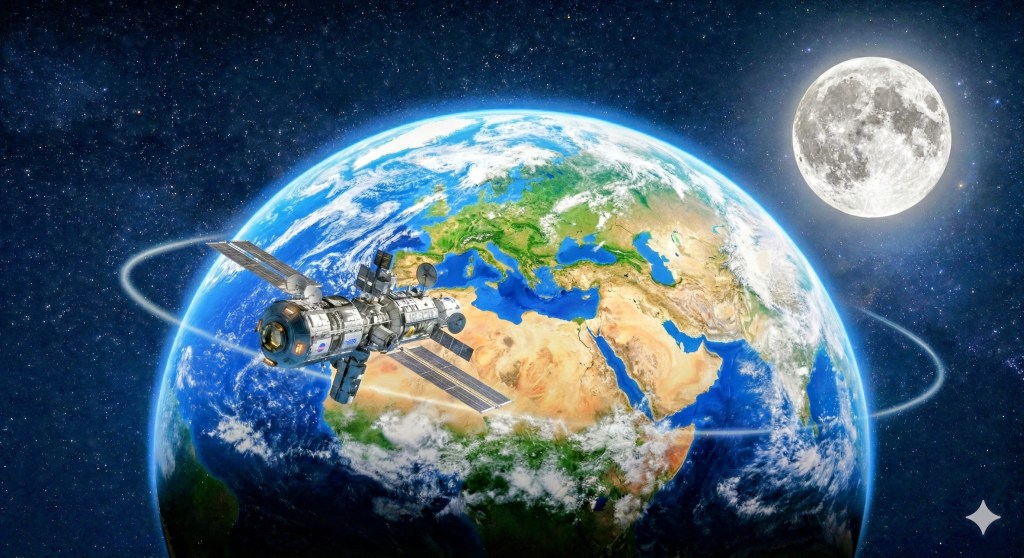
Quranic heavens and earth through the lens of science and theology
Presented by Zia H Shah MD
The Quran’s concept of “the heavens” (al-samāwāt) and “the earth” (al-arḍ) constitutes the most fundamental structural pair in its cosmological vision, appearing in 222 verses Wikipedia and forming a comprehensive ontological framework that modern scholars increasingly examine alongside contemporary astrophysics, geology, and ecology. Zia H Shah MD, Chief Editor of The Muslim Times and founder of the blog The Glorious Quran and Science (thequran.love), Thequran has produced one of the most sustained contemporary explorations of this intersection, culminating in his March 21, 2026 article “The Concept of the Heavens in the Quran: A Cosmological and Scientific Inquiry.” His work represents a refined form of scientific exegesis (tafsīr al-ʿilmī) that accepts modern scientific consensus—including evolution, a 13.8-billion-year-old universe, and Big Bang cosmology—while reading the Quran as a “book of signs” whose language resonates with, rather than encodes, scientific discoveries.
How Shah reads the Quran as a dual “book of nature”
Zia H Shah’s methodology rests on several distinctive pillars that set him apart from both crude concordism and outright skepticism about Quran-science dialogue. His central thesis draws on the “Two Books” theory: God authored both the Book of Scripture and the Book of Nature, and the two cannot ultimately conflict. Thequran When tension arises, Shah argues, “one should re-examine the human interpretation of scripture rather than dismiss the science.” Thequran This positions him between Maurice Bucaille’s strong concordism and Nidhal Guessoum’s more cautious epistemological approach.
Shah describes conflict between science and religion as stemming from “wrong theology,” not from Islam itself. Thequran He rejects fideism—the view that faith requires suspension of the intellect— Thequranand instead embraces what he calls “Guided Evolution,” a theistic evolution framework that accepts common ancestry, genomic evidence (including endogenous retroviruses), and the full apparatus of modern biology. For Shah, the Quranic narrative of Adam is “a spiritual milestone rather than a denial of biological history.” Thequran
His approach is distinctly ecumenical and interfaith. His motto—”Bringing all of Christian scholarship to the service of the Glorious Quran”—reflects a methodology that draws on John Polkinghorne, Thequran Ian Barbour, Paul Davies, C.S. Lewis, Alvin Plantinga, and Hans Urs von Balthasar alongside classical Islamic scholars like al-Ghazālī and Ibn Rushd. Across more than 400 articles, Thequran Shah builds a cumulative case Thequran anchored in Quran 32:7 (“He made beautiful all that He created”) and 59:24 (God as “the Creator, the Maker, the Fashioner”), arguing that pervasive beauty and order in nature constitute powerful evidence for a purposeful Creator. Thequran
His March 21, 2026 article falls within a prolific burst of publications—categorized under Arabic, Cosmological Argument, Cosmology and Physics, Language, and Quran Commentary—that systematically examine how Quranic cosmological language intersects with modern scientific understanding.
The ontology of al-samāwāt and al-arḍ in Quranic cosmology
The pairing of “heavens and earth” in the Quran functions as a merism—a literary device where two contrasting terms refer to the totality of creation. Wikipedia As scholars Mohammad Ali Tabatabaʾi and Saida Mirsadri demonstrated in their landmark 2016 Arabica study, “the heavens and the earth are the most vital elements on the scene—in terms of occurrence and emphasis—compared to which all other elements lose importance.” WikipediaWikipedia The Quranic universe consists entirely of three components: the heavens, the earth, and “all that is between them” (e.g., Q 50:38), WikiIslam with this intermediate space encompassing clouds (Q 2:164), birds (Q 24:41), WikiIslam and what Shah identifies as interstellar clouds—the Arabic phrase وَمَا بَيْنَهُمَا (wa mā baynahumā) describing vast accumulations of gas and dust crucial to star and planetary formation. Thequran
The heaven (al-samāʾ) is described as a concrete, constructed object: “built” by God (Q 50:6), “lifted up” (Q 88:18), a “protected roof” (saqfan maḥfūẓan, Q 21:32), and a “structure” (bināʾ, Q 2:22). Wikipedia Seven heavens are mentioned in eight verses (Q 2:29, 17:44, 23:86, 41:12, 65:12, 67:3, 71:15, 78:12), arranged ṭibāqan (“in layers”). Wikipedia The lowest heaven is adorned with “lamps” (stars, Q 41:12; 67:5). The Quran challenges observers: “You see no discrepancy in the creation of the Compassionate. Look again. Can you see any cracks?” (Q 67:3). Clear Quran
The earth (al-arḍ) is notably never pluralized in the Quran, though heavens appear in plural. It is described as “spread out” (Q 79:30; 51:48), compared to a “bed” (Q 20:53) and “carpet” (Q 71:19). Wikipedia Mountains are placed upon it as “pegs” (awtād, Q 78:7) and “stabilizers” (rawāsī, Q 16:15; 21:31). The single reference to “seven earths” in Q 65:12 WikiIslam has, as Shah notes, drawn Divine attention to the possibility of numerous earths without overwhelming a pre-scientific audience. Thequran
Adrien Chauvet’s 2023 analysis in the American Journal of Islam and Society offers an important insight relevant to Shah’s approach: American Journal of Islam and Society Quranic cosmographical verses achieve “multiplicity of correspondences” through subjective descriptions open to interpretation, negative affirmations that allude to paradigms without endorsing them, and strategic silence about details that would lock them into any single scientific model. American Journal of Islam and Society This interpretive openness is precisely what allows Shah and others to find resonance with modern cosmology without claiming the Quran is a science textbook. American Journal of Islam and Society
Where Big Bang cosmology meets Quranic creation narratives
The most scientifically discussed Quranic cosmological verse is Q 21:30: “Have those who disbelieved not considered that the heavens and the earth were a joined entity (ratqan), and We separated them (fafataqnāhumā)?” The Last Dialogue Shah reads this as “mirroring the Big Bang theory, describing a primordial singularity (‘closed-up mass’) that was ‘split apart’ to form the cosmos.” Thequran The Arabic ratq means “sewn/stitched/closed up,” while fatq means “to cleave asunder”— The Last Dialoguelanguage that maps suggestively onto the cosmological picture of a 13.8-billion-year expansion from an initial singularity.
Shah’s analysis of Q 41:9–12 is particularly detailed. These verses describe creation in phases: Thequran earth in two periods, provision and mountains in four, and seven heavens in two— Wikipediawith the early heaven characterized as “smoke” (dukhān). Wikipedia Shah demonstrates that the Arabic conjunction thumma (“then” or “furthermore”) does not necessarily imply strict temporal sequence, resolving the apparent difficulty of the earth seemingly preceding the heavens. Thequran The term dukhān is read as corresponding to the hot, opaque primordial plasma of the early universe—a gaseous, particulate state that preceded the formation of discrete cosmic structures. Thequran +2
Q 51:47—”And the heaven We constructed with strength, and indeed, We are [its] expander”—receives extensive treatment across Shah’s work. The active participle lamūsiʿūn implies continuous, ongoing expansion. WikiIslam Shah emphasizes that “the fact that the Quran spoke of an expanding heaven in the 7th century—a fact only empirically confirmed in the 20th century—is, at the very least, an intriguing coincidence in the dialogue between scripture and science.” Thequran Edwin Hubble’s Quran Gallery App 1929 discovery of galactic redshift and the 1990s confirmation of accelerating expansion provide the scientific backdrop. Classical exegetes like Ibn Kathīr interpreted mūsiʿūn as God possessing vastness and power, Quran Gallery App while modern commentators like Maududi offered dual interpretations acknowledging continuous cosmic expansion. QuranX
The creation in “six days” (ayyām), mentioned in seven verses (Q 7:54, 10:3, 11:7, 25:59, 32:4, 50:38, 57:4), Wikipedia is interpreted by Shah and many scholars as referring to six periods or epochs, not literal 24-hour days. The Quran itself uses yawm for periods of 1,000 years (Q 22:47) and 50,000 years (Q 70:4). Shah and other contemporary scholars map these to stages of cosmic evolution—from the primordial particle era through stelliferous ages to earth formation—while noting that Eurasia Review the Quran explicitly rejects the Biblical concept of God resting after creation (Q 50:38). NAU
Mountains, water cycles, and the earth’s geological signs
Shah’s work systematically examines Quranic references to geological phenomena, reading them as āyāt (signs) pointing to divine design while acknowledging their resonance with modern earth sciences.
The description of mountains as “pegs” (awtād, Q 78:7) and “stabilizers” (rawāsī, Q 16:15; 21:31) finds a parallel in the geological concept of isostasy—the principle that mountains have deep crustal “roots” extending into the mantle, analogous to an iceberg with most of its mass below the surface. Islamonweb Frank Press’s geology textbook Earth depicts mountains as wedge-shaped structures with most mass underground. The Last Dialogue Shah’s geological interpretation draws on the work of Zaghloul El-Naggar, who New Arab argued that mountains stabilize the lithosphere by sinking into the asthenosphere “as wooden pegs sink into the ground.” Wikiislam Critics counter that mountains form as a result of tectonic activity rather than preventing it, and that earthquakes frequently occur in mountainous regions. WikiIslamWikiislam The scholarly debate remains active, with proponents arguing that mountain belts contribute to broader crustal equilibrium even if they do not prevent localized seismic events.
The Quranic hydrological cycle receives detailed treatment across Shah’s work. Verses describe evaporation (winds carrying moisture, Q 15:22, 30:48), cloud formation and condensation (Q 24:43), precipitation (Q 23:18, 39:21), groundwater infiltration (Q 23:18, 39:21), surface runoff (Q 13:17), and plant absorption (Q 39:21). The phrase bi-qadar (“according to measure”) in Q 23:18 emphasizes precise hydrological balance. mehbooba As Maurice Bucaille noted, Aristotle erroneously believed springs were fed by subterranean vapor; the Quran, centuries earlier, described rain penetrating earth to form springs— ThequranYolasite a connection Shah finds scientifically significant.
The word lawāqiḥ (“fertilizing”) for winds in Q 15:22 is linguistically remarkable: it describes winds as “impregnating,” connecting both to cloud formation (carrying water vapor) and plant pollination. The Last Dialogue Shah’s geological arguments extend to the sky as “a protected roof” (Q 21:32), which he reads as describing Earth’s atmosphere—its filtering of harmful radiation, destruction of meteoroids, and climate regulation. Thequran
Khalifa, sovereignty, and the cosmic trust
The theological framework surrounding Quranic cosmology centers on several interlocking concepts. Khalīfa (vicegerent/steward), introduced in Q 2:30—”Indeed, I am going to place upon the earth a khalīfa”—establishes humanity’s role as custodial, not sovereign. Quran Learning USAWikipedia Al-Qurṭubī clarified that the role involves “delegated authority, requiring justice, accountability, and adherence to divine guidance.” Quran Gallery App The immediately following verse (Q 2:31) teaches Adam “the names of all things,” establishing humanity’s capacity for knowledge as the qualifying factor for this cosmic responsibility. My Islam
The companion concept of amāna (trust, Q 33:72) elevates stewardship from social contract to cosmic burden: “We offered the Trust to the heavens and the earth and the mountains, and they declined to bear it and feared it; but man undertook to bear it.” Quran Gallery AppCilecenter This creates a framework where human authority is entirely derivative, accountability before God is inherent, and free will—the capacity to choose obedience or disobedience—distinguishes human stewardship from the involuntary submission of the rest of creation. IslamOnlineCilecenter
God’s sovereignty (mulk al-samāwāt wal-arḍ) pervades the Quran. Q 35:41 states: “God holds the heavens and the earth, lest they cease. And if they should vanish, no one could hold them back after Him.” Thequran Al-Ghazālī distinguished between ʿālam al-mulk (the sensual, temporal world) and malakūt (the intelligible, everlasting world), while Suhrawardī added ʿālam al-jabarūt (the world of divine power), creating a tripartite cosmos. Wikipedia Shah’s work on the unseen (ghayb) draws parallels between this concept and modern scientific realities: dark matter and dark energy constituting approximately Eurasia Review 95% of the universe’s content, quantum phenomena, and the information-theoretic foundations of physical reality. Thequran
The concept of mīzān (balance, Q 55:7–9) extends from cosmic order to ecological ethics. “He raised the heaven and established the balance, so that you may not transgress the balance.” Islamonweb Q 15:19 adds that everything grows “in proper proportion” (mawzūn). This has become the theological basis for modern Islamic environmentalism, Wikipedia culminating in institutional initiatives like the Al-Mizan Covenant (a UNEP-backed Muslim ecological covenant), Wikipedia the 2015 Islamic Declaration on Global Climate Change, and the scholarly framework articulated in Harvard’s Islam and Ecology: A Bestowed Trust. Kharchoufa
Five schools of thought on the Quran-science dialogue
The scholarly landscape on Quranic cosmology and science falls across a clear spectrum, with Shah occupying a distinctive position:
- Strong concordism (Bucaille, El-Naggar, Zakir Naik) claims the Quran contains encoded scientific foreknowledge proving divine authorship. QarawiyyinprojectWikipedia El-Naggar, an Egyptian geologist who published 45+ books before his death in November 2025, interpreted mountains as foreknowledge of isostasy and plate tectonics. Islamonweb +2
- Refined concordism (Zia H Shah) harmonizes the Quran with science through careful hermeneutics, embraces scientific consensus including evolution, and builds a cumulative aesthetic argument from beauty and fine-tuning in nature to divine purpose. Shah explicitly distinguishes himself from Naik’s selective literalism. Thequran
- Nuanced reconciliation (Nidhal Guessoum) rejects i’jāz al-ʿilmī as based on “flawed principles” ResearchGate that “misrepresent science as a collection of ‘facts’” and “overstretch the meaning of Quranic verses.” Zygon Guessoum advocates for complementary epistemologies pursuing truth through different methods. ResearchGate
- Sacred science/Traditionalist (Seyyed Hossein Nasr, Wikipedia Muzaffar Iqbal, Ziauddin Sardar) critiques modern Western science’s metaphysical assumptions. Academia.edu Nasr argues the environmental crisis stems from the “desacralization of nature” Wikipedia and advocates recovering a framework where nature is inherently sacred. Amazon
- Critical/Skeptical (Taner Edis, Pervez Hoodbhoy) views claims of Quran-science harmony as illusory. Unchangingword Edis argues that “religious texts preserve fragments of ancient cosmologies rather than prophesy modern scientific developments.” Blogger
Shah’s work navigates between these positions with characteristic ambition. His aesthetic argument—spanning fine-tuning of physical constants, the cosmic web of galaxy filaments, DNA’s golden ratio structure, butterfly wing symmetry, and the Fibonacci sequence in sunflower seeds—builds what he calls a cumulative case that “a truly blind and random world should be ‘tasteless’—yet ours overflows with aesthetic splendor at every scale.” Thequran
Conclusion: where ancient text meets expanding cosmos
The Quranic vision of heavens and earth operates simultaneously on theological, phenomenological, and—as contemporary scholars increasingly argue—proto-scientific registers. Shah’s contribution is to read these registers as harmonious rather than competing, guided by the principle that Thequran Quran 21:16’s declaration—”We did not create the heavens and the earth and what is between them in play”—is a claim about ultimate meaning, while science supplies proximate mechanisms. My Islam The distinction matters: confusing the two, as Shah’s own methodological framework acknowledges, “can produce bad science and brittle theology; distinguishing them can produce intellectually resilient theism.” Thequran
What remains genuinely remarkable is the Quran’s interpretive resilience across cosmological paradigms. Whether read against Ptolemaic spheres, Newtonian mechanics, or quantum cosmology, the text’s American Journal of Islam and Society strategic combination of vivid imagery, deliberate ambiguity, and theological framing allows each generation of readers to find their own scientific moment reflected in its language. American Journal of Islam and Society That this openness is itself by design—as Chauvet argues—or merely a feature of poetic language—as skeptics contend—remains the central unresolved question in this centuries-long dialogue between scripture and science. Shah’s body of work, now exceeding 400 articles, Thequran stands as one of the most sustained contemporary attempts to resolve it in favor of harmony. Thequran



 The Glorious Quran and Science
Leave a comment