
Presented by Zia H Shah MD
Abstract
This report presents an exhaustive commentary on Surah Ar-Ra’d, Verse 19 (13:19), exploring the Quranic dichotomy between the “sighted” (Ulu’l-Albab—those endowed with knowledge of the Truth) and the “blind” (A’ma—those who deny the Divine Revelation). Through a rigorous synthesis of classical exegesis (Tafsir)—including the works of Ibn Kathir, Al-Qurtubi, and Fakhr al-Din al-Razi—and contemporary interpretations by scholars such as Sayyid Qutb, Abul A’la Maududi, and Muhammad Asad, the analysis illuminates the profound “blessing advantage” possessed by the Believers and the existential “handicap” of the Deniers. The report incorporates corroborating evidences from Surah Al-Qalam (68:35-36), Surah Sad (38:28), and Surah Az-Zumar (39:9) to demonstrate the Quran’s consistent rejection of moral equivalence. The study argues that the Quranic definition of sight is fundamentally cognitive and spiritual rather than optical; the “blessing advantage” is identified as a state of integrated cognitive coherence, emotional stability, and social constructiveness, while the “handicap” of denial is characterized by existential anxiety, social fragmentation, and a regression to chaotic amorality. The findings suggest that the Quranic worldview presents belief not merely as a theological position but as a functional necessity for psychological and societal health.
I. Introduction: The Context of Surah Ar-Ra’d and the Cosmic Argument
Surah Ar-Ra’d (The Thunder) occupies a unique and pivotal position in the Quranic corpus, bridging the themes of divine power manifest in the natural world with the internal psychological landscape of the human soul. Revealed primarily during the late Meccan period—though containing verses that some scholars, such as Al-Qurtubi and others, argue reflect the transitional phase to Madinah—the Surah addresses a hostile audience demanding supernatural miracles while remaining oblivious to the miraculous order of the cosmos. The central thesis of the Surah is the vindication of the Revelation: that the message sent down to the Prophet Muhammad (peace be upon him) is the absolute Truth (Al-Haqq), inextricably linked to the laws governing the universe.
The Surah takes its name from the thunder (Ar-Ra’d), a phenomenon described in Verse 13 not as a mere meteorological event, but as a conscious entity glorifying its Creator: “And the thunder exalts [Allah] with praise of Him”. This personification of nature sets the stage for the central argument of Verse 19: if the inanimate universe is “awake” to the reality of God, what is the status of the human being who remains “asleep” or “blind” to this reality?
Verse 13:19 stands as the pivotal axis of this argument. It moves the discourse from the external evidences of God’s power—the raising of the heavens without pillars, the subjugation of the sun and moon, and the spreading of the earth—to the internal evidence of human perception. The verse poses a rhetorical question that shatters the possibility of moral or intellectual equivalence between belief and disbelief. It establishes a binary that is not based on wealth, social status, or lineage, but on the faculty of perception. This report dissects this binary, positing that the Believer enjoys a functional advantage in navigating the complexities of existence, while the Denier suffers from a disabling handicap that renders their engagement with reality fundamentally flawed.
II. The Verdict of Verse 19: The Great Divergence
2.1 The Rhetorical Interrogative and the Impossibility of Equivalence
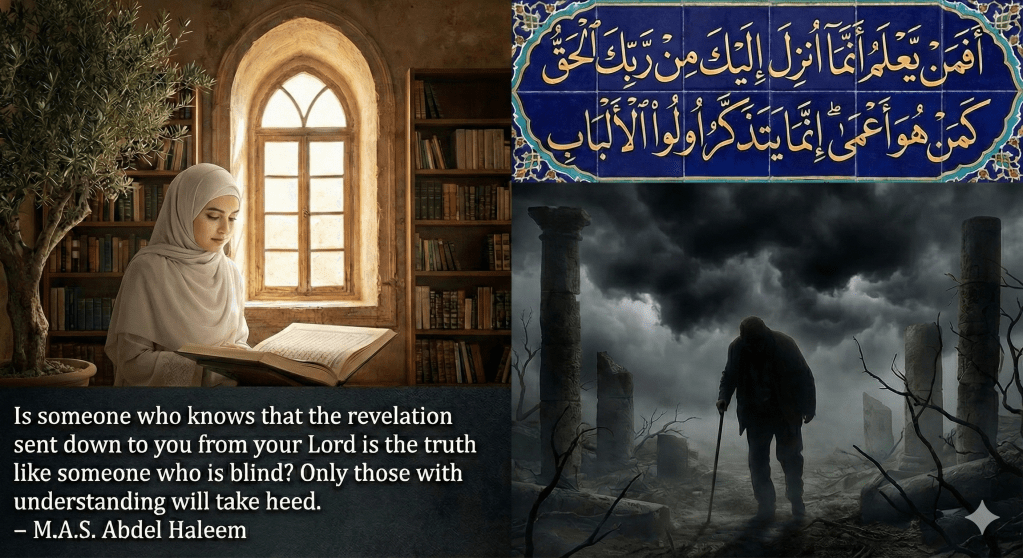
The verse opens with a piercing interrogative structure: “Afaman ya’lamu annama unzila ilayka min Rabbika al-haqqu kaman huwa a’ma?” (“Then is he who knows that what has been revealed to you from your Lord is the truth like one who is blind?”).
Classical philologists and exegetes note that the particle Hamza at the beginning of the verse serves the function of Istifham Inkari (rhetorical denial). It implies an emphatic, almost incredulous negation: “They are certainly not equal.” The phrasing compels the listener to acknowledge the absurdity of equating the two conditions. Ibn Kathir, in his seminal Tafsir, asserts that this rhetorical question highlights a difference as stark as that between light and darkness, or life and death. He argues that just as night and day cannot be the same, the one who possesses the “vision” of revelation cannot be equated with the one stumbling in the darkness of ignorance.
This theme of “impossible equivalence” is a recurring motif in the Quran, utilized to dismantle the arrogance of the Meccan elite who believed their worldly status equated to spiritual rectitude. The argument is forcefully reiterated in Surah Al-Qalam (68:35-36):
“Then will We treat the Muslims like the criminals? What is [the matter] with you? How do you judge?”
Here, the Quran challenges the very cognitive faculties of the denier. To equate the “Muslim” (the one who submits to reality) with the “Mujrim” (the criminal who violates reality) is a corruption of judgment. The “Blessing Advantage” is thus framed as an alignment with Divine Justice, while the “Handicap” of the denier is a profound inability to judge value correctly.
2.2 The Nature of “The Truth” (Al-Haqq)
The object of knowledge in this verse is specific and absolute: “annama unzila ilayka min Rabbika al-haqqu” (“that what has been revealed to you from your Lord is the Truth”). The use of the definite article Al-Haqq implies the Absolute Truth—the ultimate reality that explains the origin, purpose, and destination of existence.
Contemporary commentator Sayyid Qutb, in his magnum opus Fi Zilal al-Quran (In the Shade of the Quran), elaborates that recognizing this Truth is not merely an academic acceptance of a dogma. It is the alignment of the human soul with the “living, conscious universe.” For Qutb, the Truth is the natural law that governs the thunder, the angels, and the human heart. The universe is not a dead, mechanical entity but a vibrant stage of worship. To know this Truth is to find one’s place in the cosmic order; to fail to know it is to live in a state of dissonance with the very fabric of reality.
Furthermore, the phrase min Rabbika (“from your Lord”) emphasizes the source of this Truth. It is not a philosophical conjecture or a human invention. It is Rabbani (Lordly/Divine) in origin. This gives the Believer a “Blessing Advantage” of certainty. While human philosophies are subject to revision, debate, and obsolescence, the Truth from the Rabb is constant, providing a stable foundation upon which to build a life.
2.3 The Definition of Blindness (Al-’Ama)
The counter-position in the verse is kaman huwa a’ma (“like one who is blind”). Here, the Quranic discourse on blindness is critical to understanding the “handicap” of the denier.
The classical exegete Al-Qurtubi emphasizes that this is not physiological blindness. It is ‘Ama al-Qalb (blindness of the heart). A person may have 20/20 vision, capable of seeing the intricate details of a flower or the vastness of a galaxy, yet remain utterly blind to the Creator who fashioned them.
Fakhr al-Din al-Razi, in his Tafsir al-Kabir, engages in a philosophical dissection of this blindness. He argues that the blind man may possess physical sight but lacks the Basirah (spiritual insight) to connect phenomena to their Noumena (divine origins). For Al-Razi, the blind person is one trapped in the realm of sensory data without the interpretative framework to understand its meaning. They see the rain but not the Mercy; they hear the thunder but not the Praise. This metaphorical blindness acts as a severe handicap. Just as a physically blind person cannot navigate a physical terrain without guidance, the spiritually blind person cannot navigate the moral and existential terrain of life. They stumble over ethical dilemmas, fall into pits of despair, and collide with the immutable laws of consequences because they cannot “see” the spiritual topography of the world.
2.4 The Exclusive Qualification: Ulu’l-Albab
The verse concludes with a restrictive clause: “Innama yatazakkaru ulu’l-albab” (“Only men of understanding heed”).
Ulu’l-Albab is a prestigious Quranic title, often translated as “People of Intellect,” “Men of Understanding,” or “Those of the Core.” The singular Lubb refers to the kernel or the core of a thing, distinct from its husk or shell.
- The Husk: The superficial appearance of the world—wealth, power, material causality, and transient pleasures.
- The Core: The underlying divine reality, the moral law, and the ultimate accountability to God.
Therefore, Ulu’l-Albab are those who have penetrated the husk of material existence to grasp the core reality. Maududi notes that the distinction here is not based on high IQ, academic degrees, or worldly sophistication. A person may be a genius in engineering or finance—adept at manipulating the “husk”—but remain “blind” in the Quranic sense if their intellect does not lead them to the Creator.
This definition is explicitly reinforced in Surah Az-Zumar (39:9), which draws a parallel line between knowledge and spiritual practice:
“Is one who is devoutly obedient during periods of the night, prostrating and standing [in prayer], fearing the Hereafter and hoping for the mercy of his Lord, [like one who does not]? Say, ‘Are those who know equal to those who do not know?’ Only they will remember [who are] people of understanding.”
By linking 13:19 with 39:9, we see that the “knowledge” of the Ulu’l-Albab is not abstract information; it is knowledge that compels action (devout obedience). The “Blessing Advantage” is an intellect that functions correctly, leading the human being to the logical conclusion of servitude to the Divine.
III. The Blessing Advantage of the Believer: A Functional Superiority
The “blessing advantage” of the Believer, as elucidated in the subsequent verses (13:20–22), is not a passive state of grace but an active, functional superiority in the management of life. It manifests as a multidimensional resilience that spans the cognitive, social, and emotional domains.
3.1 The Cognitive Advantage: Coherence and Purpose
The primary advantage of the Ulu’l-Albab is the possession of a coherent worldview. By acknowledging “The Truth,” the Believer operates with a unified theory of existence (Tawhid). They are not plagued by the existential fragmentation that characterizes the modern human condition—the separation of science from spirit, public life from private morality, or action from consequence.
Classical Insight: Ibn Kathir notes that the Believer’s knowledge is constant; it does not fluctuate with circumstances because it is anchored in the Divine Covenant. Whether in poverty or wealth, sickness or health, the “Truth” remains the same.
Modern Insight: Muhammad Asad describes the alternative state as being subject to “invisible forces” of one’s own blind appetites and erroneous notions. The Believer, conversely, is liberated from the tyranny of conflicting desires. They possess Furqan (a criterion) to judge right from wrong, rendering their decision-making process efficient and consistent. This clarity reduces “cognitive load”—the mental energy required to constantly renegotiate ethical stances. The Believer knows the rules of the game of life, while the Denier is constantly trying to invent them, leading to perpetual confusion.
3.2 The Social Advantage: The Covenant of Connectivity
Verse 20 defines the Believers as “Those who fulfill the covenant of Allah and do not break the contract”. Verse 21 adds, “And those who join that which Allah has ordered to be joined”. This provides a distinct “Blessing Advantage” in the realm of social capital and human relationships.
3.2.1 Fidelity as Social Currency
The Believer is bound by a transcendental honor code. Their trustworthiness is not contingent on surveillance, legal enforcement, or social pressure, but on their covenant with God. This makes them the most reliable components of any social system. In a world of shifting allegiances and transactional relationships, the Believer represents a bedrock of stability.
3.2.2 Silat ar-Rahim (The Bond of Kinship)
The command to “join what Allah has ordered to be joined” is interpreted by Al-Qurtubi and others as maintaining family ties (Silat ar-Rahim) and broader social cohesiveness. This is not merely a moral platitude but a prescription for social health.
Psychological and Physical Benefits: Modern research, often cited in the context of Islamic psychology, suggests that Silat ar-Rahim contributes significantly to mental health. Studies indicate that strong kinship networks provide a buffer against depression and anxiety. Furthermore, the Prophet Muhammad (peace be upon him) explicitly stated in a Hadith that maintaining family ties “increases sustenance and prolongs life”. The Believer, by adhering to this command, activates these spiritual and physical benefits. They are embedded in a web of meaningful relationships, protected from the alienation (“social atomization”) and loneliness that plague the “blind” individualist who cuts ties for convenience.
3.3 The Emotional Advantage: Resilience through Sabr
Verse 22 highlights “Those who are patient, seeking the countenance of their Lord”.
Strategic Patience: The term used is Sabr. Contemporary scholars distinguish this from mere passive waiting or suffering in silence. It is “fortitude” or “steadfastness”. It is an active state of endurance. The Believer possesses an emotional buffer against the vicissitudes of fortune. Because their ultimate goal is the “Face of their Lord” (Wajh Rabbihim), worldly losses do not devastate them, and worldly gains do not intoxicate them.
Stress Management: Sayyid Qutb analyzes this as a source of immense power. The Believer perceives difficulties not as random cruelty or bad luck, but as part of a divine curriculum designed for their growth. This “reframing” capability is a massive psychological advantage. It prevents trauma from resulting in despair. The Believer asks “What is Allah teaching me?” rather than “Why is this happening to me?”.
3.4 The Behavioral Advantage: Repelling Evil with Good
Verse 22 continues, “…and they repel evil with good”. This acts as a sophisticated conflict resolution strategy. The Alchemy of Character: Instead of escalating conflict through retaliation, the Believer de-escalates through benevolence. This behavior disarms enemies and transforms toxic environments into nurturing ones. As noted in similar verses (e.g., 41:34), this can turn a “devoted enemy” into a “close friend.” The Believer thus navigates social hostility with a grace that the “Blind” man, driven by ego and reactionism, cannot comprehend.
3.5 The Metaphysical Advantage: Itm’inan (Tranquility)
Though explicitly mentioned later in Verse 28 (“Unquestionably, by the remembrance of Allah hearts are assured”), the foundation is laid here. The Ulu’l-Albab enjoy Itm’inan—a state of deep internal security and tranquility. In a world of flux, anxiety, and uncertainty, they possess a stable center of gravity. This internal peace is described by Qutb as the “living voice” of the universe resonating within the human chest. While the Denier seeks peace in transient material accumulation (Mata’), the Believer finds it in the Eternal Source.
IV. The Handicap of the Denier: An Existential Diagnosis
In stark contrast to the Believer, the Denier (the “Blind”) operates under a severe existential handicap. This is not merely a theological penalty to be enacted in the Hereafter; it is a functional disability in the here and now, detailed in Verse 25.
4.1 The Cognitive Handicap: Fragmentation and Irrationality
The Denier is described as “Blind” (A’ma). This implies a cognitive failure to perceive the full spectrum of reality. The Narrow Vision: They see the immediate cause but not the Ultimate Causer. They see the material resource but not the trust (Amanah) attached to it. Philosophical Implications: Al-Razi argues that reason (‘Aql) is the tool for perceiving the Divine. To deny the Divine is to fundamentally misuse the instrument of reason, leading to intellectual incoherence. Al-Razi famously stated that “Reason does not lie,” implying that true reason leads inevitably to God. The Denier, therefore, is forced to live in a universe that is, to them, accidental, purposeless, and indifferent. This generates a background radiation of existential dread and an “identity crisis” as they struggle to find meaning in a meaningless void.
4.2 The Social Handicap: Treachery and Isolation
Verse 25 describes the Deniers as those who “break the covenant of Allah after contracting it and sever that which Allah has ordered to be joined”.
The Pathology of Treachery: By breaking the primary Covenant with Reality (God), the Denier inevitably breaks secondary covenants with humanity. If there is no transcendent accountability, contracts become matters of convenience, valid only as long as they serve self-interest. This unreliability makes the Denier a “bad bet” in social and economic exchanges.
Social Darwinism and Isolation: “Severing what should be joined” leads to social atomization. The “Blind” individual cuts ties of kinship and community when they become burdensome or financially draining. While this may offer short-term “freedom,” it leads to long-term isolation and vulnerability. They forfeit the psychological protections of Silat ar-Rahim, leaving them exposed to the full brunt of life’s hardships without a support network. This is the handicap of the “self-made man” who ends up alone.
4.3 The Environmental and Societal Handicap: Corruption (Fasad)
The verse states they “spread corruption on earth”. Blindness as Destructiveness: A blind man moving carelessly through a room knocks things over not necessarily out of malice, but out of an inability to see the order of the room. Similarly, the spiritually blind person, moving through the economy, politics, or the environment, disrupts the delicate balance of justice and nature.
This destruction is not an accidental byproduct but an inevitable result of their “handicap.” Surah Sad (38:28) sharply contrasts the constructive nature of the believer with the destructive nature of the denier:
“Or should we treat those who believe and do righteous deeds like corrupters in the land? Or should We treat those who fear Allah like the wicked?”
By juxtaposing “Righteous Deeds” (Salihat) with “Corruption” (Mufsideen), the Quran identifies the denier as an agent of Fasad (entropy and ruin). The “Handicap” here is the inability to build; they can only consume or destroy. They create economic systems based on exploitation (usury), political systems based on tyranny, and environmental systems based on extraction without stewardship. This Fasad comes back to haunt them—they must live in the ruined world they created.
4.4 The Emotional Handicap: The Curse and the Hardened Heart
The penalty mentioned in Verse 25 is “for them is the curse, and they will have the worst home”.
The Curse (La’nah): In Islamic theology, La’nah signifies “distancing from the Mercy of Allah.” Existentially, this manifests as a lack of Barakah (blessing/continuity). Their efforts, no matter how energetic, lack ultimate fruition or satisfaction. They are like Sisyphus, constantly rolling the boulder without purpose. They chase the mirage of the world (like the “thirsty traveler” in 24:39) but find no water.
The Hardened Heart: Surah Al-Ma’idah (5:13) links breaking covenants to the “hardening of hearts” (Qaswat al-Qalb). The handicap of the Denier is an emotional numbness—an inability to feel compassion, awe, or true peace. They require ever-increasing stimulation (material or sensory) to feel alive, yet remain internally hollow. This emotional deadness is a prelude to the “Worst Home” (Su’ ad-Dar), which refers to Hell in the Hereafter but also implies a wretched psychological state in this life—a home devoid of peace, love, or sanctity.
V. Detailed Exegesis of Characteristics: A Comparative Analysis
To fully appreciate the divergence between the “Blessed” and the “Handicapped,” it is instructive to compare their specific behavioral traits as listed in the surrounding verses.
Table 1: The Binary of Characteristics in Surah Ar-Ra’d
| Feature | The Believer (Advantage) | The Denier (Handicap) |
| Covenant | “Fulfill the Covenant of Allah” (13:20) Operates on absolute integrity. Word is bond. Result: Trust capital, psychological consistency. | “Break the Covenant” (13:25) Operates on situational ethics/convenience. Result: Social distrust, cognitive dissonance (hypocrisy). |
| Relationships | “Join what Allah ordered joined” (13:21) Maintains Silat ar-Rahim (kinship). Result: Emotional support, longevity, sustenance. | “Sever what Allah ordered joined” (13:25) Cuts ties for ego or gain. Result: Isolation, loneliness, lack of safety net. |
| Accountability | “Fear their Lord and dread Reckoning” (13:21) Possesses internal regulator (Khashyah). Result: Self-discipline, avoidance of destructive risks. | “Spread corruption” (13:25) Lacks internal brakes; acts with impunity. Result: Recklessness, collision with justice/consequences. |
| Conflict Style | “Repel evil with good” (13:22) Transforms enemies into friends. Result: Peace of mind, social harmony. | “Spread corruption” (13:25) Escalates conflict; returns evil with evil. Result: Perpetual conflict, stress, creation of enemies. |
| Outcome | “Peace be upon you” (13:24) Angelic validation, Gardens of Eden. Result: Eternal success, family reunion. | “The Curse and Worst Home” (13:25) Spiritual exile, Hellfire. Result: Eternal ruin, separation from mercy. |
VI. Embellishing the Perspectives: Classical and Contemporary Synthesis
6.1 Classical Perspectives: The Absolute Divide
Ibn Kathir focuses on the sharp dichotomy. For him, the distinction in 13:19 is absolute; there is no middle ground between “Knowing the Truth” and “Blindness.” He cites the verse “Not equal are the dwellers of the Fire and the dwellers of Paradise” (59:20) to reinforce that the Ulu’l-Albab are defined strictly by their adherence to the Shariah. The “Advantage” is the structure of the Law, which guides the Believer to safety, while the “Blindness” is the refusal to submit to this safety mechanism.
Al-Qurtubi brings a legal and social dimension. He highlights Silat ar-Rahim not just as a nice gesture, but as a mandatory obligation (Wajib). He discusses the “Handicap” of the denier as legal culpability and social ostracization in the Hereafter. He also emphasizes that the “blindness” is the blindness of the Basirah (inner eye), citing that the physical eyes may see, but if the heart is blind, the person is lost.
Fakhr al-Din al-Razi offers a theological and rationalist view. He challenges the “Blind” to use their reason. He recounts the famous anecdote where he supposedly had “70 proofs” for God, but an old woman’s simple faith trumped them, leading to the realization that intuitive certainty (Fitrah) is the true sight. However, he maintains that true reason (‘Aql) inevitably leads to belief. The “Blindness” of the denier is a voluntary suspension of reason, a refusal to process the data of the universe. The “Advantage” of the Believer is intellectual integrity—their belief is the logical conclusion of an honest mind.
6.2 Contemporary Perspectives: The Psychological and Societal Dimension
Sayyid Qutb, writing from the crucible of prison in Fi Zilal al-Quran, moves beyond the individual to the societal. He sees 13:19 as a diagnosis of the human condition. The “Blind” are not just individuals; they are entire societies (Jahiliyyah) that have severed the link with Heaven. Qutb describes the “Advantage” of the Believer as “Harmony.” The Believer moves with the current of the universe. The stars, the trees, the thunder—all are Muslim (submitting to God). The Believer joins this cosmic procession. The Denier, however, tries to swim against the cosmic current, resulting in friction, exhaustion, and ultimate failure. Qutb embellishes the “peace” (Salam) of the Believer as a resonance with the “living conscience” of the world. He writes: “The thunder we hear is not a dead, mechanical sound. It is a living voice, glorifying its Lord.” The Believer understands this language; the Denier hears only noise.
Abul A’la Maududi, in Tafhim ul Quran, focuses on the “Covenant” as the social contract of Islam. The Believer is a responsible citizen of the Kingdom of God. The “Advantage” is a character marked by responsibility and consistency. The “Handicap” of the Denier is their unreliability; you cannot trust a man who has broken faith with his Creator to keep faith with his fellow man. Maududi argues that the “blindness” leads to a materialistic worldview that ultimately fails to satisfy the human soul, leading to a society of opportunists.
Muhammad Asad emphasizes the “intangible” aspects of reality. He translates Ulu’l-Albab as “those endowed with insight.” He argues that the “Blindness” is caused by an immersion in passing pleasures, which acts as a barrier to spiritual perception. Asad highlights that the “Truth” is not just theological data but a transformative realization that changes one’s entire mode of being. The Believer sees the “Face of God” behind the mask of events, giving them a profound depth of character and immunity to the superficial despair of the materialist.
VII. Embellishing the “Blessing Advantage”: The Visionary Life
To “embellish” the idea of the blessing advantage, we must consider the quality of life of the Ulu’l-Albab as depicted in the Quranic narrative.
1. The End of Existential Loneliness: The Believer, as described in Surah Ar-Ra’d, is never alone. Verse 11 mentions “For each one are successive [angels] before and behind him who protect him by the decree of Allah”. The Ulu’l-Albab are conscious of this angelic company. They walk with the confidence of the protected. The Denier, “blind” to this reality, walks in a universe they perceive as empty and indifferent.
2. The Architecture of Peace: The ultimate advantage is stated in Verse 28: “Unquestionably, by the remembrance of Allah hearts are assured.” The word Tatmainnu implies a settling, a resting, a stillness after agitation. The “Blind” are in a state of constant agitation (Idtirab), chasing fleeting desires (Mata’ – 13:26). The Sighted possess a sanctuary within. Psychological studies on Quranic recitation confirm this “Advantage,” showing measurable reductions in anxiety and stress among those who listen to and internalize the verses, reinforcing the Quran’s claim of being a “healing” for the chests.
3. The Transcendent Family: The reward for the Ulu’l-Albab includes a profound social blessing: “Gardens of Eden… and whoever was righteous among their fathers, their spouses, and their offspring” (13:23). Their relationships are eternalized. The “Advantage” is the hope of an everlasting reunion. The “Handicap” of the Denier is the finality of loss; their relationships end with death, or worse, turn into enmity in the Hereafter.
4. The Angelic Reception: The Believers are greeted by angels: “Peace be upon you for what you patiently endured. And excellent is the final home” (13:24). This is the validation of their struggle. The “Handicap” of the Denier is the absence of this validation—a life of struggle with no commendation at the end.
VIII. Thematic Epilogue
The journey through Surah Ar-Ra’d Verse 19 and its associated passages brings us to a singular, resounding truth: Belief is Function, Disbelief is Dysfunction.
The Quran does not present faith merely as a ticket to the afterlife, but as a “technology of living” for the here and now. The Ulu’l-Albab are not just “pious”; they are the only ones who are truly “awake” in a sleeping world. Their advantage is the sanity of knowing where they came from (the Covenant), where they are going (the Gardens of Eden), and how to navigate the present (Patience, Connection, Integrity).
The handicap of the denier is the madness of walking in the dark on the edge of a precipice. They are “blind” not because they lack eyes, but because they have severed the connection to the Light. Theirs is a world of broken promises, severed ties, and existential anxiety—a “Worst Home” constructed by their own hands before they even reach the Hereafter.
The divine logic is inescapable:
- “Then will We treat the Muslims like the criminals?” (68:35) – Justice demands divergence.
- “Or should we treat those who believe and do righteous deeds like corrupters in the land?” (38:28) – Order cannot equate to Chaos.
- “Are those who know equal to those who do not know?” (39:9) – Sight cannot equate to Blindness.
In the thunder of Ar-Ra’d, the Believer hears a hymn of praise; the Blind man hears only a terrifying noise. The difference is not in the ear, but in the heart. And it is in the heart that the vision of God—and the ultimate advantage of the Believer—truly resides.
“It is only the men of understanding who take heed.” (13:19)
Key Terminology Reference Table
| Arabic Term | Translation | Context in Surah Ar-Ra’d | Implication for “Advantage/Handicap” |
| Al-Haqq | The Truth | Verse 19: The Revelation is The Truth. | Advantage: Cognitive certainty; anchored reality. |
| A’ma | Blind | Verse 19: The state of the Denier. | Handicap: Spiritual incapacity; inability to perceive meaning. |
| Ulu’l-Albab | Men of Understanding | Verse 19: The audience who heeds. | Advantage: Constructive intellect; penetrating the “husk.” |
| ‘Ahd / Mithaq | Covenant / Pact | Verse 20, 25: Kept by Believers, broken by Deniers. | Advantage: Fidelity; identity stability. Handicap: Treachery; moral fluidity. |
| Silat ar-Rahim | Joining Ties | Verse 21: Command to connect. | Advantage: Social cohesion; mental health; longevity. |
| Sabr | Patience/Fortitude | Verse 22: Characteristic of Believers. | Advantage: Emotional resilience; reframing suffering. |
| Fasad | Corruption | Verse 25: Result of Denier’s actions. | Handicap: Social/Environmental ruin; destruction of habitat. |
| La’nah | Curse | Verse 25: Consequence for Deniers. | Handicap: Spiritual exile; lack of Barakah. |
| Salam | Peace | Verse 24: Greeting of Angels. | Advantage: Ultimate validation; internal serenity. |
Scholarly Sources Integration
- Ibn Kathir:
- Al-Qurtubi:
- Fakhr al-Din al-Razi:
- Sayyid Qutb:
- Abul A’la Maududi:
- Muhammad Asad:
- General/Linguistic/Psychological:
If you would rather read in Microsoft Word file:


 The Glorious Quran and Science
Leave a comment