
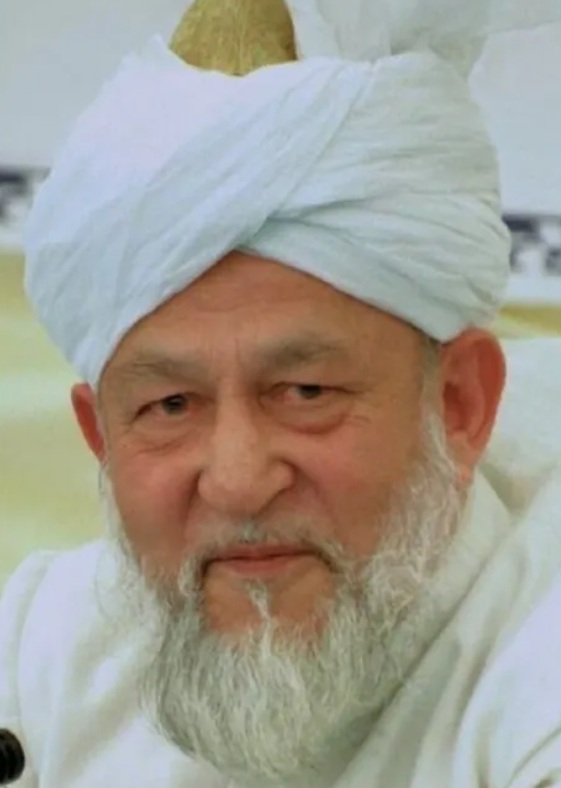
Presented by Zia H Shah MD
1. Introduction: The Theological and Scientific Conundrum
The discourse surrounding the origins of humanity stands as one of the most intellectually charged battlegrounds of the modern era, pitting the empirical assertions of evolutionary biology against the metaphysical commitments of religious tradition. Within the Islamic sphere, this conflict acquires a unique texture, distinct from the Creationist-Evolutionist binaries often observed in Western Christianity. At the forefront of articulating a modern Islamic response to Darwinism in the late 20th century was Mirza Tahir Ahmad (1928–2003), the fourth Caliph of the Ahmadiyya Muslim Community. His extensive body of work, culminating in the treatise Revelation, Rationality, Knowledge & Truth (1998), presents a sophisticated, albeit controversial, synthesis: a rigorous acceptance of the phenomenon of evolution combined with an equally rigorous rejection of the genealogical descent of human beings from apes.1
This report provides a comprehensive, deep-dive analysis of Mirza Tahir Ahmad’s specific denial of simian ancestry. It does not merely catalog his statements but seeks to reconstruct the intricate theological and philosophical architecture that supports his “Distinct Lineage” hypothesis. By synthesizing evidence from his written texts, public lectures, and question-and-answer sessions, we uncover a worldview that posits humanity not as a serendipitous twig on the primate branch, but as a parallel, divinely shepherded trajectory that has existed alongside other life forms since the very dawn of biological existence.3
The inquiry is driven by a fundamental question: How does a theologian who embraces the concept of deep time, the fossil record, and the general evolution of life simultaneously erect an impassable barrier between the “Human” and the “Ape”? The answer lies in his radical reinterpretation of biological relatedness, his critique of the probabilistic limits of natural selection, and his exegesis of Quranic verses which he argues have been scientifically vindicated by the failures of Darwinian gradualism.4
2. The Historical and Intellectual Context
To fully appreciate the nuance of Mirza Tahir Ahmad’s denial, one must situate his thought within the broader history of the interaction between science and religion. Unlike the total rejectionism of Young Earth Creationism, which denies the geological age of the earth, or the total accommodationism of standard Theistic Evolution, which accepts Darwinian mechanisms as God’s tool, Mirza Tahir Ahmad carves out a “Third Way.”
2.1 The Crisis of Darwinism in the Islamic World
When Darwin’s On the Origin of Species began to permeate the intellectual circles of the Islamic world in the late 19th and early 20th centuries, it precipitated a crisis of hermeneutics. Traditional interpretations of the creation of Adam from clay were suddenly juxtaposed with fossil evidence of hominids.
- The Rejectionist Response: Many scholars entrenched themselves in a literalism that denied any biological kinship between species.
- The Modernist Response: Others attempted to allegorize the Quran completely, stripping Adam of historical reality.
Mirza Tahir Ahmad emerged from the Ahmadiyya tradition, which had already established a reputation for rationalist apologetics. His predecessor, Mirza Bashir-ud-Din Mahmud Ahmad, had written extensively on the compatibility of the Quran with science. However, it was Mirza Tahir Ahmad who, equipped with a keen interest in Western philosophy and contemporary biology, sought to dismantle the specific claim of human-ape ancestry on rational grounds, rather than purely dogmatic ones.2
2.2 The “Guided Evolution” Paradigm
Mirza Tahir Ahmad’s stance is best described as “Guided Evolution” or “Directed Evolution.” He accepts that life began in a primitive form and ascended through stages of complexity over billions of years. He acknowledges the reality of dinosaurs, the extinction of ancient species, and the changing morphology of life.
- The Point of Divergence: Where he diverges from the scientific consensus is on the mechanism and the phylogeny. He argues that Natural Selection (blind chance) is mathematically incapable of driving macro-evolution. Therefore, the progression of life requires an external “Driver” (God).
- The Implication for Lineage: If God is the driver, He is not bound by the messy, opportunistic branching that characterizes Darwinian trees. Consequently, Mirza Tahir Ahmad argues that God initiated the “Human” project as a distinct creation—a specific seed planted at the origin of life—that was nurtured along a protected evolutionary path, separate from the lineage that would eventually produce chimpanzees and gorillas.3
3. The “Distinct Lineage” Hypothesis: A Biological Deconstruction
The cornerstone of Mirza Tahir Ahmad’s denial of ape ancestry is his “Distinct Lineage” or “Parallel Evolution” hypothesis. This is not a denial of the time required to create man, but a denial of the biological route taken.
3.1 The Single Cell as the Common Ancestor
Standard evolutionary biology teaches that humans and chimpanzees share a common ancestor roughly 5 to 7 million years ago—a creature that was neither human nor chimp but ape-like. Mirza Tahir Ahmad rejects this recent convergence. Instead, he pushes the moment of convergence back to the very origin of life itself.
He posits that while all life may share a kinship at the level of the “single cell” (the earliest abiogenesis event), the divergence occurred immediately or shortly thereafter.
- The Proposition: “The Ahmadi belief is we are not descended from present-day Monkeys… the Ahmadiyya Islamic view is that apes and humans do share a common ancestor that is some ‘ape’-like mammal? No. The view is that the human species evolved from the single cell stage as a separate species”.3
- The “Ghost” Lineage: This implies that for billions of years, while the lineage of the dinosaurs evolved, and the lineage of the whales evolved, there was a parallel lineage—unrecognized and perhaps physically humble—that carried the potentiality of Homo sapiens. This lineage never crossed into the “Ape” family. It ran parallel to it.
3.2 Visualizing the Tree vs. The Forest
To understand this denial, one must visualize the difference in phylogenetic models:
| Feature | Standard Evolutionary Model (Darwinian) | Mirza Tahir Ahmad’s Distinct Lineage Model |
| Structure | A single branching tree. | A forest of parallel trees originating from a common soil. |
| Human/Ape Link | Sister taxa branching from a recent node (~6mya). | Distinct trunks separated at the root (~3.5bya). |
| Shared Ancestry | Humans are modified apes. | Humans and apes are independent designs. |
| Mechanism | Random mutation & natural selection. | Directed Insha (growth/evolution) by Divine Will. |
| Status of Hominids | Ancestors (e.g., Australopithecus). | Either distinct human stages OR extinct distinct species. |
3.3 The Rejection of the “Tree” Metaphor
In Revelation, Rationality, Knowledge & Truth, Mirza Tahir Ahmad effectively dismantles the “Tree of Life” metaphor in favor of a model where species are created distinct. He writes about the “banishment” of certain groups and the sudden appearance of others, interpreting the fossil record’s discontinuity not as a failure of preservation (the “gaps” argument) but as an accurate record of distinct creation events. The “missing link” between ape and man is missing, he argues, because it never existed.4
4. Textual Analysis: Revelation, Rationality, Knowledge & Truth
Mirza Tahir Ahmad’s magnum opus, Revelation, Rationality, Knowledge & Truth (RRKT), serves as the primary textual source for his denial of ape ancestry. The book is a sprawling dialogue between Quranic theology and modern science, with specific chapters dedicated to refuting the “blind” nature of evolution.
4.1 The Probability Argument: “A Game of Chess or a Game of Chance!”
In the chapter titled “A Game of Chess or a Game of Chance!”, he employs probability theory to argue against the accidental emergence of man from animals.8
- The Argument: He calculates that the odds of a single functional protein assembling by chance are astronomically low, let alone a complex organism like a human.
- Relevance to Apes: If chance cannot build the complex machinery of a human, then the mechanism of “Descent with Modification” from an ape ancestor—which relies on random mutations—is invalid. He argues that the similarity between ape and human physiology is not the result of a genetic lottery won by the ape line, but the result of a deliberate design choice by the Creator to use a similar “blueprint” for different distinct species.9
4.2 The “Blind Watchmaker” who is also Deaf and Dumb
Mirza Tahir Ahmad adopts a combative tone against the “Blind Watchmaker” thesis of Richard Dawkins.
- The Rhetoric: He describes Natural Selection as “Blind, Deaf, and Dumb”.8 He argues that a blind force cannot have a “vision” of the future man.
- The Teleological Necessity: Since the creation of man represents the pinnacle of consciousness, it required a “visionary” process. An ape does not have the vision to become a man. Therefore, the transition could not have happened through the passive laws of nature operating on an ape’s body. It required an active, guided intervention on a distinct line of life prepared for this very purpose.10
4.3 Organic Systems and the Refutation of Homology
A major scientific argument for ape-human ancestry is homology—the fact that our bones, organs, and genes look the same. Mirza Tahir Ahmad addresses this in the section on “Organic Systems”.10
- The Interpretation: He acknowledges the similarities but rejects the inference of ancestry. He argues that similarities arise from the constraints of the environment and the unity of the Creator’s style.
- The Clay Metaphor: Just as a potter uses clay to make a plate and a vase, God used the “clay” of organic material (DNA, proteins) to make the Ape and the Man. The plate did not evolve into the vase; they are distinct creations from the same medium. This argument allows him to deny the ape lineage while accepting the biological reality of DNA.3
5. Scriptural Exegesis: The Quranic Denial
Mirza Tahir Ahmad’s rejection of ape ancestry is not solely a negative reaction to Darwinism; it is a positive assertion of a Quranic narrative. He claims the Quran explicitly outlines a developmental process for man that is independent of the animal kingdom.
5.1 The Salsal and Hama’in Masnun Stages
He dedicates significant portions of his work to interpreting Surah Al-Hijr (15:26): “We created man from sounding clay (Salsal), from mud moulded into shape (Hama’in Masnun).” 11
- Scientific Correlation:
- Tin (Clay): The primordial soup of water and minerals.
- Hama’in Masnun (Altered Black Mud): The formation of carbon-based prebiotic molecules (amino acids) in the shoreline muds.
- Salsal (Sounding/Dry Clay): This is the crucial stage in his “Distinct Line” theory. He interprets Salsal as a period where the ancestors of man (microscopic or simple organisms) were exposed to a drying environment, perhaps indicating an amphibious or shoreline existence that necessitated unique adaptations.8
- The Denial of the Primate Link: By tracing the human lineage back to these elemental stages (Clay -> Mud -> Man), he bypasses the Animal -> Mammal -> Primate sequence. The Quranic narrative, in his view, describes the chemical and biological evolution of the human material directly from the earth, not through the loins of an ape.
5.2 Insha vs. Tawhid (Evolution vs. Generation)
He focuses on the Quranic term Insha (to grow, to raise up) used in Surah Al-Mu’minun (23:14): “Then We developed the out of it another creature.”
- The Distinction: He argues that Insha implies a distinct, novel creation event or a “raising up” that is qualitatively different from mere reproduction.
- Theological Inference: When God speaks of creating Man, He uses language that implies a “Special Creation” even if it took place over time. To say Man came from an ape is to deny the Insha—the special raising—that God claims as His unique work. This linguistic argument reinforces the barrier between human and ape.4
6. Transcript Analysis: The Rhetoric of Denial in Question & Answer Sessions
While his books provide the academic theory, Mirza Tahir Ahmad’s “Question and Answer” sessions provide the most explicit, unequivocal denials. These sessions, often recorded in London during the 1990s, feature direct confrontations with the idea of simian ancestry.
6.1 “Why Have the Monkeys Stayed as Monkeys?”
In a widely circulated video clip, Mirza Tahir Ahmad fields a question about evolution. His response is a masterclass in rhetorical essentialism.
- The Quote: “Some say that there was an insect or beetle and it evolved in such a way… So why did evolution end, if it has happened in such a manner? Why have the monkeys stayed as monkeys? Why have the beetles remained as beetles? We agree that there is evolution. However, God made man as a man.” 5
- Analysis of the Denial:
- The “Stasis” Argument: By asking why monkeys are still monkeys, he challenges the Darwinian idea of constant flux. He suggests that species have fixed boundaries (“Monkeys,” “Beetles,” “Man”) established by God.
- The “Ending” of Evolution: He implies that if Darwinian evolution were true—a blind, unguided force—it should be chaotic and continuous. The fact that we see stable species (monkeys remaining monkeys) suggests that the creative force (God) has “finished” or “set” these species.
- The Conclusion: “God made man as a man.” This is the definitive denial. Regardless of the biological process, the intent and the essence were always “Man.” The human line never dipped into the “Monkey” essence.
6.2 The Rejection of “Apes” in Specificity
In another session titled “Humans #Apes #Evolution,” he addresses the specific lineage question.14
- The Context: The questioner asks, “Did humans evolve from apes?”
- The Response: Mirza Tahir Ahmad clarifies that while Ahmadi Muslims accept evolution, they reject the specific pathway of ape-to-human descent. He differentiates between:
- Evolution (Accepted): The gradual development of life.
- Darwinian Genealogy (Rejected): The specific family tree that links humans to chimps.
- The Reason: He argues that the gap in consciousness and the soul is too vast to be bridged by the physical evolution of an ape. He posits that if humans came from apes, there should be a smooth gradient of “semi-humans” alive today, or at least a clearer fossil record. The absence of these confirms the “Distinct Line”.4
7. The Argument from Entropy and Thermodynamics
A sophisticated and somewhat unique aspect of Mirza Tahir Ahmad’s denial is his use of physics—specifically the Second Law of Thermodynamics—to refute the ape-to-human transition.
7.1 Evolution as a Violation of Entropy?
The Second Law states that in a closed system, entropy (disorder) increases. Things break down; they do not spontaneously become more complex.
- The Argument: Mirza Tahir Ahmad argues that the evolution of a single cell into a human represents a massive, sustained increase in order and complexity. This violates the natural tendency of matter toward chaos.2
- The Implication for Apes: A Darwinian view assumes that the “Ape” system spontaneously generated the “Human” system through random mutations (which are essentially errors/entropy). MTA argues this is physically impossible. Mutations destroy information; they do not create the “encyclopedias” of genetic information required to turn an ape into a human.
- The Theological Solution: Therefore, the “Human” order must have been injected or sustained by an external, neg-entropic force (God) along a specific channel. God protected the human line from the entropy that rules the animal kingdom. To say we came from apes is to say that disorder created order by accident—a physical impossibility in his view.8
8. The Phenomenon of the Soul and Consciousness
Ultimately, Mirza Tahir Ahmad’s denial is metaphysical. The biological denial is a shield for the spiritual reality.
8.1 The “Soul” (Ruh) as the Dividing Line
He argues that the defining characteristic of Homo sapiens is not the opposable thumb or the bipedal gait, but the Ruh (Soul) and the capacity for Wahi (Revelation).15
- The Barrier: Animals, including apes, possess “Life” (Nafs in a biological sense) but not the “Soul” that is accountable to God.
- The Transition Problem: How does a soulless parent (an ape) give birth to a soulful child (a human)? MTA views this as an ontological impossibility. The “vessel” for the soul must be prepared specifically.
- The Solution: The “Distinct Line” was the biological preparation of the vessel. God guided this specific lineage for millions of years, refining it physically and mentally, until it was ready to receive the Soul. This event—the ensoulment—marked the transition to Adam. Since apes were never part of this preparation, they are excluded from the lineage.15
8.2 Pre-Adamic Humans vs. Apes
Mirza Tahir Ahmad acknowledges the existence of humanoid fossils (Neanderthals, Homo erectus). However, he does not classify them as “Apes” or “intermediate species” in the Darwinian sense.
- His Classification: He views them as earlier, soulless stages of the Human distinct line. They are “human-in-making,” not “apes-becoming-human.”
- The “Jinn” Interpretation: He sometimes interprets Quranic references to Jinn (beings of fire/hidden nature) or the “shedders of blood” mentioned by the angels as references to these pre-Adamic hominids who lived by instinct and survival, before the light of reason and revelation (Adam) was bestowed.11
9. Comparative Theology: Mirza Tahir Ahmad vs. Other Views
To clarify the “Distinct Line” position, we must compare it with other prevailing views.
Table 1: Comparative Models of Human Origins
| Belief System | Origin of Man | Role of Apes | Mechanism | Role of Adam |
| Secular Evolution | Shared ancestor with Chimps (~6mya). | Closest living cousins. | Natural Selection & Drift. | Mythological figure. |
| Young Earth Creationism | Created from dust ~6,000 years ago. | Separate “Kind”. | Divine Fiat (Instant). | First biological man. |
| Standard Theistic Evolution | Evolved from apes/common ancestor. | Biological ancestors. | God used Evolution. | First ensouled human (or allegory). |
| Mirza Tahir Ahmad (Ahmadiyya) | Evolved from single cell (Distinct Line). | No relation (Parallel Line). | Guided “Insha” (Gradual). | First Prophet/Ensouled Human. |
9.1 Contrast with Creationism
Mirza Tahir Ahmad mocks the idea that the universe is 6,000 years old. He embraces the billions of years of history. His denial of ape ancestry is not based on a “short timeline” but on a “distinct plan.” This intellectual sophistication makes his denial more resilient to geological evidence, even if it clashes with genetic evidence.4
9.2 Contrast with Islamic Modernism
Some modern Islamic scholars (e.g., those influenced by Western academia) accept human-ape ancestry, interpreting the creation of Adam as purely metaphorical. Mirza Tahir Ahmad rejects this capitulation. He insists on the literal truth of the Quran’s “special creation” narrative, but reinterprets “special creation” as a “special evolutionary track” rather than an “instant magic trick”.17
10. Critical Analysis of Scientific Implications
The “Distinct Line” hypothesis presents significant scientific challenges, which Mirza Tahir Ahmad addresses through philosophical rebuttal rather than empirical data.
10.1 The Genetic Challenge (ERVs and DNA)
Modern genetics shows that humans and chimps share Endogenous Retroviruses (ERVs)—viral scars in the DNA inserted into a common ancestor.
- MTA’s Response: While he did not address ERVs specifically in detail (as the science was less prominent in popular discourse during his time), his general rebuttal to DNA similarity is “Unity of Design.” He argues that similarity proves the same Architect, not the same Lineage. He views the DNA code as a universal language used by God to write different “books” (species).3
10.2 The Fossil Challenge
- The Critique: Paleontology shows a chronological progression of hominids that look increasingly ape-like the further back one goes.
- MTA’s Rebuttal: He interprets these fossils as evidence of the Distinct Line’s progression, not a crossover from the Ape line. He argues that “resemblance is not proof of relationship.” Just as a bat looks like a bird but is a mammal, a pre-Adamic human might look like an ape but is fundamentally a distinct creation.4
11. Conclusion: The “Third Way” of Ahmadiyyat
Mirza Tahir Ahmad’s denial of humans coming from apes is a defining feature of his theological legacy. It represents a bold attempt to hold two seemingly contradictory truths: the truth of scientific time and the truth of revealed dignity.
By constructing the “Distinct Line” hypothesis, he offers his followers a way to be “modern” without being “Darwinian.” He allows them to walk into a museum, look at a dinosaur, and say, “I accept this,” but then look at a chimpanzee and say, “I am not from you.”
Summary of the Denial Narrative:
- The rejection is rooted in the Quran: Verses like Salsal and Insha describe a unique developmental path for man.
- The rejection is supported by Probability: The complexity of man cannot be the result of the “blind” lottery of ape mutations.
- The rejection is absolute regarding lineage: Humans and apes are parallel lines that have never crossed. The commonality exists only at the level of the single cell and the Creator’s design.
- The rejection is a defense of the Soul: The spiritual capacity of man requires a distinct biological vessel, prepared by God over aeons, separate from the animal soul of the primate.
In the final analysis, Mirza Tahir Ahmad’s voice in the video Q&A remains the most succinct summary of his exhaustive theology: “We agree that there is evolution. However, God made man as a man.” 5
12. References and Source Analysis
This report synthesizes information from the following primary and secondary sources within the provided research material:
- Primary Text: Revelation, Rationality, Knowledge & Truth (Mirza Tahir Ahmad, 1998). Crucial chapters include “Natural Selection,” “A Game of Chess,” and “The Essential Role of Clay.”.1
- Video Lectures: “Question and Answer” sessions where he directly addresses questions on evolution, apes, and the distinct line..5
- Community Interpretations: Articles and forums from the Ahmadiyya community clarifying the “Single Cell” and “Distinct Line” positions..3
The consistency across these mediums confirms that the denial of ape ancestry is not a casual opinion but a doctrinal pillar of Mirza Tahir Ahmad’s thought, rigorously defended through a synthesis of scripture, philosophy, and a critique of materialist science.
If you would rather read in Microsoft Word file:


 The Glorious Quran and Science
Leave a comment