
Epigraph
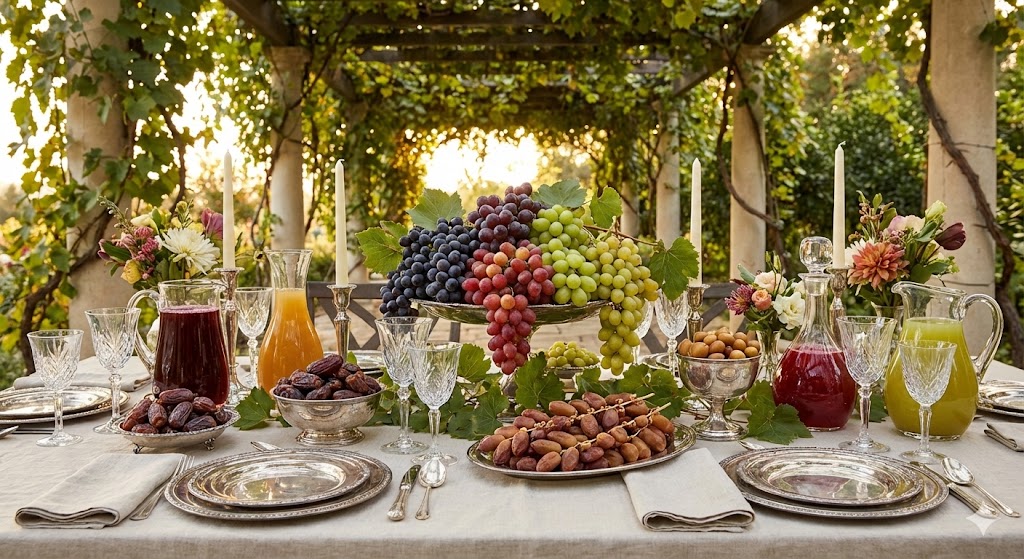
وَمِن ثَمَرَاتِ النَّخِيلِ وَالْأَعْنَابِ تَتَّخِذُونَ مِنْهُ سَكَرًا وَرِزْقًا حَسَنًا ۗ إِنَّ فِي ذَٰلِكَ لَآيَةً لِّقَوْمٍ يَعْقِلُونَ
Presented by Zia H Shah MD
Abstract
This comprehensive research report presents a rigorous examination of Surah An-Nahl, Verse 67 (16:67) of the Holy Quran, analyzing its theological implications alongside the complex biochemical mechanisms of fermentation. The verse, which distinguishes between sakar (intoxicants) and rizqan hasanan (good provision) derived from dates and grapes, serves as a focal point for understanding the intersection of divine revelation and biological science. This study traverses the etymological roots of the Arabic text, the metabolic pathways of Saccharomyces cerevisiae in alcoholic fermentation, and the bacterial conversion of malic acid in malolactic fermentation. It further explores the oxidative processes leading to vinegar—the “good provision”—and situates these phenomena within the history of Islamic science. By juxtaposing the prohibition of intoxicants with the mandate to study the natural world, the report illuminates a profound paradox: the encouragement to understand the molecular “signs” (ayat) of creation, even within substances prohibited for consumption. The analysis demonstrates how the Quranic text anticipates modern chemical distinctions, offering a framework where scientific inquiry into fermentation becomes an act of theological reflection.
Chapter 1: Introduction to the Quranic Cosmos
1.1 The Context of Surah An-Nahl (The Bee)
Surah An-Nahl, the 16th chapter of the Quran, is widely recognized in Islamic scholarship as Surah al-Ni’am (The Chapter of Blessings) due to its exhaustive enumeration of the natural bounties provided to humanity and the intricate systems that govern the natural world. Revealed during the Meccan period, this Surah serves as a foundational text for establishing the monotheistic worldview through empirical observation. The Surah does not merely list natural resources; it frames them as intellectual provocations—clues planted in the fabric of reality that demand cognitive engagement from the observer.
The structure of the Surah is significant. It moves systematically through the domains of creation: the heavens and the earth, the creation of man, the utility of livestock, the water cycle, and the vegetable kingdom. Verse 16:67 is situated within a specific triad of verses (16:66–69) that describe the processing of raw natural materials into fluids beneficial for mankind. This sequence is not accidental but represents a progression of biological complexity and human intervention.
Verse 16:66 describes the biological miracle of milk production in ruminants, separating pure nutrition from blood and excrement.1 This is a process that occurs entirely internally within the animal, driven by “instinctive” biological laws (Sunnat Allah), requiring no conscious chemistry from the human beneficiary. Immediately following this, Verse 16:67 shifts the focus from the animal kingdom to the plant kingdom, specifically the fruits of the date palm (nakheel) and the grapevine (a’nab). Here, the dynamic changes. The production of the final product is not automatic; it requires human agency (“you take” or “you derive”).
1.2 The Verse 16:67: A Textual Analysis
The Arabic text of the verse reads:
Wa min thamarāti an-nakheeli wal-a’nābi tattakhidhoona minhu sakaran wa rizqan hasanan; inna fee dhālika la-āyatan li-qawmin ya’qiloon.
Translation:
“And from the fruits of the palm trees and grapevines you take intoxicant and good provision. Indeed in that is a sign for a people who reason”.3
This verse is distinct in its juxtaposition of two potential outcomes derived from the same source. Unlike the milk in the previous verse, which is presented as a singular, pure product of divine processing, the fruits of the vine offer a choice to the human processor: they can be converted into sakar (an intoxicant) or rizqan hasanan (wholesome provision).4
The verse operates on multiple levels:
- Botanical: It identifies specific flora (dates and grapes) as high-value resources.
- Chemical: It distinguishes between two chemically distinct end-products derived from the same substrate.
- Moral: It subtly categorizes one product as “good” (hasan) and the other implies a lack of that quality.
- Cognitive: It concludes with a specific appeal to the faculty of reason (‘aql), suggesting that understanding this divergence requires intellectual effort.
1.3 The Objective of the Inquiry
This report aims to deconstruct this verse not merely as a legalistic text regarding the permissibility of alcohol—though that historical trajectory is relevant—but as a scientific observation of the chemical potentiality inherent in glucose-rich fruits. We will explore how the Quranic distinction between sakar and rizqan hasanan maps onto the divergent metabolic pathways of yeast and bacteria. Furthermore, we will analyze the “sign” (ayah) mentioned at the end of the verse, arguing that it serves as an invitation to understand the microbiology of fermentation, the chemistry of oxidation, and the philosophy of mind preservation.
The report will rigorously examine the biological mechanisms of Saccharomyces cerevisiae (yeast) and Oenococcus oeni (bacteria), detailing the conversion of sugars to ethanol and heat, and the secondary transformation of malic acid to lactic acid.7 We will demonstrate how these microscopic processes, invisible to the naked eye of the 7th-century Arab but implicitly acknowledged in the revelation, constitute the “sign” for those who reason.
Chapter 2: Linguistic and Exegetical Foundations
2.1 Etymology of “Sakar” and “Sukkar”
The term sakar used in 16:67 is of profound philological and chemical interest. In classical Arabic lexicons, such as Lisan al-Arab, the root s-k-r denotes the closing up, damming, or stopping of a passage.10 When applied to water, sakara al-nahr means to dam the river. When applied to the human mind, sukr (intoxication) acts as a blockage that prevents the passage of reason, logic, and sensory processing. The intoxicated person is “dammed” off from reality.
There is a significant philological debate regarding the relationship between sakar (intoxicant) and sukkar (sugar). The word sukkar in Arabic shares a phonetic and historical lineage with the Persian shakar and the Sanskrit sharkara (meaning gravel or grit, referring to sugar crystals).12 While some linguists debate the direct derivation of the Quranic sakar from the word for sugar, the chemical relationship is undeniable: sugar is the precursor to alcohol.
The Quran’s choice of sakar in this context captures the dual nature of the substance—it is chemically linked to sweetness (energy) but biologically linked to intoxication (the blocking of reason). This anticipates the biochemical reality that alcohol is simply a metabolic derivative of sugar. The verse acknowledges the source material (dates/grapes are rich in sugar) and the end product (intoxication) in a single root constellation.
2.2 The Distinction of “Rizqan Hasanan”
The verse establishes a binary opposition. On one side is sakar, and on the other is rizqan hasanan (good provision). The adjective hasan (good/beautiful/wholesome) is applied explicitly only to the provision, not to the intoxicant.3 This linguistic subtlety is viewed by commentators (mufassirun) as the first “gentle hint” or disapproval of alcohol, revealed in Mecca long before the legal prohibition (tahrim) was enacted in Medina.5
Rizqan hasanan encompasses the non-intoxicating uses of the grape:
- Fresh Fruit: High in vitamins, minerals, and immediate energy.
- Preservation: Dried raisins (zabib) and dates (tamr).
- Processed Non-Intoxicants: Molasses (dibs) and vinegar (khall).
Vinegar is chemically the result of continuing the fermentation process past the alcohol stage, converting the intoxicant into a preservative and condiment. Thus, the “good provision” is not just the raw fruit, but also the product of a specific chemical trajectory that avoids or corrects the state of intoxication.16
2.3 The Chronology of Revelation and Law
Verse 16:67 is Meccan by consensus.15 At the time of its revelation, the consumption of alcohol was not yet forbidden for Muslims. The verse acknowledges the sociological reality of the time: people were deriving intoxicants from these fruits. However, by contrasting it with “good provision” and concluding with a call to reason, the verse sets a theological trap for the intellect: if God has given you a fruit rich in energy and nutrition, why convert it into a substance that destroys the faculty of reason?
This sets the stage for a scientific investigation. What exactly happens inside the grape juice to create this divergence? The answer lies in the microscopic world of fungi and bacteria. The verse prompts the “people who reason” to investigate the mechanism of this divergence.
Chapter 3: The Botanical Substrate: The Grape
3.1 The Composition of the Must
To understand the “sign” in the grape, one must analyze the grape itself. The juice of the crushed grape, known as “must,” is a complex chemical soup. It is primarily composed of water (70-80%), but its significance lies in its solutes:
- Sugars: Glucose and Fructose. These are the fuel for fermentation.
- Organic Acids: Tartaric acid and Malic acid. These define the pH and stability of the juice.18
- Nutrients: Nitrogenous compounds (amino acids, ammonium) which yeast require for growth.
- Phenolics: Tannins and anthocyanins (in red grapes) responsible for color and texture.19
3.2 The Energy Potential
The grape is a battery of solar energy. Through photosynthesis, the vine converts sunlight and carbon dioxide into glucose ($C_6H_{12}O_6$). This molecule is a stable form of chemical potential energy. In the context of “Rizq” (provision), this sugar is the primary source of caloric energy for the human consumer.20
The verse mentions that mankind “takes” or “derives” (tattakhidhoona) products from this fruit. This verb implies a process—an extraction or manipulation.4 The scientific “sign” here is that the grape does not spontaneously become wine or vinegar without specific biological conditions. It requires a catalyst, a living agent of change.
3.3 The “Bloom”: Nature’s Pre-Packaging
One of the most remarkable biological facts about grapes, which aligns with the Quranic concept of “sign,” is the presence of the “bloom”—the waxy coating on the grape skin. This coating naturally harbors the very yeast (Saccharomyces cerevisiae and wild yeasts) needed for fermentation. The grape comes pre-packaged with the biological machinery required to transform it.22 This symbiosis between the fruit and the fungus is a testament to the interconnectedness of creation described throughout Surah An-Nahl.
Chapter 4: Primary Fermentation (The Alcoholic Transformation)
4.1 The Agent: Saccharomyces cerevisiae
The process of creating sakar (the intoxicant) is known scientifically as alcoholic fermentation. The primary agent is the yeast Saccharomyces cerevisiae. These microscopic fungi are single-celled eukaryotes. While they are invisible to the naked eye, their effects are macroscopic and transformative.
In the 19th century, Louis Pasteur, a figure central to the history of fermentation science, proved that fermentation was not a purely chemical decomposition (as believed by Liebig and others) but a biological process driven by living organisms.23 This discovery aligns with the Quranic theme of life emerging from “dead” matter, a recurring sign of divine power. Pasteur’s work validated the complexity of the “sign” mentioned in 16:67—that the transformation of grape juice is an act of life.
4.2 The Metabolic Pathway: Glycolysis
When yeast cells consume the sugars (glucose and fructose) in the grape juice under anaerobic conditions (absence of oxygen), they utilize the Embden-Meyerhof-Parnas pathway. This is a sequence of ten enzyme-catalyzed reactions that break down glucose into pyruvate.
The overall chemical equation for alcoholic fermentation is:
$$C_6H_{12}O_6 (aq) \rightarrow 2C_2H_5OH (aq) + 2CO_2 (g) + Energy (ATP + Heat)$$
7
This equation represents the transformation of the “Rizq” (sugar) into sakar (ethanol). It is a degradation of potential energy. The yeast extracts only a fraction of the energy available in the glucose molecule, leaving the rest “trapped” in the ethanol bond—a waste product for the yeast, but an intoxicant for the human.
4.3 The Mechanism of Intoxication Production
The conversion occurs in two critical steps after glycolysis, involving specific enzymes:
- Decarboxylation: Pyruvate ($CH_3COCOO^-$) is converted to acetaldehyde ($CH_3CHO$) and carbon dioxide ($CO_2$) by the enzyme pyruvate decarboxylase. This step releases the gas that makes fermentation “bubble” (the Latin root fervere means “to boil”).27$$CH_3COCOO^- + H^+ \rightarrow CH_3CHO + CO_2$$
- Reduction: Acetaldehyde is reduced to ethanol ($C_2H_5OH$) by the enzyme alcohol dehydrogenase, utilizing NADH as the electron carrier.$$CH_3CHO + NADH + H^+ \rightarrow C_2H_5OH + NAD^+$$
27
This specific molecular arrangement—the ethyl alcohol molecule ($C_2H_5OH$)—is the agent of intoxication. It is a small, water-soluble molecule that easily crosses the blood-brain barrier, disrupting neurotransmission (GABA and glutamate systems), leading to the suppression of the “reason” (‘aql) mentioned in verse 16:67.29
4.4 Thermodynamics: The Release of Heat
The fermentation process is exothermic; it releases heat.30 Winemakers must carefully control this heat, or it will kill the yeast. This detail—that the transformation of sugar to alcohol generates heat—adds another layer to the “sign.” It is a combustion without fire, a biological burning of energy. In the theological metaphor, the production of sakar “burns” the wholesome provision to produce a substance that “burns” the intellect (the Arabic word for hellfire, Saqar, is phonetically distinct but thematically related in the sense of heat/burning, though chemically, fermentation produces “heat” and $CO_2$).
4.5 The Theological Implication of Anaerobiosis (The Pasteur Effect)
It is scientifically notable that yeast prefers aerobic respiration (using oxygen) to fully break down sugar into water and $CO_2$, yielding far more energy (up to 38 ATP vs 2 ATP). However, alcohol production requires anaerobic conditions (or high sugar concentrations that trigger the Crabtree effect) to force the yeast into fermentation.22
Theologically, this can be viewed as a powerful metaphor: the production of sakar occurs when the “breath of life” (oxygen) is restricted, leading to an incomplete breakdown of nutrients that results in a toxic byproduct (ethanol). Conversely, in the presence of oxygen, the process shifts—a concept we will explore in the section on Vinegar. The “corruption” of the juice into an intoxicant is a result of stifling the oxidative environment.
Chapter 5: Secondary Fermentation (The Malolactic Conversion)
5.1 Beyond Alcohol: The “Softening” of the Wine
While 16:67 mentions the production of intoxicants, the complexity of winemaking—and the depth of the “sign” within the fruit—extends to a secondary process known as Malolactic Fermentation (MLF). This is not a fermentation in the strict sense (it does not produce alcohol from sugar), but it is a vital biological transformation in oenology.8
The verse mentions that from these fruits “you take” (tattakhidhoona)—implying a craft or a process. The winemaker’s craft often involves encouraging this secondary bacterial action to alter the sensory character of the liquid.
5.2 The Agent: Oenococcus oeni
MLF is driven by Lactic Acid Bacteria (LAB), primarily Oenococcus oeni (and sometimes Lactobacillus or Pediococcus). These bacteria consume the malic acid naturally present in the grape. Malic acid (C₄H₆O₅) is a harsh, diprotic acid associated with the sharp taste of green apples.33
5.3 The Chemistry of Texture: Decarboxylation
The bacteria convert L-malic acid into L-lactic acid and carbon dioxide.
$$C_4H_6O_5 \rightarrow C_3H_6O_3 + CO_2$$
Chemically, this transforms a diprotic acid (two acidic protons) into a monoprotic acid (one acidic proton). This reduces the titratable acidity of the wine and raises the pH. Crucially, lactic acid is “softer” on the palate, associated with the creaminess of milk and yogurt.9
5.4 The “Buttery” Sign: Diacetyl
A byproduct of this bacterial metabolism is diacetyl (2,3-butanedione), a compound that imparts a buttery aroma and creamy texture to the liquid.33 This is the chemical responsible for the “buttery” taste of Chardonnay and movie theater popcorn.
Insight: This secondary process highlights the complexity of the “sign.” The grape contains acids (malic) that are naturally harsh, which biology can transform into something “softer” (lactic). While in winemaking this is used to enhance the sensory appeal of the intoxicant (making the sin more palatable), the biochemistry itself is neutral and demonstrates the malleability of plant matter. It shows how “nature” (bacteria) can refine “nature” (fruit acids). The verse 16:67 alludes to the human choice (“you take from it”). Humans have learned to manipulate these microscopic bacteria to engineer the taste of their drink, further emphasizing the responsibility of the “people who reason” to choose which transformations to pursue.
Chapter 6: The Oxidative Divergence: Acetification and the “Good Provision”
6.1 The Third Path: Vinegar (Khall)
If the “intoxicant” (sakar) represents one path of the grape, what is the rizqan hasanan (good provision)? While fresh dates and grapes are obvious candidates, the processing of these fruits also yields vinegar. In Islamic Prophetic tradition (Sunnah), vinegar is highly praised (“What a blessed condiment is vinegar” – Sahih Muslim).
Vinegar is the result of a third biological process that acts upon the product of the first. If wine (the intoxicant) is left exposed to oxygen, it spoils. But in this spoilage, it finds redemption.17 This is the chemical pathway that reclaims the provision from the state of sakar.
6.2 The Agent: Acetobacter
This process is oxidative fermentation. Bacteria of the genus Acetobacter (acetic acid bacteria) are ubiquitous in the air. They colonize the surface of alcoholic liquids, forming a biofilm known as the “Mother of Vinegar.”
6.3 The Chemical Redemption: Oxidation
The bacteria consume the ethanol produced by the yeast and oxidize it into acetic acid. The reaction requires oxygen (aerobic):
$$C_2H_5OH + O_2 \rightarrow CH_3COOH + H_2O$$
36
6.4 Scientific and Theological Synthesis
This is a profound “sign” for the people of reason:
- Sakar (Alcohol): Anaerobic, intoxicating, blocks reason, chemically unstable.
- Rizq Hasan (Vinegar): Aerobic (requires oxygen), non-intoxicating, preservative, antiseptic, chemically stable.
The same starting material (grape juice) can become a poison or a medicine depending on the environment (oxygen) and the biological agent (yeast vs. bacteria). The transition from Alcohol to Acetic Acid is a chemical purification.
6.5 The Jurisprudence of Chemistry: Istihala
This chemical reality underpins the Islamic legal concept of Istihala (transformation). According to Islamic jurisprudence (Fiqh), if wine naturally turns into vinegar, it becomes Halal (permissible) and pure (Tahir). Why? Because the chemical nature has changed. The intoxicating attribute (the hydroxyl group of the ethanol) has been chemically oxidized into a carboxyl group (acetic acid).17
The verse 16:67 thus anticipates the chemical truth that the “intoxicant” and the “good provision” are separated only by a few atoms and a biological process, yet they are worlds apart in their effects on the human mind and soul. This demonstrates that “impurity” in Islamic law is often tied to chemical structure and physiological effect, not just origin.
Chapter 7: Neurobiology and the Philosophy of Mind
7.1 The Mechanism of “Veiling” Reason
The Quranic term for intoxicant, Khamr (related to Sakar), means to “veil” or “cover.” This linguistic description is remarkably accurate neurobiologically. Ethanol acts as a central nervous system depressant. It does not “stimulate” the brain in a generative sense; it suppresses inhibition.
Ethanol enhances the effect of the inhibitory neurotransmitter GABA (Gamma-aminobutyric acid) and blocks the excitatory neurotransmitter glutamate (NMDA receptors). This suppression disproportionately affects the prefrontal cortex—the area of the brain responsible for decision-making, impulse control, and rational thought.10
7.2 The Theology of Mind Preservation (Hifz al-‘Aql)
Islam identifies the preservation of the intellect (Hifz al-‘Aql) as one of the five higher objectives (Maqasid) of the Sharia. By contrasting sakar with “reason” (ya’qilun) in 16:67, the Quran establishes a direct opposition: Intoxicants are the enemy of Reason.
Therefore, the “Good Provision” (Rizqan Hasanan) is not just nutritional; it is that which sustains the body without compromising the mind. Glucose (from the dates/grapes) fuels the brain; Ethanol (from the fermentation) shuts it down. The verse implicitly argues that true provision supports the human faculty of reason, while intoxicants dismantle it.
Chapter 8: Historical Context: The Islamic Golden Age and Fermentation
8.1 The Paradox of Study
A significant question arises: If alcohol is prohibited in Islam, how and why did Muslim scholars contribute so heavily to the science of distillation and chemistry? The answer lies in the distinction made in 16:67—the recognition that these substances exist as part of God’s creation and contain “signs” to be studied, even if not consumed.40
8.2 The Etymology of Alcohol
The word “alcohol” derives from the Arabic al-kuhl (or al-ghawl in some etymologies). Muslim chemists like Jabir ibn Hayyan (Geber) and Al-Kindi perfected the alembic (al-inbiq) still. They isolated ethanol not to create stronger drinks (which was forbidden), but to create solvents, perfumes, and medicines. They recognized the chemical utility of the substance separate from its recreational vice.21
8.3 Ibn al-Haytham and the Scientific Method
The closing of verse 16:67—”Indeed in that is a sign for a people who reason”—resonates with the methodology of scholars like Ibn al-Haytham (Alhazen). Ibn al-Haytham, a pioneer of optics and the scientific method, viewed the pursuit of truth in nature as a form of worship. He famously stated, “I constantly sought knowledge and truth, and it became my belief that for gaining access to the effulgence and closeness to God, there is no better way than that of searching for truth and knowledge”.42
For these scholars, studying the fermentation of the grape was not an act of disobedience, but an act of decoding the Ayat (signs) of Allah. They understood the fermentation process described in 16:67 as a mechanism of nature, governed by laws (Sunnat Allah) that were worthy of investigation.43
8.4 Al-Biruni on Nature’s Laws
Al-Biruni, another titan of Islamic science, argued that the laws of nature are the laws of God. Investigating how a grape turns into wine, or how wine turns into vinegar, is an investigation into the Will of the Creator manifest in the physical world. This perspective allowed Islamic civilization to lead the world in chemistry for centuries, precisely because they did not shy away from studying substances that were religiously restricted for consumption.
Chapter 9: Comparative Analysis of Metabolic Pathways
To visualize the “signs” mentioned in the verse, we can compare the chemical pathways directly. This table illustrates the divergence described in 16:67.
| Feature | Rizqan Hasanan (Fresh/Dried Fruit) | Sakar (Alcoholic Fermentation) | Rizqan Hasanan (Vinegar – Acetification) |
| Primary Molecule | Glucose ($C_6H_{12}O_6$) | Ethanol ($C_2H_5OH$) | Acetic Acid ($CH_3COOH$) |
| Biological Agent | Plant Cells (Photosynthesis) | Saccharomyces cerevisiae (Yeast) | Acetobacter (Bacteria) |
| Oxygen Requirement | Aerobic (Photosynthesis) | Anaerobic (Fermentation) | Aerobic (Oxidation) |
| Energy Value | High Caloric (Fuel for Brain) | Empty Calories + Toxic | Low Caloric + Metabolic Aid |
| Effect on Mind | Sustains Function | “Veils” Reason (Khamr) | Sharpens/No Effect |
| Quranic Status | “Good Provision” | “Intoxicant” / “Sin” | “Good Provision” / “Blessed” |
Table 1: The Chemical Divergence of the Grape as implied in Quran 16:67.
Chapter 10: Epilogue: The Mandate of Science
10.1 The Synthesis of Science and Faith
Surah An-Nahl, Verse 67, stands as a monumental testament to the compatibility of divine revelation and scientific discovery. It does not shy away from the reality of chemical transformation; rather, it highlights it as a sign of God’s power. The verse anticipates the discoveries of chemistry by acknowledging the latent potential within the fruit. It implies the existence of the microscopic agents—the yeasts and bacteria—that act as the invisible laborers carrying out these transformations.
10.2 An Opportunity to Learn from the Forbidden
The user query highlights a profound point: the verse uses the process of winemaking as an opportunity to learn science, philosophy, and theology, even though the Quran prohibits the use of intoxicants. This is a critical pedagogical principle.
- Scientific Curiosity: The prohibition is on consumption, not cognition. The Muslim scientist is encouraged to understand the yeast, the fermentation pathway, and the chemistry of ethanol. The prohibition does not create a “black box” of ignorance; rather, it creates a boundary of safety from which one can observe the danger.
- Theological Reflection: The existence of sakar serves as a test. It demonstrates that the world is not “safe” by default; it requires human discernment. The grape can be a blessing or a curse depending on how it is processed. This teaches moral responsibility.
- Philosophical Insight: The duality of the grape teaches that “good” and “bad” are often matters of arrangement and process. The atoms in sugar, alcohol, and vinegar are the same (Carbon, Hydrogen, Oxygen). It is their structure—determined by the biological path taken—that defines their moral and physical status.
10.3 The Call to “People Who Reason”
The phrase “for a people who reason” (ya’qilun) is a mandate. It encourages the believer to become a scientist. To understand 16:67 fully, one must understand botany, microbiology, and organic chemistry. One must understand the pathways of glycolysis and the neurobiology of addiction.
The prohibition of alcohol in Islam is often viewed as a restriction, but through the lens of 16:67, it is a redirection. It redirects human curiosity away from the consumption of the mind-destroying substance and toward the contemplation of the complex, divinely orchestrated processes that create it. It teaches that even in the things we are forbidden to consume, there are lessons we are commanded to learn.
In the fermentation vat, we see the struggle between preservation and decay, between oxygen and suffocation, between nutrition and intoxication. These are physical manifestations of spiritual truths. The grape is a test, a provision, and a laboratory. By exploring its chemistry, we fulfill the Quranic command to reflect, proving that the pursuit of scientific truth is, ultimately, an act of theological devotion.
If you would rather read in Microsoft Word file:



 The Glorious Quran and Science
Leave a comment