
Written and collected by Zia H Shah MD
Abstract
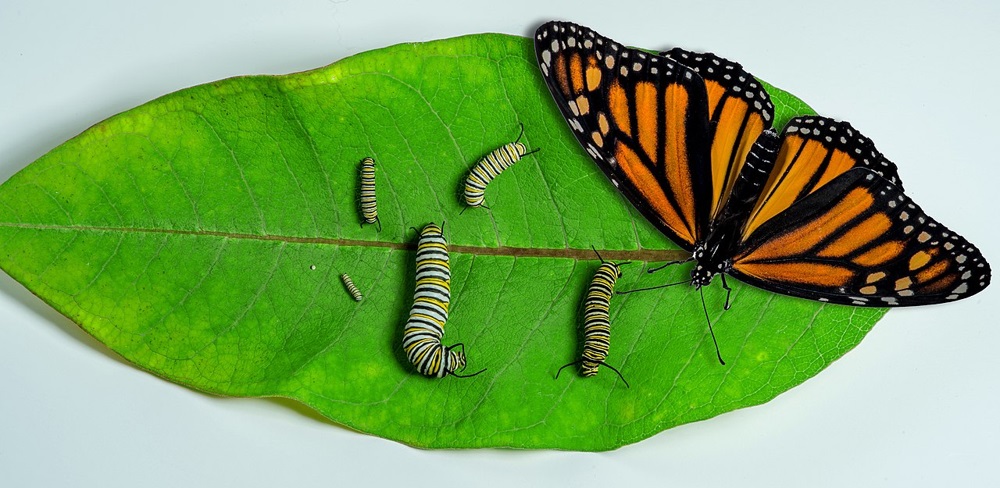
In a world of breathtaking biological diversity, guided evolution offers a perspective that marries scientific understanding with spiritual insight. Rather than seeing evolution as a blind, random process, this view proposes that evolution is the method by which a wise Creator unfolds life’s tapestry – gradually, majestically, and with purpose. By examining the Quran’s own references to nature’s order and beauty, we find a consonance between faith and science. The metamorphosis of a humble caterpillar into a radiant butterfly and the peacock’s extravagant plumage are two striking examples: both illustrate complexity and beauty that hint at intentional design rather than mere chance. Drawing on the works of Zia H. Shah MD and Quranic verses, this article argues that nature’s wonders – from a butterfly’s chrysalis to the “eyes” on a peacock’s tail – reflect a divinely guided evolutionary process. In Islam, God’s creative agency and the observable mechanisms of evolution are not at odds. Instead, they form a harmonious narrative in which nature is a revelation: a living scripture that, alongside the written Quran, guides us to the truth that behind life’s evolution is an intelligent, benevolent purpose.

Quranic Perspective on Guided Evolution
The Qur’an portrays creation as a deliberate, ordered process under divine guidance. It emphatically states that God “perfected everything which He created” (Qur’an 32:7) themuslimtimes.info. Rather than a haphazard outcome, every creature is formed in a fitting manner, reflecting intention and wisdom. In Islamic thought, one of the names of God is Al-Muṣawwir – “The Fashioner” or Bestower of Forms (Qur’an 59:24), indicating that the diversity of forms in nature is the result of a conscious artistry themuslimtimes.info. Another divine name, Ar-Rabb (often translated “Lord”), carries the meaning of a nurturer who guides things through stages to their completion. As one commentary highlights, Ar-Rabb encapsulates God’s nurturing guidance, “progressively from one stage to the next until it reaches its goal of perfection” iicoman.com. In essence, the concept of guided evolution is the idea that evolution is how Allah creates – not aimlessly, but with gradual unfolding and direction towards purposeful ends iicoman.comiicoman.com.
Crucially, the Quran invites us to observe patterns and origins in the natural world as signs of this guided process. “Travel through the earth and observe how He began creation,” it encourages (Qur’an 29:20), underscoring that the story of life’s development holds divine lessons. The Quran describes life emerging from water (Qur’an 21:30, 24:45) and humanity’s own physical creation as originating from earth’s elements (clay), then developing through mingled fluids and embryonic stages iicoman.com. “He began the creation of man from clay. Then made his progeny from a humble fluid…” — these words in Qur’an 32:7–8 are followed by, “Then He proportioned him and breathed into him of His Spirit…” (32:9). According to Zia H. Shah MD, this sequence “encapsulates the entire evolutionary process”, with human physical form evolving over time and the divinely given soul marking the culmination of humanity’s creation iicoman.com. In other words, the Qur’an itself outlines a progression: from simple matter to complex life to conscious humanity – a progression that mirrors what science tells us, but crucially, the Qur’an attributes it to God’s plan and guidance at every step. themuslimtimes.info The Qur’an also teaches that God endows each creature with its form and then guides it to its destined capabilities (Qur’an 20:50). Classical Islamic scholars interpret this to mean every species is guided to fulfill the purpose intended for it. Modern Muslim thinkers like Zia H. Shah MD see in this a resonance with evolution: just as an embryo is guided to develop into a fully formed human, so too have species been guided through natural laws to their current forms. This guidance operates through what science calls the laws of biology – genetics, natural selection, ecological interactions – but from a faithful perspective, these laws are “divinely guided” instruments of God’s creative will thequran.love. Crucially, such guidance often results in outcomes that “transcend what blind chance alone might achieve” themuslimtimes.info. In simple terms, while evolution involves random mutations and survival pressures, the overall direction and the emergence of remarkable complexity and beauty are seen as signs of a higher orchestration. The Quranic worldview negates the idea that life is an accident; instead, it portrays nature as an expression of qudra (divine power) and hikmah (divine wisdom) working through gradual processes.
Read further in Microsoft Word file:


 The Glorious Quran and Science
Leave a comment