
Epigraph
الْحَمْدُ لِلَّهِ رَبِّ الْعَالَمِينَ
“All praise is due to Allah, the Lord of the worlds!” (Al Quran 1:1)
Written and collected by Zia H Shah MD
Abstract
This paper offers a comprehensive scientific, philosophical, and theological commentary on three Quranic verses – Quran 1:1, 7:54, and 45:36–37 – which exalt God as “Lord of the Worlds” (رَبِّ الْعَالَمِينَ). We explore how the Quran’s wording and classical Islamic exegesis imply a multiplicity of “worlds,” a notion that intriguingly resonates with the modern multiverse hypothesis. Drawing on contemporary cosmology, we examine the concept of a multiverse: multiple universes beyond our own, potentially innumerable in scope. We integrate evidence of cosmic fine-tuning – the observation that the fundamental constants and initial conditions of our universe are remarkably calibrated for life – and argue that this fine-tuning strengthens the case for God’s existence, even if a multiverse exists. Contrary to claims that a multiverse would undermine divine design, we contend that an ensemble of universes would itself require an explanation and, in fact, magnifies the creative scope attributable to God. Through Quranic analysis and scientific reasoning, we conclude that the fine-tuning of the universe (or multiverse) points to a purposeful Creator rather than chance. In doing so, we find a harmonious convergence between the Quran’s theological vision and cutting-edge cosmological thought. A thematic epilogue reflects on the spiritual significance of God’s lordship over all possible worlds, inviting awe at the infinite creativity of the Divine.
Introduction
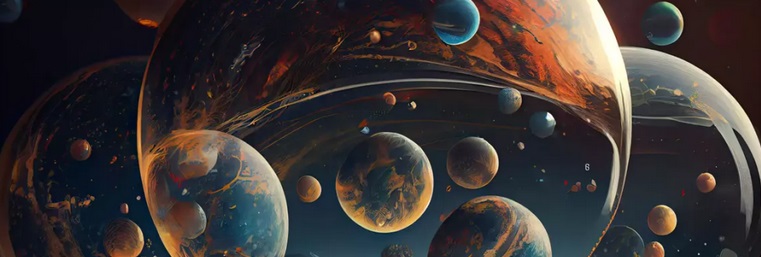
The Quran opens with a profound declaration that frames the Islamic worldview: “All praise is due to Allah, the Lord of the worlds” (ٱلْحَمْدُ لِلَّـهِ رَبِّ الْعَالَمِين1) thequran.love. From the very first chapter (Al-Fātiḥah), God is described not just as Lord of one world, but of all worlds. This phrase recurs throughout the Quran, emphasizing the vast scope of divine dominion. In Sūrah Al-A‘rāf, after describing the creation of the heavens, the earth, and the celestial order, the Quran concludes: “Blessed is Allah, the Lord of the worlds” (تَبَارَكَ اللّٰهُ رَبُّ الْعَالَمِينَ) myislam.org. And in the closing verses of Sūrah Al-Jāthiyah, we read: “To Allah belongs all praise – Lord of the heavens and Lord of the earth, Lord of the worlds” (فَلِلّٰهِ الْحَمْدُ رَبِّ السَّمٰوٰتِ وَرَبِّ الْأَرْضِ رَبِّ الْعَالَمِينَ) thequran.love. Clearly, the Qur’anic text itself invites readers to think in terms of a plurality of realms or worlds under one ultimate Lord.
What did “the worlds” (al-‘ālamīn) mean to the early Muslim understanding, and could it encompass realities beyond the one universe we know? Classical Islamic scholars predominantly interpreted “worlds” to mean everything in existence apart from God – every category of creation in all times and places thequran.love. In this view, Rabb al-‘ālamīn (Lord of the worlds) is an all-embracing title: God is Lord of every realm of being, from the material cosmos to the unseen dimensions of angels and jinn, from the earthly world to the afterlife thequran.love thequran.love. The plural form ‘ālamīn was seen as signifying an abundance: not one world, but many sorts of worlds or domains. For example, the medieval exegete Ibn Kathīr defined “the worlds” as “everything in existence” apart from Allah – including every land, sky, habitat, and even the hereafter thequran.love. Some commentators enumerated a multitude of worlds: the world of humans, the world of animals, the world of jinn, the angelic world, etc. A striking narration even speaks of eighteen thousand worlds created by Allah, our Earth being merely one among them thequran.love. While such reports are extra-Qur’ānic and not verifiable, they demonstrate that early Muslims were comfortable with the idea of innumerable realms in creation. The Quranic phrase itself, by using the plural “worlds,” inherently implies multiple spheres of creation, all under one sovereign God thequran.love.
Importantly, the traditional understanding of ‘ālamīn did not limit “worlds” to physical planets or universes in the modern sense. Rather, ‘ālam in Arabic can mean a world or domain of existence, a whole category of creation. Thus, to a 7th-century listener, “the worlds” meant the fullness of the cosmos as they knew it – encompassing both the seen world and the unseen, the present life and the life to come thequran.love. The Quran itself provides context for this interpretation: when Pharaoh challenged Moses asking, “And what is the Lord of the worlds?”, Moses replied, “The Lord of the heavens and earth and all that is between them…” (Quran 26:23–24) thequran.love. In other words, “the worlds” was equated with everything in the heavens and earth – the totality of creation. Each era or realm of creatures can be thought of as a “world,” and God is Master of them all thequran.love.
Yet alongside this broad understanding, the Quran contains intriguing hints that creation is not monolithic but occurs in multiplicity. For instance, Allah says in Sūrah Aṭ-Ṭalāq: “It is Allah who has created seven heavens and of the earth the like thereof. His command descends among them…” (Quran 65:12) thequran.love. This verse explicitly mentions seven earths to parallel the seven heavens. While many scholars interpreted the “seven earths” as seven layers or divisions of our single planet, some did not rule out that it could imply seven distinct terrestrial worlds thequran.love. Modern commentators note that “while this text does not provide unequivocal support for the multiverse, it is highly suggestive of a large number of multiple ‘heavens and earths’”, especially if “seven” is taken as a symbolic number of perfection rather than a literal count thequran.love. In any case, the Quran emphasizes that creation isn’t limited to one plane – it speaks of multiple heavens and, intriguingly, multiple earths, indicating a layered or plural cosmos.
Another verse broadens this vision further. Sūrah Ash-Shūrā 42:29 proclaims: “And among His signs is the creation of the heavens and the earth and the living creatures that He has spread throughout them; and He is able to gather them together when He wills.” This suggests that life is not confined to Earth – there are creatures “dispersed” throughout the heavens as well, whom God can assemble if He so pleases thequran.love. Some classical scholars understood those “creatures” as angels or jinn. However, the verse is open-ended and, notably, some have read it as leaving room for biological life elsewhere in the universe – essentially, other worlds with their own inhabitants thequran.love. In the 21st century, this verse resonates with the scientific hope (or expectation) that life might exist on other planets. At the very least, it underscores that Islamic scripture envisions a cosmos teeming with creations beyond our immediate knowledge.
To be clear, pre-modern Muslim scholars did not articulate a “multiverse” in the strict modern sense of multiple separate physical universes. Their focus was on multiple realms within a single created order (layers of heaven, earth, spiritual planes, etc.). However, they never constrained Allah to creating only a single world. In fact, some Muslim thinkers went remarkably further in their speculation. The 12th-century scholar Fakhr al-Dīn al-Rāzī, reflecting on the infinitude of God’s power, mused that nothing in reason or scripture rules out Allah having created many worlds beyond our own. He wrote that evidence indicates “beyond the world exists a void without end, and God Most High has power over all possible things. Therefore He… has the power to create a thousand thousand worlds beyond this world, such that each of those worlds be as big and as substantial as this one, with its own heavens and earth, sun and moon” thequran.love. Rāzī boldly criticized those philosophers who claimed our universe was unique, calling their arguments “weak, flimsy” thequran.love. In his view, an Omnipotent God could create endless worlds, whether sequentially or concurrently, and we have no basis to assert that this cosmos exhausts His creative capacity. Such remarks are astounding for their time – effectively an Islamic precedent for embracing an immensely expanded cosmology. Rāzī’s conjecture did not describe parallel physical universes in the modern sense, yet he clearly opened the door conceptually to plural universes (whether spiritual or physical), all under the dominion of God.
In summary, the Quran’s designation of Allah as “Lord of the worlds” plants the seed of a grand perspective: God’s sovereignty extends over every realm one can conceive – and perhaps realms yet unconceived thequran.love. This engenders in the believer a sense that God’s creative power is limitless and not confined to the little theatre of our planet or even our universe. The Quran taught its audience to think big. It shattered any notion that reality is only what we immediately see; rather, it declares that countless worlds, known and unknown, lie within God’s creation thequran.love. Thus, if modern science today speculates about a multiverse – numerous universes beyond our own – a reflective Muslim can find this idea unsurprising, even natural, in light of the Quran’s expansive language. The One who is “Lord of all worlds” would by definition be God over any universe that exists. Far from undermining faith, the possibility of other worlds can deepen one’s appreciation of God’s majesty. As we shall argue, acknowledging a multiverse (should it exist) can be seen as multiplying the avenues for glorifying God, not denying Him. Each world or universe would declare God’s praise in its own way – as the Quran states: “The seven heavens and the earth and all within them exalt Him, and there is not a thing except that it exalts [Allah] by His praise” (Quran 17:44) thequran.love. With that spiritual backdrop, we now turn to the scientific exploration of the multiverse idea, and the related discussion of fine-tuning in cosmology, to see how these concepts intersect with theology.



 The Glorious Quran and Science
Leave a reply to “Lord of the Worlds” vs “Cosmic Dice”: Scientific, Philosophical, and Theological Dimensions Compared – The Glorious Quran and Science Cancel reply