
Written and collected by Zia H Shah MD
Abstract
Surah Al-Fath (“The Victory,” Quran chapter 48) celebrates a manifest victory granted by God to Prophet Muhammad – not a military triumph, but the peace treaty of Hudaybiyyah (628 CE) between the Muslims of Medina and their Meccan foes thequran.love thequran.love. At the time, many companions viewed the treaty’s terms as humbling and unfavorable, yet the Qur’an declares it a “clear victory” thequran.love. This commentary examines each verse in historical context, drawing on classical biographies and modern scholarship to relate the surah to events in the Prophet’s life. We explore how seemingly adverse conditions – a delayed pilgrimage, strict terms imposed by Mecca – became the groundwork for Islam’s rapid expansion, illustrating the Qur’anic principle that God’s wisdom and plan may defy immediate human expectations surahquran.com surahquran.com. Philosophically and theologically, Surah 48 underscores Al-Ghazali’s doctrine of occasionalism: the belief that every event and outcome occurs directly by God’s will and power thequran.love thequran.love. Throughout the chapter, victory is explicitly attributed to divine agency rather than human might – God “sent down tranquility” into believers’ hearts, “withheld the hands” of enemies, and “fulfilled” the Prophet’s reassuring vision of a peaceful pilgrimage. The Prophet Muhammad’s exemplary leadership shines in this narrative: his flexibility, patience, and trust in God turned a potential conflict into an epoch-making peace, earning God’s pleasure and paving the way for Mecca’s bloodless conquest two years later thequran.love surahquran.com. In the epilogue, we synthesize the surah’s themes – the primacy of peace over war, the importance of steadfast faith in trials, and the continuous interplay of divine providence in historical events – drawing lessons on compassionate leadership and reliance on God’s decree in the spirit of Al-Fath’s message.
Verse 1
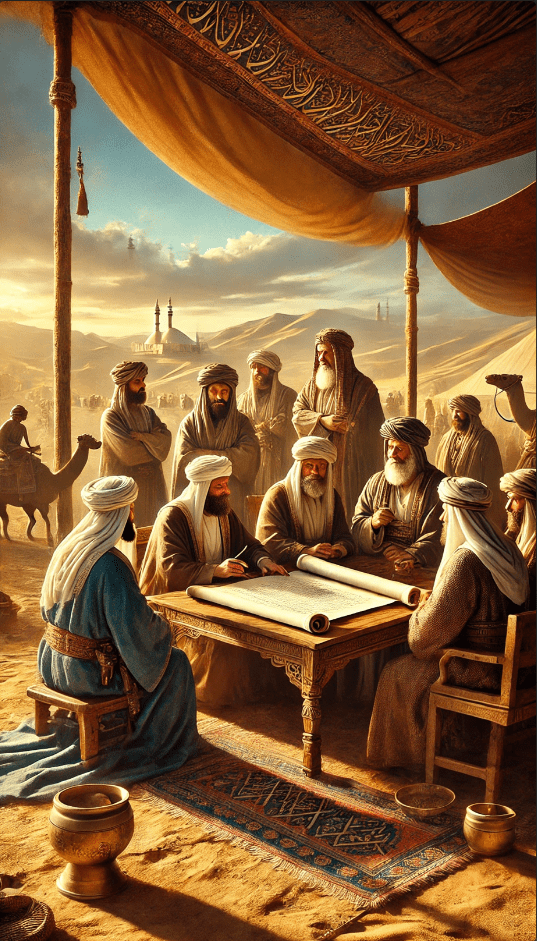
“Truly We have opened up a path to clear triumph for you [Prophet]” islamawakened.com. The chapter opens with a definitive divine proclamation of victory. Historically, this refers to the Treaty of Hudaybiyyah, concluded in Dhul-Qa‘dah, 6 AH (628 CE) thequran.love thequran.love. Prophet Muhammad and ~1,400 Muslims had journeyed from Medina in peacetime ihram garb to perform the lesser pilgrimage (‘Umrah), only to be barred from Mecca by the Quraysh thequran.love thequran.love. After tense negotiations at a place called Hudaybiyyah just outside Mecca, the Prophet agreed to a 10-year truce and to postpone the pilgrimage to the following year thequran.love thequran.love. Many companions were dismayed – outwardly, the Muslims appeared to concede to Quraysh’s demands, accepting conditions like returning without entering Mecca and repatriating any Meccan who migrated to Medina (while Mecca need not return any Muslim) thequran.love thequran.love. ʿUmar ibn al-Khattab famously voiced his confusion: “Was this truly a victory?” thequran.love thequran.love. In response, God revealed this verse on the Muslim caravan’s return to Medina, affirming the treaty itself as a great victory thequran.love thequran.love.
From a historical perspective, Hudaybiyyah was a manifest victory “though there was no actual fighting” thequran.love. It achieved through peace what battles had not. The treaty recognized Muslims as an equal negotiating party to Quraysh (a huge prestige gain) thequran.love, halted hostilities, and crucially opened Arabia’s doors for daʿwah (inviting to Islam) among formerly hostile tribesthequran.love. In the ensuing two years of peace, Islam spread far more rapidly – “large numbers came over to Islam”, as later noted by Muhammad Ali and other historians thequran.love. The “path” that God “opened” was thus a diplomatic and spiritual breakthrough that eventually led to the bloodless conquest of Mecca in 630 CE and the unification of Arabia under Islam thequran.love surahquran.com. Philosophically, declaring a peace treaty as the “clear triumph” highlights Islam’s emphasis on reconciliation and mercy over warfare thequran.love thequran.love. Seyyed Hossein Nasr observes that God reserved the acclaim of “a great victory” for this moment of non-violent conflict resolution, not for the earlier military victories at Badr or elsewhere thequran.love thequran.love.
Theologically, verse 1 sets the tone of occasionalism: victory is “granted” by God alone. The Arabic uses “inna fataḥnā laka” – “Surely We (God) have given/opened for you [this] victory” – underscoring that the triumph emanates directly from God’s will, not from human swords. Al-Ghazali’s doctrine of occasionalism, which asserts that all causes and effects are directly orchestrated by Allah thequran.love thequran.love, is reflected here. Despite the Prophet’s astute leadership, it was ultimately God who facilitated the circumstances and softened hearts to enable this win-win treaty. As later verses will elaborate, every aspect of Hudaybiyyah’s success is attributed to God – a reminder that in Islam’s worldview, “the outcome of every affair is with God” thequran.love thequran.love. Thus, verse 1 is both an announcement and a reassurance: what looked like a setback is in fact a divinely ordained victory, heralding a new chapter of expansion and “clear triumph” for the Prophet and believers.
Read further in Microsoft Word file:

 The Glorious Quran and Science
Leave a comment