
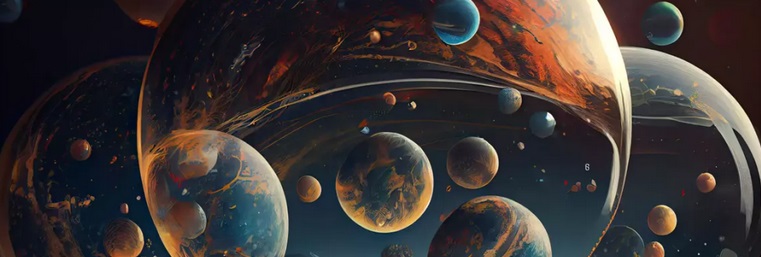
Epigraph
فَلِلَّهِ الْحَمْدُ رَبِّ السَّمَاوَاتِ وَرَبِّ الْأَرْضِ رَبِّ الْعَالَمِينَ
وَلَهُ الْكِبْرِيَاءُ فِي السَّمَاوَاتِ وَالْأَرْضِ ۖ وَهُوَ الْعَزِيزُ الْحَكِيمُ
Written and collected by Zia H Shah MD
Abstract
This essay offers a devotional yet scholarly commentary on Quran 45:36–37, exploring how the praise of God as “Lord of the worlds” may hint at realities far beyond our single universe. We integrate cosmology, philosophy, and Islamic theology to examine the possibility that the Quran alludes to a multiverse. After introducing the verses and their classical interpretation (that all creation, seen and unseen, is encompassed by “the worlds”), we delve into modern scientific perspectives on multiple universes. We discuss theoretical physics concepts – from the inflationary cosmos to quantum many-worlds – and consider philosophical ideas about possible worlds. Throughout, we draw connections with other Quranic verses that support the notion of multiple realms of creation. The commentary maintains a reflective and devotional tone, inviting readers to marvel at the convergence between divine revelation and contemporary cosmology. In conclusion, we find that acknowledging a multiverse can deepen one’s appreciation of God’s majesty, as the One worthy of all praise in any and every world that exists.
Introduction
The closing verses of Surah Al-Jathiyah (45:36–37) resound with an anthem of praise, declaring God’s sovereignty over “the heavens and the earth” and naming Him “Lord of the worlds.” In translation, these verses read:
“Then, to Allah belongs [all] praise – Lord of the heavens and Lord of the earth, Lord of the worlds. And to Him belongs [all] grandeur within the heavens and the earth, and He is the Exalted in Might, the Wise.”
At first glance, this exaltation emphasizes that all domains of existence are under God’s dominion. Muslims recite similar words daily in Al-Fātiḥah: “Praise be to Allah, the Lord of the worlds” (Quran 1:2). Traditionally, commentators explain “the worlds” (al-‘ālamīn in Arabic) as a plural that signifies everything in existence apart from God. It encompasses every realm: the human world, the jinn world, the angelic world, the hereafter – all creation in both the spiritual and physical sense. In this classical sense, “Lord of the worlds” is an expansive term declaring that God is Lord of all categories of beings and every possible realm of creation.
This essay asks a bold question: could these Quranic verses also be hinting at a reality that modern science is only beginning to theorize – the existence of multiple universes? The phrase “Lord of the worlds” has intrigued some contemporary scholars to consider whether “worlds” could suggest… other, spatio-temporally unrelated worlds (universes) — the stuff of the multiverse. While medieval exegesis did not use the language of “parallel universes,” the Quran’s choice of the plural “worlds” invites contemplation of a cosmos more complex than a single world-sphere. At the very least, it affirms that God’s creative power is not confined to one small domain. This dovetails with modern ideas in cosmology that our universe might be just one of many – a single “bubble” in a vast multiversal ocean.
In what follows, we will explore the concept of the multiverse from multiple angles and see how it might resonate with Islamic thought. First, we will examine Quranic imagery of multiple worlds and classical Islamic views on the breadth of creation. Next, we’ll summarize key scientific theories of the multiverse from cosmology and quantum physics, keeping the discussion accessible. We will then discuss philosophical and theological perspectives – how infinite or multiple worlds fit with the notion of an infinitely creative God. Throughout, we maintain a devotional perspective: our aim is not to force scientific readings onto scripture, but to broaden our sense of wonder at Quranic verses in light of contemporary knowledge. In doing so, we echo the approach of believers who see science as a means to better appreciate the glory of the Creator. As one Muslim physicist notes, issues at the boundary of cosmology and metaphysics remind us that “the problem of creation is not a matter of physics alone”. Ultimately, whether or not a physical multiverse exists, the Quran’s vision of God’s lordship over “all worlds” provides a rich framework for integrating new scientific ideas into a faith-informed understanding of reality.
“Lord of the Worlds” – Many Realms, One Lord
When the Quran calls God “Rabbul-‘ālamīn” (Lord of the worlds), it uses a term that has invited reflection for centuries. Classical scholars generally held that ‘ālamīn (worlds) signifies all created things in their various domains and epochs. The medieval exegete Ibn Kathīr, for example, defined “worlds” as encompassing “everything in existence” apart from Allah – including every realm of creatures on land, sea, in the heavens, and even the hereafter. Other commentators enumerated worlds of humans, jinn, angels, animals, etc., or even speculated vast numbers: a saying attributed to early authorities speaks of eighteen thousand worlds created by Allah, of which our earthly world is just oneislam.stackexchange.comislam.stackexchange.com. While such narrations are not from the Quran itself, they demonstrate that Muslim imagination was comfortable with abundance in creation. The phrase “Lord of the worlds” inherently implies that multiple spheres of creation exist, all under one sovereign Divinity.
It is important to note that traditional interpretations did not limit “worlds” to planetary worlds as we might think today. Rather, ‘ālam (world) can mean an entire category or realm of being. For instance, the Quran recounts that Pharaoh, in his hubris, asked Moses “What is the Lord of the worlds?” Moses replied, “The Lord of the heavens and earth and all that is between them…” (26:23–24). This response equates “worlds” with everything in the heavens and earth – essentially all of creation in its totality. Thus, to a 7th-century listener, “the worlds” meant the fullness of the cosmos as they understood it: the seen world and unseen world, the present world and the world to come. Every generation (alam) or habitat of creatures is a “world,” and God is Master of them all.
However, the Quran also contains intriguing phrases that suggest a plurality of cosmic structures. For example, Allah says in Surah Ṭalāq: “It is Allah who has created seven heavens and of the earth the like thereof. His command descends among them…” (65:12). This verse explicitly mentions seven earthly realms to parallel the seven heavens. Some commentators understood the “seven earths” as seven layers or continents of our planet. Yet others did not rule out that it could mean seven distinct worlds. Contemporary writers have noted that “while this text does not provide unequivocal support for the multiverse, it is highly suggestive of a large number of multiple ‘heavens and earths’ (taking ‘seven’ as metaphorical for the number of perfection)”. In other words, the Quran itself emphasizes that creation isn’t monolithic – it comes in multiplicity, even if that multiplicity was traditionally seen in vertical layers or metaphysical realms.
Beyond the heavens and earth, Islamic teachings speak of realms like Barzakh (the intermediate world of the dead) and the Ākhirah (Hereafter), reinforcing that reality, in Islam, is multi-layered. The Quran states that Allah “creates what you do not know” (16:8), hinting that unseen worlds or creatures may exist beyond our knowledge. A striking verse in Ash-Shūrā (42:29) says: “And among His signs is the creation of the heavens and the earth and the living creatures that He has spread throughout them; and He is able to gather them together when He wills.” This suggests that life is not limited to earth – there are creatures “dispersed” throughout the heavens too, whom God can assemble at will. While some scholars interpret those “creatures” as angels or jinn, others allow that it leaves open the possibility of biological life elsewhere – essentially, other worlds with their own inhabitants.
To be clear, classical Islamic scholarship did not articulate a concept identical to the modern multiverse (in the sense of totally separate physical universes). But importantly, it never constrained Allah to a single world. In fact, a number of Muslim thinkers entertained the notion of plural worlds. The 12th-century scholar Fakhr al-Dīn al-Rāzī mused on the infinitude of God’s power and the finiteness of our cosmos. He wrote that evidence indicates “beyond the world [exists] a void without end, and that God Most High has power over all possible things. Therefore He… has the power to create a thousand thousand worlds beyond this world, such that each of those worlds be as big and as substantial as this one, with its own heavens and earth, sun and moon”en.wikiquote.org. Rāzī boldly criticized earlier philosophers for claiming this universe was unique, calling their arguments “weak, flimsy”en.wikiquote.org. His perspective was that an omnipotent God could create endless successive or coexisting worlds, and nothing in reason or scripture definitively rules that out. Such remarks show an Islamic precedent for embracing a vastly expanded cosmology. The exact nature of those other worlds – spiritual or physical – was not detailed, but the conceptual openness is undeniable.
In sum, “Lord of the worlds” in Quranic language establishes God’s supremacy over every realm one can conceive – and perhaps even realms yet unconceived. It engenders in the believer an expectation that God’s creative act is limitless. Thus, if science today speaks of numerous universes or hidden dimensions, a reflective Muslim can find this unsurprising in light of the Quran’s own grand vision. The Quran taught us to think big: it shattered any notion that reality is confined to our familiar world. Instead, all praise belongs to the One who presides over countless worlds known and unknown.
Before delving into science, let us remind ourselves why this matters devotionally. If indeed there are myriad worlds or even a true multiverse, it only multiplies the avenues for glorifying God. Each world would declare God’s praise in its own tongue – as the Quran states, “The seven heavens and the earth and all within them exalt Him, and there is not a thing except that it exalts [Allah] by His praise” (17:44). With that spiritual backdrop, we turn now to the scientific idea of the multiverse: what it means and how it might be glimpsed through modern cosmology.
Read further in Microsoft Word file:



 The Glorious Quran and Science
Leave a reply to Lord of the Worlds: Quranic Verses, Multiverse, and the Fine-Tuning of the Cosmos – The Glorious Quran and Science Cancel reply