
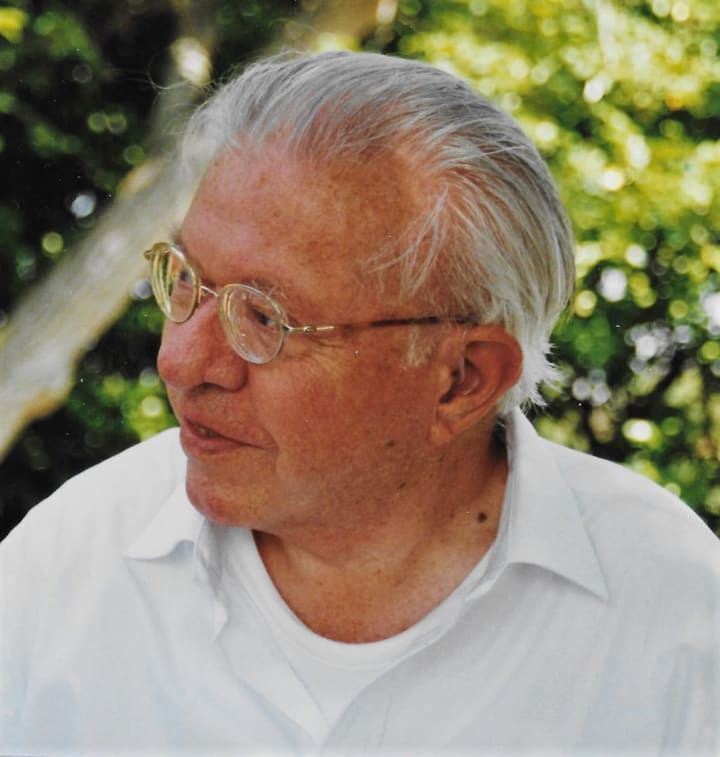
Written and collected by Zia H Shah MD
Fred Hoyle (1915–2001) was a renowned English astronomer and astrophysicist, famous for his groundbreaking contributions to stellar nucleosynthesis and his staunch opposition to the Big Bang cosmological model en.wikipedia.org. Hoyle’s long and influential career spanned academic research, popular science writing, and even science fiction. He coined the term “Big Bang” (originally meant derisively) for the theory he vehemently rejected, advocating instead for a rival Steady State model of the universe en.wikipedia.org. A committed atheist, Hoyle allowed his philosophical beliefs to inform his science – most notably in his rejection of a universe with a definitive beginning, which he saw as uncomfortably akin to a Creation event en.wikipedia.org. This article delves into Hoyle’s life and scientific career, his reasons for rejecting the Big Bang theory, the Steady State cosmology he championed, and how the scientific community responded to his ideas.
Early Life and Education
Fred Hoyle was born on 24 June 1915 in Gilstead, a village near Bingley in Yorkshire, Englanden.wikipedia.org. From an early age, he displayed remarkable aptitude in mathematics and science – reportedly multiplying numbers up to 12×12 by age four and avidly reading astronomy books by age tencsueastbay.edu. His father was a wool merchant and his mother a schoolteacher, providing a supportive environment for his early intellectual developmentcsueastbay.edu. Hoyle attended local schools and excelled academically, earning a scholarship to Emmanuel College, Cambridge, where he completed a Bachelor’s degree in mathematics in 1936csueastbay.edu. He was soon elected a Fellow of St. John’s College, Cambridge in 1939 for his research on beta-decay in nuclear physicscsueastbay.edu.
While at Cambridge, Hoyle’s interests shifted from pure mathematics to astrophysics, thanks to the influence of his friend and colleague Raymond Lyttletoncsueastbay.edu. Under Lyttleton’s encouragement, Hoyle began applying his mathematical talent to problems in astronomy. The pair co-authored early papers on the accretion of matter onto stars and on stellar evolutioncsueastbay.edu. These formative experiences set Hoyle on the path toward theoretical astrophysics, a field in which he would soon make landmark contributions.
Read further in Microsoft Word file:




 The Glorious Quran and Science
Leave a comment