
Written and collected by Zia H Shah MD, Chief Editor of the Muslim Times
Abstract: This commentary explores Quran 2:2–3 with a focus on the clause “those who believe in the unseen.” It examines the scientific, philosophical, and theological dimensions of this verse, arguing that the Quran’s guidance is inherently conditioned on an openness to realities beyond the physical senses. We highlight why a dogmatic commitment to metaphysical naturalism or physicalism (the worldview that only material phenomena are real) is incompatible with benefiting from the Quran’s guidance. Insights from philosophy of science and mind – including those discussed in a Closer to Truth dialogue – are brought in to show how strict physicalism struggles to account for consciousness and other “unseen” aspects of reality. In an interfaith spirit, we also compare how other traditions value faith in the unseen. Confidently yet respectfully, we conclude that the Quran will not guide those staunch atheists who insist that nothing exists beyond the physical world.
Quran 2:2–3 in Context – Guidance and Unseen Faith
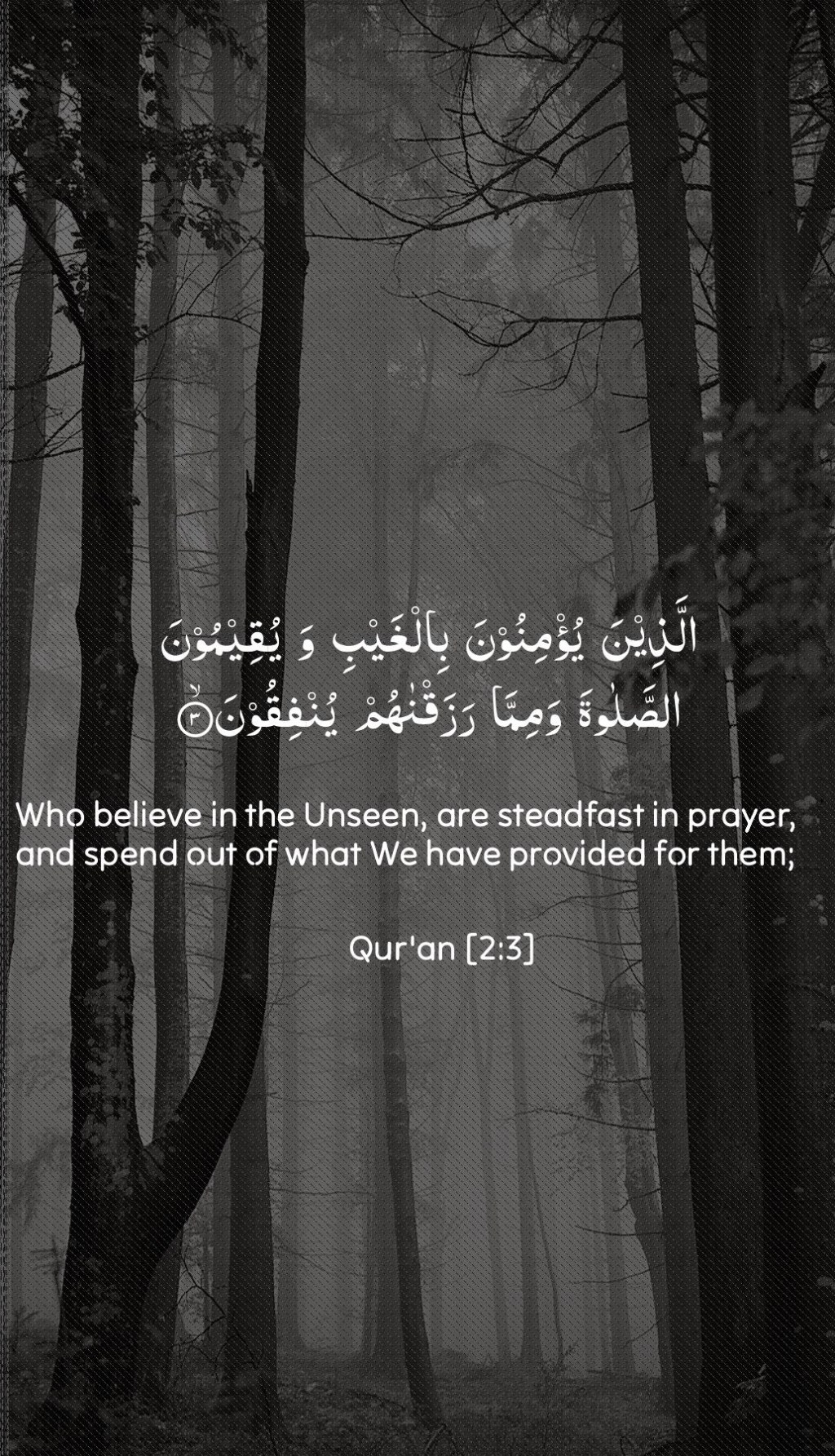
Quran 2:2 declares that “this is the Book about which there is no doubt” and that it is “guidance for the God-conscious (al-muttaqīn).” Verse 3 then describes those who can benefit from this guidance as “those who believe in the unseen, establish prayer, and spend out of what We have provided for them.” In Islamic theology, belief in the unseen (īmān bi’l-ghayb) refers to accepting realities that lie beyond direct human perception – e.g. the existence of God, angels, the hereafter, and other metaphysical truths qurangallery.app qurangallery.app. Classical Quranic commentators emphasize that acknowledging such unseen realities is a foundational condition for obtaining guidance from the Quran myultimatedecision.info. In other words, the reader must be willing to trust in truths that cannot be empirically observed or measured in order to fully benefit from the Quran’s message.
Notably, Quran 2:3’s emphasis on “those who believe in the unseen” implies a clear exclusion: those who insist that nothing exists beyond material, observable phenomena will not find guidance in the Quran. Sayyid Abul A‘la Maududi, a renowned exegete, explicates this verse by saying “only such a person who believes in the ‘unseen’ can benefit from the guidance of the Qur’an.” Conversely, “as for the one who believes only in those things which can be seen, tasted, smelled, or measured and weighed, [he] cannot get any guidance from this Book.” myultimatedecision.info This strong statement underscores that a strict empiricist or materialist stance – one that demands laboratory proof for every truth – is antithetical to the Quran’s required posture of faith. Another modern commentator, Muhammad Asad, similarly notes that the Quran effectively “will…remain a closed book to all whose minds cannot accept [the] fundamental premise” that ultimate reality extends beyond the observable world myultimatedecision.info. In short, belief in unseen reality is presented as a pre-requisite for enlightenment through scripture. The guidance of the Quran is not value-neutral information; it is a light that illuminates only the hearts already inclined to trust in more than meets the eye.
Theologically, this requirement aligns with the Islamic understanding that humans have both a physical and spiritual component. A person heedlessly locked into materialism is, in Islamic terms, veiling an innate God-given intuition (fiṭra) that points to transcendent truth. In an interfaith context, the notion of trusting unseen reality is not unique to Islam. The Bible, for example, defines faith (īmān) in a remarkably similar way: “Now faith is the substance of things hoped for, the evidence of things not seen” (Hebrews 11:1, NKJV)preceptaustin.org. Thus, across the Abrahamic traditions, faith in the unseen is upheld as a virtue and a gateway to spiritual understanding. It represents a posture of humility and openness towards God’s signs, even when they are beyond our sensory verification.
By contrast, metaphysical naturalism – the doctrine that “only the physical is real” – demands the opposite posture. A dogmatic naturalist position, often associated with physicalism or scientistic thinking, holds that all of reality can in principle be reduced to scientifically observable entities and forces. Such a worldview leaves no room for unseen spiritual truths. The Quranic perspective is that a person who absolutely insists on this worldview has effectively shut the door on any guidance the scripture could offer. As the verse indicates, guidance is only for those willing to “believe in the unseen” – which we may rephrase as those willing to admit that reality is more than just what our eyes can see or instruments can detect.
Read further in Microsoft Word file:



 The Glorious Quran and Science
Leave a comment