
Epigraph
ذَٰلِكَ عَالِمُ الْغَيْبِ وَالشَّهَادَةِ الْعَزِيزُ الرَّحِيمُ
الَّذِیۡۤ اَحۡسَنَ کُلَّ شَیۡءٍ خَلَقَہٗ وَ بَدَاَ خَلۡقَ الۡاِنۡسَانِ مِنۡ طِیۡنٍ ۚ
“Such is He who knows all that is unseen as well as what is seen, the Almighty, the Merciful, who gave everything its perfect form. He first created man from clay.” (Al Quran 32:6-7)
Written and collected by Zia H Shah MD
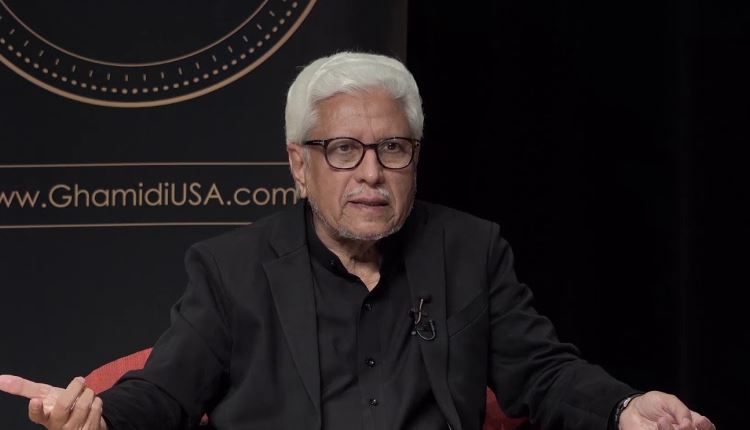
Javed Ahmad Ghamidi is a prominent Pakistani Islamic scholar, theologian, and public intellectual known for his rationalist and reformist approach to Islamic thought. A former disciple of the renowned scholar Amin Ahsan Islahi, Ghamidi has developed a distinctive interpretive framework for the Qur’an that emphasizes internal textual coherence (nazm), historical contextualization, and moral universality. He is the founder of the Al-Mawrid Institute and the online platform Ghamidi Center of Islamic Learning, which disseminates his lectures, writings, and interpretations to a global audience. Ghamidi advocates for a non-sectarian, non-political vision of Islam, and is widely recognized for his balanced views on issues such as Shariah, jihad, the role of women, democracy, and interfaith relations. His televised debates and educational series have made him a household name among Urdu-speaking audiences, while his writings continue to shape contemporary Islamic discourse, especially among educated Muslim youth seeking harmony between faith and modernity.
Here is the commentary by Ghamidi on Quran 32:7, in Urdu, I added translation of 32:6 also above for the sake of context:
یہ پہلے مرحلے کا بیان ہے، جب انسان کا حیوانی وجود تخلیق ہوا۔ اِس کے لیے وہی طریقہ اختیار کیا گیا جو انسان کی پیدایش کے لیے اب اختیار کیا جاتا ہے، اِس فرق کے ساتھ کہ اب جو عمل ماں کے پیٹ میں ہوتا ہے، اُس وقت زمین کے پیٹ میں ہوا۔ چنانچہ مٹی کے وہی اجزا جو غذا کی صورت میں ہمارے اندر جاتے اور حقیر پانی کے خلاصے میں تبدیل ہو کر اُس عمل کی ابتدا کرتے ہیں جس سے انسان بنتے ہیں، اُس وقت سڑے ہوئے گارے کے اندر اِسی عمل سے گزرے۔ یہاں تک کہ جب خلقت پوری ہوگئی تو اوپر سے وہی گارا انڈے کے خول کی طرح خشک ہو گیا جس کے ٹوٹنے سے جیتی جاگتی ایک مخلوق نمودار ہوئی جسے انسان کا حیوانی وجود کہنا چاہیے۔ اِس سے قیاس کیا جا سکتا ہے کہ دوسری تمام مخلوقات بھی پہلی مرتبہ اِسی طریقے سے وجود میں آئیں۔
English Translation of Ghamidi’s Commentary
This is the description of the first stage, when the animal form of man was created. For this, the same method was adopted as is adopted for the creation of man now, with the difference that the process that now takes place in the mother’s womb, at that time took place in the womb of the earth. Thus, the same components of the soil that enter us in the form of food and, being transformed into the essence of the humble water, initiate the process by which man is made, at that time went through the same process within the rotten mud. Until, when the creation was complete, the same mud from above dried up like an eggshell, from the breaking of which a living creature appeared, which we may call the animal form of man. From this it can be inferred that all other creatures also came into existence for the first time in the same way.
Critique of Ghamidi’s Idea of the First Creation of Man
The classical religious creationists believed that God made a statue of mud and blew His breath into it and lo and behold the statue became a living and breathing man. Apparently Ghamidi did not like this simplistic picture and he has presented his idea of the first creation briefly in the above paragraph which is copied in Urdu from his Quran commentary.[1] The English translation is done by me with the help of Google translation.
Ghamidi and those who agree with his presentation draw confidence from the Glorious Quran and think that as they are reading it under some coherent system they have a rational understanding of this verse. But, what they fail to see is that they are making up claims and indirectly attributing to the Quran. Where does the Quran talk about eggshell for humans and other animals and then eventually breaking of the eggshell?
Ghamidi in this example and I have written before about Yasir Qadhi, fail to see that they have no empirical evidence, whatsoever, for their claims about the Quranic commentary in biology, molecular biology, genetics, archeology, anthropology or history.
In contrast to made-up stories that many such neo-creationist like to present, the claims of common ancestry of all life forms by biologist come with encyclopedic evidence from molecular biology and genetics. I provide a short version below and then link other articles at the end.
This one insight of relating the literal word of God, the Glorious Quran with His creation, the universe that we study in science, opens new insights and also show the limitations of classical commentators, who did not know science and even the contemporary commentators, who do not properly understand biological sciences or honor them appropriately.
What I have written for Ghamidi will invariably apply to other commentators as well who have written about this verse without acknowledging theistic evolution, as I do.
I believe in theistic or guided evolution, like BioLogos of Francis Collins the former head of NIH. More about him linked below. When the Quran talks about humans coming from clay it is talking about very early stages at the time of origin of life.
Now a short article by me to demonstrate common ancestry of all life forms on our planet from molecular biology:
The Genetic Ties That Bind: Molecular Evidence of Life’s Common Ancestry
Abstract
All living organisms, from simple microbes to humans, share a profound family connection written in their molecules. Modern molecular biology has revealed that the DNA code of life is virtually universal, and many organisms carry the same biological building blocks. By comparing genetic sequences, scientists have found striking similarities that point to a common ancestor for all life en.wikipedia.org. In particular, the genomes of humans and our close primate relatives, like chimpanzees, are nearly 99% identical amnh.org. These genetic parallels extend beyond DNA to the very proteins that build our bodies – many critical proteins are conserved or even identical across species, a clue that they were inherited from shared ancestors rather than invented from scratch en.wikipedia.org. From the fused chromosome in our genome that reveals our ape heritage en.wikipedia.org to ancient viral DNA “fossils” embedded in matching locations of different species’ genomes en.wikipedia.org, the evidence for evolution and common descent is written in our cells. This article narrates how DNA, RNA, proteins, and genomic quirks all testify to the unity of life. In accessible language and illustrative diagrams, we explore how molecular biology not only confirms the theory of evolution but also deepens our appreciation of the interconnected story of all life on Earth.
The Universal Code of Life: DNA Links All Living Things
Walk into any biology lab, and you’ll find the same molecular “alphabet” being used to spell out life’s instructions, whether the sample on the slide is bacteria, oak tree, or human. Deoxyribonucleic acid (DNA) – the famous double helix – is the hereditary material for virtually all organisms, and it’s composed of the same four chemical bases (A, T, C, and G) in every species. There’s no separate DNA for dogs and a different DNA for daisies; life’s blueprint is written in a common language. Even viruses (which many scientists don’t classify as fully living) use DNA or a close cousin, RNA, to store genetic information en.wikipedia.org. Moreover, the genetic code itself is nearly universal. This code is like a dictionary translating DNA sequences into proteins, and almost every creature on Earth uses the same dictionary – for example, the DNA sequence “ATG” encodes the amino acid methionine in you, a mushroom, or a blue whale en.wikipedia.org. This shared genetic code is a powerful hint of common ancestry. If life had multiple separate origins, we might expect different codes or entirely different molecular systems in different lineages. Instead, the fact that a human gene can be read and used by a bacterium (scientists routinely insert human genes into bacteria to produce medicines like insulin) shows that our cellular machinery is fundamentally compatible en.wikipedia.org. In all cells, DNA is transcribed into RNA and then translated into proteins by complex molecular machines called ribosomes – and these processes are conserved across all forms of life en.wikipedia.org. Every cell also uses the same energy currency, ATP, to power its reactions en.wikipedia.org. Such universal biochemistry is best explained by inheritance from a common ancestor that established these molecular rules eons ago.
Life’s common molecular language enables some remarkable cross-species substitutions. For instance, researchers have found that the gene for cytochrome c, a vital protein used in cellular respiration, can be swapped between incredibly diverse organisms. Human cytochrome c protein works in yeast cells (a single-celled fungus) that have had their own cytochrome c gene removedtalkorigins.org. In fact, cytochrome c from fish, birds, mammals, or insects can all function in yeasttalkorigins.org. This interchangeability underscores that the core machinery of life has been conserved over billions of years. It’s as if very different organisms are using the same spare part, inherited from a distant common toolkit. These shared fundamentals – DNA structure, a universal genetic code, common metabolic pathways – set the stage for the more detailed evidence of evolution. With the molecular language in common, scientists can directly compare genetic messages between species to deduce their relationships. And when we turn to those comparisons, the family tree of life comes into sharp focus, often in astonishing ways.
Closer Than Cousins: Human–Chimpanzee Genetic Kinship
Perhaps the most famous molecular comparison is between humans and our closest living relatives, the chimpanzees. For decades we knew from anatomy and fossils that humans belong in the great ape family. Molecular biology has since quantified just how close that kinship is. When researchers first sequenced and aligned the entire genetic code of humans and chimps, they found the two genomes are over 98% identical amnh.org. In fact, humans and chimpanzees share about 98.8% of their DNA sequence in common, a degree of similarity that stunned many people and vividly confirmed our close evolutionary relationship amnh.org. This means that if you walk along the 3-billion-letter code of human DNA, letter by letter, only about 1.2% of those letters will differ if you do the same for a chimpanzee. In practical terms, a mere 35 million or so letters out of those 3 billion are different – the rest are the same in both species amnh.org. It’s a testament to how closely related we are that even such a small genetic difference can encompass all the obvious disparities between a human and a chimpanzee. And yet, in many respects, we and chimps are incredibly alike. We both have the same set of genes (even genes for things like hair texture or brain development – it’s often how they’re used, rather than their mere presence, that differs)amnh.orgamnh.org.
Humans, chimpanzees, and our lesser-known cousins the bonobos descended from a single common ancestor that lived roughly six to seven million years ago amnh.org. As the lineages split and evolved separately, mutations (random changes) accumulated in their DNA. The longer two species have been separated, the more differences creep in. In the case of humans and chimps, the separation time has been short (in evolutionary terms), so only a few genetic changes have occurred – hence the 98.8% similarity. By comparison, our DNA is a bit less similar to a gorilla’s (around 98% identical) and much less so to more distant relatives like baboons (around 93% identical) en.wikipedia.org. This gradient of genetic difference neatly matches the expected evolutionary branching: chimpanzees are our closest relatives, gorillas slightly more distant, then orangutans, and so on, all the way down the family tree.
Not only do our DNA sequences align closely with chimps’, but even the broad structure of our genetic information is strikingly similar. Human and chimp chromosomes (the packaged bundles of DNA) display virtually identical patterns when stained and observed under a microscope amnh.org. Early studies showed that the light and dark banding pattern on each human chromosome has a corresponding pattern on a chimp chromosome, indicating that gene for gene, in the same order, the two species’ genomes match up remarkably well amnh.org. It’s as if one took two sets of encyclopedias and found nearly all the entries in the same sequence – not a coincidence you’d expect unless the encyclopedias were copied from each other or from a common source. In evolutionary terms, that common source is the ancestral primate genome we inherited.
Chromosome 2: A DNA Fossil of an Ancestral Fusion
One particularly compelling piece of the human story is carried on chromosome 2. Humans have 23 pairs of chromosomes, but other great apes like chimpanzees, gorillas, and orangutans have 24 pairs. What happened to the missing chromosome? Molecular evidence points to a fascinating answer: two ancestral ape chromosomes joined together end-to-end in an ancient ancestor of humans, forming what we now know as human chromosome 2 en.wikipedia.org en.wikipedia.org. In our DNA, chromosome 2 bears the telltale marks of this fusion. Normally, chromosomes have special DNA sequences called telomeres at their tips (think of them like the plastic caps on shoelaces, protecting the ends) and a single centromere (the central region important during cell division). Yet, in the middle of human chromosome 2, scientists discovered what appear to be fragmented telomere sequences and even an extra, vestigial centromere – precisely where the two ancestral chromosomes fused en.wikipedia.org en.wikipedia.org. In other words, human chromosome 2 looks exactly as it would if two chimpanzee-like chromosomes were pasted together end-to-end long ago.
Read further in Microsoft Word file:
Reference
Additional reading
Summarizing Fool Proof Evidence for Evolution, Namely Common Ancestry, If You Are Still on the Fence
Comparative Genomics of Humans and Chimpanzees
Intelligent Design vs BioLogos: Science, Philosophy, and Faith in Dialogue
Genetic Diseases, Evolutionary Processes, and Implications for Human Origins
Guided Evolution in Qur’anic Perspective: A Commentary on Surah Nūḥ 71:13–21
Clay-Based Creation in the Quran: Classical Exegesis and Scientific Perspectives on Guided Evolution
The Grand Show on Earth: From Embryology to Evolution to Afterlife
Javed Ghamidi’s Video: Denial of Evolution or Common Ancestry


 The Glorious Quran and Science
Leave a comment