
Written and collected by Zia H Shah MD
Mountain ranges are often perceived as Earth’s majestic landmarks, but beyond their grandeur, they play a crucial role in stabilizing our planet’s geological and environmental systems. Beneath their serene exteriors, mountain ranges perform a vital planetary function: they act as natural shock absorbers, dissipating tectonic energy and safeguarding Earth from catastrophic seismic events. This article explores the geological mechanisms behind this phenomenon, examines real-world examples, and reflects on ancient wisdom—such as Quranic metaphors—that poetically foreshadowed mountains’ role in stabilizing our dynamic planet.
Developed from the 1950s to the 1970s, the theory of plate tectonics is the modern update to continental drift, an idea first proposed by scientist Alfred Wegener in 1912 which stated that Earth’s continents had “drifted” across the planet over time. Wegener didn’t have an explanation for how continents could move around the planet, but researchers do now: Plate tectonics.
The Earth’s crust comprises of seven large tectonic plates. According to this new geological theory Earth’s outer shell is divided into seven large slabs of solid rock, called “plates,” that glide over Earth’s mantle, the rocky inner layer above Earth’s core. Earth’s solid outer layer, which includes the crust and the uppermost mantle, is called the lithosphere. It is 100 km (60 miles) thick, according to the Encyclopedia Britannica. Below the lithosphere is the asthenosphere — a viscous layer kept malleable by heat deep within the Earth. It lubricates the undersides of Earth’s tectonic plates, allowing the lithosphere to move around.
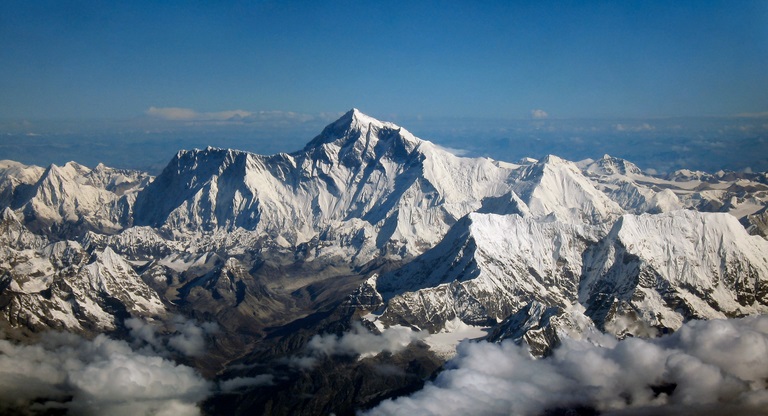
So, Mountains are formed through tectonic processes, primarily at convergent plate boundaries where Earth’s lithospheric plates collide, leading to crustal thickening and uplift—a process known as orogeny. This thickened crust extends deep into the mantle, forming “roots” that provide isostatic balance, much like how an iceberg floats with a significant portion beneath the water’s surface. These deep roots anchor the crust, contributing to the stability of continental landmasses.[1]
Mountains extend deep into the mantle, forming dense roots that stabilize plates. This isostatic equilibrium prevents excessive crustal shifting, akin to a ship’s keel stabilizing it in water. The roots of Mount Everest, and indeed the entire Himalayan mountain range, extend down into the Earth’s mantle, reaching a depth of about 155 miles (250 kilometers).
Mountain ranges can influence seismic stability by acting as natural barriers that dissipate tectonic stress. Their massive structures absorb and redistribute the energy from tectonic movements, potentially reducing the frequency and intensity of earthquakes in certain regions.
Centuries before plate tectonics, the Quran described mountains as stabilizers: “And We have placed within the earth firmly set mountains, lest it should shift with them…” (Quran 21:31). Another verse likens them to “pegs” (Arabic: awtad): “Have We not made the earth a resting place? And the mountains as stakes?” (Quran 78:6–7).
These metaphors align with modern geology—mountains as shock absorbers that “peg” the crust, preventing destabilization.
In Surah Luqman Allah not only describes this function of the mountains, but along with other creations uses His creativity as a proof of His divinity and denies any other claims of divinity, made on behalf of others:
He created the heavens without any visible support, and He placed firm mountains on the earth––in case it should shake under you –– and He spread all kinds of animals around it. We sent down water from the sky, with which We made every kind of good plant grow on earth: all this is God’s creation. Now, show Me what your other gods have created. No, the disbelievers are clearly astray. (Al Quran 31:10-11)
A similar detailed message is delivered in Surah Nahl, mentioning other parts of Allah’s creation along with the mountains:
It is He who made the sea of benefit to you: you eat fresh fish from it and bring out jewelry to wear; you see the ships cutting through its waves so that you may go in search of His bounty and give thanks. He has made mountains stand firm on the earth, to prevent it shaking under you, and rivers and paths so that you may find your way, and landmarks and stars to guide people. Can He who creates be compared to one who cannot create? Why do you not take heed? (Al Quran 16:14-17)
Conclusion
Mountains are Earth’s silent custodians, absorbing tectonic violence and nurturing life through their stabilizing embrace. Their role as natural shock absorbers bridges science and spirituality, echoing ancient insights like those mentioned in the Quran.
References




 The Glorious Quran and Science
Leave a reply to Our Collection of Essays or Articles about the Glorious Quran – The Glorious Quran and Science Cancel reply