

Commentary by by Zia H Shah MD, Chief Editor of the Muslim Times
Many a Christian apologist have alleged over the centuries that the Quran is copied from the Bible as it has repeated several Biblical stories. Far from it. The Quran removes the mistakes of the Biblical narration and often adds subtle details that reveal Divine speech.
Here, I first describe the Biblical account of the baby Moses, from the second chapter of Exodus:
The Birth of Moses
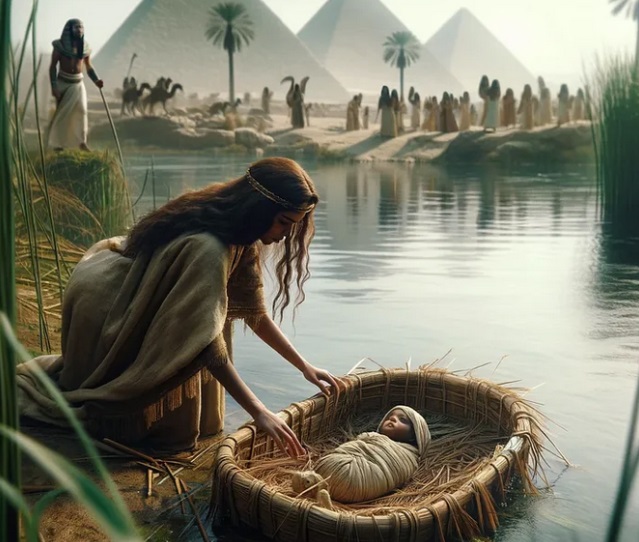
Now a man of the tribe of Levi married a Levite woman, 2 and she became pregnant and gave birth to a son. When she saw that he was a fine child, she hid him for three months. 3 But when she could hide him no longer, she got a papyrus basket for him and coated it with tar and pitch. Then she placed the child in it and put it among the reeds along the bank of the Nile. 4 His sister stood at a distance to see what would happen to him.
5 Then Pharaoh’s daughter went down to the Nile to bathe, and her attendants were walking along the riverbank. She saw the basket among the reeds and sent her female slave to get it. 6 She opened it and saw the baby. He was crying, and she felt sorry for him. “This is one of the Hebrew babies,” she said.
7 Then his sister asked Pharaoh’s daughter, “Shall I go and get one of the Hebrew women to nurse the baby for you?”
8 “Yes, go,” she answered. So the girl went and got the baby’s mother. 9 Pharaoh’s daughter said to her, “Take this baby and nurse him for me, and I will pay you.” So the woman took the baby and nursed him. 10 When the child grew older, she took him to Pharaoh’s daughter and he became her son. She named him Moses, saying, “I drew him out of the water.”
Now, here is the Quranic account, in some ways it covers a greater landscape in fewer words:
We desired to show favor to those who were considered weak in the land, and to make them leaders and make them inheritors of Our bounties, and to establish them in the earth and to show Pharaoh and Haman and their hosts that which they feared. We directed the mother of Moses: Suckle him; and when you fear for his life cast him afloat into the river and fear not nor grieve; for We shall restore him to thee and shall make him a Messenger. Then a member of Pharaoh’s family picked him up from the river that he might become an enemy and a source of sorrow for them. Indeed, Pharaoh and Haman and their hosts were in error.
Pharaoh’s wife said: He will prove a source of joy for you and me. Slay him not; perhaps he may prove useful for us, or we may even adopt him as a son. They perceived not Allah’s purpose. The heart of the mother of Moses became free from anxiety. Had We not strengthened her heart so that she might be a firm believer in Our grace and mercy, she would have disclosed his identity. She said to his sister: Follow in his wake. So she observed him from afar, but they were not aware of this. We had decreed in advance that he shall refuse the wet-nurses; so his sister said to them: Shall I tell you of a household who will take care of him for you and will be his sincere well wishers? Thus did We restore him to his mother so that her heart might be at rest and that she might not grieve and should know that Allah’s promise always comes to pass. But most of them know not. (Al Quran 28:5-13)
The brief Quranic description not only covers the Biblical details but also reveals psychology of Moses’ mother, Pharaoh’s wife and Moses himself.
The Bible suggests that the encounter was with Pharaoh’s daughter, while the Quran states that it was with Pharaoh’s wife.
The Quran beautifully highlights the maternal love by highlighting that unless God had specially strengthened the mother’s heart, when her son was threatened, she could have revealed his and her identity.
The Quran also states that because Moses refused to suckle any other wet nurse, it paved the way for his mother. The beauty of the Quranic coverage of the Biblical narratives, far from being a case of plagiarism, becomes a source of establishing its divine origin.





 The Glorious Quran and Science
Leave a comment