
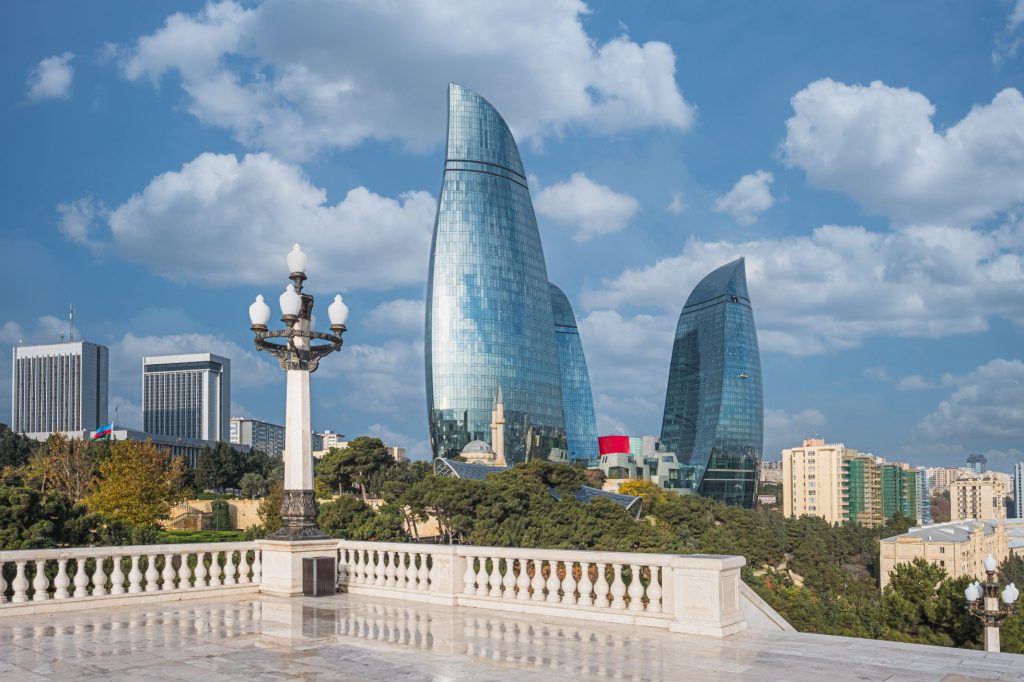
The Crescent Over the Caucasus: A Millennial History of Islamization in Azerbaijan and the Formative Influence of the Golden Horde
Presented by Zia H Shah MD
Audio teaser:
Abstract
The religious transformation of Azerbaijan from a mosaic of Zoroastrian, Christian, and pagan beliefs into a predominantly Muslim society represents one of the most complex sociological and geopolitical evolutions in the history of the Caucasus. This report provides a multi-layered analysis of this transition, beginning with the 7th-century Arab conquests which introduced the foundational structures of Islam through a combination of military treaties and fiscal incentives. It traces the subsequent period of cultural synthesis, characterized by the rise of vernacular Islamic traditions and the emergence of resistance movements that blended pre-Islamic heritage with new theological concepts. A significant portion of this analysis is dedicated to the 13th and 14th centuries, focusing on the pivotal roles of Berke Khan and Ozbeg Khan of the Golden Horde. Their conversion to Islam and subsequent governance not only shielded the Islamic heartlands from total Mongol annihilation but also institutionalized Islam as a state religion in the northern reaches of the Caucasus, creating a enduring Sunni-Shia demographic divide that persists to the present day. The report further examines the 16th-century Safavid revolution, which forcibly established Twelver Shi’ism, and the following centuries of Russian and Soviet secularization. Finally, it synthesizes these historical trajectories into a thematic epilogue that explores Azerbaijan’s current status as a unique model of secularism and inter-sectarian coexistence in the modern Islamic world.
The Pre-Islamic Religious Landscape
Before the arrival of the Arab armies in the 7th century, the territory of modern-day Azerbaijan was a complex borderland between the Sasanian Empire and the Byzantine sphere of influence. This geopolitical positioning created a diverse religious environment where state-sponsored faiths competed with deeply entrenched local beliefs. The southern region, known as Atropatene or South Azerbaijan, was an integral province of the Sasanian Empire, where Zoroastrianism served as the spiritual and political backbone of society. Historical accounts from medieval geographers frequently identify Azerbaijan as the birthplace of Zoroaster, specifically citing sites like Urmia or the great fire-temple complex at Shiz (modern Takht-e Soleyman) as the religion’s spiritual center.
In the northern region, the state of Caucasian Albania (Arran) had adopted Christianity as its official religion as early as the 4th century. However, the institutionalization of Christianity was largely an elite phenomenon. While the royal court and urban centers in Barda and Gabala maintained an organized church, the rural and lower-class populations remained committed to a variety of ancient pagan practices and nature worship. These folk beliefs often involved fire worship and astronomical cults that would later color the local interpretation of Islam.
| Region | Primary Pre-Islamic Faith | Political Affiliation | Cultural Language |
| Southern Azerbaijan | Zoroastrianism / Mazdakism | Sasanian Empire | Middle Persian / Old Azeri |
| Northern Azerbaijan | Christianity (Orthodox/Albanian) | Caucasian Albania (Vassal) | Caucasian Albanian / Various |
| Mughan / Steppes | Paganism / Shamanism | Tribal Confederations | Various Turkic / Local |
The constant warfare between the Sasanians and Byzantines, compounded by devastating raids from the Khazars in the north, had left the local populations exhausted and the administrative apparatus of both the Sasanian and Albanian states weakened. This state of perpetual instability created a vacuum that allowed the nascent Arab Caliphate to penetrate the region with surprising speed after the fall of the central Sasanian government in 651.
The Arab Conquest and the Initial Spread of Islam (639–750 AD)
The entry of Islam into Azerbaijan was a direct consequence of the rapid expansion of the Rashidun Caliphate following the death of Prophet Muhammad in 632. The first organized Arab expedition into the region occurred in 639 under the command of Hudhayfah ibn al-Yaman, during the caliphate of Umar ibn al-Khattab. The initial encounter in southern Azerbaijan was characterized by fierce resistance from the marzban of Ardabil, who mobilized local forces from across the province. Despite this, the Arab victory led to a peace treaty that established the template for early Islamic rule: the preservation of local lives and property in exchange for an annual tribute of 800,000 dirhams.
Treaties and the Mechanism of Conversion
The early Arab approach to Islamization was primarily administrative and fiscal rather than a program of forced mass conversion. The population was categorized as ahl al-dhimma (People of the Book), granting them religious freedom and physical protection in exchange for the jizya tax. This fiscal policy created a structural incentive for conversion; as locals began to recognize the social and economic advantages of entering the Muslim community, the pace of voluntary conversion accelerated.
| Year | Commander | Region Impacted | Treaty Provisions |
| 639 AD | Hudhayfah ibn al-Yaman | Ardabil / South Azerbaijan | Jizya payment; religious freedom; no enslavement. |
| 642 AD | Bukair ibn Abdullah | Mughan | Higher jizya due to resistance; security of property. |
| 646 AD | Salman ibn Rabiah | Barda / Gabala / Shirvan | Tax imposition; creation of Arab military garrisons. |
The establishment of Arab garrisons in strategic cities such as Ardabil, Maragha, Barda, and Derbent was the primary driver of urbanization and the physical manifestation of the new faith. The first mosque in Azerbaijan was erected in Ardabil, serving as the nucleus for a growing Muslim quarter. By the middle of the 8th century, the Umayyad and early Abbasid administrations had consolidated their hold over both northern and southern Azerbaijan, effectively eliminating the suzerainty of the Caucasian Albanian kings by the early 700s.
The Role of Arabic Language and Culture
As the central administration of the nascent Islamic state took hold, Arabic became the language of education, law, and high culture. This linguistic shift was not merely an imposition but a necessity for any local seeking social or political advancement. Persian speakers in the towns often became bilingual, using Arabic for commercial and political links with the wider Caliphate while maintaining local dialects in private life. This period laid the foundations for Azerbaijan’s contribution to the Islamic Golden Age, as local scholars and artisans began to participate in the broader intellectual currents flowing through Baghdad and Damascus.
Resistance, Heterodoxy, and the Khurramite Movement
The process of Islamization was neither uniform nor entirely peaceful. Throughout the 8th and 9th centuries, the Abbasid Caliphate faced significant internal challenges in Azerbaijan, often arising from a fusion of socio-economic grievances and persistent pre-Islamic religious sentiments. The most formidable of these challenges was the Khurramite movement, led by Babak Khorramdin, which erupted in 816 and lasted over twenty years.
Babak Khorramdin and the Syncretic Revolt
The Khurramite movement represented a complex “reverse conversion” or a hybridization of religious identities. Babak, whose original name was recorded as Hassan, was reportedly a Muslim before leading the movement, indicating that early converts often maintained deep ties to their Zoroastrian and pagan past. Centered in the impregnable fortress of Bazz, Babak’s rebellion claimed to seek the restoration of ancient Iranian traditions, specifically Zoroastrianism, while also incorporating proto-Shia elements that challenged the legitimacy of the Abbasid Caliphs.
| Movement Leader | Period of Revolt | Core Ideology | Geographical Base |
| Babak Khorramdin | 816–837 AD | Syncretic Zoroastrianism / Proto-Shi’ism | Bazz Fortress / Talysh Mountains. |
| Khurramites | 9th Century | Communitarianism; fire/sun worship | Azerbaijan / Arran / Jebal. |
Despite its eventual defeat in 837 by the Arab general al-Afshin, the Khurramite uprising had long-lasting consequences. It contributed to the disintegration of central Abbasid authority in the Caucasus and forced the Caliphate to allow more local autonomy. Furthermore, the “strongly heterodox flavor” of Azerbaijani Islam in this period—a mixture of mainstream Sunni practices with local mystical and fire-worshipping traditions—paved the way for the later emergence of diverse Sufi orders and radical Shia movements.
The Seljuk Era and the Turkic-Sunni Consolidation
In the 11th century, a transformative event shifted the ethnic and religious trajectory of the region: the arrival of the Seljuk Turks. The Seljuk conquest in the 1040s marked the beginning of a massive Turkicization of Azerbaijan. The Oghuz tribes under the Seljuks did not just bring a new language; they brought a militant commitment to the Hanafi school of Sunni Islam.
The Seljuk dynasty championed the Hanafi version of Islam as a means of legitimizing their rule and counteracting the influence of Ismaili and Shia factions that had gained ground during the decline of the Abbasids. This period saw the systematic construction of madrasas and the patronage of Sunni scholars, which effectively standardized Islamic practice across the cities of Azerbaijan. By the end of the 11th century, the regional identity had become inextricably linked to both the Turkic language and a Sunni Muslim faith, a combination that would define the region until the Mongol invasions of the 13th century.
The Mongol Catastrophe and the Geopolitical Reordering
The arrival of Genghis Khan’s forces in the 1220s initially appeared as an existential threat to Islam in the Caucasus. The first Mongol raids (1221–1225) caused immense destruction to urban centers like Ardabil, Maragha, and Beylagan, while the Eldaniz state collapsed under the pressure. From 1239 to 1256, Azerbaijan was ruled by Mongol viceroys who dismantled local government systems and imposed heavy taxes.
However, the fracturing of the Mongol Empire after the death of Möngke Khan in 1259 created a unique geopolitical dynamic. The territory of Azerbaijan became the primary bone of contention between two Mongol successor states: the Ilkhanate based in Persia and the Golden Horde based in the northern steppes. This rivalry was not merely territorial; it became increasingly defined by religious affiliation, with the Golden Horde’s conversion to Islam playing a decisive role in the spiritual destiny of the Caucasus.
The Role of Berke Khan: The Shield of the Ummah
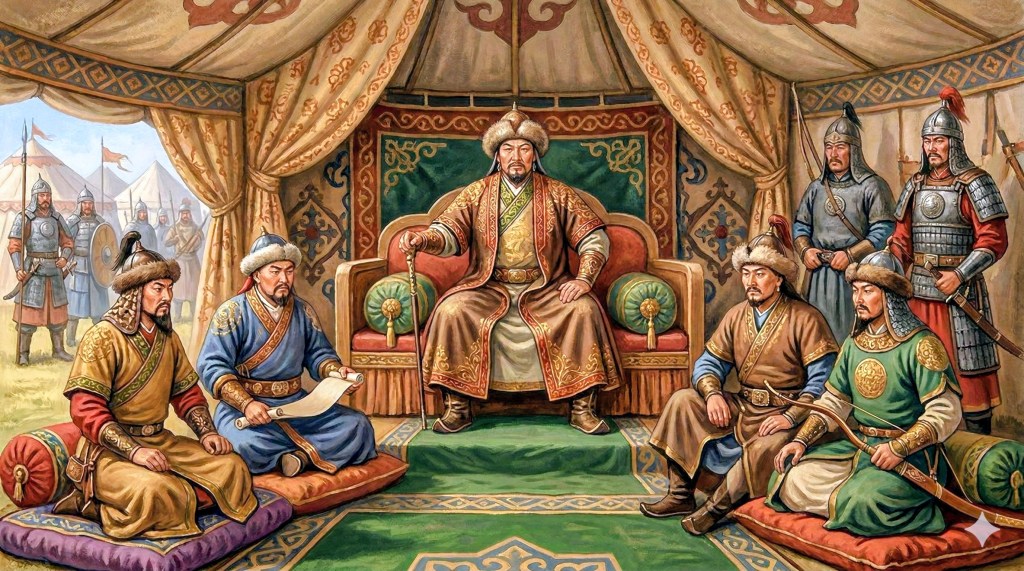
Berke Khan (r. 1257–1266), the grandson of Genghis Khan and the ruler of the Golden Horde, holds a unique position in Islamic history as the first Mongol monarch to officially embrace Islam. His conversion, which took place in 1252 in the city of Bukhara, was a personal and pious decision that had profound political ramifications for Azerbaijan and the broader Middle East.
The Theology of Conversion and Governance
According to historical chronicles, Berke was impressed by the integrity and faith of Muslim merchants from Bukhara whom he encountered at Saray-Juk. Unlike his cousin Hulagu Khan, who remained a Buddhist-sympathetic pagan and eventual destroyer of the Abbasid Caliphate, Berke became a devout Muslim. His camp hosted muezzins, imams, and Sufi shaykhs, and he reportedly abolished the Mongol Yassa code in favor of Sharia within his inner circle.
| Feature | Berke Khan (Golden Horde) | Hulagu Khan (Ilkhanate) |
| Religious Status | Muslim (Sunni) | Buddhist / Traditional Tengrist |
| View on Caliphate | Devout protector; ally of Mamluks | Executioner of the Caliph (1258) |
| Policy in Azerbaijan | Claimed as rightful Jochid territory | Occupied as core Ilkhanid province |
| Impact on Islam | Institutionalized it in the North Caucasus | Initially hostile; later conversion |
The War for Azerbaijan and the Mamluk Alliance
The Berke-Hulagu War (1262–1266) was triggered by both territorial disputes and Berke’s religious outrage at the sack of Baghdad. Berke famously declared, “He (Hulagu) has sacked all the cities of the Muslims… With the help of God, I will call him to account for so much innocent blood”.
Azerbaijan served as the primary theater for this civil war. Hulagu had seized the rich lands of Azerbaijan and Arran, which had originally been assigned to Jochi (Berke’s father) by Genghis Khan. Berke launched massive invasions through the Derbent pass to reclaim these lands, forcing Hulagu to divert his best troops from the Syrian front. By allying with the Mamluk Sultan Baibars of Egypt—who was himself of Kipchak Turkic origin—Berke created a strategic pincer that saved the remainder of the Islamic world, including Mecca and Jerusalem, from Mongol conquest.
This conflict effectively split the Caucasus. While the Ilkhans controlled southern Azerbaijan and Iran, the Golden Horde maintained influence over the northern regions and Dagestan. This division ensured that the northern populations remained linked to the Sunni-Turkic traditions of the steppes, while the south became integrated into the Persianate-Mongol administration.
The Era of Ozbeg Khan: The Institutionalization of Islam
If Berke Khan was the pioneer who introduced Islam to the Mongol elite, Ozbeg Khan (r. 1313–1341) was the sovereign who transformed the Golden Horde into a permanent Islamic sultanate. Under his reign, which was the longest and most prosperous in the Horde’s history, Islam was officially proclaimed the state religion in 1321.
The 1321 Proclamation and the Religious Purge
Ozbeg’s decision to make Islam the official religion was met with stiff resistance from the traditional Mongol aristocracy who still followed shamanism or Buddhism. They confronted him, asking why he would abandon the laws of Genghis Khan for the “religion of the Arabs”. Ozbeg’s response was decisive: he discovered a plot to assassinate him, crushed the rebellion, and executed 120 high-ranking nobles, including several Chinggisid princes. This “bloody purge” ensured that the administrative and military leadership of the Horde became exclusively Muslim.
Urbanization and Cultural Transformation
Under Ozbeg Khan, the architectural and social landscape of the Golden Horde and its Caucasian periphery underwent a radical transformation. He initiated a massive urban planning policy, building or restoring nearly 70 cities. The capital, Sarai, became a cosmopolitan center of trade and Islamic learning, attracting merchants and scholars from across Asia and Europe.
| Architectural Category | Examples in Golden Horde / North Caucasus | Cultural Significance |
| Mosques | Juma Mosques in Sarai, Solkhat, and Madjar | Adoption of the Anatolian “basilica” plan. |
| Minarets | Tatartup Minaret (North Caucasus) | Symbol of Islamic presence in previously pagan lands. |
| Public Baths | Excavations in Madjar and Sarai | Integral element of Muslim hygiene and social life. |
| Madrasas | Sarai and Northern towns | Centers for training the ulama (scholars). |
Ozbeg’s reign also saw the crystallization of the “Uzbek” identity, which originally referred to those loyal to his Islamic-Mongol administration. This identity would eventually migrate southward to Central Asia, but its roots lay in the synthesis of Turkic-Mongol tribalism and Islamic governance that Ozbeg perfected in the Volga and Caspian basins.
The Impact of Ozbeg Khan’s Campaigns on Azerbaijan
Ozbeg Khan used his military power, maintaining one of the world’s largest standing armies of over 300,000 warriors, to repeatedly invade the Ilkhanate in Azerbaijan (1319, 1325, and 1335). While these campaigns were ostensibly for territorial control, they facilitated the spread of Islamic culture into the rural areas of northern Azerbaijan and Dagestan.
The Jochid administration allowed Sufi orders, particularly the Yasawiyya and Kubrawiyya, to establish khanqahs (hospices) and madrasas throughout the Caucasus. These dervishes were instrumental in converting the nomadic tribes that roamed the northern steppes, presenting Islam in a mystical form that was more compatible with their traditional beliefs in shamans and nature spirits. Consequently, the northern region of Azerbaijan became a stronghold of Sunni Islam, a characteristic that differentiates it from the Shia-dominated south to this day.
The Safavid Revolution and the Shift to Shi’ism
The religious demographics of Azerbaijan underwent another radical change in the early 16th century. For nearly 800 years, the region had been predominantly Sunni, despite the presence of various heterodox movements. In 1501, Shah Ismail I, the founder of the Safavid Dynasty, captured Tabriz and officially proclaimed Twelver Shi’ism as the state religion.
The Mechanism of Conversion under Ismail I
Shah Ismail’s decision was both a spiritual commitment and a calculated political move to differentiate his empire from the Sunni Ottoman Empire. He initiated a campaign of forced conversion, bringing in Shia scholars from modern-day Lebanon and Iraq to replace the existing Sunni ulama. Sunni mosques were destroyed or repurposed, and those who refused to convert faced execution or exile.
| Event / Factor | Role in the Shia Shift | Long-term Impact |
| Ismail I’s Accession (1501) | Mandatory adoption of Twelver Shi’ism | Foundation of modern Azerbaijani Shia identity. |
| Ottoman-Safavid Wars | Constant border conflict along religious lines | Bifurcation of the Caucasus into Shia and Sunni zones. |
| Qizilbash Tribes | Military enforcers of the new faith | Created a militant and distinctive religious elite. |
| Nader Shah’s Reforms (1736) | Attempt to reconcile Sunnis and Shias | Attempted “Jafari” school as a 5th Sunni school. |
The Safavid era solidified the religious divide that exists today. The southern and central parts of Azerbaijan became overwhelmingly Shia, while the northern regions—frequently under Ottoman influence or governed by local Sunni dynasties like the Shirvanshahs—maintained their Sunni tradition.
Russian Conquest, Secularization, and the Soviet Era
The 19th century brought a new imperial power to the Caucasus: the Russian Empire. After the Treaty of Turkmenchay in 1828, northern Azerbaijan was ceded to Russia, separating it from the Shia mainland in Iran. This geopolitical shift had profound religious consequences.
The Displacement of Sunnis and the Rise of Secularism
The Russian administration initially favored the Shia population, viewing the Sunnis as a “fifth column” due to their religious ties with the Ottoman Empire and the rebellious tribes of the North Caucasus. This led to a large-scale emigration of Sunnis to Ottoman lands, which, combined with the arrival of Armenian and Russian Christian settlers, made the Shias a distinct majority in the territory of the modern Azerbaijani Republic.
Simultaneously, a new class of secularly educated Azerbaijani intelligentsia began to emerge under Russian patronage. This movement, known as maarifçilik (enlightenment), emphasized a common Turkic ethnic identity over religious sectarianism. By the time the short-lived Azerbaijan Democratic Republic was established in 1918, secularism had already become the cornerstone of Azerbaijani national thought.
The Soviet Suppression and the Blurring of Sects
The Soviet period (1920–1991) launched an unprecedented assault on all religions. Out of roughly 2,000 active mosques before the revolution, the vast majority were closed by the 1930s. However, this “militant atheism” had an ironic effect: by suppressing theological education, it erased the sharp doctrinal differences between Sunnis and Shias for the average person. Religion became a “nominal” cultural identity, often preserved only through private life-cycle rituals.
The Present State of Affairs: Revival and Pluralism
Following the collapse of the Soviet Union in 1991, Azerbaijan experienced a multifaceted religious revival. Today, the country is home to a population that is roughly 96% Muslim, with an estimated 65% belonging to the Shia sect and 35% to the Sunni sect.
The Modern Demographic and Sectarian Distribution
While the division is often blurred in the urban centers, specific regions retain their historical sectarian characters. Shias are most prevalent in the southern regions (Lankaran), central regions, and the villages around Baku. In contrast, Sunnis remain dominant in the northern and western districts, often associated with ethnic minorities like Lezgins and Avars, as well as Turkic communities that maintain historical links to the Golden Horde and Ottoman traditions.
| Current Group / Sect | Primary Geographic Base | Doctrinal School |
| Shia Muslims (65%) | South, Central, Baku-Absheron | Ja’fari (Twelver). |
| Sunni Muslims (35%) | North (Quba, Sheki), West | Hanafi or Shafi’i. |
| Salafi / Wahhabi | Urban clusters, specific North pockets | New movements post-1991. |
| Secular / Nominal | Major cities, youth | Cultural Muslim identity. |
The Model of Secular Coexistence
The modern Azerbaijani state, based on the secular foundation of the 1918 republic, actively discourages religious extremism and sectarianism. The government promotes a policy of multiculturalism, where Sunnis and Shias are often seen praying together in the same mosques—a rarity in much of the Middle East. The State Committee for Religious Affairs and the Muslim Office of the Caucasus ensure that religious life is regulated and aligned with the national interest.
Despite this harmony, external influences remain a source of concern. Shia missionaries from Iran and Sunni preachers from Turkey and Saudi Arabia (Salafism) have attempted to instill more dogmatic interpretations of the faith. However, the deeply embedded secularism of Azerbaijani society, inherited from both the Soviet period and the pre-revolutionary enlightenment, continues to act as a powerful barrier against the importation of sectarian conflict.
Thematic Epilogue
The trajectory of Islam in Azerbaijan is a narrative of profound resilience and adaptation. From its beginnings as a religion imposed by a distant caliphate to its transformation into a tool of Mongol statecraft under Berke and Ozbeg, and finally its institutionalization as a national identity under the Safavids, Islam has been the central axis around which Azerbaijani history has revolved.
The conversions of Berke Khan and Ozbeg Khan were arguably the most significant turning points in this long history. By adopting Islam, they didn’t just change the faith of a dynasty; they ensured that the Caucasus would remain an integral part of the Islamic world, even as the heartlands in Iraq and Syria were devastated. Their rule created a unique “Northern Islam” that blended the mobility of the steppe with the sedentary traditions of the Islamic East, a culture that still resonates in the Sunni corridors of the north.
The “present state of affairs” in Azerbaijan—a Shia majority with a significant Sunni minority living in a staunchly secular state—is the direct result of these overlapping historical layers. The Safavid legacy provided the Shia majority, the Golden Horde provided the Sunni northern belt, and the Russian/Soviet legacy provided the secular framework that keeps the two in balance. In this sense, Azerbaijan stands as a living museum of the Islamic experience, demonstrating that a society can be deeply rooted in religious history while remaining fully committed to the pluralism and secularism of the modern world. The history of Islamization here is not merely a story of faith, but a story of how a diverse population used religion to navigate the shifting currents of Eurasian geopolitics for over a thousand years.

 The Glorious Quran and Science
Leave a comment