
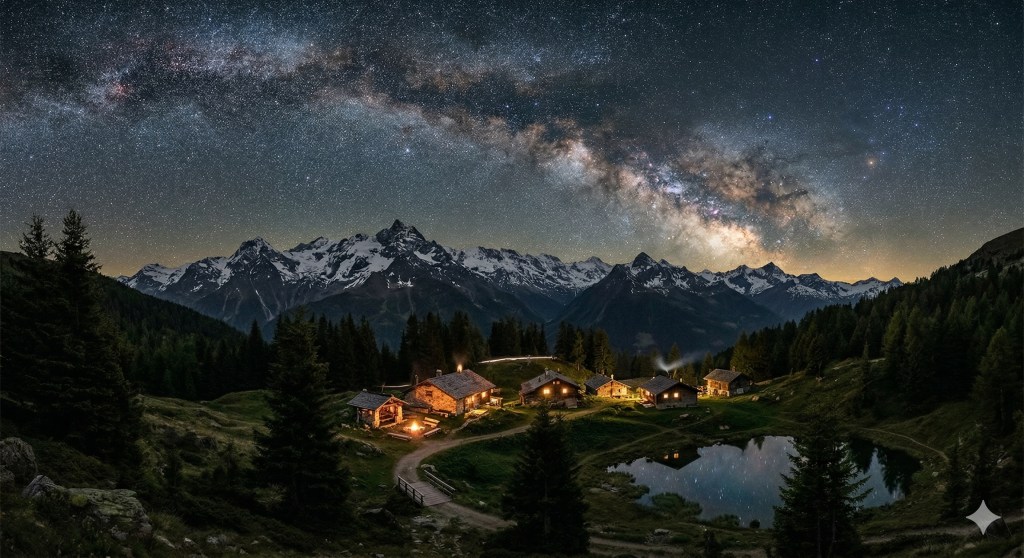
Presented by Zia H Shah MD with the help of Gemini
Abstract
While the transition to night is often dismissed as a passive absence of solar illumination, the Quranic narrative consistently frames the night as an active, deliberate creation and a profound “sign” (ayah) of divine architecture. This commentary synthesizes modern cosmological resolutions to Olbers’ Paradox—the question of why the night sky is dark—with philosophical reflections on human habituation and theological insights into the purpose of darkness. By exploring verses such as 6:96 and 79:29, we find that the “darkened night” is not a void but a “cosmological signature” of a finite, expanding universe, designed to provide a protective canopy for rest while revealing the staggering scale of the heavens.
The Primary Verse: Surah Al-An’am (6:96)
Arabic Text: فَالِقُ الْإِصْبَاحِ وَجَعَلَ اللَّيْلَ سَكَنًا وَالشَّمْسَ وَالْقَمَرَ حُسْبَانًا ۚ ذَٰلِكَ تَقْدِيرُ الْعَزِيزِ الْعَلِيمِ
Translation (MAS Abdel Haleem): “He is the one who causes the dawn to break; He has made the night for rest, and the sun and moon for reckoning. Such is the design of the Almighty, the All Knowing.”
Scientific Commentary: The Architecture of Darkness
Ordinarily, the night is viewed as a mere byproduct of the Earth’s rotation. However, in the history of science, the darkness of the night sky presents a profound problem known as Olbers’ Paradox. If the universe were infinite in extent, eternal in age, and static, every line of sight from Earth would eventually hit the surface of a star. Consequently, the night sky should not be dark; it should be as bright as the surface of the Sun in every direction.
The resolution of this paradox—and the scientific “embellishment” of the Quranic claim that God “made” the night—rests on three pillars of modern cosmology:
- Finite Age of the Universe: The universe began approximately 13.8 billion years ago. Light from stars beyond the “cosmic horizon” has simply not had enough time to reach us.
- Cosmic Expansion and Redshift: As the universe expands, light from distant galaxies is stretched to longer, invisible wavelengths (infrared and microwave), “hiding” the light from our eyes.
- Finite Stellar Lifetimes: Stars do not shine forever; they have a limited fuel budget, meaning the universe is never “saturated” with light.
A striking example of how distance and the laws of physics shape our experience of the night is the comparison between the Sun and Sirius. While Sirius is intrinsically 25 times more luminous than our Sun, it is so far away (8.6 light-years) that it appears approximately 13 billion times fainter to an observer on Earth. This staggering difference is a testament to the “proportioned” design mentioned in Surah An-Nazi’at (79:28), where the distances of the heavens are calibrated to create the “vault” of darkness.
Furthermore, the Quranic term aghtasha (أَغْطَشَ) in verse 79:29—meaning “He darkened its night”—suggests that darkness is an active cosmological outcome. In the vacuum of space, darkness is the primary state; the “daylight” is a localized extraction from this cosmic dark. As Richard Dawkins notes, humans often suffer from an “anaesthetic of familiarity,” a cognitive habituation that prevents us from seeing the dark night as the miracle it is—a window into the beginning of time.
Philosophical Commentary: The Veil that Reveals
Philosophically, the night performs a dual function: it conceals and it reveals. During the day, the overwhelming glare of the Sun (a “local” light) obscures the rest of the universe. It is only when the “veil” of night is drawn that the true scale of the cosmos—the billions of galaxies and trillions of stars—becomes visible.
The night serves as a remedy for the “anesthesia of familiarity.” By stripping away the daylight (as described in 36:37), the Creator forces the human mind to confront its own finitude. The darkness is not a symbol of nothingness; it is a “structured silence” that allows for introspection and spiritual awakening. In the absence of external distractions, the human soul is invited to look inward and upward, recognizing that the “blackness” between stars is actually filled with the afterglow of creation—the Cosmic Microwave Background—which, though invisible to our eyes, suffuses the entire sky with the relic light of the Big Bang.
Theological Commentary: The Sign of Mercy and Order
Theologically, the night is framed as a “garment” (libas) and a source of “tranquility” (sakan). The Quran emphasizes that the alternation of night and day is not accidental but a “sign” (ayah) for people of understanding.
Supporting Verses (MAS Abdel Haleem):
- Surah Al-Anbiya (21:33): وَهُوَ الَّذِي خَلَقَ اللَّيْلَ وَالنَّهَارَ وَالشَّمْسَ وَالْقَمَرَ ۖ كُلٌّ فِي فَلَكٍ يَسْبَحُونَ “It is He who created night and day, the sun and the moon, each floating in its orbit.”
- Surah Al-Furqan (25:47): وَهُوَ الَّذِي جَعَلَ لَكُمُ اللَّيْلَ لِبَاسًا وَالنَّوْمَ سُبَاتًا وَجَعَلَ النَّهَارَ نُشُورًا “It is He who makes the night a garment for you, and sleep a rest, and makes the day a time for rising up.”
- Surah Ghafir (40:61): اللَّهُ الَّذِي جَعَلَ لَكُمُ اللَّيْلَ لِتَسْكُنُوا فِيهِ وَالنَّهَارَ مُبْصِرًا “It is God who made the night for you to rest in and the day to give you light.”
- Surah Al-Isra (17:12): وَجَعَلْنَا اللَّيْلَ وَالنَّهَارَ آيَتَيْنِ ۖ فَمَحَوْنَا آيَةَ اللَّيْلِ وَجَعَلْنَا آيَةَ النَّهَارِ مُبْصِرَةً “We made the night and the day as two signs, then We obscured the sign of the night and made the sign of the day bright.”
- Surah Az-Zumar (39:5): يُكَوِّرُ اللَّيْلَ عَلَى النَّهَارِ وَيُكَوِّرُ النَّهَارَ عَلَى اللَّيْلِ “He wraps the night around the day and wraps the day around the night.”
- Surah Yasin (36:37): وَآيَةٌ لَهُمُ اللَّيْلُ نَسْلَخُ مِنْهُ النَّهَارَ فَإِذَا هُمْ مُظْلِمُونَ “The night is also a sign for them: We strip the daylight from it, and—lo and behold!—they are in darkness.”
- Surah Al-Qasas (28:71): قُلْ أَرَأَيْتُمْ إِنْ جَعﻠَ اللَّهُ عَلَيْكُمُ اللَّيْلَ سَرْمَدًا إِلَىٰ يَوْمِ الْقِيَامَةِ مَنْ إِلَٰهٌ غَيْرُ اللَّهِ يَأْتِيكُمْ بِضِيَاءٍ “Say, ‘Think: if God were to make the night perpetual for you until the Day of Resurrection, what god other than He could give you light? Do you not listen?’”
- Surah Fatir (35:13): يُولِجُ اللَّيْلَ فِي النَّهَارِ وَيُولِجُ النَّهَارَ فِي اللَّيْلِ “He makes the night merge into the day and the day merge into the night.”
In these verses, the “merging,” “wrapping,” and “stripping” of the night describe a dynamic celestial order. This theological framework treats science as a source of commentary: the more we understand the physics of planetary rotation and cosmic expansion, the deeper our appreciation for the “design of the Almighty.” Furthermore, this emphasis on the universal signs of creation fosters interfaith tolerance, as the dark sky and the sun’s rising are shared experiences that point to a single Creator, transcending sectarian divides.
Thematic Epilogue: The Cosmic Curtain
The investigation into the darkness of the night sky leads us from the simple observations of the layperson to the complex mathematics of the astrophysicist and finally to the profound reflections of the theologian. The night is far from a mere absence of light; it is a “protected canopy” that shields us from the blinding fire of a trillion suns and the searing radiation of the Big Bang. Olbers’ Paradox serves as a permanent reminder that the universe is not a static machine but a dynamic creation with a purposeful beginning. As the Quran states, the “darkening of the night” was a deliberate act of construction—a curtain that God draws over the world to allow for the “primary experience of wonder.” In that darkness, we find not only the distant stars but also the capacity for introspection, breaking the anesthesia of familiarity and reconnecting with the One who “proportioned” the heavens and the earth.
 The Glorious Quran and Science
Leave a comment