
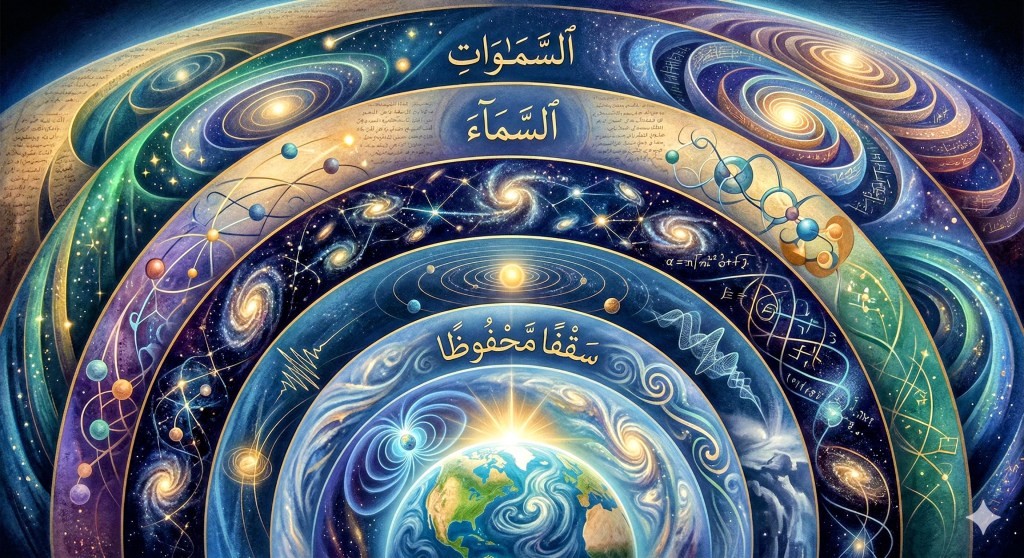
The Concept of the Heavens in the Quran: A Cosmological and Scientific Inquiry
Presented by Zia H Shah MD
Introduction: the Quranic sky as a gateway to the cosmos
The Quran devotes an extraordinary share of its textual landscape to the heavens. Of its approximately 6,600 verses, roughly one thousand address nature and natural phenomena, thequran and among these the term al-samāʾ (السَّمَاء, “the sky” or “the heaven”) and its plural al-samāwāt (السَّمَاوَات, “the heavens”) appear more than 310 times. Far from serving as mere poetic backdrop, these references constitute a coherent theological architecture in which the heavens function simultaneously as evidence of divine creative power, a repository of providential sustenance, a shield safeguarding terrestrial life, and a portent of eschatological dissolution. What makes this architecture arresting to contemporary readers is its resonance — sometimes uncanny, always provocative — with discoveries in modern astrophysics, atmospheric science, and cosmological philosophy.
This study undertakes a systematic examination of the Quranic discourse on the heavens, organised into seven thematic categories drawn directly from the Arabic text, and supplemented by six scientific excursuses that place the Quranic imagery alongside current knowledge of the Big Bang, cosmic expansion, fine-tuning, atmospheric protection, the cosmological argument, and the “seven heavens.” Throughout, attention is given to the scholarly writings of Zia H Shah MD, Chief Editor of The Muslim Times and author of over four hundred articles on the intersection of Islam and science, whose work at thequran.love offers a sustained modern engagement with these themes.
Part I: Quranic Verses on the Heavens — A Thematic Taxonomy
1. “He created the heavens and the earth”: the act of cosmic origination
The single most recurrent assertion the Quran makes about the heavens is that God created them. The Arabic construction khalaqa al-samāwāti wa-l-arḍ (خَلَقَ السَّمَاوَاتِ وَالْأَرْضَ) appears in dozens of verses, establishing the heavens as the supreme exhibit of divine creative agency. The creation narratives range from sweeping declarations to startlingly specific cosmogonic imagery.
The foundational statement appears in Sūrat al-Baqarah:
هُوَ الَّذِي خَلَقَ لَكُم مَّا فِي الْأَرْضِ جَمِيعًا ثُمَّ اسْتَوَىٰ إِلَى السَّمَاءِ فَسَوَّاهُنَّ سَبْعَ سَمَاوَاتٍ وَهُوَ بِكُلِّ شَيْءٍ عَلِيمٌ
“It was He who created all that is on the earth for you, then turned to the sky and made the seven heavens; it is He who has knowledge of all things.” (2:29) My Islam +2
This verse establishes the dual-directional logic of Quranic cosmogony: the earth first, then the heavens shaped into seven distinct strata. The number seven will recur with striking consistency, as will be discussed in the scientific section below.
The temporal framework of creation appears in several verses specifying “six Days” (sittati ayyām). In Sūrat al-Aʿrāf, the Quran declares:
إِنَّ رَبَّكُمُ اللَّهُ الَّذِي خَلَقَ السَّمَاوَاتِ وَالْأَرْضَ فِي سِتَّةِ أَيَّامٍ ثُمَّ اسْتَوَىٰ عَلَى الْعَرْشِ
“Your Lord is God, who created the heavens and earth in six Days, then established Himself on the throne; He makes the night cover the day in swift pursuit; He created the sun, moon, and stars to be subservient to His command; all creation and command belong to Him. Exalted be God, Lord of all the worlds!” (7:54) My Islam +3
This six-Day motif reappears in 25:59, 32:4, 50:38, and 57:4. Notably, 50:38 adds a theological gloss that distinguishes the Quranic account from earlier Near Eastern creation myths: وَمَا مَسَّنَا مِن لُّغُوبٍ — “without tiring.” IslamAwakened The explicit denial of divine fatigue marks a departure from the Genesis narrative, where God “rested” on the seventh day, Islamic StudiesIslamic Studies and underscores the Quranic insistence on God’s absolute transcendence over creation. Medium
Perhaps the most cosmologically suggestive passage in the entire Quran is the description of primordial creation in Sūrat Fuṣṣilat:
ثُمَّ اسْتَوَىٰ إِلَى السَّمَاءِ وَهِيَ دُخَانٌ فَقَالَ لَهَا وَلِلْأَرْضِ ائْتِيَا طَوْعًا أَوْ كَرْهًا قَالَتَا أَتَيْنَا طَائِعِينَ فَقَضَاهُنَّ سَبْعَ سَمَاوَاتٍ فِي يَوْمَيْنِ وَأَوْحَىٰ فِي كُلِّ سَمَاءٍ أَمْرَهَا وَزَيَّنَّا السَّمَاءَ الدُّنْيَا بِمَصَابِيحَ وَحِفْظًا ذَٰلِكَ تَقْدِيرُ الْعَزِيزِ الْعَلِيمِ
“Then He turned to the sky, which was smoke — He said to it and the earth, ‘Come into being, willingly or not,’ and they said, ‘We come willingly’ — and in two Days He formed seven heavens, and assigned an order to each. We have made the nearest one beautifully illuminated and secure. Such is the design of the Almighty, the All Knowing.” (41:11–12) My Islam
The word دُخَان (dukhān, “smoke”) is extraordinary. Classical exegetes such as al-Ṭabarī understood it literally as a gaseous, nebular state predating the solidification of the heavens. Islamic Studies Modern commentators have drawn a parallel with the hot, opaque plasma that pervaded the early universe before the epoch of recombination approximately 380,000 years after the Big Bang, when photons first decoupled from matter and the cosmos became transparent. Additional creation verses of note include 65:12, which hints at cosmic pluralism — اللَّهُ الَّذِي خَلَقَ سَبْعَ سَمَاوَاتٍ وَمِنَ الْأَرْضِ مِثْلَهُنَّ — “It is God who created seven heavens and a similar [number] of earths,” My IslamSlideShare and 67:3, which introduces the motif of flawless layered construction: الَّذِي خَلَقَ سَبْعَ سَمَاوَاتٍ طِبَاقًا مَّا تَرَىٰ فِي خَلْقِ الرَّحْمَنِ مِن تَفَاوُتٍ — “He created seven heavens, one above the other. You will not see any flaw in what the Lord of Mercy creates. Look again! Can you see any flaw?” Quranic Arabic Corpus +3
2. Sovereign dominion over the heavens: the divine mulk
If the creation verses establish God as cosmic architect, the sovereignty verses establish Him as cosmic ruler. The Arabic noun mulk (مُلْك) — rendered by Abdel Haleem as “control” — appears in conjunction with the heavens in a dense cluster of verses asserting that every particle in the cosmos belongs to, and answers to, God alone.
The supreme expression of this theology is Āyat al-Kursī, the Throne Verse, arguably the single most celebrated verse in the entire Quran:
اللَّهُ لَا إِلَٰهَ إِلَّا هُوَ الْحَيُّ الْقَيُّومُ لَا تَأْخُذُهُ سِنَةٌ وَلَا نَوْمٌ لَّهُ مَا فِي السَّمَاوَاتِ وَمَا فِي الْأَرْضِ … وَسِعَ كُرْسِيُّهُ السَّمَاوَاتِ وَالْأَرْضَ وَلَا يَئُودُهُ حِفْظُهُمَا وَهُوَ الْعَلِيُّ الْعَظِيمُ
“God: there is no god but Him, the Ever Living, the Ever Watchful. Neither slumber nor sleep overtakes Him. All that is in the heavens and in the earth belongs to Him… His throne extends over the heavens and the earth; it does not weary Him to preserve them both. He is the Most High, the Tremendous.” (2:255) My Islam +2
The theological import is dual: God’s kursī (throne) encompasses the entirety of cosmic space, and its preservation costs Him no effort. Islamic StudiesQur’an Wiki This effortless sovereignty is reiterated in 2:107 — “Do you not know that control of the heavens and the earth belongs to Him?” Islam AwakenedIslamAwakened — and 3:189 — “Control of the heavens and earth belongs to God; God has power over everything.” My Islam The phrase وَلِلَّهِ مُلْكُ السَّمَاوَاتِ وَالْأَرْضِ appears with near-formulaic regularity in 5:17, 5:18, 5:120, 57:2, 57:5, and 85:9, each time asserting that no entity — neither the Messiah, nor any claimed intermediary, nor any human king — shares in God’s cosmic dominion.
Verse 25:2 adds a dimension critical to the fine-tuning discussion below: الَّذِي لَهُ مُلْكُ السَّمَاوَاتِ وَالْأَرْضِ … وَخَلَقَ كُلَّ شَيْءٍ فَقَدَّرَهُ تَقْدِيرًا — “He has dominion over the heavens and earth… He created all things and determined them most exactly.” ThequranThe Last Dialogue The term تَقْدِيرًا (taqdīran, “precise determination”) will prove indispensable when we consider the physical constants of the universe.
3. The expanding heavens and cosmic architecture
A small but momentous group of verses describes the heavens not merely as created but as structurally dynamic — raised, sustained, and expanded by ongoing divine agency.
The most scientifically discussed verse in the entire Quran is 51:47:
وَالسَّمَاءَ بَنَيْنَاهَا بِأَيْدٍ وَإِنَّا لَمُوسِعُونَ
“We built the heavens with Our power and made them vast.” (51:47, Abdel Haleem) My Islam
The Arabic active participle لَمُوسِعُونَ (la-mūsiʿūn), from the root و-س-ع (w-s-ʿ, “to widen, expand”), denotes continuous, ongoing action. While Abdel Haleem renders it as “made them vast,” other translators — including Sahih International (“We are certainly expanding it”) Islam Awakened and the Ahmadiyya rendering (“We go on expanding it”) — preserve the present-continuous sense more explicitly. The linguistic point is significant: the Quran does not say God expanded the heavens at some point in the past, but that He is their expander, an ongoing condition. Quora
Equally arresting is the description of the heavens as raised without visible supports. Sūrat al-Raʿd declares:
اللَّهُ الَّذِي رَفَعَ السَّمَاوَاتِ بِغَيْرِ عَمَدٍ تَرَوْنَهَا
“It is God who raised up the heavens with no visible supports.” (13:2) Quranic Arabic CorpusMy Islam
The phrase bi-ghayri ʿamadin tarawnahā (“without pillars that you can see”) has been interpreted by classical scholars such as Ibn ʿAbbās as meaning either “without any pillars at all” or “with pillars that exist but are invisible.” Modern interpreters have noted the resonance with gravitational force — an invisible “pillar” sustaining the architecture of space. Islamic Studies In 55:7, the cosmic architecture merges with the theme of balance: وَالسَّمَاءَ رَفَعَهَا وَوَضَعَ الْمِيزَانَ — “He has raised up the sky. He has set the balance.” Quran.com +2 The juxtaposition of a raised sky with an established mīzān (balance/scale) suggests that the cosmic structure is not merely vast but precisely calibrated.
The primordial unity and subsequent splitting of the cosmos appears in 21:30:
أَوَلَمْ يَرَ الَّذِينَ كَفَرُوا أَنَّ السَّمَاوَاتِ وَالْأَرْضَ كَانَتَا رَتْقًا فَفَتَقْنَاهُمَا وَجَعَلْنَا مِنَ الْمَاءِ كُلَّ شَيْءٍ حَيٍّ أَفَلَا يُؤْمِنُونَ
“Are the disbelievers not aware that the heavens and the earth used to be joined together and that We ripped them apart, that We made every living thing from water? Will they not believe?” (21:30) thequran +2
The terms رَتْقًا (ratqan, “a sewn-together, closed-up mass”) and فَفَتَقْنَاهُمَا (fa-fataqnāhumā, “then We unstitched/split them”) evoke a primordial singularity that was “opened out” The Religion of Islam — an image that modern Muslim scholars have frequently paralleled with the Big Bang.
4. The sky as a well-guarded canopy
The Quran repeatedly describes the sky as a protective covering, using architectural and military metaphors that acquire new dimensions when read alongside atmospheric science.
The central verse is 21:32:
وَجَعَلْنَا السَّمَاءَ سَقْفًا مَّحْفُوظًا وَهُمْ عَنْ آيَاتِهَا مُعْرِضُونَ
“And We made the sky a well-secured canopy — yet from its wonders they turn away.” (21:32) thequran +4
The word سَقْفًا (saqfan, “roof” or “canopy”) casts the sky as a structure analogous to the ceiling of a building, while مَحْفُوظًا (maḥfūẓan, “well-guarded” or “well-secured”) implies active, purposive protection. Classical exegetes (al-Jalālayn, Ibn Kathīr, al-Rāzī) understood this primarily as the sky’s stability — held aloft without collapse. thequranBlogger Modern commentators such as Maurice Bucaille, Zaghloul El-Naggar, and Zia H Shah have extended the interpretation to encompass the magnetosphere, the ozone layer, and the atmosphere’s capacity to incinerate incoming meteoroids. Thequran
A complementary image appears in 86:11: وَالسَّمَاءِ ذَاتِ الرَّجْعِ — “By the sky and its recurring rain” (Abdel Haleem), though the Arabic ذَاتِ الرَّجْعِ (dhāt al-rajʿ) literally means “possessing the quality of returning/sending back.” This has been interpreted not only as the water cycle but as the atmosphere’s capacity to reflect radio waves (via the ionosphere), deflect harmful radiation (via the ozone layer and magnetosphere), and return heat to the surface (via the greenhouse effect). Islamweb
Additional protective-sky verses include 67:5, which describes the lowest heaven adorned with lamps (stars) that serve as missiles against intruding devils; 37:6–7, which states “We have adorned the lowest heaven with stars and made them a safeguard against every rebellious devil”; My Islam +2 15:16–18, describing constellations and sentinels guarding the sky; and 72:8–9, where the jinn report: “We tried to reach heaven, but discovered it to be full of stern guards and shooting stars.” Aronra
5. Rain and provision descending from the sky
The Quran treats rain as the supreme embodiment of heavenly provision — a tangible, life-sustaining connection between the celestial and terrestrial realms. The Arabic formula أَنزَلَ مِنَ السَّمَاءِ مَاءً (“He sent down water from the sky”) recurs throughout the text with almost litanic regularity.
Among the most scientifically precise descriptions of the rain cycle is 24:43:
أَلَمْ تَرَ أَنَّ اللَّهَ يُزْجِي سَحَابًا ثُمَّ يُؤَلِّفُ بَيْنَهُ ثُمَّ يَجْعَلُهُ رُكَامًا فَتَرَى الْوَدْقَ يَخْرُجُ مِنْ خِلَالِهِ
“Do you not see that God drives the clouds, then gathers them together and piles them up until you see rain pour from their midst? He sends hail down from [such] mountains in the sky.” My Islam (24:43) Quranic Arabic Corpus
The verse describes a three-stage process — God drives individual cloud fragments (yuzjī saḥāban), then joins them together (yu’allifu baynahu), then piles them up (yajʿaluhu rukāman) — matching the modern meteorological understanding of cumulonimbus cloud formation through convective aggregation. The reference to “mountains in the sky” (min jibālin fīhā) from which hail descends corresponds to the towering anvil-shaped tops of mature cumulonimbus clouds, which can reach altitudes of 12–15 kilometres.
Other significant rain-provision verses include 23:18, which introduces the concept of measured rainfall — وَأَنزَلْنَا مِنَ السَّمَاءِ مَاءً بِقَدَرٍ — “We sent down water from the sky in a measured amount and lodged it in the earth”; 39:21, which traces the complete hydrological cycle from sky to spring to crop — “God sends water down from the sky, guides it along to form springs in the earth, and then, with it, brings forth vegetation of various colours”; and 2:164, which places rain within a comprehensive catalogue of natural signs including navigation, wind patterns, and cloud behaviour. Quran
6. Eschatological dissolution: when the sky is torn apart
If the creation verses describe the heavens’ beginning and the provision verses their ongoing function, the eschatological verses describe their end. The imagery is violent, vivid, and cosmically total.
The central verse is 21:104:
يَوْمَ نَطْوِي السَّمَاءَ كَطَيِّ السِّجِلِّ لِلْكُتُبِ كَمَا بَدَأْنَا أَوَّلَ خَلْقٍ نُّعِيدُهُ وَعْدًا عَلَيْنَا إِنَّا كُنَّا فَاعِلِينَ
“On that Day, We shall roll up the skies as a writer rolls up [his] scrolls. We shall reproduce creation just as We produced it the first time: this is Our binding promise. We shall certainly do all these things.” My Islam (21:104)
The image of the heavens being rolled up like a scroll (naṭwī al-samāʾa ka-ṭayy al-sijilli lil-kutub) is both poetically stunning and cosmologically suggestive. The verse’s additional clause — “We shall reproduce creation just as We produced it the first time” — implies a cyclical cosmology: the same God who began the universe will end it and begin it again. This has been compared by some scholars to the Big Crunch hypothesis or cyclic cosmological models.
The eschatological palette is extended by 39:67 — وَالسَّمَاوَاتُ مَطْوِيَّاتٌ بِيَمِينِهِ — “The heavens will be rolled up in His right hand”; My Islam 55:37 — فَإِذَا انشَقَّتِ السَّمَاءُ فَكَانَتْ وَرْدَةً كَالدِّهَانِ — “when the sky is torn apart and turns crimson, like red leather”; Quranic Arabic CorpusIslam Awakened 69:16 — وَانشَقَّتِ السَّمَاءُ فَهِيَ يَوْمَئِذٍ وَاهِيَةٌ — “the sky will be torn apart on that Day, it will be so frail”; 70:8 — يَوْمَ تَكُونُ السَّمَاءُ كَالْمُهْلِ — “on the Day when the sky becomes like molten metal”; 78:19 — وَفُتِحَتِ السَّمَاءُ فَكَانَتْ أَبْوَابًا — “when the sky is opened up, becoming [full of] gates”; 81:11 — وَإِذَا السَّمَاءُ كُشِطَتْ — “when the sky is stripped away”; 82:1 — إِذَا السَّمَاءُ انفَطَرَتْ — “When the sky is torn apart”; Wikipedia and 84:1 — إِذَا السَّمَاءُ انشَقَّتْ — “When the sky bursts open.” Masjid Tucson
Collectively, these verses describe a cosmic termination of astonishing thoroughness: the sky will be torn, split, stripped, made molten, turned crimson, riddled with gates, and finally rolled up. Zia H Shah has argued that the Quranic assertion of a finite cosmic lifespan — “We have not created the heavens and the earth, and all that is between them, but with truth and a real purpose, and for an appointed term” (46:3) — aligns with modern cosmology’s prediction of universal heat death or a “Big Freeze,” and that this eschatological framework could not have been intuited in an intellectual environment dominated by the Aristotelian assumption of an eternal cosmos. Thequran
7. Divine omniscience spanning the heavens
A final thematic cluster presents the heavens as the spatial domain of God’s all-encompassing knowledge. These verses assert that nothing in the heavens or the earth escapes divine awareness — not the weight of an atom, not a whispered conversation, not the innermost thought of a human heart.
Sūrat Sabaʾ articulates this with a striking image of scale: لَا يَعْزُبُ عَنْهُ مِثْقَالُ ذَرَّةٍ فِي السَّمَاوَاتِ وَلَا فِي الْأَرْضِ — “not even the weight of a speck of dust in the heavens or earth escapes Him” (34:3). The word ذَرَّة (dharrah, traditionally “atom” or “mote of dust”) acquires cosmic significance when the heavens are understood at their full astronomical extent: God’s knowledge penetrates to the subatomic level across the entirety of cosmic space.
Other key verses include 3:29 — “God knows everything that is in your hearts, whether you conceal or reveal it; He knows everything in the heavens and earth”; My IslamMy Islam 6:3 — “He is God in the heavens and on earth, He knows your secrets and what you reveal”; My Islam 27:65 — “No one in the heavens or earth knows the unseen except God”; 35:38 — “God knows all that is hidden in the heavens and earth: He truly knows the innermost thoughts”; and 58:7 — “Do you not see that God knows everything in the heavens and earth? There is no secret conversation between three people where He is not the fourth.” My Islam
Part II: Scientific and Cosmological Embellishment
A. Creation from nothing: the Big Bang and Kun Fayakun
Modern physical cosmology converges on a single, extraordinary claim: approximately 13.787 ± 0.02 billion years ago, the entirety of cosmic space, time, matter, and energy expanded from a state of near-infinite density and temperature. Wikipedia The evidence is formidable and threefold. First, the cosmic microwave background (CMB), discovered in 1964 by Arno Penzias and Robert Wilson, constitutes a relic radiation field at 2.725 K pervading all space Study.com — the cooled afterglow of the primordial fireball. Second, Edwin Hubble’s 1929 observation of galactic redshifts demonstrated that galaxies recede at velocities proportional to their distance, QuranhouseStudy.com implying a universal expansion PNAS that, run backwards, converges to a beginning. Third, Big Bang nucleosynthesis predicts the observed cosmic abundances of light elements — approximately 75% hydrogen, 25% helium-4, and trace deuterium and lithium Berkeley — with a precision that renders the model virtually impossible to “untune.” Wikipedia
The philosophical and theological resonance of this scientific narrative with the concept of creatio ex nihilo — creation from nothing — has been noted by scholars across traditions. The doctrine holds that the universe was brought into being by God without recourse to any pre-existing material. ThequranWikipedia In Islam, this concept finds its most concentrated expression in 2:117:
بَدِيعُ السَّمَاوَاتِ وَالْأَرْضِ وَإِذَا قَضَىٰ أَمْرًا فَإِنَّمَا يَقُولُ لَهُ كُن فَيَكُونُ
“He is the Originator of the heavens and the earth, and when He decrees something, He says only, ‘Be,’ and it is.” (2:117) thequranIslam Awakened
The Arabic بَدِيعُ (Badīʿ, “Originator” or “unprecedented Creator”) implies creation without prototype or pre-existing substrate — precisely the meaning of ex nihilo. As Zia H Shah has argued, “The Arabic term Badi’ implies creation ex nihilo — from absolutely nothing,” and he further notes that this Quranic position “contrasts with Aristotle’s eternal universe and Plato’s de novo creation from pre-existing material,” placing the Quran in a distinctive intellectual position that cannot be explained as borrowing from either Greek tradition.
The most explicit cosmogonic verse, 21:30, describes the heavens and earth as having been a رَتْقًا (ratqan, “a joined, sewn-together entity”) that was then فَفَتَقْنَاهُمَا (fa-fataqnāhumā, “split apart”). Classical Arabic lexicons (Lisān al-ʿArab) define ratq as “sewn together, closed up” Rational Religion and fatq as “unstitched, split open.” Quran The parallel with the Big Bang singularity — a primordial state of extreme unity from which the cosmos “opened out” — has been widely noted. Shah describes this correspondence: “Qur’an 21:30 opens by alluding to a common origin of the heavens and earth, which modern readers often compare to the Big Bang. Quran Gallery App This verse mirrors the Big Bang theory, describing a primordial singularity (‘closed-up mass’) that was ‘split apart’ to form the cosmos.” ThequranThequran
The formal philosophical bridge between Big Bang cosmology and theistic creation was constructed by the Kalām Cosmological Argument, revived in its modern form by William Lane Craig Wikipedia in his 1979 doctoral work The Kalām Cosmological Argument. AmazonWikipedia The argument’s structure is elegant:
- Whatever begins to exist has a cause.
- The universe began to exist.
- Therefore, the universe has a cause. thequran +2
Craig supports Premise 2 with both philosophical arguments (the impossibility of an actually infinite temporal regress) and scientific evidence, including the Big Bang University of Colorado Boulder and Thequran the Borde-Guth-Vilenkin theorem thequran (2003), which demonstrates that any universe that has, on average, been expanding throughout its history “must have a past spacetime boundary.” Inference As Alexander Vilenkin wrote in Many Worlds in One (2006): “With the proof now in place, cosmologists can no longer hide behind the possibility of a past-eternal universe. There is no escape; they have to face the problem of a cosmic beginning.” Reasonable Faith The Quran, Shah observes, makes its own direct version of this logical challenge in 52:35–36: أَمْ خُلِقُوا مِنْ غَيْرِ شَيْءٍ أَمْ هُمُ الْخَالِقُونَ — “Were they created from nothing, Thequran or did they create themselves? Did they create the heavens and the earth? No! They have no faith.” Shah calls this “a direct articulation of the cosmological argument” — over a millennium before Craig formulated his version.
B. The expanding universe and the word mūsiʿūn
When Edwin Hubble published his landmark 1929 paper, Quranhouse “A relation between distance and radial velocity among extra-galactic nebulae,” he overturned a cosmological assumption that had reigned since antiquity: the belief in a static, eternal universe. PNAS Even Albert Einstein, whose general relativity equations naturally predicted an expanding or contracting cosmos, had introduced a “cosmological constant” to enforce a static solution. After Hubble’s confirmation, Einstein reportedly called this his “greatest mistake.”
The intellectual priority, however, belongs to the Belgian priest-physicist Georges Lemaître, who in 1927 independently derived expanding-universe solutions to Einstein’s field equations and estimated the velocity-distance relation using observational data, two years before Pontifical Academy of Sciences Hubble’s publication. Lemaître subsequently proposed the “Primeval Atom” hypothesis — the first scientific formulation of what would become the Big Bang theory. In 2018, the International Astronomical Union formally renamed Hubble’s Law as the Hubble-Lemaître Law in recognition of Lemaître’s priority.
Today, the expansion is known to be accelerating. In 1998, two independent teams — the Supernova Cosmology Project (Saul Perlmutter) and the High-z Supernova Search Team (Brian Schmidt and Adam Riess) — discovered using Type Ia supernovae that the universe’s expansion rate has been increasing for the past approximately six billion years, driven by a mysterious “dark energy” constituting roughly 68% of the universe’s total energy density. This discovery earned the 2011 Nobel Prize in Physics.
Against this backdrop, Quran 51:47 acquires extraordinary resonance. The Arabic text — وَالسَّمَاءَ بَنَيْنَاهَا بِأَيْدٍ وَإِنَّا لَمُوسِعُونَ — uses the active participle مُوسِعُونَ (mūsiʿūn), from the root أَوْسَعَ (awsaʿa, “to make wide, to expand”). The active participial form in Arabic denotes continuous, ongoing action: “We are [continuously] expanding it.” As Shah writes: “The Prophet living in the wasteland of Arabia in the seventh century had not even the slightest idea about the expanding universe,” and he further notes that “the concept of a solid firmament persisted from ancient Hebrews through Aristotle to Copernicus” — making the Quranic assertion of an expanding sky a radical departure from every cosmological model available to its original audience. “The Quran talks about the expanding universe in the 7th century. So, there is hardly a human explanation for this.”
Shah and his co-author Dr. Lutf ur Rehman have argued in The Muslim Sunrise that “the concept of the continuous expansion of the universe is exclusive to the Qur’an” — no other ancient text describes it. The significance is heightened by the fact that the expanding universe was not discovered until over 1,300 years after the Quranic revelation, and that the prevailing scientific consensus until the 1920s was a static, eternal cosmos.
C. Fine-tuning of the universe and the cosmic mīzān
Perhaps the most philosophically consequential discovery of twentieth-century physics is that the fundamental constants of nature appear to be calibrated with extraordinary precision for the existence of complex life. The Standard Model of particle physics, together with cosmological parameters, involves approximately 31 independent constants, and the life-permitting ranges for many of these are vanishingly small fractions of the total possibility space.
The cosmological constant (Λ), representing the energy density of empty space, is fine-tuned to approximately 1 part in 10^120 — a precision so extreme that physicist Paul Davies described it as making the cosmos appear as if balanced on a “knife-edge.” The strong nuclear force coupling constant cannot vary by more than 2% in either direction: 2% weaker, and no nuclei heavier than hydrogen could form; 2% stronger, and all hydrogen would have been converted to helium in the early universe, leaving no fuel for long-lived stars and no water. The ratio of electromagnetic to gravitational force between protons is approximately 10^36 — if gravity were slightly stronger relative to electromagnetism, all stars would be red dwarfs; if weaker, all would be blue giants. Neither regime supports life. The initial expansion rate of the universe was balanced against its density to approximately 1 part in 10^15 one second after the Big Bang. And Roger Penrose calculated the probability of the universe’s extraordinarily low initial entropy to be 1 in 10^(10^123) — a number so vast that writing it in standard notation would require more digits than there are particles in the observable universe.
Sir Martin Rees, Astronomer Royal and former President of the Royal Society, distilled these findings into his influential 1999 work Just Six Numbers, identifying six parameters (N, ε, Ω, Λ, Q, and D) that collectively define the recipe for a habitable universe. Rees concluded: “Cosmic evolution is astonishingly sensitive to the values of these numbers. If any one of them were ‘untuned,’ there could be no stars and no life.” Robin Collins, Distinguished Professor of Philosophy at Messiah University, has formulated a rigorous Bayesian argument: fine-tuning is not improbable under theism but is exceedingly improbable under the atheistic single-universe hypothesis, and therefore strongly confirms theism. John Polkinghorne, who resigned his Cambridge chair in mathematical physics to become an Anglican priest, put it plainly: there are two options — a multiverse or “just one universe which is the way it is in its anthropic fruitfulness because it is the expression of the purposive design of a Creator.” He called the multiverse “a metaphysical guess… mostly invented to explain away the fine tuning.”
The Quran, remarkably, deploys precisely the language of precise calibration. In 25:2, God is described as having created all things and “determined them most exactly” (فَقَدَّرَهُ تَقْدِيرًا). In 55:7, the raised sky is immediately paired with the establishment of the mīzān (balance): “He has raised up the sky. He has set the balance.” Classical exegete Maudūdī commented that “had there been no harmony and balance and justice established among the countless stars and planets moving in space, and the mighty forces working in this universe, this life on earth would not have functioned even for a moment.” In 67:3–4, the challenge to find any flaw in the layered heavens reads as an invitation to empirical investigation — one that modern science, rather than exposing flaws, has answered by discovering ever-more-astonishing levels of precision.
Shah has written extensively on this theme, noting that the Quran’s invitation to “look again and again” for flaws “parallels the scientific method” and that “with each new discovery, our sense of ‘flawlessness’ in the cosmos only deepens.” Citing both Fred Hoyle’s concession — “a common-sense interpretation of the facts suggests that a superintellect has monkeyed with physics” — and Stephen Hawking’s observation that “the values of these numbers seem to have been very finely adjusted to make possible the development of life,” Shah argues that the cumulative case for cosmic design has grown stronger, not weaker, with every advance in precision cosmology. He has further argued that even a multiverse would not eliminate the need for a designer, since “an ensemble of universes would itself require an explanation,” and the meta-laws governing any universe-generating mechanism “may themselves be fine-tuned.”
D. The magnetosphere and atmosphere as the “well-guarded canopy”
The Quranic description of the sky as سَقْفًا مَحْفُوظًا (saqfan maḥfūẓan, “a well-secured canopy”) in 21:32 acquires vivid scientific specificity when examined against the multiple protective functions of Earth’s atmosphere and magnetosphere.
The magnetosphere is generated by convection currents of molten iron-nickel alloy in Earth’s liquid outer core, combined with planetary rotation, producing a magnetic field that extends from the surface to approximately 63,000 km on the sunward side. This field deflects the solar wind — a continuous stream of charged particles moving at roughly 400–800 km/s — preventing it from stripping away the atmosphere. The devastating consequences of losing this protection are visible on Mars: research published in Nature Communications (2022) by Shunpei Yokoo and colleagues at the University of Tokyo demonstrated that Mars lost its magnetic field approximately 4.1 billion years ago when its smaller core cooled and convection ceased. NASA’s MAVEN mission confirmed that the solar wind subsequently stripped away most of Mars’s atmosphere, reducing its surface pressure to roughly 1% of Earth’s and rendering the planet cold, arid, and almost certainly lifeless.
Within the magnetosphere, the Van Allen radiation belts, discovered in 1958 by James Van Allen using Explorer 1 data, form two torus-shaped zones of trapped energetic particles: an inner belt (1,000–6,000 km) of high-energy protons and an outer belt (15,000–25,000 km) of energetic electrons. These belts contain what NASA has described as a “nearly impenetrable barrier” for the most energetic electrons.
The ozone layer, residing in the stratosphere at approximately 15–35 km altitude, absorbs 97–99% of the Sun’s medium-frequency ultraviolet radiation (UV-B, 280–315 nm). Without it, surface UV radiation would cause epidemic skin cancers, cataracts, and immune suppression, while damaging marine phytoplankton and reducing crop yields.
The atmosphere as a whole serves as a thermal blanket — maintaining an average surface temperature of approximately 15°C versus the −18°C that would prevail without the greenhouse effect — and as a meteor shield, incinerating most incoming meteoroids through frictional heating in the mesosphere (50–85 km). The 2013 Chelyabinsk meteor dramatically demonstrated this protection: a 20-metre asteroid exploded approximately 30 km above the surface, its kinetic energy dissipated by the atmosphere before it could make surface contact.
Shah’s article “The Glorious Quran: ‘We made the sky a well-secured canopy’” (March 2025) provides an extensive treatment of these parallels, noting that “the Van Allen Belt serves as a shield against harmful radiation… without it, massive solar flares would destroy all life on Earth.” He writes: “This remarkable correspondence is often cited by Muslim scientists as an āyah (sign) in the scientific sense as well — a sign that our world is intentionally configured.”
The complementary verse 86:11, وَالسَّمَاءِ ذَاتِ الرَّجْعِ, describes the sky as possessing the quality of rajʿ — “sending back” or “returning.” While Abdel Haleem renders this as “recurring rain,” the broader semantic field of the Arabic root encompasses every returning function of the atmosphere: the troposphere returns water as rain, the ozone layer returns UV radiation to space, the ionosphere returns radio waves to Earth’s surface, and the magnetosphere returns charged particles from the solar wind back into space. Shah and other modern commentators have argued that this multi-layered “returning” function is “a remarkably apt description given the 7th-century context of revelation.”
E. The cosmological argument: from al-Kindī to Craig
The formal philosophical case for the existence of a cosmic Creator — the cosmological argument — has its deepest roots in Islamic intellectual history. The Kalām Cosmological Argument, named after the medieval Islamic theological tradition of ʿilm al-kalām, was first articulated by al-Kindī (c. 801–873 CE), known as the “Philosopher of the Arabs.” In his treatise On First Philosophy (Fī al-Falsafa al-Ūlā), al-Kindī used reductio ad absurdum arguments against actual infinities, drawing on Euclid’s axiom that the whole is greater than its part, to demonstrate that the material world cannot be infinite in the past. He argued that prior to the universe’s existence, it was equally possible for it to exist or not exist, and therefore a “determining agent” (muḥdith) — God — was necessary.
Al-Ghazālī (1058–1111 CE) sharpened the argument in his Tahāfut al-Falāsifa (The Incoherence of the Philosophers), presenting the syllogism: “Every being which begins has a cause for its beginning; now the world is a being which begins; therefore, it possesses a cause for its beginning.” Al-Ghazālī deployed vivid paradoxes — such as the differing orbital periods of Jupiter and the sphere of fixed stars, which in an infinite past would paradoxically yield equal (infinite) numbers of revolutions despite different rates — to demonstrate the absurdity of an infinite temporal regress.
Craig revived this argument in his 1979 Birmingham doctoral thesis, now recognised as one of the most influential works in contemporary philosophy of religion. The Cambridge Companion to Atheism (2007) reports that “more articles have been published about the Kalam argument than about any other contemporary formulation of an argument for God’s existence.” Craig further argues that the cause of the universe must be uncaused, timeless, spaceless, immaterial, enormously powerful, and personal — since only a personal agent with free will could produce a temporal effect from a timeless, changeless state.
The complementary Leibnizian argument from contingency, formulated by Gottfried Wilhelm Leibniz (1646–1716) on the basis of the Principle of Sufficient Reason, holds that even an eternal universe would require an external explanation, since all contingent beings demand a sufficient reason for their existence that ultimately terminates in a metaphysically necessary being. This maps onto the Quranic description of God as الصَّمَدُ (al-Ṣamad, “the Self-Sufficient, upon whom all depend”) in 112:2.
Shah has dedicated multiple articles to the cosmological argument, arguing that the Quran functions as “a comprehensive presentation of the cosmological argument” spanning its entire text. He draws attention particularly to the rhetorical force of 52:35–36, which he reads as a direct philosophical challenge: “Were they created from nothing, or did they create themselves? Did they create the heavens and the earth? No!” Shah writes: “The Quran has approximately 6,600 verses, with a thousand talking about nature and natural phenomena and encouraging the believers to study them to find pearls of wisdom and signs and miracles in them. These, with a little poetic licence, become a part of the cosmological argument.”
F. The seven heavens: between classical cosmology and modern science
The Quran’s repeated reference to سَبْعَ سَمَاوَاتٍ (sabʿa samāwāt, “seven heavens”) — appearing in 2:29, 41:12, 65:12, 67:3, and 71:15 — has provoked centuries of exegetical reflection. The question of what these “seven heavens” correspond to physically has generated three broad interpretive traditions.
The classical tradition operated within the Ptolemaic astronomical framework that dominated both Islamic and European science from the ninth through the sixteenth century. Medieval Muslim astronomers — including al-Khwārizmī, al-Farghānī, Ibn al-Haytham, and the scholars of the Marāgha observatory — adapted the Ptolemaic system of nested celestial spheres, and a natural correspondence was drawn between the Quran’s seven heavens and the seven spheres of the Moon, Mercury, Venus, the Sun, Mars, Jupiter, and Saturn. This identification was never universal, however. Fakhr al-Dīn al-Rāzī (1149–1209), one of the greatest classical exegetes, remained “undecided as to which celestial models, concrete or abstract, most conform with external reality,” candidly admitting that “there is no way to ascertain the characteristics of the heavens” by observable evidence or divine revelation alone.
The atmospheric-layers interpretation, advanced by modern Muslim scholars, proposes a correspondence with the layered structure of Earth’s atmosphere: the troposphere, stratosphere, mesosphere, thermosphere, exosphere, and two additional zones often counted as the ionosphere and magnetosphere. Each layer has distinct physical properties — temperature profiles, chemical compositions, and protective functions — and the Quranic term طِبَاقًا (ṭibāqan, “in layers”) in 67:3 and 71:15 is cited as supporting this reading. The interpretation has some explanatory appeal but faces the objection that the standard scientific classification recognises five primary atmospheric layers, not seven, and that 41:12 places stars in the “nearest heaven” (al-samāʾ al-dunyā), which does not match any atmospheric layer.
The cosmic-structure interpretation, favoured by some contemporary commentators, suggests that the seven heavens may refer to levels of cosmic organisation — from planetary systems to star clusters to galaxies to galaxy clusters to superclusters to the cosmic web to the observable universe as a whole — or to multiple universes. This reading is more speculative but aligns with the Quranic implication that the seven heavens represent a vast, multi-tiered cosmic architecture extending far beyond human sight.
A mediating position holds that the number “seven” (sabʿa) functions in Arabic as an expression of plentitude rather than a strict numerical count, signifying “many” or “a great number.” On this reading, the Quran asserts that the heavens are multi-layered and extensively structured without specifying an exact number of layers. Shah captures this perspective when he writes that “the broader point is that the Quran depicts a multilevel cosmos created with order at every level — and this is exactly what we observe.”
The key Quranic passage for this discussion remains 67:3–4, which pairs the seven-layered heavens with a challenge to empirical scrutiny: “You will not see any flaw in what the Lord of Mercy creates. Look again! Can you see any flaw? Then look again, and again. Your vision will return to you humbled and fatigued.” This dual assertion — structural layering combined with absolute perfection — constitutes what Shah calls “an invitation to the scientific method,” an encouragement to examine the cosmos with ever-greater precision and discover, at every level, evidence of design rather than defect.
Part III: Synthesis — Where Revelation Meets Discovery
The cumulative case: converging lines of evidence
The scholarly investigation of the Quranic heavens reveals not a single, isolated correspondence between scripture and science but rather a web of mutually reinforcing convergences. The cosmogonic imagery of 21:30 and 41:11 resonates with Big Bang cosmology. The active participle mūsiʿūn in 51:47 anticipates the discovery of cosmic expansion by over a millennium. The taqdīr (precise determination) of 25:2 and the mīzān (balance) of 55:7 map onto the fine-tuning of physical constants. The “well-secured canopy” of 21:32 and the “returning sky” of 86:11 describe functions of the atmosphere and magnetosphere with a specificity that transcends the knowledge available to any seventh-century author. And the cosmological argument — articulated in its Islamic form by al-Kindī and al-Ghazālī, encoded in the rhetorical challenge of 52:35–36, and now supported by the Borde-Guth-Vilenkin theorem — links the Quranic doctrine of creation to the most rigorous philosophical reasoning about cosmic origins.
Shah’s methodology, developed across more than four hundred articles, treats these convergences not as isolated curiosities but as components of a cumulative case for the divine authorship of the Quran. He has been careful to note that “the goal is not to ‘prove’ the Quran through science but to deepen appreciation of its layered wisdom,” and he warns against “rigidly tying Quranic exegesis to transient theories.” Yet the persistence of Quranic-scientific consonance across such diverse domains — from nucleosynthesis to atmospheric physics, from the philosophy of infinity to the hydrology of cloud formation — constitutes, in Shah’s framing, a pattern that demands explanation. As he writes regarding the expanding universe: “The Quran talks about the expanding universe in the 7th century. So, there is hardly a human explanation for this.”
The epistemological question: foreknowledge or retrospective reading?
Academic integrity requires acknowledging the counter-position. Critics of the “scientific miracles of the Quran” approach argue that modern scientific readings are retrospective projections — that verses like 51:47 were not understood as referring to cosmic expansion until after Hubble’s discovery, and that mūsiʿūn was traditionally interpreted as “We are enrichers” or “We have power/capacity” rather than “We are expanders.” Similarly, the atmospheric interpretation of “seven heavens” is not found in any pre-modern tafsīr. The classical exegetical tradition interpreted these verses through the lens of Ptolemaic cosmology or theological metaphor, not modern astrophysics.
This objection has force but does not settle the question. The Quran itself, in 41:53, anticipates a progressive unveiling of its meanings: سَنُرِيهِمْ آيَاتِنَا فِي الْآفَاقِ وَفِي أَنفُسِهِمْ حَتَّىٰ يَتَبَيَّنَ لَهُمْ أَنَّهُ الْحَقُّ — “We shall show them Our signs on the horizons and within themselves until it becomes clear to them that this is the Truth.” The claim is not that seventh-century Arabs understood quantum cosmology, but that the Quran’s language was crafted with a semantic depth that would unfold across centuries of human discovery. Whether this constitutes evidence of divine authorship or the natural productivity of rich poetic language is, ultimately, a question that each reader must resolve at the intersection of evidence and conviction.
A cosmos that points beyond itself
What emerges from this investigation is a Quranic cosmology of remarkable coherence. The heavens are not merely a physical canopy; they are a semiotic system — a structure of signs (āyāt) pointing beyond themselves to the Creator who fashioned them. The creation verses testify to His power. The sovereignty verses testify to His authority. The expansion and architecture verses testify to His ongoing agency. The protective-canopy verses testify to His care. The rain verses testify to His provision. The eschatological verses testify to His ultimate sovereignty over cosmic fate. And the omniscience verses testify to His knowledge that penetrates every corner of the heavens He has made.
Modern science, in its relentless probing of the cosmos, has not diminished this semiotic richness but deepened it. The Big Bang reveals a universe that began — confirming the Quranic insistence on creation. Cosmic expansion reveals a universe that is dynamically sustained — confirming the active participle of 51:47. Fine-tuning reveals a universe balanced on a razor’s edge — confirming the mīzān of 55:7 and the taqdīr of 25:2. The magnetosphere and ozone layer reveal a sky that actively guards terrestrial life — confirming the “well-secured canopy” of 21:32. And the cosmological argument, born in the kalām tradition that the Quran itself helped inspire, reveals a universe whose very existence demands an explanation that points beyond the physical to the transcendent.
The Quran’s final word on the matter may be the most apt: أَفَلَا يَنظُرُونَ — “Do they not look?” (88:17). The heavens, in the Quranic vision, are not merely there; they are there to be read. And the more carefully science reads them, the more their verses seem to speak.
Conclusion: key insights from the intersection of scripture and science
This study reveals several findings that deserve emphasis beyond mere summary. First, the Quranic discourse on the heavens is not a scattering of isolated references but a systematically interlocking theological framework with seven distinct but interconnected dimensions — creation, sovereignty, architecture, protection, provision, eschatology, and omniscience — each reinforcing the others.
Second, the scientific correspondences identified here are not limited to a single domain. They span astrophysics (Big Bang, expansion, fine-tuning), atmospheric science (magnetosphere, ozone layer, meteor ablation, hydrological cycle), and philosophy (Kalām and Leibnizian cosmological arguments). This breadth is itself significant: a single coincidence might be dismissed, but a pattern spanning six independent scientific domains warrants sustained scholarly attention.
Third, the linguistic precision of the Arabic text — the active participle mūsiʿūn for ongoing expansion, the term dukhān (“smoke”) for the primordial state, the word ratqan for the primordial unity, and taqdīran for precise cosmic calibration — constitutes a level of terminological specificity that merits careful philological analysis alongside scientific comparison.
Fourth, the writings of Zia H Shah represent a significant contemporary contribution to the ʿilm al-kalām tradition, developing a cumulative-case methodology that integrates textual exegesis, philosophical argument, and empirical science into a coherent framework. His willingness to engage with difficult questions — including the multiverse hypothesis, the epistemological limits of concordism, and the role of prior assumptions in evaluating evidence — elevates his work above simple apologetics into genuine interdisciplinary scholarship.
Finally, and most importantly, the Quranic heavens function as what might be called a permanent theological provocation: a perpetual challenge to human beings to look upward, observe, reason, and discern in the architecture of the cosmos the signatures of its Architect. Whether one ultimately reads these signatures as evidence of divine authorship or as the product of human interpretive creativity, the conversation between the Quran and the cosmos remains, after fourteen centuries, very much alive.
For references go to PDF file:

 The Glorious Quran and Science
Leave a comment