


The Radiance of Ahsan: A Scientific, Philosophical, and Theological Synthesis of Nature and Revelation
Presented by Zia H Shah MD
Audio teaser: How quantum physics guides evolution
Abstract
This comprehensive research report investigates the ontological and epistemological intersections of Quran 32:7 and 39:23, focusing on the Arabic superlative Ahsan (the best, most beautiful, or perfected). By analyzing the linguistic symmetry between the verse describing the perfection of creation and the verse characterizing the Quran as the “best of messages,” the report establishes a robust “Two Books” framework. Drawing extensively from the interdisciplinary corpus of Dr. Zia H. Shah MD, the analysis demonstrates how the study of nature—from the bioluminescent efficiency of fireflies to the mathematical elegance of cosmic fine-tuning—serves as an empirical commentary on the Quranic text. Conversely, it argues that the Quran provides the necessary metaphysical guidance to interpret the “aesthetic surplus” of the natural world, which strictly naturalistic or “blind” evolutionary models fail to explain. The report further addresses the psychological and philosophical pivot from the “problem of suffering” to the “problem of beauty,” suggesting that aesthetic transcendence offers a unique pathway to the Divine. Through the lenses of biological artistry, quantum indeterminacy, and philosophical realism, the report concludes that the pervasive beauty of the universe is a deliberate divine signature (Al-Muṣawwir) intended to lead the appreciative observer toward the Creator.
The Linguistic Sovereignty of Ahsan: Connecting Creation and Revelation
The foundational premise of an integrated Islamic epistemology rests on the unity of truth, which implies that the “Work of God” (nature) and the “Word of God” (scripture) must necessarily harmonize. This harmony is linguistically encapsulated in the Quranic use of the term Ahsan. In Quran 32:7, the text describes the Creator as “He Who has made everything which He has created most good (ahsana)”. This verse establishes an ontological standard of excellence that permeates the entire created order, from the microscopic to the cosmic. In Quran 39:23, the same superlative is applied to the revelation: “Allah has sent down the best (ahsan) message—a Book of perfect consistency and repeated lessons”.
The convergence of this specific term across these two domains suggests that the “beauty” of the universe and the “beauty” of the Quran are emanations of the same Divine Intelligence. According to classical exegesis, Ahsan in 32:7 implies that every creature is formed with an inherent suitability, proportion, and aesthetic integrity that matches its functional purpose. Al-Qurtubi and other commentators observed that there is nothing “ugly” or “ill-shaped” in the fundamental design of the universe; rather, everything possesses its own special beauty and symmetry.
Semantic and Frequency Analysis of Ahsan and Related Terms
| Concept | Quranic Reference | Linguistic Application | Ontological Significance |
| Creation | 32:7 | Ahsana kulla shay’in | Universal perfection of form and function. |
| Revelation | 39:23 | Ahsan-ul-hadith | Literary, logical, and spiritual supremacy. |
| Human Stature | 95:4 | Ahsan-i-taqwim | Excellence in physical and cognitive design. |
| Consistent Truth | 39:23 | Mutashabiha | The internal harmony of laws and verses. |
| Pedagogical Cycle | 39:23 | Mathani | Repetition of themes to mirror natural cycles. |
The linguistic analysis reveals that the “best message” is characterized by mutashabih (consistency) and mathani (repetition). In nature, this consistency is reflected in the “Sunnah of Allah”—the immutable laws of physics that remain constant across space and time. The repetition in the Quran acts as a pedagogical mirror to the repetitive patterns in nature, such as the cycles of the sun and moon, the alternation of seasons, and the recurring motifs of biological growth. Dr. Shah argues that these repetitions are designed to help truths “settle down” in the human mind, just as the laws of nature provide a stable foundation for the development of life.
Nature as an Empirical Commentary on the Quranic Text
An unapologetic case for the study of nature as a commentary on the Quran is rooted in the Quranic invitation to observe the Ayat (signs) in the horizons and within the self. Dr. Zia H. Shah MD revitalizes the “Two Books” theory, proposing that scientific discovery is a modern form of tafsir (exegesis) that reveals layers of meaning previously hidden from pre-scientific audiences. When the Quran declares that God “perfected everything He created,” it provides a general principle; the biological and physical sciences provide the specific, breathtaking details of that perfection.
Biological Artistry: The Case of Fireflies and Metamorphosis
The bioluminescence of fireflies serves as a vivid commentary on the “perfection” mentioned in 32:7. Fireflies utilize a chemical reaction involving luciferin, oxygen, and the enzyme luciferase that operates at nearly 100% efficiency, generating almost no heat. This level of energy efficiency is a feat of engineering that human technology has yet to match, pointing toward a standard of design that transcends blind chance.
Furthermore, the diversity and synchronization of these insects illustrate a level of “biological artistry” that exceeds the requirements of mere survival. There are over 2,000 species of fireflies, each with unique flash patterns, some of which synchronize in unison to create a choreographed spectacle. While naturalistic explanations focus on the signal as a warning of toxicity or a mating ritual, the sheer extravagance and aesthetic beauty of the display suggest an intentional “theater of nature”. This “aesthetic surplus”—beauty that is “gratuitous” from a strictly functionalist perspective—serves as a signpost to the Divine Artist (Al-Muṣawwir).
The evolution of butterflies provides another layer of commentary. The process of metamorphosis and the intricate, iridescent patterns of butterfly wings are cited by Shah as case studies for “Guided Evolution”. The “perfect form” of each butterfly species is the end-point of a divinely ordained evolutionary journey, rather than a sudden apparition. This perspective harmonizes the scientific reality of change over time with the theological reality of purposeful design.
The Mathematical Signature: Symmetry and the Golden Ratio
The “Ahsan” of creation is also manifest in the pervasive mathematical order of the universe. Research into protein structures finds a “startling bias towards simple structural symmetry” among the forms that actually evolve, compared to the vast number of irregular forms that are theoretically possible. Nature appears to “prefer” beauty and order, a preference that is difficult to account for in a purely random, entropic universe.
The presence of the Fibonacci sequence and the Golden Ratio in plant spirals, seashell architectures, and even the dimensions of DNA molecules points toward a “Supreme Mind” that has ordered the universe through intelligible principles. These patterns are not required for survival but represent an aesthetic dimension of reality that allows the human mind to resonate with the cosmos.
| Biological Feature | Scientific Observation | Quranic Link (32:7) |
| Enzyme Efficiency | Firefly luciferase at ~100% efficiency. | Functional perfection (Ahsan). |
| Protein Folding | Bias toward symmetrical structures. | “Everything is proportionate.” |
| Orchid Architecture | 25,000 species with unique geometry. | Extravagance of “Al-Muṣawwir.” |
| DNA Dimension | Proportions matching the Golden Ratio. | Mathematical excellence. |
The Quran as a Metaphysical Guide to the Natural World
While science describes the mechanism (how), the Quran provides the metaphysical framework (why) that allows for a full appreciation of nature. Without this framework, the observer risks falling into what Shah describes as the “Cognitive Bottleneck”—a state where the materialist mind recognizes the complexity of nature but is unable to grasp its teleological significance. The Quranic text acts as a lens that focuses the disparate data points of science into a coherent picture of a “lovingly crafted” universe.
The Architecture of Omniscience: Fine-Tuning and Intentionality
One of the strongest arguments for the Quran’s role in guiding metaphysics is the concept of “Cosmic Fine-Tuning.” Physicists like Freeman Dyson and George Ellis, whose work is highlighted by Dr. Shah, have noted that the fundamental constants of physics—such as the strength of gravity, the electromagnetic force, and the initial entropy of the universe—must fall within an incredibly narrow range for life to exist.
The Quran anticipates this by describing a universe that is “Built, Adorned, and Without Rifts” (50:6, 67:3). The metaphysical guidance of the Quran directs the scientist to see these constants not as “happy accidents” but as the “Architecture of Divine Volition”. This perspective transforms science into a form of worship, where the study of physics becomes the study of the “Creator’s Mind”.
Guided Evolution: A Theistic “Theory of Everything”
Dr. Shah proposes a framework of “Guided Evolution” to reconcile the biological reality of common ancestry with the theological reality of divine providence. He argues that the evolutionary process is not a “blind” mechanism but a designed instrument of God’s will.
- Common Ancestry: Shah accepts the genetic evidence for the relatedness of all life as “beyond any doubt”.
- Mechanisms: Natural selection and mutation are the “instruments” that God uses to “fashion” creation.
- Divine Guidance: Using insights from quantum mechanics, Shah suggests that the inherent “randomness” at the subatomic level (quantum indeterminacy) is the interface where God determines specific outcomes.
By determining the outcome of quantum events—such as which mutation occurs or how a specific radioactive atom decays—God can steer the evolutionary trajectory toward the intended “perfect forms” without violating the observable laws of physics at the macroscopic level. This sophisticated metaphysical move allows for a “Guided Evolution” that satisfies both scientific rigor and theological integrity.
Aesthetic Transcendence: How Beauty Leads to God
The central thesis of the “Ahsan” commentary is that beauty is a bridge from the material to the transcendent. Dr. Shah argues that a “blind and random world should be tasteless”—a chaotic scatter of matter without form or joy. The fact that the universe is instead “saturated with beauty at every level” is a powerful teleological proof.
The Argument from Aesthetic Surplus
Naturalistic evolution typically focuses on “fitness”—the ability of an organism to survive and reproduce. However, much of the beauty in nature appears to be “surplus” or “superfluous” to these ends. The peacock’s tail, the iridescent plumage of birds of paradise, and the myriad architectures of orchids (over 25,000 species) strain naturalistic explanations to their breaking point.
Darwin himself admitted that the sight of a peacock’s feather made him “sick” because it seemed so cumbersome and dangerous to the bird’s survival. While he proposed sexual selection as a proxy for fitness, modern ornithologists like Richard Prum suggest that “beauty itself” may be an irreducible evolutionary force. From an Islamic perspective, this is evidence of Al-Muṣawwir (The Fashioner) bestowing unique forms for the sake of beauty and recognition.
Redirecting the Gaze: From Suffering to Splendor
A frequent hurdle for atheism is the “fixation on life’s shadows”—the problem of suffering and the perceived “pitiless indifference” of nature. Richard Dawkins and others define the universe by its capacity to inflict pain. However, Shah argues that focusing solely on suffering is like looking at the shadows and ignoring the light.
The “Ahsan” of creation includes the capacity for the universe to produce beings capable of love, compassion, and the appreciation of beauty. Shah posits that suffering and beauty are two halves of the same reality; suffering is the “wound where the light enters,” as Rumi suggested. By redirecting the “atheist gaze” from the abyss of pain to the “gratuitous reality of splendor,” the seeker finds a path well-trodden by philosophers who see beauty as a signpost to the Divine.
| Metaphysical Outlook | Perception of Nature | Conclusion on God |
| Materialist (Dawkins) | “Pitiless indifference,” blind mechanism. | Atheism. |
| Traditionalist | Fixed, static species; miracle-centric. | Exoteric Theism. |
| Integrative (Shah) | “Guided Evolution,” aesthetic splendor. | Transcendental Theism. |
| Mystical (Rumi) | Mirror of Divine Attributes; the “Wound.” | Esoteric Spirituality. |
Philosophical Foundations: The Universal Language of Beauty
The pursuit of the “Ahsan” connects Islamic thought with the perennial philosophy of the world. The concept of aesthetic transcendence is not unique to Islam but finds echoes in various traditions that Dr. Shah incorporates into his pluralistic theological paradigm.
The Platonic Ladder and the Hindu Trinity
In classical Western philosophy, Plato described a “ladder of love” where the soul ascends from physical beauty to the “Form of Beauty” itself—the eternal and spiritual source of all goodness. St. Augustine later Christianized this, viewing created beauties as “manifestations of the good” that awaken a nostalgia for God.
Similarly, in Hinduism, the Absolute (Brahman) is described as Satyam, Shivam, Sundaram (Truth, Goodness, and Beauty). The attribute of Sundaram suggests that beauty is not merely a sensory experience but a “theophany”—a direct revelation of the Divine. In the Bhakti tradition, the “irresistible beauty” of deities like Krishna acts as a magnet to draw the devotee into spiritual ecstasy.
Kant and the Sublime
Immanuel Kant suggested that the experience of the sublime—the awe felt before vast natural wonders like the starry sky or the crashing ocean—makes humans aware of a rational-spiritual nature that transcends the material realm. The Quranic “Verse of Light” (24:35) provides a similar metaphor, where divine guidance is compared to a “Light upon Light,” illuminating both the universe and the human heart.
This universal “call of beauty” serves as a “universal language of the soul” that nurtures faith even when formal doctrine or ritual falls short. It is through the “Ahsan” that the Creator communicates with His conscious creatures, inviting them to reflect on the Source of all order and elegance.
The Cognitive and Linguistic Symmetry of the Best Message
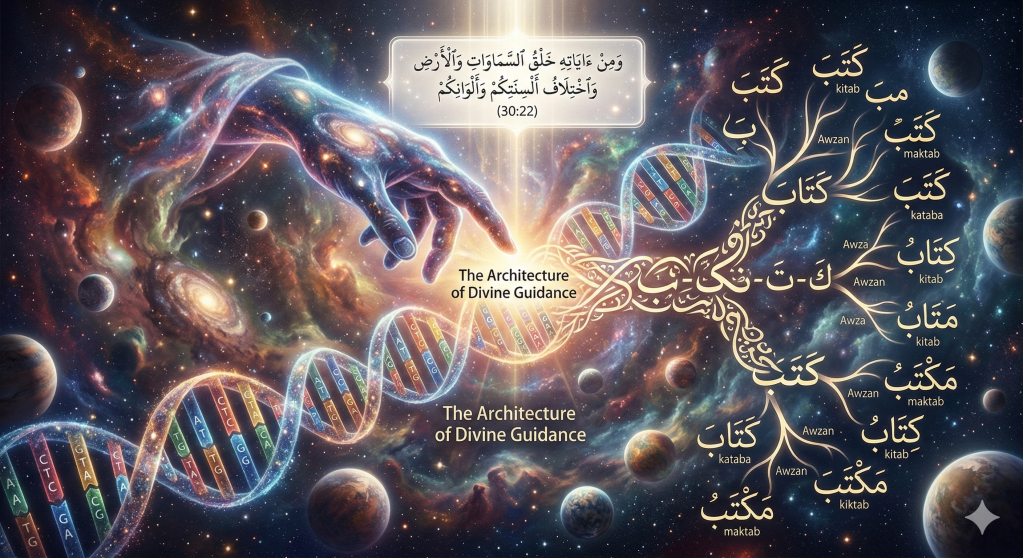
If the universe is the “Best Creation,” the Quran is the “Best Message” (Ahsan-ul-hadith) because it provides the symbolic and linguistic tools to decode the universe. Dr. Shah emphasizes that the complexity of the Arabic language itself is a sign. The Quranic use of “Form X” verbs and the morphological complexity of Arabic reflect a degree of organization that resonates with the mathematical complexity found in biological systems.
Mathani: The Pedagogical Pattern
The attribute of Mathani (repeated lessons) in Quran 39:23 is often interpreted as the repetition of stories or themes. However, in the context of nature as a commentary, it reflects the cyclical and fractal nature of reality. The same laws that govern the motion of atoms also govern the motion of planets; the same branching patterns found in trees are found in river deltas and human lungs.
This “consistency” (Mutashabih) is the hallmark of divine authorship. If the universe were inconsistent, science would be impossible; if the Quran were inconsistent, guidance would be impossible. The fact that both are consistent allows for the “Two Books” to be read in harmony, where one validates and illuminates the other.
The Human Mold (Ahsan-i-taqwim)
Quranic metaphysics posits that humans are created in the “best of molds” (Ahsan-i-taqwim). This excellence is not merely physical but relates to the “Spirit” (Ruh) breathed into man, which grants the capacity for reason (ʿaql), consciousness, and aesthetic appreciation.
Human consciousness is the “point where the evolving lineage became ‘human’ in the spiritual sense,” capable of receiving revelation and bearing moral responsibility. It is the human observer who connects the “perfection” of the firefly to the “perfection” of the Creator. Without this “best mold” of consciousness, the beauty of the universe would remain unobserved and unpraised.
Conclusion: The Convergence of Truth
The analysis of Quran 32:7 and 39:23 through the lens of Dr. Zia H. Shah’s interdisciplinary work reveals a unified vision of existence. The term Ahsan serves as the linguistic glue that binds the “Book of Nature” to the “Book of Scripture.” The study of nature is an unapologetic commentary on the Quran because it provides the empirical verification of the Quran’s claim that creation is perfected and without flaw.
Conversely, the Quran serves as the ultimate guide to metaphysics, preventing the human mind from becoming lost in the “tastelessness” of a blind materialist world. It redirects the gaze from suffering to splendor, transforming the data of science into the signs of a Creator. Through Guided Evolution, Cosmic Fine-Tuning, and Aesthetic Transcendence, the “Two Books” are shown to be in perfect harmony, leading the conscious soul toward the Source of all Beauty—the Almighty, the Fashioner, the Bestower of Forms.
Thematic Epilogue: The Worship of the Artist
The journey through the “Ahsan” of creation and revelation culminates in a shift from observation to worship. Dr. Shah captures the essence of this transition: “The world is a painting of God, beautiful and intentional. Our role is to be the appreciative spectators who then turn that appreciation into worship of the Artist”.
In this integrated paradigm, every scientific discovery—whether it is the orbital rotation of the Milky Way, the efficiency of a bioluminescent enzyme, or the genetic history of Homo naledi—becomes a form of Dhikr (remembrance). The “Ahsan” of the universe is not a static property but a dynamic invitation to explore, to wonder, and to love. By embracing the “Two Books” tradition, the modern believer finds that reason is not the enemy of faith, but its “closest friend”.
The beauty of the firefly, the symmetry of the butterfly, and the fine-tuning of the stars are all Ayat that point toward a single reality: “God is beautiful, and He loves beauty”. As humanity continues to uncover the secrets of the horizons and the depths of the self, the truth of the Quranic message becomes increasingly clear: the universe is not a byproduct of accident, but a “lovingly crafted” masterpiece designed to reflect the Glory of its Maker. To see the world through the lens of the “Ahsan” is to see the hand of God in every leaf, every star, and every verse.
References used
thequran.loveThe Convergence of the Cosmos and the Quran: An Exhaustive Analytical Report on the Work of Dr. Zia H. Shah MDOpens in a new windowthequran.loveThe Two Books in Harmony – Reflections on Quran and Science by …Opens in a new windowmyislam.orgSurah Sajdah Ayat 7 (32:7 Quran) With Tafsir – My IslamOpens in a new windowquran.comTafsir Surah Az-Zumar – 23 – Quran.comOpens in a new windowthequran.loveBeauty as the Signature of God: An Argument from Aesthetic …Opens in a new windowthequran.loveAesthetic Transcendence: How Beauty Reveals the Divine – The …Opens in a new windowquranx.comTafsirs for Qur’an 39.23 Az-Zumar (The Troops) الزمرOpens in a new windowthequran.loveSurah Yaseen: The Duality in Nature and Sun’s Appointed CourseOpens in a new windowthequran.loveEvery Beauty Points to the Creator: Scientific, Philosophical, and …Opens in a new windowthequran.loveBeauty in Nature as a Path to God: Fireflies and Guided EvolutionOpens in a new windowthequran.loveGuided Evolution and the Beauty of Butterflies: A Commentary on Qur’an 32:7Opens in a new windowthequran.loveBeauty Leads to God — A Blind and Random World Should be Tasteless – The Glorious Quran and ScienceOpens in a new windowthequran.loveThe Glorious Quran: “He Made Beautiful All That He Created.”Opens in a new windowthequran.loveImam Omer Suleiman Versus Dr. Zia H. Shah: Adam From Clay Versus Ancient Viruses?Opens in a new windowthequran.loveThe Shadow and the Light: The Atheistic Fixation on Suffering, The Psychology of Unbelief, and the Paradox of Spiritual Awakening – The Glorious Quran and ScienceOpens in a new windowarchive.orgArabic Language – Internet ArchiveOpens in a new window


 The Glorious Quran and Science
Leave a comment