

Beauty as Revelation
Presented by Zia H S hah MD
Abstract
This commentary argues that the Qur’an’s use of aḥsan (“most beautiful / most excellent / best”) in 32:7 and 39:23 establishes a deliberate symmetry between the beauty of creation and the beauty of revelation: God makes the world aḥsan (beautiful, fitting, perfected), and God sends down the Qur’an as aḥsan al-ḥadīth (the most beautiful/best discourse).
From that symmetry follows a strong epistemic and spiritual claim: the study of nature is not religiously neutral. It functions as a “commentary” (tafsīr in the broad sense) on the Qur’an because natural phenomena are themselves āyāt (signs), while the Qur’an trains the metaphysical and moral “taste” by which the world’s signs can be read—moving the human being from raw wonder to intelligible awe, and from intelligible awe to worship.
In the recent “beauty corpus” of Zia H Shah, this mutual illumination is defended unapologetically through a cumulative argument: a truly blind universe should be “tasteless,” yet ours is saturated with aesthetic surplus—beauty that exceeds survival—so beauty is rationally and theologically interpretable as a signature of the Creator.
Textual and philological grounding of Ahsan in 32:7 and 39:23
Qur’an 32:7 describes God as alladhī aḥsana kulla shay’in khalaqahu—“the One who made good/beautiful/perfected everything He created,” immediately followed by the reminder that human origins begin from seemingly humble material (clay). The Qur’anic Arabic Corpus tags aḥsana here as a Form IV perfect verb glossed “made good.”
Classical Arabic lexicography makes clear why translations oscillate between “made good,” “perfected,” and “beautified.” In Lane’s entry on the root ḥ-s-n, ḥusn encompasses goodness and beauty, while aḥsana is explicitly used as “he made it goodly/beautiful,” including “beautified, embellished, or adorned,” and Lane even cites the Qur’anic phrase about God making all things goodly in this very discussion. That semantic range matters: Qur’an 32:7 is not merely saying that creation functions; it says creation bears excellence, fittingness, and (often) splendor as an intended feature of the divine act.
Qur’an 39:23 mirrors this vocabulary on the side of revelation: Allāhu nazzala aḥsana al-ḥadīth—God has sent down “the best discourse / most beautiful message,” described as a Book of internal correspondence and repetition (mutashābihan mathānī), producing a bodily-spiritual response in the God-fearing: skins shiver, then skins and hearts soften toward remembrance. Ma‘ārif al-Qur’an (via Quran.com) notes that ḥadīth here means speech or account, and calling the Qur’an aḥsan al-ḥadīth signifies its surpassing eloquence among all human discourse, while mutashābih indicates internal harmony and cross-illumination between verses, and mathānī indicates repeated re-approach to core themes.
The interpretive fulcrum, then, is not only that aḥsan appears in both verses, but that the Qur’an positions beauty as a twofold divine disclosure:
- Beauty disclosed in being (creation as aḥsan), and
- Beauty disclosed in meaning (revelation as aḥsan al-ḥadīth).
Nature as a living tafsir of scripture
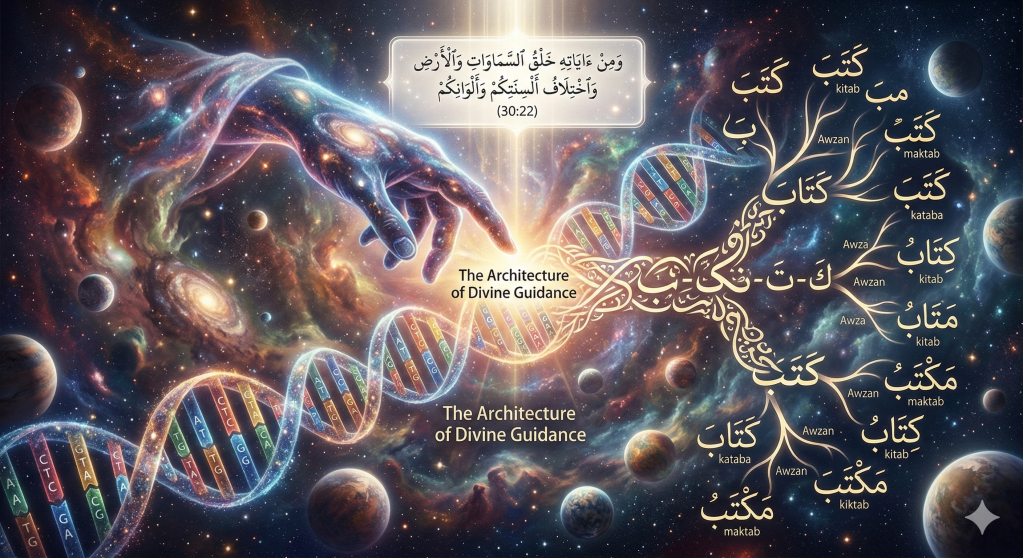
The Qur’an repeatedly instructs believers to read nature as āyāt—signs that solicit reflection rather than passive looking. It explicitly declares that the heavens and earth, and the alternation of night and day, contain signs for people of understanding who reflect and conclude that creation is not purposeless. It declares that God will show signs “in the horizons and within themselves” until the truth becomes clear. And it singles out aesthetic diversity—“varying colors”—as a locus of signhood for the mindful.
A striking formulation of this “two-text” theology appears in Robert G. Morrison’s discussion of natural theology and Qur’anic interpretation: the Qur’an uses the same word āyāt for its verses and for creation’s phenomena, so creation may be treated as a kind of readable “book,” though not identical in authority to revealed law. An even more explicit framing appears in a God, Evil, and Suffering in Islam chapter that describes a Qur’an-rooted tradition of viewing the world as a revealed sacred book: creation is called āyāt like the Qur’an’s verses, and some scholars describe creation as an “expanded Qur’an” while the scriptural Qur’an is its “translation,” urging believers to approach the natural world with reverence and contemplation.
Within the philosophy of signs, Mohammad Hashim Kamali makes a parallel point from a semiotic angle: much of science and technology is, at root, decoding natural signs, and the Qur’anic invitation to sign-reading is an invitation to look beyond surfaces toward intelligible meaning. The upshot is that “commentary on the Qur’an” need not mean only books written about scripture; it can also mean disciplined attention to the world as a text of signs—provided the interpreter has a framework for what counts as sign and what the sign is of.
That is where science becomes religiously significant without being reduced to apologetic slogan. Consider a few examples of nature’s beauty described in terms science can actually investigate:
Earth’s biodiversity is so immense that even the number of eukaryotic species has to be statistically estimated; a widely cited synthesis estimates about 8.7 million eukaryotic species globally (with uncertainty), underscoring how much remains undescribed. Orchids alone are often placed around ~25,000 species, revealing a “lavishness” of biological form that invites both scientific explanation and philosophical wonder. Fireflies are commonly described as about 2,000 species, and their bioluminescence is a well-characterized biochemical reaction involving luciferin/luciferase and ATP, making beauty measurable down to enzymatic mechanism.
Evolutionary theory explains some beauty through selection, including sexual selection (ornamental traits shaped by mate choice). Yet even within Charles Darwin’s own correspondence, beauty appears as a conceptual irritant: he famously admitted that the peacock’s tail made him feel sick when he tried to imagine its emergence by selection. The point is not that science “fails,” but that beauty often forces science to expand its explanatory vocabulary—from mere survival to reproductive display, from reproductive display to preference, from preference to deeper questions about why aesthetic preference exists in a law-governed cosmos at all.
This is precisely where 32:7 becomes philosophically provocative: if God aḥsana everything created, then beauty is not an accidental byproduct but a structural feature of the created order—something one expects to find at multiple scales: biological, mathematical, cosmic.
Metaphysical guidance as the Qur’an’s gift to the study of nature
Qur’an 39:23 does not present revelation as a cold manual; it presents revelation as aesthetic-spiritual guidance that works through coherence, repetition, and embodied affect: shivering, then softening—fear giving way to remembrance. Ma‘ārif al-Qur’an emphasizes that mutashābih here indicates internal correspondence: verses explain and confirm one another, and the Book is free of contradiction. In other words, the Qur’an claims aḥsan not only in content but also in form-as-guidance: structure that trains the listener’s mind and heart.
That matters for nature because metaphysics governs perception. A person can look at the same sunset and see “photons scattered by an atmosphere” or see “a sign.” Qur’anic guidance does not deny atmospheric scattering—but it insists that meaning is not exhausted by mechanism. The Qur’an’s repeated pairing of cosmological observation with moral-theological response (“signs… for people of understanding,” “signs… until it becomes clear,” “varying colors… a sign for the mindful”) shows that its goal is to cultivate a seeing that is simultaneously cognitive and devotional.
Put differently: science describes how patterns occur; Qur’anic metaphysics asks what patterns are for—where “for” includes not only instrumental function but also recognition (ma‘rifah), gratitude (shukr), and reverent awe (khashyah). This is structurally echoed by the Qur’anic claim that true awe is especially characteristic of those who have knowledge. In the aesthetic frame of 39:23, the human being is not merely an observer but a respondent: the “best discourse” is the one that changes the body and softens the heart toward remembrance, not the one that merely informs.
This is also why Islamic tradition has treated Qur’anic recitation not merely as communicating propositions, but as an embodied art of sound and meaning—an oral phenomenon whose form is itself part of how it functions religiously.
In this light, calling the Qur’an aḥsan al-ḥadīth is not a detached aesthetic compliment; it is a claim that revelation supplies the metaphysical grammar by which the world can be read as aḥsan creation—so that science becomes, at its best, a disciplined form of tafakkur (contemplation) rather than a spiritually mute catalog of facts.
Beauty as a pathway to God
Philosophically, beauty has often been treated as an ultimate value alongside truth and goodness, and reflection on beauty has been central to major traditions of aesthetics. In Immanuel Kant’s mature aesthetics, beauty is not reducible to appetite; it opens a distinctive kind of reflective judgment and can function as a “propadeutic” (a preparation) for moral ideas. Even classical accounts of the “transcendentals” treat properties like truth and goodness (and, in some traditions, beauty) as deeply tied to being itself—so that beauty is not merely decoration but an index of intelligibility and value.
Islam’s theological idiom presses this discourse into explicit devotion. The prophetic saying “Allah is Beautiful and loves beauty” grounds beauty not merely in the world but in God’s own perfection, while simultaneously warning that genuine beauty is not arrogance but truth and humility. This metaphorical movement—beauty leading beyond itself—also resonates with the Qur’anic logic of “signs”: colors, patterns, and harmony are not only pleasant; they are invitations to remembrance.
Within the interpretive circle formed by 32:7 and 39:23, “beauty leads to God” can be stated in a precise way:
Beauty leads to God when beauty is experienced as (a) intelligible order, (b) generous excess beyond mere utility, and (c) spiritually formative—awakening awe, gratitude, and remembrance, rather than terminating in self-satisfaction.
This is why Qur’an 39:23 describes not only “best discourse” but also an affective trajectory: fear → receptivity → remembrance. The logic is not “beauty is pleasant,” but “beauty is transformative”—and transformation is presented as guidance.
That transformation is not threatened by science; it can be intensified by it. A common scientific worry is that analysis disenchants. Yet the “flower” anecdote associated with Richard Feynman is often mobilized to argue the opposite: deeper knowledge can multiply the layers at which beauty is seen—structure, process, and scale. The Qur’anic approach is more radical: nature’s intelligibility is not merely aesthetically pleasing; it is itself a form of signhood, and gratitude is the appropriate response.
Insights from Zia H Shah on beauty as evidence, pedagogy, and therapy
Across multiple essays, Zia H Shah develops a consistent thesis: the world displays what he calls an “aesthetic surplus”—beauty “far exceeding what survival demands”—and this surplus is evidentially and spiritually significant, inviting the inference that the cosmos is not blind but the work of an Artist. He repeatedly frames this not as a single deductive proof but as a cumulative, person-shaping argument that appeals to aesthetic and moral intuition alongside rational reflection.
His “tasteless universe” formulation functions as a rhetorical stress-test: if reality were purposeless mechanism, we should not expect it to be saturated with colors, harmonies, and patterns that exceed function; yet (he argues) our world is anything but tasteless. The same theme is carried into biological case studies: fireflies (bioluminescent beauty) and butterflies (morphological splendor) become emblematic of a theistic reading of evolution as “guided” rather than metaphysically blind. Here he explicitly integrates Qur’an 32:7 with modern evolutionary description, presenting “guided evolution” as a way to hold together empirical mechanisms and divine purposiveness.
On the cosmic side, he links beauty to the surprising mathematical orderliness of nature, echoing a long scientific tradition in which elegance is treated as a heuristic for truth. In this context, the aesthetic claims of Paul Dirac—that beauty in equations can guide discovery—become part of a broader theological picture: mathematical beauty is not merely in our minds, but written into the world’s lawful structure.
Several further motifs recur in his corpus and directly serve the present Qur’anic commentary:
Beauty as “living scripture.” In “Aesthetic Transcendence,” he explicitly claims that in moments of natural beauty the world becomes a kind of living scripture, moving the heart toward origin and purpose, as if nature “speaks” of the Divine beyond words.
Beauty as interfaith convergence. In his reflection on Qur’an 59:24, he argues that theism across Abrahamic traditions has historically treated beauty as sign: natural splendor and human artistry converge like roads toward God, whose “most beautiful names” ground creaturely beauty.
Beauty as therapy against atheistic fixation on suffering. In “From Suffering to Splendor,” he contends that modern atheist rhetoric often centers suffering so exclusively that it becomes blind to the “equally real” reality of order and splendor; he does not deny suffering but insists it is not the whole data-set of existence. This is philosophically important: if beauty is real, then any worldview that cannot account for beauty’s abundance is, in his terms, impoverished—a failure of perception as much as a failure of argument.
Beauty as cultural and architectural pedagogy. In his Islamic-aesthetics reflections, he links mosque geometry and arabesque patterns to the mathematical beauty of nature itself, suggesting that Islamic art functions as an interiorized reminder of the world’s patterned signhood—bringing the “outside signs” into sacred space as tadhkira (remembrance).
Taken together, these insights reinforce the thesis that the Qur’an’s aḥsan vocabulary is not accidental: it offers a unified aesthetic-metaphysical vision in which the world is created as aḥsan reality and the Qur’an is revealed as aḥsan discourse so that human beings can learn to read the first by means of the second.
Epilogue
Qur’an 32:7 and 39:23 together yield a coherent doctrine of beauty: reality is not only functional but meaning-laden, not only lawful but lovely. The Qur’an is designated aḥsan al-ḥadīth not merely to be admired, but to educate perception—to turn the human being into a reader of signs whose knowledge culminates in awe and remembrance.
Within that doctrine, science is not a threat to faith but a discipline of attention: the more precisely one learns to read the world’s patterns, the more one encounters the depth of “He made beautiful all that He created”—whether one is looking at biodiversity, symmetry, or the intelligibility of mathematical law. And yet, without guidance, attention can become spiritually mute. The Qur’an’s metaphysics—teleology, signhood, gratitude, worship—keeps wonder from collapsing into either nihilism (“pitiless indifference”) or mere aesthetic consumption.
The deepest claim is therefore not simply that beauty is pleasant, or even that beauty is evidence. The claim is that beauty is a road: from perception to praise, from admiration to humility, from the seen (shahādah) to the unseen (ghayb), until the heart is softened toward the remembrance of the One whose act and speech are each aḥsan.
For references, please go the Microsoft Word file:



 The Glorious Quran and Science
Leave a comment