

The Metaphysics of Continuous Creation: A Scientific, Philosophical, and Theological Commentary on Quran 30:25 and 35:41
Presented by Zia H Shah MD
Abstract
This research report presents a comprehensive interdisciplinary investigation into the ontological and cosmological implications of Quranic verses 30:25 and 35:41. These verses serve as the scriptural foundation for the doctrine of occasionalism—the metaphysical thesis that God is the sole immediate cause of every event in the universe. By analyzing the Arabic text and the English translation of M.A.S. Abdel Haleem, the study explores how the “standing firm” of the heavens (30:25) and the “divine grip” preventing cosmic dissolution (35:41) challenge the Aristotelian notion of inherent causal necessity. Central to this analysis is the work of Abu Hamid al-Ghazali, whose critique of the falasifa dismantled the deterministic framework of secondary causation to preserve the absolute sovereignty of the Divine Will. The report further embellishes these classical insights with the contemporary synthesis of Dr. Zia H. Shah MD, who utilizes quantum indeterminacy, Bell’s Theorem, and the simulation hypothesis to provide a modern scientific vocabulary for the Ash’arite doctrine of continuous creation. Through the “Two Books” paradigm—the Book of Revelation and the Book of Nature—the analysis demonstrates that what modern science defines as “laws of nature” are ontologically “divine habits” (Sunnat Allah). The report concludes that occasionalism offers a superior explanatory model for the stability of the cosmos, the “Hard Problem of Consciousness,” and the fine-tuning of physical constants, ultimately framing reality as a perpetually rendered scene maintained by a non-local, sustaining Agency.
The Ontological Pivot: From Causal Necessity to Radical Contingency
The intellectual history of Islamic civilization is marked by a seminal conflict between two competing visions of reality: the Hellenized philosophy (falsafa) of thinkers like Avicenna (Ibn Sina) and the theological tradition (kalam) of the Ash’arites. At the heart of this struggle lies the nature of causality. The falasifa posited a universe of “necessary emanation,” where the cosmos flows from God as a logical consequence, governed by secondary causes with inherent powers. In this deterministic view, fire burns because it is in its essence to burn; the laws of nature are metaphysical compulsions that even the Divine cannot suspend without contradiction.
The Quranic discourse, however, introduces a paradigm of radical contingency. It portrays a universe that does not possess independent existence or self-derived efficacy. Instead, every moment of stability, every movement of a celestial body, and every transition from life to death is an immediate manifestation of the Divine Command (Amr). Verses 30:25 and 35:41 are not merely poetic descriptions of nature; they are ontological assertions that relocate causal power from the creature to the Creator. This shift leads directly to the occasionalist philosophy of Al-Ghazali, which finds its modern empirical resonance in the “looseness at the joints” of quantum physics as articulated by Dr. Zia H. Shah MD.
Exegesis of Quran 30:25: The Architecture of the Divine Command
The first foundational verse for this occasionalist framework appears in Surah Ar-Rum (The Romans):
وَمِنْ آيَاتِهِ أَنْ تَقُومَ السَّمَاءُ وَالْأَرْضُ بِأَمْرِهِ ۚ ثُمَّ إِذَا دَعَاكُمْ دَعْوَةً مِنَ الْأَرْضِ إِذَا أَنْتُمْ تَخْرُجُونَ
Translation (MAS Abdel Haleem): “Among His signs, too, is the fact that the heavens and the earth stand firm by His command. In the end, you will all emerge when He calls you from the earth.”
The Nuance of “An Taquma” (To Stand Firm)
The word taquma (from the root Q-W-M) implies more than just static presence; it denotes a state of being upright, maintained, and operational. In classical exegesis, such as that of Abul Ala Maududi, this signifies that the universe did not merely come into being through a one-time creative act but continues to function only because of a persistent, unceasing command. The “standing” of the heavens is an active process. If the command (Amr) were to be withdrawn for even a single instant, the entire “grand workshop of life” would collapse into nothingness.
For the occasionalist, this verse establishes that the stability of the physical world—what we might call the laws of physics—is a direct result of the Divine Will. The heavens do not “stand” because of an inherent property of space-time or an autonomous force like gravity; they stand because they are commanded to do so. Dr. Zia H. Shah MD notes that the Quranic use of “signs” (ayat) here encourages a “double-look”—an empirical scrutiny that reveals no flaw in the cosmic order, yet recognizes that this order is not self-explanatory.
The Linkage to Eschatology and the Logic of Re-creation
The verse concludes with a transition to the resurrection: “In the end, you will all emerge when He calls you from the earth.” In the theology of Al-Ghazali and the modern synthesis of Dr. Shah, the “First Creation” is the primary argument for the “Second Creation”. If the Divine Command is powerful enough to maintain the “standing” of the vast heavens and the earth, then calling humanity forth from the dust is a minor application of the same power.
Occasionalism views the resurrection not as a violation of nature, but as a shift in Divine Habit (Sunnat Allah). Just as God habitually “commands” the earth to sustain life, He will one day “command” it to yield the dead. This eschatological claim is framed through the lens of information theory by Dr. Shah, suggesting that the “call” from the earth is an activation of the data preserved in the “Clear Record” (6:59), mirroring the physical laws of information conservation.
| Semantic Element | Quranic Term | Theological/Scientific Correspondence |
| Active Stability | An Taquma | Spacetime integrity; cosmological constants |
| The Instrument | Bi-Amrih | Divine Volition; the “Amr” as non-local agency |
| Cosmic Signs | Ayat | Empirical regularities; fine-tuning |
| Resurrection Call | Da’watam | Re-activation of preserved information; new rendering |
Exegesis of Quran 35:41: The Divine Grip and the Prevention of Vanishing
The second pillar of occasionalist scripture is found in Surah Fatir (The Originator):
۞ إِنَّ اللَّهَ يُمْسِكُ السَّمَاوَاتِ وَالْأَرْضَ أَنْ تَزُولَا ۚ وَلَئِنْ زَالَتَا إِنْ أَمْسَكَهُمَا مِنْ أَحَدٍ مِنْ بَعْدِهِ ۚ إِنَّهُ كَانَ حَلِيمًا غَفُورًا
Translation (MAS Abdel Haleem): “God keeps the heavens and earth from vanishing; if they did vanish, no one else could stop them. God is most forbearing, most forgiving.”
The Metaphysics of “Yumsiku” (The Holding)
The verb yumsiku (to hold, grasp, or seize) denotes a persistent and direct exertion of power. Unlike the deistic “Clockmaker” who winds up the universe and lets it run, the God of the Quran is the “Holder” whose active grip is the only thing preventing the cosmos from zawal—vanishing or ceasing to exist. Dr. Shah highlights the linguistic depth of the root Y-M-S-K, comparing it to a bag (musk) that holds water; while the bag and water can move, they are held in a stable relationship. This negates the idea that the verse implies a stationary Earth; rather, it speaks of a stable, governed relationship between celestial bodies.
From the perspective of occasionalism, this “holding” is synonymous with “continuous creation” (tajdid al-khalq). The universe is not a substance that exists by itself over time; it is a series of discrete events, each created anew by God. If the Divine “holding” were to cease for even a “blink of an eye,” the heavens and the earth would vanish into the nothingness from which they were first summoned.
Scientific Commentary: Entropy, Gravity, and Spacetime Integrity
In modern scientific terms, Dr. Shah and other commentators map this “keeping from vanishing” onto the Second Law of Thermodynamics and the integrity of spacetime.
- Entropy Resistance: The universe naturally tends toward maximum disorder (entropy). The structured “standing” of the heavens and earth is a violation of this trend, suggesting an external “Conscious Mind” that maintains order against the thermodynamic pull toward homogenization and “vanishing”.
- Gravity as the Invisible Grip: Quran 13:2 mentions “pillars that you cannot see,” which Dr. Shah identifies as the force of gravity and the curvature of spacetime. The “holding” in 35:41 describes the delicate balance between the expansion of the universe (Big Bang) and the gravitational attraction that keeps galaxies and planetary systems from flying apart or collapsing prematurely.
- Physical Information Theory: centering on Surah Fatir 35:41, Dr. Shah explores the “physics of spacetime integrity.” He suggests that the Divine “holding” aligns with quantum error correction—the active maintenance of the state of every entity to prevent the loss of information and the subsequent collapse of reality.
The Attribute of Forbearance (Al-Halim) in Physics
The verse ends with Haleeman Ghafoora (Most Forbearing, Oft-Forgiving). This is traditionally seen as an attribute related to human sin, but Dr. Shah argues for a “thematic epilogue” where these attributes ensure cosmic stability. In an occasionalist universe where everything depends on Divine Will, the “forbearance” of God is what allows the laws of nature to remain consistent despite the “corruption” or entropy introduced by worldly systems. The stability of the cosmos is not an ontological necessity but a result of Divine “patience,” allowing a term for life to flourish before the eventual dissolution.
Al-Ghazali’s Occasionalism: The Critique of Aristotelian Causality
The transition from these Quranic verses to a formal philosophical system was articulated most forcefully by Abu Hamid al-Ghazali (1058–1111) in The Incoherence of the Philosophers (Tahāfut al-falāsifa). Al-Ghazali’s objective was to dismantle the “philosophers’ claim” that the created order is governed by secondary efficient causes that act independently of the Divine Will.
The Seventeenth Discussion: Conjunction vs. Connection
Al-Ghazali’s most famous argument centers on the relationship between fire and the burning of cotton. The philosophers argued that fire has an inherent “power” or “nature” to burn cotton, and that this effect follows necessarily from the cause. Al-Ghazali’s critique prefigures the skepticism of David Hume by centuries:
- Observation of Conjunction: We observe that when fire touches cotton, burning occurs. However, we only observe coexistence (conjunction), not a necessary connection. We do not see “causality” itself; we only see one event followed by another.
- Logical Independence: There is no logical contradiction in imagining fire touching cotton without the cotton burning. Since the two events are distinct, their connection cannot be one of logical necessity.
- God as the Sole Agent: Al-Ghazali concludes that it is God (directly or through an angel) who creates the “burning” at the moment of contact. The fire is merely the “occasion” (sabab) for the Divine act, but it possesses no causal efficacy of its own.
The Role of Miracles
The theological motivation for occasionalism is the preservation of the possibility of miracles. If nature were governed by necessary laws, then a miracle (like Abraham being unharmed by fire, per Quran 21:69) would be a logical impossibility—a “breaking” of a law that cannot be broken. For Al-Ghazali, miracles are simply instances where God chooses not to follow His “habit.” Since the “laws of nature” are merely “Divine Habits” (Sunnat Allah), God is free to act outside of them at any moment.
| Aspect | Philosophical Determinism | Ghazalian Occasionalism |
| Primary Agency | God as First Cause | God as Sole Immediate Cause |
| Secondary Causes | Efficient and Necessary | Occasions for Divine Action |
| Nature of Laws | Inherent and Compelling | Habitual and Voluntary |
| Status of Miracles | Violations of logic/nature | Suspensions of Habit |
| Scientific Predictability | Grounded in Essence | Grounded in Divine Constancy |
Zia H. Shah MD: Occasionalism and the Quantum Revolution
While Al-Ghazali used logic and scripture to argue for occasionalism, Dr. Zia H. Shah MD argues that the shift from Newtonian physics to quantum mechanics provides a “scientifically resonant” vocabulary for this ancient doctrine. Classical physics suggested a “Clockwork Universe” where every event was determined by prior states and rigid laws. However, quantum mechanics has introduced a fundamental “indeterminacy” that Dr. Shah identifies as the “causal joint” for Divine action.
Quantum Indeterminacy and the “Photon Emblem”
Dr. Shah utilizes the behavior of light as a primary emblem of the “looseness at the joints” of reality. When a photon strikes a surface (like water), quantum electrodynamics can provide the probability of reflection (4%) or refraction (96%). However, the laws of physics are “radically open” regarding what any individual photon will do.
- The Materialist View: The individual outcome is “brute randomness”.
- The Deterministic View: There must be “hidden variables” we don’t yet understand.
- The Occasionalist View: God determines the actual outcome of each individual event in accordance with His wisdom.
In this framework, the “laws of physics” describe the habitual statistical distribution of outcomes, while God remains the active agent who “decides” every single event. This allows God to govern the universe without “violating” the laws of physics, because the laws themselves are probabilistic and leave room for Divine choice.
Bell’s Theorem and the Denial of Local Realism
One of the most profound developments in modern science is the confirmation of Bell’s Theorem (validated by the 2022 Nobel Prize in Physics). These experiments proved that there are no “local hidden variables”—meaning nothing inside the particles predetermines their behavior in quantum entanglement.
Dr. Shah reads this as a “striking parallel” to Al-Ghazali’s contention that natural objects possess no independent causal power. If the fate of a particle is not decided by local physical information, it must be decided by something non-local or non-physical. For the believer, this is the “holding” and “commanding” of God mentioned in 30:25 and 35:41—a sustaining Divine causation that operates outside the ordinary boundaries of space and time.
Continuous Creation and the Simulation Hypothesis
The Ash’arite doctrine of Tajdid al-khalq (renewal of creation) posits that atoms and their qualities (a’rad) do not persist over time. Instead, they vanish in the instant they are created and must be re-created by God in the next instant. Dr. Shah utilizes the Simulation Hypothesis as a pedagogical bridge to explain this concept to the modern mind.
Reality as a “Rendered Scene”
In a computer simulation or a video game, the screen is not a static object; it is being “rendered” frame-by-frame by a processor.
- Frame-by-Frame Sustenance: Just as a programmer must refresh every pixel to maintain the image, God re-creates every atom in the universe at each discrete moment of time. An apple doesn’t fall because of an innate force; God creates the apple slightly lower in space in each successive frame.
- The “Command” as Code: The “Amr” (Command) of 30:25 is analogous to the source code of the simulation. The “laws of nature” are the programmed algorithms that ensure consistency.
- The “Holding” as Processing: Surah Fatir 35:41’s “holding” is the continuous operation of the “non-local processor” (the Divine) that keeps the simulation from crashing or vanishing.
| Feature | Al-Ghazali’s Occasionalism | Simulation Hypothesis |
| Causal Agency | God is the only true cause | The Simulator/Code is the cause |
| Material Autonomy | Objects have no inherent power | Virtual objects have no physical power |
| Nature of Time | Discrete moments of creation | Discrete frames of rendering |
| Laws of Nature | Habits of God (Sunnat Allah) | Programmed algorithms/Code |
| Miracles | God acting against His custom | Programmer editing the simulation |
Biological Occasionalism: Guided Evolution vs. Blind Chance
Dr. Shah extends the occasionalist framework to the biological realm, addressing the tension between the theory of evolution and the Quranic insistence on purposeful creation. He breaks evolution into three components to maintain theological and scientific integrity:
- Common Ancestry: Shah accepts the “biological fact” that all life is related, as supported by molecular biology.
- Mechanisms: He views natural selection and mutation as the “instruments” or “mechanisms” through which God’s will is manifested.
- Philosophical Interpretation (The Guidance): This is where occasionalism diverges from neo-Darwinian materialism. Rather than viewing mutations as “blind chance,” the occasionalist sees them as the “sovereign choice of God” at the quantum level.
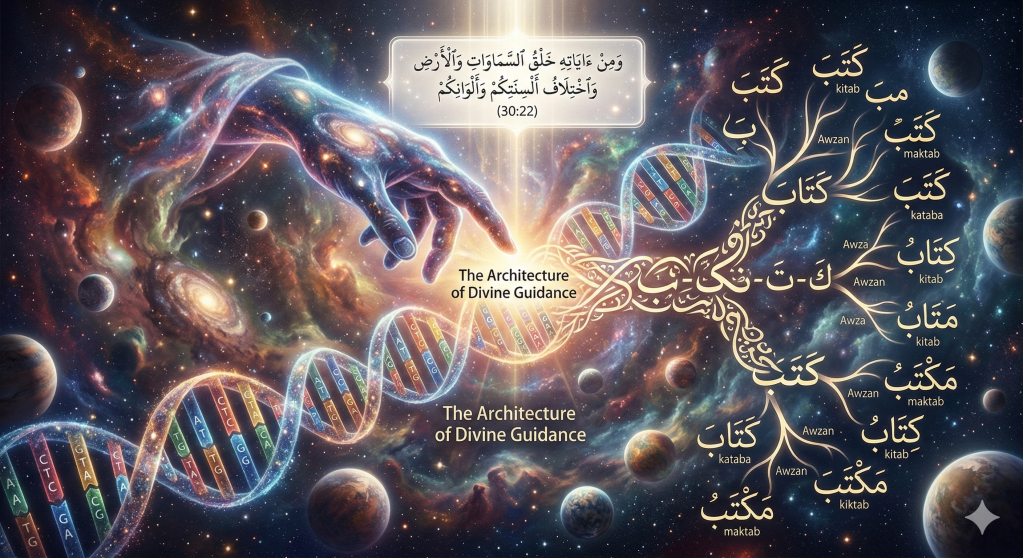
The “Biological Singularity”—the fact that all life on earth shares a single, incredibly complex genetic language—is cited by Shah as a signature of the “One” (35:40). Occasionalism provides a “Guiding Hand” that directs the evolutionary process through the very “looseness” of quantum indeterminacy in DNA sequences.
Other Quranic Pillars of Occasionalism
Beyond 30:25 and 35:41, Al-Ghazali and modern commentators like Dr. Shah draw upon several other verses to construct a total theology of agency.
Quran 8:17: The Metaphysical Proof-Text
فَلَمْ تَقْتُلُوهُمْ وَلَٰكِنَّ اللَّهَ قَتَلَهُمْ ۚ وَمَا رَمَيْتَ إِذْ رَمَيْتَ وَلَٰكِنَّ اللَّهَ رَمَىٰ
Translation (MAS Abdel Haleem): “It was not you who killed them; it was God. And when you [Prophet] threw [sand at them], it was not your throw that defeated them, but God’s…”
This verse is frequently cited as the definitive scriptural proof for occasionalism. It explicitly negates human agency in the very moment of action (“when you threw… it was not your throw”). Al-Ghazali and later scholars like Fakhr al-Din al-Razi argued that this establishes God as the “true actor” behind every human deed. Dr. Shah interprets this “metaphysical negation” as proof that creatures possess no autonomous, inherent power; they only “acquire” (kasb) the acts that God creates for them.
Quran 55:29: The Rhythm of Ceaseless Activity
يَسْأَلُهُ مَنْ فِي السَّمَاوَاتِ وَالْأَرْضِ ۚ كُلَّ يَوْمٍ هُوَ فِي شَأْنٍ
Translation (MAS Abdel Haleem): “Everyone in the heavens and earth entreats Him; every day He is at work.”
The phrase Kulla yawmin huwa fi sha’n (“Every day He is engaged in a new affair/matter”) is interpreted as the scriptural foundation for Tajdid al-khalq (continuous creation). For the occasionalist, the world is not a wound-up clock but a reality where God is “day in and day out” bringing about affairs. It signifies that creation is an ongoing process, not a historical event.
Quran 2:255 (Ayat al-Kursi): The Attribute of Al-Qayyum
The Throne Verse describes God as Al-Hayyu Al-Qayyum—The Living, The Self-Subsisting Sustainer of all. Dr. Shah emphasizes that Al-Qayyum implies a constant, unceasing vigilance; “neither slumber nor sleep seizes Him” because the universe requires His active presence to remain in being. Occasionalism is the logical conclusion of these Divine attributes: if God is the Sustainer of all things, then no part of reality can function independently of His immediate will.
Scientific Fine-Tuning: The Empirical Evidence for the “Command”
The Quranic challenge in 67:3—to “look again… can you see any flaw?”—anticipates the modern scientific investigation of the fine-tuned universe. Dr. Shah argues that the “standing firm” of 30:25 is evidenced by the breathtaking precision of physical constants.
| Constant | Value/Precision | Significance for Occasionalism |
| Cosmological Constant | 1 part in 10120 | Precise balance of “holding” vs. expansion |
| Carbon Resonance | 7.656 MeV | Precise planning (Khalq) of atomic structure |
| Initial Entropy | 1 in 1010123 | Extreme order requiring non-random agency |
| Strong Nuclear Force | Calibrated to 2% | Ensuring the “stability” of the heavens/earth |
Maududi’s commentary on the “harmony and balance” among stars and planets is viewed by Dr. Shah as a prescient restatement of the fine-tuning argument. Modern cosmology confirms that if there were a slight imbalance in these “mighty forces,” the universe would have “ceased” to exist almost immediately—directly echoing the warning in 35:41.
The Epistemology of Occasionalism and the “Hard Problem of Consciousness”
A significant portion of Dr. Zia H. Shah’s contemporary project involves utilizing occasionalism to address the “Hard Problem of Consciousness”—the question of how subjective experience arises from material brain processes.
- Failure of Physicalism: Dr. Shah argues that strict physicalism struggles to explain how “meaning” or “subjectivity” can emerge from the mere collision of atoms.
- The Occasionalist Solution: Occasionalism provides a unified account of physical and mental life without reducing one to the other. Just as God creates the “burning” when fire meets cotton, He creates the “thought” or the “feeling” as the “occasion” for a neural event.
- Divine Proximity: This aligns with Quran 50:16 (“We are closer to him than his jugular vein”) and 8:24 (“God supervenes between a man and his mind”). Consciousness is viewed as the “meeting point” between the finite human soul and the Infinite Divine presence.
The Doctrine of “Kasb” (Acquisition) and Moral Responsibility
Critics of occasionalism often argue that it destroys human free will. If God creates every act, how can humans be judged? Al-Ghazali and the Ash’arites responded with the doctrine of Kasb (Acquisition).
- Creation vs. Choice: God creates the power to act and the act itself at the exact moment of choice.
- Acquisition: The human “intends” or “chooses” the act, thereby “acquiring” it and becoming morally responsible for it, even though the metaphysical efficacy belongs to God.
Dr. Shah notes that this provides a robust framework for moral accountability within a system of total Divine control, much like an actor is responsible for their performance even though the script and the stage are provided by another.
Occasionalism as the “Metaphysics of Inshallah”
Daily Islamic speech is permeated with the phrase Inshallah (If God wills). Al-Ghazali’s occasionalism is essentially the rigorous philosophical explanation for this linguistic habit. It acknowledges that every outcome, from a billiard ball’s movement to a future travel plan, is utterly dependent on the immediate will of Allah.
Dr. Shah argues that occasionalism does not reject the scientific method but reinterprets it. Science becomes the study of “How God Customarily Acts” (Sunnat Allah). The stability of these “habits” is what allows us to plant crops, set bones, or send rockets into space. However, the occasionalist maintains a “metaphysical humility,” knowing that the reliability of the world rests on a Creator’s unceasing volition, not on a self-sufficient material necessity.
Conclusion: The Unified Theory of Divine Agency
The commentary on Quran 30:25 and 35:41 reveals a sophisticated metaphysics that harmonizes scripture, philosophy, and modern science. Al-Ghazali’s occasionalism, derived from these verses, provides a radical alternative to the deterministic models of the past. By denying that creatures have inherent, autonomous power, occasionalism preserves the absolute sovereignty of God and the possibility of the supernatural within the natural order.
Dr. Zia H. Shah MD’s synthesis updates this ancient theology for the quantum age. By identifying quantum indeterminacy as the “divine interface” and the simulation hypothesis as a model for “continuous creation,” he demonstrates that the Quranic vision of a world “standing” and being “held” by the Divine Command is more compatible with 21st-century physics than the rigid materialism of the 19th century. Reality is not a static machine, but a “story unfolding in real time,” sustained by an All-Powerful, All-Aware, and Forbearing Creator.
Thematic Epilogue: The Horizon of Unity
The “Two Books” paradigm—the Book of Scripture and the Book of Nature—finds its ultimate convergence in the doctrine of occasionalism. When we look at the vast heavens (30:25) and recognize their stability as a result of a Divine “Holding” (35:41), we move from a fragmented view of reality to a unified vision of Truth. The “laws of nature” are revealed to be the “faithful habits” of a singular Author.
The occasionalist worldview transforms our perception of the everyday. The blue of the sky, the vibration of an electron, and the resolve of the human heart are all “fresh miracles”—moments of creation happening “day in and day out” (55:29). This philosophy fosters both a scientific commitment to understanding the “habits” of God and a spiritual awe at His constant proximity. In the end, the “standing” of the universe and the “calling” of the resurrection are two sides of the same coin: the unceasing, sovereign Command of the One who holds the heavens and the earth lest they vanish, and who remains the ultimate ground of all that exists.


 The Glorious Quran and Science
Leave a comment