
Presented by Zia H Shah MD
For Spanish readers:
Invitación al Islam para el pueblo de España: memoria compartida, conciencia moral y un camino de mi:
A Compassionate Invitation to Islam for the People of Spain
Executive Summary
This report offers a research-grounded, poetic, and constitutionally respectful model for a comprehensive invitation to Islam addressed to Spain’s general public—people of diverse ages, convictions, and life histories. It integrates three strands: Spain’s layered Islamic heritage (Al‑Andalus and its living cultural traces), contemporary Spanish moral sensibilities as expressed in public opinion and public debate about Gaza, Iran, and Lebanon, and primary Islamic teachings that emphasize mercy, justice, dignity, neighborliness, and non-coercion.
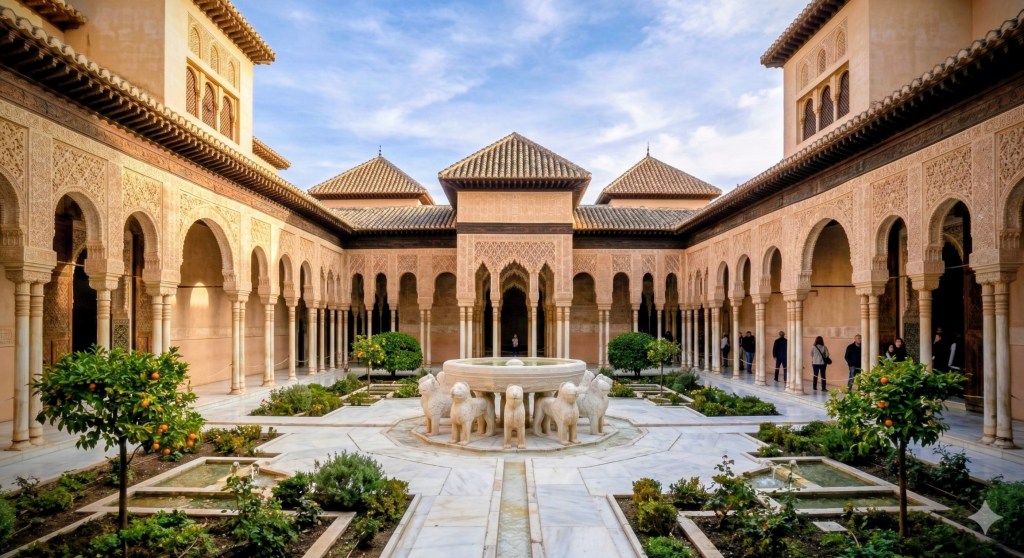
Historically, Spain’s Islamic past remains materially visible in internationally recognized heritage sites: the Alhambra–Generalife–Albayzín ensemble, Córdoba’s historic center, and Seville’s cathedral complex where the Giralda is identified as a former minaret and an emblem of cultural syncretism. Linguistically, the Instituto Cervantes notes that Arabic left “more than 3,000” words of Arabic origin in Spanish—evidence of deep, everyday interpenetration rather than a purely “museum” inheritance.
In the present, Spain’s public conscience—often articulated through the vocabulary of human rights, proportionality, sanctions, and “No to war”—is measurable in reputable surveys and reflected in mainstream reporting. The Real Instituto Elcano’s Barometer reports that large majorities of surveyed Spaniards described Israel’s conduct in Gaza as “genocide” (71% in the March–April 2024 wave; 82% in the May–June 2025 wave), alongside strong support for European recognition of Palestine and, in 2025, support for EU sanctions. Spain’s government formally recognized the State of Palestine on May 28, 2024, framing the move in terms of justice, coherence, peace, and the two-state horizon. After the U.S.–Israel attack on Iran (reported as beginning February 28, 2026), a 40dB “flash” poll for Cadena SER and El País found 68.2% of respondents opposed the intervention, and majorities supported Spain’s refusal to allow U.S. use of jointly operated bases for the attack.
The invitation framework in this report deliberately avoids incitement and explicitly foregrounds freedom of conscience. Its ethical spine draws on primary Islamic sources: “no compulsion in religion” (Qur’an 2:256), justice even amid hatred (5:8), a prophetic mission of mercy (21:107), the sanctity of life (5:32), and kindness/justice toward non-hostile others (60:8)—supported by widely accessed references (Quran.com; Sunnah.com).
Historical and Cultural Grounding
Al‑Andalus is not only a chapter in medieval political history; it is also a living archive embedded in Spanish streets, language, and aesthetics. As a broad historical frame, Encyclopaedia Britannica defines Al‑Andalus as a Muslim kingdom that occupied much of the Iberian Peninsula beginning in 711 CE, with major transformations over time. That legacy is materially anchored in internationally documented heritage. UNESCO’s description of the Alhambra, Generalife, and Albayzín portrays them as complementary medieval urban realities—palatine city and residential district—preserving remains of the ancient Arabic quarter in Granada. UNESCO also describes the historic center of Córdoba as a place whose “greatest glory” began after the 8th‑century conquest, with extensive construction and later conversions and additions. In Seville, UNESCO explicitly identifies the Giralda as a former minaret and a “masterpiece” of Almohad architecture, later adapted—an emblem of cultural layering rather than cultural erasure.
Beyond monuments, Spain’s linguistic inheritance reveals how culture often survives through daily speech. The Instituto Cervantes states that Arabic left “more than 3,000” Spanish words of Arabic origin, associated with fields from agriculture to architecture and medicine. And the often-cited translation movement around Toledo—whether described as a “school” or a broader scholarly ecosystem—appears in Britannica as a historical example of Christian, Arab, and Jewish cultural fusion, with the Toledan school of translators understood as a conduit for knowledge transmission. UNESCO also hosts material describing “the Toledo school” in the 12th century translating influential works (a source that remains valuable even when historians debate later labeling).
A rigorous invitation must also resist idealization. The word “convivencia” is widely used as shorthand for interreligious coexistence, yet its meaning and limits are debated in scholarship. A Cambridge review essay explicitly signals that “convivencia” has “discontents,” and points readers toward the historiographical conversation (including popular narratives and their critiques). Likewise, the later history of Spain includes coercive ruptures: Britannica’s Morisco entry notes a royal deportation order dated September 22, 1609, with expulsion “completed some five years later.” This past matters because an ethical invitation must be honest: Islam does not require mythical histories to be meaningful; it requires moral clarity.
Spain’s Contemporary Moral Landscape
Modern Spanish public ethics—especially on foreign war—often crystallize around civilian protection, legality, proportionality, and skepticism toward open-ended military escalation. On Gaza, the Real Instituto Elcano Barometer documents how respondents themselves framed the issue: in the March–April 2024 wave, 71% of respondents characterized Israel’s action in Gaza as “genocide,” and 78% favored European states recognizing Palestine. In the May–June 2025 wave, the same Barometer reports an increase to 82% using that characterization, with continued 78% support for recognition of Palestine and a reported 70% support for EU sanctions on Israel. (The report should treat this as measurement of Spanish public perception and moral language, not as a legal adjudication.)
Institutionally, Spain’s government recognized the State of Palestine on May 28, 2024, via an official statement published by La Moncloa framing the decision around peace, justice, and the two-state horizon. Public mobilization also became visible: the Associated Press reported that hundreds of thousands marched in Barcelona and Madrid (alongside Rome) on October 4, 2025, protesting Israel’s military campaign in Gaza—evidence of sustained civic engagement rather than fleeting outrage.
In 2026, the war involving Iran introduced a new test of Spanish “anti-war” reflexes. A 40dB “flash” poll reported by Cadena SER found 68.2% opposed the U.S.–Israel attack on Iran said to have begun February 28, 2026, and 57% supported the government’s decision not to support the war militarily; the article also reports majority support for not allowing Spanish bases to be used for the operation. El País reported closely aligned findings, including strongly negative evaluations of Donald Trump and Benjamin Netanyahu among respondents—data relevant to perceptions of U.S./Israeli leadership choices within the Spanish moral imagination.
Spanish government actions around the same period were reported internationally. Reuters reported that Spain prohibited the use of jointly operated bases for Iran attacks and that U.S. aircraft subsequently departed, with Spanish officials emphasizing that any use must align with the UN Charter and bilateral agreements. The Associated Press reported a further escalation: Trump threatened trade consequences after Spain disallowed use of joint bases; Spanish officials defended their position as consistent with international law.
Lebanon is not only an “elsewhere” in Spanish consciousness; it is connected to Spanish risk and responsibility through peacekeeping. The UN lists Spain among UNIFIL troop contributors (with country counts updated periodically). Spain’s Ministry of Defence describes UNIFIL/FINUL’s tasks as monitoring cessation of hostilities and assisting the Lebanese Armed Forces, situating Spanish participation within an internationally mandated framework. La Moncloa’s English-language note on UNIFIL also describes the Spanish contingent as one of the largest and mentions Spanish leadership roles within the mission, underlining that Spain’s relationship to Lebanon includes peacekeeping rather than only commentary.
Qur’anic and Prophetic Ethics for a Peaceful Invitation
A moving invitation to Islam for a plural society must lead with Islam’s own guardrails: freedom of conscience, justice, and mercy. The Qur’an’s ethic of non-coercion is explicit: “Let there be no compulsion in religion” (2:256). The Qur’an also binds moral integrity to emotional restraint: “Do not let the hatred of a people lead you to injustice. Be just…” (5:8). The prophetic mission is framed as universal compassion: “We have sent you… only as a mercy for the whole world” (21:107). Human life is treated with maximal gravity: saving one life is likened to saving all humanity (5:32). And peaceful coexistence is not an afterthought: kindness and fairness toward those who do not fight or expel you is explicitly praised (60:8).
Hadith literature reinforces these themes in social ethics. Jami` at-Tirmidhi reports: “Be merciful on the earth…” (Tirmidhi 1924). Sahih al-Bukhari transmits the Prophet’s repeated emphasis on neighbors (Bukhari 6014). Sahih Muslim warns that oppression becomes “darkness” on the Day of Resurrection (Muslim 2578). Bukhari likewise transmits the warning against oppression (Bukhari 2447) and a severe deterrent against murdering someone under a protection covenant (Bukhari 3166).
In Spain, emphasizing non-coercion is not only Islamic fidelity; it is civic fidelity. Spain’s constitutional framework guarantees freedom of religion and worship and bars compelling individuals to declare beliefs. Spain’s legal architecture also includes cooperation agreements with Muslim representation: Law 26/1992 incorporates an agreement between the Spanish state and the Comisión Islámica de España.
The Invitation to Islam: A Letter‑Essay to the People of Spain
Dear people of Spain,
I write to you neither to quarrel nor to compete with your conscience—whether you are Christian, Jewish, agnostic, atheist, “spiritual but not religious,” or simply weary of all labels. I write to invite: with respect, with tenderness, and with the kind of seriousness Spain reserves for what is humanly sacred.
Let me begin where Islam itself begins: freedom. The Qur’an says, plainly, “Let there be no compulsion in religion” (2:256). In other words, if an invitation becomes pressure, it stops being Islamic. And in Spain today, where the constitution protects freedom of religion and worship, an invitation worthy of your intelligence must meet you as a free person, not as a target.
Spain knows what it means to live inside layers. Stone remembers. Water remembers. A courtyard remembers. The curve of an arch, the geometry that refuses to flatter the ego, the quiet insistence that beauty can be an act of devotion—these are not foreign languages here. UNESCO’s descriptions of Granada, Córdoba, and Seville do not read like tales of a distant planet; they read like pages from your own long book: a medieval city, a transformed sanctuary, a tower once built for the call to prayer and later crowned for other worship—history as palimpsest, not as a single ink.
Yet honesty is the first courtesy. “Convivencia” is a word both beloved and contested; scholars debate how far it reaches and where it breaks. Spain’s past includes exchange and brilliance—and also coercion, suspicion, and expulsions. If Islam is to be offered with dignity, it must not be sold with myths. Truth does not need a costume.
So why invite you now?
Because Spain’s moral bloodstream is speaking loudly in our own century—in the language of the wounded. Gaza has entered Spanish public consciousness as a moral crisis framed by many citizens through harsh, absolute words; the Real Instituto Elcano Barometer documents that majorities of respondents chose the term “genocide” to describe Israel’s actions in Gaza, alongside strong support for recognition of Palestine and, later, support for EU sanctions. Whatever one’s politics, this reveals something deeper than partisanship: a national refusal to treat distant suffering as disposable.
And in 2026, as war widened toward Iran, a familiar Spanish moral reflex resurfaced: “No to war.” A 40dB poll reported by Cadena SER and El País found nearly seven in ten opposed the U.S.–Israel attack on Iran and majorities supported Spain’s refusal to let its bases be used for that operation. International outlets reported the diplomatic strain and even threats of trade retaliation—yet the Spanish government’s public justification repeatedly returned to legality and restraint.
In this moral atmosphere—where people fear escalation, mourn civilians, and distrust the normalizing of devastation—Islam has something urgent to offer, if it is taught from its own ethical center rather than from extremists’ distortions or headlines’ caricatures.
Islam offers a discipline against hatred. The Qur’an commands: “Do not let the hatred of a people lead you to injustice. Be just…” (5:8). This is not a slogan; it is a spiritual technology. It takes the wild animal of outrage and teaches it to walk on a leash called justice. If your heart breaks for Gaza, for Iran, for Lebanon—Islam does not ask you to trade compassion for rage. It asks you to protect your compassion from becoming cruelty.
Islam offers mercy as purpose, not as ornament. The Qur’an describes the Prophet’s mission: “only as a mercy for the whole world” (21:107). And the prophetic teaching says, “Be merciful on the earth…” Mercy here is not weakness. It is the courage to keep a human face when the world invites you to dehumanize. It is the refusal to let any group—any flag, any tribe, any religious label—turn a child’s death into a statistic you can swallow.
Islam offers sacred regard for life. The Qur’an speaks of saving one life as saving all humanity (5:32). And the Prophet’s teachings severely deter violence against people living under covenant and protection. This matters because the loudest misrepresentation of Islam in Europe is that Islam is “about violence.” But the sources—read carefully—place unjust killing and oppression among the darkest moral crimes, not among the permitted ones.
Islam also offers a path of coexistence without hypocrisy. The Qur’an says God does not forbid kindness and fairness to those who have not fought you or expelled you (60:8). That verse does not erase disagreement; it civilizes it. It teaches that living together is not merely tolerated; it can be righteous.
So what would it mean, practically, for a Spanish citizen—curious, cautious, perhaps wounded by politics or disappointed by religious institutions—to explore Islam?
It would mean reading the Qur’an slowly, not as a weapon in a debate, but as a mirror held up to the soul. Start with the short chapters; then return to the passages on justice, patience, the poor, and the human heart. It would mean stepping into a mosque when it is open to visitors—especially during Ramadan—simply to listen, to ask, to observe. It would mean meeting Muslims who do not resemble one stereotype: Spaniards by birth, migrants, converts, professionals, workers, students—a human community rather than a headline.
And it would mean guarding your freedom while you learn. Islam, if it is true, will not collapse under your questions. And if it is not true for you, you will still have gained something Spain already values: a deeper understanding of one of the civilizations that helped shape its own language, art, and memory.
If, after honest learning, you feel inward certainty—then Islam’s doorway is simple: to bear witness that God is One and that Muhammad is His messenger, and to try, day by day, to live with justice, mercy, and humility.
I do not ask you to abandon Spain. I ask you to purify what is best in Spain: the defense of dignity, the tenderness toward suffering, the rejection of cruelty, the longing for coherence. Islam calls that purification submission—not to rulers, not to tribes, not to rage, but to God.
May your conscience remain free, and may your compassion remain brave.
Appendix: Timeline, Source Table, Imagery, Tone & Rhetoric
Key timeline anchors are supported by Encyclopaedia Britannica’s historical summaries (711; 1492), the Britannica Morisco entry (1609/“completed some five years later”), Spain’s constitutional text in the BOE (religious freedom), the BOE text of Law 26/1992, Spanish official descriptions of UNIFIL participation, and official/news reporting for the 2024/2026 policy moments.
For references of the articles in English please go to:
Para consultar las referencias, vaya al archivo de Microsoft Word


 The Glorious Quran and Science
Leave a comment