
Epigraph
أَمْ خُلِقُوا مِنْ غَيْرِ شَيْءٍ أَمْ هُمُ الْخَالِقُونَ
أَمْ خَلَقُوا السَّمَاوَاتِ وَالْأَرْضَ ۚ بَل لَّا يُوقِنُونَ
Have they been created from nothing, or are they their own creators? Have they created the heavens and the earth? In truth they put no faith in anything! (Al Quran 52:35-36)
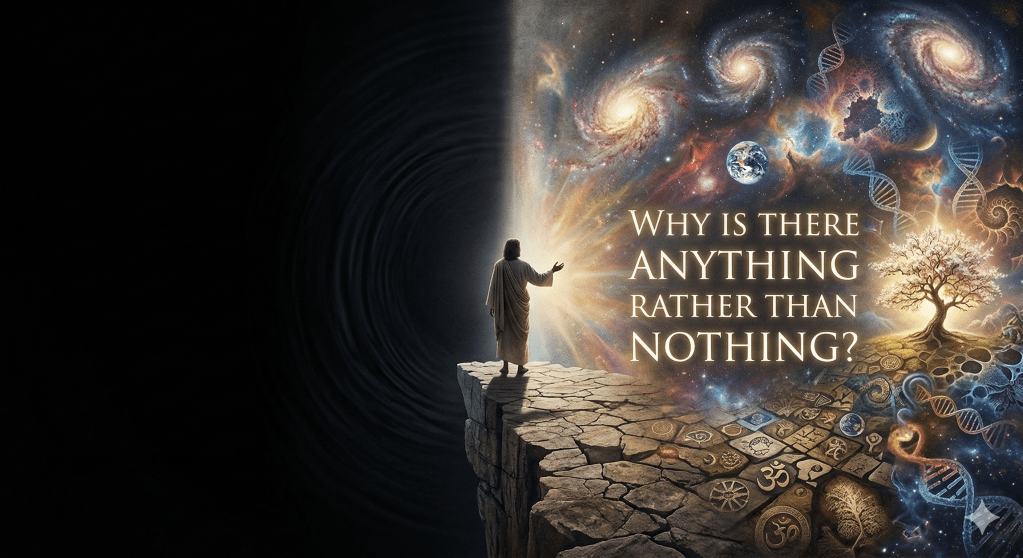
Why is there anything at all? A philosophical odyssey from cosmology to God
Presented by Zia H Shah MD
The deepest question humanity can ask — why anything exists rather than nothing — receives ten radically different answers in a single episode of Closer to Truth, the long-running PBS series created and hosted by Robert Lawrence Kuhn. The episode “Why is There Anything at All?” assembles a remarkable roster of philosophers, physicists, and theologians — John Leslie, John Polkinghorne, Richard Swinburne, Paul Davies, Peter van Inwagen, Max Tegmark, Bede Rundle, Simon Blackburn, Quentin Smith, and Victor Stenger PodbeanApple Podcasts — who collectively map every serious response to Leibniz’s haunting question. What emerges is not a stalemate but a striking convergence: from the firing-squad analogy of cosmic fine-tuning to the Bayesian calculus of divine probability, from Platonic axiarchism to the Quranic exhaustive disjunction, the explanatory chain terminates — for those willing to follow it — in a necessary, self-existent Mind behind all reality.
The production and its extraordinary cast
Closer to Truth is a PBS public television series TV Guide created, written, hosted, and executive produced by Robert Lawrence Kuhn, Closer To Truth a public intellectual Deeptransformation with a PhD who has spent over two decades interviewing the world’s leading thinkers on cosmos, consciousness, and meaning. Co-produced and directed by Peter Getzels, Closer To Truth the series has broadcast over 300 episodes across multiple seasons, with a YouTube channel exceeding 1,800 videos and 400,000 subscribers. Rlkuhn The episode in question — Episode 305, “Why Is There Something Rather Than Nothing?” (also released under variations of the title “Why is There Anything at All?”) — became the catalyst for the landmark 2013 anthology The Mystery of Existence: Why Is There Anything At All?, co-edited by Kuhn and philosopher John Leslie, Space.com which gathers over fifty writers from Plato to the present. AbeBooks +3
The interviewees divide roughly into three camps. The theists — John Polkinghorne (Cambridge physicist turned Anglican priest), WordPress Richard Swinburne (Oxford’s Nolloth Professor of the Philosophy of the Christian Religion), Closer To Truth and Peter van Inwagen (Notre Dame metaphysician and devout Christian) — argue that a personal God provides the simplest and most rational terminus to the chain of explanation. The naturalists and atheists — Quentin Smith (Western Michigan philosopher who argued Wikipedia the universe is self-caused), Victor Stenger (particle physicist who called God a “failed hypothesis”), Simon Blackburn (Cambridge quasi-realist and self-described “infidel”), and Bede Rundle (Oxford philosopher who dissolved the question by denying the coherence of absolute nothingness) Closer To Truth — deny that God is needed. The explorers of middle ground — John Leslie (whose axiarchism posits goodness itself as the creative force), Max Tegmark (whose Mathematical Universe Hypothesis collapses physical existence into mathematical structure), Wikipedia and Paul Davies (Templeton Prize–winning physicist who senses “something going on” behind it all but resists conventional theism) — chart intellectually adventurous paths that resist easy categorization.
The interviewees and their positions on the ultimate question
John Leslie (b. 1940), Grokipedia University Professor Emeritus at the University of Guelph Closer To Truth and Fellow of the Royal Society of Canada, Closer To Truth is the episode’s philosophical linchpin. Educated at Wadham College, Oxford, Closer To TruthWikipedia Leslie has devoted his career to a single question: why does anything exist? His landmark books — Value and Existence (1979), Universes (1989), and Infinite Minds (2001) Closer To Truth — develop the thesis that ethical requiredness is itself creatively effective: Closer To Truth things exist because it is good that they should. His framework in Universes presents the options for explaining cosmic fine-tuning: (1) the universe as a brute fact requiring no explanation; (2) chance alone; (3) the universe as self-explaining or necessarily existent; (4) a multiverse of vastly many varied universes; (5) God — a divine mind who created the universe; and (6) axiarchism, Leslie’s own view, where goodness itself is the creative principle. His celebrated firing-squad analogy — if fifty marksmen all miss you, you do not shrug it off as unremarkable simply because you would not be alive to notice if they hadn’t SolasHandWiki — has become one of the most widely cited thought experiments in philosophy of religion, adopted by Francis Collins, WikipediaHandWiki William Lane Craig, and Polkinghorne himself.
Sir John Polkinghorne KBE FRS (1930–2021) brought unimpeachable scientific credentials to the theistic side of the debate. He spent 25 years as a mathematical physicist at Cambridge, playing a role in the discovery of the quark Wikipedia and training students who became Nobel laureates and Astronomers Royal before being elected Fellow of the Royal Society in 1974. Wikipedia In 1979 he resigned his Cambridge chair to train for the Anglican priesthood, Wikipedia eventually becoming President of Queens’ College, Cambridge, Encyclopedia Britannica and winning the Templeton Prize in 2002. WikipediaWordPress In the episode, Polkinghorne argued that the universe’s deep rational intelligibility — “the fact that we can understand the world” — and its exquisite fine-tuning demand explanation. He adopted Leslie’s analogy and favored divine purpose over the multiverse on grounds of “economy and elegance,” Timstafford’s BlogWordPress insisting that the multiverse hypothesis “is not physics, but in the strictest sense, metaphysics.” Gsu His broader thesis, developed in 26 books on science and religion, Wikipedia holds that theology is “the great integrating discipline” that sets the insights of science within a deeper context of intelligibility. PBSWordPress
Richard Swinburne (b. 1934), who held the Nolloth Professorship at Oxford Amazon for seventeen years and is a Fellow of the British Academy, Wikipedia brought his distinctive Bayesian methodology to the episode. Swinburne’s magnum opus, The Existence of God PhilPapers (1979, revised 2004), applies Bayes’ theorem to the God hypothesis, Wikipedia treating it as one would treat any scientific hypothesis — to be assessed against evidence. He argued that theism has a high prior probability because God is the simplest hypothesis: one entity with two infinite properties (omnipotence and omniscience) and one absence (no irrationality). The Partially Examined Life Infinite values, he claims, are simpler than large finite values because they require no arbitrary stopping point. His cumulative case proceeds from the existence of the universe to its orderliness, fine-tuning, consciousness, moral awareness, providence, and religious experience Wikipedia — each adding Bayesian weight until the probability of theism exceeds 0.5. Notre Dame Philosophical Reviews On the specific question of the episode, Swinburne argued that without God, the universe — whether finite or infinite — reduces to an inexplicable brute fact, Stanford Encyclopedia of Philosophy and that this is deeply improbable given the specific, fine-tuned, orderly character of what exists.
Paul Davies (b. 1946), the British-born physicist at Arizona State University who won the 1995 Templeton Prize, occupied a fascinating middle position. Author of The Mind of God and First Things The Goldilocks Enigma, Davies Amazon acknowledged that “the impression of design is overwhelming” Science Musings and proposed that the universe may be self-explaining through some kind of self-consistent causal loop. He famously wrote that “science offers a surer path to God than religion,” Light Of Truth yet stopped short of affirming a personal Creator, preferring the language of “something going on behind it all.” Science Musings
Peter van Inwagen (b. 1942), one of the most distinguished living metaphysicians and a devout Christian, offered a probabilistic argument: if there are infinitely many possible worlds and at most one contains absolute nothingness, the probability of nothing existing is vanishingly close to zero. Medium Something, he argued, is overwhelmingly more probable than nothing.
On the opposing side, Quentin Smith (1952–2020) argued that “the most reasonable belief is that we came from nothing, by nothing, and for nothing” Internet Infidels — the universe is self-caused, with each state explained by preceding states, leaving no explanatory remainder requiring God. Internet Infidels Victor Stenger (1935–2014) contended that the universe is “the ultimate free lunch,” requiring no supernatural explanation, Wikipedia and attacked fine-tuning arguments in his book The Fallacy of Fine-Tuning. Bede Rundle (1937–2011) argued that absolute nothingness is incoherent Oxford University Press — the expression “there is nothing” presupposes something Notre Dame Philosophical Reviews — so the physical universe must have always existed in some form. Closer To Truth Simon Blackburn (b. 1944) Wikipedia took a characteristically deflationary neo-Humean approach, skeptical that the question “why is there something?” has a deep metaphysical answer. And Max Tegmark (b. 1967) proposed the most radical naturalistic answer: physical reality is mathematical structure, all mathematical structures exist, Wikipedia and our universe is one such structure — eliminating the question by identifying existence with mathematical necessity.
John Leslie’s fifth option and the convergence toward Mind
Among Leslie’s framework of options, the fifth — that a mind, consciousness, or God stands behind the universe — deserves sustained attention, precisely because it is the option toward which the strongest philosophical currents flow once the alternatives are carefully examined.
The brute-fact option collapses under scrutiny. To claim the universe “just is, and that’s all,” as Bertrand Russell did, is to dismiss the Principle of Sufficient Reason at the one point where it matters most. Medium As the philosopher Alexander Pruss has shown, abandoning the PSR leads to radical skepticism: if things can exist without sufficient reason, our perceptual experiences might themselves be brute facts bearing no connection to objective reality. Catholic Answers The double standard is glaring: no atheist would accept “God just is, with no explanation” as intellectually satisfying, yet the same move applied to the universe is treated as philosophical sophistication. Catholic Answers
The chance option fares no better. Leslie’s firing-squad analogy remains devastating: the fine-tuning of the cosmological constant OCCA to one part in 10^120, Timstafford’s Blog the expansion rate balanced to one part in 10^55, Perlego and dozens of other parameters make the chance hypothesis not merely implausible but, as Polkinghorne put it, “beyond belief.” The anthropic reply — we would not be here to notice if things were different — does nothing to eliminate the need for explanation, any more than a prisoner’s survival eliminates the need to explain why all fifty marksmen missed. Solas
The multiverse displaces the question without answering it. Even granting the existence of vastly many universes with varied parameters, one still faces Leibniz’s deeper puzzle: why is there anything at all? Why should there be a universe-generating mechanism? As Polkinghorne noted, the multiverse hypothesis is metaphysics, not physics — it is “unobservable in principle” and lacks any independent empirical support. Gsu Leslie himself acknowledged the multiverse as a serious response to fine-tuning Amazon while insisting it cannot address the existence question. BioLogos
Mathematical Platonism and abstract objects are causally inert. Tegmark’s radical identification of physical with mathematical existence Wikipedia is ingenious but faces a fundamental objection: mathematical structures, however necessary, cannot cause anything. Numbers do not create galaxies. Logical laws describe patterns but generate nothing. If all mathematical structures “exist,” this is a statement about abstract necessity, not about why there is a physical cosmos of quarks and consciousness. As Eugene Wigner marveled, “the unreasonable effectiveness of mathematics” is itself a mystery that cries out for explanation EveryStudent — the very kind of explanation that an abstract structure, lacking agency, cannot provide.
What remains, once these alternatives are tested and found wanting, is the option Leslie labeled fifth: a transcendent, personal Mind — what the Abrahamic traditions call God. Polkinghorne arrived at this conclusion from physics: the universe’s rational intelligibility is explicable if “the Mind of its Creator lies behind it.” Faraday Swinburne arrived from probability theory: theism is simpler, more explanatory, and more probable than any rival hypothesis. Stanford Encyclopedia of PhilosophyWikipedia Leslie himself, though preferring his axiarchistic variant (where ethical necessity is the creative force), acknowledged that traditional theism — a divine person whose existence is itself ethically required — is a valid form of the same fundamental insight: BioLogos +2 that value, goodness, and mind are more fundamental than matter.
Swinburne’s Bayesian case and Polkinghorne’s scientific theology
The theistic arguments of Swinburne and Polkinghorne powerfully amplify Leslie’s fifth option, each from a different angle.
Swinburne’s method is rigorously probabilistic. He treats the existence of God as a hypothesis h, evaluates evidence e (the universe’s existence, its orderliness, fine-tuning, consciousness, moral awareness), and calculates probabilities using Bayes’ theorem. PhilArchiveNotre Dame Philosophical Reviews His key insight is that God’s prior probability is high because the theistic hypothesis is maximally simple — one entity, infinite in power and knowledge, with no arbitrary parameters. Boston Collaborative Encyclopedia of Western Theology By contrast, the naturalistic hypothesis requires specifying the particular initial conditions, particular laws, particular constants, and particular arrangements of the universe — each an additional layer of unexplained specificity. Even before examining evidence, Swinburne argues, theism starts with a probabilistic advantage. The cumulative weight of multiple C-inductive arguments (each raising the probability) produces a P-inductive case where theism is more probable than not. Boston Collaborative Encyclopedia of Western TheologyPhilPapers The problem of evil is the only significant counterweight, and Swinburne argues it is insufficient to overcome the cumulative case. WikipediaOxford University Press
Polkinghorne’s approach is that of a “bottom-up thinker” Sage Journals — a scientist who starts from evidence and asks what best explains it. MDPI His central argument rests on two pillars. First, the intelligibility of the universe: the fact that human minds can understand quantum mechanics and general relativity — domains utterly remote from survival needs — is inexplicable on naturalistic evolution alone. The Christian CenturyWordPress “A religious understanding renders the intelligibility of the universe itself intelligible,” he wrote, “for it says that the world is shot through with signs of mind precisely because the Mind of its Creator lies behind it.” Faraday Second, fine-tuning: the physical constants had to take a “quantitatively specific form for life to be possible anywhere within the universe,” FaradayWordPress and this is best explained not by invoking an unobservable multiverse but by recognizing divine purpose BioLogos — a Creator who “purposes that it should be so.” Gsu His framework of critical realism holds that both science and theology address aspects of the same reality, MDPIWordPress and that the “metaquestions” science raises but cannot answer — Why is science possible? Why is the universe fine-tuned? — are precisely where theology provides understanding.
The Quranic argument: an exhaustive disjunction in two verses
Fourteen centuries before Leibniz posed his question, the Quran presented what may be the most concise and logically rigorous cosmological argument in any scripture. Surah At-Tur, verses 35–36, present an exhaustive disjunction — a logical division covering all possible explanations for existence:
أَمْ خُلِقُوا مِنْ غَيْرِ شَيْءٍ أَمْ هُمُ الْخَالِقُونَ Am khuliqū min ghayri shay’in am humu al-khāliqūn “Were they created by nothing, or were they themselves the creators?” quran +3
أَمْ خَلَقُوا السَّمَاوَاتِ وَالْأَرْضَ ۚ بَل لَّا يُوقِنُونَ Am khalaqū al-samāwāti wa al-arḍa bal lā yūqinūn “Or did they create the heavens and the earth? Rather, they are not certain.” Quran.com
The argument’s logical structure is devastating in its simplicity. The Last Dialogue For any existent thing, only three alternatives obtain: (A) it arose from nothing, uncaused — absurd, since ex nihilo nihil fit; (B) it created itself — logically impossible, since self-creation requires existing before one exists; (C) it created the greater cosmos — evidently false for contingent beings. When all three are eliminated, the conclusion is inescapable: a transcendent Creator brought them into existence. The Last Dialogue +2
The classical exegetes mined these verses with extraordinary philosophical precision. Al-Razi (Fakhr al-Din, d. 1210) identified multiple interpretive layers for the phrase min ghayri shay’ — “without a creator,” “for no purpose,” “without prior material” الموسوعة الشاملة لتفسير — and arranged the alternatives in a graduated logical series of increasing absurdity. Al-Baghawi (d. 1122), citing Abu Sulayman al-Khattabi, articulated the core principle: “the dependency of creation on a creator is a logical necessity — that which has no existence cannot create.” Quran Al-Sa’di summarized: “This is an argument against them where they can only either submit to the truth or depart from the dictates of reason.” Surah Quran The verse’s concluding assessment — bal lā yūqinūn, “rather, they are not certain” — shifts the burden: the problem is not lack of evidence but lack of intellectual honesty and conviction.
The historical impact of these verses is attested in Sahih al-Bukhari. Jubayr ibn Mut’im, a pagan Meccan nobleman who came to Medina to negotiate prisoner ransoms after the Battle of Badr, heard the Prophet Muhammad recite Surah At-Tur during the sunset prayer. The Last Dialogue When the Prophet reached verses 35–37, Jubayr later recalled: “My heart was about to fly from my chest.” The Last DialogueHadith Ibn Kathir records that this hearing was among the factors that led Jubayr to embrace Islam. Quran.comMy Islam
From brute facts to necessary being: why matter cannot be the final answer
The philosophical concept of a “brute fact” — a fact that admits no deeper explanation — is the last refuge of every explanatory chain that refuses to reach God. But the claim that the universe, or matter, or abstract objects, or laws of nature are brute facts faces insurmountable difficulties.
Matter is contingent. Every component of the physical universe could have failed to exist or existed differently. The specific values of physical constants, the specific arrangement of particles, the specific initial conditions at the Big Bang — all are contingent. Anthropic-principlePerlego If all parts of the universe are contingent, the universe as a whole is contingent. As Leibniz demonstrated with his famous analogy: even an infinite series of books, each copied from the one before, still requires an explanation of why there are any books at all. Encyclopedia.com
Abstract objects are causally inert. Mathematical truths, laws of logic, and Platonic forms — even if they are necessary — cannot bring anything into existence. The number seven does not create galaxies. The law of non-contradiction does not generate quarks. Reasonable Faith As Paul Davies observed, “the laws of physics we observe” cannot explain their own existence: “the favorite reply is, ‘There is no reason they are what they are — they just are.’” EveryStudentEdge.org But this is precisely the brute-fact concession that the Principle of Sufficient Reason exposes as intellectually bankrupt.
Laws of nature describe but do not cause. Physical laws tell us how the universe operates but not why it exists. They presuppose the universe’s existence rather than explaining it. Even a Theory of Everything would face the question: Why does this theory describe reality rather than some other theory, or no reality at all? Richard Feynman’s honest admission — “the fact that there are rules at all is a kind of miracle” — underscores the point. EveryStudent
The Kalam cosmological argument, originating in Islamic philosophy with Al-Kindi (d. ~873) Grokipedia and refined by Al-Ghazali (d. 1111), addresses the temporal dimension: whatever begins to exist has a cause; the universe began to exist (supported by the Big Bang, the second law of thermodynamics, and the Borde-Guth-Vilenkin theorem); therefore the universe has a cause. Conceptual analysis reveals this cause must be uncaused, timeless, spaceless, immaterial, enormously powerful, and personal — personal because only a free agent can produce a temporal effect from a timeless state. WikipediaReasonable Faith
Leibniz’s contingency argument addresses the modal dimension: everything that exists has an explanation, either in the necessity of its own nature or in an external cause. 1000-Word PhilosophyPhilopedia The universe is contingent (it could have been otherwise). Therefore, the universe’s explanation lies in something external — a necessary being whose essence includes existence, Encyclopedia.comCrossExamined who “carries within itself its reason for existence.” lse As Leibniz concluded: lse “This final reason for things is called God.” University of Colorado Boulder
Both arguments mirror the Quranic reasoning of 52:35–36. The Kalam argument corresponds to the rejection of “created from nothing” (Premise 1: whatever begins to exist has a cause). The contingency argument corresponds to the rejection of self-creation and the affirmation of a transcendent, necessary Creator. The Islamic philosophical tradition’s contribution to these arguments is not incidental — it is foundational. Thequran Al-Ghazali’s formulation in The Incoherence of the Philosophers Medium directly entered Western philosophy through Bonaventure and influenced Aquinas. Reasonable FaithWikipedia William Lane Craig explicitly named his modern revival after the kalām tradition, Stanford Encyclopedia of Philosophy acknowledging his debt to these Muslim thinkers. Thequran +2
Conclusion: the only coherent resting place
The convergence is striking. John Leslie’s framework, when tested rigorously, eliminates every option except the fifth — a Mind behind the universe — and its axiarchistic cousin. Polkinghorne’s scientific theology demonstrates that the universe’s intelligibility and fine-tuning point toward a Creator’s mind. University of Cambridge Swinburne’s Bayesian calculus shows that theism is the simplest, most probable hypothesis. WordPressWikipedia And the Quran — in just two verses of breathtaking concision — presents the exhaustive disjunction that all of modern philosophy has labored to formalize: nothing cannot create; things cannot create themselves; contingent beings cannot account for the cosmos. Surah QuranThe Last Dialogue The explanatory chain must terminate in a being that is not contingent, not caused, not composed — a being whose very essence is existence itself.
This is why matter cannot be the ultimate brute fact: it is contingent, composite, and could have been otherwise. This is why abstract objects cannot be the ultimate brute fact: they are causally inert and cannot generate anything. This is why laws of nature cannot be the ultimate brute fact: they describe but do not create, presuppose the universe rather than explaining it, and are themselves contingent. The only coherent terminus of explanation is a necessary, self-existent, personal being — what the Abrahamic faiths identify as God. Chronicles of Strength Not a brute fact that “just is,” but a being whose existence is self-explanatory because existence belongs to its very nature. Philopedia
As Polkinghorne wrote from the vantage of physics: “The world is shot through with signs of mind because the Mind of its Creator lies behind it.” University of Cambridge As Swinburne argued from the vantage of probability: God is “the simplest kind of person there could be” Cambridge Core and the best explanation for everything that exists. University of Oxford As the Quran declared from the vantage of revelation: Am khuliqū min ghayri shay’in am humu al-khāliqūn? — Were they created by nothing, or were they the creators? quran +3 The question answers itself. The only mystery is why, as the verse concludes, so many remain without certainty — bal lā yūqinūn. Great Tafsirs


 The Glorious Quran and Science
Leave a comment