
Epigraph
وَيَسْأَلُونَكَ عَنِ الرُّوحِ ۖ قُلِ الرُّوحُ مِنْ أَمْرِ رَبِّي وَمَا أُوتِيتُم مِّنَ الْعِلْمِ إِلَّا قَلِيلًا
And they ask you concerning the soul. Say, ‘The soul is by the command of my Lord; and of the knowledge thereof you have been given but a little.’ (Al Quran 17:85)

Presented by Zia H Shah MD with the help of Claude AI
Abstract
Consciousness — the luminous, irreducible fact that there is something it is like to be you at this very moment — remains the most stubborn enigma in the entire history of human inquiry. After five centuries of systematic scientific investigation, more than 225 competing theories thequran jostle for explanatory authority and not one commands consensus. Thequran This article argues, unapologetically and with full engagement with the scientific and philosophical literature, that consciousness is not an accident of blind matter but the supreme miracle of divine creation — a reality that points irresistibly to a preceding, originating Mind: God. Drawing on the work of David Chalmers, Thomas Nagel, Roger Penrose, John Eccles, Francis Collins, Alvin Plantinga, William James, Henri Bergson, John Searle, and many others, we demonstrate that every purely materialist account of consciousness fails — whether it is eliminativism, illusionism, or reductive physicalism. We refute the bizarre claim, advanced by Daniel Dennett, Paul Churchland, and Keith Frankish, that consciousness is an “illusion,” showing this position to be self-refuting, philosophically incoherent, and morally catastrophic. thequran We integrate extensively the writings of Zia H Shah MD, whose remarkable body of work at The Glorious Quran and Science presents a Quran-centered framework for understanding consciousness as a divinely bestowed mystery — the rūḥ (soul/spirit) that belongs to the “command of God” and will forever exceed the reach of human comprehension. The Quranic verse 17:85 — “And they ask you concerning the soul. Say, ‘The soul is by the command of my Lord; and of the knowledge thereof you have been given but a little’” thequran +2 — stands, fourteen centuries after its revelation, as a prophetic declaration Thequran whose truth grows more luminous with every failed attempt to reduce the mind to matter. Consciousness is not a problem to be solved. It is a miracle to be received with awe, gratitude, and humility before its Creator.
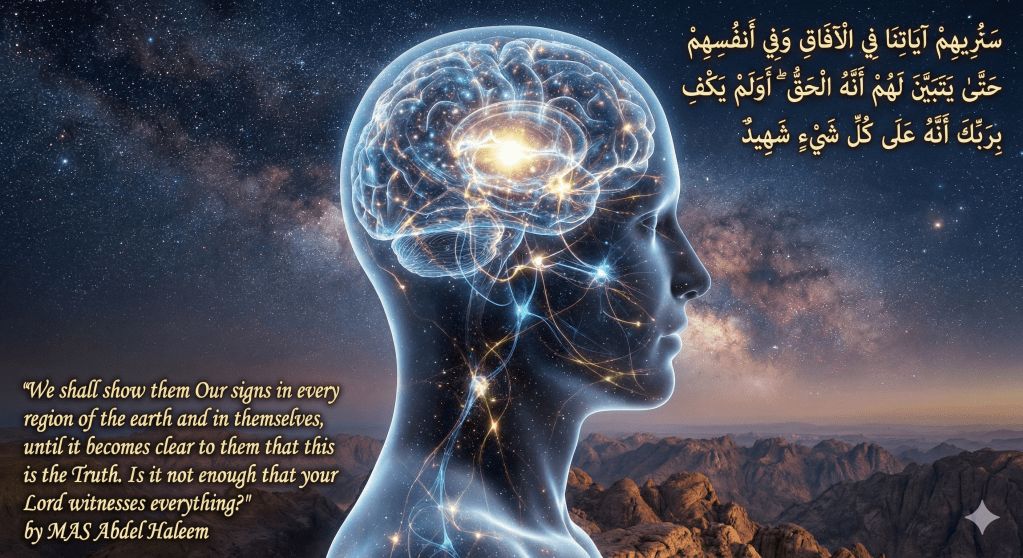
The last frontier of science remains unconquered
There is no fact in the universe more intimate, more undeniable, and more confounding than the fact that you are conscious right now. You experience the warmth of light, the weight of meaning, the sting of doubt, the rush of love. These are not hypotheses. They are the bedrock data of existence itself — more certain, as Galen Strawson has argued, than any claim about the external world. And yet, after everything modern science has achieved — splitting the atom, decoding the genome, photographing black holes — consciousness remains what Zia H Shah MD calls “the final frontier of the five centuries or more of the scientific enterprise.” Thequran +2
The scale of the failure is staggering. In 2024, Robert Lawrence Kuhn, creator and host of the PBS series Closer to Truth, published a landmark taxonomy cataloging over 225 distinct theories of consciousness in the journal Progress in Biophysics and Molecular Biology. Thequran +2 Shah was among the first to recognize the theological significance of this finding: “In the scientific and philosophical world, at least 225 theories are trying to explain consciousness and counting,” Thequranthequran he writes, and “the total lack of consensus among them serves as a testament to the truth of the Quranic verse.” thequranThequran That verse is Quran 17:85: “And they ask you concerning the soul. Say, ‘The soul is by the command of my Lord; and of the knowledge thereof you have been given but a little.’” Thequran
The “radical diversity” of approaches, as Kuhn himself noted, is “telling” — it indicates that no single paradigm commands wide agreement. thequran We have Global Workspace Theory, Integrated Information Theory, Orchestrated Objective Reduction, Higher-Order Theories, predictive processing models, quantum mind hypotheses, panpsychism, and dozens more — yet not one can explain why there is something it is like to see red rather than merely to process a particular wavelength of light. David Chalmers, the philosopher who gave this conundrum its now-famous name, stated the matter with austere clarity: “Even when we have explained the performance of all the cognitive and behavioral functions in the vicinity of experience — perceptual discrimination, categorization, internal access, verbal report — there may still remain a further unanswered question: Why is the performance of these functions accompanied by experience?” conscConsc
This is the hard problem of consciousness. And it is, as Shah writes, “the lethal wound to metaphysical naturalism.” Thequran
Dead matter does not dream: the argument from consciousness
The most fundamental question in the philosophy of mind is brutally simple: How can raw, inert matter become conscious? Diamonds do not wonder. Water does not grieve. Coal does not compose symphonies. As Shah puts it with arresting directness: “We simply cannot understand how inorganic atoms, molecules, and compounds yield the fantastic inner experience of thoughts, emotions, dreams, consciousness, and more.” ThequranThequran The atoms in your body are the same atoms found in rocks and rivers and dead stars — carbon, oxygen, hydrogen, nitrogen. Arranged one way, they are lifeless dust. Arranged another way, inside the intricate architecture of your brain, they somehow give rise to the entire theater of subjective experience: the taste of coffee, the pang of nostalgia, the blinding flash of insight.
Thomas Nagel, one of the most respected philosophers of the twentieth century, declared this situation intolerable for materialism. In his landmark 2012 work Mind and Cosmos, he wrote: “The modern materialist approach to life has conspicuously failed to explain such central mind-related features of our world as consciousness, intentionality, meaning, and value.” ThequranOxford University Press He concluded that “the materialist neo-Darwinian conception of nature is almost certainly false.” Wikipedia Nagel is himself an atheist Wikipedia — yet his intellectual honesty compelled him to acknowledge that something is profoundly wrong with the reigning materialist paradigm. Consciousness, he argued, demands a “teleological” principle in nature — something directing the cosmos toward the emergence of mind. Wikipedia Nagel could not bring himself to name that principle God. But others can, and do, and must. thequran
Roger Penrose, the Nobel Prize-winning mathematical physicist, reached a parallel conclusion from the side of mathematics and physics. In The Emperor’s New Mind and Shadows of the Mind, Penrose demonstrated that human mathematical understanding is non-algorithmic — it transcends what any Turing machine can compute. Wikipedia “We need a major revolution in our understanding of the physical world in order to accommodate consciousness,” he stated. “The most likely place, if we’re not going to go outside physics altogether, is in this big unknown — namely, making sense of quantum mechanics.” Nautilus Penrose’s work implies that consciousness is not a computation. It is something deeper — something that current physics cannot even describe, let alone explain.
Sir John Eccles, the Nobel laureate neuroscientist, was bolder still. Having spent a career studying the synaptic mechanisms of the brain, Eccles concluded that the mind is irreducible to its neural substrate. thequran “I believe that there is a fundamental mystery in my existence, transcending any biological account of the development of my body (including my brain) with its genetic inheritance and its evolutionary origin,” he wrote. He added, poignantly: “I cannot believe that this wonderful gift of a conscious existence has no further future, no possibility of another existence under some other unimaginable conditions.” Wikiquote For Eccles, the more we learned about the brain, the more wondrous — and more irreducible — consciousness became: “The more we discover scientifically about the brain the more clearly do we distinguish between the brain events and the mental phenomena, and the more wonderful do the mental phenomena become.” Wikiquote
Shah draws the theological conclusion that these scientists approach but do not always articulate: “You are reading these lines or watching the above videos and in my view that is proof enough that God exists… Consciousness will lead to God if we can expose the incoherence of all the alternative explanations.” Thequran The argument is not a “God of the gaps” fallacy, he insists, because “this gap will never genuinely be filled in decades or centuries to come.” Thequran Consciousness is not a temporary puzzle awaiting a future solution. It is a permanent signpost pointing to its Creator.
Richard Swinburne, the Oxford philosopher of religion, formalized this intuition: “The presence of conscious experiences in humans is more plausibly explained by the existence of a divine being than by naturalistic processes alone.” Thequran And the philosopher J.P. Moreland has argued that since matter is intrinsically insentient, the brute reality of our conscious experience demands a spiritual dimension to reality. Thequran Shah summarizes: “These immaterial aspects of human existence are best explained by the presence of a divine creator.” Thequran
The logic is elemental: consciousness cannot arise from unconsciousness. Mind cannot spring from mindlessness. Experience cannot be conjured from the void. If the universe began as dead, blind, purposeless matter — if at the ground floor of reality there was nothing but particles and forces and empty space — then there is no conceivable mechanism by which the inner light of awareness could have been kindled. As Shah writes: “We face a choice: either the ultimate reality is dead, mindless matter, or the ultimate reality is a Conscious Mind.” thequran
Voices from the summit: what the greatest minds have confessed
The mystery of consciousness has extracted confessions of awe from some of the most formidable intellects in history. These are not theologians making faith-claims in the absence of evidence. They are scientists and philosophers speaking from the very summit of human knowledge — and finding, at that summit, an abyss they cannot cross.
David Chalmers set the terms of the modern debate: “The really hard problem of consciousness is the problem of experience. When we think and perceive, there is a whir of information-processing, but there is also a subjective aspect.” conscAfterall He later concluded: “Materialism is a beautiful and compelling view of the world, but to account for consciousness, we have to go beyond the resources it provides.” Goodreads Chalmers’ zombie argument — the logical conceivability of a being physically identical to a human but utterly devoid of inner experience — remains one of the most powerful demonstrations that consciousness is not entailed by physics alone. MIT Open Learning Library Shah recognizes the zombie argument as decisive: “If such a being is logically possible, then consciousness is not logically entailed by physical structure, implying that consciousness involves ‘further facts’ beyond physics.” thequranThequran
Thomas Nagel established that consciousness is irreducibly subjective: “An organism has conscious mental states if and only if there is something that it is like to be that organism — something it is like for the organism.” thequran +2 His famous bat thought experiment showed that even complete physical knowledge of a bat’s neurology would never tell us what echolocation feels like from the inside. Aquestionofexistence Nagel declared: “Consciousness is what makes the mind-body problem really intractable.” MIT Open Learning Library +2
William James, the father of American psychology, proposed in his 1898 essay Human Immortality that the brain does not produce consciousness but transmits it — like a prism transmitting light or a radio receiving a signal. “Consciousness in this process does not have to be generated de novo in a vast number of places,” James wrote. “It exists already, behind the scenes, coeval with the world.” Wisdom & Folly Shah’s work extensively develops this transmission model, noting that “the brain does not produce consciousness on its own, but rather acts as a filter or transmitter of mind from a larger reality… much like a radio receiver tuning into a broadcast.” Thequran +2
Henri Bergson, Nobel laureate and philosopher of time, reinforced James’s insight from a different angle. In Matter and Memory, Bergson argued that the brain’s function is “not to preserve the past, but primarily to mask it, then to allow only what is practically useful to emerge through the mask.” Medium The brain, Bergson proposed, “keeps consciousness, feeling and thought tensely strained on life, and consequently makes them capable of efficacious action.” Philosophy Now It is “the organ of attention to life” Philosophy Now — a filter, not a factory. Contemporary scholars have revived this filter theory as a credible alternative to strict materialism. As philosopher Paul Marshall observes, quoted in Shah’s work: dependence on the brain “is not the same as production” — just as a radio can be damaged and distort sound without generating the music itself. Thequranthequran
Christof Koch, the neuroscientist who spent decades searching for the neural correlates of consciousness alongside Francis Crick, ultimately conceded more than he found. Thequran “Without consciousness there is nothing,” Koch wrote. “The only way you experience your body and the world of mountains and people, trees and dogs, stars and music is through your subjective experiences, thoughts, and memories.” The Marginalian His journey from strict reductionism to Integrated Information Theory — and toward a form of panpsychism — is itself a parable of materialism’s limits. Thequranthequran As Shah documents: Koch arrived at what Shah calls “the ground floor of reductionism” and discovered that consciousness “cannot be further reduced.” ThequranThe Marginalian
Francis Collins, the geneticist who led the Human Genome Project, offered the testimony of a scientist who found that science itself points beyond itself: “There are answers that science isn’t able to provide about the natural world — the questions about why instead of the questions about how. I find many of those answers in the spiritual realm.” Wikiquote Collins’s confession speaks to the same asymmetry Shah identifies: science can map correlations but cannot reach the subjective interior.
Alvin Plantinga, the analytic philosopher of religion, delivered a devastating challenge to the naturalist worldview with his Evolutionary Argument Against Naturalism: “If naturalism is true, the probability that our cognitive faculties are reliable is low or inscrutable. For those faculties have been shaped by a process of natural selection which does not select for truth but merely for survival.” Reasonable Faith The argument strikes at the root: if our minds are mere byproducts of blind evolution, we have no reason to trust them — including no reason to trust the belief in naturalism itself. Plantinga concluded: “There is superficial conflict but deep concord between science and theistic religion, but superficial concord and deep conflict between science and naturalism.”
Colin McGinn, the philosopher who coined the term “new mysterianism,” suggested that the human mind may be constitutionally incapable of solving the consciousness problem — that the solution lies “beyond the rim of human intellectual competence.” Thequran +2 Shah sees in this a direct echo of Quran 17:85: the soul is “by the command of my Lord,” and of its knowledge, we have been given “but a little.” Even the secular new mysterian, without intending to, testifies to the truth of divine revelation.
The absurdity of denying what you cannot escape
Against this chorus of intellectual humility stands a small but vocal faction of philosophers who claim that consciousness is an illusion — that the inner theater of experience does not really exist. thequran This is the position of Daniel Dennett in Consciousness Explained (1991), of Paul and Patricia Churchland with their eliminative materialism, and of Keith Frankish with his “illusionism.” ThequranWikipedia It is, as Galen Strawson memorably declared, “the silliest claim ever made” — a claim next to which “every known religious belief is only a little less sensible than the belief that grass is green.” thequranThe New York Review of Books
Dennett’s project was to explain consciousness by explaining it away. He wrote that qualia — the raw feel of subjective experience — are “characters in good standing in the fictional world of your heterophenomenology but what it turns out to be in the real world in your brain is just a complex of dispositions.” He proposed a “multiple drafts” model in which there is no central experiencer, no inner theater, no “Cartesian Theater.” Thequran His book’s title, Consciousness Explained, was derided by critics as false advertising; many preferred to call it Consciousness Denied or Consciousness Ignored. In a remarkable moment of candor, Dennett even wrote: “Are zombies possible? They’re not just possible, they’re actual. We’re all zombies. Nobody is conscious.” Mountains and rivers
Frankish extended Dennett’s project: “Phenomenal consciousness is a fiction written by our brains to help us track the impact that the world makes on us.” thequranAeon And the Churchlands predicted that folk psychology — our everyday vocabulary of beliefs, desires, and experiences — would be “eliminated” by neuroscience, Wikipedia just as “phlogiston” was eliminated by chemistry.
Shah devoted an entire article — “Refuting the Claim that Consciousness is An Illusion” — to dismantling these positions. Thequran His refutation is systematic and devastating, drawing on neuroscience, phenomenology, evolutionary biology, and philosophical logic. The core of his argument, echoing Searle and Strawson, is that illusionism is self-refuting: “The very notion of an ‘illusion’ presupposes a conscious observer.” ThequranThequran To claim consciousness is illusory, you must be conscious of the claim. As Shah puts it: “Doubting one’s own consciousness is akin to shouting ‘I am mute.’” thequranThequran The very act of denial is itself a conscious act — a performative contradiction of the most elementary kind.
John Searle delivered one of the most withering indictments: “The most striking feature of mainstream philosophy of mind of the past fifty years is how much of it seems obviously false.” thequranThe New York Review of Books He continued: “Obvious facts about the mental, such as that we all really do have subjective conscious mental states, are routinely denied.” And: “The materialist philosopher purports to offer an analysis of the mental, but his or her hidden agenda is to get rid of the mental.” The New York Review of Books Searle insisted that consciousness is a real, causally efficacious biological phenomenon with an irreducible first-person ontology: “The mind consists of qualia right down to the ground.” thequranInternet Encyclopedia of Philosophy
Strawson’s critique of Dennett was surgical. In his 2018 essay “The Consciousness Deniers” in the New York Review of Books, he wrote: “One of the strangest things the Deniers say is that although it seems that there is conscious experience, there isn’t really any conscious experience: the seeming is, in fact, an illusion. The trouble with this is that any such illusion is already and necessarily an actual instance of the thing said to be an illusion.” thequran He pointed out the moral horror implicit in Dennett’s position: “If he’s right, no one has ever really suffered, in spite of agonizing diseases, mental illness, murder, rape, famine, slavery, bereavement, torture, and genocide.” Johnpiippo
Chalmers invoked what he called the Moorean argument against illusionism: “The reality of consciousness is more certain than any theoretical commitments that may be motivating the illusionist to deny the existence of consciousness.” thequranWikipedia In other words, if your theory requires you to deny that you have experiences, the rational move is to reject the theory, not the experiences. Shah concurs: as Strawson insisted, “If it seems to you that you are conscious, that seeming just is the reality of consciousness” thequranThequran — consciousness is, in Strawson’s words, “the most certainly known fact” in the universe. thequran
Shah’s work also highlights the evolutionary absurdity of illusionism. If consciousness were truly non-functional — a mere epiphenomenal illusion — why would natural selection have produced and maintained it across hundreds of millions of years of animal evolution? Thequran Neuroscientist Stanislas Dehaene has shown that conscious processing enables “flexibility and deliberate control that unconscious processes lack” — working memory, deliberate decision-making, verbal report, and the ability to guide novel, non-automatic behaviors. Thequranthequran Consciousness does real work. It is not a ghost in the machine. It is the machine’s reason for existing.
The Quranic framework: consciousness as divine command
At the heart of Zia H Shah’s intellectual project stands a single, resplendent Quranic verse: “And they ask you concerning the soul (al-rūḥ). Say, ‘The soul is by the command of my Lord; and of the knowledge thereof you have been given but a little’” (17:85). thequran +2 Shah treats soul and consciousness as synonymous concepts Thequran and demonstrates that this verse, revealed over fourteen centuries ago, anticipates with uncanny precision the very impasse at which modern science and philosophy now find themselves.
Shah’s argument proceeds through several interlocking theses. First, he observes that the Quran identifies exactly two areas where human knowledge will remain permanently limited: the soul (consciousness) and the Afterlife. “More than 1400 years ago,” he writes, “the Quran could have prophesied about so many possible things and would have been demonstrated to be wrong in light of scientific progress of the last few centuries. For example, the Quran could have said that you will never know why the sun and the moon are bright and how far these are and would have proven to be wrong. But, this was not to be.” Thequranthequran The Quran’s prophetic precision is remarkable: it encourages the study of nature in 750 to 1,000 verses, Thequran yet reserves the caveat of permanent mystery for exactly the two domains — consciousness and the hereafter — where modern inquiry continues to stall. thequran
Second, Shah proposes a profound ontological framework rooted in the Quranic distinction between two orders of existence: Alam al-Khalq (the World of Creation — the physical universe, the domain of science) and Alam al-Amr (the World of Command — the realm of immediate Divine Will, where the soul belongs). Thequran The soul is min amri rabbī — “from the command of my Lord” — a direct act of God, not an emergent property of matter. thequranthequran This is why, Shah argues, science can study the neural correlates of consciousness but never reach its essence: the rūḥ belongs to a different ontological order than the particles and fields that physics describes.
Third, Shah draws an illuminating distinction between Rūḥ (spirit) and Nafs (self). The Rūḥ, he writes, is the “pure, immutable witness — the light of the projector,” while the Nafs is the “evolving ego — the movie on the screen.” Neuroscience, at its best, studies the Nafs — the psychological self with its emotions, memories, and personality traits. But it cannot isolate the Rūḥ, the underlying witness-consciousness that makes all experience possible. thequran This distinction maps strikingly onto what philosophers call the distinction between the contents of consciousness (which change moment to moment) and the fact of consciousness (which persists as long as we are awake and alive).
Fourth, Shah makes what may be his most distinctive claim: “Human consciousness is an interface capable of receiving messages from beyond, from the transcendent God of Abrahamic faiths.” Thequranthequran Quoting Quran 6:103 — “Eyes cannot reach Him but He reaches the human consciousness. And He is the Incomprehensible, the All-Aware” Thequranthequran — Shah argues that consciousness lies at the “sacred boundary between the finite and Infinite.” This is why it will always retain an element of irreducible mystery: “Eyes cannot reach the Infinite. As consciousness lies at the sacred boundary between the finite and Infinite, is it not reasonable to say that it will always remain shrouded in mystery?” Thequranthequran
Shah’s work on “The Enigma of Consciousness” traces how Islamic theological schools have understood the soul across centuries Thequran — from the Athari literalists to the Ash’arite tradition of “subtle body,” from the Maturidi rationalists to the Shia conception of “divine light.” Thequran He surveys the great Islamic philosophers: Ibn Sina (Avicenna), who proposed the famous “floating man” thought experiment to demonstrate that consciousness could exist independently of the body; Thequran Al-Ghazali, who argued for the soul’s divine origin; and Ibn Arabi, the Sufi metaphysician who described the rūḥ as a barzakh (isthmus) between divine and human realms — “neither fully divine nor fully created but partaking of both natures.” Thequran The poet Rumi captured the soul’s predicament: “The soul has been taken from the body as a hostage, teaching it to seek knowledge as ransom for its liberation.” Thequran
In his article “Can Consciousness Be Only Explained In the Light of the Quran?”, Shah writes that “the 225 theories, or the total lack of consensus, are a testament to the three Quranic verses quoted in this article and the inferences drawn from them.” Thequran +2 He is careful to distinguish his approach from what critics call “Bucailleism” — the retroactive fitting of scientific discoveries into sacred text. “Incidentally,” Shah writes, “these verses will also continue to emerge over the centuries as proof that the Quran is not about Monday morning quarterbacking to retrofit new scientific discoveries into the sacred text.” Thequranthequran The claim is not retroactive but prospective: the Quran made a prediction about the limits of human knowledge, and every passing decade of failed reductionism confirms it.
Why panpsychism cannot save materialism
Faced with the wreckage of eliminativism and standard physicalism, some philosophers have turned to panpsychism — the view that consciousness is a fundamental and ubiquitous feature of physical reality, present even in the simplest particles. Thequran Philip Goff has predicted that “in twenty years’ time, the idea that panpsychism can be quickly dismissed as ‘crazy’ will seem, well, crazy.” thequran Galen Strawson has argued that since the emergence of experience from wholly non-experiential matter is “brute emergence — otherwise known as magic,” we must accept that experience goes “all the way down.” thequranThequran
Shah has devoted an extensive critique to panpsychism in “Critique of Panpsychism: Philosophical Coherence and Scientific Viability.” While he respects the panpsychist instinct that consciousness must be fundamental, he argues that the theory collapses under the weight of the combination problem: How do trillions of micro-experiences in individual atoms combine to form the unified stream of a single human consciousness? William James identified this difficulty in 1890: “Take a hundred [feelings], pack them as close together as you can… still each remains the same feeling it always was.” thequran No one has solved this problem since.
Moreover, panpsychism is, as neuroscientist Anil Seth has noted, “empirically untestable” — it “remains very much a fringe proposition within consciousness science.” thequran If an electron has an iota of experience, how would we ever know? The theory makes no predictions that differ from standard physics. Biologist Jerry Coyne charged that panpsychist philosophers “have no solution” for the combination problem and that the theory is “untestable in any way.” thequran
Shah sees panpsychism as a kind of inadvertent compliment to theism — it correctly recognizes that consciousness must be fundamental but stops short of the logical conclusion. As he writes in “Consciousness and the Inert Universe”: even Galen Strawson, an atheist, conceded that trying to “derive” consciousness from physics is “incoherent… brute emergence.” Thequran If consciousness must be fundamental, and if it cannot emerge from mindless matter, then the universe requires at its foundation not diffuse proto-experience sprinkled across atoms but a single, unified, originating Mind — what the Abrahamic traditions call God. As Shah writes: “Far from being turtles all the way down, the chain of consciousness finds its first link in the everlasting, all-aware Reality that undergirds everything.” Thequran
Shah reinforces this with a vivid thought experiment he calls the “Aliens of Aliens” argument: imagine a chain of intelligent alien designers, each of which created the next. This chain cannot extend to infinity — it must terminate in an uncaused, self-existent Consciousness. Thequran And in the age of artificial intelligence, he notes, we have a fresh metaphor for this ancient insight: “The modern creation of AI by human consciousness creates another metaphor to understand why we need a prior consciousness to create any sort of intelligence.” Thequran Just as AI requires prior human consciousness to exist, human consciousness requires a prior divine Consciousness.
The brain as receiver, not generator
One of the most compelling threads running through Shah’s writings is the transmission or filter theory of consciousness — the idea, first proposed by William James and Henri Bergson, that the brain does not generate consciousness but rather receives, filters, and constrains it. James wrote: “Consciousness in this process does not have to be generated de novo in a vast number of places. It exists already, behind the scenes, coeval with the world.” Wisdom & Folly Bergson agreed: the brain’s role is “not to preserve the past, but primarily to mask it, then to allow only what is practically useful to emerge.” Medium
In “Consciousness Beyond the Brain: Theories and Evidence,” Shah marshals a striking array of empirical phenomena that support the transmission model. Terminal lucidity — the sudden return of full cognitive clarity in patients with severe dementia or brain damage shortly before death — “presents a significant challenge to physicalist assumptions,” Thequran +2 because if the brain generates consciousness, a ravaged brain should not be able to produce crystalline awareness. Yet it does. Near-death experiences, in which patients report vivid, veridical perceptions during periods of clinical death when brain activity is absent or minimal, provide further evidence that consciousness may not be tethered to the brain. Thequran Cardiologist Pim van Lommel’s landmark 2001 study in The Lancet documented cases in which patients described accurate details of their resuscitations — details they could not have known if consciousness were strictly brain-dependent. thequran
Shah also cites the extraordinary research program at the University of Virginia, where Ian Stevenson and Jim Tucker have documented approximately 2,500 cases of young children reporting verified memories of previous lives — cases in which children accurately described people, places, and events they had never encountered. thequran These anomalies, Shah suggests, are consistent with a model in which consciousness is not created by the brain but received through it — and can, under certain conditions, persist or reemerge independently of any particular physical substrate.
The transmission model is, Shah argues, precisely what the Quran’s “Sleep Verse” (39:42) implies: “Allah takes the souls at the time of their death, and those that do not die [He takes] during their sleep.” thequranThequran Sleep, in this reading, is a nightly partial departure of the soul from the brain interface — a “little death” in which the rūḥ temporarily withdraws from the body, only to return upon waking. thequranthequran The continuity of self across sleep is itself, Shah suggests, a daily miracle — a sign of the soul’s reattachment by divine will each morning.
The enduring inscrutability as sacred sign
Shah’s writings converge on a single, magnificent conclusion: the enduring inscrutability of consciousness is not a failure of human inquiry but a profound sign of its sacred origin. In his article “The Enigma of the Self,” he writes: “The enduring inscrutability of consciousness can be seen not as a failure of human inquiry, but as a profound sign of its sacred origin — a living miracle that ever invites humility and wonder.” thequran The mystery is not a deficiency to be remedied. It is a feature, divinely designed to “break the arrogance of scientism” and to orient the human heart toward its Creator.
This is not anti-science. Shah’s Quranic framework is emphatically pro-investigation — the Quran, he notes, devotes hundreds of verses to encouraging the study of nature. But it reserves for two realities alone — the soul and the afterlife — the caveat that human knowledge will be “but a little.” thequran And these two mysteries, Shah notes, “in some sense go hand in hand in continuity of human soul.” thequran The soul that cannot be fully understood in life is the same soul that survives death.
Erwin Schrödinger, one of the founders of quantum mechanics, mused that “consciousness is a singular unified phenomenon — the appearance of many is an illusion.” thequran Physicist Freeman Dyson declared: “The Universe in some sense must have known we were coming.” Even Noam Chomsky, the great linguist and secularist, has distinguished between “problems” (solvable within our cognitive architecture) and “mysteries” (which may permanently exceed it) thequran — and placed consciousness firmly in the category of mystery.
These are not appeals to ignorance. They are recognitions of limit. As the philosopher Colin McGinn admitted, the solution to consciousness may lie “beyond the rim of human intellectual competence.” ResearchGate The eye, Shah observes, cannot see itself directly. Consciousness cannot fully comprehend its own ground. And this, far from being a cause for despair, is precisely what we should expect if consciousness is what the Quran says it is: a trust (amānah) from the Infinite, bestowed upon the finite, connecting the creature to the Creator.
As Shah writes: “Human consciousness and our relationship with the Divine will forever remain a fool-proof argument for our Divine Creator, Who created us in His image.” The claim is falsifiable, he insists — it would be refuted if humans could one day create genuine consciousness from scratch, endowing a machine with authentic subjective experience. But no experiment has ever generated even a flicker of sentience from inert matter. And Shah is confident none ever will — not because of a lack of ingenuity, but because consciousness belongs to the World of Command, not the World of Creation.
Epilogue: the miracle you already are
You have been conscious throughout the reading of this article. You have experienced the meaning of these words, not merely processed them. You have weighed arguments, felt the pull of evidence, perhaps experienced a flicker of recognition or resistance. None of this was guaranteed by the arrangement of atoms in your skull. None of it follows from the equations of physics. None of it can be explained by any theory yet devised — or, if the deepest thinkers in philosophy and the most honest scientists are right, by any theory that ever will be devised.
This is not a failure. It is a revelation.
The miracle of consciousness is not something that happened long ago in a distant past. It is happening now, in you, at this very moment. Every flicker of awareness, every felt quality of experience, every instance of understanding is a fresh sign — an āyah — of the God who, as the Quran declares, “shows His signs in the horizons and within themselves, until it becomes clear to them that He is the Truth” (41:53). Consciousness is the innermost of those signs. It is the theater in which all other signs appear. And it is, finally, the interface through which the Infinite reaches the finite — the place where, as Quran 6:103 reveals, “Eyes cannot reach Him but He reaches the human consciousness.”
The scientists have done their work with admirable diligence. The philosophers have pressed their arguments with formidable rigor. And the verdict, after centuries of effort, is the same verdict the Quran delivered in a single luminous verse fourteen hundred years ago: the soul is by the command of my Lord, and of the knowledge thereof you have been given but a little.
Zia H Shah, reflecting on the entirety of this extraordinary intellectual landscape, offers a conclusion that is at once humble and audacious, scientific and sacred: “The mystery itself points to God. Our inability to comprehend the soul nudges us to acknowledge a higher truth.” We are not diminished by this mystery. We are ennobled by it. For to be conscious is to share, however dimly, in the attribute of the One who is Al-Shahīd — the Witness, the All-Aware. The miracle is not out there, waiting to be found. The miracle is you — conscious, wondering, alive, and held in being by the God whose command brought you forth from dust into the astonishing, inexplicable light of awareness.
And they ask you concerning the soul. Say, ‘The soul is by the command of my Lord; and of the knowledge thereof you have been given but a little.’



 The Glorious Quran and Science
Leave a comment