
Epigraph
إِنَّا نَحْنُ نُحْيِي الْمَوْتَىٰ وَنَكْتُبُ مَا قَدَّمُوا وَآثَارَهُمْ ۚ وَكُلَّ شَيْءٍ أَحْصَيْنَاهُ فِي إِمَامٍ مُّبِينٍ
We shall certainly bring the dead back to life, and We record what they send ahead of them as well as what they leave behind: We keep an account of everything in a clear Record. (Al Quran 36:12)
Presented by Zia H Shah MD
Audio teaser:
Quantum Cosmological Eschatology: The Many-Worlds Interpretation and the Unveiling of Divine Justice in Surah Qaf
Abstract
The synthesis of quantum cosmology and Islamic eschatology provides a robust framework for conceptualizing the mechanics of divine omniscience, the persistence of moral records, and the realization of ultimate justice. This report explores the Many-Worlds Interpretation (MWI) of quantum mechanics—originally formulated by Hugh Everett III—as a scientific prism through which the metaphysical descriptions in Quran 50:15-21 can be understood. MWI posits that the universal wavefunction is an objectively real entity that evolves unitarily, precluding wavefunction collapse and asserting that all possible outcomes of quantum events are physically actualized in a branching multiverse. This interpretation has gained significant momentum among contemporary cosmologists because it resolves the internal inconsistencies of the “observer-dependent” Copenhagen model when applied to the universe as a whole. Assuming the veracity of MWI, this analysis provides a tripartite—scientific, philosophical, and theological—commentary on Surah Qaf. It identifies the “New Creation” (Khalqin Jadid) as the continuous branching of the universal wavefunction and the “Recording Angels” (Raqib and Atid) as the physical processes of decoherence and information conservation that ensure the persistence of human action across all historical trajectories. The report argues that MWI provides a “miraculous” mechanism for the “balancing of the books,” wherein every contingent choice is preserved within the Hilbert space of the universe, allowing for a divine reckoning that is exhaustive, mathematically precise, and perfectly just.
The Technical Foundations of the Many-Worlds Interpretation
The Many-Worlds Interpretation (MWI) represents perhaps the most radical shift in the ontological understanding of physical reality since the inception of the scientific method. Originally proposed by Hugh Everett III in his 1957 doctoral thesis at Princeton University, the theory was initially termed the “Relative State Formulation”. Everett’s primary objective was to resolve the “measurement problem” that had plagued quantum mechanics since the 1920s. In the standard Copenhagen interpretation, a quantum system exists in a superposition of all possible states until an external measurement is performed, at which point the wavefunction is said to “collapse” into a single, definite outcome. Everett identified this collapse as an ad hoc postulate that created an irreconcilable dualism between the quantum world of atoms and the classical world of observers.
Everett proposed that the collapse of the wavefunction is an illusion. He argued that the linear and unitary dynamics of quantum mechanics, as described by the Schrödinger equation, apply universally to all systems, including observers and their measuring devices. When an observer interacts with a quantum system, they become entangled with it, and the universal wavefunction branches into a superposition of non-communicating “worlds,” each corresponding to a different measurement outcome. In this view, the cat in Schrödinger’s famous thought experiment is both alive and dead, but these two states exist in different, equally real branches of the multiverse.
Unitary Evolution and the Universal Wavefunction
The fundamental ontological claim of MWI is that the universal wavefunction $|\Psi\rangle$ is the only entity that exists. This wavefunction evolves deterministically and locally according to the Schrödinger equation:
$$i \hbar \frac{\partial}{\partial t} |\Psi(t)\rangle = \hat{H} |\Psi(t)\rangle$$
Under this evolution, information is never lost. The “splitting” of worlds is not a physical division of space-time but a branching of the state vector in Hilbert space. Each branch corresponds to a distinct macroscopic history that, once formed, evolves independently of the others. This ensures that every potentiality inherent in the initial conditions of the universe is eventually realized in some sector of the multiverse.
The Mechanism of Quantum Decoherence
A major criticism of the early Everettian model was its inability to explain why we perceive a singular, classical reality rather than a smeared-out quantum superposition. The resolution came with the development of decoherence theory in the 1970s and 80s. Decoherence occurs when a quantum system interacts with its environment—such as air molecules or photons. This interaction effectively “scrambles” the phase relationships between different components of the wavefunction, making interference between them impossible.
The environment acts as a permanent “witness” or recording device, capturing the state of the system and forcing it into independent branches that look like classically definite worlds. Decoherence explains the emergence of the “preferred basis”—the reason we see objects in definite positions rather than in momentum superpositions—because the locality of physical interactions in three-dimensional space privileges states that are spatially localized.
| Interpretation | Nature of the Wavefunction | Role of the Observer | Measurement Outcome |
| Copenhagen | Epistemic/Probabilistic | Triggers collapse | Single random outcome |
| Bohmian | Pilot wave (guiding particles) | Passive observer | Definite trajectory |
| Many-Worlds | Objectively Real | Part of the system | All possible outcomes |
| Decoherent Histories | Quasiclassical sectors | Not required | Emergent branches |
The Growing Popularity of MWI in Contemporary Cosmology
While Everett’s ideas were largely ignored for decades, MWI has become a mainstream interpretation among contemporary cosmologists and theoretical physicists. This resurgence is driven by the internal logic of quantum cosmology, where the system under study is the entire universe.
The Absence of an External Observer
In the Copenhagen framework, a measurement requires an observer who stands “outside” the system. However, in quantum cosmology, there is no “outside” the universe. If the universe is a closed quantum system, there can be no external agent to collapse its wavefunction. Consequently, cosmologists such as Stephen Hawking and Murray Gell-Mann turned to Everett’s “no-collapse” model as the only way to mathematically describe the birth and evolution of the cosmos. MWI allows the universe to be its own observer, with internal subsystems acting as measuring devices for others.
Parsimony and Mathematical Realism
Proponents like Sean Carroll and Max Tegmark argue for MWI on the grounds of Occam’s Razor. Although it posits a vast number of worlds, it does so using the fewest number of physical laws. It eliminates the “collapse postulate,” which is arguably the most complex and poorly defined part of standard quantum theory. By taking the Schrödinger equation literally, MWI avoids the need for a magical boundary between the “micro” and “macro” worlds. Carroll argues that MWI is the “courageous” view because it follows the mathematics to its logical conclusion, regardless of how much it conflicts with human intuition.
Symmetries and the Arrow of Time
MWI restores determinism and symmetry to physics. In a branching multiverse, the past is a single line (from the perspective of an observer) while the future is a branching tree. However, from the perspective of the universal wavefunction, the evolution is entirely symmetrical and deterministic; there is no fundamental randomness, only the subjective uncertainty of an observer who does not know which branch they will end up in. This provides a more robust foundation for the “Arrow of Time,” as the branching process naturally increases the entropy and complexity of the universal state.
Scientific, Philosophical, and Theological Commentary on Quran 50:15-21
The verses of Surah Qaf provide an arresting description of the creation, the record-keeping of human deeds, and the transition into a “sharper” reality after death. When these verses are analyzed through the lens of MWI, they reveal a profound alignment between quantum mechanics and the Islamic conception of a continuously unfolding, perfectly recorded reality.
Verse 15: The New Creation and Continuous Branching
“Were We then tired with the first creation? Nay, they are in confused doubt about a new creation.” (Quran 50:15)
The phrase Khalqin Jadid (New Creation) is traditionally understood as the physical resurrection on the Day of Judgment. However, from a quantum cosmological perspective, this “new creation” can be seen as the continuous, moment-by-moment branching of the wavefunction.
In some Sufi and philosophical traditions, the universe is viewed as being recreated at every instant—a doctrine known as Tajdid al-amthal (the renewal of likes). Al-Ghazali’s occasionalism similarly posits that God is the direct cause of every event, and that the “habit” of cause-and-effect masks a radical contingency where God could will any outcome at any moment. MWI provides a scientific mechanism for this: every quantum event is a “new creation,” a branching into new world-states where every possibility is actualized. The “confused doubt” of the disbelievers arises from their inability to perceive this multiplicity; they see only one world and assume it is the only one possible, failing to realize that the “first creation” (the Big Bang) was merely the initial state of an ever-expanding, branching multiverse.
Verse 16: Divine Proximity and the Universal Hilbert Space
“And verily We have created man and We know what his ownself whispers to him. And We are closer unto him than his jugular vein.” (Quran 50:16)
This verse describes God’s total awareness of the “whispers” (waswasa) of the human soul. In the context of MWI, the “self” is not a singular, isolated entity but a “relative state” within the universal wavefunction. If we view God as the Sustainer of the entire universal wavefunction, then His knowledge encompasses every possible state of every particle in the human brain.
The “closeness” mentioned here is ontological rather than spatial. In a branching multiverse, the “I” at any moment is defined by its entanglement with the rest of the universe. God is “closer than the jugular vein” because the existence of every branch of the human self is contingent upon the unitary evolution of the whole, which is held in the “Divine Knowledge” or the “Universal Wavefunction”. Every “whisper” or internal thought corresponds to a specific quantum configuration; in MWI, even these internal states are “recorded” as they cause the wavefunction of the individual to branch in relative ways.
Verses 17-18: The Archival Witnesses and Information Redundancy
“ that the two receivers receive [man’s deeds], one sitting on the right and one on the left… Not a word does he utter but there is a watcher (Raqib) ready (Atid) [to record it].” (Quran 50:17-18)
The traditional exegesis identifies Raqib and Atid as angels who record every word and deed. Through the lens of MWI and information theory, this imagery suggests an “architecture of divine record-keeping” built into the physics of the universe.
- Environmental Witnessing: Quantum decoherence theory posits that when an action is taken, information about that action is broadcast into the environment. For example, when a person speaks, the photons and air molecules in the room interact with them, effectively “recording” the event in a massive number of redundant copies. This redundancy is what makes the record durable and resistant to tampering. The “two receivers” can be seen as a metaphor for the structural necessity of recording both the “input” (the choice) and the “output” (the action) in the fabric of spacetime.
- Persistence of the Record: In MWI, a record is not just a ledger but a “retrievable, integrity-protected correlation with a past event”. Because the universal wavefunction evolves unitarily, no information is ever deleted; it only becomes “de-cohered” and hidden from the perception of the local observer. The “Watcher” (Raqib) is the process of interaction, and the “Ready” (Atid) is the actualized branch that preserves the history of the event forever in the Hilbert space.
- Entropy as Inscription: Every human action induces irreversible thermodynamic reconfigurations. These traces are not figurative; they consist of correlations in matter and fields that are extraordinarily difficult to erase. Divine justice thus depends on this “informational integrity,” where the “Book” (Kitab) is the preserved state of the universe itself.
| Quranic Term | Theological Meaning | Quantum/Information Analogy |
| Raqib | The Watcher / Observer | The process of interaction/measurement |
| Atid | The Prepared / Ready record | The resulting branch/stable register |
| Muntalqqiyan | The Two Receivers | Informational entanglement/redundancy |
| Kitab | The Book of Deeds | The Universal Wavefunction ($\Psi$) |
| Shahid | The Witness | Environmental decoherence traces |
Verse 19: The Stupor of Death and the Unveiling of Truth
“And the intoxication (sakrah) of death will bring the truth; that is what you were trying to avoid.” (Quran 50:19)
Death is described as a sakrah (stupor or intoxication) that brings the Haqq (Truth). In MWI, death can be seen as the ultimate transition of the observer’s perspective. During life, the consciousness is localized within a single branch of the wavefunction, leading to the illusion of a unique and isolated history. Death, however, is the “removal of the veil” between the material world and the “unseen” branches.
The “truth” that the disbeliever tried to avoid is the reality of accountability across all branches of their existence. In those final moments, the “reality which had remained concealed in the world begins to be uncovered,” and the soul gains an initial sense of its broader “relative state” across the multiverse. This aligns with the “Relative State Formulation” where the “I” is not a singular point but a state relative to the rest of the universal wavefunction.
Verses 20-21: The Trumpet and the Convergence of Worlds
“And the Trumpet will be blown… And every soul will come, with it a driver and a witness.” (Quran 50:20-21)
The “Trumpet” marks the transition to the Resurrection (Qiyamah). In the eschatological model proposed by Frank Tipler (the Omega Point Theory), the end of the universe involves a collapse into a final singularity with infinite informational capacity. This “Omega Point” functions as a cosmic computer that can simulate every possible quantum history that has ever occurred.
The “Driver” and the “Witness” accompanying each soul are the informational legacies of their life. The “Driver” represents the causal trajectory of the specific branch the soul occupied, while the “Witness” is the preserved record of its actions in the environment. On the Day of Resurrection, all these “relative states” are brought together. The “Witness” ensures that the soul cannot deny its deeds, as they are part of the very structure of the universe that the Omega Point (God) is re-actualizing.
Miraculous Record-Keeping and Perfect Justice in the Afterlife
The core of the user’s query asks how MWI provides a miraculous mechanism for record-keeping and perfect justice. The answer lies in the way MWI preserves the totality of human experience and potentiality.
The Balancing of the Books: Exhaustive Accountability
In a single-world universe, justice is often frustrated by “deadweight losses”—choices where the full consequences are never realized, or crimes where the evidence is destroyed. However, if MWI is true, then “balancing the books” takes on a much more profound meaning.
- Accounting for All Contingencies: Divine justice in a multiverse is not limited to a single timeline. If a person had the potential to do good or evil, MWI ensures that all those possibilities were explored in various branches. God’s judgment can therefore be an assessment of the “measure” or “thickness” of an individual’s choices across the multiverse. If an individual “typically” chooses the good across the majority of their branches, their soul is judged as righteous.
- Restitution for Victims: A major theological problem is how to compensate a victim for a “lost” life. In MWI, no life is truly lost; it continues in other branches. The “balancing of the books” involves the divine convergence of these histories in the Afterlife, where every version of the victim is granted their due reward and every version of the perpetrator is held to account for their specific actions.
- The Measure of Existence: The “squared amplitude” or “thickness” of a branch in MWI is often interpreted as the “probability” of that world. From a theological standpoint, this could be the “weight” given to an action in the Scales of Justice. A deliberate, repeated action creates “thicker” branches in Hilbert space, carrying more weight in the final reckoning than a fleeting thought or an accidental event.
Divine Justice and the “Normative Self”
If the self “splits” into many versions, who is the “real” person to be judged? This is the problem of “personal identity” in MWI.
Theologically, the solution lies in the concept of the “Normative Self”—a unified moral agency that spans all branches. While Parfit argues that “identity is not what matters” when an observer divides, theistic responsibility requires a “narrative coherence” that integrates all past actions into a unified moral framework. God judges the “universal consciousness” of the individual, not just a single temporal slice. This allows for a “perfect justice” that considers not just what a person did in one branch, but what they were across the entirety of the universal wavefunction.
The Unveiling: From Local to Global Perception
“Now We have removed from you your covering (veil), and sharp is your sight this Day!” (Quran 50:22)
This verse refers to Kashf al-Ghita (the removal of the veil). In our current existence, we are “barred” from sighting the full reality of God and the multiverse. This is because our “sight” is bound by the locality of our current branch.
The “sharp sight” of the Day of Judgment is the transition from a “local” observer (one who sees only one branch) to a “global” observer (one who sees the entire wavefunction). When the “covering” of decoherence is lifted, the individual sees the “face of actions”—the full, un-collapsed record of everything they have ever done across all possible histories. This is why the Quran says “no secret of yours shall be hidden” (Q 69:18); in the full quantum state of the universe, every “secret” is a physically real branch that is now “put on full display”.
The Ethics of Moral Responsibility in a Multiverse
A common objection to MWI is that it might decrease personal responsibility: “If I’m behaving badly in this branch, I’m behaving better in another”. However, a deeper reading of Surah Qaf suggests the opposite.
The Inevitability of Choice
In MWI, every choice “happens,” but that does not mean choice is meaningless. From the perspective of the observer, the branch they find themselves in is the result of their own volition and control. The “Driver” and the “Witness” (50:21) emphasize that each soul is led by its own causal history.
If God passes judgment on “moral agents” who possess “moral awareness and limited free will,” then the branching of the universe is the very medium through which that free will is exercised. The “fission” of the self into multiple branches is not an escape from responsibility but an expansion of it. You are responsible for the totality of the “You” that exists in the universal wavefunction.
The Mesoscopic Anthropic Principle
The “Mesoscopic Anthropic Principle” suggests that highly improbable events—such as the emergence of life and mind—occur because they must occur in some branches of a multiverse. This has profound theological implications for the concept of “Test” (Imtihan) in the Quran.
We find ourselves in a branch of the universe where life is possible and moral choices are available. This specific “world” is our testing ground. While other versions of us exist in other branches, our subjective experience is defined by the choices we make here. The “balancing of the books” ensures that no matter how improbable a “good” life might have been in a single history, it is realized and recorded within the vastness of the divine plan.
Theoretical Synthesis: MWI as the Mechanics of Resurrection
Frank Tipler’s Quantum Omega Point Theory provides perhaps the most direct “scientific commentary” on the mechanics of resurrection mentioned in verses 20-21.
- Infinite Computational Power: Tipler argues that for the laws of physics to be consistent, the universe must collapse into a final singularity (the Omega Point) that possesses infinite computational power. This singularity can process an infinite number of bits of information before the “end” of spacetime.
- Resurrection via Emulation: With this power, the Omega Point can “emulate” (resurrect) every possible human history. Because the emulation is accurate down to the quantum level, it is not a mere copy but the actual person. This fits the Quranic description of God’s signal being enough to gather all “scattered particles” and make them rise as they were “in the first instance”.
- Eternal Life Postulate: Tipler’s model suggests that “eternal life” is the continuation of conscious experience within this final, infinite simulation. This provides a physical framework for Heaven and Hell, where the Omega Point—acting as a “personal, omnipotent, and omniscient” God—assigns histories that are either “beatific” or “purgatorial” based on the patterns of the life that was lived.
| Omega Point Theory Element | Quranic Eschatology Parallel | Theological Significance |
| Final Singularity | The Day of Judgment / Resurrection | The ultimate goal and limit of history |
| Infinite Computation | Divine Omnipotence / Qadir | God’s ability to recreate any being |
| Multiverse Emulation | The Gathering / Hashr | Resurrection of all versions of the self |
| No Information Loss | The Guarded Tablet / Lauh Mahfuz | Absolute persistence of all records |
| Benign Omega Point | Divine Mercy / Rahman | Goal of peace and beatific vision |
Thematic Epilogue: The Symmetry of Mercy and Truth
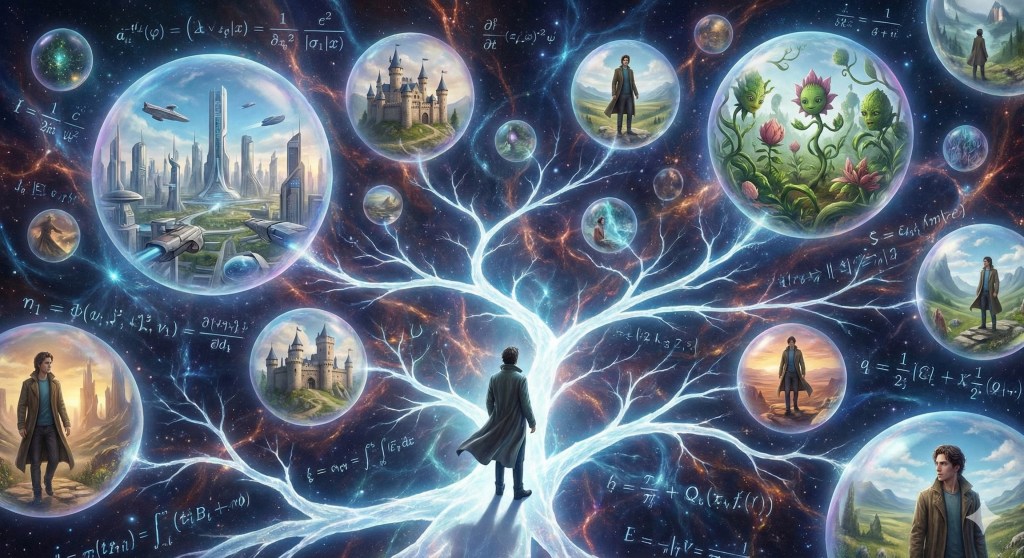
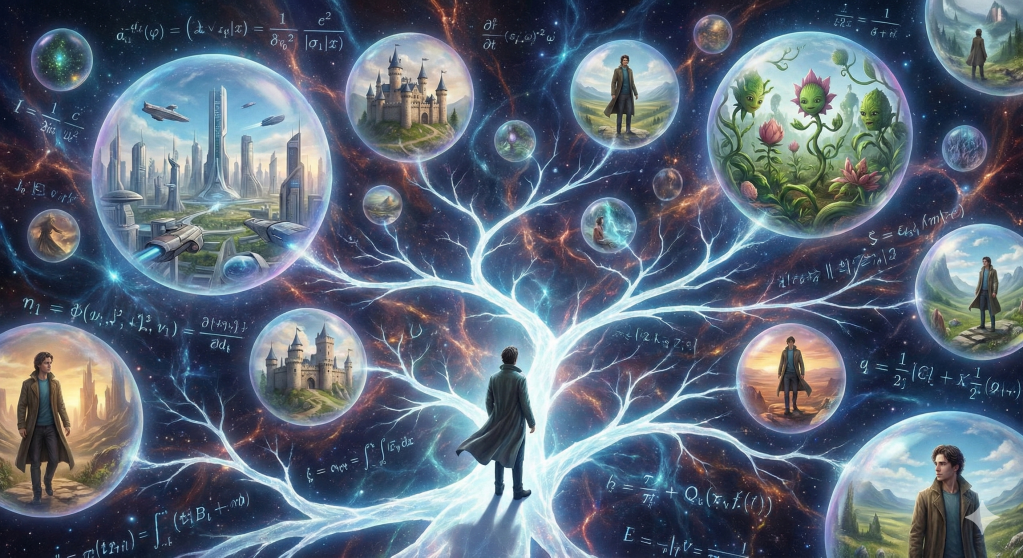
The Many-Worlds Interpretation, when integrated with the eschatology of Surah Qaf, reveals a universe of profound symmetry and terrifyingly perfect justice. It suggests that our reality is not a singular, fragile thread that could be snapped by a single “wrong” quantum measurement, but a majestic, unfolding tree of existence where every potentiality is honored.
The “New Creation” mentioned in verse 15 is the constant breathing of the universal wavefunction—the continuous divine act of manifesting every possibility inherent in the “first creation.” In this framework, the “Recording Angels” are not external scribes with parchment and ink, but the very laws of decoherence and information persistence that ensure no action, no word, and not even a “whisper” of the heart is ever erased. They are the “Watchers” and the “Ready Records” built into the architecture of spacetime, turning the universe itself into a “Guarded Tablet.”
The “Stupor of Death” and the “Blowing of the Trumpet” represent the transition from the “thin” perception of a single branch to the “piercing” sight of the full quantum reality. This is the moment of the Kashf al-Ghita—the lifting of the veil of locality—where the soul finally perceives its “Relative State” in the context of the whole.
Divine Justice, therefore, is not an external imposition but a mathematical “balancing of the books” across the multiverse. It is the assurance that no suffering goes uncompensated and no evil goes unaddressed, because every branch of reality is a real world where justice must be fulfilled. The “Book” that is opened is the universal wavefunction itself, a record so exhaustive that “no secret shall be hidden.”
Ultimately, this synthesis suggests that we live in a “miraculous” creation designed for accountability. Our “sharp sight” on the Day of Resurrection will not only be a sight of our own deeds, but a sight of the infinite Mercy of a Creator who is “closer than the jugular vein”—the One who encompasses all worlds and ensures that in the final convergence of the “Omega Point,” every soul finds its ultimate place in the Truth. Through the lens of Many-Worlds, the eschatology of Surah Qaf becomes a vision of a cosmos that is not only mathematically beautiful but morally perfect, a “New Creation” where every choice counts, and every history ends in the presence of the Eternal.



 The Glorious Quran and Science
Leave a comment