
Presented by Zia H Shah MD
The Donkey Carrying Books and Intellectual Stagnation
Audio teaser:
Abstract
The following report provides an exhaustive theological and philosophical investigation into the metaphor presented in the Glorious Quran, Surah Al-Jumu’ah (62:5), which likens those entrusted with divine scripture but who fail to uphold it to a donkey carrying weighty volumes (asfar). While the verse specifically addresses the historical context of the Israelite community in Medina, this analysis extends the critique to a universal archetype of intellectual and spiritual stagnation. It examines the “mistakes of the Jews” as a template for legalistic fossilization, wherein the “spirit” of the Law is sacrificed for its “minutiae,” a phenomenon that persists in various contemporary religious expressions. The report devotes significant attention to the Christian experience, characterizing the historical progression of the Ecumenical Councils—from Nicaea to Chalcedon—as the construction of a “dogmatic burden” that replaced the primal monotheistic fitrah with complex metaphysical formulas concerning the Trinity and the dual nature of Jesus Christ. Furthermore, the analysis confronts the contemporary crisis in Muslim scholarship, where the inability to read the Quran “afresh” for a scientifically advanced age has left many scholars in an apologetic posture, tethered to the “baggage” of medieval interpretations. By synthesizing historical exegesis, Rabbinic motifs, Christian dogmatics, and the history of Islamic science, the report argues for a return to the state of the “unlettered” (ummi)—not as a lack of knowledge, but as a “blank slate” for the direct, transformative reception of divine signs.
The Ontological Weight of Revelation: An Exegetical Foundation
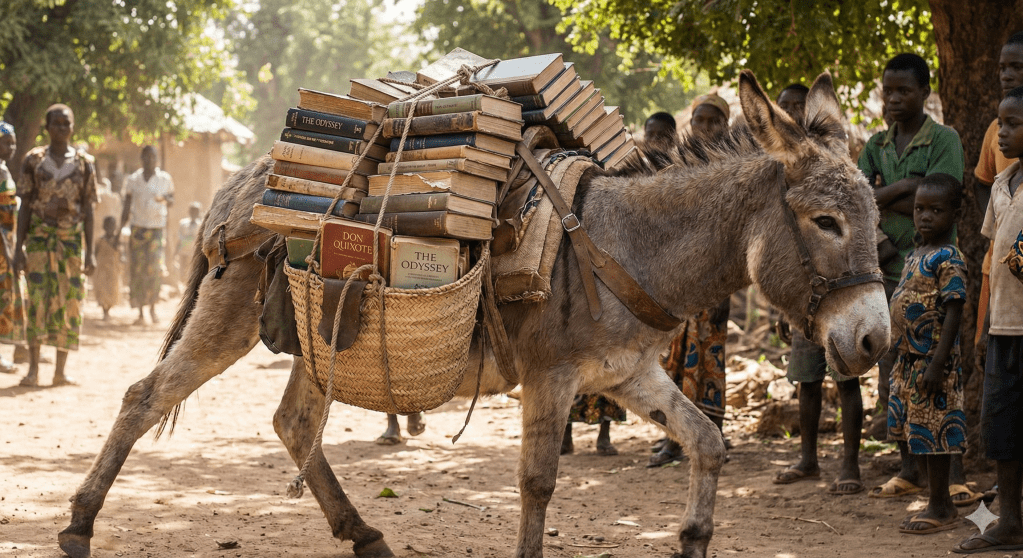
The Quranic verse 62:5 offers a scathing parable (mathal) designed to expose the disconnect between the possession of sacred knowledge and its internal transformation. The text states: “The example of those who were entrusted with the Torah and then did not take it on is like that of a donkey who carries volumes [of books]. Wretched is the example of the people who deny the signs of Allah”. To fully grasp the philosophical implications of this image, one must dissect the semantic layers of the Arabic terminology employed.
The term asfar (the plural of sifr) refers specifically to large, dense, and significant volumes of literature, often associated with scholarly tomes. Unlike the word kitab (book), which can refer to a simple writing or a revelation, sifr implies a work that is meant to be studied, unraveled, and implemented. The verb hummilu (were made to carry/entrusted) suggests a divine burden of responsibility, a covenantal weight placed upon a community to serve as the living embodiment of God’s will on earth. The failure noted—thumma lam yahmiluha (then they did not carry it)—does not imply a physical loss of the book, but a failure to “shoulder” its moral and spiritual implications.
Philosophically, this represents a rupture in the transmission of meaning. The “donkey” represents the human faculty of memory and physical preservation without the corresponding faculty of understanding or aql. The donkey feels the physical “heavy load” of the books, but its interior life remains untouched by the wisdom within the ink. This state of being represents a “practical ignoramus”—one who holds the keys to enlightenment but remains in darkness because the “books” have become mere cargo rather than a roadmap for the soul.
The Mechanism of Entrustment and Failure
The verse suggests that the “burden” of scripture is not inherently negative; rather, it is the “failed carrying” that turns the blessing into a weight. The Quran frequently links the receiving of scripture to the potential for human excellence and social justice. However, when the recipients allow “rivalry” and “selfish desires” (baghy) to interfere, the scripture becomes a source of division rather than unity. This baghy (transgression/arrogance) is identified as the primary reason why humanity, which was once a “single nation” in truth, diverged into conflicting sects.
| Term | Linguistic Origin | Theological Implication |
| Asfār (أَسْفَار) | Plural of Sifr (large book). | The density of information; the “weight” of scholarship and tradition. |
| Hummilū (حُمِّلُوا) | From Hamala (to carry/burden). | The passive entrustment of divine responsibility; a covenantal load. |
| Himār (حِمَار) | Donkey/Ass. | The archetype of the beast of burden that lacks intellectual participation. |
| Zulm (ظُلْم) | Wrongdoing/Oppression. | Displacing the revelation from its rightful station; misusing the Book. |
The “wretchedness” (bi’sa) of the example lies in the fact that those who “deny the signs of Allah” (kadhabu bi-ayati Allah) are not necessarily those who reject the Book’s existence, but those who reject its application. In this sense, the scholar who uses the Torah for “material gains and to seek position” while ignoring its ethical demands is precisely the “donkey” described.
The Israelite Template: From Covenantal Light to Legalistic Burden
The immediate context of 62:5 addresses the Jewish tribes of Medina, such as the Banu Nadir and Banu Qaynuqa, who prided themselves on being the “allies of Allah” to the exclusion of others. The Quranic critique highlights a specific theological mistake: the transformation of the Torah from a living guide into a stagnant identity marker.
The Polemical Inversion of the Rabbinic Motif
Research indicates that the Quranic metaphor of the “donkey carrying books” is a sophisticated response to an existing Rabbinic idea found in the Sifrei Debarim, a Midrashic compilation from the 3rd to 5th centuries. In the Rabbinic motif, the metaphor of an “ass” was used in a neutral or even positive light. A man sends his ass and his dog to a granary; the dog (analogized to the gentiles) strains under the load and casts it aside, while the ass (analogized to Israel) faithfully accepts the weight of the grain.
In the Rabbinic view, the “burden” represents the “minutiae” and “commentaries” of the Law—the complex web of Rabbinic rulings and traditions (Mishnah and Gemara) that Israelites took upon themselves. The Quran takes this existing cultural metaphor and “polemically inverts” it. It argues that carrying the “minutiae” (the books) without “carrying” the spirit of the Law (the truth) is not a virtue but a sign of spiritual failure. By the time of the Prophet Muhammad, the focus on “huge tomes” of legalistic interpretation had blinded the Medinan Jews to the very signs of the Prophet’s arrival that their own Torah contained.
The Stagnation of “Friends of Allah”
The Quran challenges the Jewish claim to exclusivity by daring them to “wish for death” if they are truly God’s favorites. This “ultimate dare” exposes the psychological reality of the “burdened” soul: one who carries the asfar of tradition as a cultural shield often fears the actual encounter with the Divine because their “hands have sent forth” actions that contradict the knowledge they carry.
The “mistake” of the Jews, therefore, was not a lack of literacy, but a “degenerative priesthood” and an institutional focus on “materialism” over the “signs” (ayat). They acted as “practical ignoramuses” who read the letter but did not abide by the meanings. This template of error—prioritizing the “human-made” additions (the volumes of Rabbinic debate) over the “clear signs” of God—serves as a warning for all subsequent communities of faith.
The Christian Burden: The Architecture of Ecumenical Dogma
While the primary verse mentions the Torah, the principle applies with chilling accuracy to the history of Christendom, particularly the centuries of Ecumenical Councils that fundamentally altered the “simple” monotheistic message of Jesus. The transition from the Apostolic era to the era of Imperial Dogma can be described as the construction of an increasingly heavy “tome” of philosophical definitions that many believers “carry” but few truly “understand” in light of the original fitrah (innate monotheism).
The Construction of the Trinitarian Load
The first seven Ecumenical Councils—from Nicaea I (325 CE) to Nicaea II (787 CE)—produced a “burden of dogma” through the establishment of binding theological laws and anathemas. These councils were not merely gatherings for fellowship but legislative bodies that declared specific metaphysical formulations as “infallible” and “solemn definitions”.
The “mistake” of the Christians, from a Quranic philosophical perspective, parallels that of the Jews: the replacement of a living relationship with the Divine with a preoccupation with “volumes” (asfar) of complex creeds. The Council of Nicaea introduced the term homoousios (of the same substance) to define the relationship between the Father and the Son, a term borrowed from Greek philosophy that created a permanent “metaphysical load” on the doctrine of God.
Table 1: The Dogmatic Burden of the Major Ecumenical Councils
| Council | Year | Primary “Tome” of Dogma | Philosophical “Load” |
| Nicaea I | 325 CE | Nicene Creed (Homoousios) | Defining God via Greek substance-metaphysics. |
| Constantinople I | 381 CE | Divinity of the Holy Spirit | Expansion of the Triad into a co-equal essence. |
| Ephesus | 431 CE | Theotokos (God-bearer) | Elevating Mary to a metaphysical role in the Godhead’s entry to Earth. |
| Chalcedon | 451 CE | Hypostatic Union (Two Natures) | Reconciling “Fully God and Fully Man” through logical paradox. |
The result of these centuries of councils was a “fixed, exclusive foundation for canon law” that often required anathemas (excommunications) to enforce. For the average Christian, the Trinity became a “mysterious” and “logic-stretching” formula—a set of “books” carried on the back of the faith that many found impossible to reconcile with the simplicity of Divine Unity (Tawhid).
The Conflict Between Complexity and Simplicity
A profound philosophical critique arises when comparing the “simplicity” of God with the “complexity” of Trinitarian dogma. Classical Christian theologians like Thomas Aquinas and Turretin argued for “Divine Simplicity”—the idea that God has no parts and is identical to His essence. However, the “burden” of the councils required them to also maintain the “real distinctions” of three persons. This created a situation where theologians had to develop “Scholastic metaphysics” of “real vs. logical distinctions” simply to carry the “weight” of the creed without collapsing into contradiction.
Many modern critics and atheist thinkers argue that this formula is an “after-the-fact theological invention” that “undermines the biblical stance of monotheism”. By turning the “One God of Israel” into a “Trinity of Persons,” the Church effectively loaded the believer with a “huge tome” of philosophical jargon (asfar) that the original followers of Jesus never carried. Like the donkey in the Quranic parable, the institutional Church “carries” these creeds through liturgy and law, but the “spirit” of primal monotheism is often buried under the weight of the councils.
The Muslim Crisis: The Baggage of Medievalism and the Modern Scientific Void
The application of 62:5 to the contemporary Muslim world is perhaps its most vital and self-critical extension. Muslim scholars today find themselves in an “unenviable position”: they possess the Quran, which commands the pursuit of knowledge (ilm) and the observation of the universe, yet they are often “burdened” by the “baggage” of past scholars who lived in a different epistemological era.
The “Freezing” of Islamic Thought
During the Islamic Golden Age (8th–14th centuries), scholars like Ibn al-Haytham (the father of optics), Al-Khwarizmi (algebra), and Ibn Sina (medicine) did not view their “books” as a stagnant weight. They treated the Quran as a catalyst for “observation, experimentation, and deduction”. However, starting around the 13th century, a “clerical faction” emerged that “froze this same science and withered its progress”.
The “mistake” that modern Muslim scholars repeat is the adoption of Taqlid (blind following) over Ijtihad (independent reasoning). They carry the “volumes” of medieval fiqh (jurisprudence) and kalam (theology) as if they were immutable divine laws, rather than human attempts to understand the Divine in a 10th-century context. This has led to a “block-headed behavior” where scholars recite the Quran’s calls for “reflection” while simultaneously rejecting the findings of modern physics or biology because they conflict with a “past era’s cultural norms”.
The Burden of Apologetics
Modern Muslim scholarship is frequently characterized by a “defensive apologetic” posture. Scholars feel they must “carry the baggage” of every past legal ruling—even those concerning outdated social structures like the execution of prisoners of war or authoritarian obedience—rather than reading the Quran “afresh”.
- Struggle with Modern Science: While many claim that “no verse in the Quran conflicts with science,” there is a deep-rooted “fear of modernity”. This leads to the “paradox” of celebrating scientific discoveries as “proofs of the Quran” (the ijaz movement) while marginalizing actual scientists, like the Nobel laureate Dr. Abdus Salam, because of theological sectarianism.
- Inability to Move Beyond the “Asfār”: Contemporary reformists note that the “glaring imbalance” between citations of medieval manuals and the actual Quran suggests that scholars are “unsure of what to do” with the Prophet’s teachings in a modern world. They are “burdened” by a “library of legal manuals” that act as a filter, preventing the “light” of the Quran from reaching the modern problems of gender equality, civil society, and democratic governance.
Table 2: The Shift from Living Knowledge to “Burdened” Traditionalism
| Category | Golden Age Approach (Carrier of Truth) | Modern Traditionalist Approach (Carrier of Baggage) |
| Methodology | Empirical, experimental, and quantitative. | Absolute submission to older interpretations. |
| Role of Ijtihad | Dynamic and creative interpretation. | Strict Taqlid; rejection of “corrupt foreign thought”. |
| View of Science | A way to “gain knowledge of God’s creation”. | A “threat to faith” or merely a source of “apologetic proofs”. |
| Intellectual Freedom | Interaction with Greek, Persian, and Indian ideas. | Censorship, imprisonment, and discouragement of questioning. |
The “donkey” in this context is the scholar who can recite the entire Quran and the Hadith collections—carrying the “huge burdens of books”—but who cannot apply a single verse to a contemporary ethical or scientific crisis without checking what a 12th-century jurist said first. They have “muslim names” but “fail to live up to what Islam requires” in an age that demands intellectual courage and fresh vision.
Philosophical Synthesis: The Epistemology of the “Blank Slate”
The Quranic verse 62:2 provides the antidote to the “donkey with books” state by describing the Prophet as being raised from among the Ummiyyun (the unlettered ones). Philosophically, the “unlettered” state is not an endorsement of illiteracy, but a celebration of the “blank slate”—a mind that is not “cluttered” or “burdened” by human-made dogmas, philosophical “load,” or sectarian “baggage”.
Knowledge as Transformation vs. Knowledge as Cargo
The “donkey” represents the objectification of knowledge. In this state, the Torah or the Quran is a “thing” to be possessed, defended, and “carried.” However, the Quranic ideal is knowledge as transformation (tazkiyah). The Prophet’s mission was to “recite the signs,” “purify them,” and “teach them the Book and Wisdom”. If the “carrying” of the book does not lead to “purification” and “wisdom,” then the human being has devolved into the state of the “beast of burden”.
This critique hits at the heart of the “mistakes of the past.” The Jewish focus on “minutiae” and the Christian focus on “Ecumenical definitions” were both attempts to “fix” the Truth into a “tome” that could be controlled. In doing so, they created a “burden” that the original monotheistic fitrah (natural disposition) found difficult to endure. The modern Muslim scholar who “needs to apologize” for the past is similarly “burdened” by the human-made “volumes” that have accumulated around the divine text.
The Solution: Returning to Pure Revelation
The philosophical solution proposed by the “deeper meanings” of 62:5 is a “return to pure revelation”. This requires:
- The Deconstruction of Human-Made Dogma: Recognizing that the “huge tomes” of Scholasticism and medieval fiqh are not the Revelation itself, but the “baggage” of history.
- A “Fresh Reading” for Modern Times: Using the “scientific method” and “rational inquiry” to engage with the Quran’s “signs” in the cosmos, rather than relying on 10th-century cosmologies.
- The Elevation of Spirit over Letter: Moving past the “minutiae” that divide humanity and returning to the “single nation” of truth that the prophets originally delivered.
Thematic Epilogue: The Liberation from the Burden
The parable of the “donkey carrying books” is perhaps the most enduring warning against religious and intellectual fossilization. It reminds us that the “weight” of tradition is no substitute for the “light” of understanding.
To the Jew, the verse is a reminder that the Torah is a “living sign,” not a legalistic burden. To the Christian, it is a call to unburden the faith from the “Ecumenical architecture” of the middle centuries and return to the simple, monotheistic walk of Jesus. To the Muslim scholar, it is a demand for “Ijtihad”—the courage to set down the “baggage” of the medieval scholars and read the Quran as if it were being revealed today, in an era of quantum mechanics, space exploration, and global human rights.
The “donkey” is the one who “carries” but does not “know.” The “human being” is the one who “reads” and is “transformed.” The ultimate “wrongdoing” (zulm) is to treat the Book of God as a physical weight that keeps one tethered to the past, rather than as a divine wing that allows one to soar into the future. If we do not learn to read the “signs” afresh, we remain merely “burdened beasts,” oblivious to the transformative fire contained within the “volumes” we so proudly carry. The Quran is not a load to be endured; it is a life to be lived. One who treats it as a burden will never feel its lift; but one who treats it as a light will find that it carries them long after the “books” of men have turned to dust.
 The Glorious Quran and Science
Leave a comment