
Epigraph
مَّا خَلْقُكُمْ وَلَا بَعْثُكُمْ إِلَّا كَنَفْسٍ وَاحِدَةٍ ۗ إِنَّ اللَّهَ سَمِيعٌ بَصِيرٌ
Your creation and your resurrection are only like the creation and resurrection of a single soul. Verily Allah is All-Hearing, All-Seeing. (Al Quran 31:28)
Presented by Zia H Shah MD
The Convergence of the One: DNA and Physics Refute the Trinity
The intellectual trajectory of human civilization has been marked by an unceasing quest to identify the fundamental principles governing the cosmos. In the theological sphere, this quest has historically oscillated between the radical monism of Islamic Tawhid and the triadic complexity of the Christian Trinity. While the latter posits a relational plurality within a singular essence—a Godhead consisting of three distinct persons—the former asserts an absolute, indivisible, and non-compositional Unity. This report argues that the structural reality of the universe, as unveiled by the most advanced frontiers of molecular biology and theoretical physics, increasingly aligns with the Quranic paradigm of Tawhid while systematically undermining the Trinitarian model. Through an exhaustive examination of Quran 13:15-16 and 31:10-11, this analysis demonstrates that the “signs on the horizons” are not merely neutral observations of nature but are profound theological indicators of a singular Creator.
The biological record reveals a “Biochemical Singularity”—the existence of a Last Universal Common Ancestor (LUCA) and a singular, “frozen” genetic code that governs all life, refuting the expectation of triadic biological foundations. Similarly, the physical sciences are converging upon a “Physical Singularity,” where the quest for a Unified Field Theory suggests that the seemingly distinct forces of the universe are merely low-energy manifestations of a single, primordial interaction. By synthesizing these scientific realities with the philosophical principles of divine simplicity and the “Burhan al-Tamanu” (argument from mutual hindrance), this report constructs a comprehensive rebuttal of the Trinity. The universe does not speak in three voices; it speaks in one, reflecting the absolute sovereignty of Al-Wahid al-Qahhar, the One, the Prevailing.
I. Exegetical Commentary on Quran 13:15-16: The Law of Universal Submission
The thirteenth chapter of the Quran, Ar-Ra’d (The Thunder), provides a foundational framework for understanding the ontological status of the creation in relation to the Creator. Verse 15 declares: “And to Allah prostrates whoever is within the heavens and the earth, willingly or by compulsion, and their shadows [as well] in the mornings and the afternoons”. This verse establishes the doctrine of universal submission, asserting that every entity in existence, from the celestial bodies to the most minute shadows, is inherently subservient to the divine will.
Islamic exegesis, particularly the Tafsir of Ibn Kathir and the insights of Ma’arif al-Quran, distinguishes between two modes of this submission (Sajda). The “willing” submission is the hallmark of the believer, whose intellect and heart recognize the signs of the Creator and respond in voluntary worship. Conversely, “unwilling” or compulsory submission refers to the inescapable adherence to the physical and biological laws ordained by Allah. A disbeliever may verbally deny the oneness of God, yet their heart must beat, their cells must replicate, and their very existence must follow the dictates of the laws of physics—laws they did not create and cannot circumvent. This compulsory submission is the primary refutation of any theology that posits a divided or relational godhead. If the laws governing the body were distinct from the laws governing the spirit, or if different “persons” within a trinity controlled different aspects of existence, the resulting ontological friction would manifest as chaos. Instead, the universe exhibits a seamless consistency, where the shadow follows the light in a “prostration” that is as predictable as the movement of the stars.
The mention of “shadows” in 13:15 serves as a profound metaphor for the dependency of the created order. A shadow has no independent existence; it is a derivative phenomenon that exists only in relation to a light source and an object. Its submission “in the mornings and the afternoons” signifies its total subjection to a singular geometric and temporal order. If the universe were the product of three distinct wills, one might expect the behavior of light and shadow to exhibit variations or inconsistencies depending on which divine person’s “jurisdiction” was being exercised. Yet, the physics of optics is universal, reflecting the “Mighty Strength” (Shadid al-Mihal) of a single Legislator.
Verse 16 of Surah Ar-Ra’d advances this argument by posing a direct rhetorical challenge: “Say, ‘Who is the Lord of the heavens and the earth?’ Say, ‘Allah’”. It then interrogates the logic of taking “protectors” (awliya) besides Him—entities that “do not possess for themselves any benefit or any harm”. In the context of Trinitarianism, this verse critiques the elevation of Jesus or the Holy Spirit to the level of divinity. From an Islamic philosophical perspective, any being that is dependent—such as a human messenger who requires food and sleep—cannot be an equal partner in the godhead. The verse utilizes the parables of the “blind and the seeing” and “darkness and light” to illustrate the categorical difference between the Truth of Tawhid and the confusion of plurality. The definitive conclusion of the verse, “Allah is the Creator of all things, and He is the One, the Prevailing,” establishes that creation is a singular act of a singular will, leaving no room for a triadic division of labor in the governance of the universe.
II. Exegetical Commentary on Quran 31:10-11: The Pillars of Cosmic Stability
Surah Luqman (31:10-11) shifts the focus from the submission of the creation to the structural integrity of the cosmos as a proof of divine unity. The verse states: “He created the heavens without any pillars that you see and has cast into the earth firmly set mountains, lest it should shift with you, and dispersed therein from every creature”. The observation that the heavens are raised “without pillars that you see” has been interpreted by both classical and modern commentators as a reference to the invisible forces of gravity and celestial mechanics that sustain the universe. These “invisible pillars” are the fundamental laws of nature that provide stability without the need for physical supports.
The theological implication is that these laws are unified and consistent. If the “pillar” of gravity were the work of one divine person and the “pillar” of electromagnetism the work of another, the universe would lack the “firmness” and “stability” described in the verse. The “Burhan al-Tamanu” (argument from mutual hindrance) suggests that if multiple deities existed, their potentially conflicting wills would lead to the disintegration of the cosmic order. The fact that the heavens do not “shake” or “reel” with us is the ultimate empirical evidence for a singular, coordinating Will.
Verse 11 issues a specific challenge that is central to the refutation of the Trinity: “This is the creation of Allah. So, show Me that which those besides Him have created”. This challenge demands a “creation parity” that the Trinitarian model cannot provide. If the Son and the Holy Spirit are co-eternal and co-substantial creators, where is the distinct signature of their creative activity? What we find in nature is not a triadic diversity of origins but a singular “Standard Model” of both biology and physics. The verse characterizes those who associate partners with Allah as being in “plain error,” specifically because they fail to produce any evidence of a secondary or tertiary creative source.
III. The Biological Singularity: Refuting the Trinity through LUCA and DNA
The most profound scientific confirmation of the Quranic insistence on a singular creator comes from the field of molecular biology, specifically regarding the origin of life and the universal code that governs it. The Trinitarian paradigm, which posits a relational plurality as the ultimate ground of reality, might lead one to expect a corresponding plurality in the foundational building blocks of life. However, the biological record presents a “Singularity” that is categorically incompatible with triadic foundations.
The Last Universal Common Ancestor (LUCA)
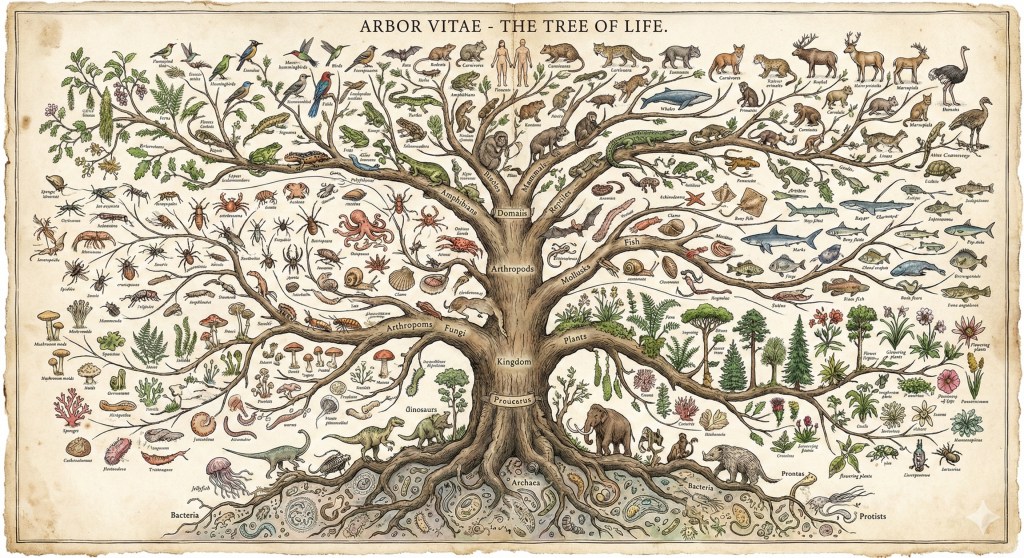
All known life forms on Earth—ranging from the most primitive bacteria to the complex multicellular organisms that constitute the human species—trace their lineage back to a single population of organisms known as the Last Universal Common Ancestor (LUCA). Most studies suggest that LUCA existed between 3.5 and 4.3 billion years ago, appearing in the harsh geochemical settings of early Earth, likely near anaerobic hydrothermal vents.
The existence of LUCA is not a mere hypothesis; it is a conclusion driven by the “detailed biochemical similarity” of all current life across the three domains: Bacteria, Archaea, and Eukarya.
| Biochemical Feature | Universal Presence across Life Domains | Theological Implication |
| Genetic Material | Double-stranded DNA | Singular blueprint, not three. |
| Protein Synthesis | Ribosomes and tRNA-mediated translation | One “factory” design for all life. |
| Amino Acid Set | Standard set of 20 amino acids | A single “alphabet” of creation. |
| Energy Metabolism | Chemiosmosis and ATP production | One “power source” mechanism. |
| Chirality | Left-handed amino acids/Right-handed nucleic acids | Uniform “handedness” throughout nature. |
Source:
If the Creator were a Trinity, and if “God is fundamentally relational” as Trinitarians claim, why would the physical expression of that “relationality” result in a strictly monogenetic biological tree?. Evolutionary theory predicts that if life were to emerge multiple times independently (abiogenesis), we would find multiple phylogenetic trees with distinct genetic codes and metabolic pathways. Yet, statistical tests strongly favor a “universal common ancestry” over any multi-ancestor model. The “355 protein clusters” identified as common to LUCA represent a primordial “Signature of the One,” establishing a unified metabolic and genetic foundation before the diversification of life began.
The fact that LUCA was already a “sophisticated organism” with a complex cellular structure and a universal organelle (the acidocalcisome) suggests that life did not emerge as a “crude assemblage” but as a fully realized, integrated system from its inception. This “complexity at the root” aligns with the Quranic description of Allah “dispersing all kinds of beasts” from a singular creative act. The “Tree of Life” does not have three trunks; it has one, and that trunk is rooted in a single, divine decree.
The Singular Code: Why DNA Refutes the Trinity
The user’s query highlights the specific argument that there is only “one type of code of life in DNA rather than three.” This is a biological reality of immense theological weight. The Genetic Code—the set of rules by which information encoded within genetic material is translated into proteins—is virtually identical across all known species. This code consists of 64 codons (triplets of the nucleotides A, T, G, and C) that map to 20 amino acids plus “stop” signals.
Despite billions of years of evolution and the astronomical number of possible alternative codes (estimated at $10^{84}$), 99% of life maintains the same identical mapping. This phenomenon is described as the “Frozen Accident” hypothesis: once the code was established in the common ancestor, any change would have been lethal, effectively “freezing” the code for all time.
From a Trinitarian perspective, this “frozen” unity is problematic. If the Godhead is three persons, and if those persons are “distinct yet inseparable,” one might expect that the most fundamental code of life would reflect this triadic structure—perhaps through three distinct coding schemes for the three domains of life (Bacteria, Archaea, and Eukarya). Instead, we find that a mouse uses the same code as a tree, a mushroom, and a human being.
Furthermore, the “Reflexivity” of the translation system—the fact that the enzymes which load amino acids onto tRNAs (synthetases) are themselves encoded by the very system they govern—points to an irreducible unity.
| Aspect of the Genetic Code | Unitary Observation | Comparison to Trinitarian Model |
| Alphabet | 4 Bases (A,T,G,C) | Not 3, nor 3 sets of 3. |
| Structure | Double Helix (2 strands) | Not a “Triple Helix” foundation. |
| Logic | Triplet Codons (64 combinations) | One logic for all domains of life. |
| Conservation | ~99% identical across taxa | Total uniformity, not triadic variety. |
| Translation | One universal mechanism (Ribosome) | One “voice” to translate the code. |
Source:
The argument that “God is one being and three persons” fails to find a parallel in the DNA code. In DNA, “being” (the chemical structure) and “personhood” (the informational message) are inseparable and unitary. There are not “three centers of consciousness” within the genetic code; there is only one coherent set of instructions that creates the diversity of life. The “near universality” of the code is the strongest evidence linking all life forms to a single source, and it serves as a biological “Burhan” (proof) for the Tawhid of the Creator.
IV. The Physical Singularity: Unified Field Theory and the Rejection of Plurality
The second pillar of the scientific refutation of the Trinity lies in the field of theoretical physics, specifically the ongoing search for a “Unified Field Theory.” The query emphasizes “one quantum physics explaining all of reality rather than three.” This reflects a fundamental drive in physics to reduce the plurality of forces to a single, primordial unity—a pursuit that mirrors the Islamic theological drive to reduce all plurality to Al-Asl al-Qadim (the Ancient Origin).
The Quest for Grand Unification (GUT)
In the standard model of particle physics, there are currently four fundamental forces: gravity, electromagnetism, the strong nuclear force, and the weak nuclear force. For decades, Trinitarian thinkers have attempted to use the “three quantum forces” (strong, weak, and electromagnetic) as a natural analogy for the Trinity, suggesting a relational world created by a relational God. However, this analogy is systematically dismantled by the discovery of “Unification.”
Grand Unified Theories (GUTs) are advanced mathematical frameworks which aim to show that at extremely high energies—such as those present at the very beginning of the universe (the Grand Unification Epoch)—the electromagnetic, weak, and strong forces were not distinct, but were merged into a “single force”.
- Electroweak Unification: In the 1960s, Glashow, Salam, and Weinberg demonstrated that at energies around 100 GeV, the electromagnetic force and the weak nuclear force unify into a single “Electroweak force”.
- Grand Unification Scale: GUT models predict that at even higher energies (around $10^{16}$ GeV), the strong force merges with the electroweak force into one “Electronuclear interaction,” characterized by a single coupling constant and a larger gauge symmetry (such as $SU(5)$ or $SO(10)$).
- Theory of Everything (TOE): The ultimate quest is to include gravity in this schema, leading to a “Theory of Everything” where all four forces are revealed as different manifestations of a “single unified force”.
The mathematical representation of this progression is:
$$SU(3)_C \times SU(2)_L \times U(1)_Y \longrightarrow SU(5) \text{ or } SO(10)$$
This progression from three distinct symmetry groups to a single, overarching group is a direct physical refutation of Trinitarian plurality. If the forces of the universe “share underlying similarities” and “converge” at their origin, it implies that plurality is a derived, “broken symmetry” state of an original, absolute Unity. The universe does not “indwell” as three; it “descends” from One.
Quantum Physics and the Informational Field
The argument for “one quantum physics” refers to the holistic nature of the quantum wavefunction ($\Psi$). In many interpretations of quantum mechanics, the entire universe is described by a single, universal wavefunction that evolves according to a single set of equations.
Trinitarians often cite “quantum holism” (entanglement) as an analogy for perichoresis (mutual indwelling), arguing that because particles can be “distinct yet inseparable,” so too can the persons of the Trinity. However, this analogy is fundamentally flawed because quantum holism is an expression of Singularity, not Plurality. In an entangled system, there are no longer “three” independent states; there is only one “state vector” that describes the entire system.
Moreover, theories such as “Unified Informational Field Theory” (UIFT) propose that consciousness and matter arise from the same fundamental “informational field” or substrate. Mathematically, this is expressed as a modified field equation:
$$\nabla^2\psi – \frac{1}{c^2} \frac{\partial^2\psi}{\partial t^2} = \alpha_c\Phi_C$$
where $\psi$ (the physical wavefunction) and $\Phi_C$ (the informational potential) are linked by a singular coupling constant ($\alpha_c$). This model leaves no room for a “tri-personal” godhead. If reality emerges from a single informational field, it reflects a single, supreme Intelligence—Al-‘Alim (the All-Knowing)—not three distinct “centers of consciousness” as suggested by Trinitarian philosophers.
| Force/Field Type | Level of Unification | Theological Significance |
| Electroweak | EM and Weak Forces | Plurality disappears at high energy. |
| GUT (Electronuclear) | Strong, Weak, EM merged | Evidence of a singular “Grand Epoch.” |
| Theory of Everything | All 4 Forces (including Gravity) | Ultimate physical “Tawhid.” |
| Quantum Wavefunction | Universal $\Psi$ describing all reality | Indivisibility of the physical order. |
| Net Energy | Total energy of universe is zero | Universe as a “word” from nothing. |
Source:
The “net energy of the universe is zero” theory provides a final scientific bridge to the Quranic “Be, and it is” (Kun fa-yakun). If the positive energy of matter is exactly balanced by the negative energy of gravity, the universe essentially “costs” nothing to create—it is a manifestation of a divine decree that brings something out of nothing. A “relational” Trinity would imply a complex, internal dynamic of “needs” and “responses” within the Godhead. A “Zero-Energy” universe, however, reflects the absolute independence (Aseity) and sovereignty of a single Creator who merely “says so, and it becomes”.
V. Philosophical Rebuttals to Trinitarian Plurality
Islamic philosophical criticism, developed by figures such as Al-Kindi and Ibn Taymiyya, provides the logical scaffolding for refuting the Trinity based on the principle of Divine Simplicity (Basata). These arguments demonstrate that the Trinity is not merely a “mystery” beyond reason, but a “contradiction” against reason.
The Argument from Composition and Causation
The philosopher Al-Kindi (d. 870 CE) argued that the Trinitarian doctrine asserts the existence of three divine individuals, each composed of the “divine essence” plus a “distinctive characteristic” (e.g., Fatherhood or Sonship).
Al-Kindi’s logical chain is as follows:
- Everything that is “composed” of parts requires a “composer” or a cause to unite those parts.
- Whatever is caused or dependent upon a composition cannot be “Eternal” (Qadim) or “Necessary” (Wajib al-Wujud) in its own right.
- If the Persons of the Trinity are composed of essence and personal properties, they are caused.
- Therefore, they cannot be eternal, which contradicts the definition of God.
This philosophical argument finds a direct parallel in modern physics. If the fundamental forces were “distinct” in their essence (a “Trinity of Forces”), they would require a higher-order mechanism to coordinate their interaction. The fact that they “unify” into a single gauge symmetry ($SU(5)$) proves that the “composition” we see at low energies is an illusion, and the ultimate reality is a “Simple” and “Uncaused” Unity.
The Arbitrariness of the Number Three
Muslim critics have long argued that the Trinitarian selection of “three” persons is arbitrary. If the Persons are identified with God’s attributes (such as Life, Knowledge, and Power), why stop at three?. God possesses an infinity of attributes (the 99 Names of Allah). To arbitrarily select three and elevate them to the status of “Persons” is a theological move that lacks both scriptural and logical consistency.
In the natural world, the number three is conspicuously absent as a fundamental organizational principle for “origins.”
- Life has one origin (LUCA), not three.
- DNA has one code, not three.
- The universe has one net energy (zero), not three.
- The fundamental forces converge into one, not three.
The Trinitarian claim that “God is one essence in three persons” is a category error. As Ron Rhodes admits, Trinitarianism distinguishes between “what” God is (essence) and “who” God is (person). But Islamic philosophy argues that in the Necessary Being, the “Who” and the “What” are identical. To divide them is to imply that God is a “substance with accidents”—a metaphysical impossibility for an absolute Unity.
Burhan al-Tamanu (The Argument from Mutual Hindrance)
The “Burhan al-Tamanu,” based on Quran 21:22 (“If there had been multiple gods… they would surely go to ruin”), is a syllogistic argument against multiplicity in the efficient cause of the universe.
The logic holds that:
- If there were two or more independent wills, they could potentially disagree.
- If one will wanted an object to move and the other wanted it to stay still, either both wills would be frustrated (meaning neither is all-powerful) or one would override the other (meaning the overridden one is not a god).
- Even if they “always agreed” (as Trinitarians claim the persons do), this agreement would be a “compulsion” or a “necessity,” which contradicts the absolute freedom of the divine will.
Modern physics confirms this lack of “mutual hindrance.” The consistency of physical constants—such as the speed of light ($c$) or Planck’s constant ($h$)—across the entire observable universe proves that a single, unified decree governs all matter and energy. If the “Son” controlled the weak force and the “Father” the strong force, the stability of the atom would depend on a perpetual “negotiation” between persons. The “Singularity” of the Unified Field Theory proves that there is only one “Controller” (Al-Mudabbir).
VI. The Failed Analogies of Trinitarianism
Trinitarian apologists often resort to scientific and mathematical analogies to explain the “three-in-one” concept. However, when examined through the rigorous lens of professional science and theology, these analogies collapse.
The Analogy of Light (Wave-Particle Duality)
Some theologians argue that just as light is “both a wave and a particle,” God can be “both one and three”. This analogy is scientifically inaccurate. Wave-particle duality (complimentarity) is not about “one thing being two things at once”; it is about a single quantum entity (a photon) exhibiting different behaviors depending on how it is measured. This is an analogy for “Manifestation” (Tajalli), which is an Islamic concept, not “Personhood.” In Islam, Allah manifests Himself through His names, but those names are not “distinct persons” with their own centers of consciousness.
The Analogy of Water ($H_2O$)
The common analogy that water can exist as “ice, liquid, and steam” (Modalism) is actually considered a heresy in orthodox Trinitarianism because it implies that the persons are merely “modes” of God rather than distinct persons. If the Father “becomes” the Son, they are not co-eternal and co-existent. If they are co-existent, they must be three separate “entities,” which is Tritheism—a charge the Quran explicitly levels against Trinitarians (“Say not, ‘Three’… Allah is but one God”).
The “One Being, Three Persons” Distinction
The core of the Trinitarian defense is the distinction between “being” and “personhood”. This is often explained by saying, “I am one being (human) but I could be multiple persons if I had multiple personalities.” However, theologically, a “Person” is defined as a “center of consciousness”. If God has three centers of consciousness, and if one center (the Father) knows something that another center (the Son) does not know—such as the “Hour” of the Day of Judgment (Matthew 24:36)—then they are “physically separate and unique entities”.
The biological record of LUCA and the DNA code shows no such “centers of consciousness.” The “355 genes” of LUCA and the “64 codons” of the DNA table act as a singular, unified “Mind” or “Program”. There is no evidence of “internal dialogue” or “relationality” within the fundamental code of life. It is a monologue of the Creator.
VII. Synthesis: The Testimony of the Signs
The “signs” (Ayat) mentioned in Quran 13:15-16 and 31:10-11 provide a roadmap for the scientific and philosophical refutation of the Trinity. When the Quran challenges the polytheists to “show Me what those besides Him have created,” it is a call to examine the Signature of Unity in the natural world.
| Level of Reality | The Trinitarian “Plurality” Claim | The Scientific/Quranic “Unity” Reality |
| Origin of Life | Relationality requires multiple roots or diverse types. | LUCA: All life descends from one anaerobic population. |
| Code of Life | Complex Godhead might produce multiple coding schemes. | Universal DNA Code: One language for all domains of life. |
| Cosmic Forces | Three forces (Strong, Weak, EM) as a triadic analogy. | GUTs: All forces unify into one at high energy. |
| Cosmic Energy | Dependency between persons. | Net Energy = 0: Absolute independence of the Creator. |
| Cosmic Stability | Relational balance of three wills. | Invisible Pillars: One set of unified laws (Gravity/EM). |
Source:
The “Unwilling Submission” of the universe (13:15) is found in the Thermodynamic Imperatives. Evolution is not merely a biological process but a thermodynamic one—a “path-dependent process of least-time consumption of free energy”. This thermodynamic law is singular and universal. There is no “special” physics for life and “ordinary” physics for non-life; both follow the same “imperatives that force all systems toward stationary-state”. This holistic unity of nature—where the animate and inanimate are governed by the same single set of thermodynamic laws—is the ultimate philosophical refutation of a “divided” or “tri-personal” source.
The “Singularity of the Genetic Code” and the “Singularity of the Unified Field” are two sides of the same coin. They represent the “manifestly proven” truth that the Quran speaks of when it says that falsehood (plurality) is like “foam” that is “subdued and eliminated,” while the truth (oneness) “remains”.
VIII. Conclusion: The Finality of Tawhid
The comprehensive commentary on Quran 13:15-16 and 31:10-11, integrated with the findings of modern biology and physics, reveals a universe that is “Monistic” in its fundamental architecture. The Trinitarian doctrine, born of late antiquity councils (Nicaea 325 CE, Chalcedon 451 CE) and complex theological redefinitions, finds no support in the “primordial” facts of the cosmos.
- Biological Testimony: The fact that all 5 billion species on Earth share the same DNA code and the same 355-gene heritage from LUCA is a biological “Shahada” (testimony) of Oneness. If there were three creators, there would be three codes.
- Physical Testimony: The convergence of the strong, weak, and electromagnetic forces into a single $SU(5)$ or $SO(10)$ symmetry at high energy is a physical “Shahada.” If the origin were three, the forces would remain three.
- Philosophical Testimony: The “Burhan al-Tamanu” and the principle of “Divine Simplicity” demonstrate that any “composition” of persons within the Godhead would lead to the “ruin” of the cosmic order. The “invisible pillars” that sustain the heavens without shaking are the unified laws of a single Sovereign.
The Quranic message is clear: “Allah is the Creator of all things, and He is the One, the Prevailing” (13:16). This is not just a statement of faith; it is an observation of the “signs” that are now “manifestly proven” by the highest reaches of human science. The “shadows” that prostrate in the morning and afternoon are the very particles of the quantum field, following the “pilot wave” of a single Divine Will.
Thematic Epilogue: The Final Call to Unity
The journey through the exegesis of Ar-Ra’d and Luqman, paired with the revelations of molecular genetics and grand unified physics, leads to a singular destination: the absolute Oneness of Allah. We have seen that the “plurality” of the Trinitarian model is an “excess in religion” (4:171) that fails to find an echo in the foundational mechanisms of the universe. Where the Trinity posits a relational “Three,” the cosmos insists on a “Singularity.”
At the dawn of the 21st century, the “Biochemical Singularity” of LUCA and the “Physical Singularity” of the Unified Field stand as two magnificent “Pillars” of Tawhid. They remind us that the “shaking” of the earth and the “darkness” of misguidance are avoided only by adhering to the “Firm Anchor” of monotheism. The challenge of Quran 31:11 remains as potent today as it was fourteen centuries ago: “Now show Me what those [gods] other than Him have created.” In the face of a single genetic code and a single unified force, the Trinitarian answer is a silence that speaks volumes. The universe is a “Single Book” written by a “Single Author,” and its every page—from the double helix of DNA to the superstrings of the quantum field—proclaims: La ilaha illa Allah (There is no god but Allah).



 The Glorious Quran and Science
Leave a comment