
Presented by Zia H Shah MD
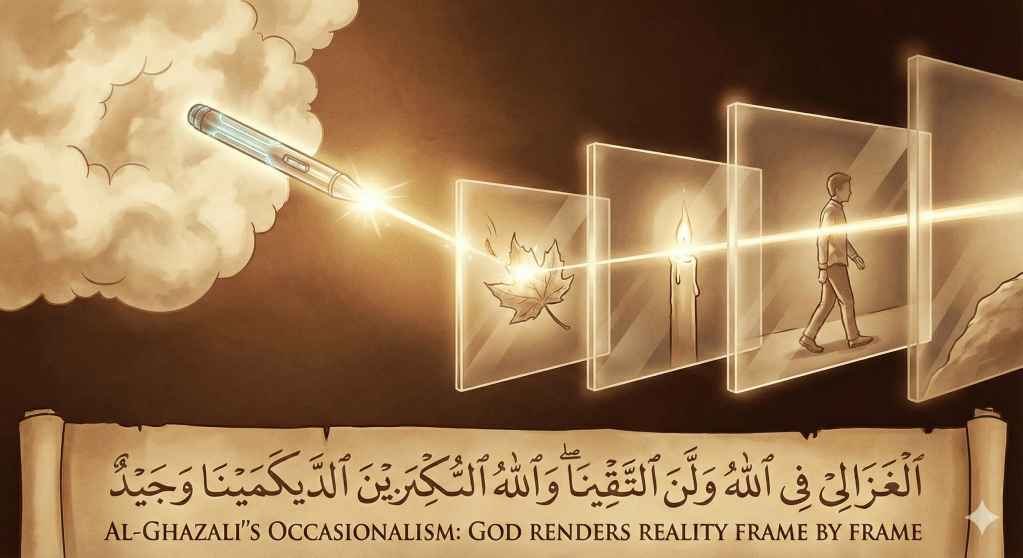
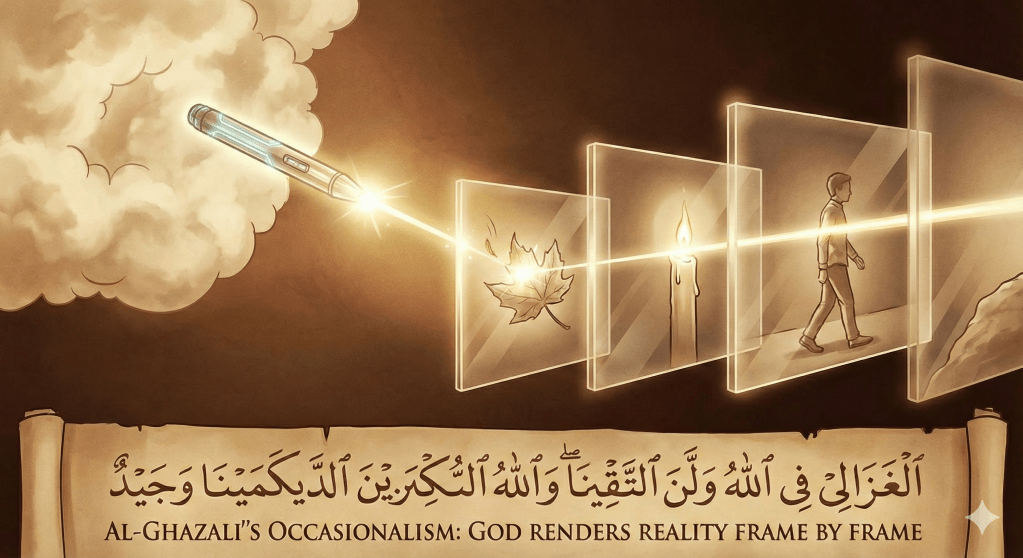
God Renders Reality Frame by Frame
Abstract
This report provides an exhaustive analysis of the occasionalist metaphysics of Abu Hamid al-Ghazali (1055–1111), contextualized within classical Islamic theology and contemporary scientific paradigms. Occasionalism, the doctrine that God is the sole immediate cause of every event in the universe, serves as the definitive Ash’arite response to the perceived determinism of Aristotelian philosophy. By re-evaluating the “laws of nature” as the habitual “customs” of the Divine Will (sunnat Allah), al-Ghazali preserves both the absolute omnipotence of God and the possibility of miracles. This study further explores the contemporary revival of occasionalist thought through the work of Dr. Zia H. Shah MD, who utilizes quantum mechanics, specifically quantum indeterminacy and entanglement, along with the simulation hypothesis, to provide a modern scientific vocabulary for this ancient theological stance. Central to this discourse is a detailed exegesis of nine pivotal Quranic verses (2:255, 8:17, 8:24, 13:28-29, 35:41, 50:16-18, 50:21, 81:29, and 100:10) which provide the scriptural foundation for a world utterly contingent on its Creator. The report concludes that occasionalism offers a superior explanatory model for the “Hard Problem of Consciousness,” the guidance of evolutionary processes, and the existential continuity of the cosmos, ultimately harmonizing the “Word of God” with the “Work of God” in a unified “Two Books” paradigm.
The Historical and Philosophical Genesis of Ghazalian Occasionalism
The intellectual landscape of the 11th-century Islamic world was defined by a profound tension between traditionalist theology (kalam) and the burgeoning tradition of Aristotelian and Neoplatonic philosophy (falsafa). Abu Hamid al-Ghazali emerged during this era as the “Proof of Islam,” a scholar tasked with reconciling these competing worldviews or, where reconciliation failed, establishing the primacy of revelation over speculative reason. Al-Ghazali’s education under the Ash’arite theologian al-Juwayni at the Nizāmiyya Madrasa in Nishapur provided him with the dialectical tools necessary to challenge the falasifa, most notably Avicenna (Ibn Sina), whose deterministic framework posited that the universe was a necessary emanation from God, governed by fixed, inherent causal powers.
The Critique of the Falasifa and the Seventeenth Discussion
In his landmark critique, The Incoherence of the Philosophers (Tahāfut al-falāsifa), al-Ghazali focused specifically on the nature of causality in the seventeenth discussion. The philosophers maintained that the connection between a cause and its effect is necessary—that a specific cause must produce a specific effect by virtue of its nature. For example, the philosophers argued that fire has an inherent power to burn cotton. Al-Ghazali recognized that if nature possessed such autonomous necessitating powers, it would limit God’s omnipotence and render miracles—the divine interruption of the ordinary course of nature—logically impossible.
To dismantle this, al-Ghazali proposed a skeptical, almost Humean, argument centuries before the European Enlightenment. He asserted that we observe “conjunction” but not “connection.” We see fire touching cotton, and we see the cotton burning, but we do not observe an inherent “necessity” that binds the two. He argued that the relationship is one of coexistence, not necessity: “The connection between what is habitually believed to be a cause and what is habitually believed to be an effect is not necessary according to us”. This realization allows for the relocation of causal efficacy from the created objects to the Creator Himself.
Ash’arite Atomism and Continuous Creation
The theological backbone of al-Ghazali’s occasionalism is the Ash’arite doctrine of metaphysical atomism. Unlike the Greek atoms, which were permanent and self-subsistent, Ash’arite atoms (jawahir) and their qualities (a’rad, or accidents) have no temporal duration. They are created by God and vanish in the next instant, requiring God to re-create them perpetually. In this framework, the universe is not a static machine running on autopilot; it is a “story unfolding in real time,” or a “constantly rendered scene”.
| Causation Model | Locus of Power | Nature of Regularity | Role of the Divine |
| Aristotelian | Inherent in substances. | Ontological necessity. | Remote first cause/Prime Mover. |
| Mu’tazilite | Delegated to creatures. | Created laws. | Indirect sustainer. |
| Ghazalian Occasionalist | Solely with God. | Habitual sequence (Sunnat Allah). | Immediate, direct efficient cause. |
| Newtonian Mechanist | Inherent in matter/forces. | Mathematical necessity. | Divine “Clockmaker” (initial setting). |
This continuous creation implies that an apple falls not because of an innate gravitational “force,” but because God creates the apple a little lower at every successive moment, giving the illusion of continuous motion. This perspective elevates God from a distant architect to an immediate, intimate Sustainer, a view that resonates deeply with the Quranic description of God as Al-Qayyum.
Quranic Exegesis: The Scriptural Foundation of Occasionalism
The metaphysical claims of occasionalism are primarily derived from the Quranic narrative, which consistently attributes all phenomena to God’s immediate agency. Al-Ghazali and later commentators, including Dr. Zia H. Shah MD, highlight specific verses that serve as the ontic pillars for this worldview.
The Eternal Sustainer (2:255)
Ayat al-Kursi (the Verse of the Throne) is widely regarded as the most significant verse describing God’s relationship with the cosmos. It declares: “Allah – there is no deity except Him, the Ever-Living, the Sustainer of [all] existence (Al-Hayy Al-Qayyum). Neither drowsiness overtakes Him nor sleep… His Kursi extends over the heavens and the earth, and their preservation tires Him not” (2:255).
The term Al-Qayyum signifies the “Eternal Master of all” who “sustains everyone and everything”. For the occasionalist, this implies that the universe’s existence is not self-derived but is a moment-by-moment gift from God. The negation of “drowsiness” and “sleep” emphasizes a constant, unceasing Divine vigilance. If God’s sustenance were to cease for even a blink of an eye, the heavens and the earth would vanish into the nothingness from which they were summoned. This verse establishes that the universe is a contingent reality, entirely dependent on a Necessary Being.
The Negation of Human Agency (8:17)
In the context of the Battle of Badr, the Quran provides a startling negation of apparent human efficacy: “It was not you who killed them; it was God. And when you [Prophet] threw [sand at them], it was not your throw that defeated them, but God’s…” (8:17). Al-Ghazali uses this verse to demonstrate that even when humans act, they possess no autonomous power. The physical “throw” and the “defeat” are two separate events that God creates in sequence. This led to the Ash’arite doctrine of kasb (acquisition), where God creates the act and the human “acquires” it, maintaining moral responsibility without infringing on Divine sovereignty.
Divine Intervention in the Heart (8:24)
The Quran asserts: “O you who believe! Respond to Allah and His Messenger when He calls you to that which gives you life. And know that Allah intervenes between a person and his heart, and that to Him you will be gathered” (8:24). This verse serves as a profound statement on Divine closeness and control over the inner self. The “heart” (qalb) in Quranic terminology signifies the seat of thought and intention. If God “intervenes” between a person and their heart, it implies that even our most private thoughts and volitions are under Divine purview. Philosophically, this suggests that consciousness is the meeting point of the finite human mind and the Infinite Divine presence, supporting an occasionalist view of mental states.
The Restfulness of Remembrance (13:28-29)
The verses “Those who believe and whose hearts find comfort in the remembrance of Allah. Surely in the remembrance of Allah do hearts find comfort” (13:28) and “Those who believe and work righteousness, Joy is for them, and a beautiful place of (final) return” (13:29) highlight the psychological dimension of occasionalism. In a world where every cause is actually God, true peace can only be found by aligning one’s soul with the Source of all outcomes. This alignment, achieved through dhikr (remembrance), serves as a spiritual anchor in a contingent world, satiating the heart’s innate longing for the Transcendent.
The Preservation of the Cosmos (35:41)
“Indeed, God holds the heavens and the earth, lest they cease. And if they should vanish, no one could hold them back after Him” (35:41). This verse explicitly attributes the stability of the universe to God’s ongoing role as Sustainer. For Dr. Zia H. Shah MD, this is the scriptural foundation for the rejection of autonomous natural laws. The universe does not “hold itself together” through gravity or electromagnetism; rather, God “holds” these forces in place frame-by-frame.
Proximity and Omniscience (50:16-18, 50:21)
Surah Qaf emphasizes God’s intimate knowledge: “Indeed, We have created man and We know whatever his own self whispers to him, and We are closer to him than [his] jugular vein” (50:16). It further describes the recording of every word: “He does not utter a single word without a watcher by him, ready [to record it]” (50:18) and the Day when every soul will come with “a driver and a witness” (50:21). This omniscience is central to occasionalism; for God to be the immediate cause of all things, His knowledge must encompass every “whisper” and every “accident” inhering in the atoms of existence.
The Absolute Will (81:29)
“And you do not will except that Allah wills – Lord of the worlds” (81:29). This verse provides the ultimate seal on the doctrine of total contingency. It stresses that even the human faculty of volition is nested within the Divine Will, reflecting the Ash’arite view that no event—internal or external—occurs without God’s direct command.
The Unveiling of Secrets (100:10)
“And what is in the breasts will be made known” (100:10) refers to the Day of Resurrection when hidden intentions and secret thoughts will be exposed. Dr. Zia H. Shah MD interprets this eschatological claim through the lens of modern information theory and neuroscience, suggesting that no thought is ever truly “deleted” or perfectly sealed, as it corresponds to physical processes in the brain which God, as the Creator and Sustainer, can “read” and unveil.
Scientific Paradigms: Modern Vocabulary for Occasionalism
A unique contribution of Dr. Zia H. Shah MD is the revitalization of Ghazalian occasionalism through the framework of modern physics and biology. He argues that the rigid determinism of Newtonian mechanics, which once seemed to exclude Divine agency, has been replaced by paradigms that effectively provide “space” for God’s continuous action.
Quantum Indeterminacy as the Divine Interface
Quantum mechanics reveals that at the subatomic level, nature is fundamentally probabilistic. The position of an electron or the decay of an atom cannot be predicted with certainty; instead, physics provides a wave function of possibilities. Dr. Shah proposes that what science labels as “randomness” is, in reality, the “sovereign choice of God”.
In this view, quantum indeterminacy is the “interface” for occasionalism. While the statistical laws of physics remain consistent at the macroscopic level (representing God’s “habit”), God determines the outcome of every specific quantum event (the “collapse of the wave function”). This allows God to guide reality and sustain the universe without “breaking” the observable laws of nature.
Quantum Entanglement and Universal Sustenance
Quantum entanglement, where particles remain coordinated across vast distances without a physical link, resonates with the occasionalist claim that nature is not “locally real”. From an occasionalist perspective, these correlations are not managed by local physical causes but are maintained by God, who “continually sustains the existence and interaction of all things”. This non-locality mirrors the Quranic concept that God is “with you wheresoever you may be” (57:4) and is the ultimate “Holder” of the heavens and the earth.
The Simulation Hypothesis: A Modern Metaphor
Dr. Shah utilizes the simulation hypothesis—the idea that our universe might be a digital simulation generated by a higher intelligence—as a modern pedagogical tool for understanding occasionalism. Just as a simulated world has no independent existence and relies on a programmer to “render” its pixels at every refresh cycle, occasionalism views the universe as a reality “re-created by God at each instant”.
| Feature | Simulation Hypothesis | Ghazalian Occasionalism |
| Continuity | Frame-by-frame updating. | Moment-by-moment re-creation (Tajdid al-khalq). |
| Causality | Programmed code sequences. | Habitual Divine customs (Sunnat Allah). |
| Efficacy | Pixels have no inherent power. | Atoms/Accidents have no inherent power. |
| Miracles | “Hacking” or re-coding by the Programmer. | Suspension of Divine habit. |
This analogy helps the modern mind grasp al-Ghazali’s insistence that a lit match does not “cause” paper to burn; rather, God causes the paper to burn on the “occasion” of the match being struck, much like a programmer dictates the interaction of two digital objects.
Biology and the “Two Books” Theory
Dr. Shah’s integration of science and religion culminates in his “Two Books” theory: the idea that the “Word of God” (the Quran) and the “Work of God” (the Universe) are two emanations of the same Truth and therefore cannot conflict. This is particularly evident in his treatment of evolutionary biology.
Guided Evolution
Dr. Shah breaks the theory of evolution into three distinct components to maintain theological and scientific integrity :
- Common Ancestry: The biological fact that all life is related. Shah accepts this as “beyond any doubt,” supported by the overwhelming consensus of molecular biology.
- Mechanisms: Natural selection, mutation, and genetic drift. Shah accepts these as the “instruments” or “mechanisms” through which God’s will is manifested in the biological realm.
- Philosophical Interpretation: The question of whether the process is “blind” or “guided.” Here, Shah diverges from neo-Darwinian materialism, arguing that the complexity and directionality of life evidence a “Guiding Hand”.
By utilizing the “looseness” of quantum mutations, Dr. Shah argues that God can guide the trajectory of evolution without violating the observable laws of biology. This “Guided Evolution” treats the biological process as a “sacred script” being written by the Creator over billions of years.
Reinterpreting the Narrative of Adam
Aligning with this framework, Shah views the Quranic narrative of Adam not as a denial of biological history but as a spiritual milestone. He suggests that Adam represents the point in the evolutionary lineage where hominids became “human” in a spiritual sense—capable of receiving revelation and bearing moral responsibility. The creation from “clay” is reinterpreted as the origin of life from inorganic matter (abiogenesis), which then evolved through the “extract of fluid” (reproduction) to the final human form.
Consciousness: The Isthmus Between Finite and Infinite
One of the most profound applications of occasionalism in Dr. Shah’s work concerns the mystery of human consciousness. In his commentary on Quran 8:24, he describes consciousness as the “meeting point of finite and infinite”.
The Brain as a Receiver
Shah rejects strict physicalism, which views the mind as merely an emergent property of brain chemistry. Instead, he cites scientists and philosophers who view the brain as a “receiver” of consciousness, akin to a radio receiving a signal. Consciousness is seen as a “spirit” (ruh) belonging to a higher, transcendent order—the “World of Command” (‘Alam al-Amr).
The “Inshallah” Universe and the Soul
This dualistic approach, supported by occasionalism, explains how an immaterial mind influences physical motion. In this framework, God acts as the universal intermediary, producing physical motion on the “occasion” of a mental decision. This creates a “Metaphysics of Inshallah,” where every action, from a heartbeat to a thought, is dependent on the fresh, renewing will of the Creator.
If consciousness is not identical to its biological substrate, it can theoretically survive the destruction of that substrate, providing a rational basis for the Quranic promise of the Afterlife and the “second creation”. Shah speculatively bridges these eschatological concepts with the Many-Worlds Interpretation of quantum mechanics, suggesting that information conservation in the universe ensures an “ultimate accounting” of all trajectories and states.
Philosophical and Moral Implications
Occasionalism is often criticized for allegedly leading to fatalism. However, al-Ghazali and Dr. Shah argue that it actually provides a more robust framework for moral responsibility and divine justice.
Compatibilism and Acquisition (Kasb)
The Ash’arite solution to the problem of free will is the doctrine of kasb (acquisition). While God is the Creator of the action, the human is the Acquirer of it. God creates the “power” in a human to act at the exact moment of the action, but God alone creates the actual effect. This is a form of compatibilism: our freedom is real but contingent on God’s allowance.
Al-Ghazali argues that if humans were not responsible for their choices (niyyah), God would not have issued commandments or held them accountable. Free will is a “Sacred Trust” (amanah), representing a limited but real participation in Divine wisdom.
The Role of Reason and Effort
Despite the total dependency of the world on God, al-Ghazali emphasizes the importance of human effort (mujahada) and the use of reason (‘aql), which is a divine gift allowing humans to distinguish truth from falsehood. He teaches that humans must strive as if everything depends on their own effort, while simultaneously trusting in God as the ultimate source of all outcomes. This balance prevents the “negligence” of fatalism while maintaining the “humility” of tawhid (Divine Unity).
Miracles as a Shift in Divine Habit
In an age of science, occasionalism provides a unique framework to understand miracles not as “violations” of nature, but as reminders of the continuous Divine action sustaining all reality. Since natural laws are merely God’s “habits” (sunnat Allah), He is free to alter those habits at will—such as making a fire not burn Abraham or a staff turn into a serpent for Moses. Miracles are “signs” that nature has no independent power against the Creator’s Will.
The Convergence of Science and Spirituality
The synthesis presented by Dr. Zia H. Shah MD suggests that modern science, rather than displacing God, is increasingly pointing toward a reality that is being “continuously rendered” or sustained by a non-material Agency.
The “11-Ton Elephant” of Truth
Shah uses the metaphor of an “11-ton African elephant” to describe the theory of evolution—an undeniable truth that traditional religious orthodoxy often chooses to ignore. He argues that the conflict is not between the Quran and science, but between “Wrong Theology” and science. By adopting al-Ghazali’s occasionalism, believers can embrace the full rigors of the scientific method without compromising the core tenets of monotheism.
Reason as the Closest Friend of Revelation
Shah posits that Reason is the “Closest Friend” of Revelation. Studying the natural world (including physics, genetics, and cosmology) is an act of exegesis parallel to studying the verses of the Quran. This “Two Books” paradigm allows for a “theological critical realism” where science discovers how events regularly unfold (God’s custom), but the ultimate why remains rooted in God’s will.
| Domain | Scientific Observation | Occasionalist Interpretation |
| Physics | Probabilistic outcomes. | Manifestation of Divine choice. |
| Biology | Genetic mutations/Selection. | Instruments of Guided Evolution. |
| Neuroscience | Brain-Mind correlations. | Brain as a “receiver” of the soul. |
| Cosmology | Stability of the universe. | Continuous sustenance by Al-Qayyum. |
Thematic Epilogue: Living in a World Sustained by God
The occasionalist worldview of al-Ghazali, interpreted through the scientific and theological corpus of Dr. Zia H. Shah MD, offers a profound reimagining of our place in the universe. It is a world where the distinction between the “natural” and the “supernatural” dissolves into a single, comprehensive governance by the Divine. Every sunrise, every chemical reaction, and every thought is a fresh miracle—a “new matter” in which God is engaged at every moment (55:29).
This metaphysics of “Inshallah” transforms the way a believer interacts with reality. It creates a sense of “urgency” to do good, as God can “step in” between a person’s resolve and their action (8:24). It fosters “humility,” realizing that success in any endeavor—even a heartbeat—comes only through Divine grace. And it provides “tranquility,” knowing that despite the apparent turbulence of the material world, the heart finds its only lasting rest in the remembrance of the One who holds the heavens and the earth (13:28, 35:41).
In conclusion, al-Ghazali’s occasionalism, when informed by the “looseness” of quantum physics and the “rendering” metaphors of simulation theory, becomes a powerful and intellectually robust modern philosophy of nature. It harmonizes the scientific search for mechanism with the theological search for meaning, revealing a universe that is not a godless machine, but a beautiful, fragile, and constantly renewed theater of Divine Will. To study science is, therefore, to study the “Habits of God,” and to live is to participate in a “Continuous Creation” that began with a word and continues with every breath we acquire.


 The Glorious Quran and Science
Leave a comment