
Presented by Zia H Shah MD
Audio summary:
Abstract
The theological and historical relationship between the Islamic tradition and the Jewish people is a subject of profound complexity, characterized by shared prophetic lineages and rigorous scriptural critique. This report provides an exhaustive analysis of Quran 62:4-8 (Surah Al-Jumu’ah) and its thematic resonance with the historical “two warnings” found in Surah Bani Israel (17:1-8). Central to this investigation is the dismantling of religious exclusivity through the concept of “Divine Bounty,” which the Quran posits as a grace that transcends ethnic monopolies. By integrating modern perspectives from The Muslim Times, this report explores the intellectual bridge-building of Muhammad Asad, a Jewish convert who became a premier apologist for Islam, and the metaphysical insights of Albert Einstein, whose scientific genius is presented as a guide for understanding the “Signs” of a Personal God. Furthermore, the report addresses the modern construction of antisemitism in the Muslim world—characterized as a European import rather than an inherent theological tenet—and moves toward a vision of coexistence exemplified by the appointment of a Muslim judge to the Israeli Supreme Court and proposals for rebuilding Solomon’s Temple as a common sanctuary. The final synthesis argues that the “Reckoning” mentioned in the context of modern conflicts like the Gaza war is not a partisan threat but a psychological and theological necessity for absolute justice in the Afterlife.
The Exegesis of Al-Jumu’ah: The Challenge to Religious Exclusivity
The Bestowal of Bounty and the End of Monopolies
The opening section of Surah Al-Jumu’ah (62:1-4) establishes a foundational principle of Islamic theology: the universality of Divine Sovereignty. The declaration that all things in the heavens and the earth glorify Allah—the King, the Holy, the Almighty, the All-Wise—serves as the necessary backdrop for the specific claim regarding the “Unlettered” (Ummiyyin) Messenger. Historically, the Jewish community of Medina, possessing the Torah and a long history of prophetic guidance, viewed the prospect of a final messenger from the Arab “Gentiles” with skepticism and contempt. They operated under a “false delusion” that the office of prophethood was a racial inheritance reserved for their own community.
Quran 62:4 directly addresses this ethno-religious tension by asserting that the guidance brought by Muhammad is “the bounty of Allah, which He bestows on whom He wills”. This verse serves as a deconstruction of what modern theorists might call “religious capital.” By identifying the “Gentiles” as recipients of the same purification, book, and wisdom once granted to the Israelites, the Quran establishes that God is not “related to anyone” by favoritism and is not restricted by human perceptions of lineage. This “supreme bounty” is extended not only to the immediate companions of the Prophet but to “others among them who have not yet joined them”—a reference interpreted by scholars such as Mujahid as encompassing all subsequent generations who embrace the faith, regardless of their ethnic origin.
| Concept | Traditional Jewish Perspective (Medinan Context) | Quranic Counter-Perspective (62:2-4) |
| Source of Prophethood | Exclusive racial heritage/Israelite lineage | Universal Divine Bounty bestowed as God wills |
| The “Gentiles” | Contemptuously viewed as excluded from grace | Recipients of the Book, Wisdom, and Purification |
| Scope of Mission | Limited to the chosen community | Extended to the “Unlettered” and future generations |
| Divine Nature | Favoritism toward a specific race | Just Sovereign, Holy, and All-Wise King |
The Metaphor of the Burdened Donkey: Stagnation vs. Implementation
The critique reaches its rhetorical peak in Quran 62:5, which presents a striking metaphor for those who possess scripture but fail to embody its teachings. The comparison of such individuals to a “donkey which is loaded with books” highlights a fundamental disconnect between intellectual possession and spiritual internalization. A donkey possesses the strength to carry the physical weight of volumes of knowledge but is utterly devoid of the cognitive capacity to benefit from the wisdom contained therein.
The verse implies that the Medinan Jewish tribes, by focusing on the “letters” of the Torah while ignoring its “meanings” and its clear signs regarding the final messenger, had reduced their faith to a mechanical burden. This stagnation is described as a deliberate choice; unlike the donkey, which lacks sense, these people were intelligent beings who “deliberately” shirked their covenantal responsibilities. This metaphor serves as a warning not only to the Israelites of that era but to all religious people who risk becoming mere “bearers” of a tradition rather than “implementers” of its moral code.
The Existential Gauge: Fear of Death and Moral Consciousness
In verses 62:6-8, the Quran moves from a critique of intellectual failure to an existential challenge regarding the afterlife. The Jews of Medina frequently claimed to be “friends of Allah, to the exclusion of other people”. The Quran demands an empirical proof of this intimacy: if one is truly certain of a high rank and an honorable place reserved with God, one should naturally “long for death” as the doorway to that divine presence.
However, the text asserts with certainty that they “will never long for it,” citing the specific cause as “what their hands have sent before them”. This is a profound psychological observation: the fear of death is often a byproduct of the consciousness of misdeeds and a realization that one’s internal state does not align with one’s public religious claims. The Quranic conclusion in 62:8 reminds the reader that death is not something that can be evaded through ethnic privilege or religious labels; it is a “meeting” that will inevitably occur, followed by a reckoning before the “Knower of the unseen and the seen”. While reason and Shari’ah dictate that a person should avoid the immediate causes of death (like a collapsing wall or a fire), the “fleeing from death” denounced here is the spiritual avoidance of accountability for a life of injustice and disbelief.
The Historical Dialectic of Surah Bani Israel: Cycles of Grace and Judgment
The Two Warnings: Destruction and Restoration
Surah Bani Israel (17:1-8) provides a broader, macro-historical framework for understanding the trajectory of the Children of Israel. The Quran mentions a specific decree recorded in the Torah: “Certainly you will make mischief in the land twice, and behave insolently with mighty arrogance”. These two periods of “corruption” are historically identified with major cataclysms in Jewish history, serving as a lesson in the consequences of collective disobedience.
The first “promise” relates to the destruction of the First Temple in Jerusalem. When the Israelites turned to sin and killed their prophets, God “sent against you servants of Ours given to terrible warfare”. Most commentators identify these servants as the Babylonians under King Nebuchadnezzar, who invaded Jerusalem, destroyed the sanctuary, and took the Jews into a seventy-year exile in Babylon. Interestingly, the Quran describes the pagan Babylonians as “servants of Ours” (ibadan lana), indicating that even disbelieving armies can function as the tools of divine retribution.
The second “promise” is linked to the Roman period. After a period of mercy where the Jews were allowed to return to Syria and restore the Temple under Persian protection, they reportedly returned to “mischief”—specifically identified with the rejection and attempted killing of Jesus (Isa). This led to the Roman invasion under Titus, which “disfigured their faces” and resulted in the second destruction of the Temple.
| historical Event | Era | Cause of Punishment | Divine Instrument | Result |
| First Destruction | ~586 BCE | Killing Prophets/Mischief | Babylonians (Nebuchadnezzar) | Temple destroyed/Exile |
| First Restoration | ~538 BCE | Repentance/Persian Conquest | King of Iran (Cyrus/Darius) | Return/Temple Restored |
| Second Destruction | 70 CE | Hostility to Jesus/Mischief | Romans (Titus/Caesar) | Total Destruction/Disfigurement |
| Modern Trial | Contemporary | Modern Corruption | Ongoing Conflicts | Loss of Sovereignty |
The Perpetual Law of Reciprocity
The historical narrative in Surah Bani Israel concludes with a conditional principle that remains operative until the Last Day: “It may be that your Lord will have mercy on you. And if you return (to mischief), We will return (to punishment)”. This is not a static condemnation of a race but a dynamic law of history. For the Jews of Medina, their opposition to the Prophet Muhammad was seen as a “return to mischief” that triggered a corresponding “return to punishment,” which manifested in their defeat and exile from the city.
Modern commentators in The Muslim Times and Ma’arif-ul-Quran observe that this law is equally applicable to the Muslim community. The loss of control over Baytul-Maqdis (Jerusalem) in the 20th century is interpreted as a “punishment for the disobedience” of Muslims rather than a permanent grant of honor to their opponents. The desecration of places of worship is described as a recurring symptom of spiritual decline, and the only “remedy” suggested is a “genuine taubah” (repentance) and a return to the moral commandments of the faith.
Muhammad Asad: The Intellectual Bridge between Sinai and Mecca
The Journey of Leopold Weiss
The life of Muhammad Asad (1900–1992) embodies the possibility of a “unified vision of Monotheism” that transcends historical enmity. Born Leopold Weiss into a distinguished rabbinical lineage in Galicia, Asad received a rigorous religious education and was proficient in Hebrew and Aramaic by age thirteen. His eventual conversion to Islam in 1926 was not a rejection of his Jewish roots but an extension of his search for a rational, spiritually consistent monotheism that he believed was uniquely preserved in the Quran.
Asad’s career as a journalist, diplomat, and scholar earned him the moniker “Leopold of Arabia” and established him as one of the most influential European Muslims of the 20th century. He served as a confidant to King Ibn Saud, a deputy secretary in the Foreign Ministry of Pakistan, and Pakistan’s envoy to the United Nations. His bibliography—including The Road to Mecca and Islam at the Crossroads—reflects a lifelong effort to bridge the cultural gap between the West and the Islamic world.
The Message of The Qur’an: Rationalism and Ijtihad
Asad’s magnum opus, The Message of The Qur’an, is an idiomatic English translation and commentary that emphasizes rationality and “Ijtihad” (independent reasoning). In his commentary, he utilized his deep understanding of Semitic linguistics to argue that the Quranic message is inherently compatible with human reason—a stance that often mirrored the intellectual rigor of the Jewish rabbinical tradition he was born into.
His work is characterized by a “religious bridge-building” approach. Even while his parents were being murdered by the Nazis in the Holocaust, Asad was working to establish the intellectual foundations of an Islamic state in India/Pakistan. This tragic juxtaposition underscores the universal nature of his mission: to move beyond racialized identities toward a shared ethical framework based on the “Signs” of the Creator.
Einstein: The “Man of the Century” as a Metaphysical Guide
Physics as a Collection of Miracles
The Muslim Times frequently highlights Albert Einstein as a guide for understanding the intersection of science and faith. Einstein, named “Person of the Century” by Time magazine, is synonymous with “genius,” yet his search for God represents a “deeply emotional conviction” that mirrors the Quranic emphasis on observing the heavens and the earth.
The core of this Islamic-Einsteinian synthesis is the concept that “everything is a miracle”. While an atheist might view the laws of nature as cold, random occurrences, the Quran and Einstein both see them as “Signs” of a “superior reasoning power” that reveals itself in the world of experience. The Muslim Times argues that studying nature—as suggested by the Quran dozens of times—draws monotheists of all sects together in worshiping the “Creator, the Maker, the Fashioner”.
| Einsteinian Principle | Islamic Metaphysical Correlation |
| Unified Field Theory | Tawhid (The Oneness of God/Universal Unity) |
| Relativity of Time | Quranic passages on Divine time (e.g., 22:47) |
| “Everything is a Miracle” | Concept of Ayat (Signs) in the creation (45:3) |
| Determinism vs. Free Will | Quantum Indeterminacy as the space for Divine Will |
Quantum Indeterminacy and the Personal God
Einstein’s adherence to determinism—his belief that “God does not play dice”—led him to struggle with the concept of human free will and responsibility. However, the commentary provided in The Muslim Times suggests that “demystifying quantum physics” is actually necessary for modern faith. Quantum indeterminacy (the uncertainty regarding an electron’s location) provides a scientific framework for an “in-deterministic” reality at certain scales, allowing for human free will and the possibility of a “Personal God” who can intervene and answer prayers.
This perspective allows the modern believer to reconcile a universe governed by “fixed, discernable laws” with a God whose “divinity is not suspended”. The creation of the universe—the “Big Bang”—is viewed as the inaugural miracle that set up a chain of further miracles, a “13.8 billion year pregnancy” in the “womb of God-the-Mother” that ultimately made the earth habitable for Homo sapiens.
Confronting the Shadows: Antisemitism and the Gaza War
The Modern Import of Hatred
Historical analysis within The Muslim Times and academic sources contends that antisemitism in its virulent, conspiratorial form is a modern “European import” into the Arab and Muslim worlds. While Jews lived as ahl al-dhimma (protected minorities) for centuries under Islamic rule, they were historically subject to “social frameworks of discrimination” but were generally spared the “historically more malicious” anti-Judaism of Christian Europe, where they were labeled as “murderers of God”.
The shift toward modern antisemitism was catalyzed by several 19th and 20th-century factors:
- Colonial Penetration: As European powers weakened the Muslim world, Christian missionaries and Western-educated graduates introduced themes like the “Damascus blood libel” of 1840.
- The Rise of Pan-Islamism: Intellectuals like Rashid Rida, initially protective of Jewish rights during the Dreyfus trial, eventually developed strong antipathy due to the emerging Zionist-Arab conflict in Mandatory Palestine.
- Conspiracy Theories: The importation of The Protocols of the Elders of Zion and the “power myth” (that Jews control the media and world economy) provided an “easy culprit” for the complex challenges of the modern era.
The Gaza Reckoning: Justice and the Afterlife
The article “The holy Quran: There will be another reckoning after the Gaza war” by Zia H. Shah MD, frames the current conflict as an argument for the necessity of an Afterlife. Using the horrors of modern warfare—including the October 7 Hamas attacks and the subsequent war in Gaza—the author contends that “human psychology demands justice” that often cannot be delivered on earth.
The concept of a “Divine Reckoning” is presented not as a threat but as a promise of absolute justice. The “All-Knowing God” possesses a “360 degrees perspective” that accounts for all “mitigating circumstances” and “circles of propaganda”. This reckoning is the ultimate rebuttal to the feeling of being “left alone” in suffering, as expressed in Surah Qiyamah.
| Dimension of Justice | Human Legal Systems | Divine Reckoning (Quranic Perspective) |
| Perspective | Limited evidence/subjective | “360 degrees”/All-Knowing |
| Context | Often ignores mitigating factors | Accounts for all personal/historical limitations |
| Effectiveness | Susceptible to propaganda/gaslighting | Absolute, fair, and square |
| Purpose | Social order/Retribution | Psychological healing/Ultimate accountability |
The Vision of Jerusalem: Coexistence and the Third Temple
The Night Journey as a Bridge of Coexistence
The Prophet Muhammad’s Night Journey (Isrā’) from Mecca to the “Farthest Mosque” in Jerusalem is interpreted by The Muslim Times as a mission of “religious coexistence”. By stopping in Jerusalem before ascending to heaven, Muhammad gave a “unified vision of Monotheism” based on the experience of the Jewish prophets and Jesus.
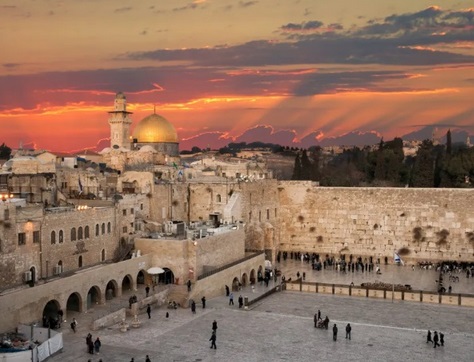
This vision was put into practice by the second caliph, Umar ibn al-Khattab. Upon taking control of Jerusalem in 637 CE, Umar signed a treaty guaranteeing the “safety for themselves, their property, their churches, and their crosses” for the Christian inhabitants. Furthermore, Umar is credited with cleaning the Temple Mount—which had been a garbage dump—and restoring 70 Jewish families to Jerusalem after they had been banished by previous rulers.
A New Muslim Vision: Rebuilding Solomon’s Temple Together
A bold proposal within The Muslim Times advocates for the rebuilding of Solomon’s Temple as a “house of prayer for all nations”. This vision, presented by Sinem Tezyapar, argues that casting any believer out is an offense to the Quranic teaching (2:114) that condemns those who forbid the celebration of God’s name in places of worship.
Key components of this vision include:
- Universal Brotherhood: Christians, Jews, and Muslims cooperating “hand in hand” to restore the sanctuary.
- Preservation of Existing Shrines: Rebuilding the Temple “just a little way” from the Al-Aqsa Mosque and the Dome of the Rock, ensuring no harm to the existing Islamic structures.
- Aesthetic Magnificence: Using the Quranic description of Solomon’s glory to create a sanctuary covered in gold and adorned with gardens.
- Common Heritage: Emphasizing that Solomon is a prophet to Muslims as well, and the site belongs to all the children of Abraham.
This vision is complemented by the contemporary development of a Muslim judge taking a permanent seat at Israel’s Supreme Court—a move that represents a step toward the “Islamic system of justice” and the “benevolent message of Islam” in its pristine purity.
Thematic Epilogue: The Horizon of Universal Brotherhood
The analysis of Quranic commentary and modern intellectual history presented in this report reveals a narrative of responsibility that transcends racial and sectarian divides. The critique of the “burdened donkey” in Surah Al-Jumu’ah remains a perpetual warning that the possession of scripture is a trial of conduct rather than a guarantee of status. The historical destructions detailed in Surah Bani Israel serve as a reminder that “mischief” and “arrogance” trigger a universal law of retribution that is blind to religious labels.
Yet, the synthesis of these themes with the lives of figures like Muhammad Asad and the insights of Albert Einstein points toward a “unified vision of Monotheism”. By viewing the universe as a collection of “miracles” and science as a tool for “demystifying” faith, the modern believer can move beyond the “circles of confusion” that fuel antisemitism and conflict.
The proposal to rebuild Solomon’s Temple as a common sanctuary and the emergence of Muslim voices in the highest judicial halls of the Jewish state suggest that the “Bounty of Allah” is indeed vast enough to encompass all of humanity. The final “Reckoning” is not an end to hope, but the ultimate assurance that every act of compassion and every pursuit of justice—regardless of the faith of the actor—will be met with the absolute justice of a Creator who is the “Owner of supreme bounty”. In this global village, the path forward lies in recognizing that “if you do good, you do good for your own selves,” and that the true station of humanity is found in being an accepted “servant” of the Most High.


 The Glorious Quran and Science
Leave a comment