
Presented by Zia H Shah MD
Audio teaser:
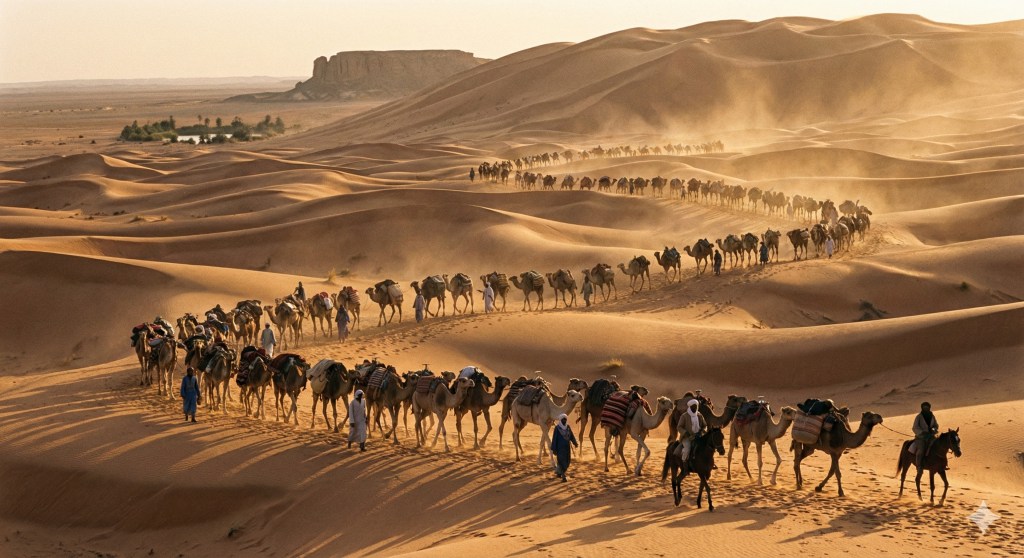
The camel represents a singular nexus where the rigors of biological adaptation meet the profundity of theological discourse. This report offers an exhaustive multidisciplinary analysis of the family Camelidae, synthesized with the extensive terminology and conceptual frameworks found within the Quranic revelation. Spanning a 45-million-year evolutionary trajectory from the Eocene rainforests of North America to the hyper-arid deserts of the contemporary Old World, the biological narrative of the camel serves as a primary example of morphological resilience. This narrative is woven into the rich semantic tapestry of the Quran, which utilizes a specialized vocabulary of at least thirteen distinct terms to categorize camels by age, gender, and function. Central to this inquiry is the Quranic invitation in Surah Al-Ghashiyah (88:17) to observe the “how” of camel creation, an inquiry that finds its contemporary fulfillment in the study of paleontological transitions and physiological specializations. The report explores the deconstruction of pre-Islamic superstitions through legislative correctives (5:103) and the use of camel-based metaphors to illustrate eschatological realities, such as the “eye of the needle” and the “aimless” wanderer. Finally, the analysis culminates in a thematic epilogue regarding “Guided Evolution,” as articulated by Zia H. Shah MD, which positions the camel’s complex phylogeny as a divinely orchestrated process rather than a product of blind chance. This perspective bridges the gap between the 7th-century Arab audience, whose survival was tethered to the camel, and the 21st-century global community, which views the animal as a biological “clue” pointing toward the wisdom of the Creator.
Paleontological Foundations: The North American Genesis of Camelidae
The evolutionary history of the camel is characterized by a geographic and morphological paradox: while currently synonymous with the Middle East and Central Asia, the entire family Camelidae originated in North America. This lineage began approximately 45 million years ago during the Eocene epoch, a period characterized by a transition from a “greenhouse” to an “icehouse” climate.
The Eocene and Oligocene: Primitive Ancestry
The earliest known camelid, Protylopus, inhabited the rainforests and savannahs of what is now the American Midwest, specifically South Dakota and surrounding regions. Far from the imposing desert beasts of today, Protylopus was a rabbit-sized, forest-dwelling mammal possessing four toes on each foot and lacking a hump. This primitive form underscores the “stages” of creation emphasized in Quranic thought, where complex life emerges from humble, rudimentary beginnings.
By the late Eocene and early Oligocene, roughly 35 million years ago, the genus Poebrotherium appeared. This ancestor reached the size of a modern goat and exhibited a significant evolutionary milestone: the loss of the two lateral toes, leaving only two functional digits—a hallmark of the suborder Tylopoda (“padded foot”). During this era, the cooling global climate initiated the replacement of dense forests with more open, arid woodlands and grasslands, driving the evolutionary pressure for longer limbs and more efficient locomotion.
The Miocene and Pliocene: Diversification and Migration
The Miocene epoch (23 to 5.3 million years ago) marked the “golden age” of camelid diversification. Within North America, the family radiated into diverse ecological niches. Notable genera included Aepycamelus and Oxydactylus, giraffe-like browsers with extremely long necks and legs designed for feeding on high canopy foliage. In contrast, Stenomylus represented a lineage of small, gazelle-like runners.
The divergence of the two primary modern lineages—the tribe Camelini (ancestors of the dromedary and Bactrian) and the tribe Lamini (ancestors of the llama and alpaca)—occurred approximately 17 million years ago in the late Early Miocene. Despite this split, both groups remained confined to North America for several million years. The transcontinental migrations that would define the modern distribution of the family were precipitated by the formation of geological land bridges.
The Bering Land Bridge and the Great American Interchange
Approximately 6 to 7 million years ago, the ancestor of Old World camels, Paracamelus, crossed the Bering Land Bridge—a corridor of land that emerged between Alaska and Siberia due to lowering sea levels. This migration was a critical juncture in the “guided” trajectory of the family. Those Paracamelus populations that entered Eurasia eventually gave rise to the two-humped Bactrian camel (Camelus bactrianus) and the single-humped dromedary (Camelus dromedarius). Recent protein and DNA analysis of fossils found on Ellesmere Island and in the Yukon suggests that these “desert” animals actually developed many of their iconic adaptations—such as broad, padded feet and fat-storing humps—as tools for surviving the snowy, high-latitude environments of the Arctic Circle.
Simultaneously, members of the Lamini tribe, such as Hemiauchenia, migrated southward. Around 3 million years ago, during the Pliocene, they crossed the newly formed Isthmus of Panama into South America during the Great American Interchange. This led to the speciation of the four extant South American camelids: the domesticated llama and alpaca, and the wild guanaco and vicuña.
| Genus/Species | Time Period | Location | Key Characteristics |
| Protylopus | 45-40 MYA | North America | Rabbit-sized, 4 toes, no hump |
| Poebrotherium | 35 MYA | North America | Goat-sized, 2 functional toes |
| Aepycamelus | 20-5 MYA | North America | Giraffe-like neck and limbs |
| Paracamelus | 7-1 MYA | Eurasia/Arctic | Large body, ancestor of modern camels |
| Camelops | 4 MYA – 10k YA | North America | “Western camel,” 7ft tall at shoulder |
| Hemiauchenia | 10 MYA – 10k YA | Americas | Migrated to South America 3 MYA |
The North American Extinction
In a stark irony of natural history, the family Camelidae became extinct in its place of origin. The last North American camels, including the massive Camelops hesternus (which stood seven feet tall at the shoulder), disappeared approximately 10,000 to 11,000 years ago. This extinction coincided with the end of the last Ice Age and the arrival of Paleolithic humans via the same Bering Land Bridge that the camels’ ancestors had used to exit the continent. Evidence of Camelops bones at prehistoric campsites suggests that overhunting by early human settlers, combined with rapid environmental changes, led to the final collapse of camelids in the Americas.
Morphological Engineering: The Art of the Desert Machine
The camel is frequently presented in both biological and theological literature as a masterpiece of functional design. The specific adaptations that allow it to survive in hyper-arid environments are not merely isolated traits but a highly integrated system of physiological, anatomical, and behavioral mechanisms.
Thermoregulation and Adaptive Hyperthermia
Unlike most mammals that maintain a strict homeostatic body temperature, the camel employs “adaptive hyperthermia.” A hydrated camel typically fluctuates between 36∘C and 38∘C, but when dehydrated and exposed to extreme heat, its body temperature can safely rise to 41∘C during the day and drop to 34∘C at night. This 7∘C range allows the camel to store heat within its body mass during the peak of the day, which it then dissipates through radiation during the cool desert night. This mechanism significantly reduces the need for evaporative cooling (sweating), thereby conserving precious water.
The Hump: Adipose Storage and Metabolic Water
The camel’s hump is perhaps the most misunderstood of its anatomical features. Contrary to popular myth, it does not store liquid water; rather, it is a reservoir of fatty tissue. This centralization of fat serves two critical purposes. First, by concentrating the fat in a single dorsal location, the camel minimizes insulation over the rest of its body, allowing heat to escape more efficiently from its skin. Second, when food is scarce, the camel metabolizes this fat for energy. A byproduct of this chemical reaction is “metabolic water”—the oxidation of one gram of fat produces approximately 1.1 grams of water. While this metabolic water is largely offset by the respiratory loss required to obtain the necessary oxygen, it provides a vital buffer during long periods without external resources.
Hematological Specialization: Oval Erythrocytes
The blood of the camel is uniquely engineered to handle extreme dehydration. While other mammals have round red blood cells (erythrocytes), the camel’s cells are oval-shaped. This elliptical shape facilitates blood flow through the veins even when the blood becomes viscous due to water loss. Furthermore, these cells are exceptionally stable and elastic. When a dehydrated camel finally gains access to water, it can consume over 100 liters in less than ten minutes—an intake that would cause “osmotic shock” and cell rupture in any other mammal. The camel’s oval erythrocytes can swell to 240% of their initial volume without bursting, accommodating the sudden influx of fluid into the bloodstream.
Water Conservation Pathways
The camel’s water-saving strategies extend through its entire anatomy. Its kidneys are highly efficient, with a medulla-to-cortex ratio of approximately 4:1, and long loops of Henle that enable the production of extremely concentrated urine. In the respiratory tract, the camel’s nose acts as a counter-current heat exchanger; the mucous membranes cool the air being exhaled and trap the water vapor, reabsorbing it back into the body before it can be lost to the atmosphere. In the digestive tract, the large intestine is exceptionally long and efficient at reabsorbing water from waste, resulting in feces so dry they can be used as fire starters immediately upon excretion.
| Adaptation | Biological Mechanism | Survival Benefit |
| Oval Red Blood Cells | High osmotic stability and flow efficiency | Prevents cell rupture during rapid rehydration |
| Fatty Hump | Energy storage and lack of full-body insulation | Facilitates thermoregulation and survival during famine |
| Nasal Membranes | Counter-current cooling and reabsorption | Minimizes respiratory water loss |
| Broad Foot Pads | Large surface area with leathery, fat-filled soles | Prevents sinking in sand or snow; reduces pressure |
| Fluctuating Body Temp | Adaptive hyperthermia (34∘C−41∘C) | Eliminates need for sweat in moderate heat |
| Kidney Medulla | Highly developed with long loops of Henle | Produces hyper-concentrated urine |
Semantic Landscapes: The Quranic Vocabulary of Camelidae
The Quranic text utilizes a highly specialized and tiered vocabulary to describe the camel, reflecting the animal’s central role in the socio-economic and spiritual life of the 7th-century Arabian Peninsula. While the Arabic language famously contains hundreds of terms for various states of the camel, the Quran employs approximately 11 to 13 specific terms, each selected to convey precise biological, functional, or religious nuances.
Primary Generic and Collective Terms
- Ibil (إِبِل): This is the most common collective term for camels used in the Quran. It appears in the pivotal verse 88:17, where humanity is challenged to reflect on the creation of the Ibil. It also appears in 6:144 in the context of listing pairs of livestock.
- Jamal (جَمَل): This term generally refers to the adult male camel. Its most famous usage is in Surah Al-A’raf (7:40), where the Quran describes the impossibility of the arrogant entering Paradise “until the camel (Jamal) passes through the eye of a needle”. This metaphor parallels biblical imagery and underscores the “absurdity” of sinners expecting divine reward while persisting in disbelief.
- Naqah (نَاقَة): Specifically designating the she-camel, this word is used almost exclusively in the Quran to describe the miraculous “She-Camel of Allah” given to the people of Thamud and the Prophet Salih as a “visible sign” (mubsirah). The Naqah was a trial for the people, and their decision to “hamstring” her led to their swift destruction.
- Ba’eer (بَعِير): This term refers to a camel specifically in its capacity as a beast of burden or a transport animal. In Surah Yusuf (12:72), the king’s herald announces that whoever returns the missing cup shall receive “a camel’s load” (himlu ba’eer) as a reward.
Functional, Age-Based, and Sacrificial Terms
The Quranic vocabulary shifts as the focus moves toward specific uses or life stages of the animal:
- Eshar (عِشَار): Derived from ashara (ten), this term refers to she-camels that are ten months pregnant. In the context of pre-Islamic Arabia, these were the most prized assets of a Bedouin tribe. In Surah At-Takwir (81:4), the Quran states that on the Day of Judgment, even these “full-term she-camels” will be “neglected” (uttilat), highlighting that the terror of the hour will make man forget his most valuable earthly wealth.
- Budn (بُدْن): This term refers to the large, robust camels (or cattle) designated for ritual sacrifice during the Hajj. Surah Al-Hajj (22:36) defines the Budn as being among the “symbols of Allah” (sha’a-ir Allah) and commands that they be sacrificed after they have been “lined up” for slaughter.
- Dhamir (ضَامِر): Appearing in Surah Al-Hajj (22:27), this term describes a camel that has become lean and travel-worn from a long journey. The Quran uses this to paint the picture of pilgrims arriving for Hajj from “every distant pass,” riding on “lean mounts” to reach the sacred precinct.
- Rikab (رِكَاب): This term refers to camels used as riding mounts, particularly in the context of military or travel expeditions. In Surah Al-Hashr (59:6), the Quran mentions that the believers did not have to “spur horses or camels (rikab)” to obtain certain spoils, emphasizing that the victory was granted by Allah without conventional combat.
- Heem (هِيم): Found in Surah Al-Waqi’ah (56:55), Heem refers to camels suffering from a pathological, unquenchable thirst (a disease known as Hiyam). The inhabitants of Hell are described as drinking boiling water “as the drinking of Heem,” a metaphor for insatiable suffering and the lack of relief.
| Arabic Word | English/Functional Meaning | Quranic Reference |
| Ibil | Camels (Collective) | 88:17 |
| Jamal | Adult Male Camel | 7:40 |
| Naqah | Female She-Camel | 7:73, 11:64, 54:27, 91:13 |
| Ba’eer | Pack Camel (Burden-bearing) | 12:72 |
| Eshar | Pregnant She-Camel (Valuable) | 81:4 |
| Budn | Sacrificial Livestock (Fat/Large) | 22:36 |
| Dhamir | Lean/Travel-worn Mount | 22:27 |
| Rikab | Riding Camel (Expeditionary) | 59:6 |
| Heem | Diseased/Thirst-mad Camels | 56:55 |
| Jimalat | Group of Camels (Yellow/Black) | 77:33 |
Legislative Correctives: Abolishing the Jahiliyyah Rites
One of the most biologically and sociologically significant passages regarding camels is Surah Al-Ma’idah (5:103). This verse explicitly names four categories of camels that were subject to pre-Islamic (Jahiliyyah) superstitions. These categories involved the dedication of animals to idols and the arbitrary prohibition of their labor, milk, or meat.
The Four Superstitious Categories
- Bahirah (بَحِيرَة): This was typically a female camel whose ears were slit (bahara) after she had delivered five offspring, the fifth of which was a male. Once designated as Bahirah, she was consecrated to the idols; she could not be milked by any person, her wool could not be shorn, and she was left to roam freely.
- Sa’ibah (سَائِبَة): The term Sa’ibah refers to an animal “let loose” (sab). This was often a camel (or sometimes sheep) freed as an act of gratitude—for instance, after a owner returned safely from a journey or was cured of a disease. The animal was exempted from all work and reserved solely for the service of the gods.
- Wasilah (وَصِيلَة): This term describes an animal that “connected” (wasalat) two births. For example, if a she-camel or a ewe gave birth to female twins in successive deliveries without a male being born in between, she was considered Wasilah and dedicated to the idols.
- Ham (حَام): Also known as Hami, this was a stallion camel that had reached a certain count of sired offspring (often ten) or whose offspring had themselves sired another generation. His “back was protected” (Hama) from any burden; he could not be ridden, and he was left to graze and drink from any source without restriction.
Theological Implications of 5:103
The Quranic response to these categories is a categorical denial of their divine origin: “Allah has not instituted things like Bahirah or Sa’ibah… but those who disbelieve fabricate a lie against Allah” (5:103). This verse serves as a crucial point in Islamic theology, establishing the principle that legislation—specifically the declaration of what is Halal (lawful) and Haram (prohibited)—belongs exclusively to Allah.
By abolishing these practices, the Quran corrected two “Jahiliyyah” errors. First, it ended the “Legislative Shirk” of attributing human-made prohibitions to God. Second, it restored the status of camels as a blessing to be utilized for human benefit. The pagan practices were deemed “wasteful” as they removed productive animals from the economy without any divine command. As Al-Qurtubi and other exegetes note, the core issue was the usurpation of divine authority to designate the “sacred”.
Deep Metaphors: The Aimless and the Fiery
Beyond physical descriptions, the camel serves as a vehicle for complex philosophical and eschatological metaphors in the Quranic narrative. These metaphors leverage the Arab audience’s intimate knowledge of camel behavior to illustrate profound spiritual concepts.
The Aimless Camel: Suda (75:36)
In Surah Al-Qiyamah, the Quran asks a rhetorical question: “Does man think that he will be left Suda?” (75:36). According to the classical lexicon Lisan al-Arab, the word Suda refers specifically to a camel that is left to wander aimlessly, grazing at will, without a shepherd to guide it or a master to account for it.
This imagery is central to the Quranic argument for resurrection and accountability. The verse challenges the “materialist” view that life is merely a biological process with no ultimate goal or consequence. By using the term Suda, the Quran suggests that just as no rational owner would leave a valuable camel to wander aimlessly and be lost, the Creator of the universe—who engineered the human with intellect and moral choice—would not leave man to exist without a purpose or an eventual reckoning. The contrast is clear: the animal is born and dies within the limits of its instinct, but man’s life is a “test” leading toward a “final requital”.
The Fiery Sparks: Jimalatun Sufr (77:33)
In the description of the Day of Judgment in Surah Al-Mursalat, the sparks thrown by the Hellfire are compared to “castles” (al-Qasr) in size (77:32) and to “yellow camels” (Jimalatun Sufr) in appearance (77:33).
This specific imagery is the subject of significant linguistic analysis:
- Color and Chaos: The term Sufr (yellow/tawny) describes the color of the sparks. Some exegetes, such as Al-Tabari and Ibn Kathir, note that the most prized black camels of the Najd were often called sufr because their hair had a yellow or copper-colored sheen when reflecting sunlight. Thus, the sparks are described as massive, dark, fiery masses that move with the chaotic speed of a stampeding herd of camels.
- The Rope Metaphor: An alternative interpretation, supported by Ibn Abbas and Mujahid, suggests that Jimalat refers not to camels, but to the “giant ropes” or “thick cables” used in ships. In this view, the sparks are as thick and twisted as the cables used to moor vessels, emphasizing their density and destructive power.
Regardless of the specific reading, the metaphor relies on the camel (or its byproducts) to convey a sense of overwhelming size and terrifying intensity to a listener who understands these elements as the pinnacle of physical scale in their world.
The Call to Reflection: Surah Al-Ghashiyah 88:17
The centerpiece of the Quranic discourse on the camel is the invitation in Surah Al-Ghashiyah: “Do they not then look at the camels—how they are created?” (88:17). This verse is not a simple rhetorical question; it is a directive toward empirical observation and biological inquiry.
The Question of “How” (Kayfa)
The verse specifically uses the word Kayfa (“how”). Zia H. Shah MD highlights that the Quran does not merely ask the observer to see the camel, but to ponder the mechanism of its creation. To the 7th-century Arab, “how it is created” meant looking at the wondrous fashioning of the hump, the padded foot, and the water-defying physiology. To a 21st-century scientist, the “how” refers to the millions of years of evolutionary adaptation and genetic mutations that allowed a forest-dwelling hare to transform into a desert-dwelling master of resilience.
The Quran as a “Book of Clues”
Dr. Shah argues that the Quran is not a “book of science” but a “book of clues for science”. Verse 88:17 provides a biological clue, while subsequent verses (88:18-20) provide geological and cosmological clues regarding the raising of the sky, the anchoring of mountains (isostasy), and the spreading of the earth. The theological purpose of this “look” is to establish the feasibility of resurrection. If the Creator can “engineer” a creature as complex and perfectly adapted as the camel from simple beginnings, then bringing the dead back to life is an act well within His power.
Epilogue: Guided Evolution and the Modern Paradigm
The relationship between the Muslim community and the camel has transitioned from a physical necessity to a symbolic and scientific one. For the companions of the Prophet, the camel was a ubiquitous part of daily life—their transportation, their currency, their food, and their poetry. In contrast, 21st-century Muslims, largely urbanized, have very little direct connection to these animals, seeing them primarily as symbols of a nomadic past. This distance, however, allows for a more profound “look” at the camel through the lens of modern science—a fulfillment of the Quranic injunction that has only become possible with the advent of evolutionary biology.
The Synthesis of Zia H. Shah MD: Guided Evolution
In his writings on “Guided Evolution,” Dr. Zia H. Shah MD bridges the gap between traditional creationism and materialistic neo-Darwinism. He argues that while the theory of evolution—the common ancestry of all life and the mechanism of natural selection—is a biological fact “beyond any doubt,” the interpretation of this process as “blind” is a philosophical error.
Shah defines “Guided Evolution” as a theistic model based on several Quranic insights:
- The Common Thread of Water: The Quranic statement “We made from water every living thing” (21:30) aligns with the biological consensus that life originated in aqueous environments and that all organisms, including camels, share a water-based biochemistry.
- Creation in Stages (Atwar): The Quran asks: “What is the matter with you, that you are not conscious of God’s majesty, seeing that He created you stage by stage?” (71:13-14). Shah interprets these atwar (stages) as the long geological epochs of evolution. The transition of the camel from Protylopus to Camelus is a living commentary on this stepwise creation.
- The Exact Measure (Qadar): The Quran describes God as having created everything and “proportioned it with an exact measure” (fa-qaddarahu taqdira) (25:2). This suggests that evolution is not a series of random accidents but a process governed by divinely set laws—the laws of genetics, physics, and natural selection—that were “front-loaded” or “guided” to produce specific outcomes.
The Interface of Quantum Indeterminacy
A sophisticated aspect of Shah’s “Guided Evolution” is the proposal that God interacts with the physical world at the level of quantum indeterminacy. Because quantum events (such as the specific mutation of a gene) are probabilistic rather than deterministic at the microscopic level, there is a “theological space” where divine sovereignty determines the outcome of “random” events to sustain and guide reality without violating the macro-laws of physics. In this framework, the “accidental” development of the camel’s padded foot in the Arctic, which later became perfect for the desert, is seen as a “sovereign choice of God” that prepared the animal for its future role.
Conclusion: Reconnecting with the “Ayah”
The camel remains one of the most powerful “signs” (Ayat) mentioned in the Quran. For the 7th-century audience, the sign was found in the animal’s immediate resilience; for the 21st-century audience, the sign is found in its 45-million-year epic of survival and transformation. By recognizing that “God germinated you from the earth like a plant” (71:17), the modern believer can see the camel not just as a relic of the past, but as a masterpiece of “Guided Evolution”. The invitation of Surah Al-Ghashiyah to “look at the camel” is a perennial call to integrate faith with reason, reminding humanity that the “how” of creation always leads back to the wisdom of the “All-Powerful, All-Wise Designer”.



 The Glorious Quran and Science
Leave a comment