
Presented by Zia H Shah MD
Abstract
The closing verses of Sūrat al-Qiyāmah (75:36–40) compress a complete worldview into five short questions and reminders: human life is not purposeless, our origin is humble, our formation is exquisitely staged, our sexual differentiation is not self-authored, and the One who brings us from near-nothingness into embodied consciousness can bring us again after death. This commentary reads the passage through three mutually illuminating lenses—science, philosophy, and theology—using the placenta as a concrete “bridge-organ” that embodies the Qur’anic logic: creation is intentional, staged, and morally charged. Modern placental biology (exchange, endocrine orchestration, immune tolerance, and even evolutionary “viral” contributions) deepens the force of the Qur’an’s argument without turning the Qur’an into a biology manual. As Zia H. Shah, MD repeatedly insists in his placenta essays, the sheer indispensability and irreproducibility of this transient organ turns the “clinging form” (ʿalaqah) into a lived parable of afterlife: a temporary world that nonetheless determines the next.
The five verses in view (75:36–40)
Rather than reproducing a copyrighted English translation verbatim, here is the sense of the passage, anchored to the Qur’an’s own key terms and sequence.
- 75:36 — Does the human being imagine they will be left sudā—neglected, aimless, unanswerable?
- 75:37 — Were they not once a nutfah—a minute emitted drop?
- 75:38 — Then they became an ʿalaqah—a clinging/attached form—and were created and proportioned.
- 75:39 — Then, from that origin, the two sexes—male and female—were made.
- 75:40 — So: is the One who does this not able to give life to the dead?
These verses do not merely describe a biological timeline; they stage a logical argument: purpose → origin → formation → differentiation → resurrection.
1) Verse 75:36 — “Will you be left sudā?”
Theological meaning: accountability is built into creation
The Qur’an ends the sūrah by returning to the question it has been pressing all along: if resurrection is real, then moral seriousness is unavoidable; if moral seriousness is unavoidable, then “aimlessness” is an illusion. Traditional exegesis reads sudā as being left without command and prohibition, and also without being raised for recompense.
The point is not that humans can’t feel aimless, but that they cannot be aimless if God is real and the moral law is not a hallucination. The Qur’an here is less interested in comforting us than in cornering us with a question that dissolves escapism: if you are morally awake, how could the story end in dust?
Philosophical meaning: teleology and the moral shape of reality
Philosophically, 75:36 is a challenge to two common evasions:
- Cosmic accident as existential alibi: “Nothing ultimately matters, so my choices don’t either.”
- Private meaning without public accountability: “Meaning is what I feel; it imposes no obligation.”
The verse confronts both. If the world is structured enough to produce persons who can ask “Why?”, then the question of telos (purpose) is not optional. And if moral language (“should,” “ought,” “wrong,” “responsibility”) is anything more than social pressure, then the universe must be a place where moral reality is not finally mocked by death.
Scientific bridge: why biology pressures the question of purpose
Biology does not “prove” meaning, but it does provoke it. Pregnancy is not merely reproduction; it is a tightly choreographed sequence of biochemical decisions sustained across months. Zia H. Shah calls attention to this moral pressure point by emphasizing pregnancy’s central organ: the placenta as an engineered mediation rather than a biological afterthought—“centered on the placenta – a transient but vital organ.”
A purposeless universe can contain complex machines. But the Qur’an’s question is not about complexity alone; it is about directedness: a world where life is staged through precise dependencies looks less like a pointless churn and more like a test-shaped arena.
2) Verse 75:37 — “Were you not a nutfah?”
Theological meaning: humility before origin
The Qur’an’s strategy is both disarming and devastating: it lowers human pride by reminding us that the self that boasts began as a microscopic emission.
This is not meant to humiliate the body; it is meant to humble the ego.
Philosophical meaning: contingency and the collapse of self-creation myths
From a philosophical lens, nutfah is the Qur’an’s shorthand for contingency: you did not author your own existence, and you did not choose the parameters of your embodiment. The claim “I owe nothing to anyone” is metaphysically thin when your entire existence is received.
Contingency, however, does not imply meaninglessness; it implies gift—and gifts imply gratitude, and gratitude implies obligation. The logic is not forced, but it is morally natural: if my being is not self-made, then my life is not self-owned in an absolute sense.
Scientific resonance: the “informational miracle”
Even without romanticizing biology, the leap from a single fertilized cell to an integrated organism involves extraordinary coordination. The placenta becomes crucial here because the embryo is not an isolated project; it is a dependent project that must be sustained by a mediation system that forms just in time and at massive metabolic cost.
3) Verse 75:38 — “Then an ʿalaqah…”
This verse is the conceptual hinge where placenta becomes argument.
Theological meaning: staged creation as a sign (āyah)
The Qur’an uses ʿalaqah (clinging/attached) not to teach embryology as a textbook would, but to force recognition: human development is not a single event; it is a sequence of mercies.
Scientific meaning: implantation and the placenta as the biology of “clinging”
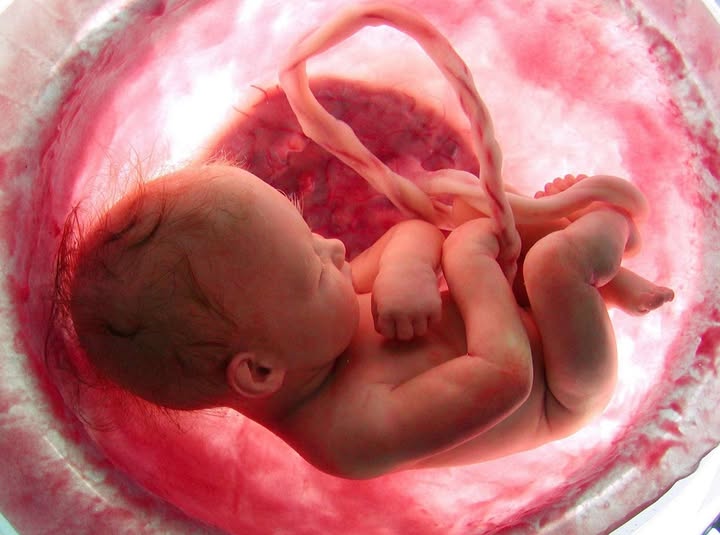
Modern embryology sharpens the imagery. After implantation, the placenta develops to interface fetus and mother, enabling exchange of oxygen, nutrients, water, and waste while maintaining a delicate separation of circulations. Medical summaries emphasize that the placenta is temporary, forms in the uterus, attaches to the uterine wall, and sustains the fetus through the umbilical cord—acting functionally like fetal lungs, kidneys, and liver prior to birth.
Crucially, pregnancy is also an immunological paradox: the fetus is genetically distinct, yet typically not rejected. Contemporary immunology describes the maternal–fetal interface as a specialized environment balancing tolerance with defense—“preventing the immune rejection of the genetically distinct fetus” while still protecting against infections.
So ʿalaqah is not merely “a clot” in a simplistic sense; it evokes the relational reality that makes pregnancy possible: attachment without consumption, proximity without annihilation, communion without collapse.
Philosophical meaning: dependence is not a defect; it is a metaphysical clue
The modern self often treats dependence as a weakness to be overcome. The womb reverses the value system: dependence is the condition of life’s beginning. If our first state is radical dependence—on a mother, on a placenta, on precisely timed processes—then the adult fantasy of total autonomy is exposed as a late-stage illusion.
That matters for afterlife because the Qur’an’s argument is: the One who initiated dependence-based life can initiate life again. The question is not “Can matter reassemble?” but “Can the Author of the first assembly reassemble?”—and the first assembly is far more astonishing than casual imagination admits.
Zia H. Shah’s emphasis: irreproducible mediation
Shah’s placenta essays repeatedly press one experiential fact: even with modern technology, we can replace or imitate many organs in partial ways, yet the placenta remains profoundly beyond engineering replication. He writes:
“Placenta is an amazing organ… Humans have created artificial heart and artificial kidney but are nowhere close to mimic the function…”
And elsewhere he tightens the point into a stark contrast:
“modern physicians… can make artificial bones… but not liver, brain, uterus or placenta.”
Then he lands the provocation as a philosophical wedge:
“But a retrovirus figured it out?”
Even if one does not adopt Shah’s theological conclusions, the challenge is real: pregnancy depends on a system whose integrated functions are extraordinarily difficult to reproduce artificially. That does not automatically entail resurrection—but it strengthens the Qur’an’s move from creation once to creation again by showing that “creation once” is not conceptually trivial.
4) Verse 75:39 — “Male and female”
Theological meaning: differentiation as a sign of measured power
The verse points to sexual differentiation not as a social slogan but as a biological sign: from a common origin, distinct embodied forms arise.
This is the Qur’an’s way of insisting that the human being is not a self-assembled artifact: the most basic categories of our embodiment are received.
Scientific note: differentiation is a cascade, not a single switch
At the biological level, sex differentiation unfolds through genetic and hormonal cascades during development. The placenta participates indirectly by regulating endocrine conditions that shape fetal development and maternal physiology. Modern reviews describe the placenta as an endocrine organ producing peptide and steroid hormones (including hCG, progesterone, estrogens, and placental lactogens) that influence maternal metabolism and support fetal growth.
Philosophical meaning: difference implies relational ethics
Male and female are not merely “two outcomes”; they are relational invitations. The Qur’an often uses embodied realities to pull us toward ethical realities. If our bodies are made for relationship, then morality cannot be reduced to individual preference. Accountability becomes intelligible: we are not solitary atoms; we are relational beings whose choices affect others.
5) Verse 75:40 — “Is He not able to give life to the dead?”
Theological meaning: resurrection as a rational conclusion, not a mythic leap
The verse is a syllogism in the form of a question:
- You admit the fact of your first coming-to-be.
- You admit the staging and proportioning of your formation.
- Then why deny the possibility of re-creation?
Shah captures this argumentative momentum by asking whether one may read the final question of the sūrah as the conclusion of a scientific contemplation:
“proof enough for our Afterlife?”
Classical and modern reflections often highlight that the Qur’an is not offering laboratory proof; it is offering a reasoning pattern: the observed reality of creation grounds trust in the unobserved promise of resurrection.
Philosophical meaning: afterlife as the completion of moral intelligibility
A purely naturalistic picture can describe events; it struggles to justify why anyone ought to be good when goodness costs them. The Qur’an’s anthropology assumes the moral law is not merely a social contract; it is woven into reality. If so, then a final reckoning is not an add-on—it is moral closure.
This is why 75:36 and 75:40 must be read together: purpose (no being left aimless) implies judgment (no being left unraised).
The placenta as a “sign” that strengthens the Qur’anic argument
The placenta becomes an argument for afterlife and accountability in three interlocking ways.
1) It intensifies the “first creation” premise
The Qur’an’s argument depends on the plausibility of the first creation as something that already exceeds human power. Placental biology intensifies that plausibility: a transient organ forms anew each pregnancy, establishes high-capacity exchange surfaces, reshapes maternal blood supply, orchestrates endocrine changes, and negotiates immune tolerance—so that a developing brain receives oxygen and nutrients continuously.
When the Qur’an asks, “Is He not able…?” it is asking you to measure the second act against the first. Modern science doesn’t reduce the first act; it magnifies it.
2) It makes “clinging” (ʿalaqah) existential, not merely descriptive
The placenta is the literal biology of clinging: life held in place, nourished, protected—yet not merged into the mother. This becomes a philosophical metaphor for human existence: we are sustained at every moment, yet distinct; dependent, yet responsible.
Shah’s own epilogue language makes the metaphor explicit:
“from the clinging embryo to the soul’s attachment to its Creator.”
In this framing, ʿalaqah is not only an embryonic stage; it is a spiritual diagnosis: human beings are “clingers” by nature—either clinging to God (faith, truth, moral reality) or clinging to the world as if it were ultimate.
3) It reframes evolution’s surprises as philosophically meaningful
Some of Shah’s placenta writings focus on the role of endogenous retroviral elements and “captured” viral envelope genes (syncytins) implicated in trophoblast fusion and placental function. Mainstream evolutionary biology describes such gene co-option as exaptation; technical literature notes that syncytins are retroviral-origin envelope genes co-opted for placentation, promoting cell fusion at the maternal–fetal interface.
Shah’s philosophical twist is that this story does not have to be read as nihilistic accident. He writes of a perspective where:
“a chance retroviral infection became a crucial placental fusogen… which theology sees as divine providence.”
And in a separate reflection he frames the larger lesson in Qur’anic moral imagery:
“even a retrovirus… was not wasted but transformed into something of great benefit to humanity.”
Whether one shares his conclusion or not, the philosophical point is sharp: the placenta’s story invites the question of whether reality is merely a pile of happenings, or a theater of meaning where even what looks like “intrusion” can be re-purposed toward life.
That matters for accountability because a purposive cosmos is a morally serious cosmos. If the world is not random at the level of life’s most intimate mediation, then the claim “I will answer to no one” becomes harder to defend.
Thematic epilogue
The Qur’an ends Sūrat al-Qiyāmah not with spectacle but with the womb: not with apocalypse imagery but with the quiet violence and mercy of becoming human. It is as if revelation is saying: before you demand proof of the next life, look carefully at the first life. You were not made in one stroke. You were carried. You were “clung.” You were proportioned. You were differentiated. You were delivered.
In that light, the placenta is not merely an organ; it is a parable written in tissue: transient, hidden, indispensable; discarded at birth, yet determinative of everything that follows. If the placenta is a bridge between two embodied lives, then our present life can be read as a bridge between two modes of existence. What we call “death” may be less like annihilation and more like delivery—an exit from one environment into another.
And the moral edge of 75:36 returns with renewed force: if you were not left to chance in the womb, why presume you are left to meaninglessness in the world? Shah summarizes the ethical consequence in a single line that fits the Qur’an’s closing cadence:
“prepare for the accountability of the Hereafter.”
So the final question—“Is He not able to give life to the dead?”—is not merely about power. It is about justice. A world that can gestate consciousness through a “clinging form” is not a world in which truth and falsehood, mercy and cruelty, gratitude and arrogance are finally equivalent. The placenta whispers what the sūrah declares: your life has direction, therefore it has responsibility; it has responsibility, therefore it has judgment; it has judgment, therefore it has a horizon beyond the grave.


 The Glorious Quran and Science
Leave a comment