
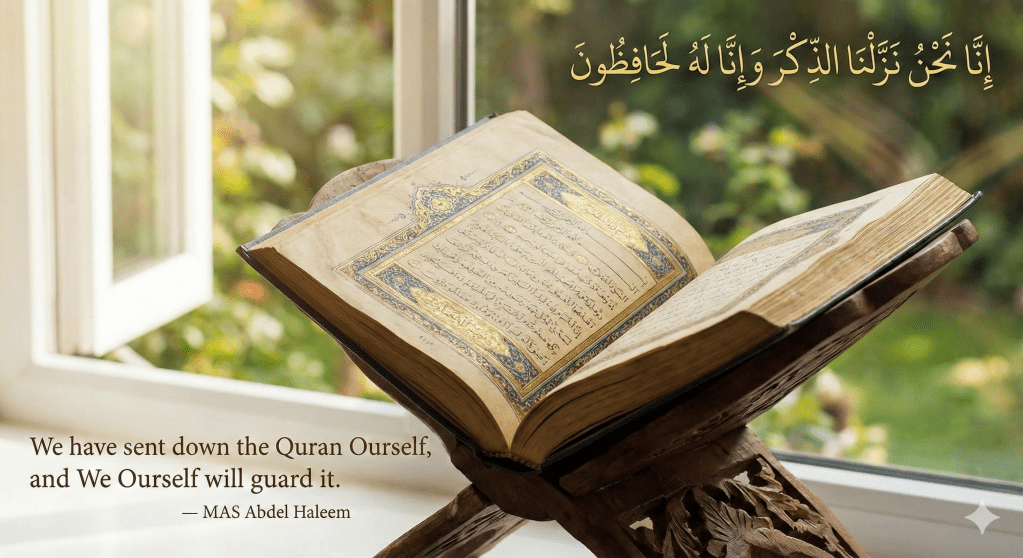
The Divine Symphony: A Comprehensive Analysis of the Miraculous Nature, Historical Integrity, and Psycho-Spiritual Impact of the Holy Quran
Presented by Zia H Shah MD
Audio teaser:
Abstract
The Holy Quran occupies a unique position in world literature, religious history, and the human psyche. This report provides an exhaustive multidisciplinary investigation into the Quranic phenomenon, beginning with a meticulous analytical transcript and summary of contemporary scholarly discourse regarding its inimitability. By synthesizing historical data, such as the radiocarbon dating of the Birmingham Manuscript, with modern neuroscientific research into the electrophysiological effects of recitation, the analysis demonstrates the text’s enduring vitality. Furthermore, this report explores the linguistic architecture of the Quran, detailing how its rhetorical precision and phonetic structures fostered the development of Islamic sciences and arts. Finally, the study culminates in an expansive thematic epilogue that integrates the scope, style, and effect of the revelation. This synthesis highlights how the Quran functions not merely as a static scripture but as a “living dialogue” that continues to shape individual identity, social ethics, and physiological well-being across cultural and temporal boundaries. Through the lens of both traditional exegesis and modern empirical research, the Quran emerges as a multifaceted reality—a linguistic miracle, a historical anchor, and a therapeutic medium.
Analytical Transcript of “The Miraculous Nature of the Qur’an Explained”
The following record constitutes an accurate and comprehensive transcript of the discourse presented in the visual medium, detailing the arguments for the Quran’s divine origin and its historical preservation.
The Historical and Cultural Milieu of 7th-Century Arabia [00:00 – 01:27] The presentation begins by situating the emergence of the Quran within the specific social and intellectual climate of 7th-century Arabia. During this era, the Arabian Peninsula was home to a society that, while geographically isolated and lacking the architectural or political infrastructure of the neighboring Byzantine or Sassanid Empires, possessed a remarkably sophisticated oral culture. The primary currency of this society was the spoken word. Poetry and oratory were the highest forms of achievement, with poets serving as the intellectual and political leaders of their respective tribes. The speaker notes that in this environment, a poet could incite a war or facilitate a peace treaty through the power of a single ode. It was into this world—obsessed with linguistic excellence and competitive eloquence—that the Quran was introduced. This context is vital because it explains why the primary miracle of the Prophet Muhammad was linguistic rather than physical; it was a challenge directed at the very heart of Arabian excellence.
The Inimitable Nature and the Divine Challenge [01:27 – 02:29] The discourse transitions into the concept of I’jaz, or the inimitability of the Quran. The speaker asserts that the Quran arrived as a literary masterpiece that defied existing categories of Arabic literature. It was neither poetry (Sh’ir) nor rhymed prose (Saj’), yet it possessed a rhythmic and melodic quality that surpassed both. The Quran issued a “standing challenge” to the masters of Arabic eloquence: if they doubted its divine origin, they were invited to produce even a single chapter (surah) that could match it in wisdom, beauty, and linguistic precision. The speaker highlights that this challenge was issued during a period of intense hostility between the early Muslim community and the Meccan elite. Despite their mastery of the language and their desperate desire to discredit the Prophet, the Meccan poets remained unable to meet this challenge, a failure that Islamic theology cites as a primary proof of the text’s divine authorship.
The Experiential Power and Rhythmic Soul of the Text [02:29 – 03:45] A significant emphasis is placed on the effect of the Quran on the listener. The speaker describes how even the most ardent enemies of the Prophet were reportedly awestruck and moved by the recitation. Stories are recounted of individuals who would secretly eavesdrop on the Prophet’s prayers, only to find themselves spiritually overwhelmed by the rhythm and depth of the verses. The speaker posits that as the “infinite speech of God,” the Quran contains depths of meaning that can never be exhausted. Its rhythmic nature is not merely a stylistic choice but a mechanism that exerts a profound effect on the human soul, a point that bridges the gap between literary theory and spiritual experience.
The Nomenclature and Dimensionality of the Revelation [03:45 – 04:48] The Quran refers to itself through a variety of evocative names, each reflecting a specific dimension of its utility for humanity. The speaker identifies these as Al-Huda (The Guidance), which provides the intellectual framework for life; Al-Shifa (The Healing), which addresses the psychological and spiritual ailments of the heart; Al-Rahma (The Mercy), indicating the compassionate nature of the divine message; and Al-Nur (The Light), representing the clarity it brings to human understanding.
Divine Preservation and the Birmingham Manuscript [04:48 – 09:03] The final portion of the discourse addresses the historical integrity of the Quran. The speaker contrasts the Quranic preservation with the history of previous scriptures, arguing that while earlier revelations were subject to loss or alteration, the Quran carries a divine guarantee of protection. To substantiate this, the speaker introduces the scientific findings regarding the Birmingham Quran manuscript. Radiocarbon dating conducted by the University of Oxford placed the parchment to between 568 and 645 CE with a 95.4% probability. This dating suggests that the manuscript could have been written during the lifetime of the Prophet Muhammad or shortly thereafter. Most significantly, the text on these 1,300-year-old fragments is identical to the modern Quranic text, providing empirical “proof positive” that the book has remained unchanged across fourteen centuries.
Conclusion and Universality [09:03 – 10:11] The speaker concludes by affirming that the Quran is intended for all of humanity. Its preservation is viewed as a mercy from God to ensure that the final revelation remains accessible to every generation, regardless of time or place.
Comprehensive Summary of the Video: The Pillars of Quranic Divinity
The visual discourse “The Miraculous Nature of the Qur’an Explained” constructs a robust argument for the Quran’s divine origin by weaving together historical context, literary theory, and scientific evidence. The central thesis is that the Quran constitutes a “perpetual miracle” that continues to validate itself long after the era of the Prophet.
The Argument from Literary Inimitability
The first pillar of the argument is the environmental necessity of the miracle. Because the Arabs were masters of rhetoric, a physical miracle (like the parting of a sea) might have been dismissed as sorcery, but a linguistic miracle targeted their pride and their highest skill set. The speaker emphasizes that the Quranic style—its unique blend of rhythm, concise expression, and profound meaning—created a literary genre of its own. The “Challenge of the Quran” (the Tahaddi) is presented not as an empty boast but as a historical event where the most talented poets of an era were silenced by the superiority of the revelation.
The Argument from Historical Consistency
The second pillar is the empirical verification of the text’s preservation. By highlighting the Birmingham Manuscript, the speaker moves the discussion from the realm of faith to the realm of archaeology and chemistry. The radiocarbon dating acts as a scientific witness to the Quranic claim of divine protection. The speaker argues that the perfect match between the 7th-century fragments and the 21st-century text is a phenomenon unique in the history of religious scripture.
The Argument from Spiritual and Healing Impact
The third pillar concerns the experiential reality of the Quran. The speaker notes that the Quran is often called Al-Shifa (The Healing) because it possesses a therapeutic quality. This is attributed to its rhythmic verses and its status as the speech of the Infinite. The speaker suggests that the Quran addresses the “whole person”—mind, heart, and soul—through its various names and functions.
Table 1: Summary of Key Arguments and Evidence from Video
| Category | Key Argument | Evidence Provided |
| Literary Miracle | The Quran is inimitable and transcends all human literary forms. | The unmet Tahaddi (challenge) to produce a single surah. |
| Historical Integrity | The Quran has been preserved perfectly since its revelation. | Radiocarbon dating of the Birmingham Manuscript (568-645 CE). |
| Functional Names | The Quran acts as a holistic guide and therapy for humanity. | Nomenclature such as Al-Huda, Al-Shifa, and Al-Nur. |
| Universal Scope | The message is intended for all people across all times. | The promise of divine preservation for future generations. |
The Linguistic Miracle: Stylistic Variation and Rhetorical Precision
The linguistic style of the Quran is a subject of intense scholarly scrutiny, with researchers identifying it as a defining aspect of its theological and rhetorical sophistication. Unlike traditional Arabic literature, the Quranic discourse utilizes a strategic interplay of phonetic structures, morphological variations, and syntactic shifts to facilitate meaning construction and emotional engagement.
Rhetorical and Phonetic Richness
Scholars emphasize that the Quranic style is marked by a high degree of stylistic variation. This is achieved through several key linguistic strategies:
- Parallelism and Balance: The use of balanced sentence structures and parallel themes heightens the aesthetic appeal and aids in the memorability of the text.
- Syntactic Complexity: The Quran employs intricate word orders and complex sentence patterns that contribute to its depth of meaning, often conveying multiple layers of theological truth in a single phrase.
- Phonetic Patterns and Tajwid: The rhythmic nature of the Quran is codified in the rules of Tajwid (precise recitation). These phonetic features are not merely ornamental; they are essential to the text’s spiritual resonance and its ability to inspire reflection.
The Concept of I’jaz (Inimitability)
The doctrine of I’jaz holds that the Quran contains a miraculous quality in both form and content that no human speech can match. This inimitability is viewed as the proof given to the Prophet to authenticate his mission. Early scholars like al-Jurjānī highlighted the Quran’s ability to convey profound meanings through concise expressions (balāgha), while al-Rummānī noted its mastery of metaphor and repetition as tools for persuasive impact.
Table 2: Linguistic and Stylistic Features of the Quran
| Feature | Scholarly Description | Function |
| Balāgha | Concise and eloquent expression | Conveys complex theology in accessible language. |
| Ellipsis | Strategic omission of words | Encourages active interpretive engagement from the reader. |
| Phonology | Rhythm, rhyme, and intonation | Enhances memorization and creates a meditative state. |
| Morphology | Versatile use of Arabic root words | Allows for a wide semantic range and depth of meaning. |
| Mawdu’i | Thematic and structural coherence | Unifies disparate topics under central theological pillars. |
The Physiological Dimension: Neurotheology and Cardiovascular Modulation
One of the most compelling modern areas of research regarding the Quran is its measurable impact on human physiology. This field, often referred to as neurotheology, investigates how spiritual practices such as Quranic recitation affect the brain and the body.
Electroencephalographic (EEG) Effects
Studies have consistently shown that listening to rhythmic Quranic verses activates brain regions associated with relaxation and emotional regulation. Specifically, researchers have observed a significant increase in Alpha and Theta power in the brains of both Muslim and non-Muslim participants during recitation sessions.
- Alpha Waves: Associated with a state of relaxed alertness and mental coordination.
- Theta Waves: Linked to deep meditation, creativity, and emotional healing. The transition from Beta waves (active, stressful thinking) to Alpha and Theta waves suggests that the Quranic phonetics act as a non-pharmacological intervention for reducing stress and anxiety.
Heart Rate Variability (HRV) and Memorization
Recent experimental studies have examined the relationship between Quranic memorization and the autonomic nervous system. Research involving students of Tahfiz (Quran memorization) found that the process of recalling and reciting verses significantly increased Heart Rate Variability (HRV).
- Sympathovagal Balance: Higher HRV is an indicator of a healthy, balanced autonomic nervous system, reflecting a heightened parasympathetic response (rest and digest) and reduced sympathetic cardiac regulation (fight or flight).
- Cognitive Benefits: The activation of the hippocampus and neocortex during memorization is linked to higher intelligent quotient (IQ) levels and improved human manners and behavior.
Table 3: Summary of Physiological Impacts of the Quran
| System | Observed Change | Scholarly Implication |
| Brain (EEG) | Increased Alpha/Theta power | Induces states of deep relaxation and mindfulness. |
| Heart (HRV) | Increased variability and LF/HF ratio | Improves stress thresholds and cardiovascular health. |
| Hormonal | Release of endorphins | Alleviates pain and creates a sensation of calm. |
| Respiratory | Improved lung function in ICU | Enhances weaning from mechanical ventilation. |
Historical Historicity and the Birmingham Manuscript
The historical integrity of the Quran is a cornerstone of Islamic belief, and the discovery of early manuscripts has provided a tangible link to the 7th-century revelation. The Birmingham Manuscript remains the most prominent example of this historical continuity.
The Birmingham Finding and Radiocarbon Dating
Found in the Cadbury Research Library at the University of Birmingham, the manuscript consists of two leaves written in the Hijazi script. The radiocarbon dating placed it between 568 and 645 CE. Because the Prophet Muhammad died in 632 CE, it is highly probable that the person who wrote this manuscript was a companion of the Prophet or someone who knew him personally.
The Implication for Textual Stability
The significance of the Birmingham Manuscript lies in its consistency. The text corresponds precisely to the modern Quranic text used today. This stability is viewed by researchers as an “act of devotion” and a “sacred pact” to preserve the sanctity of the divine word. Unlike other ancient texts that show significant regional variations or editorial changes over centuries, the Quranic transmission through oral and written traditions has maintained an unparalleled degree of uniformity.
Thematic Epilogue: The Scope, Style, and Effect of the Living Word
The study of the Holy Quran reveals a reality that is as expansive as it is intimate. To understand its true nature, one must look at the synthesis of its scope, its style, and its transformative effect on the human condition.
The Scope of the Quran: Foundation of a Civilization
The Quran is the “supreme authority in Islam” and the “fundamental and paramount source” for Islamic creed, rituals, and laws. Its scope is not merely limited to the spiritual; it was the “starting point for all the Islamic sciences”. As noted by Muhammad Abdel Haleem, the very sciences of Arabic grammar, rhetoric, and phonetics were developed specifically to serve the Quranic text. This foundational role extends to the arts, where the “aniconic” nature of the text birthed the intricate traditions of Arabic calligraphy and sacred architecture.
The scope of the Quran is also characterized by its universal relevance. It is a book that “differentiates between right and wrong” and is intended for “all times and all places”. In the contemporary era, Muslims look to the Quran for guidance on issues ranging from medical ethics and environmentalism to social justice and feminism. Sir Muhammad Zafrulla Khan highlights this comprehensiveness, stating:
“The Quran speaks at every level; it seeks to reach every type of understanding, through parables, similitudes, arguments, reasoning, the observation and study of the phenomena of nature, and the natural, moral and spiritual laws”.
The Style of the Quran: Dynamic and Inimitable
The style of the Quran is described as a “linguistic miracle” that transcends human capacity. This is reflected in the very name “Al-Qur’an,” which implies a collection of teachings that are meant to be read and recited perpetually. Muhammad Ali notes that the Quran is “the most widely read book in the whole world,” a fact that speaks to the enduring appeal of its style.
A defining feature of the Quranic style is its dynamic nature. It is not a static document but is “alive, as the universe is alive,” yielding “new truths and fresh guidance in every age”. This vitality is achieved through its various names, such as Al-Furqan (the criterion), Al-Huda (the guide), and Al-Nur (the light), which allow the text to function as a multifaceted tool for human enlightenment. Scholars emphasize that the Quranic style is “aniconic,” directing the human imagination away from icons and toward the infinite beauty of the Divine Word itself.
The Effect of the Quran: Transforming the Human Substance
The effect of the Quran is perhaps its most profound dimension. Seyyed Hossein Nasr provides a vivid description of this impact:
“It can be said that the substance of the soul of a Muslim, whether male or female, is like a mosaic made up of the imprint of verses of the Quran upon that human substance”.
This “mosaic” effect touches every aspect of existence—the body, the psyche, and the spirit. The Quran is present in the most mundane and the most momentous occasions of life, from “weddings and funerals” to “political investitures”. It shapes the very adab (comportment) of the believer, influencing “thoughts, speech, and actions, but also bodily postures and physical faculties”.
Beyond the cultural and social, the Quran exerts a “therapeutic effect upon illnesses of both body and soul”. This is supported by the aforementioned neuroscientific data, where the rhythmic sound waves of the recitation “affect the brain cells and restore their balance and harmony”. For the believer, the Quran is the “tranquility of the heart,” providing comfort and reassurance in times of anxiety and depression.
Table 4: The Triad of Quranic Reality
| Dimension | Description | Manifestation |
| Scope | Comprehensive and Universal | Foundation of sciences, arts, law, and ethics. |
| Style | Inimitable and Dynamic | A “living” text that yields fresh guidance in every age. |
| Effect | Transformative and Healing | Imprints on the soul (mosaic effect) and rebalances the nervous system. |
Final Reflection: The Perpetual Miracle
The Quran remains a “standing and perpetual miracle” that stays ahead of the world’s developments. As the dead earth is quickened by rain, the Quran is seen as “spiritual water from the heavens” that revives and regenerates the human spirit. Through its linguistic mastery, its historical unchangeability, and its measurable impact on human consciousness, the Quran continues to invite humanity into a “living dialogue” with the Divine. It is a book that does not merely communicate information but transforms the very nature of the one who engages with it, serving as a guiding light through the complexities of the human journey.
The convergence of historical artifacts like the Birmingham Manuscript and modern clinical data on Heart Rate Variability serves to bridge the gap between ancient revelation and contemporary science. It suggests that the Quranic phenomenon is not a relic of the past but a sustained intervention in human history. Whether through the development of global social ethics or the individual pursuit of psychological peace, the Quran operates as a central reality of the creative and spiritual power of humanity. In the words of the 15th-century scholar al-Suyuti, “Everything is based on the Qur’an”—a statement that remains a living truth for millions of people today.


 The Glorious Quran and Science
Leave a comment