
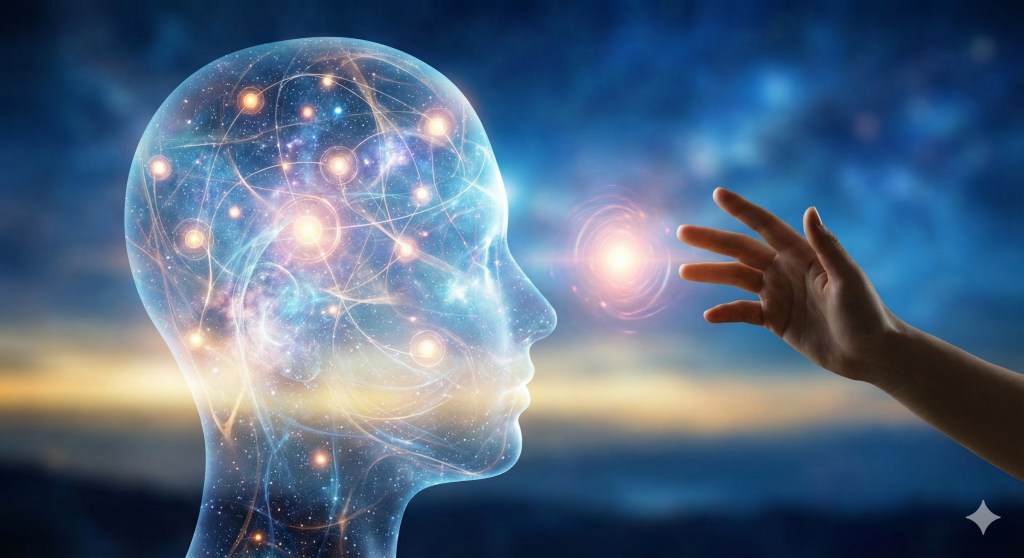
Presented by Zia H Shah MD
Is Consciousness Just A User Illusion?
Audio teaser:
Abstract
This report provides a comprehensive analysis of the philosophical and scientific trajectory that characterizes modern atheism, physicalism, and metaphysical naturalism. It posits that these worldviews, when followed to their logical conclusions, reach an extreme and inherently incoherent position: the denial of phenomenal consciousness as a real attribute of existence. By examining the works of key thinkers—ranging from the eliminative materialism of Paul and Patricia Churchland to the illusionism of Daniel Dennett, Keith Frankish, and Michael Graziano—the analysis demonstrates how the commitment to a strictly quantitative, third-person ontology necessitates the dismissal of the first-person perspective as a “user-illusion” or “mistaken construct.” The report highlights the “primary datum error” central to these frameworks, wherein the very consciousness that serves as the epistemic foundation for all scientific inquiry is declared non-existent or illusory. Furthermore, the discussion explores the profound social, ethical, and existential implications of this ontological crisis, including the dissolution of agency, the rise of nihilism in the “polycrisis,” and the revaluation of suffering. Ultimately, the report argues that the naturalist denial of consciousness is not a discovery of science but a desperate metaphysical maneuver to preserve a flawed ontology, suggesting that a more robust, “realist” approach to consciousness is required to resolve the contemporary crisis of meaning.
The Conceptual Architecture of Modern Naturalism
The contemporary intellectual landscape is increasingly defined by a triad of interlocking metaphysical commitments: atheism, metaphysical naturalism, and physicalism. While these terms are often used interchangeably in popular discourse, they represent distinct but mutually reinforcing layers of a singular worldview. Atheism, in its modern analytical form, is defined primarily as the absence of belief in the existence of deities, or more narrowly, the position that no deities exist. This absence of belief is rarely held in a vacuum; it typically rests upon the foundation of metaphysical naturalism.
Metaphysical naturalism is the overarching belief that only natural laws and forces operate in the world, explicitly excluding supernatural or spiritual entities. Within this framework, the universe is seen as a closed causal system. Physicalism serves as the ontological core of this system, asserting the thesis that “everything is physical”—that there is nothing “over and above” the physical, or that every property supervenes on the physical reality described by the natural sciences.
| Concept | Philosophical Commitment | Relationship to Consciousness |
| Atheism | Rejection of divine or supernatural origins. | Views the mind as a purely biological, non-transcendent phenomenon. |
| Metaphysical Naturalism | Exclusive reliance on natural laws and forces. | Restricts explanation to empirical and objective measures. |
| Physicalism | Ontological monism: everything is physical. | Asserts that mental states must be grounded in physical states. |
| Materialism | Matter is the fundamental substance of nature. | Argues that consciousness is a result of material interactions. |
The tension within this architecture arises from the “hard problem” of consciousness—the question of why and how physical processes in the brain give rise to subjective experience, or “what it is like” to be a subject. Because physicalism insists that all entities must be grounded in physical reality, and because qualitative experience (qualia) does not appear in the objective, third-person descriptions of physics or neuroscience, the naturalist is faced with a stark choice: either expand the definition of the “physical” to include consciousness (a move toward panpsychism or dualism) or deny the reality of consciousness altogether.
The prevailing trend among contemporary naturalist philosophers is to take the latter path. This results in the “extreme conclusion” that consciousness is an illusion—a conclusion that many critics argue is not a scientific result but a reductio ad absurdum of the physicalist premise itself. The following sections explore the mechanisms and proponents of this eliminative and illusionist turn.
Eliminative Materialism and the Displacement of Folk Psychology
The intellectual precursor to contemporary illusionism is eliminative materialism, a radical thesis championed by Paul and Patricia Churchland. Their central argument is that our common-sense understanding of the mind—often referred to as “folk psychology”—is a fundamentally flawed and stagnant theory that will eventually be eliminated by a matured neuroscience.
The Theory-Theory of Mind
The Churchlands treat our everyday conceptualization of mental states (beliefs, desires, fears, intentions) not as direct perceptions of our inner reality, but as a “fully developed but non-formalized theory” used to predict and explain behavior. They argue that as a theory, folk psychology must be evaluated by its predictive power and its explanatory success. By this metric, they find it wanting. Folk psychology has remained largely unchanged since the ancient Greeks, while the natural sciences have progressed exponentially. It fails to account for memory, sleep, learning, and mental disorders—phenomena that neuroscience is beginning to explain in terms of action potentials and synaptic connectivity.
Historical Parallels of Elimination
The Churchlands provide historical precedents for the elimination of ontology when a superior theory arrives. They argue that “beliefs” and “desires” will follow the path of concepts like “caloric fluid” or “phlogiston”.
| Obsolete Concept | Original Explanatory Role | Replacement in Modern Science |
| Caloric Fluid | A material substance used to explain heat flow. | Kinetic energy (corpuscular motion). |
| Phlogiston | A substance supposed to be released during combustion. | Oxidation (interaction with oxygen). |
| Star-flecked Sphere | The visual certainty that the heavens turn daily. | Rotation of the Earth on its axis. |
| Folk Psychology | Beliefs, desires, and intentions as causes of behavior. | Neurobiological circuit activation. |
The move from reduction to elimination is critical here. While some physicalists seek to “reduce” mental states to brain states (Identity Theory), eliminativists argue that the categories of folk psychology are so mismatched with the categories of neuroscience that they cannot be reduced; they must simply be discarded. In this view, there are no “beliefs” in the brain, just as there is no “caloric” in fire. The subjectively felt intentionality or “aboutness” of our thoughts is seen as a linguistic artifact that has no place in the spiking frequencies of the nervous system.
Daniel Dennett and the User-Illusion of the Cartesian Theater
Daniel Dennett, while often associated with functionalism, has developed an influential form of eliminativism specifically targeting qualia—the “raw feels” of experience. In his seminal work, Consciousness Explained, Dennett argues that consciousness is not a single, unified stream of experience but a “Multiple Drafts” process.
The Multiple Drafts Model
Dennett rejects what he calls the “Cartesian Theater”—the intuitive idea that there is a central place in the brain where “it all comes together” for a conscious observer to witness. Instead, he proposes that various neural processes produce “drafts” of interpretation that compete for dominance. There is no point at which a draft becomes “conscious”; rather, consciousness is a matter of a particular draft being “probed” by a report or a behavior.
Qualia Eliminativism and Heterophenomenology
Dennett famously advocates for “Quining Qualia,” a strategy aimed at showing that the properties we attribute to experience (ineffability, intrinsicality, privateness) are incoherent. He argues that once we have explained all the functions of the brain—how it discriminates stimuli, how it triggers speech, how it controls behavior—there is no “leftover” phenomenal property to account for.
To study the mind, Dennett proposes “heterophenomenology,” a method that treats subjective reports as data about what the subject believes is happening, rather than as evidence of actual qualitative experience. The “user-illusion” is his central metaphor: just as a computer’s desktop icons simplify the complex machine code for the user, consciousness is a simplified “interface” the brain creates to manage its own complex operations. Critics, such as David Bentley Hart, argue that this method is “fabulous” rather than logical, constructing a narrative that simply avoids the absolute qualitative difference between physical events and subjective experience.
Keith Frankish and the Mechanism of Illusionism
Keith Frankish has formalized the “illusionist” position, defining it as the view that phenomenal consciousness is a “robust illusion” generated by the brain. Frankish identifies two aspects of the program: the “negative” aspect, which rejects the Hard Problem, and the “positive” aspect, which seeks to solve the “illusion problem”—explaining why it seems to us that we are conscious when we are not.
Quasi-phenomenal Properties and Introspective Distortion
Frankish introduces the concept of “quasi-phenomenal properties”—actual, physical, functional properties of brain states that are misrepresented by introspection as being phenomenal.
- Introspective Misrepresentation: The brain’s internal monitoring systems are not direct or precise; they provide a “caricatured” or “distorted” view of internal states.
- Cognitive Illusion: This distortion leads us to judge that our experiences have inner phenomenal properties (qualia) that they do not actually possess.
- Inference to Non-functionality: We mistakenly infer that these properties are “non-functional” because their complex physical details are “bundled together” and represented as simple, intrinsic feels.
Frankish argues that illusionism is the only way for physicalism to remain consistent. If phenomenal properties were real, they would be “too weird” to yield to physical explanation. Therefore, the physicalist must maintain that it is the illusion of consciousness, rather than consciousness itself, that requires a scientific account.
Michael Graziano: Attention Schema Theory and the Mistaken Construct
Neuroscientist Michael Graziano provides a mechanistic basis for illusionism through his Attention Schema Theory (AST). Graziano argues that consciousness is a “data model” that the brain uses to represent its own process of attention.
From Social Perception to Self-Modeling
Graziano posits that the brain first evolved the ability to model the attention of others to predict their behavior. Eventually, this machinery was turned inward, creating a “schema” of the brain’s own attention.
| Process | Definition | Status in AST |
| i-consciousness | Information processing and attentional enhancement. | Physically real and mechanistically explained. |
| m-consciousness | The “mysterious” or “ethereal” feel of experience. | A mistaken construct; an inaccurate model of i-consciousness. |
| Attention | The process of enhancing some signals over others. | A real biological function. |
| Consciousness | The brain’s simplified description of its attention. | A “useful, if simplified, self-model.” |
The “White Light” Analogy
Graziano compares the “hard problem” of consciousness to the perceived purity of white light. We perceive white light as a distinct, simple quality, but it is actually a “mishmash” of many wavelengths that the brain translates into white. Similarly, the brain translates complex, high-bandwidth information processing into the “feeling” of being a conscious subject. Graziano asserts that “consciousness doesn’t happen”—the brain merely constructs information to the effect that it is happening.
Tor Nørretranders and the Information Bottleneck
Tor Nørretranders, in his work The User Illusion, utilizes information theory to argue that consciousness is a drastically reduced, processed “user interface” of the brain. He highlights the profound disparity between total sensory input and conscious capacity.
Sensory Bandwidth vs. Conscious Attention
| Sensory Input Channel | Estimated Data Rate (Bits/Sec) |
| Vision | 10,000,000 |
| Touch | 1,000,000 |
| Audition | 100,000 |
| Olfaction | 100,000 |
| Gustation | 1,000 |
| Total Input | ≈11,201,000 |
| Conscious Capacity | 20 to 60 |
Nørretranders argues that consciousness handles only a “paltry” amount of information compared to the subconscious. The process of consciousness is one of “chunking” information into symbols, which he calls “Trojan horses” used to smuggle complex meanings into our limited bandwidth of awareness.
The Delayed Observer
Referencing the experiments of Benjamin Libet, Nørretranders points out that consciousness lags behind neural decisions by approximately half a second. This suggests that consciousness is not the “initiator” of action but a “module” that observes what is already occurring and creates a narrative of “conscious decisions”. The feeling of a “conscious I” in charge is an illusion; the true work is done by the unconscious “me”.
Susan Blackmore: Meme Machines and the Dissolution of the Self
Susan Blackmore extends the illusionist argument into the realm of memetics, arguing that the “self” is not a real entity but a “memeplex”—a cluster of memes competing for replication within human hosts.
The Selfplex as a Replicator
Blackmore posits that the “inner self” is an illusion created by memes for the sake of their own propagation.
- Imitation as the Key: Humans are the only animals that imitate a wide range of behaviors, leading to a second form of natural selection: memetic selection.
- Creation of the Illusion: Memes that are promoted as “personal” beliefs or desires survive more effectively, leading to the formation of a “selfplex.” We mistakenly identify with this collection of memes, thinking we are the “thinker” or “agent”.
- Machine Equivalence: Blackmore argues that any machine capable of imitation would eventually develop a “human-like illusion of consciousness” and a sense of self.
This perspective dissolves the distinction between the “true self” and cultural influence, suggesting that humans are merely “meme machines”. This leads to the “Buddhistic” conclusion that there is no one at the core of the experience—just a series of impressions and replicated ideas.
The Logical Incoherence of the Naturalist Denial
The shift from explaining consciousness to explaining it away has led to accusations of profound logical incoherence. Critics, including Galen Strawson, Thomas Nagel, and David Bentley Hart, argue that illusionism and eliminativism are not just counter-intuitive but represent a fundamental failure of reasoning.
The Primary Datum Error
The core of the incoherence charge is what is termed the “primary datum error”. Consciousness is not a conclusion of an experiment; it is “nature’s one given” and is “epistemically fundamental”.
- Epistemic Precedence: Consciousness is the primary datum of existence—the only thing to which we have direct access. All scientific knowledge, including the concept of the brain and neurons, is known through consciousness.
- Inversion of the Map and Territory: Naturalism attempts to make the description (the physical model) generate the thing being described (the consciousness). This is described as “pulling the territory from the map”—using derivative models to deny the foundation of those models.
- Self-Negation: The claim that consciousness is an illusion is logically incoherent because it involves consciousness arguing for its own non-existence. As Galen Strawson notes, for a conscious being to argue that consciousness does not exist is “truly unhinged”.
The Pleonastic Fallacy
David Bentley Hart identifies a recurring logical error in naturalism he calls the “pleonastic fallacy”. This is the attempt to bridge absolute qualitative differences (such as the gap between electrochemical brain events and first-person experience) by positing an indefinite number of minute quantitative steps through evolution or complexity. Hart argues that there is no imaginable science capable of crossing this “absolute qualitative chasm”.
The Incoherence of Atheistic Ontologies
A further charge of incoherence focuses on the “meta-problem” of consciousness. If physicalism is true, the claim that physical entities exist independently of consciousness can never be verified or falsified, as we have no access to a “world out there” except through the medium of consciousness. Therefore, the positive ontological claim of physicalism rests on an unverifiable metaphysical assumption.
Ethical and Social Implications: The Dissolution of Human Agency
The declaration of consciousness as an illusion is not merely a technical academic dispute; it carries extreme implications for the human condition, ethics, and the structure of society.
The Polycrisis and the Meaning Crisis
The reductionist worldview is identified as the “unspoken foundation” of the contemporary “polycrisis”—a convergence of environmental, political, and economic challenges.
- Nihilism and Modal Confusion: By reducing the world to “stuff” and biological machines, physicalism fosters what Eric Fromm called “modal confusion,” where society focuses on “having” (material accumulation) rather than “being” (spiritual and existential fulfillment).
- The Loss of Inherent Meaning: If mind is an illusion, then inherent purpose and value disappear. This nihilism is described as the root of the “Meaning Crisis,” leaving individuals in existential despair.
- Will to Power: In the absence of objective values, the only remaining metrics for existence are power and material distribution. This serves as the basis for “will to power” philosophies like post-modernism and Marxism.
The Revaluation of Suffering
A physicalist/eliminativist stance regarding consciousness profoundly changes ethical intuitions.
- Suffering as Mechanical Output: From an eliminativist perspective, “suffering” is redefined as “aversive sensory inputs” or “activated fear systems”. This could lead to a loss of empathy, as humans are viewed as “just particles moving”.
- Expansion of Moral Consideration: Conversely, some argue that by removing “mystical” requirements for consciousness, we might extend moral concern to plants, bacteria, and AI.
- Ethical Asymmetry: If consciousness is just a category used to classify minds, then “conscious emotion” becomes “physical operations that I care about morally.” This makes the determination of who “deserves” consideration a subjective projection of the observer rather than an objective fact.
Digital Sentience and Moral Status of AI
The debate over illusionism is directly relevant to the future of AI. If consciousness is a “user-illusion” that can be acquired by any imitating machine, the moral status of AI becomes a pressing dilemma.
- Mindless Robot Dilemma: If we act toward human-like machines as if they have value, we might maintain our own virtuous habits, but we risk “losing our sensitivity to the infinite value of conscious human beings”.
- Algorithmic Value: If consciousness is reduced to algorithms, then artificial systems that exhibit these algorithms (like self-modeling) must be granted ethical consideration, leading to “computer welfare” guidelines.
Counter-Currents: Toward a Realist Philosophy of Mind
In response to the perceived failures of illusionism, several alternative frameworks have gained traction, seeking to reconcile the reality of consciousness with a rigorous understanding of the physical world.
Real Physicalism (Galen Strawson)
Galen Strawson argues for what he calls “Real Physicalism,” which acknowledges consciousness as a fundamental physical fact. Strawson contends that a truly naturalistic view must accept that matter itself possesses experiential or mental properties. This move toward panpsychism avoids the “interaction problem” of dualism while refusing the “unnatural” denial of experience found in standard physicalism.
Analytic Idealism (Bernardo Kastrup)
Analytic idealism posits that universal phenomenal consciousness is the fundamental ontological category.
- Decombination Problem: Rather than asking how matter creates mind, idealism asks how individual conscious subjects arise from a unitary phenomenal field.
- Dissociated Alters: Human beings are viewed as “dissociated alters” of universal consciousness, similar to how multiple personalities exist within a single person.
- Reality as a Mental Process: In this view, the physical world is the appearance of transpersonal mental activity. This resolves the “hard problem” by identifying consciousness as the primary reality, rather than a byproduct of matter.
Perennial Idealism and the Ground of Being
Some thinkers point to “Perennial Philosophy,” which suggests that our inherent nature is pure, unconditioned consciousness, identical to the ground of all being. In this framework, the “illusion of self” is not the absence of consciousness, but the mistaken assumption that consciousness is confined to a private, localized perspective.
| Theory | View of Reality | Status of the Human Subject |
| Physicalism | Fundamentally material/mathematical. | A complex biological machine/user-illusion. |
| Panpsychism | Matter has a mental “inner nature.” | A combination of mental units. |
| Idealism | Fundamentally conscious/phenomenal. | A localized alter of universal mind. |
| Eliminativism | Fundamentally neurobiological. | A theoretically mistaken construct. |
The Meta-Problem as the Final Frontier
The current state of the debate is encapsulated in the “meta-problem of consciousness”—the problem of explaining why we have “problem intuitions” about consciousness. While illusionists believe that solving the meta-problem will dissolve the hard problem, critics argue that even a complete physical explanation of our reports about consciousness would leave the “qualitative feel” untouched.
The meta-problem highlights that the struggle to understand consciousness is unlike any other scientific endeavor because it requires the observer to become the object of observation. Treating consciousness as an “object” may itself be a category error. The “hard problem” might not be a barrier to progress, but a “signpost” indicating that the naturalist project has reached its inherent limits.
Conclusion: The Persistence of the Miraculous
The attempt by modern atheism, physicalism, and metaphysical naturalism to reduce the human mind to a mechanistic process has led to the logically incoherent declaration that the most certain fact of our existence—subjective experience—is an illusion. By examining the works of Dennett, Frankish, Graziano, and the Churchlands, it becomes clear that this “illusionist turn” is a necessary consequence of a closed ontological system that cannot accommodate the first-person perspective.
However, the “primary datum error” at the heart of these theories suggests that the naturalist paradigm is fundamentally incomplete. Consciousness is not a “brain trick” to be explained away, but the epistemic foundation upon which all science, ethics, and meaning are built. The dissolution of the self and the revaluation of suffering into mechanical outputs carry profound risks for human dignity and societal stability, contributing to a global crisis of meaning.
Resolving this crisis requires moving beyond the “extreme conclusions” of naturalism. Whether through the “real physicalism” of Strawson or the analytic idealism of Kastrup, a more robust ontology must recognize consciousness as a fundamental feature of reality. Only by restoring the reality of the conscious subject can we address the polycrisis and recover a sense of inherent purpose in the universe. The “miracle” of consciousness remains the primary fact of Being, and any system that seeks to deny it ultimately collapses into incoherence.
Thematic Epilogue: The Mirror and the Light
In the naturalist narrative, the human mind is often likened to a mirror—a biological adaptation designed to reflect the physical world with enough fidelity to ensure survival. According to the illusionist, however, the mirror is so poorly constructed that it misrepresents its own reflections as having “phenomenal” qualities that do not exist in the “real” world outside. We are told that the light of awareness, which makes the reflection possible in the first place, is itself a shadow—a “user interface” designed by mindless selective pressures for a user who does not exist.
Yet, this narrative suffers from a fatal flaw. For an illusion to exist, there must be someone to be deceived. An illusion without a subject is a contradiction in terms. By denying the reality of the perceiver, the naturalist has not clarified reality; they have removed the only light by which reality can be seen.
The contemporary “Meaning Crisis” is the inevitable shadow cast by this denial. If our beliefs are just neural drafts and our selves are just “memeplexes,” then the search for truth is itself a “mistaken construct.” To reclaim human agency and meaning, we must recognize that consciousness is not a reflection of the world, but the medium in which the world appears. The light of subjectivity is not a biological trick; it is the fundamental “is-ness” of existence. As we face the challenges of the twenty-first century—from the rise of sentient AI to the ecological polycrisis—we must choose between an ontology that dismisses our inner lives as fiction and one that honors the conscious subject as the ultimate witness of the universe. In the end, the persistence of the “what-it’s-like” quality of experience is the final refutation of a worldview that seeks to reduce the miracle of awareness to a mechanical mistake.
We have an extensive collection of articles to refute atheism: Click here




 The Glorious Quran and Science
Leave a comment