
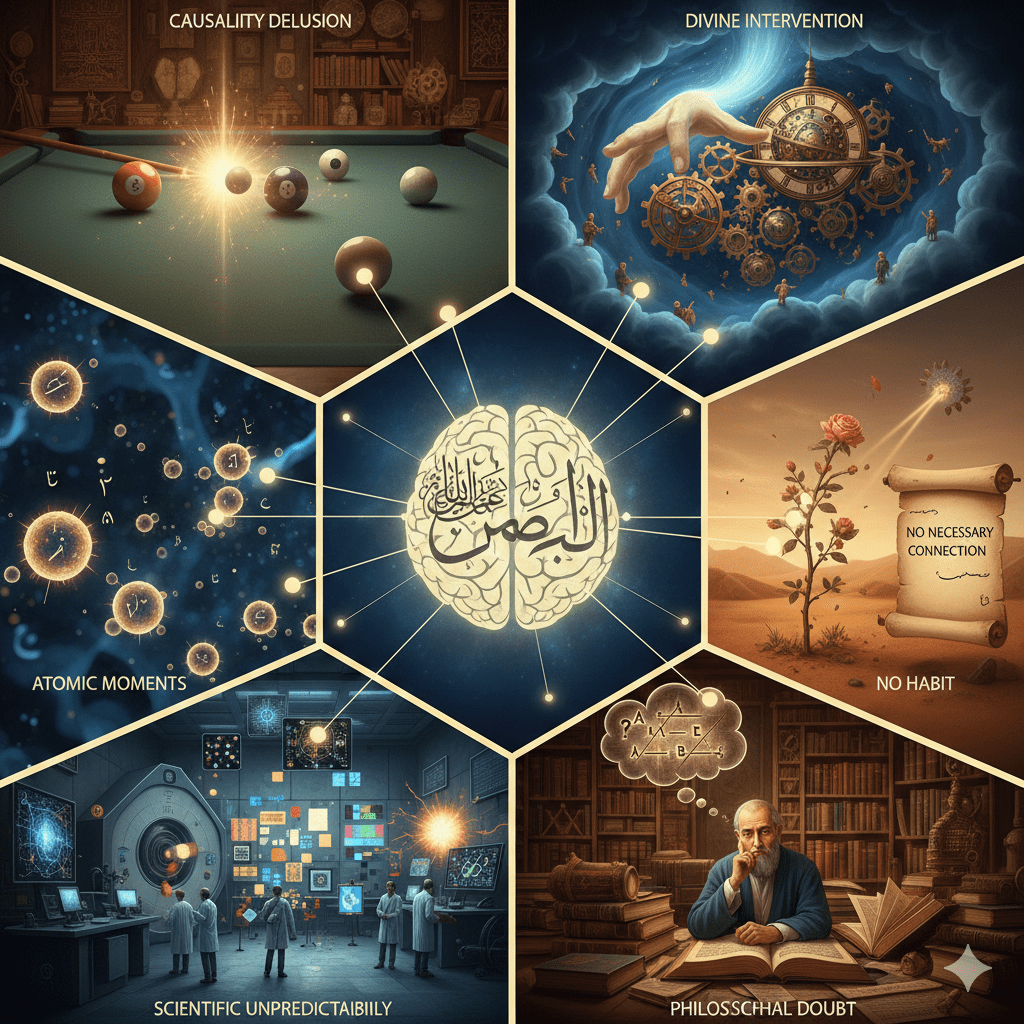
Epigraph
أَوَلَمْ يَرَوْا إِلَى الطَّيْرِ فَوْقَهُمْ صَافَّاتٍ وَيَقْبِضْنَ ۚ مَا يُمْسِكُهُنَّ إِلَّا الرَّحْمَٰنُ ۚ إِنَّهُ بِكُلِّ شَيْءٍ بَصِيرٌ
Al-Mulk (67:19) asks: “Do they not see the birds above them, spreading their wings and closing them? None holds them [up] except the Most Merciful…”.
Presented by Zia H Shah MD
Audio teaser:
Abstract
This report presents an exhaustive defense of Al-Ghazali’s doctrine of occasionalism, synthesizing classical Islamic theology, medieval philosophy, and contemporary scientific paradigms. Occasionalism, the metaphysical thesis that God is the sole immediate cause of every event in the universe, rejects the notion of inherent causal powers in created substances. By analyzing the primary Quranic proof-texts that establish divine omnipotence and continuous creation, this study demonstrates how Al-Ghazali’s “habit” (sunnat Allah) provides a robust framework for understanding natural regularity without sacrificing divine agency. Furthermore, the report incorporates the work of modern thinkers, specifically Dr. Zia H. Shah MD, to illustrate how the “looseness at the joints” found in quantum indeterminacy and the conceptual framework of the simulation hypothesis provide an empirical and logical vocabulary for occasionalism. Central to this analysis is the “deterministic pivot,” wherein the very evidence for a closed causal system favored by materialist agnostics is reinterpreted as the supreme evidence for a consistent and sustaining Divine Will. The study concludes that occasionalism offers a superior explanatory model for consciousness, miracles, and the uniformity of nature, ultimately harmonizing the “Word of God” with the “Work of God.”
Introduction: The Metaphysical Stakes of Causality
The question of causality—what it means for one event to “bring about” another—stands as the primary battleground between religious and secular worldviews. In the history of Islamic thought, no figure has navigated this terrain with greater impact than Abu Hamid al-Ghazali (1058–1111). His development of occasionalism was not merely a reaction against the Aristotelian philosophy of his time but a profound attempt to ground the radical monotheism of the Quran in a coherent metaphysical system. For Al-Ghazali, the stakes were absolute: if natural objects like fire or water possessed their own autonomous, necessary causal powers, then God’s sovereignty would be compromised, and the miracles central to prophetic revelation would become logical impossibilities.
Al-Ghazali’s occasionalism posits that the connections we observe between “causes” and “effects” are not necessitated by the things themselves. Instead, what we perceive as natural laws are the habitual ways in which God chooses to act. This framework is not a denial of science but a re-description of the nature of physical laws. Today, as classical Newtonian determinism gives way to the probabilistic reality of quantum mechanics and the information-centric models of the simulation hypothesis, Al-Ghazali’s vision is experiencing a significant intellectual revival. Modern commentators like Zia H. Shah MD argue that these scientific shifts do not just “allow” for God but increasingly point toward a reality that is being continuously “rendered” or sustained by a non-material Agency.
The Theological Core: Quranic Occasionalism and Divine Sovereignty
The foundation of Al-Ghazali’s thought is the Quranic insistence on God as the Al-Khaliq (The Creator) and Al-Qayyum (The Sustainer). Occasionalism is the theological commitment to these attributes taken to their logical conclusion: if God is truly the Sustainer of all things, then no part of reality can function independently of His immediate will.
Direct Negation of Creaturely Power
The primary scriptural anchor for the denial of independent causal power is found in Surah Al-Anfal. During the Battle of Badr, the Prophet Muhammad threw a handful of sand toward the opposing army, an act followed by their sudden defeat. The Quranic commentary on this event is foundational for Ash’arite and Ghazalian theology: “It was not you who killed them; it was God. And when you [Prophet] threw [sand at them], it was not your throw that defeated them, but God’s…” (8:17).
This verse is frequently cited to demonstrate that even when human action is visibly involved, the metaphysical efficacy remains with God. For Al-Ghazali, this establishes that creatures possess no inherent, autonomous power. The human “will” to act and the subsequent physical movement are two separate events that God creates in sequence. This led to the doctrine of kasb (acquisition), where God creates the act and the human “acquires” it, maintaining moral responsibility while upholding total divine agency.
Divine Sustenance in the Natural Order
The Quranic worldview repeatedly attributes natural phenomena—which a materialist would call “automatic”—to direct divine intervention. Surah Al-Mulk (67:19) asks: “Do they not see the birds above them, spreading their wings and closing them? None holds them [up] except the Most Merciful…”. From a modern perspective, bird flight is explained through aerodynamics and fluid dynamics. However, for the occasionalist, these physical descriptions are simply the map of how God habitually “holds them up.” The aerodynamics are the “habit,” but the “power” is God’s.
Similarly, the provision of water and the growth of crops in Surah Al-Waqi’ah (56:68-70) are presented as direct acts of divine will rather than autonomous biological processes. The text poses a challenge to human assumptions of natural autonomy: “Is it you who bring it down from the clouds, or do We bring it down?”. These verses serve to remind the believer that the universe is not on “autopilot” but is a theater of constant divine volition.
| Quranic Verse | Key Theme | Significance for Occasionalism |
| Surah Al-Anfal (8:17) | Negation of Autonomy | Establishes that the true agent behind human acts is God. |
| Surah Al-Mulk (67:19) | Divine Sustenance | Attributes the continuity of natural phenomena to God’s immediate power. |
| Surah Al-Waqi’ah (56:68-70) | Direct Provision | Challenges the assumption that natural processes are automatic. |
| Surah Ya-Sin (36:82) | Instantaneous Creation | Creation is an immediate “Be!” rather than a mediated causal chain. |
| Surah Ar-Rahman (55:29) | Continuous Engagement | “Every day He is engaged in a [new] matter” indicates ongoing creation. |
| Surah Al-Ahzab (33:62) | Sunnat Allah (Habit) | Defines natural laws as God’s customary behavior, which He can break. |
Continuous Creation and the Instantaneous Will
Central to the Ash’arite occasionalism that Al-Ghazali championed is the idea of “continuous creation” (al-khalq al-jadid). In this view, the universe is not a static object that was created once and then left to run. Instead, it is being recreated at every discrete moment of time. Surah Ya-Sin (36:82) states: “His command, when He wills a thing, is only to say to it, ‘Be!’—and it is.” This suggests an immediate relationship between the divine will and the existence of a thing, bypassing the need for a chain of intermediate causes.
Surah Ar-Rahman (55:29) further supports this: “Every day He is engaged in a [new] matter.” Al-Ghazali and later commentators interpret this as God’s ongoing, moment-to-moment involvement in the governance of every atom. In modern terms, this is akin to a computer screen refreshing its pixels thousands of times per second; the image appears stable and continuous to the observer, but it is actually a series of discrete renderings.
Al-Ghazali’s Philosophical Revolution: The Critique of Necessity
In his masterpiece Tahafut al-Falasifa (The Incoherence of the Philosophers), Al-Ghazali deconstructs the Aristotelian notion of “necessary causality”. The philosophers of his time, following Ibn Sina (Avicenna), believed that the relationship between a cause (like fire) and its effect (like burning) was a logical necessity. Al-Ghazali identified this as a philosophical error that limits God’s power and renders the miraculous impossible.
The Disconnection of Observed Simultaneity
Al-Ghazali’s core argument is that observation only shows us that two events happen together, not that one necessitates the other. He provides the famous example of fire and cotton. We see the fire touch the cotton, and we see the cotton burn. We assume the fire is the “agent” of the burning. However, Al-Ghazali argues that “the agent of the burning is God,” either directly or through the mediation of angels.
He compares our perception to a man blind from birth whose eyes are covered by a membrane. If the membrane is removed during the day, he might think the opening of his eyelids is the cause of the light he sees. In reality, the sun is the source, and his eyelids are merely the occasion for the perception to occur. This distinction between an “occasional cause” (the fire) and the “true cause” (God) is the hallmark of his system.
The Sunnah of Allah: Natural Law as Divine Habit
If there is no necessary link between events, why does the world appear orderly? Why does fire always burn cotton in our experience? Al-Ghazali introduces the concept of Sunnat Allah—the “habit” or “custom” of God. God, being wise and not arbitrary, usually creates effects in a consistent sequence to allow for human life and knowledge to function.
However, because this regularity is a habit and not a necessity, God can choose to act differently at any moment. This is how miracles are explained. When the fire did not burn the Prophet Abraham, it was not that the “law” of fire was suspended (since fire has no law of its own); rather, it was that God chose not to create the effect of burning on that specific occasion. As Al-Ghazali notes, “He who has power over the creation of the heavens and the earth has power over the creation of everything”.
Epistemological Humility and the Problem of Induction
Al-Ghazali’s critique prefigures the work of David Hume by nearly seven centuries. Both argued that we cannot rationally justify the belief that the future will resemble the past based on experience alone. For Hume, this led to a psychological explanation—causality is a “habit of the mind.” For Al-Ghazali, it led to a theological one—causality is a “habit of God”.
While Hume’s analysis often leads toward religious skepticism, Al-Ghazali’s leads toward what has been called “Aristotelian epistemic optimism”. He argues that God creates in us a “habit of knowledge” that allows us to trust the regularity of nature, even though we recognize it as contingent. This grounding of science in the consistency of the Divine Will provides a more stable foundation for reason than a purely materialist framework, which must accept the uniformity of nature as a “brute fact” without explanation.
The Modern Synthesis: Zia H. Shah MD and the “Two Books”
A significant figure in the contemporary revival of Ghazalian occasionalism is Dr. Zia H. Shah MD. A physician and prolific author, Shah revitalizes the “Two Books” theory: the idea that God is the author of both the Book of Scripture (the Quran) and the Book of Nature (the Universe). His work focuses on bridging the gap between traditional Ash’arite theology and modern scientific discoveries.
The Elephant in the Room: Confronting Science with Faith
Shah frequently uses the metaphor of the “Elephant in the Room” to describe the silent tension between religious orthodoxy and modern science. He argues that the conflict is not between the Quran and science, but between “Wrong Theology” and science. By embracing Al-Ghazali’s occasionalism, Shah believes we can find a theological framework that is “scientifically informed and intellectually robust”.
His methodology is rooted in the principle of the Unity of Truth. If the Quran refers to natural phenomena as Ayat (signs) and scriptural verses as Ayat, it implies they share the same ontological status. Science, therefore, is the study of God’s “Work,” while theology is the study of His “Word.” Any apparent contradiction must be due to human error in interpretation.
The Defeat of Metaphysical Naturalism by Human Consciousness
One of Shah’s most potent arguments for occasionalism is based on the “hard problem” of consciousness. Metaphysical naturalism (or physicalism) asserts that all phenomena, including the mind, are the result of physical processes. Shah argues that physicalism is defeated by the reality of subjective experience. If the brain is merely a collection of atoms following deterministic physical laws, there is no explanation for the “first-person” experience of consciousness.
Shah points to the work of scientists and philosophers who view the brain as a “receiver” rather than a “generator” of consciousness. In this model, the brain is akin to a radio receiving a signal. If consciousness is not identical to its biological substrate, it implies a non-material agency. This aligns perfectly with Al-Ghazali’s occasionalism, which holds that God “intervenes between a man and his heart” (Qur’an 8:24). The mental and the physical are two different “occasions” coordinated by the Divine Will.
Occasionalism and the Frontiers of Science: Quantum and Simulation
The transition from the “clockwork” Newtonian universe to the probabilistic world of modern physics has provided a new scientific vocabulary for occasionalism. Zia H. Shah and others argue that quantum mechanics and the simulation hypothesis offer empirical support for the idea that reality is not self-sustaining.
Quantum Indeterminacy: The “Interface” for Divine Will
Classical physics suggested that the universe was deterministic—given the initial conditions, every future state could be calculated. This left no room for God’s active intervention, leading many to the “absentee clockmaker” model. Quantum mechanics, however, revealed “looseness at the joints”. At the subatomic level, events like the path of a photon or the decay of an atom are probabilistic, not deterministic.
Shah proposes that quantum indeterminacy is the “interface” for occasionalism. While physics can predict the probability of an outcome, it cannot predict the specific result of a single quantum event. Shah suggests that what physics calls “randomness,” theology identifies as the sovereign choice of God. By determining the outcome of every quantum event, God sustains and guides reality without “breaking” the macroscopic laws of physics. This allows for a universe that is both orderly (the habit) and contingent (the will).
The Simulation Hypothesis: Reality as Continuous Rendering
The “Simulation Hypothesis”—the idea that our universe might be an artificial simulation run by an advanced intelligence—has gained traction among physicists like Nick Bostrom and technologists like Elon Musk. Shah notes the “intriguing parallels” between this hypothesis and Ghazalian occasionalism.
- Dependency on an External Agent: Just as a video game ceases to exist if the computer is turned off, the occasionalist universe has no self-sustaining power and would vanish if God stopped willing it.
- Frame-by-Frame Rendering: A simulation updates its world frame-by-frame. This mirrors the Ash’arite doctrine of “continuous creation,” where reality is re-rendered by God at each instant.
- Flexible Laws: In a simulation, the “laws of physics” are just code written by the programmer. They are not inherent to the objects within the simulation. This is identical to Al-Ghazali’s concept of Sunnat Allah.
- Miracles as Code Edits: A miracle in occasionalist terms is like the divine “Programmer” editing the world’s code for a specific occasion.
This convergence suggests that the most advanced models of reality in the 21st century are remarkably similar to the metaphysical insights of 11th-century Islamic theology.
| Aspect | Al-Ghazali’s Occasionalism | Simulation Hypothesis |
| Causal Agency | God is the only true cause. | The Simulator/Code is the cause. |
| Material Autonomy | Objects have no inherent power. | Virtual objects have no physical power. |
| Nature of Time | Discrete moments of creation. | Discrete frames of rendering. |
| Laws of Nature | Habits of God (Sunnat Allah). | Programmed algorithms/Code. |
| Miracles | God acting against His custom. | Programmer editing the simulation. |
The Deterministic Pivot: From Materialism to Monotheism
A central feature of Zia H. Shah’s work is the “deterministic pivot.” Atheists and agnostics often present the deterministic nature of physical laws as evidence against the need for a Creator. They argue that if every event is the result of prior physical causes, there is no “gap” for God to fill.
However, Shah argues that as soon as we allow for the possibility of a monotheistic First Cause, all the evidence for determinism becomes evidence for occasionalism. If we observe a universe that is perfectly consistent and follows an unbroken chain of cause and effect, this is exactly what we would expect from a God who is rational, wise, and meticulous in His governance. The “closed causal chain” is simply the manifestation of a perfectly consistent Divine Habit. The fact that we can describe nature through mathematics (the “Sunnah of Allah”) points to a Mind behind the laws, not to the laws’ own autonomy.
The Problem of the “Brute Fact”
Materialist determinism ultimately relies on the “brute fact” that the laws of physics are what they are. It cannot explain why there is order rather than chaos, or how these laws are enforced. Occasionalism provides the “why” and the “how.” The laws are the consistent choices of an omnipotent Will. By moving the seat of power from the “unconscious atom” to the “All-Knowing God,” occasionalism resolves the metaphysical absurdity of inanimate matter “governing” itself.
Guided Evolution: The Instrument of the Divine
One of the most contentious areas in the dialogue between religion and science is biological evolution. Zia H. Shah applies the occasionalist framework to provide a “Scientifically Informed Tafsir” of creation. He breaks the theory of evolution into three components:
- Common Ancestry: The biological fact that all life is related. Shah accepts this as “beyond any doubt”.
- Mechanisms: Natural selection and mutation. Shah accepts these as the “instruments” of God’s will.
- Philosophical Interpretation: Is the process “blind” or “guided”? This is where Shah diverges from neo-Darwinism. He argues that the complexity and directionality of life evidence a “Guiding Hand”.
From an occasionalist perspective, every genetic mutation—often seen as “random”—is a specific event willed by God at the quantum level. This “Guided Evolution” allows the believer to embrace the full scope of biological discovery without subscribing to the “blind watchmaker” thesis. Evolution becomes the story of how God habitually brings life into being over eons, rather than in a single instant.
Scientific Commentary on Quran 10:31-36: The Neutral Ground
In his commentary on Quran 10:31-36, Zia H. Shah illustrates how scientific tafsir can serve as a “neutral, unifying ground” for understanding the Divine. These verses ask a series of rhetorical questions: “Who provides for you from the heaven and the earth? Or who owns hearing and sight? And who brings out the living from the dead… and who disposes the affairs?” The answer given is always “Allah”.
Shah argues that classical commentators were limited by the scientific knowledge of their era, often leaving the “cosmic verses” under-explored. By applying modern knowledge of biology (the mechanism of the ear and eye), cosmology (provision from the heavens), and ecology (bringing the living from the dead), we can appreciate these verses with “infinite depths of meaning”. This approach transcends sectarian divides by focusing on the “Unity of Truth”—the shared awe of the Divine signs found in both scripture and nature.
The Mind-Body Problem and the Unity of Action
The occasionalist solution to the mind-body problem—that God mediates all interactions—has profound implications for how we view human agency. Al-Ghazali and the later Ash’arites were careful to maintain human accountability through the concept of kasb (acquisition).
When a person intends to act, God creates the intention and the act simultaneously. The human is not the “creator” of the act but the “locus” where the act occurs. This preserves divine omnipotence (as no power exists besides God’s) while upholding divine justice (as humans are judged based on the intentions God creates within them). In the age of neuroscience, where the “will” is often seen as a byproduct of brain chemistry, occasionalism offers a more dignified view: our choices are real “occasions” in the sight of God, even if the “power” to execute them remains with the Creator.
Comparison of Western and Islamic Occasionalism
While Al-Ghazali is the most famous Eastern occasionalist, Nicolas Malebranche (1638–1715) developed a similar system in the West. Both were motivated by a desire to safeguard the sovereignty of God and solve the problems of substance dualism.
| Feature | Al-Ghazali (Islamic) | Nicolas Malebranche (Christian) |
| Primary Motivation | Divine Omnipotence / Miracles. | Mind-Body Problem / Cartesian Dualism. |
| Basis of Causality | Habit of God (Sunnat Allah). | Direct Divine Intervention. |
| Human Action | Kasb (Acquisition). | Human will as an “occasional cause.” |
| Scientific Outlook | Anticipated Humean skepticism. | Integrated with Cartesian physics. |
The convergence of these two traditions suggests that occasionalism is not a parochial theological quirk but a sophisticated philosophical response to the “mystery of existence” that emerges across cultures when the limits of materialist causality are reached.
Summary of Theological and Scientific Alignment
The defense of Al-Ghazali’s occasionalism presented here demonstrates a robust alignment between scriptural revelation and empirical observation. The core arguments are summarized below:
- No Independent Causality: Creatures possess no autonomous power. “The outcome of every affair is with God” (Qur’an 31:22).
- The Habitual Universe: Natural laws are God’s voluntary customs, allowing for both scientific predictability and miraculous intervention.
- Continuous Creation: Reality is “re-rendered” by God at every instant, a concept supported by both Ash’arite atomism and the simulation hypothesis.
- The Quantum Interface: Quantum indeterminacy provides the “looseness at the joints” where divine agency can operate without violating macroscopic physics.
- Consciousness as Evidence: The failure of physicalism to explain the mind suggests an external, non-material source of agency.
- The Deterministic Pivot: Determinism is the signature of a consistent Creator, not proof of a godless machine.
Thematic Epilogue: Living in the “Inshallah” Universe
The ultimate implication of Al-Ghazali’s occasionalism is a transformation of the human relationship with reality. In a world where “not a leaf falls but that He knows it,” the mundane is elevated to the level of the sacred. The “Inshallah” universe is not a world of uncertainty, but a world of radical presence. When a believer says “Inshallah” (If God wills), it is not merely a polite phrase; it is a metaphysical acknowledgment that the next moment of existence is a fresh gift, not a mechanical necessity.
This worldview fosters a state of constant spiritual awareness. If the fire burns, if the bird flies, and if the heart beats, it is because the Most Merciful is actively “holding them up” at that very second. The miracles of Moses—the staff turning into a snake or the sea splitting—are not “violations” of nature, but reminders that nature itself is a plastic medium in the hands of its Author. In an age characterized by a “disenchanted” materialist view of the world, occasionalism re-enchants the universe, turning every observation of a “natural law” into a moment of witness to the Divine Habit. By harmonizing the “Two Books,” occasionalism offers a path forward where science is a form of worship, and faith is a robust intellectual endeavor, both leading to the same unitary Truth.
To read in the Microsoft Word file:




 The Glorious Quran and Science
Leave a comment